Finding Your WHY
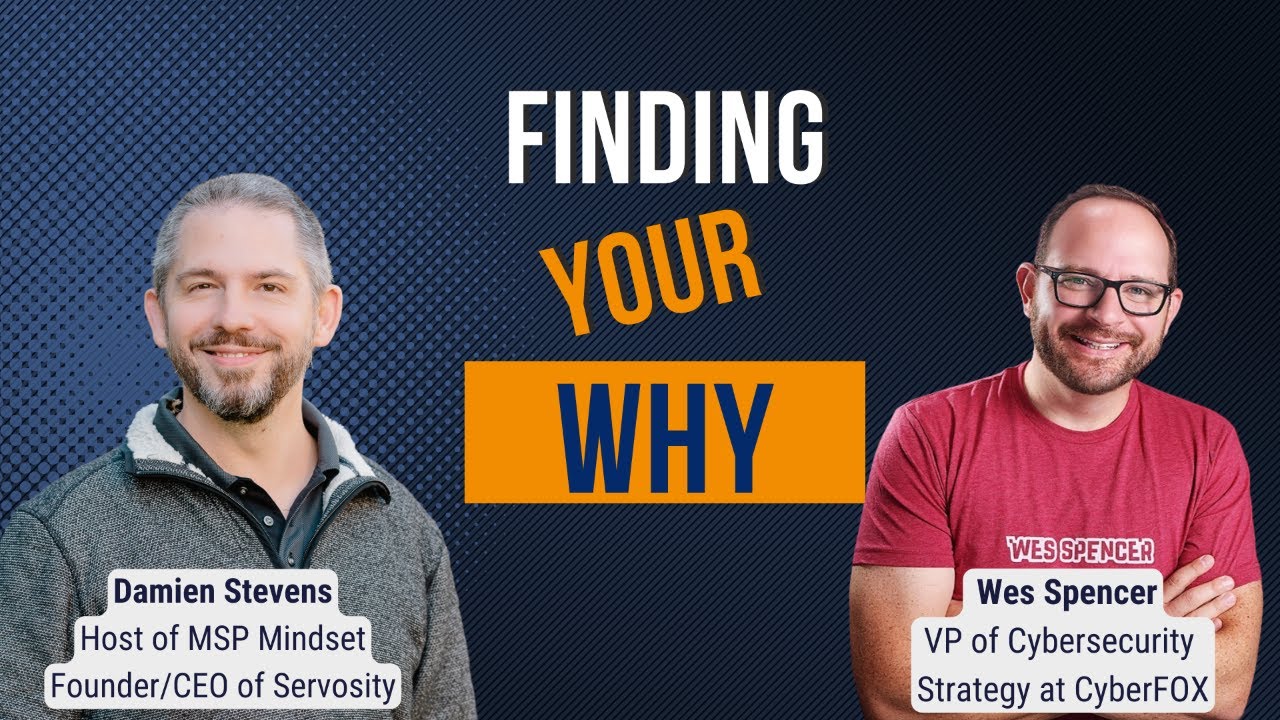
Wes Spencer, co-founder of Perch Security and VP of Cybersecurity Strategy at CyberFox, survived Guillain-Barré syndrome, which became his driving purpose for building security businesses. He explains why MSPs need a clear why to fuel resilience, and covers backup, disaster recovery, and cyber-insurance for small businesses.
Chapters
Hey guys, welcome to this episode of MSP Mindset. Really, really excited to be live with you guys today. You're listening on the podcast and on the recording, you are in for a real treat. Either way, I've got Wes Spencer. So a lot of you guys will probably know Wes Spencer, but for those that don't, he's probably maybe best known for being the co-founder of Perch Security. Which basically became a big part of ConnectWise security stack. He is currently the Vice President of Cybersecurity Strategy at CyberFox. He spent time at Fifth Wall, which is a really smart group of cyber liability experts and risk management. Interestingly, he's a connoisseur of tasty bourbon and crispy hot chicken. And a few other things that we'll get into. So you're not gonna wanna miss this episode if you wanna learn more about why it's important to have a why at your MSP, why it's important to think about cybersecurity, how you grow a company like Wes Spencer Spencer has, any of those things. Drop your questions in the chat or stay tuned. Wes Spencer, welcome.
Hey, Damien, thanks for having me. This is going to be fun.
This is. Yeah. Thank you for being here. So I wanted to start with something I think is interesting, which is in addition to being a connoisseur of bourbon and chicken, hot chicken, you tell me a little bit more about this YouTube crypto channel. What's that about?
Yeah, people do ask me this more often than not. I'll even run into people like, hey man, I watch your channel. I'm like, oh, that's cool. I, you know, first of all, hot chicken makes me hungry. I had supposed to have lunch with a real good friend of mine who's like an exercise science and like stretching entrepreneur. He like builds businesses and licenses them out. And there's all these storms coming into Tampa right now. He's like, hey, I can't, we can't, we can't meet. We're going to eat at this outdoor like taquiera. And, uh, he's like, let's just get coffee instead. I'm like, okay, I just told him yes, but now I'm like super hungry because I think he's one of those super fit guys. He probably eats once a day with like all the intermittent fasting, and here I am thinking hot chicken. I'm like, now I'm hungry, you got me distracted. Uh, all I got was coffee for lunch, but at least I'm juiced up and ready to go. But anyway, so crypto, um, okay, so I got into that because— so I, I, I have always been interested. I look at crypto as a technology, not as a finance kind of thing, right? Like, I'm not one of those crypto— I call them moon pumpers— that are like always trying to like, oh, this one Elon whatever, whatever coin is going to go to the moon, we're all going to get rich, right? And it's all— every one of them is just either scam coins or outright Ponzi schemes, right? But I'm captured by the technology behind blockchain. And it's really one of those things that was super hot in the just the hype cycle, you know, a year ago and even, you know, the past 5 years. And now it's been replaced by AI. You know, no one cares about blockchain anymore. But I'm interested in the technology and I always have been. So I started a channel on crypto just my own interest. I never— like, I have no, no real plans for it other than just it's a hobby of mine. And so the channel's blown up, it's like 80,000 subs, and I don't do enough with it right now just because I'm so busy with other things. But I really do enjoy the technology, it's always fun talking about that nerd stuff.
That's super cool. So why, why are you so passionate about blockchain?
So I look at it, I, I, here's what I first got into. It was way back in like 20, maybe 2012, something like that. And I was actually a professor at the time. And so I was doing some lab work and I was building some labs for my students on distributed password cracking. And that led me into like GPU-accelerated password cracking, which if you don't know, GPUs just really help you go much, much, much faster. And so I was looking at this tool called oclhashcat+ And I'm in the forums and I'm diving into it. One guy in the forums is like, hey, you basically— what you're doing with this, like SHA hash cracking is basically Bitcoin mining. And I'm like, timeout. What? What? I just— I guess I had never looked into crypto before. I always just saw it as magic internet money. And then when I realized that what's happening behind blockchain is a distributed ledger and it's all driven by— at least with the way Bitcoin works, right, with proof of work instead of proof of stake. I looked at this, I'm like, this is incredible. Incredible technology. Like, this is literally game-changing stuff in terms of how it's in— it's working through innovation. We're basically incentivizing people with a rotating difficult math problem, using that to push forward a, a decentralized model of, uh, financial transactions in which everyone wins without anyone knowing who they are and without— with— and enforcing us all to play by the rules. I'm making this really simple, but That, like, to me, it was the coolest thing. I come out of banking as well, right? And so I'm just looking at this from a technology perspective. I'm like, this is absolutely fascinating stuff. And so the more I got into it, the more I dove in, the more I started. And I remember buying a Generation 1 Butterfly Labs Bitcoin miner. And at the time, you know, I was making like a Bitcoin a month and I was like, this is really cool. But Bitcoin is worth, you know, $100, $150. It wasn't really worth anything to me other than just the fun of it. I had no idea, you know, what this was going to do, you know, just in terms of what Bitcoin would become, because I've I've always been a technologist looking at it from the technology point of view. Now, just so no one thinks I'm smart, if I had just bought Bitcoin with that cash instead of buying that miner, I would have made about $1 million more in today's value. So I'm not a smart person. Don't hear me saying this. I should have just spent the money and bought Bitcoin, but I had fun doing it, darn it. And I just— I've never looked back. There's a lot of projects that are out there that I just think are fascinating and fun, and I love to cover them on the channel because they're cool.
That's cool. Yeah. When it's your passion, it bleeds through. And I can tell— it reminds me of a story of a friend that's a good friend of mine. He bought his dad some Bitcoin because it was a new thing years ago and it was just something that they liked, kind of like you did, passionate about it. And it was, I don't know, $50 or $100 and went and bought it and got him the wallet. But it was for Christmas. So— but he bought it. 4 or 5 months ahead, just to make— what am I going to get him? Okay, I'm going to get him that. And so I don't know, let's say it was $100. Maybe that was what he thought was a good gift for his dad. But he told me, he was like, I don't know if I can give this to him now, because by Christmas, it was worth like $1,000 or $2,000. It was one of those crazy times. And so he was just like, this is not— I got like, I got like, you know, some salt shakers for mom or something. You know, like this is a really, really big difference here. So yeah, it was a, there were some interesting times to be in it, whether you mined it or bought it or traded it or lost it.
My son is 14 and he's like really wanting to get into it heavily, you know? And so he's like, "Dad, I'll do jobs. I just want to get, you know, I want to get paid in Bitcoin instead." You know? And so I've actually discovered it's really, really difficult to get someone under 18. You can easily go build a wallet, But acquiring Bitcoin, short of just giving it to them, is really, really difficult, believe it or not. And so we found an online bank called Step that lets him, it lets him transfer when we pay him and for jobs he does or other people pay him, that money lands, he can actually transfer that into Bitcoin and they hold it for him. So he's just over the moon with it 'cause he thinks it's the coolest thing ever. And he's like, "Dad, maybe one day, you know, when I grow up and I'm in my 30s or 40s, this will be worth $1 million of Bitcoin." And I'm like, "I don't know, son, but if you're having fun with it and you're being smart with your investment, I think it's great for you to do so." some of that. So yeah, it is cool. It's, and it's fun to see my own kiddo kind of get into it. He watches my channel a lot and it's definitely cool. Yeah.
Nice. Yeah. I don't, who knows what crypto will be like in that many years, but, or if fiat currencies are even a thing, but you know, the old advice was start investing early and let compounding do its thing, right? So if you can, if that can happen, then no matter what, currency you're in, that could be really cool.
And the last thing I'll say about it is I'm glad to actually see the hype cycle go down as low as it can go with crypto right now. I'm really glad to see it because I'm glad seeing Sam Bankman-Fried, you know, being— he's in deposition or not deposition, he's actually in criminal trial. He's indicted. I'm actually glad to see that because he was horrible for the crypto industry. Same with Alex Mashinsky from Celsius. There's been a whole bunch of these, like I just say it, these scumbags that ran Ponzi schemes that have destroyed the image and name of crypto. I actually am glad for that because I think it's good for the hype cycle to push out of it and get all these crypto moon pumpers and scammers. The more we get out of that, we just go back to the technology, I think the better off it's going to let the technology of crypto continue to grow. And I think that's actually what we need. So I'm actually glad to see this downward trend in the hype cycle. But let's just be honest, it's been replaced with, with, with AI, right? Like AI is now a hype cycle and that's all the investors want to talk about and it's all anyone wants to talk about. The thing about most post-AI, 90% of like these AI companies that are coming out are just literally ChatGPT layered on top of something else. Um, so they're not really all that innovative. Um, but, but there's absolutely innovation happening in the AI scene too. Um, but, but it's just funny when you see how these hype cycles change and people look from one thing to another. It's just sort of the nature of humanity, right?
Right, right. Yeah, that trough of disillusionment is real, but now is where the real people that are interested, not just the, uh, the early kind of gold rush miners. So, well, if you're listening, keep listening. You haven't tuned into the crypto or AI talk. Actually wanted to talk to you, Wes, a little bit about why is it important to, as a business owner or even somebody that's working at a company, to understand your why? Let's just start with that, kind of getting into the why. Why do I even need to care about my why?
Yeah, it's an interesting question because I think everyone has a why. And if you don't have a why, then you're going to get burnt out on something. You're going to lose interest in something. It doesn't matter what it is, right? Like, take a sports team. Go ask somebody, hey, why do you follow XYZ sports team? To me, it's all sportsball. But if I had to pick a team, it'd be Florida Gators. And my why for that is when I look, I grew up as a Gator fan. I grew up, you know, my dad went to school there. He got his master's degree from there. I grew, I was born in Gainesville. And so I've always had this affinity for that team, especially living outside of Florida. I live in Tampa now, but living outside of Florida most of my life, it's just kind of fun to have a team that no one else cheered for and no one else liked. I mean, imagine living in Kentucky where everyone's a Wildcat fan and you're like the lone Gator fan. It's kind of fun. It's kind of a neat little thing about it. People always ribbing you, you know, when you lose and you know, talkin' smack. I mean, I really don't— to me, it's truly all sportsball. I don't care. But I think it's fun, right? So we all have a why to something. And if you're absent of a why, then what's going to happen is you hit something in life and you're not going to cling on to what you're doing, right? And so for me, I mean, like, I don't talk about this enough, like my why, but I do have a why on why I've gone into like this world of being an entrepreneur and being an investor and doing these— what I would think most people would say is a crazy risky thing of staking a lot of time time and money building something with no sure outcome, right? Like, a lot of people look at that and you're like, that's crazy, why would you go and do something like that? You realize the risks of failure here are extremely high. And I do, I do recognize that. I'll never forget, and I'll talk about my why if you want to know, but I'll never forget, um, the day I decided we were going to go and do Perch. I'd been talking with Aaron for weeks and weeks and weeks about this. He's our founder, was the founder at Perch, and I just remember when I decided to do it, I was leaving a bank job. I was an executive at our bank. I had a nice, awesome corner office, stable bank, 150-year-old company. You know, I could have stayed there till I retired. I loved what I did. I loved the people there. I loved the job. I loved the mission. And, you know, people thought I was insanely crazy for going and leaving absolute stability to go to a startup that had one month of runway. One month. And we were out and I remember telling people excitedly, hey, I'm going to go do this thing called Perch. And I kind of explained what it is. And I remember thinking in my brain, they're like, dude, Wes, that's awesome. I'm so excited for you. Instead, I got this look like, but why? Why would you do that? That's just stupid. You have a family, you have kids, you have a wife. Like, that's just dumb. And I remember being shocked that anyone would challenge me on, on that. Right. But if you have a why that pushes you through those things, That's the key to success, to drive you to make sure those things would work, right?
Yeah, yeah. So, uh, yeah, it strikes me as very unusual to be an executive in the banking industry to being in the MSP industry. That did— that doesn't seem like the normal path.
Uh, it's not.
And I'm guessing, at least based on my entrepreneurial journey, I don't know how yours was with that one-month runway, that you're Salary at the bank was far more predictable.
Yes.
When you left than when you started your startup.
The chances of me being paid the next month at the bank was 100%. The chances of me being paid at Perch was 0% should we not have, you know, gotten that round that we were desperately trying to get. So very much so that all of the calculus on the differences between stability were wildly different. Wildly different.
So do you have an interesting one at whatever level you want to kind of explore that? But what— give me your why, especially now, or even just when you were starting that.
Yeah, you know, I, I do have a why, and it stuck with me, um, and it continues to stick with me. It actually sticks with my family, believe it or not. So sometimes you have a why that comes in that you never plan for. In fact, I would say oftentimes it's that way. I don't know that you can calculate and produce a why moment in your life. I just happen to believe, just from personal experiences, usually you're granted those, and they usually don't come through friendly, wonderful means. They come through trial and tribulation. Like, you just have to be open and okay with that. Like, most people that have some kind of driving factor, some kind of driving why in their life, it's been granted to them through trial. And mine was exactly that. So this was about 6 years ago now to the day almost. I remember it because I remember because it was getting cold in Kentucky. This is the time of year starts getting chilly, you know, and you want like a good cup of coffee in your hands and a nice jacket, you know, but the leaves are changing. You might see your breath in the morning. I just love that time. We don't get that anymore in Tampa. That's, that's, that's not a thing. And I remember just a bit. Yeah, just a bit. I remember waking up in the middle of the night and my, my toes were like asleep, like couldn't feel them asleep. And I'm like, well, that's weird. You know, I'm still in my younger 30s and mid-30s, whatever. And I remember thinking like, well, that's odd. But I, you know, whatever. I'm super good health, no medicines, nope. Never had a real health issue in my life, nothing. So I go to bed, go back to sleep and wake up in the morning and get out of bed. I can walk just fine, but I can't feel my toes, can't feel my feet. And I'm like, this is really weird. Like, I mean, can't feel like you could have hit them with a hammer. Couldn't feel. Weird, super weird. So me being your typical male, um, you know, my wife's like, hey, that's not good, you should go to the hospital. I'm like, whatever, I'm fine, right? Like, I mean, what's the worst that can happen, right? So I go through the day, I go through the weekend, um, and I remember just a few, like, two, maybe two days after this, it was a Sunday night, and I go into the bathroom and I'm washing my hands. I'm like, okay, this is weird, I can't feel the water on my hands. And I pour the water, like, the sink is pouring down, I start pouring it on my forearms and I can't feel anything. Up to here. And I'm like, okay, all right, I can't feel my feet, I can't feel my hands, I can't feel all the way up to here. This is not okay. And so I finally go to my wife, I'm like, hey, I think you're right, we should probably go and do something about this. And so we not knowing what's going on, you know, I just am like, well, I don't really have a primary care physician because I'm in my young 30s and I've never had a need for a doctor. So like, um, I guess we'll just like ask around. And so one of our good friends— I mean, I'm thinking maybe it's like a pinched nerve or something weird like that, some kind of neurological thing. And so I go to— we have a friend who's a chiropractor, right? And so I'm like, I don't know what's going on, but let's go see him. So he's like, I can't see you tonight. I can see you tomorrow. Come in first thing. I'm not actually open tomorrow, but this sounds weird, so I'll make room for you. Okay. So I'm like, all right. So next morning we get up and it's getting worse at this point. Now I'm really having trouble. No pain or anything, but I'm really having trouble walking because now it's come all the way up my legs. And so imagine trying to walk when you can't feel anything. Um, it's— I couldn't do it. So I'm kind of leaning on my wife a little bit. I had the strength to do it, but not the muscle sensation, because I just— I mean, you can't feel anything. And so we get into the doctor, and wouldn't you know it, one of my other friends is sitting in there, and she's a nurse practitioner. And we're just sitting, she's like, what brings you in? I'm like, well, kind of explain what's going on. She's like, what? What? She goes, what? And so she immediately pulls out her phone and calls her husband, who is a medical doctor. Right? So here they are both talking about my— what's going on, because she's kind of like, that's not right. We're just sitting in the waiting room of our chiropractor friend. Chiropractor comes in to see her, and she's like, no, you need to talk to Wes Spencer right here. So it's just us. The clinic is closed at the moment, so he's just talking to all of us together. And he's— I'm going through my symptoms, and he's like, yeah, that's not good. And by then, her, um, the nurse practitioner's husband had picked up, and so they're going through symptoms with him. And all three of them are like, um, we don't know what's wrong with you, but this is not normal, and you need to go to a real hospital, like, now. And I'm like, okay, I mean, sure. At this point, you know, still nothing major, but it was definitely— I mean, I'm weakening very quickly. And so, so we go— he told me, my chiropractor, Dr. Weese, I'll never forget him. What a wonderful man. He said, this is so serious that I'm going to call you every hour until you get checked in. He said, you promise you're going to go get checked in? I'm like, sure. So we go over to one of the Baptist Health Systems, bigger hospital in Kentucky, though, right? So, so don't have access to, you know, we're about an hour and a half from Nashville.. So don't have access to all of the awesome places that we might have in Nashville. And so anyway, get checked in. By the time we finally got into the hospital that night, this is, you know, 3, 4, 5, 6 hours later, I think everything had hit the fan. I couldn't walk. I could barely move. And all of a sudden my muscles start like just completely tensing up. Like, you ever had a cramp? And how painful cramps are? Imagine a cramp over your entire body. Like, my muscles just get like locked. Like, just everything is tensed up. My wife is like, I can barely— like, everything about you is just like your muscles, everything is just tensed. And I'm like, oh, it's awful. Like, it's so bad. So, so at this point they put me into a stretcher, um, and I'm just sitting there. And initially I think they were just gonna bury me in the, um, the, the all the triage in queueing because you're just in an ER. But once they realized that I was really, really struggling like this, I'm tensed up and nothing's working, I think the doctors came in like, what is wrong with this guy? We have no— none of these symptoms make any sense. They thought maybe it was MS, um, so they quickly did an MRI. They got the answers back and, you know, no, no sign of MS. So they're very, very confused at what's happening. And at this point, you know, the pain was getting pretty significant. They finally gave me morphine, and, um, morphine was just a wonderful thing, man. It was great. It finally— like, I hadn't slept in a full day just because the pain was coming in and all this stuff. And so finally, I'm just sitting— I've been in the ER for, I don't know, maybe 8 hours now, something like that, just sitting in a hospital bed and just couldn't sleep, couldn't move. Complete pain. So the morphine just knocks me out. It's wonderful. So I finally slept for about 2 hours. As soon as the morphine wore off though, I mean, I popped back awake and I'm just dying. I'm just struggling. It was really, really, really painful. So at this point they're like, okay, we know something is wrong with you. But the ER doctor said, my job as an ER doctor is to keep you alive. He's like, your health, your, your pulse ox is fine. You know, you're not in any kind of like immediate about to die moment. So he said, I don't know what to do with you other than we are gonna put you into, um, intensive care, like one step below intensive care. And we're just going to assign you a hospitalist. A hospitalist is someone that, you know, is, is a doctor that's juggling, working with other doctors to figure out what's going on. And so they're just trying to figure this thing out. Right. And they're doing tick panels to see if I had Rocky Mountain spotted fever. But they're like, we really think this is a neurological issue. We have no clue. Everything's turning up negative. And I'm like, well, at this point I'm losing— I couldn't talk anymore. My mouth stopped working. I couldn't, I couldn't talk. Pain is still outrageous. And I remember they finally, finally late at night, another doctor came in who was a neurologist. And I'd already seen a neurologist, but this was a new one. And he came in and he said, hey, I've been told to come and see you. I'm curious. I saw your symptoms reading up on them because I'm a practicing neuro out of Nashville, the Baptist system headquarters in Nashville. And he's like, I think you have this thing called Guillain-Barré. It's a It's a medical— it's a, it's an immune disorder is what he said. And he said it's very, very rare. You know, 1 in 100,000 people will get it, maybe even less than that. He goes, but I've seen the symptoms before and yours look very, very similar. And so he did some testing on me in the room, you know, just to ensure that, like, my— no muscle movement at all, couldn't move. And he actually had a couple orderlies, like, pick me up and have me stand, and they sort of just dropped me. I just crumpled to the floor. Right. And I'm in tears, but I can't really communicate and talk, not just because it's hurting, but because I'm like, I'm like 34 years old and I don't know what's going on with me, but I have no ability to do anything anymore. Like, I went from working last week and everything being great to here I am on the floor of an ICU and I can't even move. So he said, I think this is Guillain-Barré. He said, the only way that we're really going to know is looking at your spinal fluid. There's a certain protein that's in it. So he goes, I've already assigned you a spinal tap here. In about an hour, we're going to take you over there and we're going to do it. So at this point, they put me in this machine. They say that spinal taps are very painful and not fun. I've never— I never had one before, but I couldn't feel anything. So they stick this big needle into your spinal cord. I can't feel it. So whatever. People are like, oh, you had one of those? They're horrible. I'm like, well, I barely remember mine. It's nothing but pain. I couldn't— like, it's weird to have muscle pain, but you can't feel anything. Can't explain that. Anyway, long story short, they do the protein, and sure enough, that I have Guillain-Barré is what they confirm. And so Basically, Guillain-Barré is— the way he explained it is it's an immune disorder where your immune system goes haywire. And there's, there's any number of immune disorders that exist— MS, Crohn's disease. I mean, all of these different immune disorders that happen, and all of them happen because your immune system, which makes billions of antibodies, can on occasion attack, uh, your— something good in your body. So they kill off something bad, and then the antibody says, well, that looks the same thing, I'm gonna go after it. It. So wouldn't you know it, I had had a— I'd forgotten about this, but I'd had a stomach bug a week before. And there is a trigger of some kind of virus or bacteria, whatever it is, that, that can be a lead to your immune system attacking your nervous system from the stomach bug. And that's exactly what happened to me. And so what, what Guillain-Barré is, is my white blood cells were attacking the myelin sheath endings of my nerves.. And so it's like the very ends of your nerves, like where, where all of where they connect to your muscles and they cause your muscles to fire or not to fire. Right. And so the way that neuro explained to me, said it's extremely serious. He said, your symptoms are so bad, you need to know two things just to be real with you. He said, one is you have about 24 hours and you're going to die, is what he said. He goes, now we're going to keep that from happening because we're going to pulse ox you. He said, the last thing that happens for you is your respiratory system goes. He's like, I know you can hear me. I know you can't respond to me. I can't even blink my eyes at this point. He's like, so I know, I know you know what's going on. I know you're here. So we're gonna pull socks you tonight and we're gonna keep you on, you know, we're gonna keep you fully monitored. And if it goes down even a little bit, we know that your breathing is going down, we're going to intubate you, we're going to put you in a coma, and it's probably going to be a month or two before you come out of it. He said— so I'm panicking, right? Second thing he said was, um, you also have to understand that there is no guarantee of recovery at this point that some people, if you catch this early enough, you can have a full recovery, and some people have some recovery, and some people have none. And he said the way this works is if your white blood cells attack through the— through all the way through those myelin sheath endings, it's like cutting a wire. You don't get it back. And, uh, so he just said you need to be prepared for some amount of permanent paralyzation is, is what can happen here. He goes, and also we're going to start the treatment tonight, and it's like an IVIG treatment. The only way they know how to treat these kinds of things is they basically give you through IV drip thousands of people's community. It's called immunoglobulin therapy. And so they inject this through, you know, so through multiple days and sort of like resets your immune system. So I'm like, okay, I mean, I'm not saying this, but I'm like, whatever you got to do, you just got to do, right? So they start the immune stuff that night, and I go through 5 days of that in, in ICU. Um, and, uh, it works. It doesn't turn me back into like a healthy functioning adult, but it stopped the aggressive symptoms. It kind of halted it right there. And so then as the neuro is continuing to work with me over all these days in ICU, he's like, okay, you're not seeing recovery, but we're not worried about recovery. We're worried about stopping of symptoms is what we're worried about. He goes, you need to understand also that your immune system is the slowest kind of part of your body to recover. So he said, you're not looking at days of recovery, you're not looking at weeks of recovery, you're looking at years of recovery. And so that was the moment, like, I kind of fell apart. Like, I kind of was like, I like, what? You know, I'm— everything was going well for me in life. Everything was the way I wanted it. Everything was tucked up and perfect. And to hear years of recovery was not something I wanted to hear. And so eventually I got out of the hospital. They got to a point where they're like, we're comfortable that your recovery is like, like the progression of symptoms are fine, so we can release you from ICU. But you can go home for home care. Um, so, so they put me, you know, so I wheel— they wheelchair me and I get into the car. I have to lift me into the car. And, um, uh, at this point friends and family had heard what's going on and everyone's coming in to check on me. And, you know, we've got meals coming in. And, um, it was, it was a pretty dark day. Um, I don't, I don't ever want to go through that again, that's for sure. And I just remember through the recovery, I had to learn to walk again. I mean, went from, you know, wheelchair to to, to walk her, you know, all of these hours of, um, of ICU recovery time. And I'm sorry, of, uh, physical therapy, you know, doing the whole— you've seen the whole things with the two bars, you learn and walk on them. And, you know, all of the— just non-stop. And it was really hard, and it was dark days, and the pain didn't ever go away for, for many, many, many months. And, uh, but you know what, um, it seemed like every day was better than the next. Like, I think what it forced me to do is it forced me to remember that I can't— I just can't look into like, what's it next month, next week. I just have to look at where I'm at right now and focus on right now, you know. What can I do right now? Because that's about all I got for myself, you know, just right here in front of me. And so it— those are hard days. And it was about a 3-year full recovery, and I'm still not totally recovered, but, but I count all my blessings because, um, man, at this point I can walk, I can run. I'm actually in the best shape of my life post-Guillain-Barré. I can— I just— I ride. I, I'm really into cycling now, so I, you know, I just did— I can crank out 20, 30, 40, 50 miles, and I could probably do a full 100 miles if I had a full day to do it. So I'm actually in really good shape. I'm still klutzy, and my— the ends of my fingers and toes still like buzz, and that'll never go away. But, you know, other than that, I'm good to go. And, um, I say all that to say, that's my why moment. Um, it radically changed my viewpoint of risk. It radically changed my, hey, I have my life in front of me, I can do— I've got, you know, I'm going to live till I'm I got all these things I can do in the future. I've got all this stuff I can, you know, I can do. All of a sudden it was like, no, you don't. Tomorrow is not guaranteed. And so it didn't make me this— it didn't turn me into this, like, aggressively risk-pursuing, like, jump-off-mountains, you know, kind of crazy person. But it did make me realize some of the things that I've always wanted to do in life, like being an entrepreneur, they're not nearly as risky as you think. What happens if you start a business and you fail? Worst that's going to happen is I flip burgers. Best that's going to happen is I got a master's degree in, in computer science. I've got banking experience. Pretty sure I could go work somewhere else. Like, what's the worst that can happen with that? And so wouldn't you know it, you know, about, I don't know, a year into after full recovery, this whole Perch thing comes about.
Out.
And, um, I was— I knew Aaron, uh, we knew each other from our banking days, and I used some of his software from the past. And his old company kind of got bought out and things went in a direction he wasn't super thrilled with. And that was the beginning of him starting this thing called Perch. And I remember in the old days seeing the PowerPoint of like what this thing was going to become. I'm like, Aaron, I want to do this with you, this looks amazing. Uh, he's like, are you sure? Because, you know, we don't have any money. Like, I'm trying to find investors and no one wants to give us anything. I'm like, I don't care about that. We can make this thing work. I believe in the vision of this Perch thing, of this, like, threat detection and response for small companies. We can do this thing. And I just remember thinking, like, prior to me going through that health event, I'd been like, mm-mm, no, why would I do something that's risky? Yeah, and now I'm sort of like, again, all I could think of is what's the worst can happen? This could be the adventure of my lifetime. If it's not the adventure of my lifetime and I fail, at least I know I tried. At least I know I did it. At least I know I pursued it. At least I know I gave it a shot. And so to me, that was my why moment of like, it's driven me towards not necessarily go choose the highest risk you can choose, but definitely into go do something big and bold that you've wanted to do because tomorrow is not guaranteed for you. And so if there's something you really want to do, that's a bucket lister. Go do that thing because now is better than the future that is never guaranteed.
Right, right. Wow. Right. That's quite the story and thankfully comeback story because, you know, we've all— I know I've been through a lot of, you know, I think everybody has their moments where they're just like, could it get any worse? Could it get any darker? I'm not sure they compare, most of them, with that. But less about comparison, it's just that's an amazing story. Thank you for the gift of sharing it. Thank you for the gift of your time here to be with us and talking about this. Anyone that is listening, now is your opportunity to ask Wes these questions he's given us this time. So help me understand, Wes, how do we connect this to why it's so important to have a why and help us understand more about your why?
Yeah, I don't— I certainly— many people have much greater whys than I do, right? I remember hearing the guy that lost his arm in the hiking incident a while back and hearing his— he actually spoke on a keynote stage at some conference I was at. Some people, many people have many greater whys than I do. It's not about— it's just as you said, Damian, it's not about the strength or power of your why or the comparison of your why to someone else's. It's not about that. What it's actually about is what's your driver? What's your, what's your reason for what you're doing and why you're doing it? I mean, we, we had opened this, that we opened the podcast right after I was done talking about my nerd crypto stuff, um, about that story of like, what's your reason for doing what you're doing? What's your driver? Because if you don't have it and times get hard, I think it's natural for you to be like, yeah, I tried whatever that thing was, and then not about that, right? And so your why should be the driver of what you're doing. And you can even have like multiple whys in multiple ways, right? Like another why for me is I've always been someone that wants to make a difference in the lives of others. And I'd rather, I'd rather spend my time helping 1,000 small businesses than helping one big business, right? Like I just feel like there's more altruism and meaning behind that. So for me, like finding my, finding where I could not be happier in what I do, cybersecurity plus helping MSPs equals making SMBs better equals making our nation a better place. Like, that's very— like, I find meaning in that. It took a long time for things to filter in their way for me to kind of get to that stage. Right. But having a why to drive you is important. And then I think understanding that why, plugging into the mission of what you're passionate about is also important. I think you would do yourself service for everyone listening today to do the same thing of like, what am I passionate about? What do I want to make a difference in this life for? I have only a few short years to be living, so what do I want to do to make that world a better place? And what could it be that I'm doing? It's got to be unique to you and it's got to be special to you. And I can't answer that. No one can answer that but you. But your why, I think, is the driver that gets you there.
Hmm. I did want to share that we've got, I guess, an anonymous LinkedIn user here saying What an inspiring story, Wes. Glad to see you back. Such a profound message. Very true about the what's the worst that can happen. So thank you for sharing that. Both the anonymous LinkedIn person, but also you, Wes. I think that's huge. Related to that, I'm curious. You said what, you know, only you can answer it. So hopefully you can figure out maybe what you're passionate about, but what's unique and interesting. And I find that personally to be hard unless I'm really arrogant. And I used to be more, and I probably still have those, but I try not to be. So my, I guess my point is, you know, you're in banking, you got a degree in computer science. That's unusual, sure. But I mean, just because I could write some code or answer some tickets or, you know, those sort of things, how do I go, that's my my thing? Because sometimes I sit back, probably shouldn't, but sometimes I sit back and go, gee, I don't think I'm the world's foremost. You love blockchain. It's amazing. You got a great YouTube channel. Probably not the first or the world's foremost expert on it. No criticism. Wes Spencer. Wes Spencer.
Right.
So whether it's cybersecurity, et cetera, how do I go from, gee, I don't know, I'm passionate and I have some talents here to like, this is my why.
I think I do think you have to try things. And I think you don't know till you try. Like, I've worked with so many college students over the years, even, even now, but, but especially when I was even teaching. And I think it's common for younger kids to say those kind of things. Like, I don't really know what it is I want to do. And you might ask them, well, what is it you think you might want to do? And like, well, I don't really know. I'm like, okay, well then it's an experience issue. So you don't know till you try some things. And I think that's a big part of it is have you given yourself the shots to do some of that? Sometimes we're afraid to go take that step in trying it because what if it's a year or 3 years of training to try this thing and it's not for you?
Cool.
Like, how is that a bad thing? You did it. You tried. I literally just ran into a friend at the coffee shop. I just mentioned all the hot chicken and how hungry I was. It's funny how this all comes full circle. So one of my good friends was there at the coffee shop and I was just chatting with him for a bit too. And he's actually going to law school. He's 30. And he's just—
he's—
he's finishing his LSAT and he's trying to get into either University of Michigan or University of Florida. His two top choices to get into, both great law schools, both great top 10 public universities. And he's like, oh, he goes, you know, I've noticed, he goes, all my friends under 30 say I'm crazy. Like, why would you do that? That's 3 years of work. That's really hard. That's like, are you sure? What if it's not for you? You just told me you're not sure that you want to be an attorney. He goes, literally everybody that's like 35 and older is like, you should do it. That's great. You should try it. And I'm like, you know what? I think it is as much as it's an age thing. I think it's also that recognition of like, yeah, you got to try these things and take the jump before you know it. You don't know if you're going to be a great attorney, if even being an attorney is for you until you do it. And he's like, you know, that's how I see it. And he goes, the worst that can happen is I finish, I get my law degree, and I decide I don't want to be an attorney, but I can still tell people I'm an attorney. That, that's kind of cool. You're going to get a lot of respect for that. Even if I do something wildly different, I'm like, right? I mean, absolutely. I think it's great you're doing that. That, you know, as much as I said, you know, tomorrow's not guaranteed for you. Also, I think the, the, the, the other kind of other side of that coin is, short of some life-changing event for him, which let's hope that doesn't happen, he's only 30. So what happens if he goes through that and takes that jump and tries it for 3 years and he doesn't like it? He's 33. And what happens if he does like it and he thrives in it and he really thinks he will? He's 33. Like, so I'm like, there's no downside to this. I'm so excited. So I do think that's the big part of it, is willing to take a jump into doing something and willing to have a little bit of your life disrupted and a little bit of a different, um, approach to what's normal to you, um, to, to get the at-bat to try it.
Well said. Yeah, I just, I feel like in my experience sometimes you have to try something, sometimes fail before you see that you're on the other side of a threshold. You can now see you've crested another hill or another mountain, and you can see from a different view that now this is the path you want to take. Maybe in your case, that was banking before cybersecurity, right? There's some, probably some influence and some expertise you brought to bear there. Speaking of those, we were talking backstage in the green room and it sounded like you had some interesting stories regarding the recoveries or responses. Any of those that you would mind sharing?
Yeah, with this, you know, you for sure, you can't be a security person and I don't want to say, I don't want to say be a pessimist, right? But maybe be the realist of like you always are thinking what could happen. What have I not thought of? You know, what have I not— what am I not prepared for? You know, I was doing a little study last week.
Oh, go ahead. On that note, just sorry to interrupt. On that note, Wes Spencer, you are the first guest to ask me like, hey, there's some thunderstorms going on near my house. Like, if I drop internet, like, I'll connect to my— like, how do I connect to my phone? What I like— plan B, plan— you know, somebody's in disaster recovery. I was like, I love this. This is amazing. Obviously, that and making sure we don't just lose you mid-show with no explanation. But like, I love it. But no, no, no other guest so far has said, what's, what's the backup plan? So I love it.
I love it. It's the, yeah, it's, it's the risk mitigator in me, right? That's always thinking about this stuff, right? Uh, yes, yes, for sure. And it is storming and it's, we've had all these like tornado, you know, warnings and all this stuff. I'm like, I thought only thing we had to worry about in Florida was hurricanes. What are these tornadoes? Things, you know, it's like, yeah. So I will say for— I remember I'll just maybe say it this way first. I do remember every time I would, I would talk with my board and my bank and we're doing cyber risk, I would always make sure I left with them with the knowledge of, hey, this is always still going to be high risk. I know that we put— I respect the money that you've given us and the budget we've been granted to go and mitigate, mitigate cyber risk. And I can show you, and I should show you and be accountable to you, to the things where our investments have, have rewarded us maturities and risk reductions. And, you know, I've shown you the past 10 minutes these different things, which is great. I want you to know there's return on your investment here. But at the same time, I also need you to understand that this is still a high risk because anyone can be hit by something. And when that happens, if, if I have not educated you that it could happen,, then your, your knee-jerk is to point your finger at me and say, we put all this money into cybersecurity. How could this have happened? And I don't need you pointing your finger at me because that's a resume-generating event. So I want you to know we're doing the right things, we're doing the right due diligence, but something could still happen. And if it happens, I need you to understand it's not because we didn't spend enough or it's not because we spent too much. It's just going to happen. And so the key for us is actually let's Let's know that it's going to happen and let's be prepared for it when it does happen. That's the big key. And I do think when it comes to, you know, especially my days at Perch, we worked with a lot of orgs that have gone through these pretty significant breaches. And the reality is most organizations are not prepared for them to happen because I guess they never thought it would happen to them. Like, oh, we're too small. Nobody cares about my data. You know, no bad guy is going to go after me when they got Bank of America. You know, we have those natural thoughts. And if we've never been challenged in those and helped us understand that's not the reality, then I think those, those unfortunate events, when they happen, we're not prepared for them and we're not prepared for them. That's when things really go south. Right. And so say all that to say, I do think it's really important for us to make sure that we're ready for those events. And I've gone through these kinds of things, right? Whether it's been, you know, wire fraud and some of these things that have happened at our own bank and we're having to work with partners and customers at a moment's notice on, you know, they wired out $250,000 $50,000 and they're a small business and they don't know if they're going to be able to recover it. You go into IR mode and you're working with all the downline banks where they— that money went to, you know, whether you're working with— I remember we had an ice storm way back in 2009. We had like 2 inches of ice that just came in. It pulled every single phone cable and power cable down in like 9 counties surrounding us. And our major internet connection went over, over kind of stretched next to a bridge and it pulled that down. So our internet's out and there was no backup connections that we had back then. And we were using AT&T for cell service and the AT&T, they didn't have enough generators on the, on the cell phone towers in those days. So also cell phones were down like you're hard out. What do you do in those situations? You're not ready for them. You're not prepared for them. No one knew that was going to happen. And so that's where resilience comes in. What's your plan? What's your backup plan? What are you going to do? And unfortunately for us in the, in that ICE plan, we actually just literally put people in cars and trucks and drove to our core banking processor, you know, about an hour away. And we just had cots. We literally put cots and sleeping bags and said, you're camped out for 3 days until we can restore this stuff because there's no other option. So, so you could be nasty options like that, or you can have preparation for these kinds of events and be able to get back to service. And that's what I'm always teaching clients is, especially the clients of MSPs, is it's not about stopping a ransomware event. It's about being prepared for when it happens so that you can reduce its damage, speed up your time to recovery, and ultimately not have to pay that ransom. Right. And there's— if you put a lot of time and resources and training and planning into it, you can actually be successful when those things happen.
Yes. Yes, that's exactly right. I couldn't agree more. So speaking of response, guys, I just want to mention this show is sponsored by Servosity. And there's a couple of things you could do to, to level up your ability to respond. One is, is higher survivability. That's an option. I'll mention what we do. But the other is I've spent the last 18 years building a guide for MSPs to be more resilient when it comes to backup and disaster recovery. If you want to understand the blind spots in your monitoring, the blind spots in your testing, the blind spots in your setup, the blind spots in your process, the immutability, is it audited, all of those sort of things. Things, not Fortune 500 level, but for an MSP, then I've got a free download for you. So if you're interested in that or taking a look at Servosity, just head over to servosity.com/call. You can have a chat with me directly, with the founder. Be happy to talk to you about all the process things and all the guides and the things that, that you don't have to hire us. Maybe that makes me really bad at sales, but you don't have to hire us. You can take your backup tools and build the process yourself. However, if you don't have the people or the process, the only reasons that you would probably hire us is either to take care of that and manage it and test it for you. And so those are the two reasons. We will take the burden off to babysitting backups so that you can do the things that differentiate you, and we will test your backups— not some backups, but every backup every day as well as weekly, monthly, and quarterly, including full offsite DR tests. So that's the testing I wish I had back when I was an MSP. Whether you hire us to take care of it, you kind of hit the easy button proverbially, or download the process guide. And just if there's one takeaway, I'd love to help. Easy to get me fired up on that one, Wes.
Yeah, indeed. So these are things that I think every MSP has got to think about. Maybe if I could fire a question back to you. What do you think is the default state? Let's take an average MSP, you know, maybe $1 million, you know, 10 employees, something like that. What do you think are like their biggest— when it comes to resiliency, what do you think is their biggest issues or gaps?
Right. Normally I'm called in to kind of talk more about the backup disaster recovery, business continuity, you know, piece of it. So that is certainly one of them because I guess I would say everybody's so worried about protecting their clients, whereas they should be, that they keep adding more to their cybersecurity stack. And I'm not saying that you shouldn't, but after you get 7 or 12 or 15 tools, you have to start to ask where, where is the return on investment? Is my client's budget truly unlimited? And in most cases, especially a million dollar MSP, the And if the answer to all those is no, another question you should ask is, are we the right people to be operating so many disparate tools? Security tools alone, let alone be a Windows expert, update an M365 expert, and a domain controller expert, and, and, and, and. And so part of it is expertise. Are you spread too thin? And that I think applies to security. The other side of security, in my not so humble opinion, is the ability to respond. Want. So that's where I think there's probably the biggest gap. And I would say number one, the average MSP I've talked to has had an event where they could not restore. And they don't publicize it. They don't want to talk about it, but they will share that in the right setting. And it's telling when more than not are in that spot. And there's a process gap. There's a people gap. There's a, we don't have enough to test backups. We don't know how to charge enough test for backups. We don't have enough process to make that affordable. The other side, not related to backup exactly, is the average small, like, million-dollar MSP, in my experience, has no answer to who's the incident response. And as you know from your expertise, Wes Spencer Spencer, there's lots of answers to that, and you don't have to have them on expensive retainers to have an incident response. Expert available when you need it. And I would say a lot of small businesses, and unfortunately even a lot of MSPs, they not only lack the security expertise to be that, they don't even really have the answer. And so I don't want you to find out how good your backups are when you need them. That's the wrong time. And I don't want you to find out I don't want you to start looking for an incident response, security incident response provider when you need it. Those are the wrong times, right? I'd love your input on that. Is that aligned with some of the things you've seen?
Yeah, no, that's exactly it. Those are the worst of times to be prepared. Right. And the reality is, I know I understand MSPs. It's not like you can be a full-time IR shop and all you're doing is preparing and game planning. Right. I get that. I totally get that. But you are correct. If you don't at least know who you're going to call, Ghostbusters, you know, ahead of time, you're going to be in for a world of pain. I've seen that happen quite a bit. And that's why, you know, just to plug, you know, cyber insurance for a second, you know, like if your incident response plan does not begin with when we have a suspected incident, the two things we're going to do is call our attorney and call our cyber insurance. There's your starting point, right? Because Cyber insurance is not going to be a do-all, be-all, end-all, save-all. By no means. I'm not saying that. But what I am saying is they're going to bring in the resources to help you work through that incident because they are aligned with you in at least one thing: keeping the damages as low as possible. Right. And so they're going to bring in incident response. They're going to bring in breach coaching. They're going to bring in all of these other surrounding services that they need to make sure that they're they're able to help you restore and get back to order as quick as possible. Right. So, so yeah, when it comes to incident response and being prepared and ready for it, I think those two things go hand in hand. First of all, you've got to do some preparation work for— you need to have a policy and a plan in place. You need to have tested that plan. Even a basic tabletop test is helpful here. And then you need to make sure you have your ducks in a row on making sure you have cyber insurance aligned, you have your legal side aligned, all that kind of stuff. You do those things. I think you're in a much better position than 99.9% of most orgs that are out there.
Yeah, and that's the sad part. And as I listen, if I had heard what you said just a few years ago, I would have said that I don't know most of the words you said. It sounds scary, hard. It sounds years ago. You know, we have cyber insurance, we have incident response, we have those things. Do we have everything? Are we perfect? Are we Fortune 500 level? No, no, no. But we've crossed that chasm of having no idea and not probably taking it seriously enough because you're in the security space, you should think of when, not if. And so, yeah, you really wrapped that up nicely, Wes Spencer Spencer, but I guess just from my side sharing, those are a lot of big words and what's an instant responder? And of course I thought, well, they're going to want with a big fat fee or a huge retainer. And there are good ones that work without a retainer. You all either have or need cyber insurance and it doesn't have to break the bank. You already have other liability insurance as a business. So it's just like the average business will end up having not only property, but directors and officers insurance. They'll have liability insurance. So if you slip and fall, Hopefully they have cyber liability now, but if you're missing out on these other pieces, you haven't put the whole piece of puzzle together. And it's really, you know, a couple phone calls, a little bit of planning, and then it doesn't have to be huge month-long, multiple month-long projects for a small business, at least my experience.
Yep, that's exactly right.
I think it's scary when, when you go through that journey with your clients.
Again, you're educating them on We need to be prepared for these things. We need to understand that they are going to happen. And, you know, one thing, one thing I found helpful, I actually stole this from my friend David Powell at Pax8. You know, he's like, one thing I've started to share with my MSPs is, you know, when the whole conversation with the client comes up of like, I'm too small to matter, no one cares about me. Well, did you know the average salary of a Russian is $11,000 US annual? So if I, as a bad guy, could hit your small business who's not prepared and entice you and force you into paying a $50,000 ransom, which they know you can afford, it's not easy for you, but you can do it. You've just now almost 5x their salary. That's game-changing money for them. So don't think that you're too small of a target to a lot of these, these, these folks that are these bad guys, these criminals that are operating in other other countries, they're ordering off, they're working off different orders of magnitude on the value of you and your business. And when you say it like that, they're like, oh, I hadn't really thought about that way. Maybe I am a target. You are a target, you know, and then helping them understand it's not just paying a ransom. I hope you never pay a ransom. We would never encourage you at RMSP to pay a ransom. Never. But even if you do pay it, you still have to understand that is not the end of your cost. Right? You have a bit lost business outage. I know that you think I work miracles because I'm your MSP and I've always worked miracles for you. But a complete recovery of your business is not going to happen overnight, as much as I'd like to, even if I can restore it within a few hours or a day. If it's a full-on ransomware, you still have reconfigurations and settings and all kinds of stuff that just the software developers don't always make this easy for us. And then on top of that, A lot of times, Ms. Client, bad guys are going to steal all your data and they're actually going to hold your data hostage and they're going to make life miserable for you because they're actually reach out to your clients and say, look at all this data we have that we stole from XYZ. You better tell them to pay up or we're going to leak it. And so now you have litigation. Now you have fourth-party risks that come involved. Now you potentially have attorney general's offices in certain states that are coming after you for data breach because all the states in the country now have laws around all of this and reporting requirements, mechanisms. I say that not to scare you. Miss Client, but just help you understand that's the reality. Just like if you're operating in an environment where you're making like very dangerous chemicals and you're not putting in good hazmat concerns, you're in trouble, right? Same thing here. We need to do the same thing. The digital security side of the house needs to be addressed because if we don't, then things are going to come out of control and it's going to happen and it's way, way, way more damaging. So we're talking about risk mitigation. We're not talking about cyber nerd stuff. We're talking about risk mitigation. I think you can put a reasonable cost and investment into this and it's going to be extremely effective for your business. So why don't we do that? And then I think the last thing you end with when you talk to that client is you say, I know this is going to cost X amount of money and here's the 3 major things we need to do to get started. Can we do that now or do we need to budget for this? We could do this in 2 months. You know, we can wait a little bit. And I know like the security, sometimes I say that and people like my security, like purists are like, no, we got to do it now. I'm like, no, I get it. It. But you also have to use some empathy and step in the side— in the seat of your client who may not have the budget to put $5,000 into this one thing or $25,000. But they know they can go close this deal next month that they know they needed to anyway. And that's their driver so that then they can go pay for this thing. That's reasonable. And so I think when you give the client a little bit of freedom to do that, that's when you can really ramp things up because now you're really working in lockstep with the client.
Yeah. Yeah. I love empathy. Obviously that's a big, big piece that seems to be a core part of who you are, Wes Spencer Spencer. And I think there's sometimes that it's lacking because, you know, you must do it now. And I get the purist part, but you know, if you're effectively saying shut down your business because they don't have the budget, like really, are you going to say that? Are you going to say, okay, let's, It is risk mitigation, and I think as long as you inform them that that risk still very much exists. So I advise you to do it now. If the budget doesn't permit it, then 1 month, 2 months, 3 months, you're just increasing your risk exposure. And so, and I think if you put it in risk terms instead of like you said, cyber nerd, then business owners understand risk. They understand why they have insurance for when you slip and fall They understand why they have insurance for other types of liability or for different types of risk depending on what business they're in. But the cyber liability, and it's just like, I don't know, it's like technology, I don't understand. And I think part of it is just laying out, you know, we're going to do all these things. And like you said, you don't have to be a big business to be a target. Not only, like you mentioned, are there the economics in Russia or another country different. The other thing I found that others don't quite realize is, I would say a couple of things. One, whether it's ransomware as a service, whether there's now backup search and destroy kits prebuilt that understand different backups and different extensions and how they work, because they know that if you have a solid backup, your odds of getting paid is very low. They're actively disabling and destroying backups that were working in ways that can easily fool you. And so there's just all— there's this whole underground that makes just a complete novice able to do this. And so it's not like the smartest guys on the planet need to stop and target your tiny business. Now anybody can get into this, unfortunately. And the other side of it is that I think people miss is that it's a— you're not usually targeted. Specifically, it's a spray and pray, and what happened is, not that Wes would because he's in cybersecurity, but Wes clicked on an email and then that sent me an email and I know Wes, so I open it and then boom, now I've got something and maybe I didn't know it and then it's telling somebody else. So that's how they end up at you, not strategically, but all they need, like you said, the economics are different, right? One ransom could be 5 years of salary. So putting this out there and trying to get this to 10 or 20 or 30 small businesses is just life-changing. And the defenses are way lower than the bank or the Fortune 500 for sure. So why not go after these millions of small businesses with, you know, basically the equivalent of, I would say, maybe something like a locked door in a glass storefront. Yeah. You know, there's not an alarm, there's not 24/7 monitoring. There's not a lot stopping you from getting in there. And so, yeah, that's the other part is like, they don't have to specifically target you and spend 6 months working on your small business. But the impact is still huge to you. So, I wanted to share Andrew saying, "I love those tips, Wes, and thank you for sharing your story. Love the encouragement to take action." Appreciate that, Andrew. Yeah, thanks. So, I appreciate that. Thank you for sharing, Andrew. I feel like we could, personally, I would love to spend the next couple hours chatting with you. I know that that isn't really possible. I'd love to ask just kind of one more on connecting this together, connecting my why, my dreams to this. So I guess to say that a little more directly, Wes, help me understand, you know, I'm running my MSP. I'll give you a great example. I talk to a lot of MSP owners that are great guys that work so hard for their customers. And if I ask them what they do, they say the same thing everybody else in their city says. And so if I ask them their why, they say just because they needed it, or, you know, so not everybody's there. But if I am struggling to find my why, and it seems like lots of others do the same thing, how do I connect this to my dreams? How do I, how do I, how do I figure out where just what's the next step to take?
What a great question. I do think I would just encourage those that are listening to— I didn't— like, maybe you've never identified your why. You know, I think for a lot of MSPs, if I can put words in your mouth a little bit, if I can be that audacious, you just want to help people. You've always wanted to help people. I think that's awesome. And I think that's why most— if you think about the journey of most MSPs, it's they did IT at some larger capacity and they got tired of the red tape and the bureaucracy and they wanted to go do it on their own because they know they could do it better. And the excitement and thrill of doing your own. You're an entrepreneur at heart, and I celebrate that as one entrepreneur to another, right? But I'll challenge you with the same thing that I— we did a banking— we did an offsite retreat one time at my bank, and the facilitator we brought in said, okay, what we're going to do is we're going to go around to everyone here on the executive team, and I want you to tell me what makes your bank different than the next bank down the street. And you're not allowed to say customer service, because if I let you, every one of you will say that. And every bank will always say, our customer service is the best. That's why we're the best bank.
That's right.
Every bank says that, so you can't say that. And a lot of us, including myself, were kind of stumped, kind of like, hmm, what does make us different than the bank down the street? Well, that's an interesting conversation. I'm not allowed to say customer service. And so I think that'd be an exercise, a fun exercise for you to do, to say, what is it that makes us unique? And so I think it's powerful to see your next guest. I won't spoil who that person is, but I'm a good friend with this next person. And I, he will say to you, you know, what makes our MSP tick and what makes us unique is we've gone through one of these big incidents and we know just how damaging and horrible and hard it is. And we are determined to help every one of our clients avoid that. And if it does happen, we're going to help them be ready for it. We're going to be strengthened and prepared for it. That's a compelling difference. And what that means for them is they've gone down this journey of the CIS Controls and matured around it. And they help every one of their clients go through it just like they have. They eat their own tacos and then they feed those tacos to their clients. Clients next, if that makes sense. That's powerful. That's what we should all be doing. And so I just, I would encourage MSPs to really think about that. What makes you unique beyond just having great customer service? And I think finding your why is a big part of that as well. And I would say tune in to your next guest, Damien, because that person will really elaborate on this even more.
Thank you for teeing that up so nicely, Wes. Yeah. My inner foodie just resonated with eat your own tacos instead of eat your own dog food. So that's really good. So much better. And I think you hit the nail on the head from my experience. Most MSPs, and I was one, just want to help people. And sometimes, you know, we forget to sit down and say why and what's the differentiator and why are we unique? What do we stand for? So that is amazing advice. I have really, really enjoyed your opening up your life-changing moments, your why, just a peek into your life, Wes. This has been just amazing. Thank you for the gift of your time and being here. I want to let the audience get connected to you. So how, how should they reach out, connect with you? What's the best way to reach you?
Yeah, LinkedIn is where I pretty much eat, live, breathe, sleep. So if you're not already following me, just Google Wes Spencer and I'll come right up and I would love to connect with you and would love— I'm always sharing stuff on my channel and giving you thoughts and please subscribe and follow me there. And so, Jordan, thank you. You just put a link in. Thank you. And then also, I'm the vice president of security strategy at CyberFox. So we're really focused in helping clients figure out that privileged access management journey. That is very difficult stuff. And cyber insurance, by the way, is now starting to mandate this. So if you're— if you really need some help in that area, which I think all MSPs do, check out what we're doing at CyberFox. Very simple, elegant solution. And we have a ton of MSPs. I think we might hit 2,000 sometime next year, which is just absolutely bonkers to me. And then the last thing I'll say is I also started a company called Empath. I do that with Alex Farling, and it's all about helping MSPs get better at what they do. And that's empathmsp.com. So you can check that out too. And if you're interested in going down that journey of getting better at your MSP and growing not just in cybersecurity, security, but business operations, finance, technology. We're building a community and a platform for that purpose. So those are the big things. My days boil into those big 3 buckets. That's really where I live and eat and breathe and sleep. And it's— that's who I am. That's what I'm about.
Awesome. Thank you for that. So we've got everything from Empath Cyber, where you're going to want to learn a ton there, to you're nearing 2,000 at CyberFox that you're helping with, like you said, privileged access management is way easier to think about than to execute in my experience. Like it sounds easy until you think about it for a few minutes and then it's not at all. And so you're tackling some really tough problems, whether it's LinkedIn, CyberFox, Path MSP, make sure to connect with Wes Spencer. Wes Spencer, my sincere gratitude. Thank you so much for being on MSP Mindset today. You've been amazing.
Damien, thank you for having me. What an awesome discussion.
Absolutely. Thanks, guys. As Wes Spencer mentioned, you don't want to miss my next guest 2 weeks from today, October 26th, 2 PM Eastern we are going to be live with Eric Woodard, uh, the CEO of ProTech Support, an amazing MSP who has been through a journey that I hope nobody goes on, including having his RMM provider, um, help spread a cyber threat to every single client he had. So I'm going to let him tell the story, but there's a couple things that I think you don't want to miss. A real MSP, and maybe the first this ever happened to And secondly, he's been kind enough to share his top lessons and takeaways, which we're going to make away— make available as an entirely free download. So don't forget to listen, don't forget to watch, and make sure to take advantage of the download because you're going to gain 24/7 experience of what it's like to deal with an incident at every single customer at the exact same time. Time, which is something I don't wish on anybody. But you should think about what if, and even better, if you can take advantage of learning from, uh, Eric. Guys, thank you for being, uh, and listening and joining me on MSP Mindset. Join us at MSPMindset.com/news. We are MSP Mindset on LinkedIn, Facebook, YouTube, or wherever you social. I will see you in 2 weeks. Thanks.










