From Fear to Resonance: Messaging AI in a World That's Already Moved On
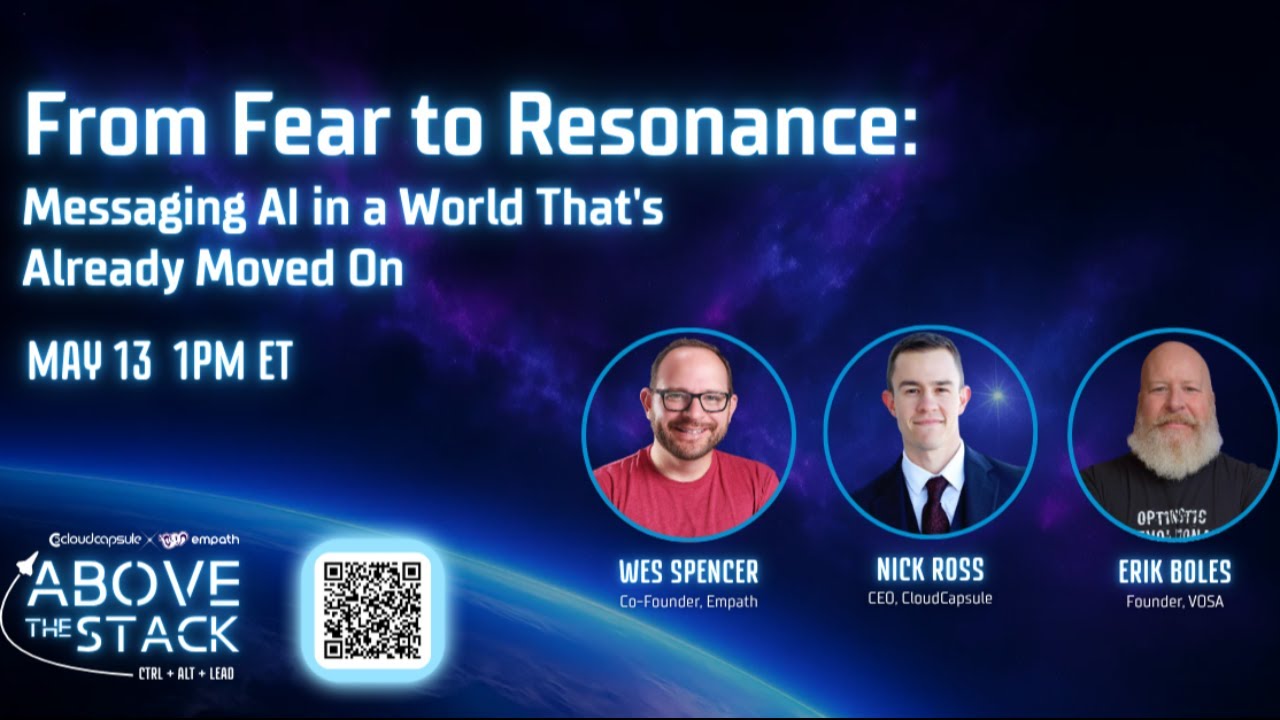
In this episode of Above the Stack, host Wes Spencer (Speaker A) and co‑host Nick Ross discuss with guest Eric Bulls how Managed Service Providers (MSPs) should shift their AI messaging from fear‑based, tool‑centric pitches to resonant, business‑strategy conversations. They explore how the buyer’s journey has evolved from “search” to “ask,” meaning prospects now come to MSPs with specific questions and expect trusted guidance rather than a sales pitch. The panel emphasizes building trust through education, free value, workshops, and consistent content, leveraging brand‑building tactics like QR‑linked guides, social media, and community events. They critique the over‑reliance on commodity tools and stress the need for MSPs to position themselves as VCIOs or strategic partners, focusing on outcomes such as productivity, risk mitigation, and automation. Practical tactics discussed include using Microsoft MDF funds for workshops, creating open‑ended discovery questions, curating a Notion idea board, and showcasing real‑world success stories to move prospects from “Believer” to “Evangelist.” The conversation also touches on the fear MSPs feel about not being AI experts, the importance of storytelling, authentic video content, and the need to continuously iterate and share knowledge. The episode ends with a call to action to download the AI marketing discussion guide, a preview of the next episode on the cloud war, and encouragement to share the show.
Chapters
What is going on, my friends? I hope y'all are doing awesome today. Nick Ross, what's up, my friend?
Not much, man. I feel like I'm still, uh, still recovering from Kaseya Connect. I don't know about you, but I feel like— great show, but it was a long week.
Yeah, I feel like every time we do one of these shows, we're like, I'm recovering from previous event. It's the life of, uh, being a vendor for sure, just, uh, going to all the major things. But Kaseya Connect It was a phenomenal event.
Yeah, we had a great time, uh, had a lot of great conversations and, um, bigger event, so there's a lot of people walking around and every couple feet, you know, you run into somebody else. Yeah, it was good.
Yes, yes, 100%. Well, everyone, welcome to Above the Stack. We're super pumped to have you here. Uh, Nick, I checked all the stats across Empath, um, our channels, like Empath internal, our channels, your channels. The last episode that we just did on AI got over 4,000 views in aggregate, I think maybe closer to 5,000. So this show is blowing up, dude. It's unbelievable to me.
That's awesome. Yeah, I feel like the topics we've been getting into lately are definitely timely and certainly outside of, you know, webinars and our conversations, it's definitely what I hear a lot of our partners talk to us about or want to know, you know, and just like everybody's reaching out about how do we navigate this AI landscape now. So it's good.
Well, you're, yeah, you're exactly right. And I've loved this journey through AI. And if you're just joining us and you're new, welcome. This is Above the Stack. This is a show where Nick and I, it has nothing to do with Empath and Cloud Capsule, great companies, has everything to do with like, how do we as MSPs go up a level? And what we mean by that is how do we shift into the strategy layer? How do we shift into the discussion layers that we think that our people, our customers, our prospects need to hear? It's less about the stack that we shift into so often and much more about going above that. And so that's— it's been a lot of fun. We've been chasing this AI stuff for quite some time. If you've missed it, go over to Cloud Capsules YouTube or Empath's YouTube and you watch all of them. Just— they're all there for free, ungated, all ready to go. And the other thing too, Nick, and I've gotten tons of good feedback, we try to give giveaways like a free— not even a giveaway, just a free— well, it's a giveaway, a free guide of some kind. And today we have sort of an AI marketing discussion guide that's also available. We'll have the QR up pretty much the whole time so you can go grab that, but we'll reference it. Throughout as well. And I don't know about you, but I've heard really great things about that too.
Yeah, it's a great way to channel kind of a lot of different directions, right? I think it's one of the biggest questions you get asked is, where do I get started, right? And what resources do I have to start to catalog where I'm at today or ask customer questions and understand where to navigate those after I get it? So a lot of the assets that we've been releasing on here are super helpful to navigate that equation. Certainly will change over time, but Definitely something to help you, you know, with, with your client conversations for sure.
Yeah, exactly right. Well, we're getting scans now. I don't know if anyone else can see it, but every time someone scans the QR, I get a little notification. So someone just literally scanned it right now. So thanks. Glad, glad you scanned it. It's going to be some— the guide's awesome. Just trust me. It's really awesome. Well, welcome to this episode, Episode 10. It's hard to believe we're already in Episode 10, but here we are. And today, we're going to be talking about a really fun discussion of going from fear to resonance. In other words, it's difficult. We've covered this, this whole journey of AI is different than cybersecurity, doesn't sell the same, it doesn't work the same. The motions are different. We've talked about the fact that your clients are already using AI every single day. We just don't always know it and they've not brought us into the conversation. So now we're going to catch up today into, I think, a really exciting topic. So co-host today, myself, Nick Ross. Glad to be with you. Hit us up on our socials if you ever want to chat more, learn more, talk more. Happy to do that. But today's guest is the one and only, a very good friend of both mine and Nick's, Eric Bulls. Um, Eric, we are super glad to have you on and would love for you just to take a minute and say hello and who the heck you are, my friend.
What's up, fellas? Good to see you, man.
You see too, brother.
I'm curious why that, um, that pic, that profile picture of mine, the way the beard is, looks like, um, Dark Helmet from Spaceballs, only it's white. Like, my beard does not flare out like that. It looks like I'm wearing like one of those like helmets that you'd like do like, you know, when you're like a road biker that's going for a speed run or whatever.
Right.
It's ridiculous.
I can't unsee that now.
Yeah, I gotta, I gotta change that picture. Or I have to move to West Virginia. I don't know which one. Probably both. Yeah. So good to see you guys. Yeah. I think this is a super interesting conversation because this lands right where I'm at, which is, you know, we, with everything we do, whether it's AI, whether it's, you know, cybersecurity, what it's, whatever. We sell everything the exact same way, which is we're geeks, we're smart, shut up, you're stupid, I will tell you everything you need to know. And it's just not the way that we sell. And now with AI, that changes drastically. Um, I just finished version 7 of the Dynamic Buyer's Journey, um, which I don't think you guys have— either one of you guys have seen yet, but, but, um, it— that, that changes quite a bit, right? Um, um, there's 5 reasons we ever go online, right? We go online to, um, discover, escape, find something, search for something, whatever, right? Like, nobody ever goes online to go, hey, I wonder what ads are running. Like, I can't wait till I can go to YouTube and see some ads, right? Like, how many people honestly, you know, um, how many people when they get to a YouTube video and you see a commercial or an ad, and you got that little like, "Skip the ad in 5, 4, 3, 2, 1." When it gets to 1, how many of you guys actually stick? How many of you guys stop and go, "Oh, you know what? I'm gonna see where this is going." Zero of us. Like, you're gamifying the skip button. Like, you're hovering over it, like, "Can I click it just as it changes to skip, or am I going to be too soon and end up going to a sponsor's website or whatever?" Like, like, that's how, that's how much we want to get out of that ad cycle.
Yeah, right.
So the thing that changes is between, you know, Discover, Escape, um, whatever, when you, when you go online, is search is no longer there. It's now ask. And just one word different. We don't search, we ask. But that is a completely entirely different motion, and it completely potentially completely removes the MSP from the picture 100%. Yeah, I no longer need to search for somebody to ask. I just ask.
Yeah, yeah. Oh, go ahead, Nick.
No, I was just gonna say, yeah, it's a big inflection point, right? Um, in the sense of like legacy commodity-level services, things like that that you typically think of, you know, and that we've, we've preached on this channel too, you know, in the sense of, you know, differentiation, niching down, um, a lot of these various concepts that get out of that motion to where you could still ask, but their specialty, right, and that you're looking for potentially as well too, that kind of branches you back out to interest in, you know, trying to find that, that special connection or relationship that you might be looking for as well too.
Yeah, 100%. You know, I think something that's really interesting is, and I apologize, I meant to send you these slides before, before this, Wes, but So I— both of you, and anybody in the comments as well, tell me where this is wrong because I want to know where this misses, right? Um, let's say you're 20 endpoints, you're really low, you're at $100 per endpoint per month, right? That's $2,000 a month, $24,000 a year. To me as a business, right? Um, I— let's see, um, So what I look at is, um, I decide, okay, I, I go out, I, I— that's $2,000 a month. I go out and pick up Rippling, that's $200 a month. I go out and pick up Automox, that's $70. I pick up Avix, that's $100 a month. I pick up Avanti Neurons, that's $100 a month. That's $470, $5,600 a year. I saved $18,300, $360. I have no tickets. Everything's automated. Zero downtime. It's 24/7. It's instant provisioning. And I don't have to worry about QR codes. So you guys, Nick and Wes Spencer and anybody in the chat, tell me, what am I missing in this model as a business that needs automated IT? What am I missing out of Rippling, Automox, Automoxovic, and Anavanti Neurons. What am I missing here?
Well, assuming that you also have the Microsoft stack, right? So you're able to use all the native tools inside of that. I know where you're going. Where you're going is all of a sudden, you know, this, hey, I've got tools to sell, is becoming less and less relevant all the time. I think that's exactly where you're going, right? It's like, okay, tools are commodity, I can get them anywhere, and yet this is the age we're in. 99% of us, maybe that's too much, but a lot of us still say our value is in the tools we offer.
So exactly, exactly that point. So let's look at it through this lens, right? I'm sure there's stuff that I'm missing. The Microsoft stack, all the other things. Like, I'm sure there's a bunch of stuff that I'm missing, but I am a knuckle-dragging marketing guy and I literally went out to Gemini and said, I'm starting a business. I have 20 employees. I want to automate as much of my AI, as much of my IT infrastructure I possibly can.. And that is what it gave me. So, you know, you're, you're both old enough to know, it's like, remember back in like early to mid-2000s when the big rage was like outsourcing your help desk to India? Like we weren't going to do onsite help desk anymore. Everything was going to get outsourced. And I was talking to these guys and they were like, yeah, they're going to figure out that that crap doesn't work. Like there's no way outsourcing help desk to India will work. And I was like, you're absolutely right. And it's going to take a 12-month contract for them to figure out that it didn't work. So what are you gonna do, sit at home on your couch for 12 months without a paycheck and go, 'Told you'? Like, who cares? You're still out of a job. And so, is there stuff missing? Yes. Are people going to be wrong? Absolutely. Is it— are they still going to fire their MSP and go, 'Nope, AI's got this,' and the tools are only getting better? Absolutely. If you, as an MSP, only provide, we come in and we are your outsourced IT department. Unless you go above that conversation, above your tech stack, and good name, become that— because again, you know, the buyer's journey is very, very different now. Um, as a matter of fact, I have— if you want to make me full screen, this is interesting, right? Um, we've all seen the buyer's journey, right? This is stuff that's written by like Forrester, Gartner, um, CEB, all these people. And the whole point of this whole buyer's journey thing is to completely baffle you with bullshit and confuse you. That's, that's, that's quite literally the only reason that they do this. It's not really that complicated. Now, this from a technical perspective still exists for sure, um, but where it exists is, uh, is, is a little bit different because where it exists is all the way up here at the top in the evaluation phase. That's after formulation, after, after awareness, consideration, pre-commerce. That's where that exists. So as I said before, right, this buyer's journey is very different. So if we start down in the awareness where, you know, we go online to learn, escape, discover, search, or find and connect, well, now that search becomes ask. And when I ask, now it gives me all the information that I need. So where do I go next? I go to consideration. What did I learn? Who do I know? And not by who do I know, I don't mean Dave that I play golf with who also owns a plumbing company. What I mean is I go out and look at Nick Ross's YouTube channel all the time, and I have been for years, and he is somebody who I know. I now know that I can go and look and trust Nick because Nick has always added value to my life in his YouTube channel for years now and never tried to pitch me or sell me anything. How many times did they touch me? What was the experience and the value I got? That's what builds memories, and that's what builds trust. Once you've— once I've built trust with you, then I move on to the evaluation phase. And the new addition there is what can be automated, right? Sure, I want to know that you've got the business acumen, the proof of domain expertise, the product fits. You've got the expertise, word of mouth, is it reviews, you're socially engaged, whatever. What can be automated? That's the first thing that I look at now, because all the rest of that is— doesn't mean that you're not good. It means that everybody's good. That's, that's table stakes. That's the price of admission. The interesting part about this is, and all the, all the latest data shows this, is that by the time we get to the evaluation page, where I, as a customer, am even entertaining an MSP, I've already made 85% of my research is completely done. At that point. 85%. If you're not in that 85%, if you're not in those top 3, once I'm 85% of the way down the road, you better have a damn attractive offer and a really good reason for me to tip the apple cart over and add somebody else in with my entire team, re-go through some evaluations, all of those things, right? Um, and really what our, what our goal is, is that we want to get down to this bottom layer where We get them all the way to an Evangelist, where we, they feel like their dreams are within reach. Like, that's really where we want them to be is, is that, that bottom section where it's like, and that's really hard to get to. Like, we can sell them something and make them a Believer. And they're like, "Yeah, I know that this MSP is great. We had good experience. We have a sense of relief, and our trust is a little bit boosted." It does not mean somebody else is not going to come along and sweep your customer out from underneath you. And I think that goes with for the Loyalist stage as well. They're still open. Until you get to that evangelist stage, which is where we all want to be and is really hard to get to, but that absolutely requires that we all go, we're no longer an MSP, we are now a business strategy partner. We're acting as— and we say VCIO all the time, right? We're truly a CIO. Like, we've all heard this, right? Where it's like, you know, I don't know, man, they got this CEO, the guy doesn't even code. Like, what? Like, what are you even talking about right now? Like, CIOs don't code. It's like CFOs don't go in and enter AR and AP either, because that's not what a CFO does. A CIO is a strategist at a super high level that says, let's look at the entire business. So bringing it back to that AI conversation, like, if you're not coming in and saying, how are you guys using AI? Why do you think you need to use AI? What's your driver for AI? I don't want to know about whether you're using ChatGPT or Claude or Gemini or Copilot or all of them. Why do you think you need it?
You know?
Yeah.
Yeah.
Like, I don't want to look at the tech of the business. I want to look at the business. All of it. Yeah. What keeps you awake at night? Go ahead, Wes.
There's so— no, you're good. This is good. There's so much to say here. Like, as you're going through each of those stages, I'm looking at them like, man, this resonates with me. Big time. And we accidented our way— I remember my Perch days, we totally accidented our way into all of this. We spent more time just teaching, educating, helping, free— as much free stuff as we could give out of like, this is what good looks like. And even jumping on with like even non-partners of like, hey, how can I help you? Can I, can I talk to your clients about what cyber is? I'm not going to pitch them. I just want to talk about what's changed and they should not go buy something. They should evaluate and they should do a risk assessment, all these things. And what I learned accidentally, Eric, was that all of a sudden what we're doing is we're earning their trust. And as we're earning their trust, that ends up starting to replicate. I remember so many demos I jump on and it was like they're already ready to buy from me. Like they don't even need the demo. The demo is just like, we have to do this to prove that it's real. So I can tell my boss that this perch company I've heard great things about that's doing all this good stuff actually works. And we're repeating the same thing at Empath. And I can tell you, watching all the stuff Nick does, He's been doing the same thing too with Cloud Capsule. It's like people already know who Nick is. They know what he does. They know his level of expertise. Therefore, that translates into a trust relationship because he's someone that's taught me something. He's a subject matter expert in something. So therefore, whatever he's going to spend time building and selling to me is going to have value, which means I don't have to worry about any of that. It really is just, does this—
okay, cool.
It does what it says it's going to do. Does he listen? Great. Is he got a good roadmap that kind of aligns where we're going? Let's make this happen. So I really do love that. I think it really resonates. And the, what MSPs should be hearing out of this, and I don't see enough of them doing this, is they should be replicating that same thing among their people, among their audiences, whether that's local and small or that's NFL cities and global. It doesn't matter. They should be replicating that same thing.
Every, everybody— go ahead, Nick, go ahead.
No, I was just going to add to that. I mean, I think, you know, the most progressive MSPs I've seen in the sense of, you know, having really progressive conversations with their customers are doing the basic of hosting a workshop. You know, and just inviting customers out and inviting them to share, you know, what they're seeing in the market, how they're thinking about, you know, security around it, but also like the productivity. And a lot of MSPs, like, I just, you know, always focus on Microsoft because that's my, it's my jam. But, you know, a lot of MSPs don't know how to use MDF with Microsoft. And that's a great way to start to tap into those funds that you're just letting, you know, go by the wayside because you don't know what to do with them or it's hard to claim. Because Microsoft is, you know, a PhD level, right, for anything that you're doing with them. But that's one area where they would supplement, you know, or pay for you to host a workshop, you know, and have your customers out. And you could say it's about Copilot, but you could make it a broad, you know, output of AI in general, right? And showcasing that. And then over time, you know, when the next time they have an AI conversation, they're going to think about you. And that's the big, the big linchpin to even just doing that in general.
So let's, let's talk about that whole MDF thing, because here's what I find interesting about that is that there's about 3,500 vendors in the channel. We all use about 75 to 100 of them. If that might be a stretch, right? Like, there's the big players that we all use. Now you can call them MSPs or ITSPs or VARs or whatever, but there's about 50,000 people all out there doing the exact same thing. I've got 50,000 people across the US that are all selling the exact same thing. They're all selling Huntress. I'm Huntress. I've got 50,000 to choose from. Guess who the hot chick at the dance is? Huntress. So when I say I'm going to spend MDF, am I going to go look at Cloud Capsule and go, wait a minute, Nick has already got this huge following on YouTube, Wes Spencer has his following on YouTube, on LinkedIn, whatever? Or am I going to go to the guy that's like, yeah, we don't really do like this whole like, you know, engagement thing, whatever, like you don't have an audience, what am I spending money on? I'm going to look at Nick or Wes Spencer or somebody else. Extend that one level further, as we're looking at roll-ups and things like that, a PE firm comes along. Who do I buy? Do I buy one of the small little players that has no presence and has very little, very few customers? Or do I buy the one that's already got a presence, that has customers, that has all those things, roll them up, then throw money at it and put all the small guys that are competing with me out of business in the local market? So this, all this stuff steers back to, you've got to start having these conversations that build trust with your customer. You know, we talk about brand a lot and they're like, oh, we have a mission statement, we have a logo, we have a whatever. Logo is brand identity. It's not brand. Your humans inside that company are your brand. I just had this discussion with a friend of mine. He was like, no, your brand, your, your, the brand is a thing. And I was like, the brand is not a thing. It's hollow without people inside of it. And he's like, no, we have a mission statement. I was like, read me your mission statement. He's like, we. And I was like, stop. We who? And he was like, we the people. I was like, keep going. He's like, we again. And I was like, we who? I was like, take the fucking we out of it. Who's— who's the brand? Is it a hollow logo? Because it sounds to me like you're powered by the people that work inside your company. Microsoft's hiring storytellers. HubSpot's hiring storytellers. Uh, uh, Salesforce is hiring storytellers or building communities around all this stuff. If you are not building a brand that gets you in the door— and that's the whole thing, is that, you know, if, if I didn't know Nick at all or Wes and I were to get an email from them, I'd look at that and go, wait a minute, I know who those guys are because I consume their content online. But if I'd never heard of Wes, there's a little stop sign up there that I just tickle— spam. I don't know who that is. I got way too much shit going on, man. I don't have time to like, you know, field your cold outreach. I'm not saying outreach is bad. Cold outreach is bad. Like, we're all online. Just go comment on something that I did or comment on a comment that I left. Like, all you have to do is a couple times and then I know that you exist, and then you can come in and have that conversation and go— again, this comes back to— I don't want to sell you anything. I just want the opportunity to learn about your business. How are you using it as a company? Like, if you're an MSP that's talking to a company right now, go into them and say, here's what you're going to do. You're going to see— you're going to reach out to everybody in the company and say, we don't care if you're using ChatGPT, Claude, Gemini, Copilot. I don't care what you're using. We want to go and find the best way to implement AI within the organization so nobody's in trouble. I want to know how you're using AI right now. Personal account, corporate account, business account, whatever. Just tell me how you're using it Today we're not shutting anything off. We're not blocking anything at the firewall. Nobody's in trouble. Nobody's coming to HR. We just want to know how you're using it. Collect that data and then bring everybody in the company in and go, how do we find the best solution for everybody and still keep us secure?
Yeah, yeah, I think that's— and that piece of it, I think, has been really hard to swallow, right? In the sense of, you know, the average MSP, when they see that, they see a bunch of risk, right? And we all should, you know, as, you know, the advisors of these accounts. And obviously, you know, being that practitioner who's seeing like there's HR data exposed, there's financial data that could get exposed, they could be in the news, those types of things that run through your mind and you're really risk averse in most of these cases because you're, you know, that's your focus as far as like cybersecurity and everything that we've been looking at. But I think when you do take that approach of, you know, taking a step back being able to swallow, okay, like we're not going to solve this overnight. And obviously there's always going to be risk and understanding there's a gap there that you have to fill. But knowing and understanding too that if you go at this approach of the parent-child relationship, right, like you can't use AI till I say you can. And that readiness conversation that we've talked about with John Harden before too on the previous episode, it's like AI enablement is really that key change in language, you know, that he calls out that I've loved. Honestly, I repeat it all the time now because it's just such a resonating factor with most MSPs. And just kind of that dynamic that you present is going to make them warm to you in the sense of, hey, let me take you on this journey and we'll talk about the risk. Every time I've gone into an engagement of consulting with a business, we've always led with the productivity benefit and the security was table stakes, but we talked about it for like a minute, you know? And it was like, yeah, okay, I gotta do that too, right? Um, and so the acceptance is actually way less friction that you're typically exposed to. Like, previous times you were like, hey, you need MFA, and they're like, oh wow, I'm not gonna do this for months, you know?
And yeah, it's like, why do we lead with the friction? Why do we do that? Because we think the friction is the thing I've got to sell the most, and all it does is make the client be like, shut up, nerd, I don't care about that stuff. It's to your exact point, Nick. If I've done a great job talking about the value. I'm like, oh yeah, we got to do some other nerd stuff. It's going to cause a little conflict. We'll get through it all. Trust me, it's not a big deal. I'll give a plan to your people. Don't worry. Business owner's going to be like, cool, man, no problem, let's go.
Yeah, people identify in stories and outcomes they can see themselves in. We tend to go out and go, oh my God, you don't have this, you're going to get ransomwared. Oh my God, everybody's using AI. Are you crazy? What's wrong with you? They're like, you know, Wes, you and I have talked about this, right? It's like, um, I go to the mechanic and he's like, yeah, your brakes are bad. And you're like, yep, I get it, I know exactly what the brakes are. It's the big square pedal in the middle. When I press it, the car goes slower. Like, I— yeah, put brakes on it. And then he comes back, he's like, by the way, um, did the brakes— took it for test drive, everything's great with the brakes, uh, fault in the TPS, um, at WOT it collapses and we got to fix that. And I'm like, I have no idea what the hell you just said, smart guy. Um, I don't know anybody that's ever had a WOT TPS thing happen to them. And, and I, and I, I don't think— and he's like, sorry, he's like, when you press the gas really hard, that's wide open throttle. You have a thing called the throttle positioning sensor, tells the engine where the throttle is. That kind of breaks when you do that and doesn't deliver enough fuel. So imagine you're going down the freeway and you have to like punch it to get out of a bad situation and the engine dies. Now you don't have power steering, and you're like, uh, yeah, replace that wat teepee thing that you talked about, whatever that was. It's just in the way that you explain it, right?
Right.
Um, we love to talk about how smart we are. They don't care. Exactly to your point, Wes, they just don't care. Let's go in and talk to them and say, peel back the layers of the business for me. What's going on? What's— why did you start this company? What's your wild, hairy, audacious goal? Where do you want to be someday? You want to open up 16 locations and have 150 employees, or do you just want to get to a point where somebody else buys this? What does the next 6, 12, 18, and 36 months look like? What are the roadblocks in the way? Not IT roadblocks, business roadblocks. Now let's back up and go, you know what, I think some of these things can be solved through the lens of technology. Some of them cannot, and I'll be very upfront about that, that We probably need to involve somebody else. But I have some people that I work with. You know, one of the companies I work with is also a financial analyst firm, and they may be willing to come in. They're one of my customers as an MSP. They might be willing to come in and talk about some of the financial stuff and how you structure this to get to a liquidity event, right? An exit. But the other stuff we can solve through tech. Some of that is AI. We can drive some automation with AI. Some things you've been told that AI can do are not really there yet. Right? Like, we can try, like, we can go out and write an agent, but that agent's not going to do what you think that agent does. And I don't think you fully understand what an agent is at this point, you know? It's like, yeah, well, you guys both remember, right? It's like back in the day, we like, we all knew what cloud was, and then Microsoft came out with their own definition of cloud and screwed it up for everybody. And we were like, oh, that's awesome, thanks, right? We all knew what encryption was, like Kerberos, two-headed dog encryption. Microsoft came out there like Let's talk about encryption. You're like, oh, thanks for screwing that up for literally everybody. That's awesome, right? And now, like, we're doing the same thing with agents, right? It's like, what's an agent? I don't know, you tell me.
Yeah, I think you make a good point in the sense that it's still a technology conversation, right? Like, a lot of people get overwhelmed thinking about— I certainly do too, right? The pace of change is rapid. I log, you know, log in every day, look at LinkedIn, and I'm like, man, like, this is, this is brand new, or this guy's doing things that I haven't even thought of before or something like that. And I think when you come back to the core basics of it, most of the engagements that I've talked with, with, with MSPs or the ones that I've done, once you dive deeper in with the client, you often find that there's just like a business process optimization that they could do. And it's the core basics of I don't actually need any automation. You could just rewrite your process and it would be way better, right? And so it's a shift in kind of expertise in that way. But you deeply, as you go through that experience, you understand their business so intimately that the next time they have the next thing, you can relate back to them. It's an EQ equation for you to use that, but it's also a way for you to understand, I could actually automate that, or I could get this technology in here, or I could, you know, replace this, and that would help them in these ways. So there's a lot of different, I think, concepts that would come from that as well too, that you don't have to be the AI expert. We've mentioned that in other calls, right? But I think it's important because a lot of MSPs also like are hesitant to open up the conversation even to how are you thinking about AI, even though it's open-ended, because they don't know how to fulfill the opposite end of that. And I think that that's a fallacy in that, you know, you know more than most people, right? In general, in general respects as far as that goes. And the same thing is true to your point on agents. There's all these businesses right now spending a bunch of energy and time and money, but not necessarily getting business ROI. And that's a big distinction, right? I think that's probably the most prevalent. If I was going to stand up on a soapbox and talk about that, that was my, my key thing right now. It's just like a lot of noise, you know, and not a lot of output.
So, you know, it's so good about this conversation. We're actually just naturally walking into this guide that Nick and I wrote, and this is super helpful. The QR is up there if anyone wants it, just go grab it. But it literally— I'm skipped by this intro thing. It literally starts with what both of y'all have just said, but first of all, this core shift, right? Like, no one is coming to you as an MSP saying, yo, what AI tool should I buy from you? It goes right back to Eric's point. Literally no one says that. So when we lead with tools and security and all these things, all we're doing is we're just saying, hey, we're not only continuing to stay irrelevant to you, we're also continuing to add friction, and we're the last person you ever want to talk about, about getting your business better. And so this gets back into like being practical. You should literally ask Just simple, open-ended questions. And I, these are just some examples. There's probably plenty more that we can come up with. Like, you know, "Hey, why do I feel like my team is buried?" Like, we're looking at that at Empath right now. Like, where are some areas we see some significant inefficiencies that are just creating drag? That's stuff that leadership wants to talk about, right? And on and on. I'm not going to go through everything, every single one of these. But these are where the conversations begin. And Eric, maybe a question I'll go to you. I feel like a lot of MSPs are scared to ask these open-ended questions because, to your point, they feel like they have to have answers to all of them, and they don't. I love what you said earlier of like, you're going to just naturally, being a technology person, but actually, that one and that one, I think we can build a plan to solve. Next time we meet, can we, can we, can we do that? You don't have to have all the answers right away. You don't have to answer every single problem that they have. That's not who you are. So I love that you said that, because I think where this begins in this Section 1 right here is really something we should start doing much more of.
It's interesting. What we're scared of is that we don't have the answer. We're not the smartest person in the room. We're still the smartest person in the room. As Nick said, we know more about this than almost anybody, but we feel like— so again, let's go back to the doctor analogy. Your doctor's like, could be this, could be this, could be this. We're gonna run some tests, take some x-rays, we'll take a look, we'll let you know what I think. Dude spent 12 years in school. He's a doctor, for God's sakes, and he's not going, I know what this is. Because he knows better. He's like, we need to diagnose it. There's nothing wrong with going in and saying, look, man, I'm going to be real honest with you. I'm in this AI world all day, every day, for hours on end. I do not have all the answers. This thing is moving as fast as the inception of the internet did back in the late '90s, right? Like, this is a huge, huge, huge breaking point. And every single day, there's not one new thing, there's 13,000 new things. Every single day.
You know what's so interesting about that, Eric? I'm going to drag— I don't know if this is going to work. I'm going to try it. YOLO it. Yeah, it worked. Cool. You should be able to see this. I find this to be so fascinating. This comes from National Academies. I wasn't even planning on showing this, but I just Googled it. This is literally how the diagnostic process works in the medical field. I did a whole talk on this like 3 years ago, and I still— it was impactful to me so much. I still remember this of like, think about how this works in the medical world when the patient first engages. Now, the difference is they're coming to you a lot of times because their knee hurts or whatever. But the difference is, is exactly what you said.
We—
they don't just jump in and start sawing your knee off. They don't just all of a sudden start, you know, handing you meds. I mean, you can find some doctors that'll do that for sure, right? But they actually go through this entire diagnostic process. And so what happens is inside of this, they're collecting information, they're doing all the right lab work and blood work and testing and physical data collection, all this kind of stuff, this information gathering, which then goes into some type of interpretation. That doesn't mean you have a diagnosis. That means the data is showing us these things. That's going to turn a bit more into a deeper diagnostic process. And then once we start to understand that the data informs the decisions, then we communicate the diagnosis. But we understand that as we go into a treatment plan, sometimes that treatment's going to work really well and we have great outcomes. Sometimes the treatment doesn't actually work, and that reinforms the diagnostic process, and we go back to the wheel again. We're not finished with what we're doing. And I love this because ultimately the patient came in because they want great outcomes. That's why they came in. They want their knee to stop hurting. Our job is to do everything in the middle of this. And I just wonder, as MSPs, if we really mapped our processes out, does it look like this or does it just look like, hey, let me just chuck a bunch of tools at you and, you know, see what goes from there? And we wonder why they want to say no to all of it.
Right. It's, it's, you know, it's interesting is where we as MSPs Whenever you talk about, hey, go in and just add value, like, like in a free environment, add value and, and see what happens, right? Like, well, if I add, if I give this stuff away for free, what do I charge for? If you're only one layer deep on the value that you own, you, you have no business being an MSP anyways. Like, like, like if that's the level of discovery that you're at where you're like, I only have one layer of stuff to give away, and once I give that away, then there's no reason for them to call me. You really need to reassess, like, why am I an MSP anyways, right? You give away layer 1, layer 2. Uh, a great example of this, I'll say, um, almost everybody knows who Gary Vaynerchuk is. He's the CEO of VaynerMedia. They're a huge digital media, um, uh, strategy firm. He's a very, very good friend of mine in New York City. Do you think even for a minute that VaynerMedia is the best digital agency out there compared to Wieden Kennedy, Chiat/Day, companies like that, right? Ogilvy. Hell no. The reason they made Agency of the Year is because Gary Vaynerchuk won't shut the hell up.
And he's—
what's given? Yeah, nothing, nothing. He's selling absolutely nothing. He's giving away everything knowing that the CEO may not watch him, may not watch him, but employee X that's 3 layers down might. And in a meeting somewhere, they mention this VaynerMedia company, and now they're hiring them. When we very, very first built Pax8, um, very, very early on, we were talking about single pane of glass, incremental ordering, um, a unified billing, all this other stuff. It's something that Ingram or anybody else could have done. And I kept challenging everybody when it was just like 5 of us, and I was like, what's the one thing that nobody can replicate? And Ryan Walsh wrote on the board, the experience you get when you work with us. It's really all that Pax8 ever sold was a better experience. I don't sell different licenses. If anything, We were more expensive. We gave you less margin as an MSP on Microsoft licenses than Ingram or somebody else did, and people still bought it because the experience is there. And if you can create that experience of coming in and saying, look, I'm not here to turn off AI, I'm not here to tell you how to build agents, I'm here to help you be a better business, not just a better customer of mine. I want you to be able to say, I want 6 months down the road, you and I flying to Scottsdale and playing golf together because your business is running on autopilot and my business is running on autopilot, and we're going to celebrate how well your business is doing.
Yep, that's right, that's right. I think this commenter is going back to what we're talking about, just all the confusing terms that we add in, all that kind of stuff. So that actually, I think that brings up a question for— I want to ask both Nick, you, and Eric, both, both of you, this question. So we've talked about what branding should look like. It's the people behind it. It's the activity that we do. We've talked about— we start to ask these open-ended questions about the business itself to start to understand what their ideal outcomes that they're trying to chase, where they feel like they're missing the mark. We start to look for areas where technology and AI might solve for it. But once we finish with that discussion, what comes next? Like, how do we— in your mind, what comes out? What's stage 2? And they say, okay, yeah, I agree that's a problem, and I'd love for you to come back and give me, you know, some kind of solution you think can fit. Fix and, and meet the need. What happens after that? What's the next thing that, that occurs?
Yeah, I'll go first here. I think, you know, it kind of depends on, you know, your, your internal competency and, and kind of how you want to navigate that conversation from there. I think there's a ton of different paths that you could take, um, in doing that. I think understanding, you know, we've talked about this in previous episodes, but if you go talk to every one of your customers and you, you do this dialogue, you do this discovery, you're going to have this amount of data that you can then normalize and understand other commonalities across my customers that I can begin to solve for and begin to package against in the sense of a delivery model. And again, this doesn't have to be something that you have to package up and sell in the sense of the traditional monetization engine. It is, is something, it is something that you want to begin to develop, you know, a competency around in that sense as well too. And that could be as basic as, you know, what John's mentioned before, too, of, you know, how do we get you plugged in with the basics of, you know, doing summarization or drafting an email or, you know, this crawl, walk, run approach, right, that we've seen work versus what he termed as like the nuclear approach, right, of like, let's get your total, you know, revamp of your CRM and do a whole data pipeline enrichment with AI. Right. That's unfeasible. And you're not going to be able to spend attention to other clients. And you're going to be learning on the fly for something that takes a lot of maintenance after the fact as well, too, right? Or it's going to be tech debt in a month. And so you're— you got to think about like, you know, the future you and how can you protect, you know, that as well, too. But with most of these client engagements, you know, I think it's also being honest about your core internal competencies or looking for partners, right, that have competencies that supplement, you know, what you guys are already doing today. I've talked about this in the past with You could be really great about the data governance layer, right? That's your focus. You've been a cyber-first MSP in the past, but you're bringing outside consultancy or work with a partner that does more of the productivity, you know, workflow automation, RPA work, things like that that you can get into as well. So there's a lot of different angles, but typically I try to be upfront about this is what we can do. These are the crawl, walk, run steps that I would start with today because we can all build around that competency. And then move from there as far as like the expertise that they're looking for as well too. I don't know, Eric, if you had something—
you— that, right? And I think you actually mentioned this earlier, and I think it's a really good idea, is you're not there to solve all the, all the problems. You're there to be a facilitator, a scribe, and, and somebody with some technical knowledge. Put together workshops with multiple customers. And if you don't have an office you can do this in, talk to your local chamber and say, do you have a conference room I can rent? Talk to your local library. They have rooms you can rent. Talk to a local coworking space, but get 8, 10, 12, 15 of your customers together and say, we're gonna do a 4-hour workshop. We're all gonna talk about AI. Nobody's stealing each other's shit. Don't be a jerk. But we're gonna like kind of boil things down and talk about it. I'm gonna take all that away. Me and my team as an MSP are gonna take that away, and we're gonna deliver something real and tangible for you for free. That's kind of a getting started guide that spans all of this because now we have a level set of data across 15 companies that are all doing whatever, talk to your local chamber about it and say, we'd love to do this for more chamber customers. Be the one that brings that solution to the table. I, I get it that you don't understand everything that's happening. They understand way, way, way less than you do, so don't be afraid of that, right?
Yeah, there's a lot. Oh, go ahead, Nick.
The other comment on that I was going to say is that what I've seen for most businesses is like you just need to put a small wrapper of you're getting kind of a dual win both for you, you know, as an MSP in that risk factor of governance, but also a win for them in the sense of their productivity by putting a wrapper around, to Eric's point earlier, whatever AI that they want to use. Right. So you want to maybe position Copilot as given the security and governance of that. But if you— if they want to use, go heads down into cloud, I think stopping them from doing that is not necessarily the right approach like we've talked about. It's putting that wrapper around it to say, hey, this is the secure approach to Claude. But the additional benefits that you get here, you know, by getting a work account and doing all of that is that you can actually get the shared learning, you know, as a team. And you get this inner-person capability here of your workers are actually sharing insights with each other. There's collaboration going on that you typically wouldn't get in these siloed pockets where they signed up with their Gmail account to Claude and, you know, they're just pumping documents into there from the corporation and things like that too. So there's just low-hanging fruit like that, um, to get them into that crawl motion. And I just, you know, I think that's something that you can always take away from most of those calls. That's a little bit more blanketed and prescriptive. Then obviously you would want to channel that into their specific needs around that, but that's also just something that they can start to look at today as well.
Yeah, another thing I wanted to come back to that you said, Eric, I thought was really good was pulling people together and literally having the open discussions. For whatever reason, we're like afraid to have those. I don't know where it exists from, but I think we're like— I think where it does exist is we say, well, I'm not an expert. I don't know enough about AI to try to bring people together. They're going to ask questions I don't have answers to. They're going to say, well, why should I listen to you when there's Sam Altman and there's Dario and there's the All In podcast and on and on and on and on it goes, right? But the reality is I'm going to steal from my buddy David Powell. In the land of the blind, the one Aye man is king. I know he didn't come up with that quote, but he's the one that says it the most. So I attribute it to him. The reality is you're, you're the expert because you're local to them. You're the expert because you actually are listening and thinking and talking about all this. They're not. They're not listening to those other people. So your actual competition is the MSP down the street that's also not doing any of these things either. And so I think we just have to get over our fear of I'm not an expert, I don't have enough information, and just start doing it. The preparation and actually the fear is a good thing because it'll drive you to self-improve. And Eric, I don't know about you, but I feel like that's probably one of the biggest holdbacks that most MSPs have.
That fear. 100%. So, so let's look at it through this lens where as an MSP you see MSSP in a day, right? You're like, oh, we can take you from MSP to a managed security service provider and you roll your eyes and you're like, my God, that is stupid. No different than if you were to see, you know, we're going to give you Azure AZ-305 in a day, or, um, any of the other things that you see and you're just like, oh my God, this is so stupid. Like, you're not going to become an MSSP in a day. No different than that when we see, you know, things like templated marketing advertisement, things like, I shouldn't be telling you this, but— or, you know, hey, here's the one thing the experts say not to do. Like, we, we see the stuff, we know it's advertising, we know it's marketing, We ignore all of it. We know that you can't become an MSSP in a day. Yet these are the kinds of things that we feel like we need to lead with as an MSP to make us sound credible to our customers versus just saying, I'm just going to be out here and be vulnerable. And everybody's going to hate to hear this because every time that I talk to people about this, like obviously the people that are within the Vosa community, they totally get it. But there's a lot of people I talk to and they're like, Oh God, you're gonna ask me to actually turn on a video camera and create content, aren't you? Yeah, I am. Welcome to 2026, motherfucker. Guess what? This is where we are now. No different than somebody going, oh God, you're gonna make me configure VLANs, aren't you? Yeah, it's new. I get it, it sucks. Yes, we are now configuring VLANs on our network. It's not going to be flat anymore. We're not gonna have a bunch of red collision lights on our switch. Yes, you're gonna have to pry your fingers off your Exchange server because we're moving everything to the cloud. Guess what? It's called evolution, and it happens, and you can ignore it. You can bury your head in the sand, and this is the best way to get in front of your customers. Wes Spencer, you know it. Nick, you know it. Matt Lee knows it. I know it. It's a big part of how we built PAX 8. It's how companies are operating now, and you can ignore it. And guess what? What's the old saying? Um, if you don't talk to your kids about drugs, somebody— about drugs, somebody else will. If you're not, not out creating content, offering value to your customer, somebody else will be in your market. There's a lot of MSPs in your market, and the younger people, guess what? They're natively just pulling this stupid thing out of their pocket and turn it on the camera and recording video for no reason at all. And the only The barrier between you and that camera right there is your brain. You thinking, I can't do it.
You're exactly right.
And Nick's a good-looking guy. Like, it makes sense that Nick has a YouTube channel. I, on the other hand, I get on camera all the time. I look like a foot. That Lee looks like a wizard, right? Like, we don't care. And, and here's the thing, nobody cares. Nobody cares. Like, Nick Nick will tell you, Wes will tell you, like, nobody cares. You're gonna find a few haters in the comments. These are sad, lonely people and whatever, but by and large, everybody's so consumed with their own day that they just don't care about your life.
Exactly right. So going, going back, so the question would come up, will often come up, what do I talk about? Like, what should I be speaking towards? Take a look at this guide. Again, QR is up there if you want it. Uh, it literally walks you through a ton of these things, opening conversations of like, you know, hey, I'm one beggar that found bread telling another one. We're seeing a lot of companies do some of these things. We'd love to have the same conversation with you. Right. And tons of open-ended questions that you can ask. And by the way, these are things that you should be creating content on, whether it's blogs, whether it's YouTube Shorts, whether it's interviews, whatever it is, go start building some of these things. It could be around what, what's existing today. But I think even better, things like friction, friction-based questions are things every business owner wants to hear about. Same with operational efficiency. What are some of these things we should be talking through? And where do we feel like we're just, we're struggling? And I love this swivel chair question of like, where do we feel like we're switching between one thing and another? Again, less about me and me selling my tools, but hey, as a bank, I understand that when a loan comes through, you want to be efficient with this thing. If you can build efficiency towards being able to stack one loan onto another with fewer errors leading into bigger challenges and more rework, like those are things that As we continue to expand to new footprints, our loan ops center can be far more effective than ever before. And where do you feel like they're switching here and doing this and doing that, right? You can get into the risk and governance conversation when it's the right type of conversation with the right type of customer, or like a regulated one, those kinds of things, or when you've earned that right. But really focusing down here is these, these business outcomes. And the reason we've given you all of these is, we just want you to have a bajillion things that you can start to talk about, things that you can start to discuss, things you can build content around, all of those kinds of things. Because I think a lot of times the other fear is like, OK, Eric, I'm going to get started on it. But what the heck do I start? What do I, what do I start with? What do I say first? There's some things that you can just go grab and literally just start cranking some things out. Don't overthink this. Just start getting the engine rolling. Then you'll notice I've gotten through the tough areas of momentum. And now that I've built momentum, it's easier to start cruising along.
Right. 100%. So I don't, I don't know if it will I don't know if it will let me share my screen. Will it, Wes Spencer?
Um, it— I think it should.
Uh, let's find out here.
Um, just real quick. Yeah, here it is. Let me add it in.
Okay, so, so this is, um, a content ideation board, and I'm happy to share this with anybody that wants it. Wes Spencer, I'll give it to you and you can email it to people or whatever. But if you look, as I scroll and I scroll, I've got just in here, I have 612 ideas within this Notion board. So what is this? This is very simply, this is I, I go out and see something and I create a new idea and put in an idea and then give it a domain. Is this about leadership, strategy, AI, trust, go-to-market? Is this about engagement, influence, whatever? And then give it a status. Is it not started? Is it queued? Is it planned? And, and, and kind of the whole entire theory here is that— whoa, that was wild.
All right, that's cool.
Let's leave it up.
That's kind of—
that's right. Let's keep doing that. The whole theory here is this, right, is that you're like, OK, I go out and I see Wes Spencer talk about something on LinkedIn, or Nick or something, or somebody else. There's two factors here. One, I've got a different perspective. Whenever any of us all get together for drinks at a bar and dinner, whatever, we have a conversation. That conversation is comprised of different people with different perspectives. If it was just one person talking and nobody else did, We call that a speech. We don't do that. We have conversations from different angles. I might have a different perspective on something that Nick has talked about, that Wes Spencer has talked about. My customers don't necessarily follow Nick or Wes, but they do follow me. And most importantly, so way, way back in the CCIE days— I'm ashamed to admit that I was ever a CCIE, but like, I couldn't learn subnetting. I don't know what it was. I couldn't learn it. I read the Microsoft guide, which was kind of the Bible on subnetting. I couldn't learn it. And literally, I boiled it down. I was like, oh wait, I know what it is. I'm stupid. I'm a stupid human being that can't learn subnetting when everybody else can. And a buddy of mine sitting at a bar pulled out a napkin and a pen and in about 3 minutes explained subnetting. And I'm like, son of a bitch, that's how you subnet. It had nothing to do with the topic. It had to do with who was teaching it, right? Some people resonate, some people don't. If your customers are following you, you already resonate. You already have their attention. Because they chose to bring you into the office or bring you into their life in the first place. So yeah, like, you know, start a Notion board. And again, Wes Spencer Spencer, I'll share that one with you and you can send it out, or anybody can reach out to me on LinkedIn or whatever, and, and I'll be more than happy to share it with you. But, um, yeah, that's the— like, start writing down ideas throughout the day, otherwise you'll forget them, especially if you're old like me, you know. Like, I have ideas all the time, like at the gym, we're all like in between sets, grab my phone, open up Notion and jot down an idea.
You know, I'm going to brag on an MSP that I think is doing this really well because I just— I think it's worthy to, to go give shoutouts to people that are just crushing it. So Rob Chaffee, if you don't know Rob, go follow him on LinkedIn. Rob, what a great job he's doing. I see so many people like posting. I don't know, as a vendor, I'm keeping you as the MSP in mind. The things I'm posting are like, what's something my audience would like? What's something that would help them? What's something that would capture them and get them to hit like and share and interact and come join this call like we're on today. You should be doing the same things. And some of Rob's just so simple but so awesome. He's been doing this whole series on just like easy shortcuts that are like, oh man, that's super helpful. I didn't know you could actually do that. That's really cool. Does that turn into someone immediately going to Rob and saying, I want to buy all your services? No. What it does start to do is position Rob as someone that, hey, I'm watching you. It's not only those and the handsome pictures, of course. He got another one down here. Here it is. Even just like building these like practical tips on things that you want and things you should be thinking about. How do we start getting things rolling? So I love all of this because these are just very simple examples of Rob, I think, doing a really, really, really good job correctly talking to his audience and saying, sure, you know, could Sam Altman have done this? Sure, he could have. But none of these people are following Sam. They're following Rob. They— in Yonkers, New York, Rob's who they should be going to. So I just wanted to brag on somebody that's doing a great job of all this. And of course, the the awesome selfies, because I think this is a good place to start.
Yeah, you can hear, and everybody looks at it's like, well, you know, I'm not a marketing person, I'm not a this, I'm not that. Neither is Rob, neither is Robert. He became a storyteller. Nick, you became a storyteller. Matt Lee became a storyteller. Wes Spencer became a storyteller. Clarity, confidence, communication style, you know, all of those things. Like, this is all doable. We, I do this every single day with people that think that they can't, and then find out that they could, right? Like, yeah, go out there and, and just be a storyteller. You do this already. And by the way, IT people, tech people, we have some of the best stories on the face of the earth because of end-user interaction and just some of the things. I'm not saying go out there and create stories around making fun of people that can't seem to monkey their way around a computer, but my point is, is that we're really, really good at telling stories because we have a lot to tell.
Well, I think, I think the customers really love that, you know, customer of your size, customer of same industry that we work with does this, you know, just giving them, you know, that, that, you know, capability of connection at that layer where you say we've helped them do this, we could do the same thing for you. It's also a confidence factor as well too, or obviously social proof, you know, in your, your own competency and your services as part of that. But yeah, I think When I started, when I first started creating content, you know, I spent more time editing out the ums in my statements than I did actually making the videos. So it's, it's an iterative process, but you also get into, you know, progressive improvement and you get feedback. That's the big thing, right? It's like you really need the feedback from your customers of what's landing, what's not. And you get stats, you know, that you can pull easily around clicks and, you know, interest, things like that as well too. It's not easy, you know, in a broader sense, but But if you get into a throughput of it, then it becomes easier and easier to start to automate that as well too, right? And your own processes too.
Well, and the benefit of this is that, you know, all three of us, like, we come from the days when it was, you know, you had to go through this editing process. A, editing's gotten easier. B, AI really helps with editing now. But C, think about it through the lens of a geek, right? It's like the flashier the stuff, the material we get is, the less that we trust it, right? Like, I don't want something from Sun Microsystems. I want a white paper on how the 6500 utilizes utilizes RAM that's 83 pages long. And I'll read that because your little glossy marketing bullshit, I don't believe a word that you say. I want to read the white paper. Here's the beauty in all of this is, is that we're moving away from the highly polished and edited stuff, and we're moving to what your kids would call yap videos, right? Which is, I just get on and start talking about a topic, and I talk about it for maybe 10 minutes, maybe it's an hour and a half. But this is what I do. This is what's resonating now is this real authentic raw, unedited, unpolished, un-whatevered kind of a video. So my daughter's never been easier.
My daughter's starting to do those exact videos on YouTube, and her channel's now blowing up. She's getting thousands of views, and I'm like, girl, and she's just sharing a day in her life. It's, it's absolutely stunning to me that this— but you're right.
Yeah, yeah, you've, you've literally got— and as geeks, what do we do? We're like, I don't have lighting, I don't have audio, I don't have this, I don't have whatever, right? It's like You've got a better camera in your pocket than Hollywood was using 7 years ago. Yes, yes, just grab it. And if you need to, I mean, I've got these things like everywhere where it's literally just a magnetic mount, stick my phone to it, there it is. They're everywhere around here. Like, I probably got 15 of these things drop down from ceilings like booby traps so that I'm never without one. Like anywhere that I'm at in the, in, in the office, in the studio. It's like, oh wait, I can just slap my phone on that and start recording.
Yep, yep. I, I'm gonna go buy some of those. That's such a great idea.
I'll send you—
I, I hope this has been super helpful. Um, Eric, where can people find more about you and Vosa?
Um, so, uh, I am pretty much Eric Bowles everywhere. So, um, by the way, that, of that, that, if you scan that QR code, it'll take you to vosa.co/above-the-stack. And that is a, that's where that buyer's journey is at. And I'll add other stuff in there if people want it or whatever. But that whole entire buyer's journey is in there and all the links to follow me anywhere you wanted to follow me if you chose to follow me, which, you know, nice. You're not missing out on a whole lot if you don't. But yeah, that QR code will get you there.
Love it, man. That's fantastic. And just as we kind of wrap up today, this has been a really fun discussion. I hope y'all have gotten some, some takeaways out of this, like, like, yeah, it's a couple of things I need to kick in the pants to go work on. That guide is here. We've had the QR code up the entire time, but if you still haven't grabbed it, there it is. Go pause the stream and go get it if you need to, or just watch it again. It's all there. It won't go away. It'll be there forever. But really helpful guide to start you into these conversations and even like Eric said, turn you into social media. And then also next, next episode is going to be June 13th at 1:00 PM Eastern, and we're going to be talking about MSPs being lost in this cloud war. I'm sorry, the fact that we have lost the cloud war. Is AI going to be different? Is it going to be similar? That's going to be the next topic we're going to be covering. It's going to be a lot of fun. Calon Sapien is going to come join us. Big fan of Calon. Just a great human being. And what he's doing at Synthreo is really cool, too. So he's gonna be joining us. Hope to see you all there. One of the best things you all can do to us is share this out. If this was helpful, share it to your teams, share it to all your peeps, let them know about it. And that's probably the best thing we'd ask for. Eric, I just want to say thank you again for joining. It's been super stellar. Nick, why don't you take us out?
Yeah, I appreciate you, uh, joining us again, Eric, and this was a great, great, uh, topic to dive into as well there too. I think there's a lot of like soft things in here that you can take out and improve your conversations immediately. So thanks everybody for joining, and we'll see you guys in the next one.
Thanks guys for having me on.










