Something New is About to Grow!
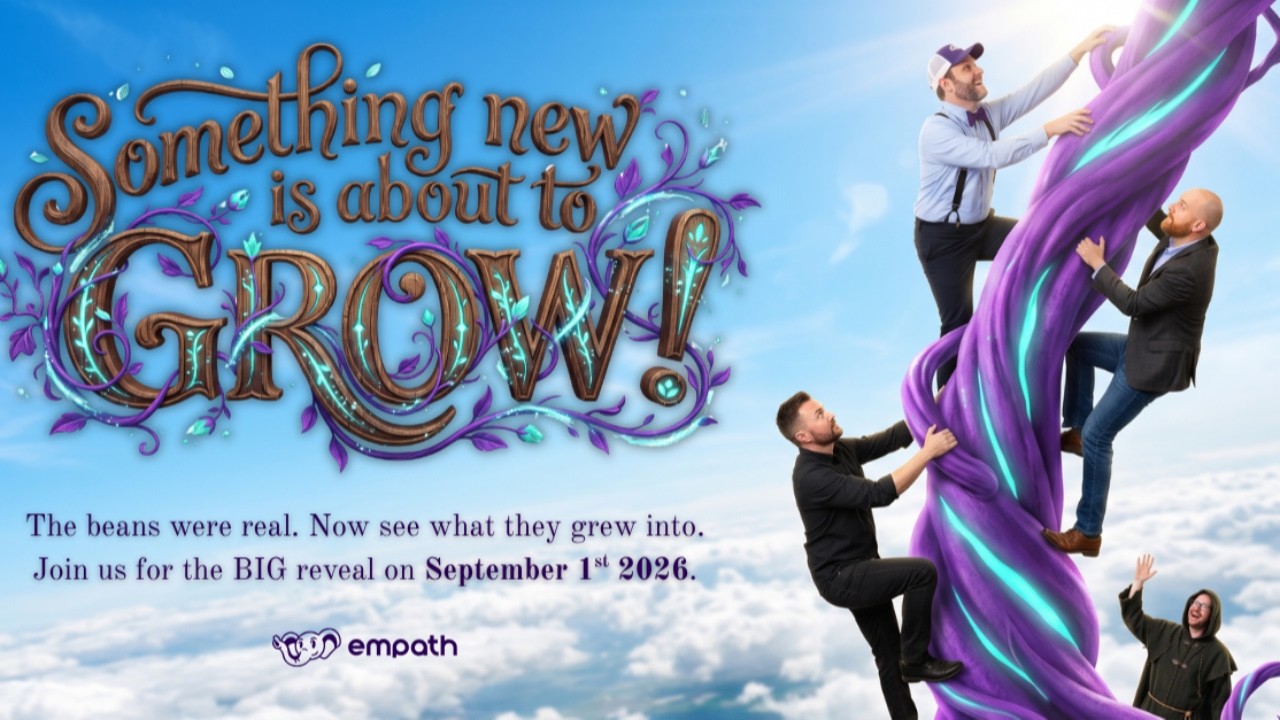
Wes Spencer, Alex, and Kyle introduce Empath Grow, a training add-on for MSPs priced at $1 to $2 per employee seat. It bundles compliance courses and three content libraries to help MSPs close knowledge gaps and create new revenue streams as AI adoption and commoditization pressure their margins.
Chapters
What's going on, my friends? How are y'all doing?
Yo, yo.
I'm good. Are you good?
I am growing with excitement.
Ah, let's see. Cha-cha-cha-cha.
Oh, look at you now.
Oh man, I wanted to have chat in here, but now it like covers Alex's face, but I guess that's okay, right?
Doing weird stuff.
I think there's a way where we can like make it compact.
I'm sure there is. I know I can remove the overlay, but who knows?
That's all right.
We'll just check in on chat as we go. Man, this is a fun day. We've been looking forward for this day for Alex. Alex, I don't know, quite quite a long time.
Quite a long time. Quite a long time. We've got got a lot going on, and it feels good as a company to to be to the point where we get to announce new and exciting stuff. Yes.
Yes, indeed. And we're over here playing with buttons.
Well, yeah, just why we're all quiet. Nerd things. Yeah, you're right. I have a face for radio anyway. It'll be fine.
It's like all software, like you, there's always new updates in SaaS and anything you log into. And now we realized, oh, you can move around the chat feature. That's so nice. So we're both like playing around with that, overriding each other, but it's all good. We're figuring it out. Thanks for joining us today. To the crew, there's a whole bunch of folks on. Go say hi to everyone in chat. Let us know. Ooh, I like that. That, that look looks awesome. Go say hi to us in chat. Let us know where you're connecting in from. We will use chat to answer questions, all that good stuff if you have it. This is a really, really fun day that we have planned today. We're really excited to kind of show you some of the things that we have been building behind the scenes and have tested this with a few MSPs that have been in some early beta with us. And it's going to be really, really great. So maybe, Alex, I'll have you kind of get us off on the playing field a little bit. For anyone that's joining and is not actually familiar with who Empath is today, who the heck are we and what the heck do we do?
Yeah, you know, Empath started kind of 3 unemployed dudes who were trying to figure out what to do with themselves when they grew up, right? I guess 2 unemployed dudes who dragged another guy into unemployment. Wes and I are sitting around trying to figure out what we wanted to do when we grew up, and we realized that both of us really had a passion for teaching MSPs, for helping MSPs, for raising everybody up. And both of our last companies involved a lot of teaching and a lot of coaching. So we decided that we were gonna go build a software platform to help train MSPs and teach MSPs. And then we had the harsh realization that neither one of us was good at operations at all. And so we went and grabbed Kyle and said, hey, somebody's gonna do all the hard work while Wes and I sit on camera and be pretty. And Kyle said, well, I want to do both, so I'll do the ops stuff. And, and so Empath was born. And what it really has turned into is learning management for MSPs. It's a platform where MSPs can train not just their technicians, not just their, their engineering team or, or some of their cybersecurity nerds, but really a place where they can train everyone in the organization. So whether it's a salesperson, whether it's a VCIO, it doesn't matter. We have content for them here in Empath. They can build learning pathways and train and upskill those folks. And we've got folks training everything from, you know, the tier 1 engineer that just started yesterday to the guy who's been around forever, who's transitioning into a VCIO role or an early management role. And it's super exciting. It's been a great journey.
It really has been an awesome and fun journey. Kyle, how about you? Tell us a little bit about your Your growth into empath and where you came from. I'm going to keep using the word grow intentionally here.
Yeah, the growth thing, just, oh man. As long as we don't get into little blue pills, I think we're fine. Or, um, I, I, I mean, I guess, do people not know who I am? Oh, that's kind of ostentatious.
I'm pretty sure they do.
Presumptuous. Um, yeah, uh, it, it really came out of, I guess, one idea that I had back in my MSP was that The hardest thing about getting into a growth cycle— I did it, I did the thing— was it wasn't sales, it wasn't account management. And everyone goes, what are you fucking talking about? It was everyone wanted to stop growing the MSP because we didn't have the people in order to be able to do the things that we were going to sell somebody. So where we got frustrated all the time is, man, recruitment takes too long and we need the perfect people. So The whole idea of Empath really, for me, came out of this. I need to be able to train somebody from zero to accountable as fast as humanly possible, because what I can't do is tell my sales team to stop selling. I can't tell them to, to tell the partner to wait 3 months to be onboarded. We had to have the inventory on the shelf for somebody to buy it. How do we manufacture our help desk technicians, our field technicians, our engineers? So when, after we built that and Cassia Kerr was a fantastic person that helped with all of that, um, I decided to build a consulting firm and that didn't have anything to do with Empath. Uh, but when you want to talk about enablement, like you guys from a software provider had to do a lot of enablement. I had to do a ton of enablement when it came to, you bought a product and then that vendor left you on an island to figure out enablement yourself. So like we built an entire business around enablement. And I think the interesting thing is with this Empath journey, Wes, is that while we've for the most part figured out how to help MSPs enable their employees to do the work for the MSP's customers, it's the customers of the MSP that have started to say, hey, we want to grow. How do we enable our employees to use some of this new stuff that you've been handing us? Because I asked your guy on the help desk how to use Excel and Word and he laughed at me.
Yep. And that's exactly what we're super excited to talk about today is where we are going with the, not just the roadmap of Empath, but some of the new capabilities that we're, we're beginning. And so we're just at the beginning, not the end of this journey. One of the best things about being such a young company that's just, we've just hit our 3rd birthday, is that we have a ton of things that we're going to be able to do and a whole bunch of places that we're gonna be able to to grow into. And so without any further ado, let's talk about some of that. We wanted to introduce to y'all today for the very first time, outside of some of our Insider folks, the introduction of Empath-Gro. I'm gonna— let's go ahead and move our chat window down for now. I don't know if, Kyle, you have the ability, or one of you guys, to kill that out.
I do.
But yes, we did resurrect the, the one and only Steve Jobs to come back and help us co-present this today. And so, Steve, thank you. We'll pour one out for you, my homie. So where did this come from? As Kyle mentioned, we've been talking about how do we help MSPs in their growth journey? How do we slay knowledge gaps? How do we help them standardize towards efficiency, standardize towards best practice? How do we help them get grips around the compliance and certification directions? And we have a lot still to build around that. Keep staying tuned. We've got some neat things in the build. But one of the things that, Alex, I know we heard over and over and over from partners and prospects was this question right here. You think I could like do something like this for my clients too? I think they need this. And Alex, I don't know about you, but that was a bit of a shock to me the first few times we started to hear it. But we're dumb enough to know, even us dumb cavemen know after hearing it 50 times, maybe there's something there.
Well, you know, the concept of building an MSP-specific learning platform was very niche, right? We were building even the training catalog custom for the MSP. So as we built it, we kind of had our blinders on and didn't really see that, hey, teaching someone how to be a VCIO requires building a big fancy platform and all the effort that goes into it. It's not really that much work to hand off the soft skills course to the end customer. It's not that much work to hand off some of the how to write an email to the end customer. It's not that much work to hand off how to learn how to use AI to the random customer, because every one of them wants to grow the same way you want to grow your MSP. And so they have a lot of the same needs. They have the same compliance reporting requirements. So If you've got to take anti-sexual harassment training or any of that kind of stuff, that all lives in their world too. And I think we just entered this very much with our blinders on going, we're going to solve MSP learning. And our customers were the ones who said, hey guys, you've stopped short here. There's a bigger opportunity.
Yep, that's exactly right. And so we've heard it enough and we're like, all right, this sounds like something that we should think about. And so we had a bajillion conversations about what does this look like? Why would we do this? Who would want it? And one of the things that we heard just over Just in the aggregate across lots of conversations with y'all is this: is that let's start with AI. We know that AI is a huge, huge, huge driver. MSPs are figuring out today what do we do with this? How do we talk about it? How do we bring our customers and clients into it? We already have the data that shows they're already using at least Claude or Chat or Copilot as just a basic chatbot, but but they don't know anything more about it, and they they we know that that's a driver. You think about Microsoft, right? I mean, almost every MSP that's out there is a huge Microsoft. And they, we have great investment into the tools. But I mean, Kyle, you know this probably better than anybody, that are we getting the investment out of the tools that we've spent? We've invested in our tech stack, but what about the people stack, right?
Yeah, it's, it's, I mean, you kind of said it. I'll be honest, like, I could try to add to it. But at the end of the day, It's, it's this obsession that the foundation of our problems are the software and not the people driving the software. And if you really think about it, why? Well, because us as technical people rather fix a piece of software or install an endpoint. I mean, the entire genesis of cybersecurity is trying to not fix the people problem. Like, let's, let's be real. Most of the time it's a person trying to do something bad.
Yeah.
Or it is a person uneducated enough that we need to create a bubble around them.
It's being trying to shove the tool between the, the end user and the bad guy, right?
Yeah, exactly. So all I'm trying to say, Wes, is at the end of the day, this is, this is the final frontier because even with AI, and we can get into the AI conversation, there's still gonna have to be a person pushing the buttons or a person in the loop or somebody that is enhanced with AI. We'll get into cybernetics, uh, that, that still is going to have to make a justification, a decision.
Yep, that's exactly right. And think about for yourself as the MSP, like, one of the things I think is important too is every time a ticket comes in, that's like, just to keep picking on Microsoft for a minute, it's like, how do I do this VLOOKUP in Excel? And you're like, that is not my job. Like, I, I very explicitly tell you in my terms of service, I don't provide support to the software. Like, it's not who I am. But every MSP that's out there is like, let's go ahead and answer the question because None of us want to have to deal with this whole, like, all right, you know, now we get combative because they're going to say, what do you mean you don't support what you sold? And so we, we eat our own margins going and figuring out how to do those things and then telling the client is frustrating, right? It's one of those things where it's like this, this happens often. So like, that's yet another use case. And I don't think we'll get— we won't spend too much time on, you know, the cyber aspect of this. One of the things I want to be clear, we're not really a phishing tool. We're not trying to become that. But we do have some cybersecurity awareness and education that's coming in, and that is valuable. And if you have clients that need that and don't need phishing, that might be something you look at. Same thing with where cyber insurance is going. That's starting— what does your training regimens look like? How do you know everyone's moving the right direction? And I think you, Alex, we could even get into all the compliancy kind of stuff like anti-sexual harassment training and workplace, you know, violence and all these kinds of things that need to be taught by many industries, maybe even OSHA. I mean, the list can get really long when you write, you really start to consider what all a client actually needs, not just to be functioning at their job, but even to meet some of the floor threshold requirements by their industry or partners that they work with, right?
Yeah, there's a lot of just getting started requirements for most businesses. And I think we've all learned a lot along this journey, right? When we went to a copier company and they said, I have to have OSHA training. And we went, what do you mean you gotta have OSHA training? And they went, well, you know, we fill ink, you know, we fill toners in the back and we handle all this stuff that is super And so we gotta teach people how to lift things and we gotta teach people not to treat, mishandle the toner 'cause it's apparently poisonous or whatever. You know, all of these things are things you don't think about when you spend half of your career teaching people how to VCIO better. And so what an eye-opener for our partners to come to us and say, no, I need to teach way more than just the things that you guys are talking about.
Yep, that's exactly right. So Kyle, I'd love for you just to spend a few minutes with AI Kyle here too and tell us not just about how great your jazz hands are, But I think you have a better pulse on this than anyone I know in the industry about like times are changing for MSPs, right? And what used to be true is not necessarily true anymore and there's opportunity in the wings.
Yeah, and sorry, I'm a little distracted when we change the owner of the LinkedIn event. We have a bunch of people hanging out in the old link right now. So they've been messaging me saying, Kyle, where's that event for Empath Grow that's on LinkedIn? So we'll get that inundated. So if you've joined the new chat, hey, sorry about that. Wes pushed some buttons. What was the question?
The question was, on top of the jazz hands, yeah, can you, can you give us a few more jazz hands? But also, yeah, just tell us how the MSP world is changing underneath us.
It is. And when we look at all the things that have predicated us and what we've been doing over the last 10, 15 years, like, let's go back to Alex when we bought LabTech back in And I mean, you'd '08, me 2011. Like, it was the whole genesis of let's start doing this automation thing. Let's start making managing workstations easier. Well, it wasn't just MSPs doing that. It was software companies doing this. It was big vendors and line-of-business apps doing this. Everyone went to cloud around 2012 and 2013. 365 happened, and Chromebooks and iPads started to create a revolution And you see a lot of these businesses that have started to come out where it's like I was talking to a marketing agency the other day where it's 25 employees and they're all cloud apps and they're all Macs or iPad driven. So you're getting to a world to where our relevance as MSPs is no longer really the IT function because shit doesn't break as much as it used to. And then you look at the consolidation efforts that have happened in the MSP channel, the M&A, where Yes, commoditization of MSP services is happening, and that's exactly what happened to our friends over in finance. You can get bookkeeping for $200 a month, $100 a month. Sure, you can probably find someone for $50 a month. That's what's happening to our IT business. But that doesn't mean that our customers, one, either don't want some type of protection and risk analysis and risk mitigation, cybersecurity, but what they also want is, hey, This technology should be enhancing my business with these line of business apps. It should be creating efficiencies. It should be allowing my sales team to sell faster, my service teams to service faster. There is a request that the technology now needs to be enabled to actually have a place and purpose in the supply chain of your customers. Well, they're all getting FOMO right now because the biggest thing is in the first time in the last 20 years, and Alex, I'll give you credit for using this terminology, there is a pull motion that is happening on MSPs where our customers are asking us for something in technology. They're not being pushed on us like we've done the last 15, 20 years. And as MSPs, we've been so ingrained in trying to find a way to force things on our customers because we know that they won't say yes to that MDR endpoint or that security awareness training. So we don't know how to handle the customer raising their hand and saying, I want this AI thing that I saw on the Super Bowl commercial. I want this AI thing that my, my buddy across the street is building out and is lowering his prices with. So we're in this weird world right now, whereas MSPs, we either are going to be the no, don't do that, do all the cybersecurity thing. And I'm going to be the purveyor of you not buying the thing that you want to buy.
Right.
Or we need to create a journey with them of like, hey, we have an easy thing for people just to start being creative and trying things in a safe place, a sandbox. But while we do that and you have this creativity, let's use that as fuel to figure out where to apply these things that you might have purchased without a rhyme or reason.
Well, you know, we always hear about MSP 2.0, MSP 3.0, the industry's changed forever. It's going to be a new thing next week, next month, next year. And I think our industry is more of a conveyor belt where it's just always in motion, and that conveyor belt might feel like it's sped up or slowed down, but it's always moving. And I think to your point, Kyle, as you said, you know, it kind of feels like help desk is becoming commoditized, or some of the traditional managed services are becoming commoditized. I don't think that means that our business has become commoditized. I think it means that the value we deliver. Got moved, and we have to be agile enough to understand we can still deliver a ton of value to a customer. And when I say value, I mean you can make money at it. But we're going to do that differently today than we did in 2008 when we bought LabTech and rolled out remote access so we didn't have to drive around the whole state to go visit every one of our customers.
Well, we have to prove our new value, and it's this whole you know I think back Alex in the days of people with. When managed service came out, they were like, oh, our revenues are gonna decrease when we go to all-you-can-eat, because now they're not going to have to pay when I spend 2 hours beating my head against the wall fixing the printer. Well, we're, we're in the same exact place where we fear AI because we think it's gonna make our recurring revenue irrelevant and that it's going to make it decrease. But it's just the next evolution to where, yeah, we're still gonna do it, and yeah, we might charge less for it. However, what is that next form of productization to where now we still can be a successful business in the technology space that, that just meets the current market demand? And that is key to where I think MSPs get so missed is they don't know how to shut up and listen to what the market wants.
Yep. So we have been spending time trying our best to shut up and listen to y'all. To really have a better understanding of this. And Brian Weiss, thanks for checking in. Yeah, yeah, he said, I had the same conversation, Alex, at ChannelCon. For sure, this is, this is a real, real thing. And so what we're really focusing on with Empath-Grow, and we're getting ready to show it to you, is helping you in the journey of helping your clients around not just education, but learning and growth for the organization, slaying knowledge gaps, being able to bring tools into their, their arsenal, or maybe the tools that they already have, and helping them invest and use them correctly. And so— What we really are not needing What we're needing today is yet another tool. We don't need yet another, here's another thing to throw on top of the client that I can try to charge them for. They get really weary of that. What they really need is, how do we make sure that our people are up to speed in all of the things that are happening in the world around them? And that is critically important. I just did a podcast with a partner of ours yesterday, and we talked about that with their clients, of how much their clients feel this burden of, man, we look at this world today, And compared to like 2022, 2023, we feel like it— this is crazy what's happened in the world around us. It is moving light speed. And so we agree with that. And so what we want to do today is show you how you can start to use, how you can start to use Empath-Gro. And so what I'm going to do, I'm gonna go and share my screen out again. I'm going to switch views here and bear with me. Let's see, replace. Window. There we go.
All right.
So I'm gonna give you a peek at what this is really all about. So I'm logged into Empath. If you've never seen Empath, we are, as we mentioned before, a learning and growth company for MSPs to help you standardize your knowledge. So we have all kinds of things like courses galore of all kinds. We have soft skill, we have hard skill, we have stuff around AI, we have stuff around vendor courses. Here's some from our friends from Roost is a good example. All kinds of things that exist along with learning pathways for your people that align to towards Microsoft certs and role-based things, all of that, right? But what we've talked about over and over and we've heard from y'all over and over is how do we get this down to our clients? Obviously, they don't need Josh Hobine telling them what a real security assessment looks like. They need courses that are related to them. And so I'm gonna show you how this works. I'm gonna go over to admin. Anyone in Empath that is using Empath today is going to have this access that is a manager role inside of Empath is gonna have access to this admin tool. So if you're logged in to go see this and it doesn't show up, that's probably why you're not listed as as an admin. And what you'll do is you're going to come over here to Empath Grow. And what's so nice about this is like the easiest thing in the world to show. I'm going to go ahead and show the, like what the flow looks like, because I've already clicked through my onboarding on this. But this is what it'll look like for you. And you do see the base pricing starts at $2 a seat. More on that in a minute. We are really excited about what the pricing looks like here. And Alex will talk a lot more about that in a minute. But it's based in price, just like what you'd You're gonna, you're gonna base it towards the number of people that you're going to onboard. When we hit Enable, there are going to be 2 different versions of Empath Grow. We'll talk more about this in just a minute. But basically, we have the full version of Grow, which allows for you to have content for your clients. It allows you to upload your own. And it also gives your own, your own clients the ability for them to add their own stuff. So if they have some of their own things they want to build, it can be a learning management system for them as well. So you kind of have this co-managed, co- control. If you have clients that are like, no, no, no, they don't need any of that. I'm going to give them what they need. They're primarily just needing to consume training and learning and growth. Well, then that's where Grow Lite would come from. And so that starts at $1. We'll get more into that in a minute. So it's really simple. Then you see down here, these catalogs, we're going to talk more about this in a minute too. But we are embedding and bringing in all kinds of catalogs left and right. The 3 that we have at release are Bigger Brains. We're huge fans of what those awesome folks are doing. We'll show you some of that in a minute.
Cliq Training, they're really awesome as well.
And then Inspired eLearning, which is a bit more of a complex catalog. It's really more focused for regulated kinds of things and stuff like that. And so, so I think before we go too deep into this, let me just kind of show you what some of this looks like. So you kind of see how it is, how easy it is to roll it out. And what you're gonna do, let me exit out of the preview. It's really simple to get your clients rolled into this. You're gonna hit Add Client. You'll fill out the basic details, who they are, Right here is where you can add your own content. So I just have filler stuff like the CCNA thing. But imagine this were a course that you've built around, hey, here's how to submit a ticket with us, your MSP. I mean, wouldn't that be awesome for you to be able to have? You're teaching your clients how to work with you. Maybe you have a course around, hey, if you suspect a cyber incident, here's the things you should do. But we also have some MSPs we've talked to that are like, they're literally helping their their clients build some of the things that they need around, like, let's say you're a dentist office and you're literally working with the clients to say, hey, when you hire new people, what are the things you need them to know? Not just HIPAA, but how to greet a client when they walk in for the first time, what the experience should look like. Maybe you're teaching things in care. Here's how to use this Dentrix system you've invested in. The things Kyle was mentioning of like the ebb and flow of where an MSP is going is changing. And so you have the ability to bring some of your own content in to really customize all of this as we kind of move forward. Kyle and Alex, what have I, what am I missing so far? Before we kind of give a tour, I'll let Alex share his screen in a second and share what the experience of the client looks like. But what I wanted to show you, it's very simple to get your folks rolled into this. It's very simple to be able to set up your account, set up their accounts, all of that inside of Empath. Anything I'm missing, Alex and Kyle, so far?
No, I don't think so. I think, I think that covers it. Sweet!
Right. I will say there is one thing that was asked in chat. Matt Yordy asked, what is the base price for all of you for this? He asked before you showed the pricing, Wes. I assume we would have to add Empath Original to get this add-on.
That is a great question. So the— you must have an Empath seat to administer Grow with your customers, but you don't have to buy an Empath seat for every one of your customers. So you read that right. Empath Grow starts super, super, super cheap with the expectation that the MSP is gonna make a nice healthy chunk of margin on, on the middle here. And that's really the goal and that's really the design.
Yep. That's a great question. Yeah. So reach out to us and we can walk you through all of that. Happy to kinda give you a peek at it. Any other questions? If not, then Alex, I'm gonna have you kinda show what the end user experience is to, to Grow.
All right, now I have to figure out how to operate this thing. Let's go. Uh-oh, I have to open system settings to allow myself to share. Oh joy, I might be coming back, guys, who knows.
Um, I think I've got a login as well I can, I can switch over to.
Give me a second.
This is where, um, Alex or Kyle does his jazz hands for us, right? Yeah, I think I've got it up. Let me share. Place window and this guy right here. Do you want to talk through it or do you want me to? Yeah, sure.
I mean, there's, there's not a ton to talk through. I had 2 accounts set up so that I could log in and let folks actually see the approval process and how somebody requests content and that kind of thing. But we'll go ahead and share your screen and we'll, we'll just wander through it and kind of explain to folks Thought it was sharing.
There we go.
Oh, and your account actually is an admin there. So you've got some, you know, some content here to look at. So here's the Empath catalog, right? This is, this is what they're going to see. We have Bigger Brains assigned to this tenant. So if your customer logs in with Bigger Brains, if you assign them Bigger Brains and log in, this is what they will see. Wes is an admin here, so he can both assign this content to someone else. Or he can watch it. So Wes, if you click into any one of those courses, we'll kind of go see what exactly it feels like. And you see here he's got an Assign Course button. If he was not an admin, what he would have there is a button that says Request Access. What does it say? Yeah, Request Access. And when he presses Request Access, if I press Request Access, that little bell up at the top right will go off. Wes will get a little, hey, go view that course, go enable it and assign it to this person. Like, hey, Alex has asked to take some training. He found something he really he wants to do. He wants to go better himself and take his CompTIA Network+. That sounds like an amazing thing to go ask to do. And now Wes can assign that content to me. That sounds miserable. But yeah, don't make the sales guy take Net+. But, but the— this is the process, right, for going through and assign it. I can assign it to one person or multiple people. This gives me the ability to, to kind of build it out. And then you see here, you can see who's been assigned to this It's designed to be super easy, guys. If you ever had access inside of a learning management system, they're not always friendly. They're not always designed to be, to be super straightforward. You'll see some simple filters on the left, exactly what you're used to from seeing YouTube or Netflix or any of the streaming services that your end customers are already using, because the goal for Empath is that your folks can get in here and use it, that it's super easy, and the lift is light and easy for you. We want to be the folks who give you another product on your line card that doesn't create a bunch of work for you to go support that product. The same way we're getting it to you cheap, we're hoping that you get it back out to your customer cheap enough that it's a no-brainer for every single one of them.
And what's, I think, so great about this too, Alex, is that it gives the capability to open up conversations, right? Imagine that you're thinking through, I don't know, let's just pick something, Sales 101, right? And maybe you watch this ahead of time before you give it to the client. And then you say, hey, when we get in, like, let's talk about some sales strategy stuff. Let's talk about what's working and what's not working with you. And, you know, maybe there's some areas around tech alignment that we can, we can help you on, that we can, once we know your processes and whatever. So what's really great about this is, don't look at this as like, I'm just throwing training at them and demand that they go take it. It really should be used in ways that can become a wedge that allow you to have better conversations, especially when it comes to AI is a great example of that, making sure that they build their knowledge and skill set up, they also have the ability to, um, you have the ability to come in and talk to a more educated client about, um, whatever, whatever it is that they've been learning.
Completely. And I think it changes the conversation a little bit, Wes, as well, even on the help desk, because for years we have, you know, relegated that the help desk is for when things don't work. So when you get that phone call from that brand new person, their first experience with the MSP, when they get their new shiny laptop is, hey, my boss said to use this Excel thing and it's not working. And then the help desk guy normally went, ew, it's because you don't know how to use Excel. I can't help you with this closed ticket. Well, if they have now access, what a better experience of like, hey, Excel's complicated. There's a lot of things you can do with it. Let me go ahead and assign you some Excel courses so that now you're in a position to learn at the pace that you can and just go from there.
Yep.
So bunch of questions coming in. Let's go ahead and take some of these. Mr. Yordy the Illustrious asked a great question. I gotta scroll back down to it again. Is there a place to see the catalog of all the courses that are available? Yes. If you'll reach out to us, Matt, just sales@empathmsp.com, we'll get you a copy of the catalogs that we have. But this kind of gets into a bigger discussion, I think, Kyle, that we should probably talk about is that Those we're releasing with 3 catalogs: Inspired eLearning, which is very much focused on your, like, your more compliance-required kinds of things. Like, I need state-mandated, lawyer-approved anti-sexual harassment training in Illinois. Cool. We got that, right? But then you also have Clip Training, which is really, is heavy in the Microsoft world, is really where their kind of moat is. And you have BiggerBrains that has a lot of everything. But, but, Kyle, there's a lot more in the works. You want to tease just a little bit about some of the stuff you've got going on? I know we can't share everything, but there's some really cool things that are about to happen with this too from a content perspective.
Yeah, for both our MSP partners and for your customers. So I guess I can't officially announce it, but coming October, we will be importing a metric— I'm just gonna say it the way I want to say it— a metric fuckton of content that will come. And Alex, do not beat me to death For just making this promise right now to all of our current subscribers at not an additional fee. And it's all of the courses everyone's wanted years for us to have. Now, you made an interesting comment, Wes, because there is compliance, but it's not the security compliance. You mentioned sexual harassment. We've talked about security awareness, but a lot of MSPs have verticals in manufacturing, in chemicals, in Finance, in all healthcare, where they have mandates for training for their compliance industry. Well, we're going to be having all of those come into the platform pretty shortly along. So when you have those partners, right, we talked about supply chain, the MSP helping the supply chain of your customer. Well, if I don't have OSHA training, then I can't get my employees to work in the warehouse. If I don't do forklift training, they can't operate a forklift. So what better way to start engaging with your customers for something that they must buy? This isn't IT where it's a, you kind of need to buy it. Like, no, you cannot drive a forklift in a warehouse unless you haven't taken the training, period. You can't even get insurance. And it's the real insurance. It's not the cybersecurity insurance. Oops, I said the word. But anywho, I'm passionate about it because this is now a stream of revenue and a relationship with you as an MSP to your customers that we've never had before. Now the stickiness goes, hey, not only do I provide this, not only do I provide that, but our tools actually allow you to hire and place faster. We have some other stuff in the works as well, like with some really upskilled sales training, account management training for your customers beyond just the BiggerBrands catalogs. But I think what everyone's going to see from us us, Wes, is that, um, we are content creator agnostic. And that was always the big vision for us, is at the end of the day, there's something that someone always needs. And the last thing we want you to have to do is to log into 14 different training portals.
Yep, it's exactly right. And it's, it's frustrating for that, right? It's just, it's not tenable. Um, so yeah, so that's, that's well said. So stay tuned. We have a significant amount of new and very exciting content on the way. And what I get so excited about is, we just literally talked to an MSP about this the other, just an hour ago, of like, we also have tons of content coming out that might surprise you around topics that you're like, wow, that is actually really relevant to us. Not just like a lightweight sales course, but what about some really in-depth stuff? You name it, there's quite a bit more. So yeah, so these are some of the use cases just quickly. that really this should be geared towards. It's not just like, oh, I'm gonna force someone to do training, but really giving them cohesive opportunity as an MSP to have better conversations, to reduce support burden, to open up more conversations, all of that. And so that's really what this is all about. I'm not gonna spend too much time on this slide, but what we wanna do is we talk to MSPs all the time like, look, man, I would love to be able to talk to my folks about AI. I just don't know how to get into the conversation. I realize some listening today are really great at that. This becomes a great leave behind. It also becomes a wedge that you can open up with to say, hey, now that we've done this AI workshop with you, we have some leave-behind training. Or maybe you lead with the training, and then you come in with a workshop later. Making sure that we can help them fix issues way before they happen, meaning if you have better tool knowledge, and you might require that. We have some MSPs that are starting to say, we're going to enforce a minimum set of training for our, the clients of our, or the employees of our clients, to make sure that they have the quality set. And you can convince the owner on that to say, do you really want them to submit a ticket to us, have to wait in their workday until they get an answer back from us and all this kind of stuff? It's better for us to enforce the minimum standards everywhere. And that becomes something that's an efficiency gain for you as the MSP, but certainly for the client as well. And same with these basic questions, talking about how to work with us. And so what this really becomes is these things over here, right? How do we train our folks? How do we get a better adoption? How do we start to have better conversations and QBRs? All of these kinds of things. And so I'm gonna skip by this because we kind of already talked about it. And Alex, I'm gonna flip it over to you and kind of how pricing works for Grow, how to start thinking about this as an MSP. Take it away.
Yep. So as we said earlier, you do have to have an Empath, a traditional Empath, we were now calling traditional Empath a Learn license. You have to have an Empath Learn license in order to administer your Grow licenses. But what you're gonna see is a couple of different types of Empath licensing coming forward. So you'll have that Grow Lite license and then the Grow LMS license. Both of those require a minimum quantity purchase of 100, so you're looking at $1 apiece or $2 apiece. The big difference in features between those— and Wes, I think that's the thing you kind of skipped over on that last screen— big difference in features in those is that $1 Lite seat is just for content consumption. So if they want to be able to assign content within the organization, if they want to be able to get reporting on their team's progress, if they want to be able to build their own content, they're gonna behave like a real true LMS, you're gonna pay $2 for that seat. To give you an idea where that sits in the market, you know, the customer's got to be 100, 200, 300 seats before they can even get down to $3, $4, $5, $6 a seat for an LMS other places. So we're giving this to you cheap enough, there's a lot of room for you to make money at it. And once you put a catalog of content behind it, you get in a really, really good spot where you can make good margins. This— and that's what we're gonna jump into on the next couple of slides. So $1 for the cheap seat, $2 for the full-featured seat. These are designed for you to really be able to mark them up. You can see we have MSRP on those somewhere between $3 and $4 and $6 and $8. The market is kind of testing this right now with some of our beta partners. Most of them have told us that we priced this too cheap, that they can get significantly more than this if they're able to curate the experience and give the folks exactly the right kind thing. And yes, you can mix and match. You just have to have a minimum 100 licenses there. Bigger Brains, they are a fantastic company to work with. I can't say enough wonderful things. They do not put any minimum on the quantity of licenses that you, that you order from them. And those are only 36 cents apiece to you. So for $1.36, I can get a really entry-level LMS that I can go out and sell to my customer for $4 to $5. And that math problem we'll get into in a second gets really, really, really fun for you guys. Um, Inspired eLearning, that is a little bit more complicated catalog. That one is the one that has 50-state compliant, um, you know, anti-sexual harassment and workforce violent content, some of the stuff that's really significantly mandated. It is security awareness. What's that?
And security awareness.
And security awareness. It is the content that is held to a higher level. Um, it's got to be constantly updated, so they charge a little more for this catalog. Catalog. It's actually fewer courses, but they charge a little more for it. You will know the customer who needs this. Um, you know, this is not the thing that you're just going to go buy for every customer, but you'll know the customers you need this for. You'll be able to add this and you'll be able to double the price of it, uh, when you go to sell it to your customer. So more money to be made there. And then of course Clip Training. Um, Clip Training has a great catalog. They'll have a lot of things similar to Bigger Brains. Uh, there's going to be a little bit of, hey, we just like the standard, or we just like the, the delivery, or we just like the way that one these catalogs comes at us better than others, give you the ability to switch back and forth a little bit. You do have a 100-license minimum on the CLIP training commitment. They do require that minimum. That is theirs. And it just kind of gets passed through to us. So, well, on the other hand— oh, go ahead.
What I was gonna say, Alex, is the cool thing about this is, and we've learned this at Empath as well, by the way. So this is something we have learned for you all is sometimes you like Coke or you like Pepsi, and you may give one customer click training and they love it. You may give it to another partner and they go, um, I don't know about that. And you can now swap it for bigger brains so that now you're not having to throw away the entire platform or product. You just go in there, click a couple buttons, and now your, your customer's experience is, hey, they found the content that I needed and they gave me Some variety or options.
Yep. And to answer Bob's question in chat, you do get to, you do get to pay for this monthly the same way your customers are used to paying for your services, even though there's an annual commit. So we do ask a 1-year commit on the Grow licenses, and CLIP training, you know, requires 100 licenses for the minimum commit. So just understand, you know, this is a thing that it's gonna take you a little bit of time to get out the door. It's gonna, it's gonna be something that your customer takes time to adopt. You're going to work this into your processes with them. But imagine a world where for $3, you can go deliver how to enable my customer with AI training that you can actually put in front of them that prepares them for the conversation that you guys are about to have. That's what we're setting you up for. Instead of going in and talking to your customer about LLMs and agents and agentic workflows, give them the training that helps them understand what the fancy nerd words are that you're using, because the first time ever will now walk in the room and will be speaking the same language as our customer. I think that's super, super, super important. So I built a couple of examples for you here because I think the numbers really start to compound faster than you think. I don't know when the last time I was as a vendor or as an MSP that I felt like I was gonna go buy a product and make money at it almost immediately. So what I've taken is kind of the average MSP. The average MSP is probably closer to 1,500 users by now, but if you've got 1,000 seats at your MSP, You, you sell, you buy 1,000 Grow Lite licenses, just some really basic Bigger Brains training. I'm gonna build a little bit of AI content for my customers and get it out in front of them. I'm gonna pluck it from the Bigger Brains catalog, put it in the right order, and hand it over to my customers. Those 1,000 licenses cost me $1,000 a month. 1,000 Bigger Brains licenses cost me only $360 a month. So I'm into this for $1,300 a month on the cheap side. I'm gonna go sell that for $4. $4 per user bundled, $4,000 a month to all my customers. My margin on that is $2,600. And if I take that out across an entire year, that is $31,680 a year in profit margin. Kyle's gonna love that because that's a huge impact on an MSP that's doing a million dollars or just over a million dollars in business, right? This is 2 or 3 points, 1 or 2 points of EBITDA that we can add here. And every dollar you increase your sell price price adds $12,000 in annual margin across 1,000 licenses. That's freaking huge. If I can go sell this for $5 instead of $4, I just made $44,000 or $43,000 and some change. This is a thing that can really improve your margin.
So here's a fun math problem for you, Alex, and I love that you did math. So that gave me permission to do math. The average MSP customer is about $2,000 revenue of recurring revenue. We are now going to find a way to hand you $2,600 of recurring profit.
It's like a new customer. Literally.
Yeah, it's a new customer that with— and no hard cost, no endpoints.
Yeah.
So like, it is a very— and it's a simple motion. And it's one of those motions that's so different because before it was, I need to put this endpoint point the security thing into your stack, which means you're gonna pay me more revenue. And the customer's like, great, something that I can't use, touch, feel, or even know that it's existing. This is something that you're actually gonna hand them to log into and get something out of.
Yeah.
And it has no hard— no real cost maintenance in it.
Yep. Yep. Now let's, let's say you're here and you're listening and you're like, I'm not the average MSP. I'm just getting I'm not ready to buy 1,000 seats of anything. Those are big numbers. I'm just not there yet. Let's fast forward to the next slide because there's another pricing slide there we should go over.
There we go.
The next slide assumes you only have 200 customers. Okay, with 200 end users, I'm gonna go out and roll out 200 seats of Empath. I assume that you've got this, you're maybe, or maybe you're just rolling this out to your one biggest customer. We've added full Grow licenses. So these are the big boy licenses. They're going to be $2 apiece because we're going to sit down, our customer is going to create some content, we're going to allow them to assign it and manage it a little bit. They're a little more mature customer and they want to actually use this thing. We can sell that for $400, or your cost on that's about $400 a month. Um, the Bigger Brains licensing, if we add that to it, $72. Darn near free. We're just gonna throw that in. And then they need this compliance-inspired e-learning stuff. We're going to add at 200 seats, that's $320 in cost to me. That'll bundle, cost you $792 across 200 customers, less than $2 a user, right? Did I do that math right? No, less than $4 each. You should be able to sell that for $1,800 to $2,000 a month. This literally puts you in a world where you're making $800 a month per user— I'm sorry, you're making $800 a month per month in— or $1,200 a month in margin on $800 a month in cost. That's it. The math is hard. See, Kyle, I don't really do math. Assuming these seats are right and that I updated the math, that's about $1,600 a year in MRR, about $10K a year in new margin. I don't know about you guys, that's a nice car payment if I'm a small business just getting started and, you know, I'm only supporting a few hundred users. At this size, I even think there's a world where you go into your empath subscription You go search Becky from Huntress. Becky has a great course where she talks about opt-out or opt-in— yeah, opt-out selling. And they teach folks to sell Huntress with an opt-out approach. You could literally go to your customers and say, hey, here's an opt-out approach. I'm gonna go ahead and sell you this training. You know, it's gonna be $6 a user, it's gonna be $8 a user, whatever. I'm just gonna add it to your bill unless you come back to me and opt out of it within 45 days. Very easy for you to do. They say the opt-out rate is very, very small, you know, in the single digits of percentages. I haven't ever run that campaign, but it sounds like a brilliant way to do it. I wish I had done it when I was an MSP, but I didn't know Becky then, so I didn't have that little trick. If you haven't watched that course in Empath, Becky Teal from Huntress teaches it. It is really short. It's 15 minutes. It will change the way you take some of these products and services to market.
Yeah, well said. Great question from Brian, and it's, I think, a really important one, right? So it Math checks out. That all makes sense. I understand. But let's talk about, you know, one of these challenges of how do we get the employee to actually do the training? I know, Kyle, you've got a bat that's handy. But outside of the assignment of the— here he goes— the bat, how do we, how do we get that traction to where the client is actually saying, yeah, no, this makes sense. I'm using it. I'm liking it. What would you say?
Yeah, so ignoring the gag, Um, it's— I, and I put in the comment to Brian because it's a fantastic question of there isn't a it depends here because there's going to be 2 levels of training. There's going to be the compliance stuff. They have to have the forklift certification. So that one is going to be where you as an MSP need to help facilitate how do we build a learning pathway with some courses that an employee needs to take on day one. In order to drive the forklift. Your customer will never push back on that because they need that employee in the forklift. They need that employee being able to access their CRM with write access on the admin's page. Like, there's going to be a level of consulting— I know that's the gross term— that you're going to have to do to enhance that. On the other side of the fence, though, it's the supply chain thing. And what's interesting about this is if we think about this this term that Alex helped add fuel to the fire over the last few years, this VCIO thing. VCIOs for so long have been doing the hand slapping if you didn't do— your users are clicking stupid emails, or your users are opening too many tickets, or, oh, your warranties are up and you need to buy more. Well, what a perfect way to try to help a customer With their needs to enhance their business to say, hey, here's the training we have assigned to your employees because you told me that they needed to adopt AI because it was built into your CRM and no one is taking it, Mr. Customer. You now have something to create a conversation around and maybe not just in the audit side, but on the curiosity side. Hey, Mr. Customer, you mentioned you needed X, Y, or Z happen. Would you like us to create a ticket to go assign that training to your team and review it with you in 60 days, aka the next QBR that you've been complaining that they won't agree to go ahead and schedule?
Yeah. And, you know, the whole time, the best and most successful VCIOs have been the ones who came in, sat down in the room and said, let me take you on a journey. And that is not changing. In fact, that is the relationship. That is the thing that allows a true VCIO to work with a customer at a strategic level. We've got to get in and understand how their business works. I would argue that if you can get one person in most of your customers, those, those 6 to 10 person companies that you work with, 10 to 20 person companies you work with, if you can identify one person who's really eating all this up around AI and kind of bubble them to the top in their organization and show them off and help them understand what it looks like to have someone start to take AI as a specialization inside of the organization, And you're going to be calling somebody out just through— just by putting out the training that allowed them to self-identify. You're going to get to call that person out and make them look like a rock star. Nobody will care about— for that 10-person organization paying $60 a month for training if they're getting functionality out of AI, if they're getting real things out of the— oh, Kyle's got one.
Well, I wanted to share what one of our early beta testers has built together.
Yep.
And this goes into Brian's question where maybe we understand the cost and the price of Empath Grow. It's cheap. It gets a lot of margin. But what's the one thing we've struggled for years to monetize? VCIO. We've been giving it away. Alex, if you haven't watched the podcast that we've done with Chris Day, we've done a 2-parter on VCIO. Fractional CIO is coming, and it's gonna have to be something that you sell as a consultant. I don't want to get too deep into that, but with the partner that we have that is bundling Empath Grow, they're doing it with a couple hours of VCIO every single month, so that now VCIO has a purpose. This is an engagement where we're gonna go in, we're gonna think tank, we're gonna do in-person training, we are going to build committees in your company to figure out where AI can be placed and where they have some constraints that they need to eliminate. And part of that is when we leave, we're going to assign some training so that next time we can enhance the next conversation. So I don't have to teach you a bunch of these other things. You learned it inside of bigger brains. And what's cool about how they're packaging it, Alex, is I think it's like a flat fee where it's like $500, $600 a month and that includes 20 seats of Empath Grow. But it also includes those 2 hours where I'm going to be in your office every single month and we're going to do X, Y, or Z.
And the statement that they made, what did he say? The retention rate for clients who are paying for that package is 90-some percent. I forget what the number was. It was absolutely insane. The retention rate for customers who are paying you extra to come in and be strategic with them is through the roof. I think that is something that, um, that, that we don't believe is possible as MSPs. We live in our own, our own uncertainty and fear and maybe some of our own FUD. Um, but this is the first time that we don't have to, to, to use FUD. Somebody made the comment to me that AI is creating FOMO, and FOMO is greater than FUD. And even when we tried not to with security, we were selling with FUD. Was it you that said that? Yeah, that's Fantastic. I talked to you too much. I couldn't even remember who said it. But, you know, the idea that now we can go to our customer and enlighten them on and help them with something that they have FOMO on already, man, that is the thing that got me excited about this sell-through product. It's the thing that got me jazzed up to help MSPs with it. And the other thing I want you to think about is once you have training like the BiggerBrands catalog or some of our catalog content or any of the other catalog content, We also start to get into a repeatable motion. The hard thing about developing a new product or putting a new product out there or doing an AI project for one customer is that the first time you do it, it's hard. But if I'm running to Kyle's point, if I'm running that AI user group inside the organization, if we have a committee that's trying to push AI forward and I'm doing the same thing with ten customers at the same time, man, the tenth one is easy. The first one's a little bit of a struggle and we learn a little something, but it's okay. We're coming back next month and we can talk about the stuff we learned doing it. So there's a huge opportunity for us to really move the needle with our customers, not just on a couple of bucks of revenue, but on the ability to present ourselves as a real value add that was kind of missing before. Wes, I'll let you take this back to how we can help.
Yeah, well, just to close the loop on that, what you just said is absolutely critical because if we don't do that, we're gonna get left behind. We've been asking the MSP space forever, how do we differentiate? How do we stop the ankle biters? You know, and these are your answers. You just heard these are the answers. So buckle up. This is an exciting new world that we're getting into. By the way, if you want to know more and you want to see more right here, this QR code, Grow Your MSP, scan that guy and it'll take you right over to us so we can start that conversation. Just quickly, one of the things we want to let you know, we are not leaving you in the lurch. You will not be starting this without help. We have a ton of things that we have available for you as any good vendor ought to. Positioning guides that can really start. How do we, how do we, how do we frame this correctly? All the good questions, especially the one that Brian asked. What are some talking points around this? How do I answer some of those questions? And, you know, sometimes I may get into objections like, I don't want to do this learning thing. I've never needed this before. We have things that will help you with this. Not just pricing guidance, but we're here. I think these are the 2 big ones: launch support and the enablement calls. These are big. And the reason that they're big is what we are going to do is meet with you. So we have recurring meetings where you can come and join. Alex and I sit on those. Some others from Empath sit on those and we'll answer your questions. We'll help you along as you get this going. I don't think it takes a lot. The early partners we've had to start get this going, like one meeting, they're like, yeah, cool. Nope, this makes sense. I get it. And then we start to see them roll out. So it really is pretty easy to do. And we are all about early feedback loop. So if you have questions, you have, you know, thoughts, you have better feature ideas, whatever, let us know. We're happy to get it over to you. So if you want to get started, a couple easy ways you can do that. One is scan that QR that's either on the slides or this one right here. And we would love to get that conversation going. Or just if you have a deeper question and just want to ask us, just sales@empathmsp.com, reach out. Alex and team are monitoring that and happy to answer any questions you want. We're happy to give you a demo, walk you through it.
If you think it's a terrible idea and you don't want anything to do with it, my email is kyle@empathmsp.com. Send, send all your hate mail there. Exactly.
That's what I always do. I thought someone actually did read it. It's good to know. Yeah. And then September 10th, coming up in just a few days, we would love to meet with you again. you will see a, just an update on some of the new things that we have rolling in. And just a good touchpoint to answer questions that you may have around what we're doing and what we are building. What'd I miss? Anyone in the comments have a question that we can answer that we haven't already? Looking through to see. I love whoever the— I just see it as a LinkedIn user, but it's time to take on a Sherpa mindset. And take our customers on the journey. Ah, that was you.
Okay.
Yeah, sorry, never mind. It's not smart anymore. I don't like it.
Not smart anymore. It's a terrible idea. I don't know why mine does that for everybody's live streams, but, uh, it shows up on my screen. Yeah, security.
Uh, Mike Riggs is asking, who is Kyle again?
A face only a mother could love.
That's right, that's right. All right, my friends, well, thank you guys for joining. We'll give you a minute or so back back into your day, which I know you will use and appreciate. This has been super fun just to chat with you more about what we've been building with EmpathGrow. We're really, really excited about it. Come reach out if you have any other questions, want to see it in action. I really think it is a super exciting opportunity for you and for your clients. Alex and Kyle, thanks for joining me, my friends.
I'm gonna, I'm gonna leave everybody with one last thing, because, and you guys don't even know about this yet. I was talking to our events team this morning, and we're running some events around the country. We will be in Atlanta. We will be in New Jersey. We'll be in Tennessee. We'll be in Knoxville, Tennessee. If you join us at any of our local events over the next couple of months, we're going to give you 250 licenses of Empath Grow for free for 60 days. So that you can go out and go make some money with your customers before we send you your first bill. So that's something we're gonna offer you guys. If you see an email from your account manager, or if somebody from Empath reaches out, or you just see one of these great things going on in the community and you want to go show up for it, just by showing up, you'll get the opportunity to get those 250 licenses for free, including the catalogs that we give away. So the stuff that costs us money, we're giving it all away free. Sorry, Kyle, I get to give away free stuff too. And we're going to do that for you for 2 months while we teach you how to sell it, while we enable you to go grow your business. I love it. All right. But you got to come see us in person for that one.
That's right. And it's going to be good.
It's going to be good.
All right, Kyle, Alex, thank you all so much for joining. And as always, you have questions, reach out, hit that QR right up over there, and we will be in touch. Thank you all so much.
Thanks, everybody.










