Stop Giving vCIO Services Away for Free | Chris Day of IT Glue and ScalePad
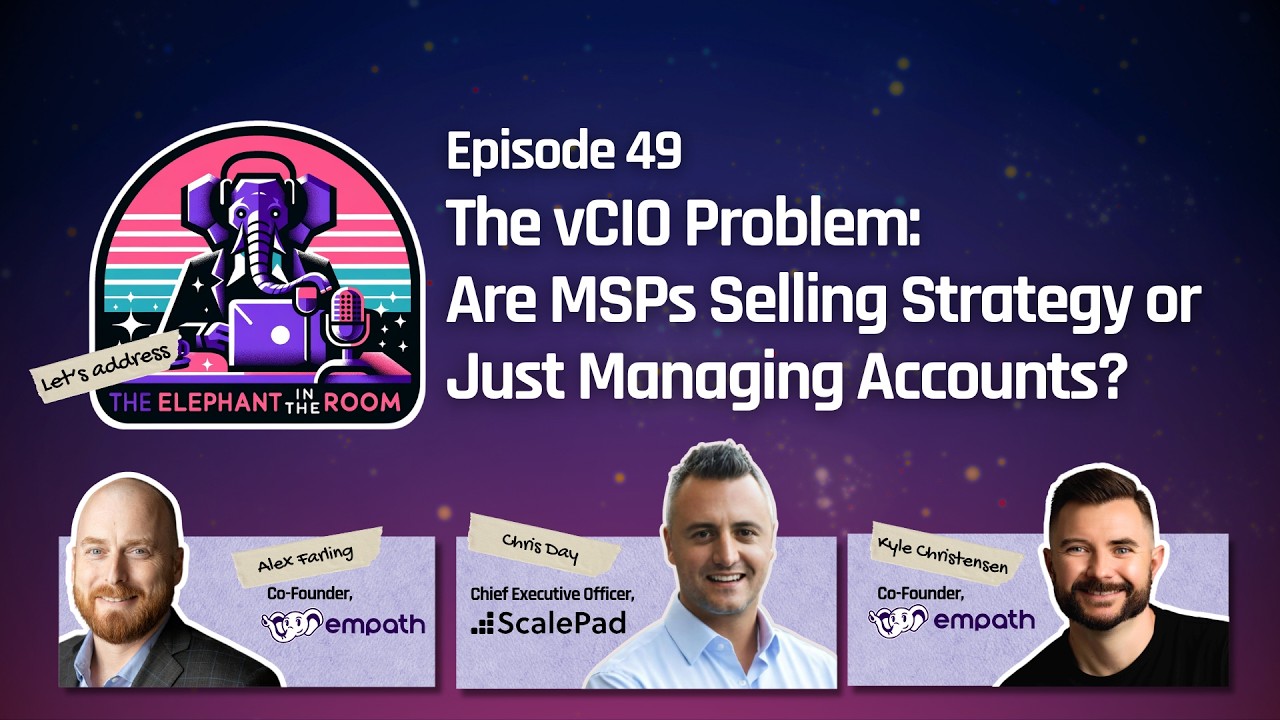
Chris Day argues MSPs are giving away vCIO advisory services that should be paid retainers. He cites 1,000 endpoints as the break-even point for hiring account managers and says paid advisory drives higher retention than free guidance. The conversation covers how to shift from selling projects to selling outcomes.
Chapters
I'm just curious if this thing is on.
I don't know, is it? I just had to go look at— check my unmute button.
Well, I can hear you. If you are in the comments, let me know if This is going to be where we have to bob and weave or jump to some other platform or just record this on YouTube. Let us know down in the comments.
Yeah, well, we'll figure it out.
We're doing this live. No one's commenting. So now I'm sitting here going, well, we're just talking to ourselves.
This is where we lose everybody.
This is where we lose everyone. Oh, hey, someone— all right, what I want to know is, help me defeat the blank page. What angry email should I send to Crowdcast? Do your best, or worst in this case.
Yeah, right. I think, I think, uh, in this, in the chat, we should have a best angry email subject line wins.
Well, and I'm just gonna send all of them is what it's going to be.
And yes, I'm just— I've been drinking, so you're drunk. Yeah.
Yeah, Dave, his face is just blurry. That's just what happens after.
I also have awful light, you know. I was in the green room talking to Chris Day, and we're both going through the moving nightmare. And, uh, I moved into a new house, and I specifically took the bedroom that didn't have a window, but it has a skylight, and there is Basically, in Florida, you've either got all the sun or none of the sun. So as the clouds move over, like, it'll probably all go away. But I don't know if I'm blurry because crowdcast or blurry because unmanaged, unfiltered light, and we'll see which one that is. So yeah, me and ChatGPT are gonna have to figure out how to shove some Styrofoam in a hole in the roof to shut this thing down. Yeah, but let's get rolling, Kyle. Let's, let's get rolling. We have a lot to talk about.
We do. We do. So we're going to— this is a continuation and this is something, Alex, that really spawned from you and I just having a cocktail at a conference, throwing shit at the clouds ultimately. And it turned into a stupid LinkedIn post, which turned into the guest of today hopping into the comments and starting a tirade feud, spicy topics in the chat. And our good friend, all 3 of us, Luis Giraldo, hit us up and said, let's make this an actual episode of my podcast. Well, we had 2 problems. One is our guest and I agreed on pretty much everything. So we need another outlier to say if we were wrong or not. But 2, we didn't have enough time to cover all the topics that we wanted to cover. So this is kind of a continuation, if you will, on another conversation. So We'll go ahead and link that YouTube episode over to the ScalePad channel so you guys can all go watch that. But let's go ahead and bring up on our guest because he is someone in our channel that I have looked up to for many years. Because when I was building Fit back in 2014 and '15, there was this little MSP out in Vancouver called Fully Managed that was doing something different. And benoathed to our guest, I did everything I could to copy how they were operating out of San Diego while they were in Vancouver. And he didn't even know this because that I was so inspired of how they were growing. I went, hell, I need to 10x my MSP and they're doing something right. So I'm just going to copy that, iterate it because being a second-time mover is a little bit easier. But he went on to do many other awesome things like he is the founder of IT Glue, the founder of ScalePad. founder and GP of Top Down Capital. Chris.
Hey guys, how are you? Rocking the yellow glasses in Arizona. That's, that's me. But, but yeah, it looks pretty put together back here. But I, I assure you it is a hot mess where I sit.
I can hear that. I can hear the empty house. And I went through that personally. Like I could hear the echo in my, in my live streams when I, when I moved until you get some of the furniture in. So you can tell you're in the middle of it.
Yeah, yeah, I'm working through it. Laws are not—
you also can't— what you can't hear is the, the melting blinds in the 125-degree heat.
It's, it's insane. I'm actually freezing. I'm actually freezing right now. But, uh, that's, you know, so that's a good thing that we're able to get it there. But, uh, there you go.
Yeah.
But yeah, if you've never been to Scottsdale and you fly in, all you see is a sea of roofs with the largest air conditioning units that you've ever seen, ever. And you just ask yourself the question of, well, we really have evolved to a new level when you can live into the lower depths of—
Yeah, straight up hell. Like, I sat on a runway out there without air conditioning for like 2 hours the other day. And man, we almost died. Yeah, Phoenix is no place to mess around. But a beautiful place nonetheless. And, uh, and more and more of our channel are starting to call it home. There's quite a few of you guys getting together out there. So it's kind of interesting.
I know a lot of really good MSPs in LA or in Phoenix. There's a lot of good ones and they all seem to double back between that and Vegas. But without that being said, let's, let's kind of go through a little bit of housekeeping. Next episode in September, we're bringing on a good friend of ours, Andrew Moore, for episode 50. We've been doing this a long time, Alex, 50 months. We have done this for over 4 years.
It's been a lot of fun. It feels like everybody we've brought has taught me something. And boy, has Andrew Moore taught us a lot as we've been working our way through Empath and working with him along some of the, some of the projects he's done with us. And that'll be a fun day.
Yeah.
Yeah. We haven't had an operational person on in a while. It's been very sales, marketing, ownership. So having an operational person back on the show is kind of a new change of pace. Perfect for September, that back-to-school rhythm. By the way, if you're in the Atlanta area, we're going to be throwing an event there, a pretty rad event. It's at a winery. So we'll go ahead and get you boozed up while we teach you some things about AI enablement, Alex. And we're bringing a good friend, John Harden, on. So we'll go ahead and link that in chat as well. That's free to attend. But with that being said, let's kind of recap what it was that Chris, Luis, and I beat up, which really the question that started it was, if you were managing the relationship, that's account management. If you're advising the executive team, then it's ultimately, Chris, you and I decided it's consulting. It's fractional CIO. It is not something that has a template. Correct. And Chris, kind of as a recap, what was your main takeaway from that episode that we had a few months back?
Well, I mean, to put it bluntly, I mean, if it's true advisory, I think the The brief version of it is we— it should be monetized because it has value. And if it is, as you wrote, you know, managing the relationship, then that's included.
Well, and then there's this third word that we didn't get enough into of client success. And there's a, there's a division between all 3 of those. And we're going to come back to that. But unpack a little bit, Chris, What, why do we need to charge for consulting? Why is this something that can't just be given away in our managed service agreements?
Yeah, I mean, I think we beat this up in a bunch of directions. But so I think, you know, it's not that it can't be included, it's that it must be monetized. And so depending on how you you know, monetize your services. If you charge enough, then it theoretically could be included. I think the reality is that most do not charge enough to make it included. And so, and I actually had a really like in 7, 8 days ago, I had a call with— I'm not going to name the MSP, but I'll just say it's the probably the largest in the world. And so I think about 4,000 or 5,000 clients that they manage globally. And we got into a really interesting conversation on the advisory piece. And 2 things that were really interesting, it was their most profitable line of business, and it was never included. And a very strong correlation to retention numbers. Like, it was something like 98%. So people that paid for the advisory service, which wasn't— it was actually a lot less than I thought. It was a couple thousand dollars or something like that on average per account. But it was a line item. And the people that had that line item on their agreement, which was serviced by a specific team that knows what they're doing around advisory, where it was something like 98% gross retention in that cohort. And so now what they're looking at is, okay, if that's true and we still have like thousands of clients that don't pay for that, what's the fastest way we can get everybody paying for that. So I just thought it was really, really kind of interesting. And so they're thinking about like, can we do like a baby advisory service? And would that, you know, have a correlation as well? So it's like, it doesn't have to be necessarily all or nothing. But for them, the ones that was the true advisory, the stuff that was, you know, formulaic, had a cadence, had a process, was—
Probably had some form of budget or constraints that was either billable or non-billable.
Exactly.
And what's interesting is I did some more homework after our episode because you and I stumbled on like big consulting firms have all met this challenge that we have. And in 2021 to 2022, the CPA industry started to refer to fractional CFO services as client advisory services. And it's funny that you use the word advisory without maybe having known this, because what they probably found was the same thing. Bookkeeping went to zero. It got commoditized. Fractional controller got commoditized. A bunch of software platforms got better to where maybe now I don't need a bookkeeper all the time because automation started doing a lot of my categorization and my journal entries, and they already pull in the reconciliations from my credit cards. So we got to survive somehow. And if you overlay this with MSPs, it's not much different.
Absolutely.
And so, Alex, kind of kicking it to you, really what our our consensus was, was kind of what we have on screen. And I guess at a high level, and we'll get into detail, in looking at this episode that we had, was there anything that you wanted to comment on or respond to? Or were you like, those guys are idiots?
Well, I think, you know, the— I think— I don't think the— I don't think you guys are idiots. I think our industry is so much in the middle of identity crisis all the time. That we look for a new title or a new widget or a new gadget to show our customers that we have value. And Chris just nailed it when he said, the folks who see value in us are the ones who pay us for some formulaic deliverable that actually adds value. And instead, we're like, how can I go call myself a fractional C-level executive that exists in your company and then go, you know, dress up as a sales guy and come sell you more shit? And I'm as offended by the title VCIO as I am by the way we've delivered it. Because if I'm a fractional executive at your company, my job is not to sell you shit. It's to help you deliver outcomes. And so, you know, my rant has always been, you know, if I'm here to make you better, I should never touch a quote. I should never be involved in that process. And it gets really hard. We talk about the human hat rack all the time. And if you're the owner at a 7-person MSP, man, are you the human hat rack, right? You're wearing the sales guy hat, you're wearing the VCIO hat, you're wearing the account management hat.
Yeah.
To do all these things. And somehow you've got to draw that line and separate yourself from the guy who's the consultant and the guy who's going to come back with a quote. And it just is a really hard thing, a really hard line to toe. And I think we just put ourselves in a better place if we just accept the fact that sometimes it's okay to be salesy. Sometimes not everybody's going to buy every product that we put in front of them. And at the end of the day, if we talk about customer outcomes, And make sure that everything that we're talking to them about is in their best interest. And most of the time that will align with my best interest. We're probably in a better place. And when we go into it about how am I Two Buck Chuck who shows up at every QBR with one more $2 widget to sell, it's where we fail. It's where we fall flat. It's where we miss.
Chris, I'd be curious on your opinion when it comes to Alex's statement about I'm not here to sell you something. thing, because in some ways you are there to help them buy things or eliminate things.
Yeah.
So is there a consensus that you have when— where does the line get drawn? And how do you wear those 2 hats when it comes to this advisory services, as you call it?
Yeah, I think I would say it's, it's about being good at getting someone to allocate budget. And as opposed to selling something, because that means, you know, you have to defend the spend and not in a salesy way. So I really think that's what an advisor does, right? And it's like, think of a wealth manager. You know, a lot of those people have a title of client advisor and they can be pretty senior financial advisors in that, in that with that very simple title of like, I'm a client advisor. And you, I mean, I don't know if you guys work with anybody like that or have, you know, met some of those people, but they do not come across salesy. It's purely about like, what are you looking to accomplish? And like, can I help you get that result that we're looking for? What's your risk tolerance? It's a very similar conversation. What's your risk tolerance? What's your horizon?
And everything's a roadmap. Yeah.
What's coming up in the future in the next, you know, 12 months or a couple of years? I mean, are you good with, you know, letting it fly for a little bit or do you want to be more conservative? And so I think that's where the, you know, that has so many parallels to what we do on the technology side. I think if you show up that way, you know, maybe that's the ultimate title is I'm Literally an advisor.
Here's my spicy question for both of you. Do you think because Alex, you talked about an identity crisis? We love to live in black and whites in this channel. You do or do not. You are compliant or you are not. You are cyber secure or not. We buy my all you can agreement or buy nothing. Do you think we have the ability to live in a gray space like advisory or consulting services without? some huge metamorphosis and change to our business model? Or is this something to where you think— I guess before I go forward, like, what is your thinking on, are MSPs even capable of this?
I'll let Chris take this one first because I have some strong opinions and I don't want to taint his.
I mean, I wonder if we're getting better or if we're getting there. I wonder if it's kind of part of the industry growing up a little. I guess I have hope. I'm hopeful that there are signs that this is starting to happen. I don't know that the MSPs, you know, that all the 3 of us used to run at that time, you know, there weren't many people that could do it. I would say I'm hopeful that there's a few more now. I still think that identity crisis absolutely is alive and well.
Yeah, I agree with that. I think Chris is right, but I also think we don't have to go too far back to where we're all running break-fix shops. And I don't know about you guys, but I remember in my break-fix shop, I had to sell projects because it was literally how we made money. And so I would say some of these young upstart MSPs or some of the ones who you know, don't have a deep backing in the industry, in the industry of the past, the young guys might struggle with it more than the old guys. And it might be worth it for them to go find the old retired guy and hire him part-time or full-time to come back in and help stand this up because there was a point at which we all ate what we killed, to steal a Kyleism, right?
Yeah.
You went out and you went and sold something and that helped you pay salaries and that helped you pay wages. And in fact, I don't have to go very far to find an award my MSP won.
Here it is.
I just unboxed this. This was for our first $100,000 project. And the school district that we did it for gave us an award because we told them we needed all summer to do the project and they called us with 6 weeks left to go back to school and said, we need this done anyway. And we worked, you know, 10 hours a day, 7 days a week to land their project. We did it at great margins, something our industry's forgotten how to do in projects. And our MSPs used to know how to do this. We used to be good at this. And so I don't— I think the identity crisis has come from 2 decades of looking to 5 people at the top of the industry and saying, I'll do whatever you tell me to do as long as I can build a bigger, more profitable business. And they haven't really helped us succeed. Average profitability is still garbage.
Yep. And my spicy take was going to be kind of along that lines, Alex, because the The MSP gods or the people that wrote the book on how to run an MSP, which by the way, Chris and I's MSPs were a lot larger than theirs when they wrote these documents.
Right.
They had this approach to education, which was do as I say and you won't make a mistake. And what they forgot along the way, and Chris, tell me if I'm wrong here, most of my largest clients, the ones that were paying me $20,000, $30,000, $40,000 a month in MRR, I got because I was willing to take on a large project to build a relationship in order to earn their trust. It wasn't this, and I have not found this once in my career, the one customer that goes, sir, can I buy a $10,000 managed service agreement package from you, please?
Yeah, no, I totally agree. That was the same. I feel like that, that was my experience exactly. We took on things that were just an absolute hot mess. That would definitely not fit the all-in-seat price model. It would require tons of onsite consulting. It would probably bleed for a year or more. But those ended up being our best clients. So I'm sure that's still the case. And you always wanted it to be SaaS. Where it's this per month. But yeah, could never quite get there.
Well, but you know, we're seeing a change just in SaaS though, Chris, if we step back and think about it. SaaS is going back to what managed services kind of started at, at least for me, which is retainer plus. SaaS was always per-seat model. And now we're seeing, look at how Anthropic bills, look at how ChatGPT bills, they bill at cost plus. So I buy a license, I buy a seat still. So now I have that floor of predictable revenue, but then they bill you token usage above and beyond. And now they can go out and make some extra money above and beyond based on your outcomes, your deliverable, your use of the product. And people have just taken to that. I always thought that we would struggle to sell that, that we'd struggle to convince people that that flat bill was not to their benefit. And man, did the AI guys prove me wrong.
Yeah, well, there's 2 things on that, Alex, that are interesting, which is one, I was talking to Peter, the CEO of Treeline, a new MSP roll-up that's developing out of Silicon Valley that Andreessen Horowitz invested in. And their perspective and their thesis is interesting because what they're seeing is that with SaaS multiples possibly going up or down and being unpredictable over the next whatever, months, days, years. Well, there is a world in which your software can actually enhance your services, where typically SaaS companies were told don't ever do services. And the perspective that he was talking about is if we develop it now just for our consumption, their prediction on where they're headed is that they will start to be valued somewhere in between a software and a SaaS company. Because they've been able to show that they can create a service offering that really has some form of automation or AI development cycle built into it. And it's kind of this convergence of software and SaaS. And it was just fascinating. I'm not doing it any justice here, but it's interesting to look at how something that used to be considered bad revenue in hyper-valued companies like software is now starting to blend into services.
Yeah.
And if you go look at a lot of public IPO software companies, they all have professional services.
The reality is at the end of the day, it was about predictable revenue all along, right? The value, the high valuations anyway. Yeah.
Go look at law firms. They're all retainer revenue and time and material. My wife's law firm just got valued at $50 billion or something like that.
That's crazy.
Yeah. Like, come on. Now, keeping this moving forward, one thing that I, we, we didn't hammer on too much that I kind of want to get to, and I would be— actually, I want Alex, you to kick this off, is this whole conversation of then what is account management? Why did maybe— what, go through maybe the steps of why we thought it was bad or why it needed a coat of paint and why it still has a place and a responsibility in your MSP. Like, I would love your take on this entire thing.
I don't think it's bad. In fact, I started building a tool for account managers. And then VCIOs came over and said, hey, look, you're building a VCIO platform. And they said it so damn much that Google started responding to it and we had to start marketing to VCIOs. But at my MSP, they were all called account managers. Account manager is not a dirty word. It is almost always known to be sales and MSPs being anti-sales really struggle to put that label on anybody because they think that we're more strategic than that. They think that we're more creative than that. They think that we're Solving bigger problems than that. At the end of the day, you know, Gary Pica calls them technical alignment managers. I just called them technical account managers. None of those phrases are bad. I prefer them to VCIO unless I have a really truly qualified CIO in a role who's charging $500, $600, $700 an hour, a premium like you would pay for a CIO to differentiate that service. Because account management is a service that pays for itself. We were talking in California last week as we were doing this workshop, and Kyle brought forward the number that anyone in a role like an account manager should be able to generate 3 to 4 times their salary in revenue. My account managers had no problem with that. They could generate 3 times their salary every year, no problem. It literally printed money. So account management done right and with the right expectation can still be a reasonably strategic role. It doesn't have to be a gross sales pitchy role. They can do budget forecast and risk alignment. Those are not things that are strictly limited to someone with a CIO in their title. And they can do it for customers who don't have the huge compliance obligation and requirement, which, let's be honest, is most of them. And we reserve the CIO for the premium product that it is and go sell it to the people who actually need it at the price that it's actually worth.
Yeah, you got to think like what, how, you know, for a typical small mid-market business, even the term or the acronym VCIO is probably just a little overwhelming. Like, what we're talking about is like, how do you show up? Like, what does that meeting feel like? And it's like, probably account manager is actually better because it's like a little more human. And it's like, hey, but my account manager is not salesy. Perfect. Then you've achieved what you're looking for. And, you know, probably 75% of the clients don't need, you know, true VCIO anyway, maybe more. So I totally agree, the label's cooked. But the sentiment behind it is still valid. And you still need people that are, you know, doing that work.
But if I'm strolling in the door and Kyle's giving away VCIO and I'm selling against him, Boy, as a customer, am I gonna struggle to understand the difference?
Yeah.
Or you're gonna create confusion because now you have a prospect that's sitting there going, this one has account management, this one has VCIO, this one has client success, and all I freaking need is my computers to work. As the shirt says, shut up, nerd.
Like, for all I care, you call him Bob, right? It's just, this is the guy who comes and solves the problem and here's the services that Bob delivers. Here's the outcomes Bob, here's the outcomes Bob delivers. Here are the things that Bob will help you with. And this is the cadence at which and the volume of that service that you're allowed to consume under your contract. I don't care what you call it. The contract should spell out the actual things that you're doing. And Dan Baird brings up a great question. We should delve into this.
Yeah.
What do you say to a smaller MSP, especially less than 10 staff, where they're already stretched thin in the help desk, They have zero project management or dedicated project people and no skill in project scoping. Half the projects end up being over budget. They just want to grow quickly. But every project, especially for clients who are not already on an MSP plan, feels like it just slows them down and takes them away from onboarding new MRR clients. This feels like the struggle of 95% of MSPs. And everybody says, oh, I'm small, I'm less than 10 people. That's average, man. That is, that is the average MSP. So, you know, don't, don't sell yourself short there. You got— who wants to take a swing at this one? Because I think this is a super interesting question. I'll let you—
he has something to say.
Me?
Yeah.
Yeah. I mean, it sounds— my first reaction is it sounds like a good problem to have. You know, like you get success. So so obviously there's a lot there to unpack. But but I would say, you know, first of all, we absolutely agree and understand that because we went through it. Like when we got better and better at at presenting and presenting risk and presenting opportunities, we we broke everything over and over again. Like our You know, we're either totally overstaffed for project delivery or totally understaffed. And neither one was good for different reasons. But I think, you know, I mean, this is, everybody's gonna have a different answer. I'm kind of like a weird person. I'm like kind of engineering mindset, but also kind of like sales mindset. And so my view was like, Let's fill the funnel and then we'll, let's break it and we'll, you know, backfill for delivery. And so that's how I did it.
I'll get along.
Yeah.
Yeah.
But that's not how, you know, a lot of people don't, aren't comfortable with that. And yeah, it was a mess.
And I was gonna say something similar, Chris, which I always had the mindset that if I, I have to always focus on sales because sales gives service a And service gives finance a purpose. And if we are not always selling, I have no use for a service team. So there kind of became this— I never said it out loud in my MSP, but service teams are meant to be broken. When it ever came to this operational maturity stuff, all it sounded to me was like, oh, I'm gonna stop growing my business to try to mature something without any type of cause. Like when something breaks, that gives me cause to go fix it.
Fix something.
And if I don't have cause, then I have no reason to invest on making something better. So, there was always that whole perpetual mindset of sell, sell, sell, sell, sell. And if we have issues with service, it's really most of the time, it was an inventory problem. It was we can't manufacture service fast enough. I don't have enough on the shelves in order to give people for the demand we're receiving. And to be quite frank, and this isn't a sales pitch of any stretch, that's where my MSP invested heavily in a learning management system because we needed to be able to manufacture service people faster. And the only way I could do that was with internal career development. So it was taking the page from my Geek Squad days of I should be able to hire someone at 16 working at a gas station to do the work because we didn't have the joys of automation that actually worked like people do now. So I feel like it should almost be easier these days.
What if I said an MSP that's doing account management right can make 75% of their projects predictable? And I mean predictable on the calendar as well as on the budget. If I know all the equipment my customer owns, if I know what their roadmap looks like, if I know this across all of my customers, if I know I support 2,000 endpoints, well, damn, I should know when 2,000 endpoints are about to go end of life and need to be replaced. If I learned anything spending 5 years on, you know, on budgeting, essentially figuring out MSP budgeting, being the guy who cracked that nut and tried to figure it out, if I learned anything, it was by making my customers predictable, my business became predictable. So the concept that I can't predict when projects are going to come through probably means something's broken somewhere else in the business, or we have some data we're not correlating. Either we're not doing enough prediction for our customers and not giving them enough input, or we're giving it to them one at a time and we're never rolling it up and looking at our company from the top down. There is a view of all of my clients' budgets from the top down that says when they have to spend money, I get to make money.
And you can control the funnel. It's an intake.
I can control the funnel just by making the recommendation to my customer.
Hey, you know what?
I think you can get by for 3 more months on this. Let's revisit this next quarter.
Yeah.
Hey, you know what? I think it's probably time we get moving on this.
Yeah. But Chris, that takes way too much time. I don't have time to do all of that.
Right. So then, like, let's just leave it where it is, I guess.
I guess I say that in an empathetic state. I know I say that sarcastically, but I mean it empathetically because someone in the crowd is probably thinking—
No, I get it.
Great. All these account management tasks are fantastic. I just kind of go into Dan's initial question of we're already hair on fire doing all these service things, and as an owner, I don't even have time to do all of this.
Yeah, so I mean, there's, there's a lot there. Like, doing it manually, um, you know, Alex knows something, something about this. Maybe, maybe built a company that, that Scalepad, um, acquired a few years ago.
A little problem there.
Yeah.
But, but yeah, like you've got to make it— it has to be a system. It— you like the operational maturity concepts obviously fit very well here. You shouldn't, you know, you're probably not doing 16 different types of infrastructure deployments because that is not very easy to scale. So ideally, I think, I think people have gotten pretty good at that. Like we don't, you know, we don't support 12 different backup platforms and so on. But I think it's, it's literally, it doesn't take long to see, to see it play out. Like you run this on, on 5 or 10 clients, you get a predictable flow of consistent delivery projects that are fairly profitable, and you get better and better at doing those. And then it becomes much easier to start to schedule this stuff out and scale it. So it's—
and the whole thing about happier customers, um, I said this on stage the other day, there's only 2 ways to get fired as an MSP. Really just 2. Everybody here in who's listening to this, think about this. Have you talked to a prospect who's like, I freaking hate my MSP, and then they end up not switching? Happens all the time. And yet there's really only 2 ways to get fired. That is lose customers' data, surprise downtime. Right? Lose data, cause an outage, something like that. All that roll into one and then roll surprise expenses into the other. When you surprise your customer with expenses that they can't plan for, I still remember the guy telling me, you know, I wanted to fish the White Marlin Open this year and instead I'm replacing Windows XP machines.
Yeah.
And I went, damn, I screwed up. And, you know, those are the things that really erode that trust. So this MSP who's delivering a real VCIO service, is helping customers reduce risk, reduce outages and downtime and all that kind of crap. And then they're helping them reduce surprise spend and those customers don't leave.
Yeah. Yeah, I think that the magic question, I may have told this story before, but like we have, you know, we have a private equity partner in Scalepad and they ended up firing their MSP. And it was just at a board meeting that, you know, I had asked the question, what, you know, what What's going on? How's your— how are things going with your MSP? And they're like, no, not good. We're gonna make a change. And so there was a— there's a third reason that, that other than they didn't have data loss, they didn't have unexpected expenses. The third one was they had no plan. And so they, in their case, they were— I would put them in a, you know, category of a more mature business. And they're basically like, there's two things I want. I want support and I want a plan. And they were—
but a plan really comes down to like, I'm asking for something and they're coming to me after the fact and asking for a check to solve it, right? It really goes back to unplanned expenses because the plan builds the budget. Those two are so tightly ingrained that it's, it's, it's all one thing. You can't build the budget without the plan. You can't build the plan without a budget falling out the bottom of it.
Yeah. And there was no VCIO and there was no account management, essentially.
Neither of those were We're a glorified break-fix shop who has an RMM that we use for remote access and call it managed services. Like, that's unfortunately where way too many folks live.
So I want to continue pulling on this thread. And because Alex, you said something and Chris, you said something, I think they kind of go together. You brought up, Alex, the— your account manager should pay for themselves. And Chris, you've brought up this kind of ability to kind of deconstruct what your partners ultimately need and the strategy and all of the other stuff. Is there a world in which when you're a small 8, 9, 10 person shop that you think you should consider this is just something you need to start delegating? Like you're gonna have to take the EBITDA drop in order to bring someone on board to manage these things. And what point do you think that's appropriate?
I'll let Alex go first on this one.
So I always felt like 1,000 endpoints was the point at which an account manager could pay for themselves, right? If I, if I sit down and do that math, if I replace those machines every 4 years, I'm replacing 250 machines a year just in, just in the top-level hardware, just, just in, just, just in endpoints. That's one a day for every workday. There should be an account manager selling all that, because if they're not, somebody's just walking in the door with their own equipment. So stuff's just showing up, and you're still gonna have to deploy it and maintain it and manage it. So 1,000 endpoints, you start to get to a math problem where I can reverse engineer my way into— if I can make $100 a workstation, $200 a workstation, something to install it, some project work there before I get to all the complicated projects of, hey, we're gonna go upgrade, you know, transfer data from one CRM system to another, migrate them from one cloud to another, do all the, all the other cool projects that we do. All the other things we can find to charge them for. There's enough baseline work there for me to at least have an excuse for an account manager to be in front of 30, 40 customers on the regular. And I should be able to, with a good process and a good system, walk them to enough water troughs and get them to drink. And that's really how I saw account management. I'm going to put you in front of something. I'm going to go, if I were in your shoes, these are the things I'd be looking at over the next 18 to 24 months. There are things you're going to have to solve at some point. When do you want to solve for this? So I don't have to have a real pushy sales bro in an account manager. He's just going to go, this is going to hurt one day. You're going to replace the server when it catches on fire, when it dies in a corner, or when you decide you'd like to deal with it ahead of time. You pick. I think it probably makes sense in the next 12 months. Does that make sense to you, Mr.
Customer?
And more often than not, they go, well, boy, I don't know if I can swing it in 12 months, but I can probably do it in 18.
Okay, great.
Put it on the budget, put it on the forecast, we're good to go. And just by having those conversations, more money falls out than you can possibly imagine. I found at my MSP that when I went to see my customers and just had a real business conversation about risk and budget forecasting, and none of it was like, I'm going to scare you into, you're going to be hacked if you don't buy my gadget. Just, here's a real-world example of where you live today. I think you could make your life a little bit better if you spend a little bit of money. I would either come home with a commitment to spend money in one of the next 2 quarters, or I would come home with a check in hand.
Yeah.
And it was just because I went out and built that relationship that Chris is talking about. I went out and added that value for the strategic conversation. So I think it's 1,000 endpoints. I'm happy to be wrong, but I think you can pay somebody $80 grand a year to do basic account management on 1,000 endpoints and you can make money at it.
Yeah, I think if you can train someone to deliver a 20-question assessment, And that's the only thing that they're able to do. There's, there's 20 questions that get— it's like a scorecard, like a very light assessment. As you know, Alex, obviously this was like the—
What we built. Ours wasn't fancy, right? It wasn't.
Yeah, it's not fancy.
It's literally intended to be.
Yeah, it's like, is this true? Is this false? Or basically is what, is what it is. Like, all of these things are true and there's 20 questions and, you know, many, many templates available for this type of thing. If you can teach someone to do that and do it well and explain, you know, why these things might matter and if they're happy with the results of this assessment or if they would like to make a change, my experience has been that they very quickly want to get rid of the red and get more green. And that equals the key projects that you want to deliver that will actually Provide the outcome that they're looking for, which is less risk.
My experience was that business owners would always carry more risk than I thought they should and less than they started with. Yeah. So, you know, we wouldn't, we wouldn't ever go in pushy and get them to buy everything and that was okay. But they were better off than we, than they were when we found them at just about every meeting when we just had a real honest-to-God conversation.
Yeah.
Mine was like, maybe there's like a quarter of customers that would actually just be like not interested. And then there was a quarter that was like, I want all the red gone. And then there was like the middle ground where there's like a portion of that we got to get rid of. And that combination works really well for growth, where you're like, oh my God, they're doing all the things.
And there's a quarter of them that you just have to look at and go, you know, am I willing to accept the risk of continuing to run with this idiot? Because they're eventually going to have a problem and try and dump it on me. And we all know who those customers are. When I say it, you can see their faces kind of, you know, come up in your brain. Chris probably still has some PTSD over his, and I'm sure Kyle does too. I do. There's a collections agency we dealt with that was just the worst customer you've ever heard of, and they didn't deal with anything till it was on fire, and then their problem was my problem. And, you know, it's just those are the customers you have to decide whether or not they're worth it to you. And yeah, the time bomb was a fantastic little— I don't know if that came from ChartTech or if that came from Gary Pica. I forget who started that, the time bomb in the risk report.
But yeah, then it was the risk letter. That was the one we used on that bottom quartile. We're like, I need you to sign this. It was like so aggressive. You need to sign this that says you waive all liability for everything that could ever happen.
You're going to get breached and it's not my problem.
Yeah. And that would like recover like maybe half of those 25%, maybe.
I tell the story of the guy who fired me when he still had file-level backups. in a world where everyone else was on full image-based backups. I think we were rolling out, I don't remember, probably ShadowProtect at that time, to all of our customers. And this guy still had a file-level backup. His server went down. It took us 2 days to get him back up. They didn't lose a bit of data. And he called me in and he fired me. I said, Chris, do you remember when I told you that you needed to go buy this better? It was a vet. So, do you remember when I told you that you need to buy this and you said you don't like subscriptions, you're not going to buy it? He said, No, but that sounds like me. And I went, then how the hell are you gonna fire me over it? He goes, because I have 7 partners and somebody has to answer to my partners and it's not going to be me.
Yeah.
And I went, okay, I know who this customer is. Like, these are the ones that you have to be prepared to lose at any time because they're just not the right customer. But we have to treat the customers who will listen to us, give them the opportunity to listen. And if all of our customers won't listen, we have to look in the mirror and say, where did I fail to deliver the right message? Because there are thousands of MSPs out there delivering the right message and getting the right, the right result. 98% retention on customers who buy VCIO services. Like that number speaks for itself. If they can do it, why can't I is a question that we should all ask ourselves.
Yeah, that's the whole thing too with customer success not being a person. It's not a VCIO. It's like, this is a system because sometimes it breaks down and the account manager is not going to get that message across well. Sometimes I would have to go meet and have a tough conversation. And so like.
I just lost my own.
I did too.
Oh, there you go.
You're back. I had to switch broadcast. I just switched off my AirPods today.
Anywho, but you both brought— since we're both back, um, you just said something in there, Chris, and I don't want to lose this train of thought because there is this inclination when it comes to client success that I've seen, oh, it needs to be a role and all they do is protect the customer's best interest because they can't be an account manager and they can't be client success at the same time. And Alex and I disagree on this quite a bit. So I would love your perspective because you brought up the whole point of it's an ethos. It's, I can't tell you how many MSPs probably have a core value around the customer's always right or what the customer wants, they get. And yet then they have this, let's find ways to fight, like go look at Reddit. It's like, do we really need to talk about customer success? Go look at Reddit and you can see plenty of customer insights there on how MSPs feel about their customers. Do you think that that can be one person or do you think it's just impossible?
Well, to split it up, like I still go back to, Like there almost there's no such like I don't know maybe this is this is a little too blunt but like I don't think there is any such thing as sales in in MSP like we already all we're trying to do is is make the customer successful like every MSP I meet is like they really have the best interests of the customer in mind and so if if providing the best outcome for the customer results in our growth. That's just inertia. And so I think it's just reframing the— everything about outcomes makes the conversations like there's no need to be in sales. And therefore the system works like the account manager, the technical account manager, the VCIO, the owner, the director of client success, whatever it is, we're all on the same page here. Literally, it's like I need to figure out how to get get in your mind what I know to be true for you guys, and like either I'm going to be successful with that or I'm going to fail with that. And I think generally that's where this like this whole system is breaking down. It's like you know if you if you look at it as quota, it that it's kind of like ugly. It doesn't feel nice. But if you look at it as You know, we're creating a measurable impact in this account because, you know, their maturity has gone up by 10 points. Um, and we celebrate that together, then is that really like a salesy thing or is that just like we actually delivered some measurable outcome?
Well, so my take on that's just a little different. Oh, go ahead, Kyle.
I was gonna say, it's just the balance of honestly, if you wanna throw a KPI at it, it's more about net revenue retention because your customers may be signaling that they're becoming more mature because they're buying what they need to buy, but they don't feel so bad or being sold to that they go ahead and fire you because, like Alex said, it's kind of give me money, Mr. Customer, unexpectedly.
Yeah. The place I differ, I think, in just my feelings on it is I use client experience or customer experience. To describe how we interact as how everyone's responsibility to interact with our customer and make sure that we make them better at every touch and customer success to be something different, which in my mind is a role. And I won't say that every MSP has to have it. But if we think to Chris's point, the genius of what you said is if we put quota on them, then all of a sudden the tendency is gross or the feeling is gross. And this is you get what you compensate. If your compensation package is dollars for dollars in revenue generated, you're going to get somebody who's naturally a little pushier. That's the person who's going to excel in that role. So if you're an organization who has chosen to have internal salespeople who go out and sell to your current customers, then you probably also need to at least consider sometimes putting on your partner success hat and saying, I'm going to go out and do what's best for them with no quota in mind and let this person go sell. Because the last thing I want, the reason that Kyle and I go back and forth on this is because I don't believe that my account manager, who's only incentivized to upsell, will spend enough time with a customer to make them successful. His job is to sell Chris something, move on, go to the next one, sell them something, move on, go to the next one. And their compensation package has to be aligned with Chris, I get to spend enough time with you to know whether or not you're having a great experience. I get to spend enough time with you to know that you're maturing. I get to spend enough time with you to consult you and bring you along. And I'm huge on consultative selling. I think it's the right way to go. But I think that there is, there are people who are better fueled by sell this one, move on to the next, sell this one, move on to the next. And there are people who just want to wrap their arms around everyone and give them a big old hug and take them on a journey and make sure they become more successful. And to, I think it was Dan's point earlier, when you're small, you don't have enough headcount to do all this. So this, I think this changes with scale. And with scale, you can say, I'm going to have somebody whose whole job is net revenue retention. Their job is to make sure our customers stay forever and that they love us. When you're small, when you're medium-sized, when you're average in the MSP space, you probably don't have enough headcount for this to be a standalone job. And I think it's important that we step back and realize the MSP that you started in your garage is not the same as As Chris's MSP was when he sold it, you know, when you have layers of management, you have more room and more money for to have these individual layers that take care of more specific jobs. In the middle, there's a little bit of that human hat rack thing going on, and you got to figure out how to carry the right mindset when you go in the door for the right meeting with the customer.
So with only 10 minutes, I don't think there's a wrong answer.
I just think the answer is you got to know what you're walking into.
So with only 10 minutes left, I have one last question for the both of you, which is, hey, this sounds like a lot of work and it sounds like a lot of reports to build. And it sounds like somebody that I don't have on my team. Can I just automate all of this account management stuff? Can I just VibeCode something to build all these roadmaps and just email it to them? Can't I just have it automatically send quotes for me?
And we've been emailing them reports for years. How's that worked out for everybody?
Yeah, well, I would say the good news is it's a lot faster to prep than it was 2 years ago. So, so that, that part was honestly was, has always been the hardest part about, about delivering something like this. It's like, you know, varying reports of, of, you know, 4 hours, 8 hours, 24 hours in some cases of labor involved in preparing for one of these strategic meetings. We're seeing now folks that are, you know, using Copilot or Claude and with good APIs and MCP, and the things that were painful are taking a fraction of the time. Like, you know, 75% of an assessment being able to be answered with, you know, with pretty high confidence without anybody typing anything into an input box. So that part's good. So that part's getting faster, which hopefully should free up time for the meeting to go talk through all of these items. So I think what was happening was because of the amount of effort required to do the setup, the meetings were not getting booked and not happening. But now there's no excuse. Like, if you can't produce a beautiful deck from from the data that you put together and it takes you less than an hour, you're doing it wrong. So now it's like, what is now the excuse to not go and meet for lunch or go meet and spend an hour in the boardroom and talk through some of these things? Well, before, the prep work was the excuse.
It was.
And I'm just gonna say this, like, all excuses aside, I'd like everybody to just go click around in your mail, in your Outlook right now. Go click over to the spam folder. Those people are sending you emails every single day. How many of them do you have a relationship with? The reason you lose a customer is because they get surprised and you didn't build enough relationship to cover that surprise, to have enough political capital for them to go, Hey, Kyle, I love you, man. You screwed up this time. Let's not do that again. But I still trust you. I still believe in you. If I'm emailing you a bunch of crap, if I vibe coded something that isn't the right conversation, and what I'll say is most MSPs, sure, you could vibe code a solution. No offense. When it comes to talking to your customers, you're not qualified. You don't understand enough of how to go in and have the right conversation. And if you're the top 5 or 10 or 15%, probably maybe top 25% of MSPs now, who have started to build that. Great, congratulations on you. But most of you need a vendor who's done this with thousands of MSPs. We weren't good at it when we built Lifecycle Insights. We built everything I wanted to build in 9 months. And then a bunch of MSP partners sat down with me and went, hey dummy, did you think about this? And I went, no, why would I think about that? I don't do that in my process. And they went, well, here's why you should. And I went, oh crap, my process just got better. I'll never forget when the guys from Elbow Computer came and said, hey, how do I build an agenda to send to my customer with Lifecycle Insights? And I went, you don't, like you manage the agenda. And they went, well, I need my customer to buy into the agenda. I want my customer to contribute to it and it to be their conversation and not mine. And I went, I'll be right back.
Right.
And we ran off and learned how to build an agenda.
Right.
But, you know, the average MSP has 1, 2, 3, 5 people's input on a very complex, very tough process to build. The right vendor will help you walk that walk. So yeah, you can vibe code it. You're going to screw it up as bad as we did. You know, 9 months into Lifecycle Insights and you're not going to have the benefit of a couple hundred MSPs coming back and telling you where you're stupid. And there's a lot of value in just getting the insight from the entire industry to come back and say, hey man, there's a little better way. We're going to build one extra widget or one extra gadget into that. If you listen to every one of your customers, you'll build 400 different solutions for 400 different people and none of them will deliver the value they think that they do because they'll just be telling your customer what they wanted to hear.
Yeah, I don't— don't even get me started on vibe coding, man.
Uh, we're all doing it. Like, we're all doing it over here in the corner. But yeah, but I'm not selling it as a product.
It resonates because it's something I would do if, if I was running an MSP now. I'd be doing it because it's more fun than dealing with customers, for sure. Uh, it's way more fun.
That was exactly the entire comment I was going to make, is stop fucking making excuses to not talk to your Well, but, but Kyle, when ChatGPT is wrong, it says, I'm sorry, you're absolutely right.
And when my customer's wrong, it tells me I'm dumb. So I'd rather talk to ChatGPT.
Well, and that's the thing that becomes infuriating is we'll go spend 100 hours vibe coding something just to say that we don't need to talk to our customers when my MSP had nothing but account managers that came from Nordstrom's. They couldn't turn on a computer, let alone even sell one. And you know what? They were really good at just saying, hey, Mr. Customer, how are you? I have no agenda to talk about. I wanted to check in. Is there anything I can help you with? Oh, you need someone to go pick up lunch? Sure, let me go do that for you. Like, there is a world in just for— just reach out to your freaking customers for the sake of reaching out to them. You made the comment, Chris, on customer success is really what you do. It's the act of making them successful. You cannot define what makes them successful unless you have a relationship with them and you're willing to talk to them just because you want to talk to them, because you like them, because you know their business. The one thing I always used to pop quiz my account managers on was, how does your customer make money? How did the business get started? And what is the one thing in their supply chain that if it broke, they could not make money anymore? If I had account managers that couldn't answer those 3 questions, they didn't know their customer. Is any of that technical?
Yeah, that's great. And if you, you know, if you want to vibe code something, what I would suggest is go in, go meet with your customer, your great customers, and vibe code something for them and charge. Imagine what that will do.
Well, and back to, back to we suck at projects. Like the first time you deliver something, you're going to fail at it. So actually go talk to 5 customers, find something they all need, build it once at a loss for the first guy and make money on the other 4, because you're going to have to deliver something 4 or 5 times before you get good at it and actually make real money at it. And that's the other trick to projects that we didn't really talk about is doing repeatable projects is really your superpower. Doing projects is not, doing repeatable projects is. So when we would get on a kick, we'd go, you know, do one certain kind of migration or one certain kind of upgrade or one certain kind of— and then we'd go talk to all of our other customers about it and go, look at this thing we learned about. I charged the guy who we did it for the 17th time the same amount I charged the first guy that we did it for, but boy, did the margin look different.
So with all of that stated, boys, we're out of time. This is— and I think there's an entire conversation, Alex, on productization that you're on, and maybe that's a future conversation because we never think of the MVP cycle or product market fit at all as MSPs. And I would— Chris, out of all people, you might be one person that I would love most to comment on that, but we don't have time today. So we'll leave that as maybe a spoiler or plant a seed for a future session. But with that being said, Chris, we only have a few more minutes. I want to give it to you. How can people get a hold of you, and what is one thing that you would love to kind of share with everybody?
Well, okay.
Yeah.
So, so LinkedIn is pretty much the only spot that I hang out nowadays. And that's the spot where I post, like, we, I don't know if you've even seen this, Alex and Kyle, but it's pretty much like we were shipping software company with AI is like pretty dangerous if you're doing it right. So we couldn't even figure out how to like tell people about what we're launching. So I just do it every Friday. And there's usually like 5 or 6 things that we launched in the week that are significant. So that's the best place to hang out for me. And that's all we do. All we do is ship.
Ship, ship, ship.
No matter what.
I get— well, with that being said, boys, this was fun. Thank you for your time. Sorry that Crowdcast was misbehaving there. No one gave me an email to send. I'm kind of disappointed in all of you. An angry email template would have been fantastic. So I'm gonna have to create my own now, which I'm all pissed off at the customer interaction topic. So I'm gonna go ahead and use that to send Crowdcast an email. But with that said, click the next episode button below in green so you can attend the conversation.
Send Kyle an email.
Yeah, send me an email.
I love emails. Send him sample emails for Crowdcast. It'd be fun. Best one gets brought up on stage next week or next month.
Yeah. Yes. And now I've lost my train of thought. So on that note, we'll see you all later. If you're in Atlanta, also get with us so we can hang out with you and buy you a drink. See you all later.
Thanks, guys.










