Portfolio Career Virtual Event with Yasi Baiani and Ha Nguyen
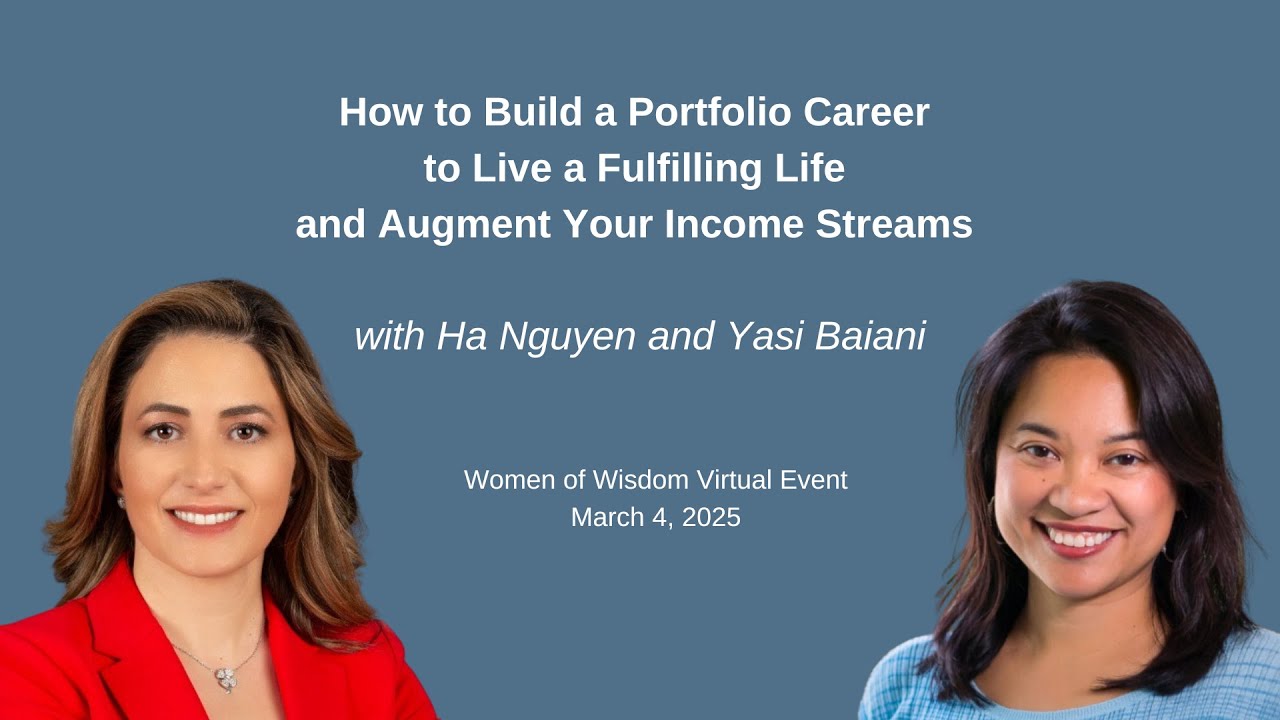
In this virtual panel, Yasi Baiani (founder & CEO of Raya Advisory) and Ha Nguyen (former COO turned fractional consultant) discuss the rise of portfolio careers—combining multiple income streams beyond a single full‑time role. They explain why the model is increasingly necessary due to macro trends such as mass layoffs, AI disruption, regulatory volatility, and mid‑life responsibilities (family, elder care). The speakers outline a menu of possible revenue streams (fractional consulting, advisory, teaching, speaking, content creation, investing, real‑estate, brick‑and‑mortar businesses, board seats, newsletters, podcasts, and traditional investments). They share personal journeys, highlighting how each transitioned from corporate product leadership to a diversified portfolio, and describe the mindset shift from “career ladder” to “career portfolio.” Practical challenges are explored: constant hustling and sales, context‑switching, time‑boxing, ruthless prioritization, building a personal brand, managing cash runway, handling administrative tasks (taxes, health insurance), and the importance of partners and referral networks. The panel answers audience questions on branding multiple identities, scaling referrals, structuring partnerships, and how early‑career professionals can credibly market themselves without C‑level titles. The overall takeaway is that a portfolio career offers resilience, flexibility, and joy when deliberately designed, but requires disciplined execution, clear criteria for client selection, and a supportive ecosystem of partners and networks.
Chapters
We're gonna do an intro in a, in a second. Ha and I will do that. But as we are also waiting for other people, I would love to get you all thinking about, you know, a side project or a passion that you would like to turn it to revenue stream, maybe a business, or at least monetizing it. And I would love to see what's everyone's thoughts in the chat. Give a little bit of information about ourselves. My name is Yasi Baiani. I'm founder and CEO of of Raya Advisory, where we provide AI and product advisory, as well as executive recruiting to high-growth companies. A lot of our clients are SaaS enterprise, AI, as well as healthcare companies. And in terms of recruiting, we focus on product, marketing, and engineering recruiting. I started this business about a year and a half ago.
Yeah.
I started the experimentation slightly before that. And now definitely I have a portfolio career. I have different revenue streams. But honestly, I've started this portfolio career mindset multiple years before that. And we're going to talk about that and my story and what different types of things I've done. But I've been product leader. I was early employee at Fitbit in my last role overseeing all of our software experiences there. And then I was part of Livongo Teladoc overseeing all of our mental health product line there. And then in my last role at Cleo, which is a female health company, which we turned it to end-to-end caregiving company, I was overseeing all the product and marketing. And pretty much the whole time I was doing those as my main operating roles, I was doing, you know, other things. I was teaching a course that I created for product managers at Haas Business School to MBA students. I was investing as an angel investor and doing a bunch of other stuff. And that led to kind of this portfolio career. I pass it to Ha to introduce herself too, and then we're gonna get to the juice of the conversation.
Ha, go for it.
Thank you, Yasi. I missed a couple of minutes of what you said, but I'm assuming that we're talking about like our why. And so for me, about 2 years ago, I guess 2 and a half years ago, I left a COO role Where I loved the company, I loved the work, I loved the team, but I was working for a narcissist, and I was deeply unhappy with, like, you know, what was going on. So I sort of made the— what I think was the, the bold and risky and scary move of just leaving without having anything lined up, because I needed to, like, self-claim my identity.
Again.
And as I was doing some soul searching, I took about a 5-month sabbatical. It was clear to me that I no longer wanted to join another startup company. I've been in the Valley for 25 years. I've worked with a number of early-stage startups, including early eBay along with Elena, 2000, 2005. I've been in venture. I've done all these things. And just there was nothing that excited me about sort of joining anything anymore. And so to me, I wanted to just really start working towards building my dream life and career. Um, I knew I wanted to just do startup consulting. I found a business partner. I've been doing that. And then, um, I quickly realized that I just don't want to be defined by one brand. I don't want to just be known as a fractional COO. I actually have a lot of interests and a lot of passions that I'm pursuing.
And kind of portfolio life. Has anyone read that? Yes, no. Okay, I see some nodding heads. Okay, that's great. So that has been a lot of inspiration, honestly, for me. This, you know, Christina is one of the professors at Harvard. She wrote this book, and she gives a lot of talks about that. But basically the concept that she has is like each of us have different kind of dimensions and different things that we bring to any job and different parts of our life that we have done different things. And how could we kind of combine these as we go to, you know, like getting older in our, you know, career and getting more mature and get to the middle age, which, you know, a lot of us are getting to. How do we bring all these different parts of our life to work, to our career, to our life, and create this portfolio concept? So That has been actually the inspiration for us, and I totally agree with her. And Ha and I talk about this quite often. We don't think at this point this is almost like a luxury. This is almost a necessity, and we're gonna talk about the why behind it. And that having diversified skills and experiences, it becoming more and more important and really allow you to have a resilient career. And I think with AI and what we, we see happening, it becomes even more important, honestly. I think the traditional way of thinking about career is a career ladder, and the kind of the model that we are advocating for is career portfolio. Of course, each of us will have strengths and we have our swim lane. I think Ha and I started from product. Both of us have that kind of core and foundation, which is allowing us to do a lot of different things that we're doing. For me, for instance, when I'm investing, a lot of times my product strengths come into play. When I'm, you know, working with different companies, a lot of times the product strength is the draw for companies that initially start interacting with us, but then they expand and do other things with us. But the kind of the point is this, like going up the ladder and staying in one company or in one field for 20 years, it's not for everyone anymore. And we see people go from one career to another career or build this kind of more portfolio career model. Let's talk about why this is important and what were the macro trends Ha and I saw and what were the kind of some of the reasons we are advocating for other people to start thinking about this career portfolio model. First of all, we saw like in the last few years, and unfortunately still continuing, this like mass layoffs, all this like changes in the environment. Again, AI is becoming a core part of everyone's business and strategy. That is exciting and big opportunity for many, but if we all not stay on top of like that trend, you know, we become less relevant as things move forward. And if you don't know how to use it, I think that becomes challenging to continue the same path. Regulatory aspects are impacting a lot of businesses. And we saw that kind of like in some of the startups I was working, like the direction of the startup could change overnight, but just like one regulatory aspect going through that. And I think we are seeing that right now with particularly new administration taking place. A lot of businesses are really fragile from that perspective. So how can you as a person at least bulletproof to some extent your career. Layoffs, restructuring, org restructuring, downsizing, management levels are shrinking in many of these companies, continue to be there. And I think that has been a trigger for some of the people participating in these conversations that we are setting up with Haa, which is, how do we protect ourselves? Like, even high performers are getting impacted in these types of restructuring and layoffs. And if you have other source of revenue, at least like you have some backups, at least for a short period of time, or, you know, it could become a more sustainable revenue stream if you have that. If you're just relying on one revenue stream, it's much harder if there's some of these macro changes that are happening. And another thing that I feel like as we go through middle age become more important, at least for me, it became more and more prominent 2 years ago. I decided to turn down a CPO role for a hyper— hypergrowth company. And the reason for that was like pretty much at the same time my mom got diagnosed with cancer, and I have 2 little kids. So, I really didn't see myself to be on the plane every day. This company was based in Texas, to be able to go meet with the executive team, with my team, with the board on a regular basis while I have these other, you know, responsibilities. And I'm not the only one. I'm just like one example of them. I think a lot of people have similar responsibilities at our age. We kind of have you know, elder care responsibility, kids responsibility, and it just becomes harder to just say all I care about is my career. We have to make choices that we can kind of accommodate different parts of our lives. And something that I love how Ha talks about that, so Ha, I would love to maybe you talk about this because like designing life and how do we bring joy is something you talk about a lot. So I would love for you to actually talk about this part.
Thank you. So, you know, when I then left my last company and I took a sabbatical, I had a coffee with a friend, and she gave me the inspiration to come up with sabbatical themes. And my themes ended up being joy, discovery, and connection. And that was how I based my entire sabbatical. And always, every day, I had to do something joyful. I had to make meaningful connections, and I had to experience something new. And then as I was starting my fractional career, I was like, well, why does Why can't I keep those same sabbatical themes, you know, as I'm starting up this fractional career and actually for the rest of my career? Like, you know, like that's how we should be thinking about our careers. It shouldn't, you know, hopefully we're at the point where it's no longer about the money, it's no longer about the prestige, it's no longer about climbing up the career ladder. It is about the work that like feeds our soul and brings us joy. For me, it's always been about mission. I know working with Elena, early days of eBay, right? Like I remember bounding out of bed every day, so inspired to do the work. It never felt like a job because it was all about the impact. And so for me, like, I'm like, if, if I'm gonna do work these days, it has to be joyful. It has to be mission-oriented. It has to feed my soul. It has to hopefully leave a legacy. And so that is how I'm, I'm approaching my fractional career and then my portfolio career as well. So—
I love that.
Thank you, Yasi.
Yeah, absolutely. And let's talk about, like, you know, what are the portfolio career and what are the potential options? This is just like a subset of things that we put here that we think at least just get everyone start thinking about what are the different ways to actually create revenue stream for yourself. You know, a lot of us have our main job, like our main thing we spend time on, and this is different for different people. Someone may have their own business, someone, you know, maybe actually have a full-time job.
Mm-hmm.
So that main revenue stream is great, but also we are encouraging you to think about other revenue streams. Like, for instance, there are some people who invest in brick-and-mortar businesses. Like, you can, you know, partner up with someone and buy a local gym. You can have a chocolate store with really premium chocolates. I don't know, pick your passion, pick your area of interest, see yourself doing something that you care about and you see a gap in the market. But I've seen a lot of people who are in different line of business actually invest in local businesses or brick-and-mortar businesses, and that actually is like a new revenue stream. Same thing with like, you know, building and flipping websites or do other lifestyle businesses, have an Etsy web page and sell, you know, whatever you're interested in making, right? There are different ways to do this. There are also like more part-time roles that are probably more kind of adjacent to a lot of us from, you know, backgrounds from corporate or tech or similar. You know, industries could potentially have. Take board seats, teaching online courses. A lot of people now teaching Maven or, you know, do other different similar types of courses on different platforms. Freelancing or advising startups, like that's how I initially started almost like 15 years ago was my first advisory work and I got some shares from that, which was really interesting. So you can kind of think about that. You don't need to like dramatically change course, you know, day one. Content, we all know content generation and content distribution became harder and harder, but there are still opportunities and there are still people who really take a nice new angle. And you can have newsletter that really picks up and you can kind of monetize that. You can have podcasts with sponsors to do that. If you're a great speaker, you can, you know, get invited to different, you know, workshops or corporate workshops or conferences. And sometimes people can monetize that, sometimes don't. But that's another kind of revenue stream. And finally, like traditional investment in stocks, you know, real estate, you know, things like that, which sometimes, you know, require, you know, more initial, you know, investment opportunity. Like, not everyone can go and buy a big house and kind of flip it or, you know, invest that and have their rent revenue stream. But these are some of the options, and I'm sure there are many other options that we missed. And maybe it would be great to talk about them, but these are hopefully getting you start thinking about them. If there's no specific questions or if you can hold off to questions towards the end, I would love to pass it to Ha. And this is the kind of the reasons why this is really important, which we talked about them briefly. Really, diversification is a big portion of that work-life balance that you can design. And, you know, as Ha talked about, like how design happiness and joy in your life potentially when you have more options, you can create that, and you can kind of lean in towards the path that gives you more satisfaction when you're not just kind of forced into one area. And pursue and plan the next chapter. Like, we all are going through different decades, and every decade, there's like our view and priorities really change. So, this kind of portfolio model allows you to do more of that. I'm actually sitting on the board of Harvard Business School Women's Association, and a lot of our members are in their 60s or some in 70s. They don't really want to have full-time jobs. They're all focused now on nonprofits, serving community, those types of things. So it's really interesting to see that in that chapter, they're very much in a different path, but they still are very effective and wanted to contribute. Ha, I'll pass it to you to talk about also what are the challenges. We both are here, we are advocating for this new path, but it's not easy, right? It's not.
It's a lot of hustle.
Okay.
Yeah.
If you don't mind flipping the screen. So, okay. So, you know, my main source of income right now is fractional consulting. But I do think that, you know, in portfolio career, this is doubly as true as well, which is that you're always selling. And it, it was interesting because as for the first 16 years of my career, I never saw myself as a salesperson, right? I did product. I was internal. You know, it was about like shipping the next product or feature, working with the teams. It was very internal. I never got a chance to build my brand at all. It wasn't until I moved into venture capital in 2016 where I was like, oh, well, how, how are founders supposed to find me if I, unless I start building a brand and like getting myself out there and, um, and, um, you know, and, and, and hustling for deals. It's no different now that I'm doing fractional and portfolio careers, is I got to get my brand out there. So I'm, um, if you're following me on LinkedIn, you'll see that I post almost every single day. Um, I have also thought leadership. I have long-form blog posts that I do write. I'm constantly meeting founders, even if I don't think that it's a good fit. Because one of the things I've learned in this business is that you just never know. You might meet a founder now, might not be a good fit. 6 months, a year later, they end up like reaching out to you again saying, okay, now's the time. I just raised money. I really need to, you know, like I really need some help, et cetera. And so what I've learned is that actually, like, the way to be successful is to put yourself out there and always be selling as well as always being— always be hustling, right? So it is not a 9-to-5 job, at least not in the beginning. Maybe over time when you're a little bit more established, but in the beginning you need to get out to events. You gotta be meeting people. You need to be hopping on a call. You need to be telling, like, everybody that you talk to, here's what I'm up to. Like, here's how you can help me. Like, do you have a founder you can introduce me to, et cetera? And so, you know, we can go a little bit more into that into the Q&A. But I do think that it's not for somebody who wants to just sort of sit back 9 to 5 and then hope that work comes to them. So you gotta ask yourself, do I really wanna be doing this? Because this is what it takes. You know, as you get started, and hopefully this changes over time, but as you get started, you really do probably wanna give yourself somewhere between 6 months and a year of runway, cash runway, to be able to pursue this. Because some of you may get lucky and find client work right away, and then others, like, it might take a while. It might take 3, 4, 5, 6 months before you land your first sort of paid client work if you're doing fractional. But certainly in portfolio careers, whether, you know, if you want to be a paid speaker, you know, if, if this is your first time, you're not going to get paid, right? You're going to probably have to do a bunch of free speaking engagements before you start asking for money. So no matter what aspect of a portfolio career you're building, the first few months are probably going to be a lot of experimentation, a lot of just doing work that might be unpaid, a lot of building relationships. And so I do think that you need 6 months to a year's worth of runway. And then, you know, in the fractional work that I'm doing, there are some downsides. Like, you know, I gotta pay for all my healthcare for both me and my families. I gotta make enough to be able to now have to pay that $2,000, $3,000 a month out of pocket. I don't get paid for my vacation time. And then shocker, like this was something new to me. It's like, What? I'm my own business person now, and I have to pay employer taxes, which is separate from like regular income taxes.
That's crazy.
So there's just a lot of things that you just need to be thinking of as you sort of branch off on your own. Next slide. Okay, a lot of juggling. This is kind of going back to the always like be hustling. You know, in my fractional work right now, I'm— I have You know, 2, 3, sometimes 4 founders that I'm working with at any given time. So it's a lot of context switching as I juggle different client responsibilities. But then now that I'm also moving beyond fractional work into some different areas, which I'll talk about in another slide, like, I'm constantly context switching, and it is hard. And so you do have to, like, learn how to you know, set boundaries with your clients. You do have to learn how to calendar and manage your time and just be thoughtful about the things that you take on and say yes to and the things that you have to prioritize and say no to. The other thing is that you sometimes have to do things that you don't always enjoy, right? Like, who enjoys, like, sending invoices and managing payroll and, like, doing your taxes and all that? But that's all the work that has to get done, at least in the beginning until you're established enough that you can and outsource that. Thankfully, for some of the stuff, I have a business partner that— and he, I don't know if he enjoys it, but he does do a lot of the— of this type of work. But there will be work that you don't always enjoy. Okay. So what does my portfolio career look like? So, so as I got started, my very first revenue stream was fractional work. And it was fractional or advisory. So what's the difference? Fractional is, you know, we are part-time within a company. We have deliverables and outcomes. We may play an interim, you know, VP of whatever role. And then we get paid for it. The way that I charge is on a retainer model. So you get X percentage of my time each week, and this is the monthly retainer that you're gonna pay me. But I also do have Founders that we just advise, we have no deliverables. And, and I don't take equity, like even in my advisory roles, it's all paid, cash paid, because I always tell my founders like, this is my livelihood. Like I need to pay the bills. I can't just take equity. If you wanna give me an equity kicker, sure, no problem. But like, I'm not trading off cash for equity. Over time, when you do a really good job for founders, what I found is that they ask you to take on more and more like responsibility. And what I've now been able to do is go back to some of them and say, I actually don't have the time to take on this extra work, but I'm also too expensive for this work. So instead of you being left hanging, I can bring in a team to do this work. I will set the strategy, I will manage them, they'll execute, they're going to be way cheaper. But, you know, but, you know, we'll work together to produce this outcome or deliverable. So I'm not intentionally building an agency, but I do have a team that sometimes I bring in. You know, they're all freelancers, but they will help me in supporting some of my client work. Some other sources of revenue or income as I've been building out my fractional practice. Referral fees. So now I have a small network of CXOs. You know, I have friends who are chief product officers who are going fractional, chief financial officers who are going fractional, CMOs, chief people officers who are fractionals. And I put them into a very small, like, sort of referral network with each other. We hop on a call every month or 2 to, like, trade notes and ideas. But then every time we send or refer each other founders, like, say, if, if I don't have the capacity to do the work or if I'm not well suited to do the work, I'll refer it to my fractional referral network and we share 10% with each other. So that's another source of income for me. I also have some deals that I have signed with a couple of SaaS founders where if I make intros to folks in my network and they end up like closing, you know, an ACV contract, then I'll get 20% of that. So I have that going. In April, my business partner and I are gonna launch a Maven course. So be on the lookout for that. And that is gonna be an additional source of income that I'm super excited about because I always get people coming to me asking for me for my advice. And I'm like, oh, I should just teach a course on this. So you'll see me promote my course on LinkedIn probably In the next few weeks. In one of my— what my business partner and I are also thinking about is doing sort of some coaching of other fractional consultants, and then actually taking a little bit of a rev share model. So instead of charging for coaching, like, it will be a little bit more of a success fee that if you— if we coach you on how to get your first clients, we will take like 10% of that. Because we're betting on you. And so, so it's a success fee. With my husband, I'm doing a bunch of real estate investments, and I've done angel investments in the past. Okay. This is brand new, Elena. Dev and I are starting also executive search. So we already have a few CEO friends who've like already said, yes, we wanna work with you to help hire our executive bench. And so that's, brand new, super excited about it. You'll hear more about that from me soon. And then finally, there's a bunch of things that I do that aren't paid, but it's all lead gen for the above. So that's my portfolio career. Quickly, next slide. Just wanted to also share that it is too hard for me to do this alone. So I actually have business partners for all these different ventures. Garrett Kelly is my business partner on my fractional business. We have a separate It was an LLC. We've turned it into an S corp to save on employer taxes. With the executive search firm, it's gonna be me and Deb. We have to create a new LLC. And then for all of our real estate investments, we have LLCs for every single property or, you know, different entities. And so I do— I can't do this alone. I have business partners. They're thought partners. And, you know, I, I, I would be too lonely and, and feel lost if, honestly, if I didn't have my business partners. My referral network is my CXO network, and then I have a bunch of subcontractors under me. I have a writer who, an editor who helps me with my Substack posts. So, you know, she sometimes, like, I'll do the first draft and she'll sort of write and edit and we'll publish. And sometimes she'll just interview me and then do the writing for me. But it helps me a lot. I have community and social managers, and I have UI and UX designers who work With me, and then a team of virtual assistants. So I always joke about this for anybody who knows me. It's like, it's like, okay, if I send you an email, it may not have been me. It might have been my virtual assistant. So if I got like your name wrong or some details wrong, please forgive me. Like, we find it funny, but I do have a team of virtual assistants who like log into my account and send emails on my behalf. You just have to surround yourself with a team if you're going to build a portfolio career. Maybe not in the beginning, but certainly over time. So that's my tips. Yasi, back to you.
That's great. That's awesome. So much insights that Ha shared here. So I'll share a little bit about different revenue streams I have and how I built the portfolio career. So my business, of course, that's kind of the big part of my revenue stream. It has already multiple revenue streams within that business. So that's like one part of it, but also like paid speaking engagements. So most of the places I go that are conferences or go talk with VCs or things like that, I get paid for my kind of speaking opportunities. Referral fees, similar to what Hal was mentioning, when we have like a different group of people with different kind of skills. So when we refer to them, you know, if they end up closing the the customer, they'll give us 10% and vice versa. Investment in startups, so I started that years ago and I'll continue to do that. I have a family fund that I invest from, but also I'm part of a venture fund called Flybridge, which they do a lot of SaaS enterprise AI investment. So I also write checks from that venture fund. And investment in other funds, so that's also another way to kind of diversify risks. And again, for some of these, people feel like You have to spend millions of dollars to invest in one company. No, you can start from small checks and then kind of build upon that. And also real estate. I think that's another way to kind of diversify and maybe more of a traditional kind of mixing digital tech revenue streams with more kind of traditional real estate investment. So that's my portfolio. I wanted to open it up. So now I stopped sharing. I wanted to see people's faces and see the chat. And maybe we can take a few minutes to answer any questions or any thoughts anyone has.
I was gonna say, just feel free to come on video, please, and ask your question.
We have Denise with a raised hand. Denise, you wanna go ahead?
Hi, hi, hi, Yasi.
Very nice to meet you. I'm Denise Ng. You know, interestingly, I did not realize I have a portfolio career, but it seems like I might have. So I do work full-time in tech. I also am the founder of Asian Women Empowerment Network and the founder of Denise Ang Coaching. My question is, how do you position and brand yourself given the multiple identities or in your portfolio? Because sometimes I struggle with that, like, what should I call myself? This slash that slash So I'd love to hear your perspective.
Yeah, I can share my 2 cents and then happy to pass it to Ha. The way I think about it is, you know, one of my professors at Harvard years ago said, you know, you made a career when you have something that people come to, to ask you for your expertise. So you want to be known for certain expertise that people come to. It could be sectoral expertise, like more like climate tech or health tech or whatever that is. Or it could be functional expertise, you know, product sales, marketing, growth, whatever, right? So you wanted to have some of that, then you can kind of surround yourself with other things you do that is based in that core. At least that has been an approach I've taken, and I've seen other people have taken that actually work nicely. Most people come to me for product stuff, like their problems could be different things. They're like, oh, I have problem with my team, come help me fix it. That may lead us to helping them to do some consulting work with them or for hiring someone for them, or, you know, we just have conversation with them and eventually they're also raising money. We invest out of, you know, funds that we have into the company. So, but that is where people usually come to me, or if they wanted to get into product management or anything around product is what they come to me. And of course, a lot of my background has been in health tech, and now we kind of have SaaS enterprise AI. So those are kind of reasons people come to us, but those are the core. I think it's very hard to have especially inbound interest if you don't have that kind of brand recognition or expertise that people start knowing about.
Yeah, I would say for me, in my LinkedIn bio, I put what my main source of income is, so fractional COO. So it's very clear, you know, that founders want to hire me, they hire me fractionally to support certain areas of the business. Um, but, um, I use very frequent LinkedIn posts to share with the world what I'm up to. So, um, you know, so I think that that's how you can sort of start to also introduce the fact that you're not one-dimensional, you're not only doing this, you're doing a bunch of other things. And then, um, you know, uh, some of these sort of extra opportunities that we're picking up or, you know, that I'm experimenting with because they're all experiments at the end of the day was more just that people just started coming to us to different things. So like, I like Deb Liu and I— Deb was the former CEO of Ancestry and she's taking a year off before she takes another CEO role. But she and I were chatting and she's like, I am introducing people, CEO friends of mine to my network all the time. And they end up getting hired, and I'm not getting paid for it. And I was like, you know what? We should just formalize this and turn it into a business. And so now when CEOs say, hey, who do you know who, like, you know, like, would be amazing for this role? We could say, well, actually, we can help you with that. So sometimes, like, people, you know, sometimes you have, you have a network, you have a reputation, people come to you. And figure out how you go from free to a paid model. So that is something that I, I don't know that I have all the answers, but I'm really, really very interested in experimenting. Same with pay. Like, you know, if you start speaking, right, you're gonna do a bunch of free, free speaking engagements in the beginning, but eventually you're gonna be like Yasi when, like, you know, when somebody who wants her to speak on their keynote stage, Yasi's gonna be say, well, actually, here's my paid speaking rate, and I'll share it. You know, I'll share it with you. So that's my, my thing is that, like, you don't have to be one-dimensional. You can be doing lots of things. When people start coming to you, figure out how to move from free to paid.
So.
Alright, Adriana, thank you for your patience.
Go ahead.
No problem. I was also interested in that, in that answer. So awesome. Hi, Ha. Good to see you.
Hi, Adriana.
So good to see you.
Um, I will be so curious to hear about how you manage context switching because I'm struggling with that, like between the business development and, you know, writing on LinkedIn or, you know, actually doing the work or the invoices and mentoring and whatnot. Like any tactics, hacks that you're— you've implemented, what has worked and what has not?
Oh, you wanna go first?
Well, I was gonna say, I was— I wanna learn from you, Yasi, because I don't think any of us, like, I mean, I, I think I would be fooling myself if, if I said, like, I'm, I've figured it out. You know, like, you know, I, I do think that, you know, calendaring helps. Like, you know, like, so in, in the exact search thing, I have a certain period of time that I'm setting aside to do just that work that's separate from my client work, right? And so I think just sort of like prioritizing which days or blocks of time you're going to focus on this one activity and don't let yourself get distracted, I think it helps. But, um, but by the way, like, I work a lot late at night. Like, if you ever send me an email at 11 PM or 12 PM, don't be surprised that I'm, you know, replying because I am juggling a lot of things. I also have a family that I'm raising. I am just working a lot. I'm hoping though that the work that I'm doing now and the hustle will pay dividends in the future where like I don't have to hustle as much and I can like, you know, scope back. But anyways, Yasi, I'm gonna learn from you. I don't have a great response.
Yeah, me too. Honestly, I don't think there's like easy way to do that, right? When you're running especially your own business, I think it's different if you do portfolio career and you have a full-time job and let's say you do one more thing. Even then, I think there's a lot of hustling, right?
I've done that.
I had my full-time job at Fitbit and I was teaching at Berkeley, and it was a lot, like, you know, like a ton of stuff because I felt like it's not just the hours I was teaching, all the prep for that, meeting with the students, everything, right? So, anything you do, it will be hustling. And when you're running your own business, that's just like amplified because of exactly the reason you said, like all of those are on you. Maybe you built a small team, but you have to be very conscious when you're spending and how— what things you can do versus what things you can delegate or wanted to delegate. So I think for me what has helped is like, I'm a ruthless prioritizer. So I always think about what matters most at any given time. So I try to make sure at least that is, you know, focused. And I always tell people I'm very deadline-driven. So if someone reached out to me, the most random person, and say, Yasi, I need your help in this, is a deadline, that kind of triggers me. All of a sudden that becomes my top priority if I care to help that person, which usually I do. I then react to that. But if someone sends me something and says, you know, for the infinite time, I would like to talk about this, like, it will never get prioritized because there's so many other things that are deadline-driven or more important from a priority perspective. But also try to do buckets of work. Like, for instance, like, I do consulting work for this company during, you know, certain hours, and I try to shift my focus on thinking about content. It's really hard to do all of those at the same time because the mental kind of requirements of those are so different. And at any given time, I can tell you, I always feel everything is behind and something is giving up, right? So there is no perfect world. Even saying all that, I feel like we all just have so much capacity and at best X many hours per day to do the work, right?
All right, Diane, you're up next.
Thank you. Thanks to both of you for some Great insights. So I do a lot of leadership coaching with clients, and one, I guess, portfolio item I've been stepping into, which I've really enjoyed, is executive offsites or retreats. And my question, when you were talking about referrals, I thought I should be doing a lot more to get referrals, and I don't know exactly where to start. Do you have any thoughts on how I can let the right people know what I do so that I am, you know, top of mind as people are having these kinds of needs?
Yeah. So do you want me to take it, Yasi? So I have a— separate from just general referrals, I do have a referral network of other CXOs, and they're kind of spread out across different functional areas. And the way that I started this was I picked and chose fractional CXOs that I thought, like, were fairly established in their business and that it could be more mutual rather than just me referring out, that it could be a mutual exchange. And then I thought that they were, you know, that I wanted to be closer to them to learn from them, etcetera. So I actually put together a one-pager, which I'm happy to send it to anybody. This is my referral network. This is like who I'm gonna let into the referral network. This is the expectations around what it means to be part of this referral network. You know, we're going to be on a Slack channel together. We're gonna hop on monthly or bimonthly calls together. We're going to, you know, refer each other work. And then, you know, if, if some of the work closes, we're gonna share out 10% with each other. You know, I reserve the right to start charging a membership fee for this referral network in case there's any expenses around, like, legal contracts or all these things, you know, to be part of this network. So I wrote out the one-pager and I just sent it to them. I was like, hey, I'm starting this referral network, you know, do we want to be a part of it? Here is— let's mute Sonia. So do you want to be a part of it? So I just set expectations very clearly upfront and people said, yeah, that sounds great. But there was just that one-pager, the expectations. Um, and that's been working really well. I think like last year I made close to $50,000 just on that 10% referral fee, which is kind of insane.
Mm-hmm.
Um, I haven't quite yet figured out how to approach it outside of the referral network, right? Because you have friends who could always send you business and I don't have that type of arrangement like with them. It's like, oh, Yeah, send me founders and I'll give you 10%. It's just a little bit weird when they're just a friend. So I haven't figured that part out yet. But like, you know, for the, for the folks who are also fractional consultants, they need business. They might see some, some opportunities that I can help with. I might see some opportunities that they can help with. You know, we've sort of structured, have a, have a real structure in place.
Thank you.
And I saw some chats that I agree with. We'd all love to learn A little bit more about your referral network and how one might approach that.
So yeah, let me, while we take the next question, or if Yasi wants to add anything, let me see if I can find that one-pager. I share everything, by the way, like I'm an open book. So, but I'll see if I can find that one-pager and I'll put it into the chat for folks.
Yeah, I think I know how to pronounce the next person's name, but Yasi, did you want to add something before we go on to the next one? No, I think the only thing I I would say also is like the best referrals are the existing clients or people you've done work with. So you, you know, you can always count on that, and that I think has so much power in terms of bringing new, new clients.
Rachana, I'm not sure how to pronounce your name. I'm sorry.
Yeah, Rachana.
Rachana. Hi, and thanks for hosting the panel, Yasi and Ha. My question's more around the choice of going it alone versus Um, getting a partner. You mentioned you started your fractional practice with a partner, and I'm curious to hear what that experience is like. How do you structure the partnership? Is it a division of labor where one person takes on more of the BD work while the other person's doing more of the operator? Just, yeah, any insights around what are the benefits of Working with a partner, how to structure the partnerships, and what are the downsides?
Yeah, so when I left my last startup and I went on sabbatical and I knew that I wanted to do fractional consulting, I was like, gosh, it's going to be a lonely road. I really don't want to be doing it by myself. I need a thought partner, you know, and A coach. And, and then as I was thinking about it, I was like, I, I know who it's gonna be. It's gonna be Garrett because he and I worked together in the past, and we were so complementary to each other. And I had to, like, convince him for 4 months to say yes to this. But my pitch to him, and it still continues to be the pitch today, is like, I have the network, you know, I will bring in the founders, you know, like, so I'm the razzle dazzle. But, like, I need somebody to do the work, and you are thoughtful, and you're wise, and you're a great communicator, and you're organized, and you are, you know, you could do so many things well. I really need you in this business with me. My husband kind of freaked out, but I was like, I'm giving Garrett 50/50 of this business. And he was like, well, you're gonna be doing all the rainmaking. I was like, I don't care. I want him to feel like an equal partner. Like, you know, and, and what that means is that we share all revenue and expenses together. But I'll tell you, he does everything. He does payroll, accounting, invoicing, taxes. He does the proposals. He sells the work. Like, he's good at selling the work. He might not be great at what I call top of funnel, but he's great at everything else. And then anytime my founders drive me crazy, I like message him. Like, he, I message him probably 8 to 10 times a day, and then we hop on a call weekly. So anyways, it's been a beautiful relationship. It's 2 years. Like, I hope we continue for as long as you know, as we both are continuing to be happy in this work. I'm just starting this exec search with Deb Liu. And like, I'm like, oh my God, in this relationship, Deb is me and I'm Garrett. Like, so Deb will be the brand, you know, she's gonna find all the founders who wanna work with us on the searches. And, you know, and I will just do all of the behind the scenes work. So it's interesting. Like, to me, I feel like find business partners who are complementary to you. You know, and where it's clear that like these are your superpowers and this is their superpowers. And, you know, and just have those honest upfront conversations on like, you know, how will we, how will we structure this? It doesn't have to be 50/50. I know a lot of people who don't have 50/50 sort of, you know, equity share arrangements. Just do what makes sense for you and your business partner. But I can't imagine not having business partners in this because there's just too much work and I wanna share in the work. And to me, the money is so secondary or tertiary. I just wanna do work that I love with people that I love, you know, and, and have a great time doing it. The money will come. I, I'm not focused on like, oh, well, you know, I sold more, you know, I'm making more. And so I wanna take more. Like, I just want them to feel like we're equal partners in this. So that's how I've approached it. Yasi, anything you want to add there?
Yeah, I actually went a different path because when I started Raya, I was just experimenting. I wanted to see some of the concepts we are thinking about. There's path to monetization, sustainable monetization. So I didn't want to have responsibility for someone else and, you know, bring them along with me to kind of do that experiment. So I was like, okay, let's just try and see if this works. But then I brought in early team members that are a big part of, you know, our success and our kind of complement skills that Han is talking about. So like, I started it alone, but we have an awesome team that helped to make things happen.
All right, Claire, you're up next.
Sure, thank you so much for including me. I am someone who's transitioning into a new phase in career from working full-time to working for myself, and consulting and advising is part of what I'm looking to do, but I'm also looking to prioritize some really deep and focused work on other types of projects. And I've been totally overwhelmed by sort of this consulting, like inbound funnel, if you will, and sort of like dating process of talking to prospective clients and figuring out if it will be a good fit or not for me and for them. So I'm wondering, do you have any advice on how to sort of get through that process as efficiently as possible as someone who's, who's new to consulting?
Can I ask, my first question is how you got so much inbound? How did you generate that? Because that's usually the problem, people don't have as much inbound.
Oh, well, you know, I've been fortunate. I have just put up a post on LinkedIn, and I think there's been some good word of mouth. What I do is I do brand work and physical product innovation work. So I also think that what I do is somewhat specific and unique, especially combining those 2 things. But, you know, so far it's also, I will say, I'm looking to do this in a focused way. So I'm not looking for consulting to be my full-time. If it was my full-time, I probably need more inbound, but for what I'm looking for, it's been really strong.
That's great.
I think the most important thing is probably like really define your criteria, what kind of things you care about, like what kind of product you want to put your name on, what kind of size of companies you wanted to work with, what are you trying to optimize for, right? Is it the brand? Is it the pay? Is it difficult problems? Or is it new sets of problems, right? And also the teams, like what do you care about in terms of team and team structure, and kind of like have your criteria written down and prioritize that and like Basically in your kind of intro conversation, try to as quickly as possible weave through that and make sure like they're meeting your criteria and then have follow-up conversation with the one that makes sense.
Yeah, I agree. I would say to add to that, like I really run all my biz dev opportunities like through the equivalent of a sales process, right? And so there's always an intro call, 30 minutes. I'll say I'll take those all day long, but during that call I'm trying to qualify like, can they afford me? You know, have they raised money? Can they afford me? Like, do they have a budget for this? And then in the call, I will always share what our process is so that they're clear upfront so that people aren't wasting our time, like, with free consulting advice forever. So it's like, okay, you know, if we think that there's a fit here, we're gonna do the next call. It's gonna be a discovery call. It's gonna be an hour. We're gonna ask you a bunch of questions around the business and what your pain points are and what your needs are. With that, we'll put together a proposal. We'll send it to you ahead of time. We'll set up another call to make sure that we got the proposal right. And after that, you let us know whether you wanna work with us or not.
Right?
Right.
So like in that, it's just so clear that like, I mean, you know, I brand myself as a fractional consultant. I have an LLC, you know, and I outlined the process for them. So, you know, there's just a lot of prequalification that happens all along the way. So we try not to like let founders waste our time or, you know, or like have too many calls with a founder that's just never going to pay you for the work. So.
Seems we have one more question.
Yeah, let's go to the next question.
Thank you, ladies. Yasi and Ha, it's been really great to hear from you and to meet all the other ladies on the call. And apologies, I've had camera off for most of this. I'm trying to juggle my other fractional role, which is a mom of 2 my kids, um, and getting them ready for bed. I am mid-30s. I've worked in products for maybe 12 years now, more recently been doing consulting work. I also enjoy the variety of working with different types of companies in different sectors, different challenges. My problem at the moment is that there's a perception that before you can start to really market yourself as an advisor, fractional leader, speaker, is that you should have reached the CX position. before you can then have, again, perception-wise, enough experience. And I'm finding that difficult because, again, like you were saying at the start of the call, rising to— like, staying in a company for 20 years and rising to CPO is no longer what's desirable for many of us. But the perception is you have to have been a CPO at some point to then be able to be a credible fractional consultant, speaker, advisor. And I just wonder if you're seeing the same challenges and how you think I might be able to address that to be able to kind of approach a portfolio career?
Yeah, I can give my thoughts and you should definitely chime in too. The way I think about it is like, yes, always like the higher in the rank you've gone and more responsibility you have done, you have had, and the more vision you've driven, bigger teams you have managed, then there is some of that credibility given, right? You know, just like when you have worked in more well-known brands, that credibility immediately is given.
Right?
However, I truly believe there is no one-size-fits-all about pretty much all of these things. So I've seen people like, I think Lenny is a good example of someone who has actually very limited product background, but he has built something really amazing, an awesome newsletter, awesome product, podcast, and a lot of followers. What he has done, he realized like he doesn't have as much years of experience or depth of experience for him to be the content generator, to be the thought leader and expert. So he actually started using other people's expertise to then bring that to his content. So there are many different ways people approach the same problem, right? So for you, you have to figure out like what is your strength, what is your edge. I do believe people have to have edge and that edge matters, but people can pick different problems, put their own edge and superpower on that, and address that problem really beautifully. So I don't believe like I've seen many people in different levels coming and do this work. Yes, their pay may be different. Problems they solve might be different. They might be more as a fractional team member or freelancer in the team versus like being the one that, you know, advises for an hour for $1,000, right? So people come in different, you know, levels, but there is definitely a way you can carve it out that could work for you. I don't know anything about your background, so sorry about that. I can't add a ton of like detailed value, but I really believe people need to believe in themselves, know their strengths, So truly know their strengths. If they have gaps that they need to fill, do that. And then make sure you— they kind of get into a specific area so they can actually add value to the customer. Any other thoughts?
I thought that that was really well said. I would say that, like, you know, in my 30s, I don't think that I would have been able to do the work that I'm doing now. So I do think, you know, more experience, a bigger network, you know, more wisdom, you know, I do think that, like, like, with more, more, more, you'll be more successful. I do believe that. But having said that, you know, I, I pasted into the chat, Gabrielle Bouffrem. So she's, you know, I mean, she has to be in her early 30s, I think. She does a lot of product coaching. She's extremely successful in her business. So she, like, early on wanted to do this work, had some doubts, Got coached by Marty Kagan, who was like, "You can do this." Like you know, you do not need to have been at the executive level, etc. And then I know I grabbed coffee with her, and she was telling me like you know which clients she was working for and how much she was making. I was like, "Oh my God! You are my hero. I am such a big fan of like you." So it can be done. I don't know for me myself. I could have been as successful as Gabby, but, you know, or Lenny. But I, you know, so there's a path. But I do feel like for me, like having the experience, the wisdom, the network, you know, has all been super helpful.
Thank you both.
Wonderful.
We are pretty much at time. So thank you all for attending. And thank you, Ha and Yasi, for a wonderfully informative and inspiring presentation and discussion.
Thanks for having us. Thanks everyone for joining.
Well, connect with us on LinkedIn and, um, and then yeah, you'll hear a lot from us when you follow us on LinkedIn. You'll hear a lot. All right, thanks.
Have a great day everyone.
Bye.
More from Yasi



Episode 116: Beyond the Basics: Non-Traditional Approaches to Product Management and Leadership w...

Leadership Lesson: The only constant in life is change. 3 tips on how to manage change effectively