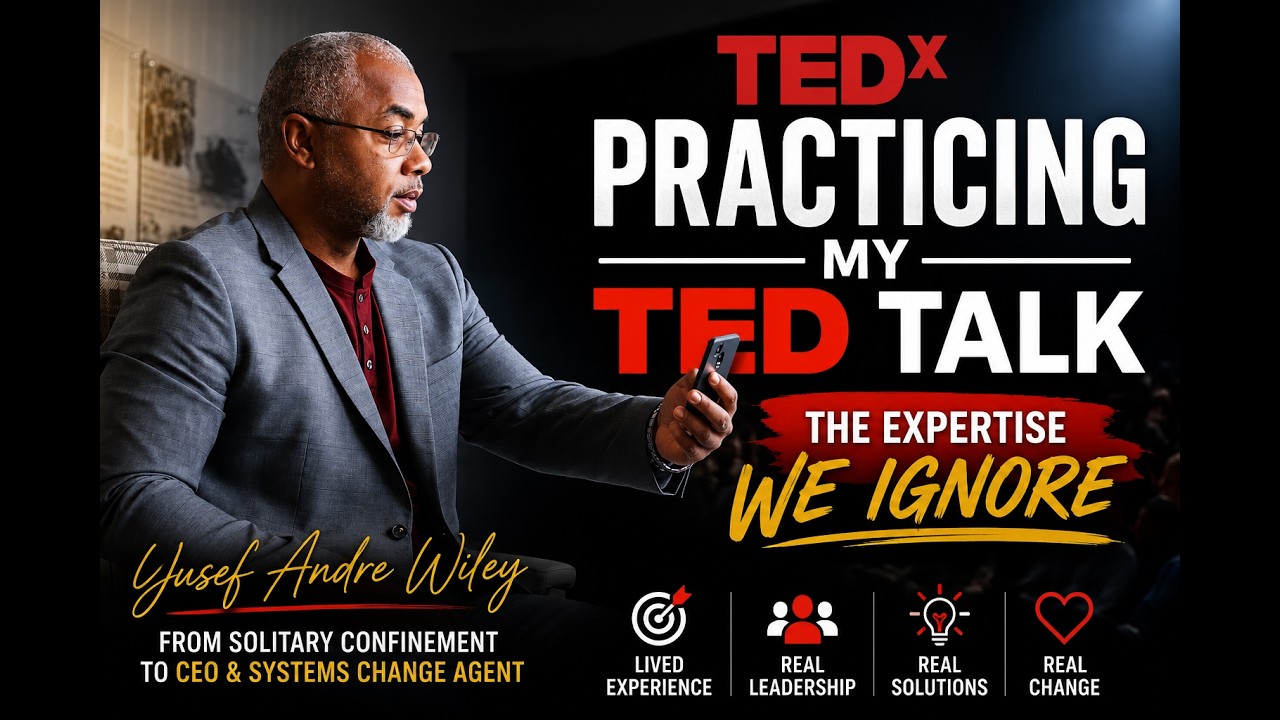
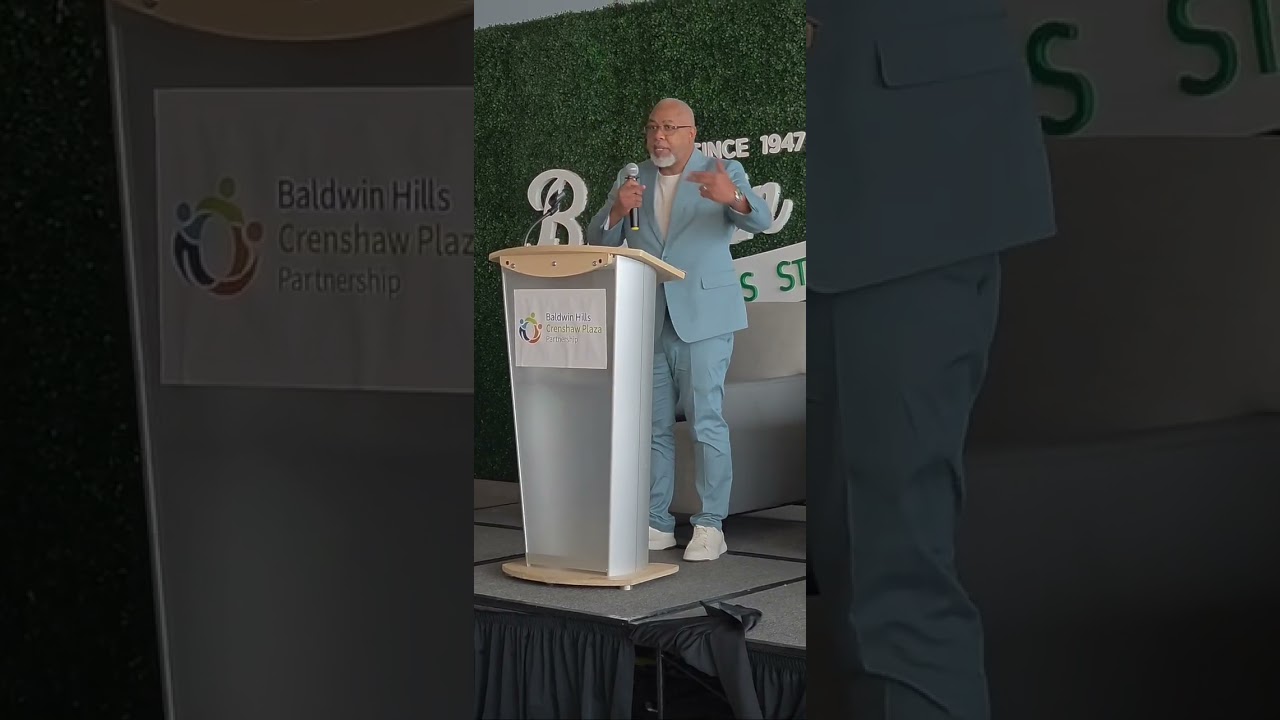
Yusef-Andre Wiley grew up in South Central LA gang culture, then created the Timeless Group while incarcerated. The workshops bring men into circles to confront trauma and rebuild. What started in prison now employs 120 people, 85% with criminal histories.
incarceration experience and what you ultimately have done for yourself and for other men and other community members. How does this speak to you and your work?
Yes, uh, first of all, I just want to say we have to recognize that Black people, Black men specifically, are in a lot of pain. We experience a lot of pain. And during the time I was incarcerated, Um, a group of us came together, Black men, and decided that we wanted to change. We literally decided that we wanted to change. We're talking about individuals that grew up mostly here in Los Angeles, South Central Los Angeles, that were former gang members. We were former gang members, Crips, Bloods. Um, during the time that Colors, the movie Colors— I'm sure y'all remember that movie, right? They began to glamorize gang activity with that movie, and I don't think people really understand the impact that that movie had on us. That was my generation in which Hollywood decided to glamorize gang violence, and only thing that did is basically justify who we were. At the time, not knowing who we should have been as Black men. We wasn't learning about, um, the roles that we played in history as leaders, as master builders, right? We were learning that we need to despise and hate each other. So during the time we was incarcerated, it just came to that point where, you know what, We have to stop this. And a group of us came together, and, um, a few weeks that went by as we were talking about how we were going to change. Initially, we talked about the courts and how we can get out of prison through the court system that we've been railroaded, right? Um, that was the conversation. But later, I started to think, I'm like You know, we— as we were reading the material, was saying things about rehabilitation in the material that we were reading that was put out by the California Department of Corrections. And it said rehabilitation. I— it just kept jumping out at me when it was saying rehabilitation. So we took a turn away from— that's not focused on the courts, that's focused on us. That's truly changed, because if we do get out from the courts, what are we going to do when we get back out there? Are we going to still be at war with each other? Are we still going to be fighting each other? Let's figure out what we going through. And that's when we began to discover our own traumas that we were raised with. Many of us, you know, coming from— I came from a two-parent home, but many of my friends didn't. The guys that I grew up with and hung out with, they didn't. You know, they come from different traumas. I have my own traumas. Of growing up in a community, in a neighborhood where Hollywood was what it was about. So the way we got Hollywood was gangbanging. Think about it. Think about the names that we were adopting, similar to, uh, uh, Al Capone. We were taking on those same names. Capone. I had homeboys with that same name. And that was how we got Hollywood. So when we got inside and realized all these things and we began to talk about it, that's when we came up with the theme, "It's never too late to change." And that became our theme after every workshop. Every time we did a workshop, we would always— we would get in the circle. Can you imagine this? A group of men getting in a circle holding hands. Right? It started off about 30 of us, and at the end of each workshop, we would say, on the count of 3, it's never too late to change. And that, that's still the theme to this day. You can go into some of the prisons right now in the state of California where the Timeless Group is still functioning as workshops, and that's still the closing of each workshop. And, um, so when I, when I see this here, um, how did it happen? How did it start? It started from reading. It started literally from reading. We wasn't reading. And many of us— and I'm gonna look at myself first— one of the reasons I began to take that turn— it gets real deep— when I took that turn to go bad, it was because I wasn't good at reading. When I was sitting in the classroom and the teacher called me out to read, that's when I became the class clown. I said, you know what, you know, I don't do that. So I became the class clown. That led to me becoming the class gang member, right? I found something else to do. But just think if that's— that teacher had to pull me to the side that day and said, Mr. Wiley, uh, are you struggling with breathing? Can we get you some help? That might have been a different human being from that point forward, right? So that's how we blend in. That was the way that we diverted that behavior. And when we realized— we have these conversations and we talk about this stuff. Like, how did you get in the game? How did you get involved? And, and this is what we started discovering. So, um, once we read and began to read, it went on and on and on to what you see today in Timex. We have about 120-something employees, uh, 85% of our workforce is, uh, system-impacted folks, right? So we come through the work.