Progressive Cooperation
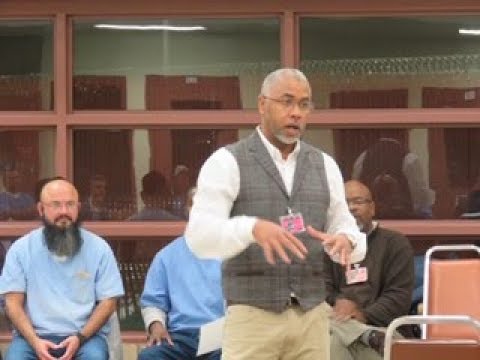
A speaker argues that "unity" is too vague to help Black and Latino communities in Southern California, especially those re-entering after incarceration. He proposes "progressive cooperation" instead: step-by-step collaboration among churches, nonprofits, and institutions to fight mass incarceration and homelessness. Three barriers block it: competitive boasting for funding, territorial attitudes, and media distraction.
Chapters
Greetings folks, um, I don't want to simply just talk about unity. I want to talk about something that I've termed progressive cooperation, progressive cooperation. And essentially what that means is this whole idea of moving towards something, something positive, beneficial step by step towards development, towards social reform or social benefit. So, because a lot of times we use the term unity when these conversations or these discussions are taking place, we often invoke unity and unity is often misused and it's a broad concept. So a lot of times when we use the term unity, uh, we have to really define what are we talking about? What are, what are we saying when we're talking about unity? Because in the sense of the word unity, when we talking about unity among races, unity among religions, unity among ideas, et cetera, it doesn't, it doesn't often work. So we really have to define, uh, the usage of the term unity when we use the term unity. So I want to use the term, uh, progressive cooperation. Progressive cooperation. And, you know, as it relates to our circumstances as African Americans, as Latinos, or, you know, the so-called minority in this society that we live in, um, this is a very, very, um, critical topic right now, uh, and I just want to hit some key points because, um, you know, I'm really struggling. I'm really struggling with, uh, what we're going through as a people. Uh, and I want to direct this specifically towards our people in Southern California where we're striving and working towards building a beautiful situation with our reentry population, with our population of individuals with barriers, whether those barriers are economic barriers, whether those barriers are educational barriers, whether those barriers are just due to incarceration or criminal convictions, et cetera. So there's a lot happening in our communities, and many of our communities are still unsafe. Very unsafe, and people are moving out. You know, our folks are moving out. We see other folks moving in, and that's not necessarily the idea. Why can't we just be in the community and we are able to implore this concept of progressive cooperation? And I want to talk about why. You know, first, Know that separation and prejudice and racism is ingrained in our society, and it has been for quite some time, uh, by the peoples of power who have manipulated us for, for centuries now on, you know, keeping us under the spell of false hope and self-satisfaction. We've been under this spell for a long time, and, um, and we just can't get out of it. It's like, you know, we're stuck in this time warp of, uh, non-progress— non-progressive actions, non-progressive attitudes and behaviors. And we need to figure out how to get out of it. And this is what we're trying to do. Um, we have a program that's coming up at LA Trade Tech, uh, on May 13th, and we're really, really trying to tackle some of these tough issues around mass incarceration, uh, re-entry services. You know, the situation that happened with the The officer in Whittier being gunned down by someone that's recently released from prison, that hurts. That hurts. It hurts us as well. It hurts us a lot. And we definitely empathize with those families, with the people that went through that difficult situation. And we feel like those of us that are service providers in this work of reentry, in this work of ending mass incarceration, We can do something about it. We just have to really, really get past a few things. So I want to look at some of the reasons why I believe that we're unable to, uh, bring this— not unity, as I said earlier, I think that term is not the correct term, but I want to say progressive cooperation— why we cannot progressively cooperate as individuals, as organizations, as churches, as leaders, you know, as organizations. That are doing similar work. And I really believe that a lot of it is related to, you know, this boastful competition. You know, we always, you know, we always in competition with each other. We hate to see another organization, another church, another community benefiting from funding or grants and, you know, having the ear or support of political entities, et cetera. And you know, we constantly at this, at each other's throat, fighting over crumbs, right? So we have to get past that. This addiction to flattery, this addiction to flattery and individualism. You know, we wanna, we really addicted to, oh, you so nice, you're doing such great work, you're so beautiful, you're so great, right? We just addicted to this flattery and this individualism. You know, wanna be identified as the one. The one, right? Like, like Jet Li, the one. And we want to be, uh, the ones that's just on the map. We want— we don't want other organizations to get any recognition. We don't want nobody else to be talked about in our space or around us. It's me, me, me, me, me, my organization, what I'm doing, instead of, you know, finding ways to, uh, progressively cooperate with each other. We have an issue progressively cooperating with each other. And then there's the envy. You know, we have envy and we hate to admit it. You know, we really, when we see people being awarded, you know, receiving big plaques, uh, we see people being, uh, saluted for their great work in the community and we have envy. And, and, and, and part of that envy, what it causes us to do, it pushes further away from these other organizations that we should be actually collaborating with, that we should be partnering with on projects, on, you know, getting to the root of the problems that exist in our communities and how to resolve them. Solve these problems in our community. We rather, you know, stay back on the sideline and watch and envy and say, well, my organization is better than this is what we're doing, right? And this is a problem. We have to get past this as a people. We just, you know, fighting over crumbs, fighting over space, fighting territory, very territorial as a people. And this exists not just in Southern California, it exists across the United States where, you know, these organizations exist. And in some cases you see cooperation, you do see progressive cooperation and unity, you know, in the sense of ideas with one another in various spaces. And then lastly, I want to say addiction to entertainment and television. Now, those of us that understand where I'm coming from, you know, we are so addicted to what's happening in the media. We're so addicted to, Uh, not just the media. I'm more so talking about, you know, reality TV, entertainment. You know, we're trying to be entertained. So many of the people that have not, uh, uh, come to join arms and lock hands with us are people that they just addicted to television. All they want to do is sit up and watch TV and be entertained. Now this is an old tradition, you know. Um, this is something that's been going on for ages. Now, you know, we can go all the way back to the Romans when the Colosseum, the concept of the Colosseum was first born. And, you know, the senators, you know, the Roman senators, you know, decided, hey, you know, if we give people food and play, you know, they keep them distracted, then we can kind of like be over here and do what we want to do. This is an old story. This is a very old story. You know, give people their toys. Give them things to play with, give them their cars, give them their, their, their, their video games, give them their entertainment, entertain them, sing to them, you know, sing songs to them, and you know, they'll be all right. And we'll stick to the business over here and run this country, run the world, right? Run the world while they play games, you know, let them, you you know, be entertained, you know, with sport and games. And this is where they have us. It's been a game that they've been playing with us for centuries. This is something is old, is the Romans, right? And before then. So we have to get out of that game and be the real players in the business. We have to be the real players in the business. And if we don't, we're gonna continue to lose. We're going to continue to lose out, and we're going to continue to lose out. And As I said, you know, the event that we're doing, it's not about us. In fact, there's several of us organizations that are cooperating progressively with each other, have decided to come together and do what we call Reentry Success Southern California, SoCal. So our objective is not to say me, me, me, me, look at me, look at what we're doing, but to introduce what we're doing and engender cooperation with others so that when others see what we have to offer, see what we're doing in the mix, that they can actually bring what they have and we can progressively cooperate with each other as organizations, as agencies, as, you know, institutions that's prepared to sit down face to face, eye to eye, have discussion, you know, exchange ideas, and get to the business of fixing our communities that are totally in shambles right now. You know, whether it's drug use, marijuana use, homelessness, you know, the lack of economic opportunity, educational resources, etc. In shambles because we refuse— it's— this is a huge space. Southern California is huge. It's humongous. And we're fighting over crumbs when we should be actually coming together as a people, as Black and Brown, cooperating with each other, getting to the business, getting to the root of the problems that exist in our community. There's plenty of room, there's plenty of space for us to work with each other instead of bickering and saying— and this even exists in the church, even in the religious communities, you know. You see it in the church, you see it in the masjids, you know. You walk in a place, people— you're not a part of my clique, my crew, you know, you don't get greetings. You know, people don't say assalamu alaikum to you. Uh, people don't say how you doing. They looking upside your face, inside your head, saying, you know, what do you want? What are you doing here? He's in my space. You know, territorial, right? And don't want to share, right? And then it goes even beyond that, you know, even in a church, you know, if it's not the right denomination— you're not my denomination, you know, we believe in, you know, this aspect of our doctrine, and you have this type of doctrine, and we don't get along, so we can't share the same space. This is ridiculous. We have to get past it. And if we don't get past it, we're going to continue to be looking for other— looking way over there. Let's look in Washington. Let's look in these other places and see who's going to come help us fix us. Who's going to help us fix us? We need to look over here. We need a better leader. We need somebody to come Help me fix myself. That's our problem right now in our society because we refuse to come face to face. We have— we don't realize how powerful we are. We literally don't realize how powerful we are. Look at me, uh, ex-felon, a gangbanger thug in, in South Los Angeles running around. Just imagine, just imagine if I had got out of prison, right? If I had got out of prison with no lesson learned, just got out of prison and been back in the streets, you know, instigating foolishness, instigating corruption and crime and, you know, hanging out and, you know, selling drugs and talking to the little homies saying, I'm the big homie, let's do this, let's put this lick down, let's rob this and rob that. Just imagine if I had got out with that, how worse off the community would be with me being back free. So just imagine if we can reverse that, look at that and see what, you know— and I'm not trying to toot my own horn, I'm only simply saying, just imagine if I had came out with a different attitude. So just think how many people, how many lives we can be changing if we get with the business, get with the work. Stop bickering, bring your organizations together. Let's come together. There's things, there's synergy that we can find between each other that can make us go out into our communities and do some awesome work. And we shouldn't care who gets the feather in the cap. We shouldn't care about a feather in the cap. We should be caring about the work that needs to be done in our community because our community is in shambles. I left 20-something years ago and went to prison and came back, and in my community I seen the same people on the street. I seen the same people with a 40-ounce in their hand walking down the street, could barely talk, right? After 20-something years, I come back, they stood there. The streets that I left that looked like bombs been dropped on them, big old— just, just tore up in Compton, right? Tore up, destroyed in Compton, you know, same streets with the big potholes, tear your car up, still the same. Nothing has changed because why? We're not united. While we're not progressively cooperating with each other and getting the business done. And this is what it's going to take, folks. You know, let's get together. Let's stop playing. You know, we can do it. All we have to do is stop looking at each other as rivals.
More from Yusef-Andre


Are you a Democrat or a Republican? How do you feel about adding a third party? #democracy

Luxury Fragrance Store coming soon. Dukhan Khafif #ould #luxurylifestyle #luxuryfragrances