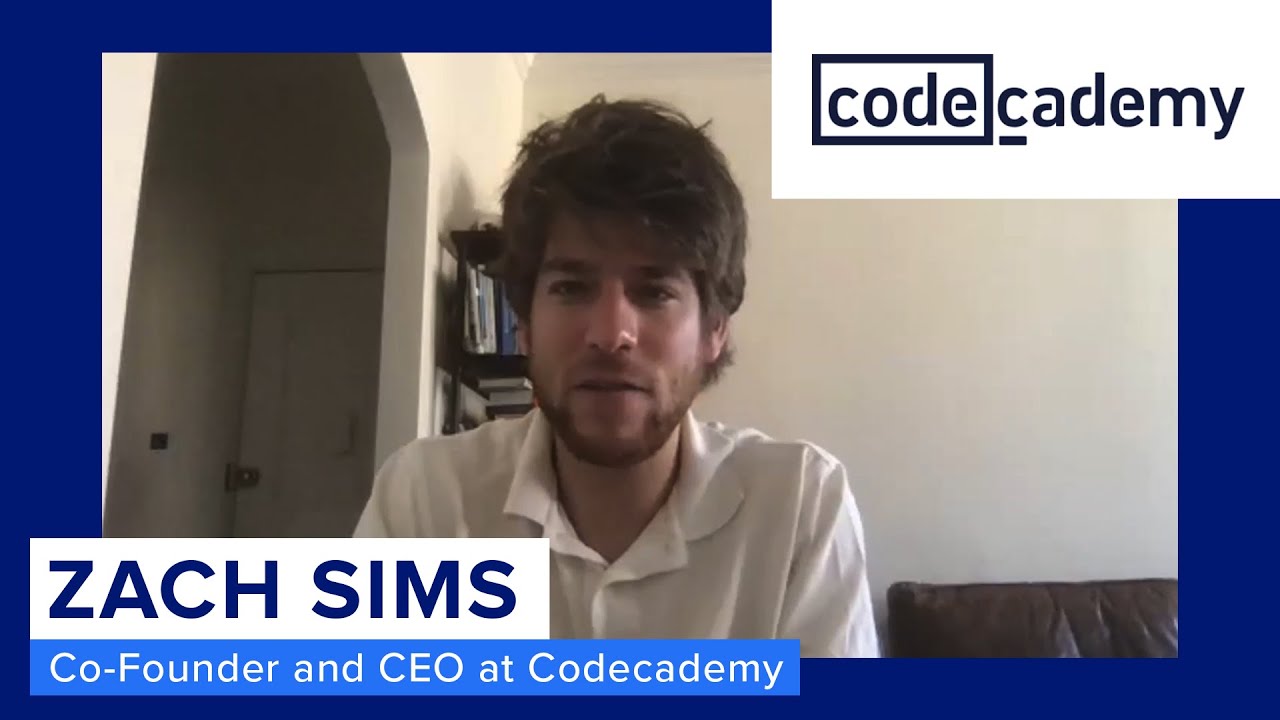
In this interview on The Startup, host Rebecca Jarvis talks with Zach Sims, the 22‑year‑old co‑founder and CEO of Codecademy. Sims recounts how he and a fellow 23‑year‑old left college, moved to Silicon Valley, and built a prototype of Codecademy while living on ramen and working 20‑hour days in a rented house. After launching, the platform attracted a few hundred thousand users within weeks and grew to several million users across many countries, with strong uptake in Brazil, Russia, India, China, the UK and the United States. Sims frames coding as the most important 21st‑century skill, highlighting a gap between what schools teach and what employers need—specifically modern web technologies such as Ruby, Python and JavaScript. He argues that Codecademy offers a fun, accessible, online alternative to costly college programs. The company is not yet generating revenue; Sims says they are exploring future monetization models but are currently focused on product development. Investors are reportedly comfortable with the vision and market size despite the lack of profit, and Sims believes that many consumer‑internet startups succeed without early revenue. The interview ends with a brief wrap‑up.
Chapters
Welcome to The Startup. I'm Rebecca Jarvis. And we're joined by Zach Sims, co-founder and CEO of Codecademy. Great to have you with us.
Thank you for having me.
So you're 22, right?
Yep.
And your story is such a quintessential startup story. You go to Silicon Valley, you rent a house, and then what?
Uh, and then start a company, uh, with eating ramen, you know, with another 23-year-old at the time, uh, and And here we are.
How did you start to learn how to code in the first place?
So I'd been reading books and watching videos and actually working with my co-founder. I just found the whole process to be super frustrating. So at the end of the day, we built something that I think was better.
How did you build it though? I mean, when you're starting out building Codecademy, what is Codecademy today? How did you begin?
So we basically thought about what we would have wanted to learn from. And what we would need to build it. You know, build something fun and interactive. And basically designed everything first and then sat down for 3 weeks and, you know, didn't get out much and built a prototype.
What does that mean, didn't get out much?
Means worked like 20 hours a day. Yeah. Didn't leave the apartment.
And then what?
And then launched it and had a couple hundred thousand people use the site in the first couple weeks that we were around. But it's been amazing to see what happens in 1 year. You know, we have a few million users at this point. Spread out across tons of different countries. And I think it's amazing to see that kind of an impact.
Where has it caught on the most rapidly?
Still biggest country-wise here, but we're seeing a lot of developed countries like Brazil, Russia, India, China, the UK, which is not a developing country, but have really seen tremendous population sizes join Codecademy.
What's the vision 5 years from now?
I think we're building the way for anyone to learn how to program online and learn what we think is the most important skill of the 21st century. We're seeing this, this gulf between what people are learning in school and what they need on the job, uh, and, you know, providing something that's fun and accessible in the middle to help them bridge that gap, uh, is very important, and programming is the way to do it.
So rather than going to a community college, for example, to further your education and paying $8,000 a year, you could go online from the comforts of your home and learn a skill that might help you on the job.
Definitely. I think it's— and it's not just community colleges, you know, there are a lot of schools where students are paying $50,000, $60,000 a year for a degree that when they leave won't necessarily mean very much to employers.
What do you hear from employers? What's the skill that they want the most?
I think, you know, employers are looking for people that are skilled in modern web technologies, you know, Ruby, Python, JavaScript. And what we're finding is those are things that aren't necessarily taught in most college curriculums. So there's definitely, even for people that are majoring in computer science, there's room for them to learn something practical with Codecademy in order to find a job.
Did you know that going in?
Definitely. I mean, I had taken a few computer science courses at Columbia and learned Java and a bunch of sort of older technologies. And had to teach myself the modern technologies on the side. So we knew that there was really no way for people to pick those things up in an institutional or structured setting.
How are you making money?
We don't make money yet.
You don't?
No.
Does that concern you?
It doesn't, not now. I think, you know, we found there are a bunch of different ways that we will foreseeably make money in the future, a bunch of pilots that we've run with people so far to see how that would work. And I think right now we're just focused on building the product.
How will it work?
I think that we'll talk about when we build it out.
So your investors are probably saying to you, Zach, please don't tell them how you're gonna make money. That's the special sauce.
I think our investors are happy with the way things are going, yeah.
How do you sell them on an idea that has no profits?
I think we sell them on the vision market size, right? If you look at how fragmented and broken education is today and what we've been able to do in a few short months at this point, I think the possibilities are really endless. And I think if you look at a lot of consumer internet and even enterprise businesses that start off with just a product and without any profit revenue, You know, great things can still happen.
All right. Well, it's great talking with you, Zach Sims.
Thanks for having me.
Great to meet you.
Yeah.
Thanks. And thank you for watching us on The Startup. Remember, if there's someone you'd like to see here, tweet us @RebeccaJarvis #TheStartup.