Zach Sims - Co-Founder and CEO of Codecademy

Zach Sims dropped out of Columbia to start Codecademy, an interactive coding platform that went from dozens of users to thousands after a viral Hacker News launch. The site now has millions of users, 70% outside the US, with plans for certifications, school partnerships, and mobile learning.
Chapters
Distribution provided by CloudSigma, the cloud that adapts to you. Today's episode of This Week in Startups is brought to you by New Relic. Visit newrelic.com/twist and see why thousands of developers worldwide don't deploy without it. And by GoToMeeting. Sign up for GoToMeeting using promo code TWIST to begin your free trial. Hey everybody, hey everybody, it's Jason Calacanis. And this is This Week in Startups. I'm back in my hometown, I'm back in New York. And we've got an amazing couple of shows I'm going to tape while I'm here for Joanne Wilson's 15th anniversary of MAUS benefit. I came out to pay my respects to Joanne Wilson who's being honored tonight here in Manhattan. And I said, "Hey, who's doing interesting stuff in New York? Who are the top entrepreneurs? Who's really breaking new ground and making cool stuff?" And of course Codecademy is the company that everybody's buzzing about here. Zach Sims is gonna be with us. He's the founder and CEO, co-founder I should say. They raised a bunch of money from Union Square. They raised a bunch of money from Index. They raised a bunch of money from Mary Meeker at Kleiner. These are some of the top investors. Why are they interested? Stick with us. Codecademy is teaching the world to code. It's a revolutionary product. It's a great founder. It's going to be a very educational episode for all of us, including myself. Stick with us. Hey everybody, welcome to This Week in Startups, the program where we talk about creating companies, founding, putting a dent in the universe. And today's going to be a great episode. With me is Zach Sims of Codecademy. Codecademy, you leave out the A there to get that Codecademy. He's a co-founder and CEO, Columbia University dropout. He was previously doing strategy at GroupMe, which was sold to Skype, and Drop.io, which was sold to Facebook. Some experience in venture capital at AOL Ventures, very nice. Named to Inc. Magazine's 30 Under 30 and Forbes Magazine's 30 Under 30 list. I remember when I used to be on all those lists. And he was named a New York City Venture Fellow in 2013, whatever the hell that is. What the hell is that? What's a Venture Fellow? What's the program? Zach Sims. The city, the city runs it.
Funds to have entrepreneurs help other entrepreneurs and give them exposure to the city.
Ah, got it, got it. So, um, wow, you lived a little bit of life here. Uh, you look like you're 21 years old.
How old are you? 23.
You're 23?
As of last week, yeah, yeah.
You're 23?
Yeah.
And you've worked for 2 companies that have been sold already. When did you start working in startups?
So I started, uh, I started a bunch of my own companies when I was in high school, uh, and then Drop.io was really my first startup.
Yeah.
But I kinda started a few of my own, like, eBay businesses and whatnot when I was in high school.
So, when was the first one?
Probably when I was 13 or 14. Yeah. And then I was blogging for a bit. I wrote for a blog called Rev2.
Ah, yeah. I remember that. Yeah.
Yeah.
So, you're 12 or 13 and you find out about businesses running on the internet. Yeah. How did you happen to stumble upon that? Did you have, like— was your dad into it or your uncle or—
No. My— I sort of— so, I was given an iPod and wanted an iPod case, and then I realized that, like, a lot of other people wanted them too. Uh, and there were all these great cases being made in China, but not being sold in the US. Uh, so I imported a bunch of stuff and sold it on eBay. Um, sort of opened my own store for a while. And the coolest part was like, no one knew that I was 12 or 13.
So, how many of these cases are you moving? And how'd you source them in China?
Yeah, it was a couple thousand. Uh, I sort of like found a bunch of, uh, factories that were making them and selling them in bulk and wholesaling. Um, and no one was really like retailing them effectively and branding them and whatnot.
So what'd you do, you called them? Yeah. On the phone, you emailed them, called and emailed. So you call Shenzhen or Shanghai.
Yeah.
And your parents see like a $72 phone, you Skype probably.
Yeah, Skype.
You Skype to China. Yeah. And what do you do? You go to say, hey, Pop, I need to buy 1,000 cases and they're $4 each. Can I get 4 dimes?
It's basically like, can I get, you know, a couple hundred dollars to go do this? And, you know, that I'd gotten from like working odd jobs and a little bit for my parents. And then turned it on eBay and then used the profits to buy more and kind of grow things.
And your parents are probably shaking their heads like, who is this?
Yeah, they didn't really have any idea what was going on.
Yeah, that's hysterical. But there's a lot of people like that. Did you meet a lot of, like, teenagers doing business kind of when you were doing that?
Yep. Definitely met a bunch of people doing that.
Yeah. Yeah. It's amazing. It's like a whole contingent of, like, high school entrepreneurship now. Yeah.—
It's, you know, the old expression like on the internet, no one knows you're a dog. It's like no one knows you're like 12 or 13.— Exactly.
This guy in Shenzhen is negotiating with me for an extra 25 cents per unit.—
I think my voice cracked at some point, and someone may have had an idea that I was a little younger than I let on.
Yeah.— You had to get like a voice filter?—
Yeah, it's like—
I was calling about the iPod cases. So you get accepted to Columbia.
Yep.
And that's fantastic. That's a BFD, as we say. You're a kid from Connecticut. Your mom must be thrilled. Thrilled that you got into the Ivy League. What is that like? Top 5 school, top 10 school. How long did you last?
3 years, 3 years.
Oh my God, and so you break your mom's heart. You're 3, you go home for Thanksgiving or Christmas or something, and Passover or whatever, and you say, Kwanzaa, you say, "Mom, I'm quitting school 75% of the way there." Take me to that conversation.
When I was working at GroupMe, I was sort of one of the first people that started working there with Jared and Steve at the time, along with a couple others started at the same time. I almost dropped out of school at the beginning of GroupMe, almost dropped out of school in the next semester, and then when I decided that I wasn't leaving school for GroupMe, I started working on some stuff in January, I think, 2011, with my co-founder Ryan. And kept telling my parents and said that this might be something we wanna get real about, and that summer we got into Y Combinator, did YC, and then I told my parents as soon as I got into YC that I had to give this a go. It's like something I had always wanted.
And what was mom's reaction? What was dad's reaction that like you couldn't finish the one more year, one year and a semester?
I think it took a little acclimating. Like originally, you know, they had said like, "Well, can't you just put this on hold and like pick up where you left in a year?" But at that point, you know, we had started building Codecademy. I think we had launched Codecademy by the point I definitively decided to drop out. We had a couple hundred thousand people that were users of the site. And it just was like, If not now, when?
Yeah. And so they got comfortable with it. Yeah. What was the original moment that you realized Codecademy needed to exist in the world?
So I was teaching myself to program. So when I was in high school and college, I sort of taught myself a little bit of PHP, took a few computer science classes, but never really picked it up enough to become an engineer until I started working full-time on something with Ryan, and Ryan actually had taught people to program in high school and college. And so as I was picking this up, reading books, like throwing books out the window, you know, smashing my computer screen as I was being, you know, angry with the videos I was watching, needed to create something better that was like interactive, had you learn by doing, and actually mirrored the real process that like the best developers learned to code with.
Yeah, and so what is the product? If somebody comes to Codecademy, how is it different than a Lynda course, or Buying Python for Dummies.
Yep, so Codecademy is like totally, it's totally interactive and it's totally community-based. So I've had hundreds of thousands of people have created their own courses on Codecademy, whether it's like intro to Python or something very specific in Ruby. And then they all kind of get ranked by quality as people rate them. And it's totally, for the user, it's totally interactive. So they're taking something where they're always learning by doing. There's no videos, there's no tedious text. You know, they hit the homepage, they start coding, and they see the result as soon as they're working on things.
So. You come and it says type hello world kind of thing into the screen. And it's kind of gamified, right? I mean, how important is the fact that you're doing, not telling people how to do? I mean, and how did you make that decision? Because before that, let's be honest, you know, state of the art was make a video, you know, and, or maybe connect people over, you know, video conferencing to do one-on-one teaching. This idea that you would actually play a game and do it, I mean, there's been, There's very few examples of that. I'm trying to think, like Mavis Beacon teaches typing. There's been a couple of math games that were kind of famous in the CD-ROM era where people actually did the work and got interactivity. But interactivity was kind of forgotten for a while in favor of video. Definitely.
Yup. And I think, you know, what we've seen is like we want people to learn concepts by discovering basically. You know, they go through things, they mess it up on their own, or they learn by doing correctly. I think there's a lot of people that have done research into this. You know, Nicholas Negroponte and the OLPC project, for instance, like airdropping laptops into Africa and seeing if people can become literate in 8 or 9 months sort of by discovering these concepts on their own. Find that that's the way the best people have learned to program, right? You talk to the best developers, they hit a wall, they learned how to fix things, you know, they got frustrated, they found a way. And I think we wanted to create that kind of series of aha moments where like you were amazed by what you were doing as opposed to like being bored watching a video or sitting in a college lecture.
Incredibly hard to execute though, I would suspect.
Definitely, yeah. But it's— how would it be fun if it wasn't?
Now you have to make a tool, though. I mean, it's one thing to write, you know, a 10-part lesson or a 20-part lesson in code, but you decided to build a platform that people could build coding experiences in. I mean, that's very meta.
Yep, definitely.
How hard is that?
Super hard. I think, you know, if you search JavaScript tutorial on Google, there are, you know, millions and millions of results of things that people have created that great content that never gets discovered, never gets seen, and it's really boring most of the time. And so we offer these people the opportunity to get their classes taken by millions and millions of people and have the reputational benefit of that happening. And so far, hundreds of thousands of them have created courses and benefited.
So how many people have actually used the product in the 2 years since it's been out there?
It's a few million at this point.
A few million? Yeah. So when we get back, I want to talk to you about growth.
Yep.
And how you actually got those 2 million people, because it's one thing to build a product. It's another thing to get 2 million people to use it. —when we get back from this very important partner message. Ah, New Relic, New Relic. What an amazing product. Love New Relic, and it's just so great to have them as a sponsor of the program. Here you can see on my screen the browser load times. If you've got a startup, you need to know how fast your application is. You need to know how fast your servers are. You need to know how fast your transport level is. You need to know speed is the biggest driver of user behavior. That was a big thing at Google. It was a big thing Marissa worked on when she got to Yahoo!— was speeding everything up.. And there's a reason for that. We don't like slow services. Slow services suck. And we all know that, right? I mean, look at Friendster, died because it was slow. MySpace had problems with speed. And Twitter, in fact, almost died because they were so slow and unreliable. New Relic helps you avoid death by slowness. Death by being unstable. You can monitor the real user experience. You can monitor the code level performance and see which part of your code is sucking— or not sucking, depending on the situation. And of course, server resources, which is critical. You know, are you killing your CPU? Are you killing your RAM? Is it— are you out of storage space? What's going on, right? And you need to be able to do that. They have 40,000 customers. 40,000! Including Skullcandy, Spotify, Skullcandy— Skullcandy, not Sandy. Skullcandy, Spotify, Nike, Zillow, Vonage. You may have heard of a couple of these companies. Of course you have. Developers across the spectrum trust their critical performance. To New Relic. And if you want superpower visibility into all your web mobile apps, sign up today and you'll get a TWiST t-shirt for free. Oh yeah, here's the email. Oh God, the email is so great. I get the email and I see, "Oh, 99.93 uptime." And then you get like a maniac like me as the CEO, like, "What's going on with this 0.07 downtime?" Right? You can be like, "Grrr," all curmudgeonly about why is this taking so long. But these guys get it. And they get our audience. That's why they created this dedicated URL, newrelic.com/twist. New Relic newrelic.com/twist. And you see on the bottom right here, create a free account, get a TWiST t-shirt. Awesome! The only place to get that TWiST t-shirt with the samurai look, with the samurai sword on it, right? Be a samurai, not a rice picker. Is available through New Relic. Super fast, super easy, and no credit card is required. Thanks again to my friends at New Relic. And you go ahead and thank @newrelic on your Twitter handle. Let's get back to this great episode. Thanks again, New Relic. Perfect. Fancy cameras. We just redid all the gear. We got these great like Sony cameras that are like stunning. But unfortunately we have to leave 3 behind because they're taping another episode. Really? Of Kevin Pollak Show. Maybe we need to buy a 5th. We just buy a 5th. You can do it right now.
She's like, I desperately want to buy a 5th.
Yeah, go ahead and buy a 5th so we have So we can do two things at the same time. Okay, and we're back. Thanks to our partner for sponsoring the program. We left our hero Zach Sims of Codecademy, which by the way, it's Codecademy, leave out the A, dot com. Codecademy.com. Go check it out. And Zach, you can find on Twitter @ZSims. 2 million people, couple million people have used the product. Millions of people have used the product. How did you get that first the first couple hundred, couple thousand people into the product, and then how hard was it to scale after that?
So we were very lucky when we built the first version of the product. We had built something in a couple of weeks. I think it was a little bit more than a month. Basically for me, we built someone who knew a little bit of programming, but didn't want to download an editor, didn't want to pick a language, just make it super simple to get started. We only had 10 lessons when we started. Put the site online on a Friday afternoon after a lot of people told us it wasn't worth putting online. We made a bet, my co-founder and I, we installed Chartbeat, made a bet that there would never be more than 50 people on the site at the same time the first couple of weeks. And then we went and we got, I think, bagels or something at the time in Mountain View. And someone posted it to Hacker News, and by the time we came back, there were 5,000 concurrent people on the site at the same time.
Which, by the way, is the limit of Chartbeat. Yeah, it's pretty insane.
I think you might have had more. Yeah, it was—
I think that's the Chartbeat limit when you have the free account, 5,000 concurrents.
And so we watched over the next couple of days. We didn't sleep for, I think it was at least 3 or 4 days, trying to make sure that this thing that we had built for 3 or 4 people to use would scale to, eventually it was 200,000 people in 3 or 4 days that had ended up using Codecademy at the beginning. I think we built a really tight viral loop. Made it easy once you got started, share it with your friends. It just made it super easy to get started. And you didn't need to sign up when we started things.
And it has a sense of fun, I think. Yeah. How important is that?
I think very important. I think the, we call it consumer education. We're creating something that's fun, fun for people to do. So it's not just about, like, God, I have to do, you know, Codecademy today. It's like part of my homework. But it's something you want to look forward to. And I think we kind of realized that it's a new category when we had mothers emailing us saying, you know, their kids stopped playing Xbox to do Codecademy, which I think is a real, like, breakthrough moment as opposed to, you know, they're doing Xbox to get away from Codecademy. Can anybody learn to code? I think so. Anyone can learn the basics. I think becoming, you know, a great computer scientist is the same way becoming a great chemist, a great biologist, a great writer is hard.
And so how far can the average American with a high school degree go, do you think? Can they go— can any American with a high school diploma, GED, become employed as a coder with Codecademy today, would you say? Or do you still have work to do?
I think so. I mean, I think we always have work to do. I think we have a lot of users who have gone from from jobs to new jobs that involve programming, right? So whether it's going from mechanic or a plumber to becoming a programmer or sysadmin, it's not always a straight programming job, and most of these people are not working at Google, but they learn the skills to really help them make, you know, $20,000, $30,000 more a year. But really the most important thing with any of this is dedication, right? It's do you have the drive to come back and put the time in?
In your estimation, what does it take to become a good to be a good and then a great programmer? What do you think the core personality type is or skill is?
I think you have to like solving problems. That's fundamentally what programming is about. And so, you have to like hitting walls and finding a way to surmount them, 'cause that's what bug squashing is most of the time, right? It's like looking something in the face, knowing you messed something up, and reading through hundreds of lines of code to figure out where you messed up and figuring out how to fix it. If you don't have that drive and that focus, That's a problem.
When do most people give up? I mean, you must monitor this and track this. What are the points at which most people give up, and how do you try to get them to break through those points?
I think we try to get people to realize that this is hard, but we make it a lot easier than it would have been otherwise. So we kind of start with baby steps, start with people getting the joy of creating something, which I think is different from a lot of other experiences. It's not like read a book and then make like Hello World. It's make Hello World, make a few things, get really excited about it, and realize that this is actually really fun. But we still see people drop out, you know, a little bit into that process when they realize, you know, they won't be creating Facebook on day 2. Right.
Yeah. And how is this going to impact higher education and the workforce? I mean, you went to an Ivy League school. You probably spent $100,000 on 3 years.
Was it worth it? I think there's kind of going to be a separation of what, what is worth it in higher education. Right. I think the top 25 schools, you know, will still maintain some sort of cachet, right, where you go to a certain school, doors will be open because of the people you meet, because you have that name on your degree, whether that's good or not. I think, you know, kind of remains to be seen. Right. Or fair or not. Yeah. Right. Or fair or not. Right. Depending on, you know, admissions criteria and whatnot. But I think after that, you're seeing a lot of schools that are kind of struggling to find their place. Right. If you're an English— I was a poli sci major at Columbia. If I was a poli sci major somewhere else, I don't know if I had graduated, the same job opportunities would have been available to me.
And even Columbia, you come out with poli sci, like, there's not a zillion jobs out there for that degree.
So I think what we're seeing is a shift in education towards things, or what we should see, is a shift towards things that are more practical, help people find more jobs. And I think that's what our focus has been, is stop thinking about, a lot of people think of higher education as like, spend $80,000 or $200,000, and the ROI will be higher earnings for the rest of your career, and that equation just doesn't work anymore.. And what does, and I think is, you know, learning real skills, focusing for a certain amount of time in order to do that, whether it's on Codecademy or elsewhere, and then finding a job because of the skills you've acquired.
What does it cost? It's free. Okay. And how do you make money?
So we don't make money now. Okay.
So you're specifically in that mode as a startup company of scale? Yep. And you're 2 years in though. You've been fabulously funded by the biggest names in the biz. Union Square Ventures, you went to Y Combinator. Yep. Which is a big deal. Then Union Square, then Mary Meeker from Kleiner, formerly of Morgan Stanley, internet analyst, and Index Ventures. So you've got plenty of money, but at some point you're gonna wanna make money. Is it as simple as just charging for courses? I don't think so.
I think we wanna create something different. You know, what we have now on the site is a network of millions and millions of people that are learning and teaching to each other. And there are, I think, a bunch of natural ways to make money on top of that to enhance those users' experiences as opposed to create a barrier to access.
So you want it always to be free?
I think we want the content to be free, yeah.
And then maybe pay for paper, pay for certifications, pay for some kind of testing?
I think we'll see, yeah.
Yeah. That seems to be where Coursera and those other guys are going, is pay for some sort of certification. Treehouse has that too. Have you played with Treehouse?
I've played Treehouse, yeah.
What do you think of their systems, the sort of— getting badges and getting certified, and Coursera getting certified.
Yep, I think there's a lot of interesting things going on in education. I think we're kind of seeing the early separation of the market. There's MOOCs, I think, just like Udacity, Coursera, and whatnot. There's companies like Treehouse and us that are more focused on vocational education. I think we're sort of in early days for a lot of those companies, yeah.
MOOC, for people who don't know, Massively—
Massively Open Online Course. Massively Open Online Course, right? Not the greatest branding.
It's terrible. Yeah. I mean, a MOOC in a Scorsese film is an idiot. Yeah. But I think that's M-O-O-K. And I don't think it's an acronym. But MOOC, Massively Online— Massively Open Online Course. Yeah, and they seem to be going for free, $100 to take a proctored exam. What do you think about that? Is the proctored exam a— important part of this process for people who are hiring? Because you must have people putting on their resumes at this point that they went to Codecademy, correct? Definitely. But they can't prove they took the course, can they?
They can't. But what we're doing is we're creating something different, right? We're creating something that's not a college course where, like, you occasionally submit homework. Yeah. But every single step of the way you're being evaluated. So your entire history of code submissions, entire history of projects that you've built. In the future, it's not inconceivable that we could actually match that with something you actually do in an assessment or something like that to see how well you match up to your past behavior on your own as well.
And when people hire coders, how often do they look at their code?
Often. I think almost all the time, right?
Yeah, I would hope.
I think we're operating in the one industry that is hopefully becoming more and more merit-based, right? When we run interviews at Codecademy, you know, you come in and you write code. We don't care where you went to school. We just care, you know, what your product's like. What about height? Weight? Unfortunately, don't care about those things. Ethnicity? None of them. Sexual preference?
Nope. Parents' income? Nope. Just are they good at programming?
Where you live? Body odor?
No. Code. I mean, that's all that people matter. So you're telling me that coding and programming and the technology industry is a meritocracy? You believe that?
I don't think it's a meritocracy.
You don't think it's filled with racists who pick based on age and gender?
I think some people do. Really, you do? Come on.
I mean, if you're Google and you need a coder, do you think they care?
I mean, they don't care if you have one arm. Hopefully it's meritocracy, right? I mean, but what do you think?
What does Zach think? I mean, at this point in time, you are in the coding space. Do you think anybody, I mean, any meaningful percentage of people makes a decision based on anything other than your ability to get the job done? It's coding and culture, right?
Culture is still an important aspect. Especially a small company, right? Like, A, can you have the skills to get the job done, but B, like, are you going to work in a way that complements the rest of the team?
Yeah, and so, do you guys work on that piece, on being a good part of a developer culture? I do. Do you think that that's something you could actually teach, like how to be collaborative?
I think it depends, right? Like, is the development culture at Insight the same way it is at Codecademy? I think it's different.
Or Foursquare, yeah.
Right, exactly. And how do you work? Do you work with PMs? Do you work, you know, with designers? Is it waterfall? Is it lean? I think all these things depend, right, especially on where you want to work, what the process is there.
What about adding apprenticeship to the offering? So, you know, internships are kind of— they're kind of illegal today, actually. Like, you can't actually have any. I don't know if you know these laws.
You had written about this, right? Apprenticeship?
Yeah, I think I've written about it. I mean, at least in California. I don't know about in New York right now, but if you give somebody who's an intern any kind of real work to do that somebody would get paid to do, you can actually get sued. Well, they have to be paid, yeah. They have to be paid, so in which case, why are you doing an internship? You wanna just hire somebody? So do you think that there's, you know, since you've reinvented college essentially, and learning the skill, do you think there's an opportunity to reinvent that next piece? 'Cause it does seem to me that the next logical piece after Codecademy is, hey, you need to work with a group and start learning how to collaborate. I mean, I could see very much Codecademy having Codecademy apprenticeships where I pay you $1,000 a month for 3 months to be part of a developer team where I'm getting mentored by somebody. Yep.
Has that come up on the roadmap? So we've already seen this kind of happen organically. It's a little crazy. Really? You know, there are people in our community who are coming together, creating companies, working for other companies without any interaction from us. Wow. So, you know, something definitely we could support in the future. It's happening organically now.
So people— tell me about that. What's an example of it?
So there's a company, I think, I'm trying to remember exactly, what they're building. But it's 5 or 6 people that came together. We have a community of moderators, and then a wider community with a groups product that we've built. And they just start a group on Codecademy, and they're building a product. They're tracking their progress in a forum, and they're committing on GitHub. So it's come from, like, we learned code on Codecademy, met each other on Codecademy, are tracking progress on Codecademy, and then their code is on GitHub, and hopefully eventually they'll launch something. That's fantastic.
Yeah. And tell me about the groups. Product, or is it just a forum, or?
It's basically, it allows schools, you know, countries, companies to get together and, you know, track how people are doing in individual small groups. So we have a lot of schools, it's more than 7,000 or 8,000 that use Codecademy in school. So it's sort of a safe place for them to kind of get together and talk about what they're learning and track progress. Got it. And do they pay for that?
Is that a revenue stream? Not now.
Oh, right. You have no revenue.
Yeah. Do people, When you say you don't have revenue 2 years in, you know, at what point did the VC say to you reasonably, like, it's time to turn on revenue? And do you have a, you know, a timeline for that from your VCs, or is that something you just pick yourself? I mean, some people who are starting companies don't understand that concept of building to scale and then turning on monetization. Explain your— the pressure you're under to do that, or the lack of pressure.
For sure. We've been really lucky. You know, we work with, I think, some of the best people in the business. And Union Square in particular has seen a lot of these businesses get created before, right? Look at Tumblr. If you look at Twitter. Companies that have kind of reached meaningful revenue scale after building to scale. I think that said, we're experimenting with revenue now a lot sooner than I think a lot of other companies would. I think this isn't something that we want to build as like a hobby or just a product. That you want to be a company. And in order to be a real company, there need to be revenues. There need to be profits. And you need to be able to be self-sustainable over the long term. And I don't— we don't want to build to be acquired. We want to build to be a real company in the long term.
What do you think this company looks like in 5 years? I mean, if you guys stay focused, keep scaling the way it's scaling, when people look at it, at Codecademy, 5 years from now, which would be 2018, what will it look like? Yeah, 5 years is a long time. It is, considering you've been working in the internet business for 10. You started at 13, you're 23 now, so you've been in it for 10 years, but take, you know, think about it for a second. 5 years from now, you got how many people? 30 people now? Yep. I'm guessing 30. It's 18, yeah. 18, okay. You got 18 people now. 5 years from now, where do you think you'll be?
So I think we change the way that people learn skills and find jobs. And so I think, you know, we now teach people to program. We help them find jobs, or we will foreseeably eventually help them find jobs in programming. And we want to teach skills in an interesting way that helps people, you know, stay motivated and stay focused, and things that are relevant, right? So I think, you know, I don't want to call this a vocational school, but I think we're teaching relevant skills that help people create things and find jobs.
So you kind of slipped up there a little bit. You said you were experimenting, and you said you're helping place people. Are you— have you experimented with placing people?
No, we haven't.
But there are companies in the system. So explain what those companies are doing in the system. Did you invite them in there, or did they like peek in and be like, hey, we need coders?
So all of our profiles are public, so companies can sort of go through profiles anyway, the same way any individual can go through profiles.
Like a LinkedIn profile?
Is it— it's sort of— it's just like, what have you accomplished on the site? How well have you done? What have you Did you finish? When did you finish it? Sort of like a report card, essentially. So right now, no one pays for that. It's all, you know, anyone can get access to it.
So would I be correct in assuming Google, Facebook, and Yahoo are all looking at information in there? Are those type of companies looking at profiles?
Those are companies that have reached out in the past, yeah.
So they're, 'cause you track IP addresses, you're seeing the biggest companies in the world looking at the progress of people.
Definitely. I mean, I think as to whether or not that translates into a product eventually kind of remains to be seen, but I think—
Well, obviously, that's the best way to do it. I mean, they're paying— how much does a Google spend to land a programmer?
All in. A lot of money. What do you think? Somewhere around like $20,000 or $30,000.
Really? Yeah. And that's— 'cause they— what does a headhunter charge these days?
Right, around— I mean, if you're hiring through a headhunter, you're paying at least, you know, $10,000 to $20,000 an engineer.
Yeah, and then so internally they've got hundreds of full-time people trying to find engineers. If you could provide them a place to sort of— are you— are people coming through the system ready for a job at Google, or do you think they need like an intermediate step?
I think they definitely need an intermediate step most of the time. You know, I think there's no reason why we can't be that intermediate step in the future too. Ah, I see.
Some of the MOOCs are starting to— people are self- organizing on the MOOCs around real-world presence. So people in other countries are saying, oh, I can take MIT courses on— or Coursera or Udacity courses on machine learning, let's say, and computer science. We're going to get a conference room like we're sitting in here at WeWork. This is a little plug. Thank you, WeWork, for giving us the space. And they might say, oh, let's get a conference room at WeWork, beautiful space. And just sit here and do the courses together and get that sort of vibe going and motivate each other and, you know, maybe fill in each other's skill gaps. Do you see that happening at Codecademy yet?
So we have meetups in more than 350 cities at this point. Wow. They're all self-organized the same way. You know, we've worked with Meetup to help provide a way for people to find each other and get together. Meetup.com. Meetup.com, yeah. And, you know, it's crazy. There's meetups, you know, anywhere, pretty much any big city in the world, you can think of, there's been a meetup.
And you're not tracking how people get jobs yet. Right. You haven't closed that loop, but you have a pretty good idea because you'll have people anecdotally telling you.
Definitely. I mean, we keep track of success stories, as it were. We get a lot of inbound from people, and if you go to Codecademy.com/stories, there's a lot of stories of people kind of going from zero to getting hired somewhere, or becoming an assistant man or a DB admin or something like that as well.
All right, when we get back from commercial break, uh, and a very important sponsor message, I want to talk about the global footprint of this, because obviously coding is something that's gone global. And for a long time, we've been outsourcing to India, Eastern Europe, and we're sort of seeing that flatten out. So I want to get an idea of what percentage of people in the platform are non-US when we get back from this important break. Okay, listen, this is the easiest ad read for me to do in the world. GoToMeeting. Meeting is believing. Look, I'm not gonna even break my eye contact. I use GoToMeeting multiple times a week, and by— I mean, probably a dozen, 6 to 12 times a week for the last 4, 5, 6 years, I have used GoToMeeting. Meeting is believing. I can connect to GoToMeeting on my iPad, my iPhone, any device, any computer. It uses HD faces. I can switch the controls from me to another person. I can dial in on the phone, or I can use VoIP, Voice over IP, right? I use my speaker and my headphones. And you know what? Sometimes during a call, my phone has problems, my phone battery dies, whatever, and then I switch over to my computer. My computer has problem, the Wi-Fi wherever I am, the hotel, the airport, lounge. It's foobar. Look it up. Foobar. Can't say it on the program or else I have to put something in the swear jar. But things can go foobar, and you just gracefully, gracefully— they probably didn't even put this in the ad read for me, but man, switching between dialing in on a phone and going to VoIP, just click, done. And sharing who's the presenter, click, doop, done. It's so easy to use, and I can make you the presenter, and then I can present your computer, and I can have control of it. I can record the call. There's just a million great features, and it always works, and it's always stable, and it's always perfect. Perfect. Flawless. You just send somebody a URL, they click on that URL, or you give them the meeting ID, and it works. And the meeting starts on time. And you know what? If you want to be a professional, you want your meeting to start on time. So go to GoToMeeting. Go to GoToMeeting and click the "Try It Free" button. Use the promo code TWIST. "Try It Free" button, use the promo code TWIST. Meeting is believing. Please go sign up for free and use that TWIST. Use that TWIST code. It's very, very important. They've been sponsoring this program for 3 years plus, and I really love the product., and I really love them for supporting the entrepreneurs on this program. Meeting is believing, and it's the one solution you need. And you know what? You want to be professional. Those free options, you get what you pay for. The meetings never start on time, they always have quality issues, and with all the dedicated service, hardware resources, and software that these guys and gals over at GoToMeeting have put to work, there's no— I mean, there's a reason they got 9.6 out of 10 on web conferencing awards. They're just awesome at what they do, and you can use any device. You can even be the presenter from your iPad, which, which is pretty crazy. I'm gonna probably do that when I'm at the beach with my daughter this summer. HD Face is a great feature as well. Uh, you know, people used to spend a quarter million dollars putting in these systems to their conference rooms, and now you get GoToMeeting at under 1% of that cost. It's unbelievable. Drop everything and sign up right now for GoToMeeting. 3, 2. Hey, and we're back. Um, I'm here with Zach Sims, the co-founder and CEO CEO of Codecademy. That's Codecademy without an A, so codecademy.com, the place where you can learn how to code instantly. You go to the homepage and you're starting to code, and a lot of great people have learned to code there, moved on to high-paying jobs. But this is a very global phenomenon. You've got a lot of aspirational people in South America, China, India, even in Africa, looking at the space saying, hey, I want to have a better life for myself, my family. My country, and they know coding is the way to do it, they know high-tech skills. What percentage of people coming to Codecademy are non-US?
So it's more than 70% of people on Codecademy are non-US at this point, and we are, you know, mostly still in English, so I think that's sort of definitely a testament to—
More than 70%? Because the average website is usually 60/40 US to non-US, or 50/50. You're a magnitude more international. Is that by intent? Have you focused on growing internationally? Definitely.
I mean, I think any big internet business in the future will be global, right? As more people are— they're lighting up, you know, more, more computers, more mobile phones outside of the US. I think that's one of the biggest opportunities, especially for us, to extend, you know, and franchise people with skills.
So what is the biggest country outside the US right now?
It's the UK, which Okay, and after—
is it gonna be one of these like follow the English language like Australia, Canada, New Zealand?
No, it's pretty much from there, it's like China, Russia, India.
China, Russia, India? And at what point would I be surprised by a country? 'Cause obviously I would think China, Russia, and India, of course.
So we have a lot of users in Estonia, 'cause we're used in a lot of Estonian schools. Sure. Malaysia, for instance, used in a lot of Malaysian schools as well, yeah. I think you should start—
I have another business model for you. Start a stock index fund based on the countries that are disproportionately using the platform, right? I mean, they're gonna— Start raising money now. Exactly. Just buy the technology index in those countries, 'cause they're gonna do well. And the governments from there, are they starting to ping you and say, "Hey, can we pay to localize this? Have you thought about localizing languages?" And how does one go about that?
Definitely. So our community has actually localized a lot of content. They've localized a lot of the site in a couple different countries. Farsi from a group of people that are in Iran, for instance, that have translated the site.
Explain how you go about having the users localize, translate the site.
Yep. So we, I think we use OneSky app is the product we use. OneSky app? Yeah. We've built our own internal translation infrastructure also for people to translate both courses and translate the site itself.
So you're crowdsourcing that? Yeah. How does that actually manifest itself to the user? Do you recognize they're from an IP address? And then you just say, "Help us translate?" Yep. And they do?
Most of the time, yeah.
Wow. Yeah. And then how do you verify?
You have somebody check and say, "Is that a good translation?" So we usually have a few like moderators or sort of authority figures in each country. You know, in some countries it is people in that— people that are— that have partnerships with us. So Malaysia, you know, we work with the Malaysian government. So they've looked at a bunch of the translations. In Colombia, you know, Spanish translations are looked at by Colombian government. —so we have— Are the governments paying you? Governments are not paying. They just— They help translate. Yeah. Help translate and distribute.
That seems like another fantastic way to make money, to just ask the government for $1 million to put in the schools, like a licensing fee and a tool for schools. Is that something that you think could wind up on the roadmap?
Something we get asked for a lot.
You get asked for a lot. Yeah. Very coy way of saying, "Maybe. We'll see, Jason." For those of you listening for the first time, a lot of times entrepreneurs don't want to tip their cards, and then it's my job to sort of handicap it. I think there's an 80% chance you'd do that one. 'cause that seems like a layup. Following Khan Academy, they seem to be doing a lot of what you're doing now. Like they started with videos and now they're starting to build dashboards for schools. How important are tools for teachers?
I think somewhat important. You know, as I mentioned, we're in somewhere between 7,000 and 8,000 schools at this point. I think that is not where we're, you know, best used a lot of the time. I think we have basic tools for teachers. We have toolkits that we send to teachers. So we're very hands-off. You know, we support a lot of after-school programs. We'd love to be in more schools, and we've grown organically, but we definitely, when I say we don't wanna be in schools, I mean we don't wanna work top-down. So we've worked very bottom-up. All of those teachers came to us. They get this package in the mail that tells them how to teach a class after school, and we haven't worked with school districts per se.
What do computer science programs at universities that are getting paid $20,000, $30,000, $40,000 a year, think of Codecademy? Are they threatened or is it a tool for them?
I think it's both. I think, you know, we're used in a lot of computer science classes. So Brown, for instance, they use us in their introductory computer science classes, I think. And we're used in a couple of other universities, Pace, elsewhere.
Pace here in New York? Yeah, down by the Brooklyn Bridge. Yeah. That's a real blue-collar school. I went to Fordham. Fordham and Pace, for people who don't know, are like, if you can't get into Columbia or your parents can't afford it, you go to Fordham or Pace for half the price. Yeah. So they're using it in their program.
Yes, they're using it in their program. And I think, you know, at the same time, we don't want to be threatening to that. We're just different, I think. But some of them are threatened. Sure. I think we provide something different. We provide something that's more hands-on, career-oriented, gives you skills that you can actually build something with, and, you know, relevant skills most of the time.
What do you think of this flip the classroom model people are talking about where, you know, instead of having the sage on the stage, you've got the guide on the side and people do— you know, the lesson, they listen to the lesson, they listen to the teacher offline, and then they come in the classroom and actually do work. You're actually having them do the work that would be in this sort of flipping the classroom, which a lot of people attribute to Khan Academy. You're actually the guide on the side, aren't you? Like, you're not the sage on the stage, you're the guide on the side. Right, definitely.
I think we can provide a— It's like a double flip. Yeah, we can provide a little bit of the sage on the stage, you know, I think you're learning while you are doing the exercise, kind of blended the two together. Lecture, as opposed to, you know, just having like reading and write— reading outside of class, doing exercises in class, kind of reading and doing exercise at the same time.
So, but you are the exercises, so in a way it's a double flip. Yeah. So what is the classroom then become if it's not the lecture, it's not the exercises, what is the value of the classroom? Like if you were running a school, what would you do in that classroom?
I think the classroom becomes a place for facilitation and for, communication. You know, I think one of the most valuable things you can get in college is, you know, you learn a lot more from your peers than you do from the classroom most of the time. And I think that social setting is still super valuable.
Huh. Any— because there is another Codecademy, which has since changed its name. They've been on the program in Chicago. They changed their name to Starter League. Starter League. So they have a physical come-learn JavaScript, or I think it was Ruby or something. Yeah, they do a Ruby class., and they've done 4 or 5 of them. It seems to do a pretty good job. They charge $3,000 or $4,000. They got a business model already out of the gate. Ever think, "Hey, maybe we should be doing that?" Or do they actually use Codecademy? Does Starter League use Codecademy?
So I don't know if Starter League themselves do, but I know that a lot of programs similar to Starter League, you know, Dev Bootcamp and whatnot, do use Codecademy as a sort of starter curriculum to get people rolling. And I think, you know, we, we are probably one of the biggest, I think I think last time I visited Dev BootCamp, we asked how many of the people in the class had used Codecademy before Dev BootCamp, and almost every hand went up. Wow. So I think we're sort of educating the market for them a lot of the time.
So do you ever think you'll have in-person classes? Do you ever think you'll, I mean, you have the meetups you're sort of facilitating, but people do need to, I think on a motivation basis, some contingent of people need to show up somewhere and sit in a room with other people to get that motivation. Do you agree with that, or?
I think that will always be necessary for a certain type of people, and I think, you know, the meetups could develop into something like that. I think, as to how involved we'll be, like, I think it's, it's not really a focus.
How far in terms of skill does the courseware go right now?
I think we can get someone to being a competent junior developer is where, is where we can get you now.
And what about those next, you know, so okay, I get you to a 7, right? Let's say out of 10, 6 and 7, which is great. You can now go to work at a startup. How do you— can you teach through your methodology to get to that 8, 9, 10 level, or is that only through, you know, the massive frustration of actually building cutting-edge, you know, apps and programs and projects? You can get there.
I think there are just a lot of different skill is that sort of when you choose to specialize, right? It's, ah, what language do I want to learn? Which, you know, we help you do on Codecademy. But like, what do I want to be very good at? And a lot of the time that's project-based, right? Like, I have to work with someone on building something or work at a company and learn from others. So I think eventually we can definitely provide like that kind of structure for people. But getting from a junior developer to a senior developer oftentimes requires like on-the-job training.
Interesting. What's the biggest challenge been for the team so far? I mean, what is the most— because it seems like everything's going so well, there has to be something that is difficult and frustrating at Codecademy. What is it?
I'm sure you've heard this before, hiring is hard, right? I think what we've— what I found, it's very frustrating to interview lots and lots of people and decide not to hire them and, you know, eventually know that it's the right decision. But even scaling a team, you know, it's been— we scaled the site pretty greatly gracefully, but I think scaling the team has been a challenge to keep pace with what we need and still find and keep great people.
So even the person who has millions of developers developing skills is having a hard time finding people. Yep. And why do you think that is? Is it just that as you've grown and you now have 18 people and a successful product, you're more finicky?
You're more discerning? Definitely. We only, you know, we only look for the best, but I'm sure everyone says that, right?. So I think we've definitely gotten more defined in exactly what we're looking for. But great developers are hard to find. You know, they're hard to find here. They're hard to find in LA, I'm sure, and in San Francisco too.
I find that if they love the vertical and the space, it's easy. Yep. So when I was doing Mahalo, that was not difficult 'cause people like search. But when I did— started Inside, which is in the news space, and God, it was so easy because developers love news, they love Hacker News, they love Reddit, they love anything news related. I would think that, don't hackers and really great coders love education and teaching other people how to program? Yes. It's gotta be a massive advantage you have over somebody going to work for a software as a service enterprise, you know, project management or billing or Wall Street, na na na, you know.
I think it's— E-commerce site.— it's sexier, you know, it's— it makes a real difference in the world, I think, is definitely what we do. And we pitch that to developers, and, you know, we've had great success getting people in the door, but it's oftentimes like whether we want them to work for the company is hard to discern.
And what about New York City as a place to get developers? It's incredibly expensive to operate here. You have incredible competition from Foursquare, Tumblr, Gilt, other people who are doing great stuff here. And actually, we're here today on the day that the Tumblr-Yahoo announcement has been announced, the acquisition. Is New York harder, easier? Do people from around the country wanna move here, to the Valley? What is your experience? 'Cause you were in the Valley for Y Combinator, obviously, and then you chose to move here. Is that right? Yep. So how'd you make that decision?
So people definitely, New York is a different place. You and I had talked about this before. It's a place where you can be challenged by diversity outside of technology, and I think that definitely informs a lot of what we do. Is not always for people in the tech world, right? We're building for the random New Yorker on the street who might wanna learn to program, not for the developer in San Francisco who just wants to learn a little bit more. And I think it helps us stay closer to our users, and people definitely wanna move here. It's different than San Francisco, I think, but you can just build as big of a company here as you can there.
And venture capital bias against New York seems to have evaporated with Fred Wilson in Union Square and Brad and those guys absolutely crushing it. Is my perception correct?
I think there are still some investors who look at you funny when you tell them you're in New York, but for the most part, you know, we've had— we met with a lot of great investors. I'm lucky enough to work with, I think, some of the best, as you mentioned.
Oh yeah, 3 of the top 15 for sure.
And they definitely don't have a bias against New York.
Yeah, if anything, they have a bias for hustlers, and New York is fill with them. Yep. You mentioned 70% international, but I had no mention of mobile yet. And it would seem to me, if you're going to try to go after Africa, India, China, Eastern Europe, even South America, Codecademy on your mobile phone, in between calls for— as an Uber driver, or for somebody who's making lattes in a café, being able to code in short bursts and do micro lessons on a mobile phone would be the holy grail. What have you done in mobile? What are you planning to do?
So we haven't done much in mobile. The site works on mobile, works on tablets. OK. So it's mobile friendly. It's mobile friendly. But it's not mobile first. It is not mobile first. I think, you know, programming probably one of the last things to move mobile, right? I think programming on a small touch keyboard is much more challenging than it is on a desktop. That said, it's definitely something we think about a lot.
And what do you think the mobile experience would be then? Because you're saying, hey, do you need to have a full keyboard and monitor to do it well? Or could you even make these sort of micro lessons I'm envisioning right now on mobile that just sort of gives you some kind of uptick when you're not in front of a computer.
I think it's what you, what you mentioned. It's something very different than what we have now.
Yeah. Yeah. Are you building that? Well, give me something here, Zach.
We're not building it now.
You're not building it right now? So what business models, you know, obviously as an entrepreneur, you're keeping all your doors open, but what business models, you mentioned one that you're not gonna do, which is charge the end users. You wanna philosophically get as many people into the top of the funnel. What have you looked at and said, no, no, no, no? That's obviously not the way to go. What have you eliminated?
I think we've looked at schools a lot, and I think selling to schools is like a battlefield. If you look in, a lot of companies in the '90s that started tried to sell to schools. Very hard to do. So we have a lot of schools that have offered to pay us, and it's kind of, it's not necessarily at the top of our list of things to do yet.
What about doing a school program where, like Yammer, when you, a bunch of people in an organization with the same domain name can kind of sign up for Yammer, the company pays nothing. You know, if a bunch of people at IBM sign up with @IBM for Yammer, nobody pays until there's 600 people on it and somebody says, you know what, I wanna delete these old messages and put people into groups and have some top-down management, and they turn that on. Seems to me that if you got, you know, 300 people at Time Inc. learning to code, giving them some sort of dashboard to manage all that activity would be just Super brilliant.
Definitely. I mean, this has happened, so, you know, we've worked with Rakuten, American Express, a few other big companies.
Oh, really?
Yeah. They use Codecademy internally for training.
Yeah, so they want to have some kind of dashboard, but there isn't one yet. There's not one. That, to me, the dashboard sounds absolutely phenomenal. It would seem to me that a place like LinkedIn would very much want to buy you guys. They ever asked to buy you guys? Ever sent feelers? No. God, what an amazing thing that would be if the biggest marketplace for people started providing skills. You think that'll ever happen? Because they, they have started to define skills. I don't know if you noticed that on LinkedIn where it's like how good of a coder this person is, and that's just pure assessment. Yep. I mean, at some point there's got to be a way to plug in your profile to theirs.
For sure. I mean, it's certainly something we thought about. How do we, you know, work with LinkedIn? How do we, you know, I think a lot of our users, if you search Codecademy on LinkedIn, a lot of our users put it as like a place they've worked or credential. So it's happening organically too.
Well, listen, Zach, this has been amazingly insightful. I wish you the best of luck with it. It's an incredible product. I played with it myself. If you're thinking about getting into coding or if even if you're not thinking about getting into coding, it's kind of good to learn to code, isn't it? Yep. No matter what. No matter what. It gives you like some ability to sort of learn the logic. So go ahead and go to Codecademy, everybody, and try it. And you guys have Codecademy, the Twitter handle? We do, yeah. So everybody follow Codecademy. What's next? I mean, what are you really proud of that's going to be coming soon?
I think making the learning experience better. You know, we focus— what we've realized is like the thing that keeps people coming back is that it's fun to learn and that the content is great. And I think that's—
So just hyper-focused on the experience. How do you assess that now that you've got the product out there in market? Do you do listening labs? Yeah, it's a lot of user interviews.
It's a lot of looking at the data.
Ah, so explain, unpack that a little bit, 'cause that's an interesting lesson. How do you do user assessment?
What's the technique? So we do basic user interviews, you know, so we pick like 30 or 40 users to sample, and then we run them through Skype and sort of sample from different geographies, sample from where they fell off in the funnel, and then run an interview. You know, ask how they use the product, ask how they like to use the product, how the product makes them feel, you know, how they wish the product made them feel.
Is that a dedicated position inside the company? Not yet. Yeah. That would be a really cool dedicated position. It's just, that person becomes almost like the truth seeker. Who does it now? You do it, or? Our community team does it. Ah. Yeah. 'Cause it does seem like if that person could bring some bias to the situation. You almost feel like you need to have a neutral third party. Yeah. And what do you do? Just email them and say, hey, can we give you a $25 gift card or something like that? The old $25 gift card. The listening lab stuff was something we did early in Mahalo, and I had a great— Eric Stevens, who now works at Etsy, I believe, did these great listening labs where they would bring people into a room Give them $25 or $50 gift card and just say like, "Hey, your friend sent you this website, Mahalo.com. Take a look at it and use it and just say out loud what you're thinking." And he would videotape them and the screen and then he would stitch them together. Incredible to watch people actually use your product.
Definitely lots of insights. Yeah, that's definitely what we've seen.
Have you videotaped users using your product?
Yeah, we do user testing like that too. So user interviews and user testing to watch how people actually use the product.
God, is that humbling as a founder, isn't it? When you watch people like—
You realize how much trouble they have sometimes. And it's like, hit the start button.
And they're like, what am I supposed to do now? And it's like, hit— it says hit the start button to begin. And they're like, what am I doing? What am I supposed to do?
They're like, you want to grab the person by the throat.
Read what's on the screen, motherfucker. Melon Farmer. Anyway, Zach, listen, I wish you all the success in the world. Congratulations. Great to see somebody in New York absolutely tearing it up on a very technological basis. Now, what's your co-founder's name? Ryan. Ryan. So tell Ryan we said hi. And you can follow Zach Sims @ZSims on Twitter. And Codecademy, very much worth $1,000 a month, $500 a month. $250 a month, $25 a month, but you can get it now for the great price of $0 per month, and it's gonna be free for life. And you worked at AOL Ventures for a little bit? Yeah.
How long did that last? Uh, it was about, about 3 months. It was a summer internship.
Oh, summer internship. Very good. All right. Hey, listen, it's been a great episode, and thank you to our partners and sponsors, and thanks to Zach to be on the program. Go ahead and check out Codecademy and tweet and tell all your friends about it. All right, we'll see you next time on This Week in Startups.
More from Zach


Teaching Millions of People to Code with Zach Sims, Co-Founder & CEO of Codecademy

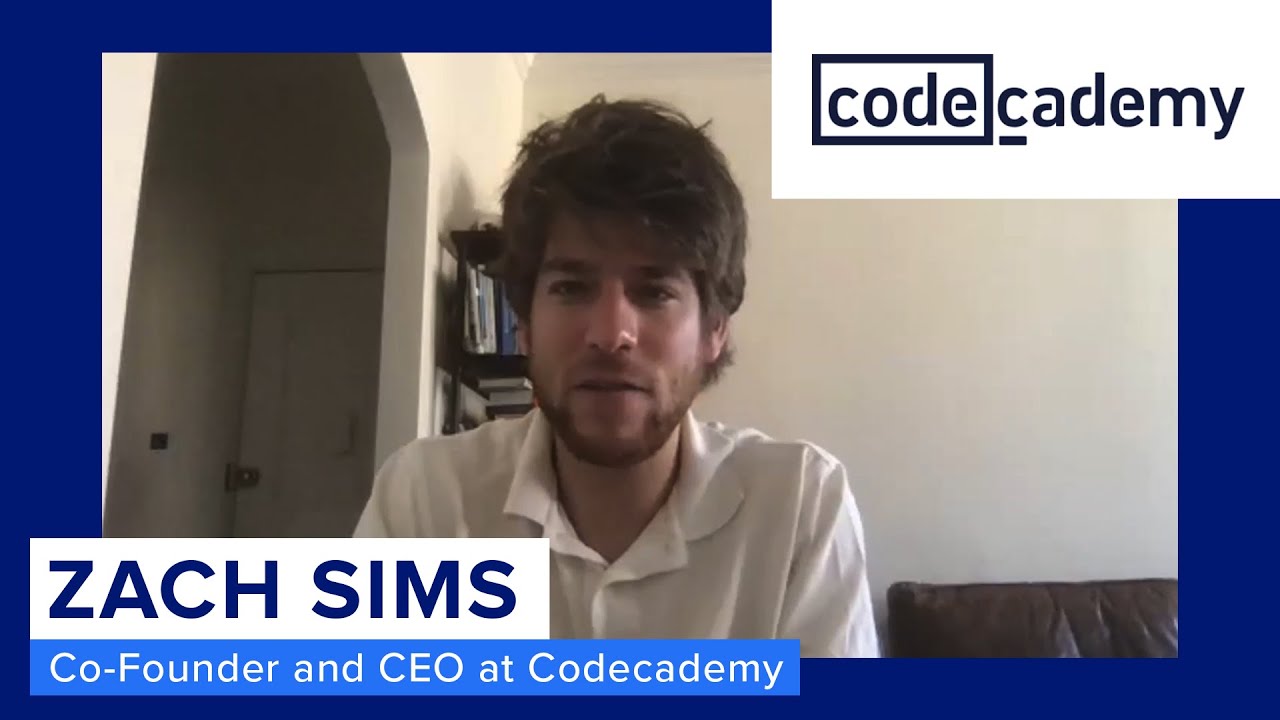
Zach Sims (Codecademy Co-Founder and CEO) gives career advice to students during WayUp Lunch & Learn