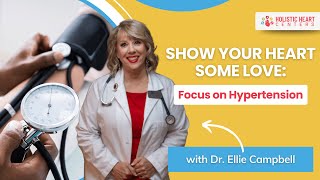
Show Your Heart Some Love: Focus on Hypertension
Transcript of a recorded conversation (Feb/February recording near Valentine’s Day) between Dr. Regina Drews (holistic cardiologist, host) and Dr. Ellie Campbell (primary care functional medicine doctor, author of The Blood Pressure Blueprint) focusing on hypertension: causes, measurement best-practices, root-cause evaluation, and management strategies. Key themes include prevalence of elevated BP, white-coat vs masked hypertension, home vs ambulatory BP monitoring, common missed contributors (sleep apnea, dental infection, inflammation, obesity, toxins, stress/cortisol, insulin resistance), testing and workup (sleep testing, labs, vascular scanning), lifestyle interventions (diet, alcohol cessation, sleep, stress reduction, weight loss), and clinical decision principles for when to start medications.
Chapters
Welcome to Own youn heart health. I'm Dr. Regina Drews, your holistic cardiologist. This week we will dive into common heart health concerns, uncovering root causes and unpacking scientific discoveries and controversies. The information provided does not constitute medical advice. Please contact your healthcare practitioner before making any changes that may impact your health. Welcome, everybody. I am very excited today. This is an episode that is being recorded, right, literally a day before Valentine's Day. And, you know, here I am with my wonderful guest, Dr. Ellie Campbell, who is all heart. You know, she is a great mentor, a great friend, and a really top notch primary care functional medicine doctor who is focused on cardiometabolic health and all things that have to do with health and longevity in general. Dr. Ellie, welcome to the show.
Thank you so much. It's my honor to be here. And we chose Valentine's Day to do this recording because cardiovascular disease is the number one killer in our country of men and women. And it doesn't have to be. We can take it off the list if we are willing to get the tests and do the work. And so I think that it is enlightening to patients to know that they have power and that with the right coaching and the right guidance that they can make a huge difference in their blood pressure and their cardiometabolic health and then their risk for heart attack and stroke.
100%. 100%. And I think this is so important for everyone who is listening to us to realize that sometimes I see patients or just us adults, right? We want to find a magic bullet. We want to find this magical solution, a magical wand. But there really isn't a magic wand. Everything that your body is capable of, you can unlock. You just have to have a right person to help you follow the right steps for that unlocking to happen. And so in your example, right, you recently released a book on hypertension. Here it is. It's called the Blood Pressure Blueprint, which I read quickly, I have to admit, I have to be honest.
But I do like it's an easy read. It's an easy read subject, but I don't think it's a boring book.
Not at all. It's very practical. So I actually did enjoy reading it. It sort of doesn't have a lot of the extra, more complicated things that people sometimes find in the hypertension books. But I think it's very practical. It's very sort of user friendly. So, Ellie, you, considering that you are in the primary care functional medicine space, why hypertension? Tell me, how did you come to choose this topic. Why this topic? You know, what. What are sort of the path of development in this.
Yeah, well, it's kind of. It's kind of a funny story, actually. I think the book is a Trojan horse, you know? A Trojan horse?
Yes.
In ancient Greece, Helen of Troy sent a horse to her opponents as a gift, and they gladly accepted the gift, not knowing that there were soldiers hiding inside of it that took over the city and won the battle. So what was disguised as a gift actually had really important things inside. And that's what my book is. My book is really a book about everything that every functional medicine doctor talks about, which is the fundamentals of wellness. Eat clean food and drink clean water and exercise and pray and meditate and spend time in nature and get good sleep. Sleep and have a purpose in your life. And those are fundamentals for everyone. But it's a really boring book. Nobody wanted to read it because people.
Didn'T find the magical solution. Right, Right. You could have said, let's sprinkle some magnesium or let's sprinkle some omega 3 fatty acids and add a little glutathione, and poof, you know, your hypertension will magically disappear. But as Dr. Ellie tells us, no, no and no. Right. It's all about work.
So.
So.
I'll tell you the story of Dee, because it really is what brought me to this book. So I'm a primary care family medicine doctor. I've been doing this job for almost 35 years. I've got a lot of experience, and for a while, one of my specialties was helping infertile women conceive. So did a lot of work mostly on thyroid adrenals and progesterone, detoxifying their life. And we got a lot of ladies pregnant, and there are about 100 babies born that were supposedly infertile. So that was a wonderful part of my career, and I was really happy. And Cheryl came to see me at the age of 42, wanting to have a baby, having failed fertility clinic, because they said her egg and her husband's sperm were incompatible and they could not have a child. And she said, but we already have one son, so I don't think your calculations are correct. See, this friend of mine says she's got a friend that had a baby from Dr. Campbell, so maybe we can try. So. So we got Cheryl pregnant, and she had a child at the age of 42, another second son, and everything was marvelous. And she said, Boy, Dr. Campbell, you're really good with hormones. I think my mother needs to see you okay? As a family practice doctor, that's like, thrilling to me right now. I have the child, the mother and the grandmother, the whole family.
You have three generations. Yes, all three generations in there, you.
Know, and that's just a blessing to be on that journey with that whole family throughout their life cycles. And so I started seeing the grandmother, and she had high blood pressure, which we treated conventionally and followed the best evidence based guidelines. She had high cholesterol, we treated that and we put her on bioidentical hormone therapy, which changed her life because she was young and vibrant and spunky and she liked to four wheel with the grandkids and like she was in the bookkeeper to the family business. One day her daughter called me, panicked, and said, mother did not come in for work today. She drove over to her house. She looked in every door, every window. She found her mother crumpled on the floor, conscious, barely breathing, paralyzed on one side of her body. She'd had a massive stroke. They brought her to the stroke center undetermined length of time. She wasn't a candidate for the magical.
Stroke for the Clock Busters.
Yep, the timing was too long. So she had to go to the stroke rehab hospital across the street. And she joked with me it was going to take a lot of physical therapy, rehab to get that dragging leg fixed so she could go line dancing again. And then about day four of her hospitalization, she developed this tragic complication called hemorrhagic transformation. And what that is, is where the blood vessel that was damaged by the stroke burst open. She developed a brain hemorrhage and Dee died. And when I got that phone call, I felt like I had been punched in the gut. I felt like something so wrong had just happened. Because our system failed us. I followed the best evidence based guidelines. I took care of her the best conventionally and integratively that I knew how. And she had a fatal stroke. So something in my system was missing. Something, something in my system of evaluating patients was lacking that I didn't know. I didn't know. So I spent three years going to every conference that I could think of to try to understand cardiometabolic health and what might I have missed? And when I learned the secret, I called her daughter and I said, cheryl, I think I know what happened to your mother. Is it possible that in the weeks leading up to her stroke that your mother had a dental problem? She goes, well, yeah. Why do you ask? I said, because I have now learned that mouth bacteria can get in the bloodstream and cause plaque rupture, and they can be the trigger for a stroke. She goes, well, she had a toothache, she was putting antibiotics, she was supposed to have that tooth extracted the next week, but she never made it to that appointment.
So that acute inflammation is a powerful trigger.
Almost certainly, and we have no way to know, but almost certainly that acute inflammation of that dental infection was the straw on the camel's back. Now, in retrospect, I never tested her for sleep apnea, I never tested her for impaired glucose tolerance. So there were some other things that I may have missed along the way.
Yeah. Some other milestones. I have to tell you that I have a similar story, but it was much more acute because I used to work in a hospital that served a very large inner city population. And there were a lot of young patients in our hospital sort of area that came for care, and they had absolutely uncontrolled traditional risk factors, including hypertension. And so we of course, did typical cardiac workup to see where patients are at. Do they have any thickening of their heart muscle, do they have any calcification in their carotid arteries, any plaquing what the heart situation is overall like. And so there was this one young man in his mid-30s, a black man, who didn't have necessarily a very bad blood pressure. He was what would consider, by contemporary guidelines, at least in the United States, stage one. Right. That's what we saw, you know, in Europe. He may actually, technically, and we'll talk about a little bit later, may actually not even be called the hypertensive. But this is, this is all we've known about him. And so he was there for a stress test. And, you know, part of this situation that is involved with the stressing. Stress testing, of course, is that we watch very carefully for a person as they exercise. The blood pressure comes up, the heart rate comes up, and these are all normal expected responses that our cardiovascular system is doing. As a matter of fact, if blood pressure doesn't come up or if it falls, this is a huge, huge, huge red flag. So as he was kind of at the end of his exercise, he came off the treadmill and everything looked fine. And somehow in that moment, he must have been so inflamed coming into it. And being in a city hospital, sort of that inner city community really didn't have the attitude to pile on a ton of testing, you know, to figure out his inflammation. But, you know, there were some inflammatory markers, there was some mild renal insufficiency. So we could see that some, some organs have begun to suffer from the hypertension effects. Right. Even though his initial level may not have been as terrible, but in that moment when he came off the treadmill, his blood pressure actually literally skyrocketed and he had what we would call a hypertensive emergency because he immediately went into heart failure. You know, we had to resuscitate him. He survived. There was no neurological deficit. But just seeing it unfold in front of us, you know, and realizing that this could have happened to this patient at home, this could have happened to this patient on the street, this could have happened to his patient when he was picking up his kids from school. Right. It could have happened in any situation. So I think what we don't appreciate, or maybe as practitioners and perhaps patients as well, is that hypertension till this day still remains a silent killer. This is what people call it, you know, do, do you believe it in this? You know, like, is that how you see it? You know, that it's still a silent killer? And people are great, many people are unaware that this is exactly what's going on with them.
If you get symptoms from your high blood pressure, if you get a headache, if you get fatigued, if you get blurry vision, count yourself luck. Because for the vast majority of people, the only way that they know that they have hypertension is to have their blood pressure measured at a practitioner's office. And that symptom of elevated blood pressure is often the first red light on the dashboard of your metabolic health, that you have a warning problem, that something is amiss in your system. And usually that's a marker of oxidative stress or internal rusting or inflammation in your blood vessels.
All of the above. And you know what's, it's interesting that you bring it up because I sort of see sometimes, you know, we as adults, we are good at playing games, right? And one of the games we're good at playing is that we are very good at self deceit in many ways. Right. So, you know, very often I see a patient and just recently a patient contacted us and said what I'm really, he said, I'm upset about that. My current doctor is not ordering a 24 hour home ambulatory blood pressure monitor because, you know, I had high blood pressure in the doctor's office and my home blood pressure is perfect. And I think this is all just a white coat effect, you know, or white coat. We don't know if he has white coat hypertension, but we certainly he is alluding to white coat effect. So, so how often, let's say like reflecting on your practice, you have a very busy clinical practice. How often do we see blood pressure, which is technically falling into the elevated range. Right. By the current guidelines, how often would you say you see it in your office is, let's say, if you were to kind of reflect on the whole group of patients that come and see you?
Probably three quarters of my patients. Yeah, right. I would say. And remember, I have a functional medicine practice. I have a practice where patients value their health. They're willing to spend their hard earned dollars on their health in ways that aren't covered by their insurance and they are highly motivated to make changes for a healthier lifestyle. And still, three quarters or so of my patients have elevated blood pressure. Now, do they all get blood pressure medication?
No.
But they all get a blood pressure plan, right?
Sure, sure.
That means let's start digging. Let's start looking. Do you have undiagnosed sleep apnea? Do you have undiagnosed ins resistance? Do you have undiagnosed dental infection? And so with Dee's story, once I was convinced that she had an oral systemic problem that was likely the triggering event for her stroke. I buckled down and a girlfriend of mine is a dental hygienist. And she called me and said, I'm looking for a functional medicine practitioner to help me write a book about oral systemic health. Will you share with me? And I said yes. So we wrote this book together about oral connections and we pitched it to 85 different publishers and nobody wanted it.
Oh, no. Okay.
So I went back to the drawing board and this is in 2019, right before pandemic. And at that time I said, all right, nobody wants to know about oral systemic. Nobody cares about it. Nobody knows. They need to know about it. So what do they want to know about? So I went to Google and I searched what were the top 10 best selling health books for the last 10 years and what were on Amazon? On Amazon, what were the top selling books? And on Google searches and 10 years in a row, high blood pressure came into the top searches. And I said, aha. That's what I'm going to do. I'm going to ride a Trojan horse. Yeah, I'm going to write a book on blood pressure.
And you know, I'm not surprised because you said in your practice, where patients are very much attuned Right. To health and wellness and are seeking health and wellness or deep understanding of the root causes, you're seeing elevated blood pressure about 75% of the time. I honestly, if I do see normal blood pressure, it may be like 10% of the time that I actually see normal blood pressure. And maybe 90% of the time my patients fall into elevated or hypertensive group. And it's actually not surprising because if you think about it, the overall sort of crude prevalence of elevated blood pressure in the United States, at least based on what the guidelines tell us and the reporting tells us, let's say 130 over 80 or greater, or people are taking medication, that actually is almost 50%. It's slightly higher for men versus women, but across all age group, it's 50%. So that's 1 and 2. And once people become older, this actually increases. So for example, for people in their mid-50s to mid-60s, right before Medicare age, we're looking anywhere from, you know, 60 to 70% in men and women. So it's like, like you said, two thirds of them are there with this elevated blood pressure. And so statistically we are seeing quite significant uptick. So what do you think is driving this? And you know, based on your research, I'm sure you did a lot of research for the book, is the situation that we're seeing in the US sort of similar to other, let's say, developed nations. Right. European nations, you know, like where. How do we compare?
Yeah, I mean, I think that we are a bit worse in America, but you also look at our body mass index and it's worse in America. And why is that? I don't think we have the exact answer, but I have two pretty good theories that are fairly well based in science. Theory number one is that we as a society are obese. And we are more obese than ever before because we are more toxic from environmental toxins than ever before. Pesticides, herbicides, petrochemicals, artificial flavors, artificial colors, flame retardants, jet fuel, all these things are microplastics. They're all in our environment and in our food and in our drink. And we, our bodies protect us against these toxicants by burying them in fat. So we get this nice layer of fluffy fat to help protect us against our.
To help to bury our toxins so.
That we can get rid of them, right? So as a result of that, we carry more weight. And that fat is a metabolic organ that triggers oxidative stress and inflammation and that makes the vascular resistance goes up and drives our blood pressure. So theory number one is obesity as a consequence of toxins toxicants. And theory number two is that I think we have mitochondrial dysregulation from so much electromagnetic smog with the rollout of 5G, we're exposed to something like one quintillion times more electromagnetic energy than we were 20 years ago. And I think that this helps dysregulate all of our hormonal pathways, our metabolic pathways, our immune system, And I think we are just more likely to have irritated, inflamed blood vessel walls as a result.
So it's interesting because I have a theory number three, I guess, to add to this. And the theory number three is actually that we are writing a cortisol curve which is out of control. Right. And so we actually have chronic and ongoing and repetitive stress that is not resolving, not mitigating, because people have obviously jobs and family commitments and financial stress and stress related to world events. And so we never are in a situation where, except for few rare instances where we're truly relaxed. And so our sympathetic and parasympathetic nervous system, they are out of balance. And so we are constantly in that state of sympathetic overdrive. And what's interesting, this has been recognized as a reason for some patients who manifest resistant hypertension. Right. Resistant hypertension is when a person remains to be hypertensive. They've been treated with at least three medications. One of them is a diuretic, and we still don't have blood pressure under control. And our more conventional colleagues, they refer to it as hypercortisolism, meaning high cortisol levels. And usually they attribute it to a source, let's say anatomical source, in your adrenals. That may be something called adrenal adenoma that may be secreting extra hormones, more than you need. But I think in most of us, you know, these fluctuating levels of blood pressure, especially labile hypertension or borderline hypertension, there is not necessarily an adrenal adenoma that pumps out too much cortisol. But we're so stressed that we still are pumping out too much cortisol. And, you know, now blood pressure does what it's supposed to do.
And even independent of cortisol, I think it's still a hypersympathetic response. Right?
Exactly.
I measure a lot of 24 hour cortisols, and I don't see epidemic of hypercortisolemia. What I do see, though, is an epidemic of high blood sugar, high blood pressure and high cholesterol. So let's go back to physiology, right? If I'm about to be eaten by a grizzly bear.
Let's hope not.
The following things happen to my body instantaneously. I don't get a choice, right? My pupils dilate My armpits sweat, my hair stands on end, my heart beats really fast, my blood pressure goes up, my blood sugar goes up, my blood cortisol, my blood cholesterol, everything goes up so that I have all the power that I need to fight that grizzly bear to the death or, or run away and get away from him, right? Fight or flight. Beautiful physiologic response. The problem is if I go to the doctor with high blood pressure and high sugar and high cholesterol, I leave with three medications. They never ask me what's stressing me out because no longer is there a grizzly bear in society. But we have this many emails and this much time and this many bills and this much money and these many commitments and this much time to do them. And, and we're constantly driven with this high dopamine of our cell phones and our computers and our inboxes and we never rest.
That's right.
That's unplug and reboot our parasympathetic nervous system.
We are in a constant fight or flight response.
Like a broken record.
Constant fight and flight response. And I think I agree with you entirely that it's driving pretty much all of our chronic diseases. You know, like what's interesting is that I have some patients, for example, once they retire, right. And they stop working, all of a sudden they get so much better blood pressure control that they really didn't have before. And you know, and that's exactly the, the parallel. So another I think corollary of this, what feeds into this fight or flight response and the lack of stress resiliency is also ongoing sleep deprivation, right? Exposure to screens. And they are sort of like two evil twins, right, Traveling with each other, you know, stress and sleep deprivation. So let's maybe walk through a patient scenario so that our listeners could understand, you know, how you and I think about it and you know, what's in the doctor's heads when we actually see someone, maybe someone like you who has had blood pressure issues or thinks you are having blood pressure issues, right? Let's suppose we are seeing a 60 year old man. It could be a woman, but I'm going to say 60 year old man. And he comes to see you, Dr. Ellie, for the first time and you're about, or your staff is about to check their blood pressure. I mean you go over it in a book. What would be a good way to actually check blood pressure for this person in, in, in a way which is accurate and makes sense, right?
Well, I'll tell you what we did Wrong. Because we did have for a lot of years, and most medical offices, I think, do it wrong. So John is sitting in the exam room or in the waiting room, right? And the medical assistant calls him to back. Hey, John, how you doing? It's time. You're gonna see Dr. Campbell. She wants vital signs on every patient. She says vital signs are vital. So come on with me. How is your meeting today? How is your work? Is everything going great? Have a seat right here. Let me check your blood pressure. I'm gonna put the blood pressure cuff on so you're sitting on the exam table. Oh, gosh. Your feet don't even touch the floor. Well, that's okay.
Just.
We're going to put this thing on your arm. We're going to check your blood pressure, and. Oh, my goodness, it's 160 over 90. That's pretty high. Let's let you sit here just a couple minutes, see if we can recheck it. Wait two minutes, check again. Oh, it's still 160 over 80. All right, I'm going to write that down. She'll be in here in a minute and come see you.
And that is happening. So let me just stop you here. That is happening hundreds of times per day in thousands of offices. Just, just. So it's not an exception. It's actually the rule. What should be the rule?
So the first rule is that there should be an opportunity for this man to empty his bladder before he's even brought to the back. Because having a full bladder can raise your blood pressure 10 or 15 millimeters of mercury. Interesting that you chose as your example a man of 60 years old. The probability that he has a slight prostate problem, an enlargement of his prostate, and he's not able to ever fully empty his bladder could be the reason why he has hypertension. And if he gets his prostate treated, and whether that's surgically or medically, or a procedure to staple his prostate open so that his urethra is open and his bladder can fully empty, he might be cured of hypertension just by treating his enlarged prostate.
Or at least seeing it improved. Right. Depending on the level of orientation.
Millimeters. Sometimes that can be the difference between normal and not correct.
So you have them empty their bladder. Right.
Next, quiet. No chit chat. If you have conversation going with your medical assistants or your front office staff, you can raise your blood pressure 10 or 15 points. Points. So we have our patients seated quietly with no chit chat. When you put the blood pressure cuff on, it has to be the proper Size. Most offices there is very specific ways, if you're a medical professional, to measure in millimeters of mercury the width of the arm and which cuff size it matters. But I'll tell you a quick thing is most offices use an adult standard blood pressure cuff.
That's right.
Most modern adults have this, that is too large for that normal size cuff. We need a long cuff. If you try to graduate to the next larger size cuff, which is a thigh cuff and you're only five feet tall like I am, that cuff is too long for my arm and you'll get a false reading. So you have to have the proper sized cuff. So the most common used cuff in my office is the adult long blood pressure cuff. So once we get the right size cuff, it has to be on a bare arm, not over a sweater, not over a coat, not over even a T shirt. It should be on a bare arm because over clothing up to 40 millimeters of extra blood pressure reading.
That's right.
Possibly be obtained.
And it's important also to note, because we're going to go into discussion of home blood pressure monitoring as well, that sometimes patients get sort of talked into, or maybe they do some Internet sleep loose thing and they say, I'm going to be fancy, I'm going to get myself a wrist blood pressure monitor. Right. So what's the problem with the wrist blood pressure monitor?
Yeah, Well, A, they're not quite as accurate, B, they, they very likely are not held in the proper position. They're supposed to be at heart level. And it's so easy to put your arm down and not get the right reading. Your arm has to be supported when you're measuring your blood pressure. So even if you're wearing a wrist cuff, if you're not supporting your elbow and supporting your arm, you're not going to get an accurate reading. An unpopulated arm can raise your blood.
Pressure 10 millimeters less accuracy and certainly, you know, less ability to position properly at the heart level with proper support so that the arm is relaxed. So let's say you do all of this. You know, you gave them some space.
There's another really important one. Because I'm vertically impaired. You are too, Dr. Drewes. We are vertically challenged, Right. So we need to be seated in a chair with our bottom to the bottom, our back supported on the back of the chair and our feet on the floor. Most chairs in most offices, if I sit with my back supported, my feet won't touch the floor. And if I have unsupported feet 5 to 10 millimeters of mercury extra added to my blood pressure that shouldn't be there.
So there has to be a special chair and a special room. Right. I usually, what I do is that I ask the patient to empty their bladder and bowels if they have to, and I take them into the exam room. The exam room usually has blinds and I actually make them lay down so that they are not, you know, trying to wiggle or position themselves in a chair or anything along those lines. And I give them maybe two to five minutes just to relax. No conversation, no phone, you know, just sort of just laying there, you know, relaxing. Because chances are they ran and, you know, they drove to see me. And we need a little bit of that downtime, right, that relaxation time.
Yeah, absolutely. And so, you know, I never in my life have been offered a step stool to rest my feet to get a proper blood pressure, which means, means probably in my entire life, I've never had a truly accurate blood pressure. Blood pressure measurement in the doctor's office. If you follow these new 2017 guidelines from the American Heart association and the CDC.
Hi everyone, it's Dr. Regina here. I know there are contradictory opinions about nutrition for heart health and longevity. Discussion often gets heated and confusing. There are those who push for low fat, low cholesterol. Then there are fans of a ketogenic diet. There are many anti meat voices as well suggesting vegan or vegetarian style of eating. With all the chatter out there on what and how to eat, my team and I decided to create a tool for patients, medical professionals to clear the clutter. It is called Holistic Heart University and it provides on demand courses, nutrition and lifestyle resources, information on supplements to make it easier to understand how to make healthy choices for your heart. I'm especially proud of our open office hours for program patients and and the Q and A feature where you get to ask your individual questions and put us in the hot seat. Head out to the show notes for the link and use my special promo code to get a huge 20% off on our annual health and wellness subscription. The code is ONER20 and I'll see you in the office hours. So let's say this gentleman, you follow the steps and I can tell you have another little blood pressure hack. So to avoid a situation where a patient may still be a bit, I guess, excited or nervous or, you know, hadn't sort of settled into their routine, I actually do my vital signs at the end of my exam, not at the beginning. I think the timing is also important because, you know, you don't want that sort of priming effect of a patient focusing on their blood pressure number right at the very beginning of examination, because that's actually going to produce additional anxiety. It's better to hold off till the end. I find that that helps sometimes with some patients who are anxious. But you mentioning the ACC and DHA guidelines, and of course, very recently in 2024, we had European Society of Cardiology guidelines. So let's say this man, he is in your office, you followed all these steps and now you're getting his blood pressure and it's 140 9D. What, what is this a concern?
Yeah. So according to the United States guidelines, that man's in stage two hypertension.
And that's right.
We have, you know, it's interesting because a normal blood pressure reading is now defined as 119 and 79 or less. But hypertension 130 or 80 or higher.
That'S the American guideline. So 130 and or 80 and so.
In Europe is now clearly stage two hypertension. So that's a problem. Now, could it be a white coat phenomenon? This is the first time I've ever met this gentleman. I don't know what traffic was like coming up, 400 driving over here. So it could be a stress phenomenon, it could be nothing more than a. A appropriate response to a physiologic stressor.
So how do you. So true hypertension. So how do you so. So. So I gave 140 over 90 deliberately, because this is actually where American and European guidelines agree. Right. So once you're at 140 over 90, that's hypertension. It's just in the US, the guidelines are a little bit older, they were put out in 2018 or so, and level is called stage two hypertension. And so in the US, to be considered normal, the upper number, the systolic blood pressure has to be less than 120 and the diastolic blood pressure has to be less than 80. So exactly as Dr. Ellie says, 119 over 79 will get you a pass, but 120 over 80 will not really get you a pass because at that point you will be considered to have actually stage one hypertension, because your lower number, or bottom number, as patients like to call it, is 80, because to be considered elevated by the American guidelines, you have to still be less than 80 in your diastolic blood pressure or your second number. Right. So there are very, very strict guidelines. You know, the European guidelines lines are a little bit less strict because they allow not non elevated blood pressure is still pretty rigorous. They do allow 120 over 70, so less than 120 over 70 is a goal. But if a person goes all the way up to 139 over 89, they don't call it hypertension, they call it elevated blood pressure. So there is sort of a discrepancy in that middle zone. So, you know, obviously depending on where the measurements are.
So how you evaluate Europeans allow you like some clinical discretion too. Right. Like patients already had a heart attack, then you need to be more strict with managing their blood pressure.
Of course. So the, so the cardiac risk. And also in the European guidelines, there is some consideration, let's say, for the age of the individual. But you know, in general, hypertension being probably the number one most impactful cardiovascular risk factor from the point of view of heart attacks and strokes. The guidelines do always put it in context. Right. And that's another super important point because I see patients getting stuck on the number itself, not realizing that the number may or may not be bad, or maybe the number even is good, but it may not be good enough for you because the overall context of cardiovascular risk is different from person to person. There are people who have fairly high risk of cardiac events in the next 10 years. And of course, younger people have a very high risk of events over lifetime risk. Right. But the short term risk, 10 year risk may be low, but there are people who have a much higher risk estimate for the next 10 years. And so for those people, even stage one hypertension or elevated blood pressure is a risk factor even though it's not, you know, blood pressure off the charts. So this is, this is where I think this often gets, gets missed because patients are so fixated on the number and what the numbers mean. And it's a classic situation of missing the forest for the trees.
Yeah. I also think that often in elderly patients, doctors give them a pass when they shouldn't because we know that systemic vascular resistance increases as we age. Our blood vessels get stiffer, our blood pressure goes up, but that also means our risk risk goes up. And so just because it's common doesn't mean it's healthy. And we often, when I was in Medical School, 160 over 90 in a senior was perfectly acceptable blood pressure. We didn't treat it, we didn't talk about it, we let it slide. It was common and normal. And we now know that those seniors suffered as a result of our not treating them. They developed heart attacks, strokes, kidney failure, blindness, all the complications of hypertension because we felt like, because it was Common, it was normal. And we were fearful that if we, oh, if I try to treat this patient, their blood pressure is going to get too low, they're going to get weak and dizzy, they're going to fall down. And I know how bad falls are for senior citizens. And it turns out that that was a misguided thought on our clinical.
And I remember that because when I trained I sort of got the tail end of this right? So, and that was at the time I do remember when somebody, some cardiologists that I looked up to, some of our mentors, said that you should never take a blood pressure to less than 140 over 90 for an 80 year old because they're going to fall and it's sort of going to be all you're doing. But just as you're saying this actually happens, the group of patients where the strokes, the heart attacks and also heart failure are actually happening because of the blood pressure, it was not necessarily a very useful strategy. And I think, think data doesn't really substantiate that. That was something that we were supposed to do. It actually shows us quite the opposite. So let's talk about white coat effect. This patient, he is meeting you for the first time now he's coming in, he is 140 over 90. What is the white coat effect? And how do you maybe in the office setting or in any other way try to figure out if a patient has it or doesn't have it?
So the white coat effect is a burst of adrenaline, sympathetic. They see this white coat and they're fearful.
They see you even without a white coat and they're fearful. Right, right.
And so, and so their blood pressure jumps up, sometimes a little, five or 10 points, sometimes a lot, 50 points. Some people are very prone to this startle effect from their blood pressure. So we need to try to distinguish that from true hypertension. Or sometimes if we have a suspicion there's the opposite of this is called masked hypertension. And that's people who are so good at getting in their Zen before they come to see the doctor, that blood pressure is perfectly normal in the office. But once they get home in the kitchen and start making dinner or fussing with their kids, their blood pressure is off the chart. So we need home data. Just like I would never in my office make a diagnostic care plan for a patient on a single blood sugar reading. Oh, you're a diabetic, your blood sugar is 227. You need to take seven insulin units three times a day for the next seven days. Come back and see me in a month from one reading. I would never do that. Nor should I make a blood pressure care plan for a patient based on a single office reading.
So we need more people. And so the, the great part, I think of both the American guidelines and most recently the European guidelines is a very strong endorsement of home blood pressure monitoring on par with 24 hour ambulatory blood pressure monitors. Because I sort of grew up in the era where 24 hour ambulatory blood pressure monitors were very popular. But I can tell you that a patient may have great 24 hours or terrible 24 hours. These machines are noisy, they disrupt people's sleep. So it's not really very comfortable. And it certainly doesn't.
Let's explain that. An ambulatory blood pressure monitor. So a home blood pressure monitor, everybody kind of understands that, right? They, they go to CVS or Walmart, they buy an Omicron unit, they take it home.
Exactly right.
They're not going to buy the wrist.
No, they're not, because we told them not to. They're going to buy this, the standard.
One, and they're going to make sure that the cuff is the proper size, right? Exactly.
They're going to play their feet on the floor, they're going to empty their bowel and bladder, they're not going to speak, they're not going to drink coffee or alcohol and they're going to just focus their thoughts on being relaxed.
So they've done all of that, standardize these readings. Right. So we want everybody on the same playing field field so that we can measure them. Right. We don't have some people run 100 yard dash on uphill and some people run downhill. Everybody runs the same so that we know who's the best. Well, this is what we're trying to do is set the playing field so we know. This is how we're going to evaluate your blood pressure. So you've got your cuff at home and you're going to check it a couple times a day, a couple times a week. You and your doctor can decide how often you need to do that. But that's home blood pressure monitoring.
So let's stop you right there because. So that people who are listening to us can actually understand because there's such a wide variety of these home blood pressure monitors. So first of all, you can find an approved list on one of the government websites they actually have. Center for Disease Control has a very, very long list that you can look at. But most of the common ones that you see at Pharmacies or Internet retailers, Omron and various other ones ones they are actually validated devices and typically if you are using a home blood pressure monitor and I do believe that every adult needs a home blood pressure monitor. My preferred company is Withinks. But that's simply because of the ease of use and the fact that we're able to follow it on our back end through the practice dashboard we can actually see the blood pressure responses. I like the fact that some of these automated Bluetooth blood pressure cuffs allow you to take three readings at a time because just like says we're not going to jump based on a single reading unless a person has obvious clinical symptoms. Right. They're having a heart attack, they're having a stroke or hypertensive emergency. Right. But if they are completely fine and we're getting this high reading, we'd like to get at least three and take an average. It's called mean. Right, your mean blood pressure measurement. So it's, it requires a little bit of time because you're sitting at home, you kind of, you know, position yourself as your back supported. You need to take those three measurements. Either you're writing them down or they may machine sums them up for you and it goes into your mobile app. And this is something that I have my patients do morning and night in approximately the same time frame. Exactly as you said. Right. Let's standardize the measurement in exact same situation for at least a couple of weeks so that I can understand what's happening, what's their vascular system is actually seeing. Now how is that different from 24 hour ambulatory blood pressure?
Yeah. So an ambulatory blood pressure pressure reading is usually a 24 hour test. It's usually something you either borrow or rent from your provider's office. So it's not something that you keep at home. It's a medical device that's sent home with you. You wear it continuously for 24 hours and every few minutes it's pumping up and giving you a reading. Some people find it very annoying to try to.
I find it super annoying and I don't use it with my patients.
It hard hardly work on your keyboard, can hardly go to sleep, can hardly eat your meal. As soon as it will wake you.
Up basically at night you won't get any sleep so blood pressure will be up.
It's considered a medical standard. So many, many, many practices use these still preferentially. I don't use them much. I will refer once in a while to my cardiologist who has a bookshelf full of them and will give them out to their patients. But I find that I can get pretty good data at home. And although I certainly love the idea of those standardized, you know, 6am and 6pm listed at the same time, I also say that blood pressures are kind of like son in laws.
Right.
You want to see them on their.
Best behavior and their worst behavior. Right. I am with you. I don't use the ambulatory blood pressure monitors because I think they also, they could give a patient a reading which is not really replicable in real life. Right. Because they're disruptor in and of itself and they sort of don't give a patient a longitudinal opportunity. Opportunity to follow over time. Because, you know, we all know that we as people may go through some rough periods and maybe that's 24 hours happens to be not the best or.
An unusually quiet one. Right.
Or usually quiet one. Right. You're on vacation, you're relaxed, you're happy. So, you know, so it's really sort of a very artificial scenario where the whole blood pressure monitors are considered to be on par with these ambulatory blood pressure monitors. And what, what's good about it is that, that there is sort of levels, corresponding values of blood pressure that we have. So let's say our patient here, you opted against this 24 hour ambulatory blood pressure monitor. You advise them to follow the home blood pressure monitoring routine and they come back and on the whole blood pressure monitoring routine, the patient says as, hey doc, you know, I'm really happy. My home blood pressure monitor, like the app, you know, spit out all these little numbers. Right. And so I am at 130 over 80 on my home blood pressure monitor. And your office blood pressure was 140 over 90. Is it hypertension or not?
I would say, and the answer is yes still. But you dropped from stage two to stage one, correct? Correct.
That's right.
We're still hypertensive. And the good news is we may be able to find some underlying root causes that won't require lifelong medication.
That's right.
That's right. 140, 90. If all your readings at home were 140 over 90 or higher all the time, we're going to have a hard time treating that without medication. But at 130 over 80, I think you got a pretty good chance.
That's right. And so this, you know, and the same actually sort of the reverse of it works for masked hypertension. So, you know, so for, for us to tell you as a patient that your blood pressure is Normal. This is called normotensive. There shouldn't be a crossover into any hypertension threshold. Whether it's in the clinic setting or the home setting, both of them should check out and be normal. However, if both numbers are in the hypertension range, and this was exactly the, the situation here, because patient was 140 over 90 in a doctor's office and 130 over 80 was their average number after doing a bunch of home blood pressure measures. That's still hypertension. And this is called sustained hypertension. Right. And so the white coat hypertension is, is a different situation where they are hypertensive in a doctor's office or let's say a clinic setting. And maybe there's a reason for it. But at home, the average numbers from that home blood pressure monitor or any other device are actually in a normal range. And to be in a normal range, by the American guidelines, when you're using the home blood pressure monitoring, you have to be less than 130 over 80. Right. It cannot, the average cannot cross that. So this is super important.
So one other thing too about wearable that we are starting to get to the point where we will be able to use our aura rings or a patch that we wear on their chest or some other device that's not a cuff to measure blood pressures or a finger that you put on the end of your iPhone and it'll measure your blood pressure.
We're not there actually holistic heart centers. We're almost there because in a very short period, period of time, we will actually have an online tool where we can actually measure your blood pressure by you just looking into it. You know, this is how interesting it will be, but obviously requires physician validation.
Is so quickly developing, developing very fast, very soon. And we're going to have dashboards where your provider will be able to monitor your blood sugar and your blood pressure and, and your blood cholesterol and your cortisol level and your.
So we do this routinely. So, you know, we kind of have a whole dashboard that gives us the body composition, the blood pressure, the stress, the recovery, you know, and all the other biometric parameters. But that's a lot of work. But I have to tell you that it's been a game changer for sure, because addressing all of these root causes that you mentioned, impaired glucose tolerance, tissue level, insulin resistance, inflammation, poor body composition. Right. We haven't even talked about that. How with when we start to get older, become mature adults or older adults, there is a very notable shift in the body composition that affects our metabolism and actually affects the level of inflammation in the cardiovascular system, making us in many ways hypertensive. So there is so many connections. So let's say for. We're gonna go back to this particular patient. And so we now found out that he is unfortunately hypertensive. Right. It is a sustainable sustained hypertension. It's just in the office setting, he showed a white coat effect because it was a little bit higher, but at home, he still was in the hypertensive range. Right. So this is what we call white coat hypertension. Or in his case, it's really not because blood pressure at home is also elevated. So it's just hypertension with the white coat effect. What are you, as an integrated functional medicine doctor, what are the next, let's say, say top three or top five things that you want this patient to do? You know, either with the medication or even before you start medications, you know, what are you actually, how you make this decision, what this patient should be doing next?
Right. Well, it's so multifactorial. You know, we do many things at one time. But I would say that, you know, if we're about to do CPR on somebody, we do ABCs, airway, breathing, circulation. Right. Airway is the first and most important thing. And so for a hypertension patient, I need an airway assessment. I need to know that their airway is wide open at night and that they are sleeping deeply and soundly without disturbance, if they're snoring, if they have a large neck, or even if they don't, because 55% of sleep apnea patients do not fit what we would think.
Of as the standard criteria.
So that's one of the next things I'm going to do, is I'm going to send this patient home with a home sleep test to screen for sleep apnea, because it's so, so, so common, so overlooked, and so easily treated. And I have at least six treatments for sleep apnea that are not CPAP masks. So once patients understand that, I might send them for oral myofunctional therapy, or they might have an ent, evaluate their nasal passages, or maybe they're going to wear a bite guard at night or take their lips closed or wear a nasal splint or just put a backpack baffle between their shoulder blades so they can't lie on their back because that's the only time they have sleep apnea is when they're on their supine position. So I have all these different ways to treat sleep apnea that are not requiring A CPAP mask. And that increases the probability that patient's going to accept the test when I offer. So airway would be the number one thing that I would do. The next thing I would do is take a look at their basic blood work and I would look to see do I have markers of oxidative stress and inflammation, do I have markers of vitamin deficiency, insufficiency or anything that needs to be addressed. Vitamin D deficiency, for example, can cause hypertension. Magnesium deficiency can cause hypertension. Potassium deficiency can cause hypertension.
Vitamin D explains why in a nice and warm climate when we're exposed to sun light, our blood pressure goes lower. Right. You know, this is, you know, the, the beach effect or effect of being on the beach.
So, so you know, there's lots of things and that all comes from one simple single blood draw. So I get all that data at one time to sort of sort through it. But in our experience, many, many people have been told before they sleep that their blood pressure is high because they eat too much salt and they need to cut salt out of their diet.
And I always tell them it's not salt, it's sugar.
So you know, sometimes salt, but not always, very often, very rarely. And that people who are salt sensitive are often not salt sensitive if their magnesium and potassium replete. So we give them enough magnesium, we give them enough potassium and now they can eat all the salt they want and it doesn't jack their blood pressure.
Hi everyone, it's Dr. Eugene. I hear many of my colleagues and I are noticing patients coming to us with self order blood test. When this trend started to gain momentum, I thought it would benefit many patients. After all, who doesn't want more access to health testing. However, I see that self ordered labs often lead to more confusion and frustration for our patients. Patients are coming in with a pile of labs and sadly they're not better off forward. This is why we at holistic card centers have launched Heartwell Toolkits. A curated collection of blood and genetic markers that one can get at home. Focused on heart and brain health. Gives you all the data you need to make informed and actionable health decisions. The toolkits can be ordered at our shop on holisticcardcenters.com you can find the link in the show notes, use the code testing 10 to get 10% off and free shipping. Shipping. So, so these are, these are great strategies. I can tell you that what I look at very extensively is that every new patient with us gets vascular scanning. So we certainly look at what's known as hypertension related and organ involvement. Right. Because whether it's masked hypertension situation, that's actually would be a definition that blood pressure is normal. But we're seeing for example some thickening of the heart muscle which is a telltale sign that your heart part is seeing pressures which are higher than they supposed to be. If there is for example anything in the carotid, there is any carotid plaques or your carotid intimidial thickness is more than what you need to be based on your age and gender because there are certain specific norms and you might be exactly where your age and gender supposed to be or you could be significantly higher than that and that's all measurable. And also, you know, we scan the abdominal aorta to see for any early arter sclerosis neurotic disease. And so if there are these signs of what's known as hypertension related and organ damage, in addition to surmising that you could have it for example from blood work. If we see any evidence of kidney dysfunction or any other, you know, inflammatory markers being high or your lipids are high or there is pre diabetes or just, you know, predisposition to diabetes, we could get a lot of it from blood work. Autoimmune diseases, obviously we didn't mention, but they are very impactful because they raise people's blood pressures all the time, occult infections. But the main decision making point is that if you have gone to a doctor's office and you are found to have elevated blood pressure, it is important for you to know is it real or is this just a white coat effect? And one of the ways we figure out if it's real or not is everything that we've discussed. We take the blood work, we look at underlying factors including including sleep apnea testing, which I agree is absolutely under diagnosed continuously despite the availability of these testing. We'll look at the end organ damage. Is there a reason for us to think that your body is seeing the impact of blood pressure while you think you may not actually have hypertension? We'll look at the home blood pressure monitoring and all of these pieces together then inform the treatment plan and the strategy. Yes, you could just, you know, get a prescription from a doc and sometimes it's absolutely necessary. I want to make sure that it comes through loud and clear. If you're in my office and your blood pressure is in 150s or 160s, you are leaving with a prescription, right? We will sort all of this out, I promise and so will Dr. Ellie, but you are not leaving out of the door. You're not leaving here without a prescription. Because we've just seen way too many thinks what happens with patients like these when they do leave without a prescription. So, you know, so it is a multifactorial issue.
It is. You know, and I mean, we'd be remiss if we didn't say somewhere along the way, a diet, alcohol and exercise history is absolutely paramount. I mean, if you're Cheetos and Mountain Dew, then we have an easy point that we can work on to correct. Right. If that's the reason why you have high blood pressure.
Yes.
And with.
With alcohol especially, that, you know, there seems to be. And, you know, I'm thinking of doing just like a separate episode on alcohol because the patients are still somewhere there, I think in the old cardiology literature is some sort of a statement that mild to moderate consumption of alcohol is good for the heart. This is absolutely nonsense because the subsequent data did not corroborate that. And we have evidence to the country with the most recent finding and actually a warning by the surgeon general that alcohol is a toxin at any those implicated in chronic diseases, including new onset of at least six cancers. So at least six cancers are related to alcohol. So this, this kind of concept that somehow you're doing good by a heart by drinking a glass of wine is please, please take it out of the window just to please park it somewhere else. So, you know, so I usually ask my patients to sort of. With hypertension, I ask them to do a dry January kind of fix. You know, I ask them to. To limit or exclude caffeine as much as possible because there's some caffeine association. Certainly exclude alcohol. We start almost right away with very basic intermittent fasting regimen, and we focus on limitation of sugar and some salt substitution to actually see what they can accomplish with that. Those are super easy to do. You don't need to spend a lot of money. You can literally do it in the span of a couple of hours. So those sort of like my very quick fixes. Fixes. Last word from Dr. Ellie. Your quick fixes. Any parting, any pearls of wisdom that you want to leave our audience with.
Heart attacks are optional and strokes are stoppable. Dialysis is not your destiny if you're willing to get the tests and do the work.
That's right. I cannot agree with this more. There is no magic bullet. You know, the magic lives inside you. You just need to be able to unlock it and, you know, look for one of our earlier episod episodes called Rapid response where you can actually go a little bit deeper into how much weight you need to lose to achieve blood pressure control. And if you subscribe to the YouTube channel, you actually get a little blood pressure Weight Loss Calculator, which is just a spreadsheet that you can plug your numbers into one by one and it'll tell you exactly how much weight, especially fat specific, you need to lose to hopefully get your blood pressure under control. Thank you so much, Ellie. It was a pleasure.
Yes.
Hi to all professionals listening to us today. If you're thinking of launching a cardiometabolic or integrative cardiology program in your practice, we can help at the Holistic Heart Centers. We help docs in practice to expand into hybrid or concierge services. Head out to the show now notes and click on the application link. Your intro call is entirely free. Ready to schedule a practice review? Use code DOC10 for 10% off our practice power hour 16 minutes coaching session. The link is in the Show Notes. Thank you for tuning in to Own youn heart health with Dr. Regina Tru. This podcast is powered by Holistic Heart Centers. If you enjoy the show, please rate interview us on your favorite podcast platform. To learn more about our services, visit holisticcutcenters. Com and subscribe to our YouTube channel. The link is in the Show Notes. See you next week.