Stellalife Innovator Series - Dr. Ellie Campbell, MS
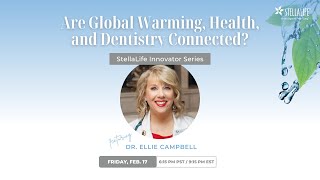
Interview (Stellalife Innovators) with Dr. Ellie Campbell, a board-certified family physician trained in integrative and functional medicine and board member of the American Academy for Oral and Systemic Health (AOSH). She explains integrative medicine as combining conventional care with complementary disciplines and details her functional medicine toolkit: creating patient timelines and identifying antecedents, triggers, and mediators to find root causes (environmental toxins, mold, chronic infections like Lyme, post-COVID immune changes). A clinical case (patient 'De') motivated her engagement with the Bale Doneen method and the oral-systemic connection—how dental infections can contribute to atherosclerosis and stroke risk. She urges interdisciplinary collaboration, continuing education through AOSH, and preventive, patient-centered care.
Chapters
Hello. Welcome to the Stell Life Innovators series. My name is Liz Lundry and today I have the pleasure and I'm so happy to be speaking with Dr. Ellie Campbell. Dr. Campbell is a native Chicagoan and graduate of the University of Illinois, the Kirksville College of Osteopathic Medicine and the Medical College of Georgia. Board certified in family medicine for 30 years. She holds certification from the American Board of Integrative Medicine. She is a solo physician with specialty interests in interdisciplinary collaboration, functional medicine, bioidentical hormone replacement therapy, reversing chronic disease, cardiovascular disease prevention, and natural treatments for high blood pressure, the oral systemic connection and vitamin D. Dr. Campbell is also a board member of the American Academy for Oral and Systemic Health. Welcome, Dr. Campbell, and thank you so much for joining me today.
Oh, you're so welcome. It's my pleasure. Thank you for having me.
Of course. And I just want to learn about what you do. And can you please tell us about the practice of integrative medicine?
Yeah. So integrative medicine is really not well defined by many experts and there's lots of disagreement as to what we actually do. But I would say for all practical purposes, integrative medicine integrates the conventional modern day practice of medicine with other disciplines that are more peripheral to the practice of medicine. So whether you're talking acupuncture, massage therapy, herbalism, homeopathy, chiropractic, we integrate those disciplines into our care plans. So the patients have a much broader palette of treatments to choose from rather than just drugs and surgery, which is what we were trained at in medical school, of course.
Right. And I know with what you're doing, you're not just treating symptoms, getting to the cause of what's causing the person's illness. And I know your team calls you the master of the human jigsaw puzzle, which is a great description of a successful holistic doctor. So tell us more about your method for diagnosing and treatment.
Yeah, so that really comes from my training from the Institute of Functional Medicine. So functional medicine is really just thought paradigm of how to organize the patient's medical history, symptoms and laboratory data into a format that allows us to take a really deep dive in potential root causes. So in functional medicine, we do two things that I didn't do in conventional medicine I wasn't trained in in residency. Number one is we create a timeline for every patient, starting with birth for sure. And in many, many cases we also go before and look at their prenatal history or their parents trauma history, because that can impact their health as Children and going forward. So we create a timeline. How old were you the first time you went in the hospital? How old were you when you had children? How old were you when you had. When you got married? How old were you when you took that trip to China? That everything changed in your health after that? So we put all that on a timeline along with their symptoms. And very, very often you can identify a trigger when you put their care on a timeline. The second thing that we do is we take a deeper dive into what we call the antecedents, triggers, and mediators of wellness and health and symptoms. Because if we can identify what started it, what perpetuates it, and what worsens it, then it gives us clues as to where the most bang for the buck is going to be in our treatment strategies. Antecedents, triggers, and mediators are so integral to the practice of functional medicine that I can't imagine practicing without them anymore in my toolkit. It is amazing. In functional medicine, the training that we get for these triggers is so much broader than anything that I got in my medical school training. To be fair, it was 30 years ago, and many of the things 35 years ago now, many of the things that we know impact people's health were not present to the same degree that they were then that they are now. So environmental medicine, looking at environmental toxins, pesticides, herbicides, petrochemicals, artificial flavors, artificial colors, heavy metals, these are things that have always been in our environment, but exponentially greater over the last few decades. And the health consequences of these are exponentially greater. Just one tiny example is polyaromatic hydrocarbons. These come from pollutants, and they have hormonal influences on our bodies. And so when we talk to women of today going through their menopausal transition, very often their symptoms are so much worse than our mothers or our grandmothers. And we can't understand why we're so symptomatic or when in part it's because of the impact of these environmental toxins. So working with our patients on a detoxification strategy to help support their liver, their bowels, their sweat glands, their lymphatics, to get rid of that toxicant can make all the difference in the world in controlling symptoms. Before I even take out my prescription pad and write, the first thing. So that's part of it is environmental toxins. Another thing that we see more than ever before is environmental influences from things like plants, including molds. We now know that because of global warming, we've increased the amount of carbon dioxide at least 30% in our. In many environments, that higher carbon dioxide level makes poison ivy more toxic. It has more of the Ursha diol SAP in it that sticks to our skin and makes us itch. So compared to grandmother's poison ivy attack, modern poison ivy attacks are substantially worse. And that's all environmental. I think that we're seeing a similar surge in mold. And I don't know if it's because of carbon dioxide or if it's because of electromagnetic fields or both, or something else we haven't identified yet. But the amount of mold and mold toxin and mold allergy that we see in our practice is so much more now than ever 30 years ago. Again, I don't know if it's just because I'm paying attention or if it's really that much worse, but these are the sorts of things that we look for in our antecedents, triggers and mediators. And something I never asked about before. I trained in functional medicine.
Yeah, I actually have a colleague who's the dentist who actually had early onset dementia because of mold that she exposed to in her home in Florida after a lot of rain and leakage of that into the home. And she couldn't do anything about it for a while. And she worked with a functional medicine doctor who specializes in that, who really helped her. And my own daughter also has been under the care of functional medicine doctor over the last few years. She's 28 and had terrible digestive issues, food allergies, hyperactive acne and eczema, psoriasis, psoriasis, alopecia.
Oh my goodness.
And nobody was helping her. They were giving her, wanting to give her anti inflammatories and medicine. So we finally found a doctor who did a series of tests, a functional medicine doctor, and found that the cause of her problem was Lyme disease. Nobody looked for that. And this all the symptoms completely lined up. So again, most physicians are working blind and not really seeing what's the problem is and.
Right. And chronic infection is another one of those triggers that we see so much more of. And again, I think the problems are worse than they used to be because back 30 years ago, if I ever saw somebody with Lyme disease, they only had Lyme disease. They didn't also have mold toxicity, food allergies, dysbiosis in their gut, hormonal disturbances, adrenal insufficiency, et cetera. So it seems like our patients are sicker and sicker and sicker in the wake of COVID That's even worse because of the things that Covid has done to our immune systems. People just don't have the resilience to fight off some of these chronic infections that they used to. So that's one of the joys in functional medicine, is that we often, when we're successful, putting those pieces together can change a patient's health trajectory and give them back their resilience and their wellness that they've lost for some period of time. And that's a blessing and an honor to be on their journey with them together as we're learning that. But one thing that I never learned about, and I think I'd like to tell you a story, because this is the story of Dee. And Dee was one of my very favorite patients. She was 74 years old. She was a spunky grandmother who took care of her children and grandchildren. Her daughter first came to see me for fertility assistance. She was in her early 40s, but wanted to have one more baby. And the fertility specialist told her she was done. She couldn't do it anymore. And I said, well, maybe we can help. So we did our functional medicine approach, and she was successfully pregnant and had a beautiful baby boy. As a result of that, I now got the wife, the husband, the two children, and the grandmother all to be patients of mine. And De was amazing. She had high blood pressure, but we treated it. She had high cholesterol, and we treated it. And she really wanted bioidentical hormone therapy so that she could keep her supple joints and her sex drive going to help with her much younger boyfriend. And so everything was going great until one day the daughter called me and said that she had her mom didn't show up for work that day. Her mom was the bookkeeper in the office. And daughter drove over to the house and found her mother collapsed on the floor. And Dee had had a massive stroke. She was paralyzed on one side of her body. And she went to the stroke rehab hospital and they took care of her. And she joked with me that she was going to have to have a lot of rehab because it's no fun line dancing with one leg dragging behind you. And she had this dreaded complication that happens in about 10%. It's called hemorrhagic transformation. And the stroke blood vessel that had the stroke in it was so fragile and so damaged that it burst and caused a brain hemorrhage. And Dee died. And I felt like I'd been gut punched. And I felt like my entire medical system had failed me because I was following the best evidence guidelines in the country for Managing hypertension and high cholesterol. And I missed something. Something caused her stroke that I didn't know about, or if I had, I wasn't aggressive enough in treating it. And so that brought me to train with Brad Bale and Amy Doneen and the Bale Doneen method. And one of the very strong emphasis in root cause, no pun intended, is looking at the oral and systemic connections and how gum dise and gum bacteria and endodontal disease or tooth root infections can lead to bacteria that cause hardening of the arteries by three different mechanisms, leading to atherosclerosis that increases risk for stroke and can actually cause a plaque rupture that triggers an event. Much later, I talked with her daughter about her case after I said I'd learned all these things, and I discovered that maybe a dental problem was the root cause of d stroke. And she said, well, funny you say that, because two weeks before her stroke, she went to the dentist for a toothache. Had I known about those oral and systemic connections back then, I might have been able to identify that her atherosclerosis was not as cooled off as I thought. We might have been able to postpone some treatment or be more aggressive in our treatment strategy to prevent that terrible, devastating stroke. Once I've learned about these oral and systemic connections, there's no looking back. There's no way to unlearn what I've learned or to withhold this information from my patients. And I am on a mission to educate as many doctors, dentists, hygienists, and patients as I possibly can about these connections so that no family has to suffer what Dee's family suffered. Because heart attacks are optional and strokes are stoppable and dialysis is not your destiny. If you can work with a functional medicine practitioner who's trained in these methodologies to identify your earliest risk, stop it in its tracks, and reverse it.
Wow. I really admire you for sharing, you know, so honestly, that experience that you had and how it changed what you're doing. And many, most physicians across the US really aren't even looking at all at what's happening with patients dentally and are unaware of that. And even today, after all the research that's out there, I still speak with doctors, dentists as well, who don't recognize and really believe that there is that connection with the oral pathogens and how it impacts the cardiovascular system and everything else. So we do still need to get that message out and show the science there. And as a member of the board of the American Academy for Oral Systemic health. That's something that, you know, that mission there is to really inform, educate everyone so we can fully support our patients. So, you know, as part of aosh, you know, you've seen, and you, from your own experience, understand that connection very well, and they're sharing that with others. So how do dentists benefit by becoming members at AOSH and go into the symposiums and the courses?
Right. So I think that, first of all, even the most enlightened dentists have more that they can learn about, more connections that they didn't realize. The connections, for example, between oral bacteria and preterm birth, pregnancy loss, Alzheimer's disease, pancreatic cancer, and the list goes on and on and on. And so most of the enlightened dentists have now at least gotten an inkling that their teeth are connected to their heart in some way, but they don't realize that that's just the tip of the iceberg. And so if they become members of aosh, they are entitled to a huge online core curriculum of education, continuing education for CE credit that they can get towards their licensure that is available on demand at their, on their time, whenever they're free, and have a 30 minutes or an hour, a couple of hours, depending on how many modules they want to sit through. And these range from oral and systemic to nutrition to lifestyle, to practice development and how to make this profitable in your practice. Because many dentists fear that if they step outside that drill and fill model, that they're going to lose revenue. And I think that there's lots of precedent to say that's not true. And also, the millennial generation is so interested in preventive care in general and preventive dentistry in particular. They don't care if it's covered by their dental insurance or not. They just want to know about it, and then they'll be empowered to make a decision if it's something they want to pursue or not. And there are some lucrative opportunities for prevention for enlightened dentists. And when an enlightened dentist is now aware, for example, let's say the patient has periodontal disease and their gums are so puffy, and they did a finger stick because they're very enlightened, and they checked the patient's blood sugar and it was 200 in the dental chair, and the patient had no idea that they were diabetic, but their oral health clued in that enlightened dentist that maybe this was a problem. Patient doesn't have a primary care provider, now they're obligated to do something. Either send them to the emergency room or better yet, what if they had a relationship with a functional medicine doctor who could see the patient and help institute therapeutic lifestyle changes to reverse that diabetes without drugs, thereby improving the patient's quality of health, oral health and future health risks. So having this interdisciplinary collaboration and a network of providers in your community, I recognize I'm a little spoiled. I live in Atlanta and I have a dozen enlightened dentists to choose from within an hour's drive of my office. There are many places that don't have that. However, there may be an opportunity for your aosh enlightened dentist to invite their local primary care provider in their small town. When there's only two doctors, invite them to come to Aush because we have curriculum for medical doctors, hygienists and dentists. And everybody has an opportunity to learn how we can elevate our patients health to the next level and more importantly, prevent chronic disease and chronic disease complications.
Absolutely. And then having that network just gives you more referrals. You refer to each other and then you're getting the kind of patients that you want in your actually want your services and aren't looking at their insurance every minute. And those that are more enlightened patients as well. So it's a win for everybody. And as dentists and as hygienists, we see our patients more often than they see their physicians. So we're really on the front lines of early disease detection. I and also many, all of my colleagues, we've all seen patients that we knew were diabetic and the first time they heard it was from us because we see what's happening in their mouths and we understand that connection. And I just think it's also fascinating, you talking about the changes in the environment with climate change and how it's affecting everything, which of course with the crops and everything else that we see, there's going to be more work for us to do in the future. So a great time for all of us to become empowered so we can really, really support our patients and, and.
Ourselves because we're patients too, or we should be. And most of your doctors and most of your dentists and most of your hygienists are not very good patients. So we think we can take care of ourselves. And we forget that we probably need a healthcare specialist on our team as well. So you learn it on yourself, you practice it on yourself, and then you roll it out to your patients. And yeah, it's a great strategy, especially.
As we have jobs that are stressful working with the public and physical as well. So we need all kinds of help and support. Thank you so much for taking the time today to share this information with everybody and we really appreciate you doing that, Dr. Campbell, and what you' for your community and for the world at large with your involvement at AOSH in getting this message out so we all have a chance to become involved with that. I'm an AOS member myself and have always learned so much every time I go have opportunities to present there as well. And so for all of you out there, please check it out. Check out integrative medicine and how you as a dentist, as a hygienist, as any clinician, can really take your patient healing to a whole other level. So thank you all for joining us today. And until our next interview, please take care of yourselves, take care of your health, stay safe and stay well. And again, thank you so much, Dr. Campbell.
My pleasure.
Thank you.