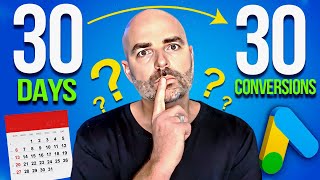
In this instructional video, Aaron Young of Define Digital Academy addresses the common belief that a Google Ads account must achieve 30 conversions within a 30‑day window before launching Performance Max (PMax) campaigns. He confirms that Google’s guidance does indeed recommend 30 conversions in 30 days and adds that the daily budget should be roughly 30 times the average cost‑per‑acquisition (CPA) to support that volume. Young explains the three data streams PMax relies on: (1) advertiser‑provided signals such as keywords, audiences, and high‑level themes; (2) the account‑level conversion history, which can be inherited from existing search, display, or shopping campaigns; and (3) indexed competitor conversion data that Google uses to test similar audiences and keywords. He offers a practical tip: audit high‑converting search terms from existing campaigns and import them into PMax asset groups to boost performance. Using an anecdotal case study of his own business, Young shows how a brand‑new account with no prior conversion data can still succeed with PMax, but it typically requires a 90‑day learning period and an initial spend of about $7,500 before conversions and CPA stabilize. He observes that during the first months the campaign’s CPA fluctuated widely before settling around $25‑$33. Concluding, Young advises most advertisers to first build conversion history with search or shopping campaigns before activating PMax, ensuring a smoother ramp‑up and better early results. The video ends with a call‑to‑action to view a recap of a live Google session on the future of Google Ads.
Chapters
If you have been studying and learning about Google Ads for any period of time, you would have or you will eventually come across this idea that you need 30 conversions in a 30 day period in order to get the best results out of Google Ads. If you wanted to get the best results in Google Ads before you engaged a smart bidding strategy like maximize conversions or maximize conversion value. Now since the inception of Performance Max campaigns, this is a question I've been asked time and time again. Do you need to have a certain amount of conversions, say for example 30 before you started Performance Max and if so, why do you need those 30 conversions? So let's get straight to it and in fact this exact question was asked in a live recording session that I had with Google head office in Sydney. And this is one of the main questions that were asked about, you know, when we're using campaigns like Performance Max, do you need to have a certain number of conversions? Now that was a live only session for my Google Ads paid community. But, but if you would like to see a recap that I ran up that session so that you can get all of the information about what is coming up with Google Ads over the coming weeks, months and years. And it's a session called the future of Google Ads and your business. And if you'd like to see my recap, all you need to do is to follow that link in the description below. Now the very strong response in that session was in fact yes, you do need 30 conversions in 30 days in order to see the best results with with Performance Max. And in fact they took it a step further to say that if you truly want to see the best results, you need to make sure that Your budget is 30 times your average cost per acquisition. Now that obviously makes sense because if you're going to be seeing 30 conversions in 30 days, you need to have enough budget to cover that. So what that will essentially mean is that if you have other campaigns running in your account and your current cost per acquisition in your account is $11, that would mean that as a bare minimum you would need to have a budget of $11 a day so that you can have a spent of $330 so that you can get those 30 conversions at that $11 per conversion mark. Now the reason for why this is so important is because by design, Performance Max was designed in order to generate more conversions for your business. It even says it as you set up your campaign, you may have seen this green pop up box saying that when you enter in your selections, Google will go beyond those Selections. So the keywords and the audiences that you've added in order to find more conversions. Now, the data that Google uses here to find your conversions comes from three, three main sources now. And the first one is the keywords and the audiences that you provide to Google in your Audience Insights tab. So you may know that when you're setting up a campaign or you're optimizing a performance max campaign, you can add in some keywords and also you can add in some audiences now over the coming weeks and months, and you may even have it in your account. There'll be another input that you can have where you can add in what's called a signal, which is more like a top level theme of what you're wanting to achieve. So if you're wanting to drive more bookings for your jet ski hire business, or if you're wanting to sell more hair care products. And the second area that Google gets information in regards to your performance max campaigns to help target more conversions is the actual conversion data that is in your account. Now, it's important to remember that with Google Ads and conversion data, it's not just held at the campaign level, because it is also held at the account level. Meaning that if you were to start a new performance max campaign and you've already got other search or display or shopping campaign campaigns that have been running for quite a while, performance max will leverage off the conversion data which is already in your account. And this leads me to a little pro tip that I want to give you for your performance max campaigns. If you've already got some highly converting search campaigns or shopping campaigns, if you go through and do a search term audit. So looking at the actual search terms which generated conversions, it increases the performance of your performance max campaign massively. If you go through and add in those converting search terms into your asset groups. And then finally, the third area that Google will grab data from is what it calls indexed data. And this is the conversion data from competitors who are bidding on the same search terms or for the same products or keywords in your product area or your niche. And Google will go through and run some tests on these audiences and these keyword themes because they're converting for other similar products or services. And what Google wants to find out is does your product or service convert at a higher level? And the reason for why Google does this is because you do need to remember that ultimately what Google is wanting to achieve here is it's wanting to match the best performing products or services to the user's search term. So if you can make sure that your website is a high converting website, Google and especially Performance Max will more likely show your ads because it takes that conversion data as a positive result and in that the user found what they were looking for. So what's important to remember here is that when you're creating your Performance Max campaigns, what you want to be doing is you want to be giving it as much information as possible. And especially when it comes to that first point about adding in keywords and audiences, remember that Performance Max is not going to be limited by that. So it's not going to only target those keywords and only target those audiences. But that's going to be a strong starting point for where Performance Max will start. So if you start a Performance Max campaign with no keywords and no audiences, you're not giving it a base to start anywhere. Think of it like this. I've never been to New York City before. I do hope to go over there over the next couple of years. But if I was to come to any New Yorkers that are watching here and I would just say, look, we're going to get the best slice of pizza, you would give me three or four different recommendations. And for me, I would then do my further research. I would then test out those different locations before I decided on what was my favorite one or my best piece of slice in New York City. But by asking some locals who I trusted, it's giving me a great starting point. And that's what's happening here with Performance Max as well, is that you're giving Google some starting points of where you want them to start targeting your campaign before they go out and find some other recommendations or other areas which may convert for you. So you can see why it's really, really helpful that if you're starting a Performance max campaign that is in an account that already has 30 conversions in 30 days, you're then adding in those search terms which are highly converting. You're also adding in those audiences which are highly converting. You can see why Performance Max is able to get results a lot quicker because it's got that starting data of where to start your start your budget spending and what are the types of keywords and audiences that convert best for your products or services. So that then leads us to the second big question, and that is, can Performance Max work in a brand new Google Ads account where you've got no conversions and no keyword data? And the answer to that is yes. But I do want to give some warnings and caveats with that. And the Best way to explain this is for me to show you a Google Ads campaign that started in Performance Max. And I'm going to be 100% honest. This is actually my campaign for this business right here. And as a bit of a test, I wanted to run Performance Max on a brand new Google Ads account with no other data at all. So there hadn't been any other search campaigns, any other YouTube campaigns that had run before I started this Performance Max campaign. Let's have a look at the results. So this is the campaign that I want you to have a look at. Once again, this is a campaign for my own business. I wanted to show you this example because this is a test that I had wanted to run. And that test being can you get results with Performance Max if it's the very first campaign that you've run in your account? And obviously I wanted to do that with my own money rather than take that risk on a client's budget. What I wanted to show you in through, in here is that we're looking at a weekly view. And you can see from here we're just looking at the cost. So what you can see from here is that we got the, you know, the clicks and the cost started going through straight away. What I'll do is I'll just bring in the conversions. But what you can actually see from here is it took quite a while for us to build up to some conversions. If I was to flip this over to a monthly view, just remember this September is obviously going down because we're only looking at half the month. But what you can actually have a look here is that we started this in March and in March we only got one conversion. In April we got 21 conversions. And then in May we got 40. And then it really started to rocket up and we got over 100 conversions. And then ever since then, it's been building up once again. This will build up again because as you can see, we're only halfway through the month. We're at 84. Last month we only got 125 conversions. So this will continue to go up. But what I want to show you here is that it was one, two, three months before we started to see quite a bit of data. Now what you can also look at from there, if you were to look at from here, that was an investment of, you know, the first month was 2,600, the next month was 2,000. So let's say four, six, and then nearly another three grand. It was about seven and a half thousand dollars in ad spend. Before we started to get those conversions up to where it needed to be. Now, the other thing that I did want to show you in through here as well, is that when we look at it from here as well, and I'll bring this down to a weekly view, is that it took that same time to to bring that conversion level down to, you know, where it was peaking up at $780. Then it also had another peak at 385. Whereas now it's comfortably sitting in and around that 25 $33 mark, which is a perfect acquisition level for my business. And that's why I'm happy to continue to spend money in this performance Max campaign. So the very clear answer to the question of can performance max work? If it's your first campaign and you don't have previous conversion data, the answer is yes. But remember what I said, it's going to take a good 90 days for Google to be able to get that data. And as long as your business has that investment and also the nerve to continue on for, you know, that good first three months with getting little result where you're spending more money than you're getting back into your business, it can work. But I do know that for most businesses, the better way of going about it would be to start with a search or shopping campaign and then build up that conversion data. And then when you've got enough conversion data, that's when you can then add performance max into your Google Ads campaigns. Thank you for joining me. And remember, as I said, if you want to watch that recap that I ran of my Google session, the future of Google Ads in your business, all you need to do is to follow that link in the description below. My name is Aaron young. I'm from Define Digital Academy and on your 15,000 hour Google Ads master. And if you'd like to keep up to date with all of the changes that are happening in Google Ads right now, all you need to do is to go through and watch this video. See you next time.