How Often Should You Change Bidding Strategies for Google Ads in 2023?
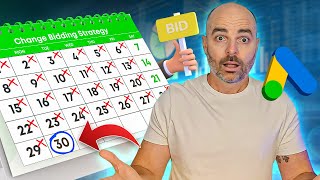
Aaron Young explains when to switch Google Ads to smart bidding strategies like Maximize Conversions, Target CPA, and Target ROAS. You need at least 30 conversions (ideally 50) and four weeks of stable data before switching. He walks through two real campaigns showing how metrics shift after the change.
Chapters
One of the most significant changes that you can make to your Google Ads campaign is to introduce a smart bidding strategy like maximize conversions or maximize conversion value. And then you can even take it a step further and add in a target CPA or a target cost per acquisition to that maximize conversion bidding strategy. Or you can add in a target roas so a target amount of revenue that you want to achieve after your ad spend, and that can be applied to your maximized conversion value campaign bidding strategy. Now, the maximize conversions or the maximize conversion value bidding strategy is easy enough to understand. Think of it like this. When you apply or add in a maximized conversions bidding strategy to your Google Ads campaign, you're effectively saying, hey, Google, get me as many conversions as possible for $50 a day. And what Google does with a command like that is that when you set a maximize conversions or maximize conversion value in your Google Ads campaign, it takes into account your current daily budget and then it looks to go through and figure out what are the best search terms, the best users, so their audiences and demographics, the best days of the week, also the best hours of the day, the best devices, and the best locations which are going to give you the highest amount of conversions or the highest amount of revenue. So Google uses all of its data to get you the best possible results. But one thing that you do need to be aware of, and what surprises a lot of people, is that this can have a big effect on some of your core KPIs, like your CPC or your cost per click, and also even the amount that your campaign spends on any given day. So let's quickly break down those two things of your CPC and your daily spend so that you can understand why you will see a change in your CPC and also the daily amount that your campaign spends. Because I see this time and time again when people introduce a maximized conversion or a maximized conversion value, and within 24 hours they see an increase in their CPC and they freak out, out and then quickly revert back. Now, the reason for why you commonly see an increase in your CPC is because we know that we get a high level of conversions when your ads appear in those top two positions. But in order to appear in those top two ad positions, you need to have a higher bid. So when Google finds a relevant search term which it believes is going to convert, it will bid higher, which is why you're seeing a higher cpc. Now, one of the things that I do explain to people and what I really want to encourage you with, is that don't just blindly look at your cpc. Now, I know that we all want to decrease or lower the amount of cpc, but you always need to think of it like this. If you've got a budget of $10 a day, would you prefer to get 10 clicks at $1 for one conversion, or would you prefer to have 5 clicks at $2 each but get 3 conversions? Yes, your CPC has doubled from $1 to $2, but you are now getting 3 conversions for every $10 spent as opposed to one. So yes, your CPC is an important metric, but just understand, a lower CPC may not get you your end result, which is more conversions. So I want you to always be thinking what would you prefer a slightly lower CPC or more conversions? And everyone will say more conversions. So that's why you do see an increase in your CPC when you add in one of these smart bidding strategies. And secondly, let's now talk about why you will see large fluctuations in the how much your Google Ads campaign spends each day. And what you need to remember is this, is that although you set your budget in Google as a daily amount, Google uses that daily amount to work out a monthly budget. So if you've got a daily budget of $10, Google doesn't see that that it's got to spend $10 every day. Google sees that you want to spend $300 in every single month. So when you then go in and add in a maximize conversions or maximize conversion value smart bidding strategy, Google will then start to go. And if it sees that you can get more conversions between Monday, Tuesday and Wednesday, it may spend over 50 to 60% in those three days. And then on those remaining four days, it'll spend the remaining sort of 40% of the budget, depending on how much it's spent on those core days. So don't be alarmed that if you've got a budget of $10 a day, you add and maximize conversions. You could even be spending between 20 to $25 on a given day because Google has data which is showing that that's when it's more likely to convert. And I've seen time and time again when I've added this, especially on small budget campaigns where people will get little blocks where they get a lot of conversions, say on noon, between 2 o' clock and 4 o'. Clock. And then they might also get another window on Thursday mornings between say 9 o' clock and 11 o', clock, because that's where Google's deemed that that campaign can get the most conversions. So now that I've given you a bit of a breakdown, on the top level of how these smart bidding strategies work and the effects that you can see to other core metrics like your CPC and the amount of money that you're spending every day in Google Ads. I want to take you through when you would go about introducing these type of smart bidding strategies into your Google Ads campaigns. But just in case we haven't met yet, my name is Aaron Young, I'm from Define Digital Academy and I'm your 15,000 hour Google Ads master. Now the first important thing that I do need to stress is that before you even think about adding in a smart bidding strategy so that maximize conversion or maximize conversion value bidding strategy, you'd want to be having at least 30 conversions in your Google Ads account. And I know that this can get confusing because especially if you're running a new Google Ads campaign, Google will give the recommendation to add in a smart bidding strategy, say maximize conversions, sometimes after the first two weeks. But the reason why I want you to wait and hold off on that is because you need to get those first 30 conversions first. Because Google would be giving you that recommendation based on its industry data. Now that is some really, really important data because Google is bringing across what your competitors are seeing and the type of audiences and keywords that are best converting for them, their businesses. And that is some really powerful data. But before we use that data, we also want Google to be able to overlay their data with your account data because there could be some differences between the type of searches that convert for your competitors products and services versus the ones that convert for you. So that's why you want to wait till at least you've got 30 conversions. So that way Google can use your own campaign data and lay that on top of its own industry data. And I've always found that that's when you've got the better results. So now that we've got that established, let's jump into a screen share and I want to take you some through some real life examples of what happens when I've added in a maximized conversion and also a maximized conversion value strategies into my Google Ads campaigns. And I want to break down the data for why I added in those strategies so that you can actually look for this same data in your own campaigns. Let's go. So I'm going to show you through two campaigns. The first one is going to be a service based industry where we used a maximize conversions strategy. And then the other one is going to be an E Commerce where we used Target roas. And in both cases I'm going to be showing you this on a Performance Max campaign. And the reason for that is because the Performance Max campaign has this great average target CPA or this average Target ROAS tool. While that tool isn't available on search campaigns or shopping campaigns, the principles would be exactly the same. So let's firstly start with this average target cpa. So we went to maximize conversions and then we added in that target cpa. And what I want to clarify here is that we haven't changed the budget. Can see our cost has been around about the same for every single week. We're also looking at a week overview and we're looking from the start of the year through to May. And that's the same in both cases. We haven't seen budget changes and we're looking from January to May. Now we're back on this average target CPA that we added which was in here. And you can see that blue line that we added in a target CPA of $30. But before we got there, you can actually see here that we added in that target CPA at this point. But as you can see before that point we had a collection of conversions and we had well over those 30 conversions. So I do say a minimum of 30 conversions. But with this one I waited till we had about 50 conversions which gave us a lot more data. And what you can see here is that as we've added this in, you can actually see that we actually had a drop in conversions for a little bit and obviously that increase in that cpa. Now the reason for why that happened is because Google in this case, and I'll just take the cost out so it's a little bit easier to see, started to show our ads to a whole different range of people. So what it was doing is that it was saying that we want to, to get conversions for $30. So Google went out on the hunt and then those conversions started coming in and you can see from here, you know, our Previous best was 10 conversions in a week. We then after adding in that target CPA, it took one week, two week, and we had lower conversions to three conversions, one conversion. Then we had 15 conversions, 13 conversions, 18 conversions and 32 conversions. So the big thing that I do want to stress is that when you do add in that target cpa, best case scenario is that you'd see a shoot up of your impressions and then it can take one or two weeks before those conversions start rolling in. And if you look in here, we did change this over to our cost per conversion We've now seen that cost per conversion come way down to $10. So we're actually in the process of. We're going to start to now reduce that target CPA. We'll probably bring that down to about $20. The reason why we don't want to go too low is because we want to make sure that we're always seeing our impressions continue to grow up, especially for performance max campaigns. So the key point there is what I wanted to show you is that before we added in that target cpa, we had a good number of conversions in through here, this yellow line. We had a good steady flow of conversions. And then the other thing I want to say is the reason why we added it in here is that we had four weeks, so 1, 2, 3, 4, 4 weeks of seeing that we had improved our CPA. Our cost per conversion went from 56 down to 38 down to 17 and then down to 15. And that was a telltale sign that Google had a really good grasp of what was happening. So I don' like to add in that target CPA in this section because you can see we're going out. CPA was going up and down, up and down. When we had four weeks of good data, that's when we then added that in. Now let's jump over to our E Commerce campaign. Once again, the cost is about the same. We've added in that target roas and we've actually started to increase this in through here. Now I'm going to change this cost over to conversions. And you can see from here is that once again, before we added that in, we had a good number of conversions coming through. Now this one was a slightly different in that we added this in. And the reason for why we added this in is that we were actually seeing that our roas was starting to drop. So we added in a target ROAS of 525. And you can see from here, previously our target conversion value cost was 5, 7.45 and 4.45. So we had a really strong indication that we could confidently get that target ROAS of a minimum of 500. When we added in that target ROAS of 525. You can see here, our impressions started to go up again. Once again, it did take a couple of weeks and then our conversion value cost went up to 7, 5.8, 7.55. And then we increased it again, it dropped again and now it's gone back up to 8.45 and also 8.3. So once again, what we wanted to See, there is we wanted to see before we added in a target roll, as we wanted to make sure that especially the last four weeks, that it was higher than our target rolls that were set. So our target rolls is at 525, you can see here, 415.5 also. So it was right at that limit where it was a good amount to set. And then when we added this other one and we went from 525 up to 575 as a new target point, you can see here that we had a conversion value cost of 7.84, 5.85 and 7.55, all above that new target of 7.57. So a big thing that you really want to make sure then I hope you saw that trend from those screen shares is that before you go through and add in that maximized conversion with that target CPA or that maximized conversion value with that target roas is that you want to have a good solid trend for the previous four weeks. So I don't like adding in a target ROAS or a target CPA when I'm seeing data that's going up and down. So it's kind of high one week, low the next. I want to make sure that we're seeing a really regular trend. Now, I do know that getting your bidding strategies right is a really, really big subject and it's quite complex. And the reason for that is because it's different for every single campaign. And to get it right, you need to take in those core princip, which was what I spoke about. You need to have that at least that 30 conversions. And you also need to be really confident in the trend over the previous four weeks. And to help you even further, I want to give you free access to an extended training that I ran specifically on Google Ads bidding strategies. And this is part of my 10x Google Ads community, which is a great community that anyone can join where I go through some extended masterclass sessions like the one I want to give you access to today. And then you've also got a community of people who are willing to answer any questions that you have in regards to Google Ads. And we also have live group coaching calls every single month. So if you'd like to go through and watch that bidding strategy session for free and also get some extra information on my 10x community, all you need to do is to follow that link in the description below. Once again, thank you for joining me. As I said, my name is Aaron Young from Define Digital Academy, and if you want to see some simple strategies that are working in Google Ads right now. All you need to do is to go through and watch this video right here. Thank you for joining me. See ya.








