How to Write Google Ads Copy that Converts [Updated for 2026]
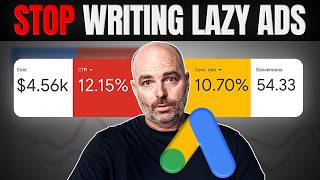
Aaron Young breaks down how to write Google Ads copy that actually converts. Focus on keywords, strong calls-to-action, unique selling points, and emotional triggers. One case study saw CTR jump from 4.5% to over 10% and cost-per-conversion drop significantly through split-testing over 30-60 days.
Chapters
Right now, I'm on a personal mission to stop bad and just flat out lazy ad copy practices when it comes to Google Ads. When we review Google Ads accounts here at Define Digital Academy, one of the biggest areas that we see for immediate improvement in the business's performance when it comes to real life Google Ads improvements does come down to their ad copy. And too many times businesses and unfortunately agencies just don't spend any time when it comes to their ad copy in Google Ads. And it's either just simple keyword focused or keyword stuffed headlines or just right now, Ayo slop, that doesn't really break through and speak to the customer. What you need to remember with your ad copy headlines is remember that your ad copy headlines are really the gateway to really move across from someone seeing your ad through to clicking your ad and going through to your website. When it comes to Google Ads, remember we've only got 30 characters and we can't change the font, we can't change the font size, we can't even change the color. So there is a uniformity across the board when it comes to the ad copy headline. And that's why I see there's a real opportunity for businesses who are prepared to put in that little bit of extra effort so that you can really write ad copy headlines that speak directly to your customer. And even right now in 2026, with all of the advancements in smart bidding and AI usage inside of the Google Ads algorithm, we're finding that writing ad copies and going through a proper split testing process still has a direct correlation to the improvement in your individual results for for your business inside of Google Ads. So in this video, I'm not only gonna be taking you through the ad copy process that we use to improve the results for our members and clients and students inside of Define Digital Academy. We're also gonna be covering topics like should you pin your headlines and what relevance does that ad quality score have on the performance of your ads. But before we get to all of that, I do wanna really break down the 4 important components that need to be in every single ad that you are writing for your Google Ads campaigns. And the first one is, is that you do need to have our keyword focus inside of your ad copy. And the reason for that is because when someone is searching for your product or your service, we do still see a direct increase if the ad copy headline does match what they have actually searched. And that's why here at Define Digital Academy, we're still big fans of features like dynamic keyword insertion. And if you don't know what I'm talking about there, when we get to the screen share, I will show you some examples of that. So number 1, you do need to have that keyword focus. Number 2, you do wanna have a strong call to action. And one of the things that I do really wanna highlight when it comes to call to actions, what we really like to include is a percentage or a dollar value. And what I mean by that is rather than just saying, "Hey, call now," or "Book now," really add in, really call out that feature. So something like, you know, "Call now to save $49," or "Call now to increase productivity by 20%." And we've seen alone just by adding that dollar or percentage value, Now it has to be real and backed in facts. It can really help to drive the needle in terms of the performance for your business. Number 3, and this is the concept where I want you to say, you need to say something that your competitors can't say or won't say. And what we're talking about here is your unique selling points. What does your product or service have to offer that your competitors don't have or can't say? And what you're really wanting to do with this one is you really want to differentiate why your product or service is best suited to that potential customer. And this becomes even more important, especially if you are not the cheapest product or service in your market. If you do have a higher price point, you need to make it really, really clear before somebody even goes to your website why they'd even think about clicking on your ad if they can find a cheaper product or service. And then number 4, and this is the one that most people miss, is that you need to have an emotional trigger. And one of the biggest mistakes I see with Google Ads ad copy is that it's written for the business, not the customer. So when it comes to your ad copy headlines, it's got nothing to do with you. It's got everything to do with the customer and the problem they are trying to solve or, or the desire they're trying to reach. And I think sometimes when it comes to businesses with Google Ads, because it is very, very data-driven around clicks, impressions, conversions, all of those type of things, we can actually forget the human element. And behind every search is one of these two core driving factors. They're trying to solve a problem, or there's a goal, or there is a desire that they are trying to attain. And that's why your ad copy needs to speak to that. And let me give you some really, really clear examples. So for example, if you're an accountancy firm, rather than writing professional accounting services, you could have something like save 12 hours on your upcoming taxes, or increase your tax return by 10%. Or rather than just going for something like best product management tool, your business could say Ship products 2 times faster. So what we're really wanting to do there is we're really wanting to uncover and unlock the pain or the desire that the customer is looking for and really articulate it in very, very clear messaging. Now we're gonna jump right into a screen share 'cause what I wanna do now is I wanna walk you through this process and give you some real-life examples. And as I said at the start, we're also gonna be taking you through the split testing process that we use here inside of Define Digital Academy. And we're also gonna be going through things like should you pin headlines, and also what that ad quality score really means for your business when it comes to Google Ads. All right, but before we get there, I did wanna let you know about a tool that we've created inside of Define Digital Academy that all of our members have access to. And it's this one here, which is our ad copywriter. Now, what our ad copywriter does, it is a Claude prompt that as you go through and use, it goes through that 4-step framework that I spoke to you about, but it also prompts you to start going through and adding in some pain and desires that the customers are wanting, your unique selling points, If you've got an active ad account, you can also upload your current ad performance and it gives you recommendations that your business can use when it comes to Google Ads. Now that one is part of 5 tools and that one is exclusive only to Define Digital Academy members. But just because you're watching this YouTube video, you can actually get access to a keyword and search term audit tool and that's completely free. And also found out more about Google Ads Mastery, which is where you can access all 5 of those tools including the ad copywriter. It also includes a 7 free day trial. Trial. If you follow that link in the description, you can get all that information where you can go through and have a test and trial of that tool. All right, but right now let's get into some real-life ads. Okay, so what I want to show you here is this is a business that we're working on. Now obviously when it comes to the actual headlines, for privacy reasons we had to blur some of those, but I'm going to 100% be able to show you through the process that we've used. And as you can see from here, this is where the business started with us. We straight away went into our A/B testing protocols and That was at the start of October. And you can see by the end of the month, we'd already increased their click-through ratio from 4.5% up to just under 9%. And then as you can see, as we've gone through some different testing metrics, but as you can see through here, we're now regularly above 10% for their click-through ratio. And then what this has allowed them to do is allowed them to also scale and grow profitably with their Google Ads. But I want to take you now through this process. Now, the first thing I want to really, really highlight, and this is a common question we get, is what does this ad strength mean inside of Google Ads, and is it actually important? Now, the one thing that I really want to clarify is that when it comes to ad strength, it's, it's very much just a diagnostic tool that Google uses to kind of prompt you through when you're first setting up your account. But in terms of the actual algorithm, your click-through ratio is far more important than this ad strength. And as you can see from here, we've had some other testing that we're running in through here. We've got an ad strength is poor, but it is by far our best performing ad. As you can see from here, it's got the highest click-through ratio, it's got the highest conversion rate, and it's also got a significantly lower cost per conversion. So to be really, really clear here, when it comes to ad strength, it's something that we don't really pay any attention to at all, because what that's really looking at is it's more looking at, you know, do you have a variety of headlines? So, so if you— and also too, the big thing that affects the score is do you have any pinned headlines in? And in this ad, we do have a pinned headline in, which is why that has dropped the ad strength. So the first thing is don't pay any attention to the ad strength. What you want to be focusing on is your click-through ratio and ultimately your conversion rates. Now secondly, it comes to that second question of should you go through and actually pin in a headline? And for me, my answer is it depends, and it depends on the results inside of your own business. Now for me, the only thing that I'm looking at as to whether you should or whether you shouldn't pin in your headline, it purely comes down to the data. So what we start with our ad copy split testing is that our very first test is that we're running two ads which are exactly the same. So the way that we do that is we'll go through and create one ad inside of Google Ads, we then duplicate that ad with the only difference being— and I'm just going to show you in through here is that we've pinned one headline, and the headline that we've actually pinned in is a dynamic keyword insertion headline. So generally what we'll do is our first test is that we'll run two ads, and one of those ads will have dynamic keyword insertion, dynamic keyword insertion pinned in to that position one. Now if you don't know what dynamic keyword insertion is, all you need to do is to use that brace or that squiggly bracket and and then you select keyword insertion. You can then put in one of your keyword terms in there, and what that means is essentially whatever keyword triggers the ad will appear in that headline position. And then all we're looking for there is purely which ad performs best. And then we'll go through and run through second levels of tests. And the second levels of tests could be is that when we find out which one wins that first test, we can then go through and go— let's just say, for example, in this case the dynamic keyword insertion worked in position 1, we would then go through and start changing some of the other headlines. And then from there, once we've worked out that first test, then second round of testing we generally go into is that we will have obviously the first ad which has dynamic keyword insertion pinned in. However, if that ad is actually the losing ad, obviously we won't use that ad and we'll use the ad with no pinned-in headlines. And then we'll go through and test some different call to actions pinned into position 2. The key thing being with your split testing is that you wanna make sure that you've only got one core difference between these two ads. So that's why we don't go through and change all of the headlines, 'cause then you don't really know what data is coming through. Now, I wanna show you what you can see in terms of real performance inside of your Google Ads account. We'll just focus on these top two ads. Reason being is because they're the ones that have the most data. And as you can see from here, you, you can get some really, really significant changes inside of your Google Ads account. Let's just go through to the last 30 days. And what we want to look at from here is, you can see from here, is that although there was only a slight difference in the click-through ratio, 8.79% versus 9.31%, where it really came into was the cost per conversion. And as you can see, it's a really, really significant difference. Now, it is important to note here that your ad copy split testing isn't the only thing that's driving this change. Obviously, we've gone through and changed bidding strategies and our keyword targeting. And that's why we like to do our ad copy split testing in segments of about 30 or 60 days. Now what I've done here is I've just gone through and just drilled down into a 30-day period when we were doing this actual live test. And what we're wanting to see between both of these ads is to see the conversion metrics to be significantly different. While click-through ratio is important, ultimately we're looking for what is driving the most significant conversion actions. And we have seen some cases where an ad has slightly underperformed performed on the click-through ratio, but the conversion metrics are just so superior. And that can sometimes happen, especially when you're dealing with like a service-based business or more of a premium product, and you're putting in a price qualifier into your ad copy headline. And that can reduce your click-through ratio, but if it's significantly increasing your conversion rate, we'll still run with that difference. And that's why we also like to firstly drive up our click-through ratios to above 10% and And the reason for that is that that allows us that when we start to add in some of those product or service qualifiers, even if we drop down our click-through ratio by 2%, we are still performing in that 7 to 8, 8 click-through ratio band, which is still well above the industry average, which for this industry is around 7%. I just did want to give that variation because while click-through ratio is an important metric, it is important to remember that it is not the main game. We don't run Google Ads to get clicks, we run Google Ads to get sales conversions. And this leads me to another really important important point to really understand where your ad copy sits inside of Google Ads. Because remember, it's important to note that with your ads, you don't only want them to click on your ad, you also want them to complete a conversion. So what we're also trying to do with their messaging is we're also trying to like kind of connect the next step. They see our ad, they click on the ad, they're going to our landing page, but we also want them to know what to expect on that landing page. That's why in our ad copy, we do like to use, as I was saying at the start, those percentage or those real dollar value messaging. Also those real cost-benefit ratios that you've got inside of Google Ads. So as a wrap-up, when it comes to getting the best results with your ad copy headlines for your Google Ads campaigns, firstly, remember the 4 key foundations. Make sure you've got that keyword focus, and if you need to, you can also use dynamic keyword insertion. Secondly, make sure you have a real strong call to action. Don't just use wishy-washy statements like "we're the best" or "we're number one." Really use those dollar value or those percentage percentages, savings, or percentage benefits to really drive home your core message. Number 3, remember you are speaking to real humans. Don't just write it with keyword focus or sort of AI slop, as we're calling it now. Really, really focus on your unique selling points and always have this guideline of what can I say that my competitors can't say or won't say. And then number 4, remember those emotional triggers. Remember that people who are searching for your products or your services, they've got 2 core drivers that they're trying to go through right now. Either dealing with some pain or discomfort that they're trying to find a solution for, or there is a goal or a desire that they want to attain. So really, really looking at those two levers of either moving away from pain or getting closer to their desire or their dreams they're looking to achieve, and really position your products or your services to be the answer to that solution. And then finally, the most important step is that when you come to actually running ads inside of Google Ads, remember to have that proper split testing process where you've got one core element that you're testing and you're running those tests over 30 to 60 days. When you find a successful ad, pause the loser ad, duplicate the winning ad, and then go through that split testing process time and time again. Hey, thank you for joining me. It's been an absolute pleasure having you here. And remember, if you wanted to find out how you can get access to our ad copywriter and also get access to that free keyword and SWOT analysis tool, Follow that link in the description below. And also as well, if you are already starting to see some conversions inside of your Google Ads account and you're ready to scale your spend so you can see even more conversions and can continue to grow your business, I want you to go through and watch this video right here. Thanks for joining me. See ya.








