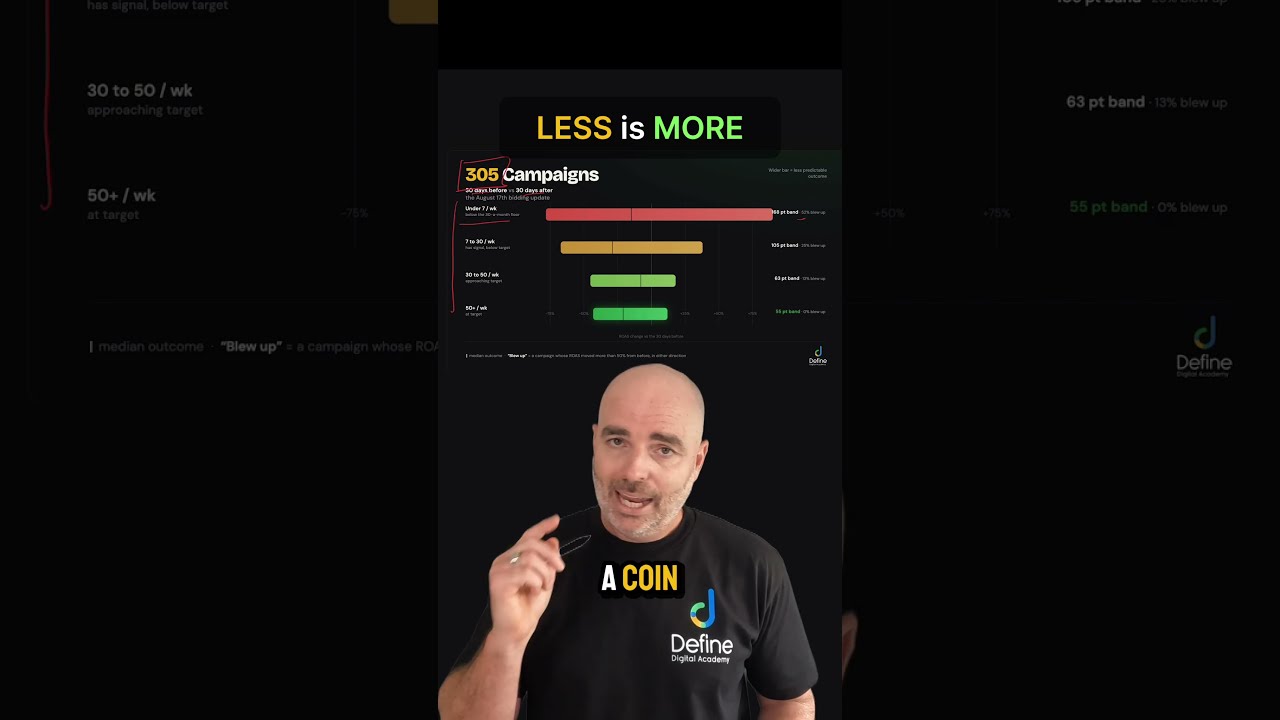
Aaron Young analyzed 305 Google Ads campaigns to show that splitting traffic across many campaigns hurts performance. Campaigns with fewer than 7 weekly conversions see over 50% variance in results, while those hitting 50+ conversions show virtually no large swings. Consolidating campaigns concentrates conversion data and stabilizes outcomes.
Chapters
A big mistake that I see all the time when it comes to reviewing Google Ads accounts is that people will sometimes think that more campaigns instantly means more and better results for your business. Couldn't be further from the truth. Right now we're seeing a big trend, especially in 2026, although I would say that this trend has been happening for a couple of years, that a more condensed structure is going to get you better results inside of Google Ads. Now, it's not saying that there isn't reasons for you to have multiple breakout campaigns. Sometimes there's really valid reasons for that, but don't just break out campaigns because you think it's going to get you better results. One of the downsides which people don't realize when it comes to adding in more campaigns is that you're robbing those individual campaigns from its valuable conversion learning data. And the reason why that's so important is because if you can get a campaign which can achieve 50 conversions in a week, you are in a really good place. And the reason for that is because it all comes back to learning cycles inside of Google Ads. We know that inside of Google Ads, its own documentation lets us know that once you've achieved 50 conversions, you can exit the learning cycle, or it's generally 3 conversion cycles, which generally takes somewhere between 1 week to 3 weeks, which is why most people say that it's gonna take that 1 to 3 weeks. So how do I know this and what data am I looking at? August 17th was the day that many people knew that inside of Google Ads where Google changed Smart Bidding. We've ran some testing and the results have just come out. Now, what I want to show you through here is this, is that we looked at 305 campaigns and it was 30 days before and 30 days after. Now, obviously, because we're looking at over 305 campaigns, we couldn't give a judge on ROAS or cost per conversion because it's different for all these different types of businesses. What we were purely looking at was this: if you got more conversions in your account, how volatile were the results? And you can see here campaigns that had under 7 conversions a week, highly volatile. Over 50% of campaigns had a variance, whether good or bad, for more than 50%. So their ROAS increased or decreased by 50%. Now some people are going to go, hey, that's great, but it's really a flip of a coin and you can't grow a business with taking that level of risk. Get up to 7 to 30, it was only 25%. Got to 30 to 50, 13%. Get to that 50 target, and there was 0%. So no campaigns across 305 that saw that massive swing in variance. So key, key take-home message is if you want some more predictable results inside of your Google Ads accounts, make sure that you are grouping them together so you can get as much conversion data as possible through individual campaigns.