The Only Google Ads Metric That Actually Matters
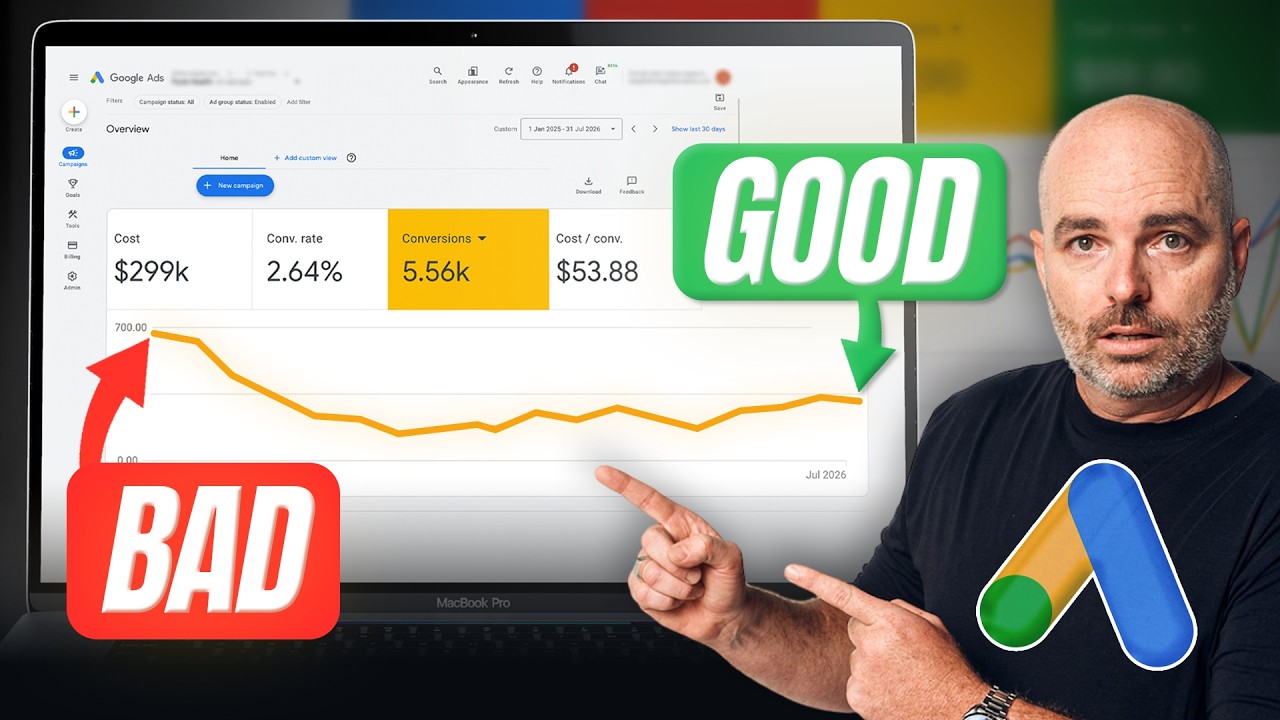
Aaron Young explains why a 500% ROAS can still lose money, and shows how to scale Google Ads beyond $30K monthly while staying profitable. As budgets grow, ROAS declines, so you need to improve order value, lifetime value, or sales processes. Incrementality testing reveals which spend just steals existing sales instead of finding new customers.
Chapters
When it comes to Google Ads, obviously it's clear that the only reason that you're spending money for your Google Ads is in order to get extra sales or leads for your business. So in this video, I'm going to take you through the exact process and the exact questions that we take business owners or brand owners like you through when they want to scale past $10,000, $20,000, or $30,000 a month inside of their Google Ads spend. So I do want to be clear right at the start of this video that if you are just starting your Google Ads journey and you're still trying to work out how to actually take someone from a click to a conversion, this is probably not the best video for you because we are picking up from the process where we're assuming or seeing that you're already getting conversions inside of your Google Ads account. So you've already solved those first problems with your ad copy, your landing pages, your sales, and your offer so that you do have a profitable Google Ads campaign. You just need to take it up to that next level. And there's generally two situations that you, the business owner, will find yourself in. The first one is, like I mentioned before, you need to scale. So you might be spending $5,000 or $10,000 a month and you want to be able to get up to $20,000, $30,000, or even above 6 figures, so $100,000 or more a month in ad spend, and you want to be able to do that profitably. Or secondly, you may already be spending well over $100,000 a month, but you need to be able to get some more profitability. So you need to be able to lower your acquisition costs so that you can then continue to maintain better profitability in your business.. And it's those two scenarios that we're really looking at. And this is the core 3-step process that we really take businesses and brands through. Now in this video, I'm going to be laying out the exact process that we use. But if you would like some extra support or some extra guidance, or you need some strategic insight along the way, I do want to invite you to our program, which is called Define Digital Academy On Demand. And this is our done-with-you strategic coaching program. And essentially the best way to explain this is that you are the driver, you're still in the driver's seat, but we're the driving instructor sitting right beside you, guiding you every step of the way. And it includes not only a full initial audit and strategy pathway, but you also get one-on-one coaching calls, and you also get a private Slack channel so that you've got personalized support every step of the way. And if you'd like to find out more about our on-demand program and apply to be part of the program, I'll just get you to follow that link in the description below so that you can see that information and also make that full application. All right, but with all that said, let's now get into the teaching. And the first point that you really need to understand, the first part of the process is that you need to understand that your in-platform data or your in-platform conversion data is not the same as your business data. Now I'm sure as a business owner, you fully are aware of that. But what we first want to get a gauge of is we want to understand the relationship between your ROAS or your cost per conversion metrics inside of Google Ads and how that relates to your business profit loss and your business bottom line revenue. Now we accept and we know that those metrics are never going to fully align but they don't actually need to align. Because more what we're looking for is we're more looking at the trends. So let's just say, for example, you've currently got a 500% ROAS inside of your Google Ads campaigns. What we really want to try and get to, and what you really need to understand, is what does that mean for your business? Is that profitable? Can you continue to spend more money at that 500% ROAS in order to see more profit come into your business? Now we've had scenarios where we've seen 2 different types of cases. We've seen one case where a business owner came up to us and said that they wanted to achieve a ROAS of 500%, but when we really dove down into their numbers and their business model and how they make money, we actually saw that they needed a ROAS of 200% in order to be profitable. So they were able to lower their ROAS goals or the expectations inside of Google Ads in order to scale aggressively. And we've also seen the other scenario where businesses think they need a cost per conversion of, say for example, $100 in order to be profitable, but in reality it's actually been at $150 or $200. So the first part of the process is you really need to understand your Google Ads dashboard data. Now, as I said at the start, that doesn't mean that if you're seeing a ROAS of 500%, we don't think that you're earning 500%. But what we need to know is we need to know, is that metric profitable for you and your business? And the reason for why that is so important is because, yes, a 500% ROAS may not mean a 500% ROAS in your real business, but we need to be able to use that data to optimize your Google Ads campaign. And the way that we can do that is through your target bidding strategies. So target ROAS or target CPA. We also need to know different markers and different metrics around can we scale that budget or do we need to work on further optimizations before we scale that budget further. Now I want this video to be as practical as possible, so let's jump into a screen share so I can show you a real-life example. All right, so what I'm showing you through here is that this is actually the Google Ads dashboard of a current On Demand Member. And if you were to look just top-line level of this account, this business started started with us in August of 2025. And if you were to look at this, you would think that we have totally ruined the performance of this account because they've gone from over 667— 600 conversions a month down to getting below 200 conversions a month. But this is the perfect example of the Google Ads dashboard lying to the agency or the people that were advertising this campaign at the time because they thought they were doing a great job. But when you actually went in and had a look at their in-business— so this is actually new weekly clients, so this isn't conversions, this is actually paying customers— you can see that through that period. So let's look at April in through here. They're only getting between 20 to 19, so under 20 conversions a week. But then fast forward through to October and they were getting some, in some cases more than double that, but up to 30 to 33, and then they had that peak of 48 conversions. So if you were to look from here, this is where they were in April at 336 And then when they're up in October, November, they were at that 180 to 260. So less conversions but more real business. And this came through the process of us working with this business owner to really hone in on what were the conversion actions which really drove revenue for the business. Now this can be done in a couple of different ways. Is if you're a lead generation business, it's all about making sure you've got the right conversion metrics. For this one, it was all about us introducing offline conversion actions. For e-commerce brands, it could be really focusing on what are the product categories which are really driving new growth and new growth for your business. Now, what I want to show you, what that's allowed us to work with this business owner to do, and I've just changed the dates now so that you can see up until the end of June, or pretty much the end of June of this year, it's been— it's allowed the business to scale up their spend. So they were previously spending about $13,500 a month. Now they're spending up to $22,000, close to $23,000 a month. And the reason they've been able to do that, because the business owner finally now understands the relationship between what are the keyword themes, what are the search terms, what are the user behaviors that are actually driving new business or new paying customers into their account. And but the first step of that is us being able to actually really look at the Google Ads data and and correlate it back to the business data. So that's the first thing you need to look at. You need to really understand that platform data does not equal your business performance. The second thing that you need to understand is that your target moves as you scale. And essentially what we mean by that is that at $10,000 a month, you may be able to achieve a ROAS of 600% or a cost per conversion of say $100. But as you scale past $25,000 a month, you might find that it's impossible to maintain that ROAS of 600%. You may have to accept that 400% ROAS is more achievable. And then that ROAS or those CPA goals might change even further as you scale past $100,000 a month. But this is where it becomes important that as you grow, you need to then change your expectations for Google Ads. And this is obviously dependent on your market size and, and obviously your product niche or your service niche. But essentially, there will come a point where you will have to focus more on your offline sales process or your average order value or your lifetime value in order to be be able to continue to scale. Let me show you a perfect example. Now, this is the same businesses that we spoke about before. And what I want to show you in through here is this adjustment here at the start of May. And then I'll just correspond this with what's happening inside of Google. We've got a better screen in through here. So you can see in from— this is including April and there's also May. You can see in from here is that we haven't really changed their ad spend that much at all. Also, their conversions jumped around a little bit, but there hasn't been really any major jumps in their actual conversions. But what has happened is you can see this sliding scale, they've been getting more and more booked new clients. And what the difference is, is from this adjustment. Now, the reason why this one is marked in green, they did have a little bit of a tracking issue for a week, which was fixed up. But this adjusted figure is where they actually updated their offline sales process. Now, in this case, they actually got a full-time offline sales appointment closer and setter. And you can see from here, with the same amount of conversions, they're being able to increase their new clients from, you know, 23, 31, all the way up into regularly seeing above 40 new clients a week. And that's a perfect example of what I was talking about before, because when you look inside of Google Ads, they're spending the same amount of money inside of Google Ads, but they're getting more new clients because they've gone through and updated their sales process. And we've seen this with— and we've also seen this with e-commerce brands where they've just gone through and really increased the lifetime value of their clients. So once they buy, they're making sure that they're buying more often. And the reason for why this becomes so important is because, as we said, that as you start to spend more money, you may not be able to get the same levels of ROAS or the same levels of target CPA. And that's where you really, really need to be focusing on things like your email database or your social media profiles in order to really make sure that once you get someone to become a customer for that first time, that you're increasing that lifetime value. Because what that does is that that changes the economics of what you can do in your business in terms of your ad spend. And what you want to be thinking about here is that if you've got a lifetime value of only $100, it becomes really, really hard to scale. Whereas if you can increase that lifetime value to $200, $300, $400, $500, or even over $1,000 over a 12-month cycle, it means that your, your ROAS targets that you're wanting to achieve inside of Google Ads can be a lot lower because you know you've got a lot more revenue coming down the line. And then this brings us to the third important question, and this is what we call the incrementality test. And what you're really wanting to ask here is, are you paying Google for sales that you would have made regardless? The incrementality test is what we're really looking at. As, as I said at the initial question, is if you weren't spending money in those campaigns, would your business actually see any real effect? And the reason for why this becomes important, especially as you're wanting to scale further and spend more money inside of Google Ads, is because if you can stop spending money— so a perfect example is on branded terms that would convert anyway— you can then reallocate that money to try and get new customers coming into your business. But the payoff is, is that obviously those new customers are potentially going to take longer to convert, or they would have a higher acquisition cost. But once again, what you're looking at doing is taking a larger business approach and essentially going, if we stop spending this money in areas that we know we're going to convert on anyway, Yes, it may like our Google Ads dashboard not look as pretty and not look as successful, but if we are then able to reinvest that money into acquiring new customers because we know where we were spending this money before, we're gonna get them anyway, it's gonna be a better long-term effect for the business. And this becomes one of the biggest areas where we are really, really helping our On Demand members, because the first step is to really understand the true driver of your business and where those leads are coming in. Now, when it comes to an e-commerce brand, that's why a lot of the times we will recommend an acquisition tracking software so we can really start to see the dynamics of if we increase spend inside of Google Ads, what does that mean for our total revenue? Or for a lead generation business, we really start diving into their CRM and really making sure they've got offline conversions so they can really look at those larger metrics of what is really driving the growth of the business. Thank you so much for joining me. It's been an absolute pleasure having you here. And if anything we've spoken about in that video is that you know that as you, as a business or brand, you are ready to grow to that next level and you would like to have some extra assistance from me and my Google Ads coaching team, I want you to follow that link in the description below because it would be an absolute pleasure to see you inside of our on-demand program. Or if you'd like to stay inside of YouTube right now and see some extra explanation of the scaling strategies that we use inside of Google Ads, I want you to go through and watch this video right here. Hey, thanks for joining me. See you next time.








