Why I am still not using AI Max (yet)
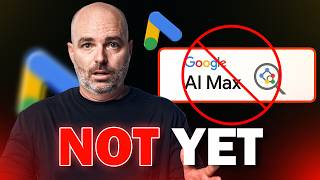
Aaron Young explains why he's not yet using Google's AI Max, which launches in September 2026. His five-week test found that 83% of AI Max search terms would have been captured by existing keywords, and the tool generated headlines with factual errors like outdated years. Google hasn't published the budget or conversion thresholds needed to hit the promised 7% lift.
Chapters
Whether you like it or not, AI Max is here and it is replacing Dynamic Search Ads in September of 2026. And in this video, I'm going to break down why I'm still not using AI Max yet. Now, I do want to really emphasize that word yet because I do really have a positive outlook on AI Max and the role that it'll play inside of Google Ads in the coming months and years. But where it sits right now, I see that AI Max is very, very similar to what Performance Max was in 2022. In that it wasn't a campaign type that I fully trusted. Now fast forward 4 years, Performance Max is pretty much one of my favorite campaigns, and we use it well over 90% of the time. And in most cases, for accounts that we're not using Performance Max right now, it's on the roadmap of future campaigns that we will be using. So that's how highly I rate Performance Max as a whole. And I do also see a world where it's highly, highly likely that for lead generation businesses, so businesses that are heavily focused on search keywords is that they will really move to a model of search campaigns and also AI Max, and they may not use Performance Max at all. But as I want to stress, we are not there yet. So what I want to do in this video is I want to list my top 3 reasons for why I'm not using AI Max right now in 2026. Now, right at the start of this video, I do really, really want to stress that here at Define Digital Academy, we are very pro AI features. And in fact, we've actually built a full suite of AI tools that we use every day for optimizing our Google Ads campaigns. And what these are is that we've built them off all of our internal Define Digital Academy frameworks. So these are all the frameworks that I've been using and updating for since 2010 when I launched my first Google Ads campaign. And there's 5 tools that all of our members are using. That's finding out which campaigns are ready to scale. We've also got ad copywriters and landing page CRO experts, and also a smart bidding coach. But there is also one which is our keyword and search term audit, and this is built to do a SWOT analysis to find out some missed opportunities opportunities inside of your campaigns. And just because you're watching this video, you can get free access to this Keyword and Search Terms Audit tool. All you need to do is to follow that link in the description below. But let— now let me get to the first reason for why I'm currently not using AI Max as a rule in my Google Ads campaigns. And the reason is, is that right now, once again in May 2026, we're not seeing any concrete evidence that AI Max is delivering on its promise of an incremental lift in search terms, especially for our accounts where we're using broad match. Now, I was actually going to do a new round of testing for AI Max, but we're doing an audit for a business, and they had actually activated AI Max without them knowing, because it is something that is really, really easy to do, in March, in the first week of March in 2026. Now, the setup that they had inside of their account was that they had 2 broad match keywords and then 3 exact match keywords. And this test went for 5 weeks, so admittedly it wasn't a long time. But, but the key thing is, is that the search terms that were triggered, 83% of them would have been triggered by either broad match or exact match. And this actually equated to 92% of the total click volume and more importantly, 100% of the conversions. Now the way that we did that is that we looked at the data, the 5 weeks of data that AOMax was running, and then also looked at the 5 weeks of previous data that was running inside that same campaign. So what you'll see through here is that when you do see— and I've just filtered the search terms by AOMAX is that AOMAX was taking credit for all of these search terms. But when we went through the previous 5 weeks, all these search terms were already appearing inside of their Google Ads campaign. And that was just by using once again, those 2 broad match keywords and also those 3 exact match keywords in the same campaign. So the first thing there is that essentially is that AOMAX is not delivering that incremental reach that it really does promise to deliver. The second thing that I'll also say there is that for many businesses, you don't need to start going down this AI Max path, especially if you've got a search impression share that is under 60%. If you're dealing with a search impression share of 10% or 20%, there is no reason for you to turn on AI Max. The reason being is because you've still got so much growth to attain and achieve just through increasing your budgets. And then the next step from there is if you're not using broad match, you could move into broad match, then layer in your smart bidding. Then you can also add in some different campaign segmentations by locations or, or also by different products or services. And then after that, you can also layer in your Performance Max. So you can see from here, I'm not saying that you should never be using AI Max. I'm just saying that for the vast majority of businesses, there's so many more proven and tested ways that you can increase the incremental lift of your Google Ads campaigns without moving across to AI Max right now. All right. The second problem that I have with AI Max right now is that I still don't 100% control. I still don't 100% trust the ad copy creators that it gives. And Andrew Loake, who I've actually had on this channel and was from Savvy Revenue actually did this great post on LinkedIn and let's go and have a look at it. And this is a database post that he'd seen in his own account. His sentiment and opening statement is very much the same as mine. AOMAX keeps letting him down. I have high hopes for it, but every time I start to believe something basic pops up and this got to do with written headlines referencing 2025. And this is what I 100% agree with Andrew here is that yes, you can go through and add guidelines that don't mention last year, but as a guardrail, it should be able to handle something similar like that on its own. And for me, that's why I don't fully trust AOMAX right now, is because we've got— I've seen countless examples of this where AOMAX is just using headlines, which is pulling in wrong data or displaying it wrong. So that's the second big reason for why I'm not using AOMAX right now. And the third reason is that Google is yet to release the type of budgets, the minimum number of clicks, or the minimum number of conversions that you need in and you need inside of your campaign data to be able to achieve its promise of seeing an increase of 7% in your conversion rates while maintaining similar CPAs or target ROAS goals. Now, at the start of this video, you may remember that I spoke about how I see AIO Max as being in the same position as what Performance Max was when it was first released in 2022. And the reason for why Performance Max has been able to be such a successful campaign type is because since its initial release, we're able to get extra data and extra updates. We're also able to leverage other release data points about Google Ads, with the perfect one being is that we knew that with Performance Max, it used smart bidding by default with Maximize Conversions or Maximize Conversion Value. So we knew that for that to work inside of that environment, you needed 30 conversions in 30 days. And then to add in a target ROAS, you also— or a target CPA, that number needs to go up to 50 conversions over a 30-day period. And then, as I said before, you're actually able to separate it out so that you could have different types of campaigns running and and you could really see the performance of your Performance Max campaigns. So we had those known data benchmarks, which we knew that we're not going to introduce Performance Max until we start to see 30 conversions in 30 days. And then we knew that if we wanted to launch it with a target CPA or a target ROAS, that we needed that number to be up to at 50 conversions. And that's the data that we don't yet have for AI Max, because once we do get that data and we can see that when Google does so that when Google gives us information around that 7% increase in conversions, because at the moment they're only saying that that's internal data. And for me, this is the biggest thing that I really want to see some more data guidelines released from Google that gives us some more confidence to go, okay, this is when we can start turning on AI Max for the best results. Because right now, the small sample sizes that we've got, we're just not seeing that data. But as I said, I do know that we will get there. But right now, as it sits, that's the 3 reasons for why I'm not actively using AIO Max in our Google Ads campaigns. All right, as always, thank you for joining me. My name is Aaron Young from Defined Digital Academy, and remember, if you want access to those free Claude or Gemini tools, all you need to do is to follow that link in the description below. And if you are seeing that your CPCs are currently increasing and you're not sure why that is happening, I want you to go through and watch this video right here. See ya!








