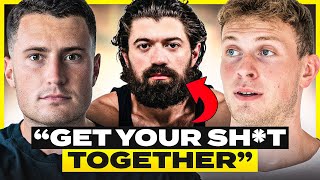
Money or God? w/ Andre Haykal Jr.

Andre Haykal Jr. talks with Matt Moore about faith and business, exploring whether entrepreneurs should chase money or purpose. They discuss how business can be worship and the role of faith in guiding decisions that serve others.
Yo, what's going on, guys? Welcome back to another podcast. I'm here with my good friend Andre, and today we're going to be talking about our faith in Jesus Christ, our Lord and Savior. We're going to be talking about how faith and entrepreneurship, like, how there's so much synergy amongst the two and just our journeys and experiences with our faith and growing businesses alongside our faith. So, Andre, what's up, bro?
Matt Moore. Good to see you, bro. I love what you're doing with Elevate and it's inspiring to me and I'll hit on it, actually, in the interview. Just the talk of entrepreneurship and how it blends into our faith and making Jesus the Lord of our lives. I think what you're doing with Elevate is a beautiful thing and it's setting such a great example for other business owners and entrepreneurs to use their businesses to glorify God. And it's, It's. It's amazing. However, I can support you and your audience. Just being on this platform is an honor. So thanks for having me.
Yeah, it's a. It's a pleasure. Likewise, brother. Like, just having you on here, man. I'm so proud of calling you a friend and seeing the things you've done and how you've grown in your faith. You know, I remember when we were first met, you even talked about just like having this fear around just prayer in general and then just getting to see attending an event of yours, and you just boldly over the mic, pray over hundreds of guys in a room. Like, I was like, that man is on fire for the Lord. Like, you're growing like crazy. So I'm excited to just share this with the people, but I wanted to just kick it off with a quote that I heard, dude. Because I feel it plays perfect into this conversation, but wanted to get your perspective on it. And the quote was, we all know that money can't buy happiness, but everyone must find out for themselves. And so I don't know how that hits you or how that may relate to your life. If you ever have felt that at any point, 100%.
And it's funny you mentioned prayer because the, the crazy thing with, like going on this faith journey is it's a never ending journey. It's a lifelong journey. Like, I literally just ended an hour long session with one of my faith mentors and all we talked about was how to improve my prior life. So even going back to our initial conversation years ago, like, I. I still feel like there's so much area to Improve. And that is so relatable to business, right? Because business is like this never ending black hole of like, your business is never finished. There's always going to be areas to improve and optimize. And so there are so many parallels. And I geek out over this stuff, so I'm excited to dive in. But that quote you mentioned of like, money can't buy happiness and you kind of have to figure it out for yourself, that was me because I grew up surrounded by, you know, wealthy individuals. Like, my, my grandpa was a successful entrepreneur, my dad was a successful entrepreneur. And obviously, like, I wasn't making crazy money throughout high school or college, but what I was doing was discovering entrepreneurship. And we had a podcast where we'd interview really successful entrepreneurs. And I heard them say this, like, on multiple occasions. We talked to very wealthy entrepreneurs as broke college students. And they were like, money doesn't matter that much. And I always wrote it off as like, oh, they're just saying that because they think it sounds good and they're humbling themselves. Obviously money matters. Otherwise they still wouldn't, they wouldn't still be in business. They'd be retired by now. And it just sounded like this really cliche, nonchalant saying. And I just truly did not believe it or buy it. And obviously back then, I wasn't super, you know, in my faith as I am now. So I think there is some truth to having to find that out for yourself. And at least for me, that was my journey of, like, I had to chase the money and the success to find out that it wasn't as fulfilling as I thought it would be. And I think the beautiful thing about our faith and God in general is like, he's very patient. Like, he doesn't need you to know as soon as he kind of sends you that message, because he could, he could have been talking to me through my grandpa or through other people I interviewed on my podcast, telling me straight to my face like, money will not make you happy. And I still didn't believe it. And God was okay that I didn't believe it right then and there. He was patient with me to go through the process to figure it out on my own. And he maybe put me through different trials or experiences to force the issue or to force me to really, you know, wake up and see this message he's, he's sharing with me. And I figured it out on my own time. And I think that's, you know, realistic for a lot of people is like, I could sit here and tell you that Money is not going to buy happiness, but you might still have to go and figure that out for yourself to really understand it and live it.
Yeah, absolutely. I know for me, like, in my experience, I had this sticky note when I was first starting out in business. I was 18. I had this pink sticky note on my desk, and I wrote down 3k per month, hundred dollars a day, you know, 30 days in the month. And like, that was my starting goal because my bills were, I don't know, like $2,000 at the time, what have you. And so I was like, if I can just make three grand a month, I'll be good. You know, I'll be set for life. I could live the rest of my life on that. Like, that was my mindset. And I remember hitting the three grand and, you know, I finally get the freedom. I quit my job, I'm all in on entrepreneurship. And then it was like, okay, well, maybe it was 10 grand that I'm really searching for, you know, because 10k is kind of like the initial benchmark getting into entrepreneurship. Right. Like, everyone's striving for that first 10k month. I'm sure a lot of your students, including client ascension, like, that's probably a goal of theirs and higher. Of course. I know you meet people at all levels, but for you, was there like a benchmark that you hit that maybe you realized, okay, money actually isn't buying happiness. Was there a moment or was it a collage of moments? I don't know if you had that sticky note moment where you were like, ah, this wasn't what I quite felt it was going to be.
Yeah, I think it probably was right around that 10,000 mark, at least for me. I. I was always in partnerships, and so like, 10,000amonth to me in a three business partnership didn't mean as much. And so my goals and ambitions were probably set a little bit higher. But, like, I'll never forget because we started our business in school, like, the. The first goal was to hit a certain benchmark by the time we graduate so that we felt secure enough to not have to go out and get jobs.
Yeah.
And we hit that within the timeframe before we graduated. And, you know, anytime you hit a goal, it's still, you know, a great feeling of achievement, but it leaves you wanting more always. I've never met someone that's either done something to a really high level or accomplished a goal that didn't feel like they wanted more. Like Tom Brady, when he wins his seventh super bowl, he's not like, okay, I'm good now. He's like, how can I get eight and then how can I get nine? It's, it's never enough. It, it, it is never enough. And I don't even think hitting like that first 10k benchmark is where you, where you feel it. It's, it's. Once you hit 10k, you push the goal post, then you hit the next goal post and you keep pushing it, keep pushing it, keep pushing it. And I think it, it almost takes a couple of experiences, like you mentioned hitting 3k and then pushing it to 10k. It takes a couple of those experiences to, to kind of take a step back and realize what's happening here. It's like I'll never be satisfied. The goals feel good, but that's fleeting. There's, there's nothing foundational that I can, you know, ingrain my identity in here because it, it doesn't last long enough. It's not meaningful enough. And I think it took a couple of those experiences for me to finally realize, like, this is not where I'm going to find my fulfillment. And so, yeah, for me, it wasn't just 10k, it was like multiple of those goal posts and then taking a step back and realizing, what the heck am I doing here?
Yeah, I think something you said, Ecclesiastes, 5, 10 puts so. Well, whoever loves money never has enough, whoever loves wealth is never satisfied with their income. This too is meaningless. Of course, the book of Ecclesiastes, you know, everything is meaningless in the book. But like you're saying you're never, never going to have enough. The goalpost is going to continue to move. And so from your perspective, like, how have you balanced keeping the foot on the gas in business, but also feeling purpose, feeling fulfillment? Because I feel like a lot of us as entrepreneurs and as men, you know, we gotta be striving, we've gotta be grinding toward that next goalpost. And if we're not grinding, then we don't necessarily feel that purpose or fulfillment. So how do you kind of juggle those two of, like, I'm doing enough, but I still have ambitions and goals?
Yeah, I think that's always going to be feeling. And I don't think there's anything wrong with that. As long as it's not, you know, the North Star. Right? The North Star for you has to be your faith in God and making Jesus the Lord and savior of your life and of your business. And so that was the change for me. I started a Bible study in client ascension with a friend named Jennings, and I should say more. More like a faith mentor than a friend, but really both. But he taught me a lot about faith early on. And the Bible study started by reading a book called Business for the Glory of God. And I just never thought of that. Like, I always place business in, like, a separate bucket. It's like, business is over here, and then my faith and my family and everything else is over here. It's almost like my business wasn't good enough to be in the same conversation of my faith and my religion and my relationship with God until we went through that study. And it made me realize, like, what is business? Business is, is a form of worship. Business is a form of prayer. Business is, is an idea from God. It's God's idea. And, and it's fundamentally good. And it can, it can worship God. And I just never saw it that way. Like, I always saw it was like, business, make a bunch of money, and then, you know, do your faith over here. But, like, once I started to look at, like, how can I use my business to glorify God? How can I use my business to worship God? And then I started to go down the rabbit hole and I started listening to guys like Myron golden and Taylor Welch. And not only did, like, my faith life, you know, flourish, but so did my business, because I rewired how I think and look at what business is rather than, like, businesses. How can I just keep growing revenue? It's, it's. How can I keep growing impact? How can I keep providing not just a great service for my customers, but job opportunities for my team? In MRR and revenue, these are all things that are important, but not for the reasons we originally thought, not because 100k mrr is going to take care of us and our situation and make it so that we can get all the material possessions that we ever wanted. No, it's so that we can continue to provide. Right? Money is a tool. There's nothing inherently wrong with money unless it's used incorrectly. But if you're using money to provide job opportunities and livelihoods for other people, that's a beautiful thing. And to me, that is a form of worship. And the only way that you create an income and make money from your business is by providing something of value to the marketplace, which, again, is something of worship. It's a form of, of honoring God. And so once I reframe my mindset, I didn't look at revenue and MRR goals as, as something that was wrong or bad. And I shouldn't be aiming to increase that number. It's just the why behind it. I know that if my business grows, the impact of it grows. And it doesn't all get summed up into a revenue number or an MRR number. There's small things that happen whether or not the business is succeeding or growing that happen on an everyday basis that honor and worship God. Whether it's an interaction with a team member, whether it's helping a customer through a difficult situation, whether it's you learning, you know, about ownership, responsibility and accountability. But if you just look at it through this new lens, business becomes like the ultimate playground for learning of how God works and how his kingdom works, which is so cool.
Yeah. Amen. Ron and I, there's so much to unpack with what you just said. There's some scripture in the book of Ephesians, which is one of my favorite books, and Paul talks about how we were all given gifts as individuals to serve the body of Christ. And of course, like you said, I'm in the relationships business. I'm in the community business. And the reason I love community so much is because we get to see individuals come together and serve each other. And it's the most purpose filled, fulfillment driven thing ever in my life of getting to build someone up and say, you have a gift to serve these other hundred people. How can I put you in a position? How can I help you and build you up to serve those guys? And what you're saying with entrepreneurship, it's the same thing. It's just on a bigger scale. You know, it's on a global scale of 8 billion people. You have a gift in serving people in, you know, client ascension, helping them grow and scale their business in these other avenues of business that you have, you have gifts to serve other people. And it's exactly what Paul is saying in Ephesians, like, we need to leverage our gifts. Go build businesses on your gifts. Use that, your service, your fulfillment to provide value and serve the body of Christ so everyone gets better. And so it's such a powerful thing you're saying. But one thing that I wanted to really touch on because you have always preached this, I feel like, like with the client ascension events that I've been to and just being your friend, being around you, you've always been so fixated on the fulfillment and the product. And I don't know if that's just because you're an ops guy and you get to just be in that role or if that's just your heart posture, especially as you've grown in your faith. But talk to us about like, how fulfillment and faith kind of coincide and how. I feel like a lot of entrepreneurs, they kind of lose sight of that and they get caught up in chasing the money and the mri.
Yeah. I mean, fulfillment is like keeping your promises, right. And it is doing, in a sense, the work of the Lord. Right. I mean, if you look at like even the history of the Bible, like Jesus wasn't who he was just because what he was saying. It's because of what he actually followed through on and did. Right. I mean, there are a lot of strong influences, not even just in the Bible, but even back in the olden times that like, were quote unquote influencers. And they told great stories and they had strong messages, but they never fulfilled those promises or backed themselves up through, you know, really strong actions and selfless actions and sacrifice like, like Jesus did. And I think the reason I'm very tied to fulfillment is because that' a service delivery. Right? And there are service driven aspects in every part of business. Sales can be service driven because you're helping someone realize that they need something that they might not have realized they needed. And so each part of the business can, can honor and worship God.
That.
That's like my main message today to the audience is I think a lot of people look at business, especially in the faith, like there's this conflict of like, well, I want to be faithful and I want to, you know, associate myself with Jesus. But this business thing over here is it doesn't line up with the morals. Like it's kind of a scam. I'm charging too much money, I'm being a snake oil salesman, et cetera, et cetera, et cetera. But business doesn't have to be like that. Business can be a form of honoring and worshiping the Lord, every part of it, from marketing to sales. But for me, it's always been the fulfillment piece because the fulfillment is the delivering of the promises. And I think it's also just a gift that God's given me of being good at fulfillment and being good at operations and finding people that can come in and deliver work to a really high quality standard. But there is something there, I think that's service based. I feel like the fulfillment part of the business is where you can really go into the service tier. Because now it's the giving, right? We already got something from them which is, you know, money or a transaction or a sign up. Now all I have to focus on is giving, returning the favor, giving them, you know, an roi on their investment over delivering value. And so because of the way I've structured my business, I don't concern myself much with sales and marketing because I have really amazing business partners that do those parts of the business well. So all I do all day is is figure out ways that I can serve my client base and then serve my team to then go out and serve our client base. And I don't know, that's just something that's really fulfilling for me. And I can imagine sales and marketing is fulfilling for other people as well. But like for me just being able to show up and figure out a way to like wow our clients and create an amazing experience for them. And it's, it's the levels that this has gone to now that we have a team as well. It's like there's two levels. It's like the customer level. Yeah. But also the team. Like helping the team to acquire the skill sets and the knowledge and the wisdom to then go out and serve our customers. And then them being able to see the result of their work in the form of like our customers having life changing business results and wins that help them to pursue their goals or move to a new city or buy a new house or get married, whatever it might be fueling in their real life. It's so fulfilling, not just for me, but for so many people. And yeah, I don't know, it's just, it's, it's just something that I've really drawn into.
Yeah. I mean Jesus said it himself that the son of man came to serve, not to be served. And so I feel like when you have this servant heart posture, like people are going to feel that that heart, even if you deliver a bad service. Like I've had clients in the past who haven't gotten results, but they've continued to pay me and stuck with me because they've just seen a servant heart posture. They know I'm working hard to serve them regardless of the result and they're willing to keep riding because of that. So I think it's such a testament there. But something you just mentioned that I think is really cool that is in the book of Exodus is you've said kind of the layers you've built in your business with your team members and in the book of Exodus we get to see Moses, right. Moses was like the vessel between the Israelites and God. Like they would go to Moses and he would like communicate with God and like give them what God said. Like he was, he was this really connected figure and leader and there's this scripture in Exodus where Moses actually meets with his father in law. And you can kind of sense, like, some burnout from Moses. Like, he is everywhere. He's solving everyone's problems. Everyone's coming to him, and he just lays it on his father in law. He's like, here's kind of what I'm going through. And his father in law, I think, gives him an incredible business lesson. He's like, you need to empower.
More from Andre


Russel Brunson, Client Ascension 2023 Event & ListKit Update - Members Lounge Special