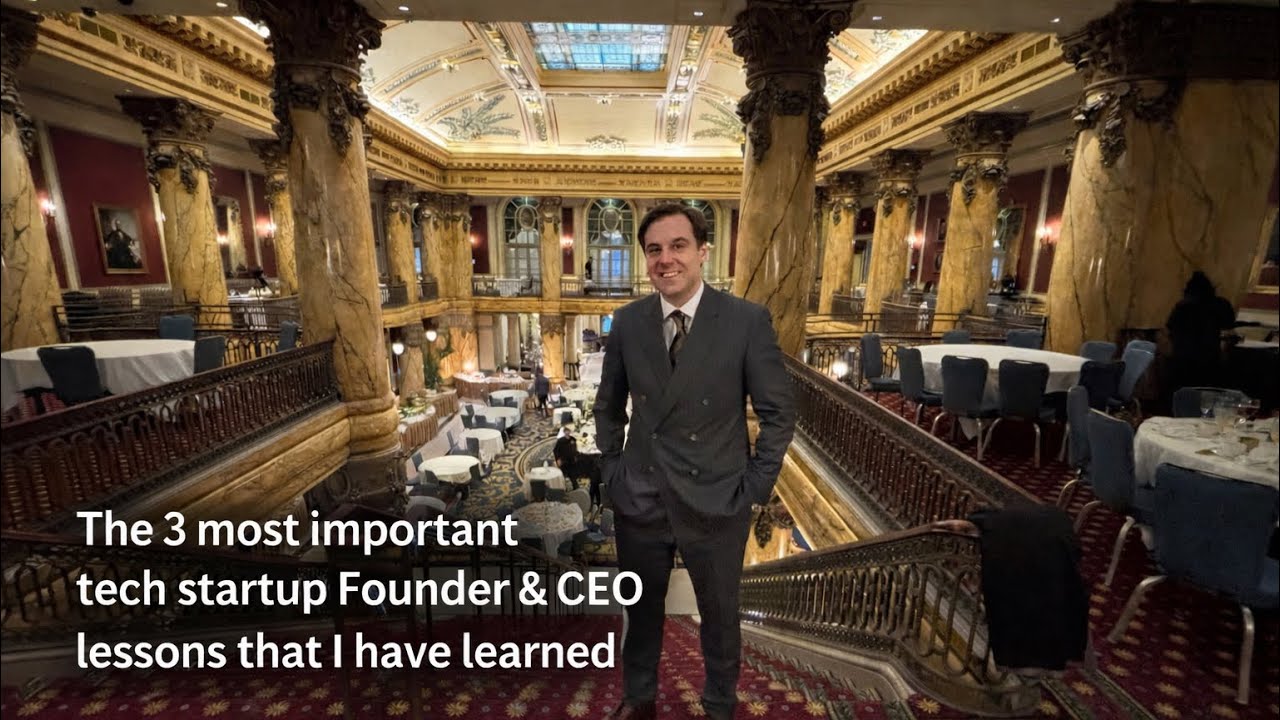
In this informal vlog, Andrey V. Karpov (BSBA, CSM/CSPO) shares practical, agile‑inspired advice on effective networking and business communication. He begins with a personal, light‑hearted introduction, referencing his morning coffee, a fashion influencer, and his past experience at Apple. The core of the talk covers how to present oneself authentically—choosing appropriate attire, maintaining a professional appearance without overspending, and aligning visual presentation with intellectual credibility. Karpov emphasizes the importance of genuine listening over consultative selling, warning against turning conversations into therapy sessions. He outlines techniques for reading the room, identifying prospects, and engaging multiple people simultaneously by inviting newcomers into the dialogue, thereby building a “circle of trust.” The speaker stresses that networking is not a transactional sales pitch but a relationship‑building exercise grounded in respectful, curious conversation. He then discusses concrete networking artifacts: physical business cards, digital card platforms (e.g., Dotto, Popple), and alternative contact exchanges (phone bump, LinkedIn). He advises asking permission before sharing contact info and interpreting a refusal as a signal to improve future interactions. Karpov also touches on mindset: applying an agile approach to personal branding, content creation, and job searching, and recognizing that consistent, value‑driven communication leads to organic follower growth and opportunities. The video concludes with a motivational recap—listen, engage, read the room, be yourself, and maintain a balance between appearance and intellect—to encourage viewers to become the kind of person others want to connect with.
Chapters
Buongiorno amici! Welcome to this beautiful day di mattina here in West Broad Village. I'm having my Americano with quadro shot and a little bit of keto creamer. It's absolutely beautiful day here. You can see the skies partially clear, partially cloudy, and Sun's shining. Remember, sun is always shining. And I want to attribute this video partially to my very, very, very great— I would want to say friend one day, but very great influencer, Massimo Peroni, who is a creator of wonderful clothes in Italy, where I plan to also live hopefully one day very soon. And travel in Europe, but also of course in the United States, unless Mr. Trump decides to eliminate, you know, citizenships, borders, and other things. But overall, I'm not political. I'm all for innovation, progress, change, good change, bad change. If there is something changing, you need to accept it gracefully per true agile mindset. Speaking of which, Today we're going to discuss with you how to network, how to be more effective at business communications when you're trying to meet other people. So first and foremost, make sure that you are being yourself when you're networking at an event. So if you're used to wearing a polo like this, jeans, all of that, that's fine overall. Right? I'm obviously walking my dog right now. If you're a startup entrepreneur in the AI space, technology consultant, you know, coach, whatever that really title or profession is, you can be dressed in any way. You can even have your hair funny enough like I have it now in the wind, which has always been kind of my issue. When I was a little kid, my mother would put a lot of you know, what's that called, that solution that holds your hair. I don't know why she used it, but she said, you know, you have your hair all over the place. So now I really don't care. I'm agile about it. But obviously when I'm conducting business, I'm dressed professionally, right? I have a tie, I have a nice suit, pants, good shoes, right? And all these things, they don't have to cost a lot, right? Some of the things that I have in my collection, they're from back in the days They're from simple places, just to let you know, like Target, where it's a two-piece suit and it has vents and it's only $100, right? So I have one gray one, I have one blue one, and it works perfectly. People can't tell, and they shouldn't be able to, and you shouldn't really care what they say as long as you feel you look good and presentable and you're able to— most importantly, that's the next step— to match your visuals to your intellect when you talk to people. That's really what matters. Obviously, don't wear sunglasses. I'm doing that because it's kind of sunny and I'm outside again, right? I know there are a lot of people out there who will say, "Oh, look at this guy. He has EarPods and glasses. He's trying to tell me how to live my life." Well, first of all, I don't really care. And second of all, I'm doing that because it's comfortable for me right now. And it's not about how I look but how I'm trying to position myself in order to gain respect and trust of other people that I'm actually extending it to as well. So with that in mind, what we have to make sure to do is listen. When we are interacting with other people, we need to give them the space to talk to us and tell us more about themselves. The situation is highly different overall when we are trying to solve their problem, when we're offering a solution, when they are expecting us to speak. I know it's going to sound kind of strange and you're going to say, "Well, it's consultative selling. You have to listen. You have to allow them to speak." Well, if you allow them to speak a lot and they are supposed to pay you money, what's going to happen eventually is they will feel that they are spending their time, or better say wasting their time, on, you know, you being their therapist and listening. That's why people kind of get pissed off. You don't get pissed off at your therapist and you just keep talking and talking and talking and it abruptly ends at 45 minutes or whatever the time that's allocated, um, that's probably not going to help you anywhere. You're going to get really frustrated. It's the same situation here. The clients or potential clients, they want to hear a solution. They want to make sure that you are telling them in the most concise way possible, on high level foremost, what is it that you are trying to offer them and what kind of value, most importantly, it will provide to them. So from that perspective, if you're doing a business speed dating or networking at an event where you have a lot of people, you need to make sure that you quickly read the room, understand who are the prospects that you're trying to engage with, come across authentically, do not come across transactionally. Remember, you are not trying to sell anything right now, you're not trying to offer anything right now, you're not trying to solve any problems right now. You don't have the permission to coach, to solve, or even enter that personal space of "I'm an expert, hello guys, I'm here for that." You don't have that moral right. And yes, you physically can try to do that, but that's not going to end well. Never does. And I went through all of that, that's why I'm sharing it with you. So what you have to do is you have to get to know people in the room, you have to converse. And something I learned at Apple when I worked there last year is that you have to be able to multitask and work collectively with a group of people. So if you're talking with someone and somebody else comes in and says, "Hey Andrey, how's it going?" So what are you going to do? Turn to them and disregard the other person? Typically doesn't end really well. So what you want to do is engage them. You want to invite them in your conversation. "Oh my God, so good to see you, Jeff." "Hey John, meet Jeff." "Jeff is..." and so forth. Right? So you're trying to create a circle of trust You're extending trust, you are inviting respect into this conversation, and you're broadening your group of collaboration that way. And when you listen to people, when they're telling you what they do and what they're excited about, what's on their mind right now, listen to them authentically. If you continuously do, "Mm-hmm, mm-hmm, mm-hmm," what that shows is that you are very anxious either to sell them something, get to the chase or to the bottom line, which people don't want, obviously. And oftentimes networking is done in a relaxed setting. People may be drinking or indulging themselves in other pleasures like food, and you may not be doing that, which is great, right? You are leading a healthy lifestyle, but you have to be respectful and mindful of the idea that not everyone in life is right now at the stage where you're at from mindset perspective. And there's nothing wrong in that. Everybody gets there at some point due to certain catalytic events like I told you about mine earlier. So with that in mind, you're listening to them, you're acknowledging, you're asking engaging questions, you're making sure that the conversation is fluidic. And the whole point of this conversation, other than of course listening to them attentively, remembering a lot of things, and not trying to take notes— because come on, this is not like a one-on-one session where you're doing scoping, this is just you're getting to know people, right? They're getting to know you— is to get them to a point where they exhaust themselves in a good sense of the word. Not after a very long time. So you have to control and balance that. You'll get a feel of that during the process as you do it more and more and more at different events and with different people. Where they're like, "Well, I want to learn more about you. Tell me about you. Like, what is it? What's going on with you?" Or they may say, if they know you for some time but they haven't seen you in a while, but they're following you on social media, and they may say that, "Oh, you're all over the place. I see so many updates, so many things happening." Yeah, man, like, it's like, it's just wild. You saw this, you did that, you opened that startup, or You know, you're involved in this business venture, now you travel. So what you can do is, depending on how much time you have and depending on the viability of relationship with that person, foremost based on communications, right? And this is something interesting I want you to remember. Fruitful, healthy business synergy with anyone is produced on communications foremost. It's not about, do you have something for me? Do I have something for you? It's about, can we have a healthy, constructive, human conversation, which in these days a lot of people just don't know how to have or to hold. So if you feel that, you can continue the conversation, but you can also add something playful like, "Well, it looks like you know everything about me already. You've been following. I truly deeply appreciate you following me on social media and reading my posts. Has anything provoked your thought lately? Are there any questions that you'd like to ask?" because one of the reasons I do this is to create feedback loops so people would give me constructive feedback for me to improve and for me to impact the world in a much greater way. So say something like that. Be genuine again. Don't try to come across egocentric or take the torch sort of and say, "Oh yeah, yeah, I'm all over the place. Exactly. Yeah, that's why you're watching. All right, good seeing you. Bye." You don't want to do that, right? Again, Fame is not what you should be after, and in fact, it's all perceived in our mind in one way or the other. It's very hard to honestly segment that, judge that, or understand from the standpoint of— not that you should, but like, are people really liking my posts? Are they sharing? Are they commenting? Why did I get these many organic impressions or not so many? It should not bother you. What you should be thinking about is if you have the passion, the time, and value, you should produce content on iterative basis, continuously. When you do that, what happens is you will gain followers sooner or later. This content will find its buyer, figuratively speaking. This will happen. It's the same type of analogy that works with you trying to find a job if you're unemployed or you're in a job transition right now. By the way, if you're unemployed, you actually are employed. You're employed by yourself. You can be a consultant. Just a side note for that, but we can talk about that in another video. And if you are also waiting for a business opportunity, for a client, again, you're really struggling, you're hustling, but, you know, opportunities are not coming to you. Maybe because, again, you're doing some things in a not the most efficient way, the process is not fine-tuned, and instead of working smart, you're working hard, which unfortunately, or fortunately, honestly, in my opinion, these days it just doesn't work. We're no longer in the 19th century where you have to put coal in the chimney. We are in a different environment where you have to be smart about how you approach your work, where you have certain outcomes that you track, and most importantly, you're providing value and you're having good synergy value to your clients and good synergy with your team. So those are the things, right? So, and then another important fact about networking is artifacts that you need to use. So make sure that you are utilizing an approach in which after you engage in a conversation, get to know people, and you want to leave space— this is very critical— you want to leave space for subsequent meeting, which is more detailing or solutioning meeting where you really dive into, okay, how can we benefit each other? How how can we support each other, how we can sustain this relationship and create something more holistic out of it. Now from that perspective, what you want to have, and I have something with me at all times almost, is a business card holder or a wallet that fits your business cards. That's really important because you can have— I have both here, Physical business cards, they don't have to be anything fancy schmancy, right? You can again improve that over time. And I have a digital business card, a very simple one from Dotto. There's Popple, there's a whole bunch of other ones. So you're giving people a choice, you're giving people an option. That's really important because again, if you give people a business card and they're not used to it, they don't like it, you can judge them or you can say, no, no worries, I got a digital one. And they say, "I don't want to scan, I don't like really scanning stuff." I say, "Okay, can you go to the website?" Right? Or, "Let me email you," or, "Let me—" You know, you can bump phones, like an iPhone has this feature. There's so many different ways of doing it where you can retain the relationship and engagement with that potential collaboratee. And last but not least, if they don't want that, if you've had a conversation for about 5, 10, 15 minutes It was a long chit-chat, and at the end you say, well, I was really fascinated to hear all these things from you, and you know, it's so great. I would love to continue the conversation at some point, or when you have time, maybe later this month, so we could see how, you know, we could synergize. Or better, if you say, how I could provide additional value to you with your permission. And if person says, yeah, I'd love that, and you know, they will typically say, do you have a card, or you know, what's your number, or so forth and so forth. In cases where you're giving someone a business card or some kind of an artifact to maintain that connection, or you're trying to add them to LinkedIn, which is very common as well, I do that, and they're saying, "No thanks, I'm okay. It was good to know you. I gotta run." So if people say that, 99% of times, unless their wife is giving birth to a child or something like that, I'm giving them a hypothetical example, that probably means that this conversation was not holistic. You did not really connect. It just may not be your person, may not be the right vibe. What you need to take out of this is improvement. You need to think about it down the road and see how you can improve your process so that next time you don't spend so much time giving all your soul and energy, both either listening or speaking depending on how the conversation goes, and getting you to nowhere because the person doesn't even want to bond with you because essentially these days If people— and this is going to sound a little weird, but that's how I'm seeing it overall, the trend— if they don't bond with you on social media, even though that's not really what you want, that's not the end result, or they don't give you a card, you don't give them a card, then there isn't really a holistic bond created. There is no handshake because handshakes, right, these days do not mean anything. They're just like, hi, how's it going? Hi. So before, previously, as you know, that meant a lot in business. Especially for gentlemen. So that's really important. Other than that, what I do suggest you do is have a simple business card, whether you're working for someone, whether you're an entrepreneur, whether you're soul-searching, job-searching, you know, whatever doing, is you need to have your contacts. You need to be ready and engaged, right? So you gotta be able to rock and load at all times. Why is that important? That is important because you carry yourself, you're your own business, and it's not about being transactional, it's not about selling, it's about being ready to engage in conversations that can impact your life down the road and that can impact someone's life down the road. And having this is very important with you. It's very thin, it doesn't take a lot of space, and you just need enough for such situations. Yesterday I had a 10 business cards. I was sitting in a restaurant eating and also working, and I ended up giving out 5. Okay, 5 without really doing much other than engaging in conversations. People asking me what I do and wanting to know more, and me saying, "Oh, I would love to, you know, to maintain contact. Would you like my business card?" Right? Asking for their permission. They say, "Oh, I'd love that. That's great." You know, "Great." So And that's all there is to it, guys. So I hope this video was helpful. So to resume: listen, engage, read the room, try different things, be yourself. If you're wearing a suit, if you're used to that, wear a suit, but be humble enough to approach people so that they feel that it's not about your suit, it's about you, your intellect. Because we say in Eastern Europe, You're greeted by your looks, but you're let go or said goodbye— probably better to say translating— by your intellect. So that's really important that you maintain this connection between the two pieces. And be the person people want to be around. That's what will get you to success in terms of synergy with other people. Smile, speak distinctly, look into the eyes. And listen and provide genuine natural interest and curiosity and train your mind to remember important key facts about the things that you're inquiring about in the first place. You've got this! I believe in you! If you'd like to learn more, please hit subscribe, please like, please reshare, and please comment so that we can continue the conversation. And may the Agile Force be with you always!