111. Cameron Marshall: Lessons Through a Running Back's Eyes
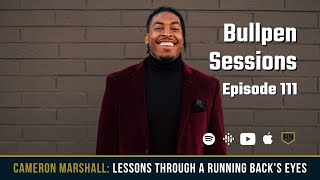
Cameron Marshall, Arizona State's 7th all-time leading rusher, talks about his path from San Jose youth sports through the NFL and CFL. He shares what it takes to compete at each level, how Division I training shaped him, and what athletes learn when their playing days end.
Chapters
All right, welcome back to Bullpen Sessions. I'm excited today to have Cam Marshall on. I got a chance to get to know Cam a little bit a few weeks ago. And, Cam, I'm excited to have you, man. You've got a. You've got quite a resume on your. On your plate from. From your sports career. And so really, what I want to use this podcast to do for the audience is talk about your journey from, you know, being a youngster up in the Bay Area to. To the NFL and then how you're applying those lessons to life today. Sound good?
For sure, Absolutely. And thanks for having me. Excited to be here.
Oh, no, I. I'm excited, man. Like I said, didn't know, you know, you and I never met before. We were in a. Actually a virtual mastermind together, but virtual being the key word. And I think we had, what, about a hundred people in there, so you can't always make close connections. But I think our time in Park City a few weeks back was really, really cool. It was great to spend time with you. And I'll actually reference a couple of amazing athletic feats you had.
In Park City, if you don't mind, as we go through this.
Yeah, do your thing.
So, Cam, let's just start right here, man, for the audience who doesn't know who the heck you are, where. Where were you born?
Yep. So I'm originally from San Jose, California, born and raised out there. So. Yeah.
Awesome, awesome. Well, we're gonna get right into it because.
Your accolades from. From sports are. Are pretty long. You know, I can just. I can spend all my time sitting here reading this, but, you know, you played. We're going to talk about your career at Arizona State. You're the number seven all time leading rusher at ASU. Single, tied for the single season record of touchdowns. 18 second all time with 38 rushing. Rushing touchdowns. And so you've had. You had one hell of a career at Arizona State in the backfield. But let's actually go. Previous to that, you know, growing up in the Bay Area, you were more on the south end, right towards San Jose.
Yep, yep. South side of the bay, huh?
When did you really realize football could be a thing for you?
So, like, early on, obviously, you know, you have some success playing and, you know, your little league sports. And, you know, my last year playing the popcorn, we had won the national championship. So that was kind of like an early test. But I'd say, like, when I was real, when I was really, like, real for me was my first, like, football Camp. So I went to, I went to Arizona State. They had like a football camp for like high school students. I don't even know if they still do this or not. But so basically our high school students from all around the country will, will come out and they'll, you know, you'll do a camp. So I had done a camp like that and I had done another camp at another point in time of year. Well, same type of thing. High school kids from all around, different areas, different states, you know, different parts of California will fly and kind of just, you know, they'll work you out, you'll do drills, you'll compete against people. And so for me, I realized I was like, okay, I'm actually pretty good. Like, I always knew I was good, but I realized I was pretty good when I got to see myself against other kids from other areas, you know, Texas and Southern California and you know, all these other different areas who are Florida and you know, these kids are good at sports. And you're like, are these, you know, these are, you know, pretty well known state. So you come out there and you compete against those guys and you're doing well against those guys. You're like, okay, like, I'm not just like locally good. I'm, I'm actually like, I'm good. Good. So. So that's probably like the first, like the first real time. So that's probably like my junior year of high school, like where I was able to really confirm and I knew I was always good, but again, I was just really able to confirm it against different competition.
Well, and I think you bring up a good point. You know, I grew up in Wisconsin and as a high school athlete, it's hard to compare yourself locally sometimes because you where. Whereas you come from one of the best states in America when it comes to high school athletics. I mean, some of the competition in California, especially in the sport of football, there's only really two other states I think of that can compare, and that's Texas and Florida. And so you're sitting at a national camp competing against kids against Texas and Florida and you're competing. That. That should have given you a pretty good indication that, yeah, I think I got what it takes to play at the next level.
Now you had obviously a really successful high school career. I'm just curious, you know, again, going back to early on in maybe little league football or whatever, was there a reason you chose running back over any other position?
Not, I mean, no. So I guess like my very first year of football, they put me at Running back, but, like, I could never remember which way the holes were. Like, you know, they have even numbers for the right, odd numbers for the left. So like, my very, you know, we're talking eight years old, I'm playing. So they're like, okay, 22, and then I'm going to the left. So they're like, they put me at O line for a day and I was killing people at O line. So they're like, okay, well, we need to go ahead and put them back at running back and we'll just help them out with the. With the stuff. I've since, you know, gained some football knowledge and, you know, understand the game a lot more than I did at 8. But yeah, so running back, it just, it was pretty natural for me. I mean, I was always a. A fast, athletic, you know, stocky kid. So it was kind of natural, especially at that time period. You know, kids weren't. We weren't. Now the kids, they throw the ball around a lot, but when the kids weren't really throwing the ball where I was playing. So all the athletic kids either played running back or, you know, some quarterback or something on defense. So, you know, running back just kind of where they put me.
I love that they actually moved you from the offensive line to running back or back to running to running back to protect the other team because you were killing kids on the offensive line. I absolutely love that. And by the way, guys, I had a chance, as I mentioned, to hang out with Cam in Park City. We were skiing, fly fishing, having fun in an indoor air park. This dude has got tree trunks for legs, so I would not mess with this guy whatsoever. In fact, did I read you ran a 432 40?
That was. Yeah, that was. So that was a hand time. And I was coming out of. I think I was coming out of high school. I was at that. So my, My pro day wasn't a 4:3. I think officially on my pro day, I was like a 4 5. But I think it was faster than that. But, you know, that's what. That's what they told me. So that's.
That's up to. That's up to the scouts, right?
Exactly. I ran enough four fours and training to. To know what one felt like. And, you know, I felt every bit of a 4 4. But, you know, that's just what they. That's what they got me at. That's what I got to be held to.
Absolutely. Now. So I'm curious because again, for the folks listening that don't. Don't know who you are. You, you also have a younger brother who's been extreme successful on the football field, both at the collegiate level and he played in the NFL and is currently in the cfl. Just like, you know, very similar to the career trajectory that you, you took.
Were your parents athletes? They, that, I mean, like the, the gene pool going through the Marshall family has to be insane. Two running. Two. Two boys who are running backs playing at major college. You know, your brother played at Oregon, you're at Arizona State, you both play in the NFL. Were your, were your parents athletes?
They are. And yes. And I do got a. I gotta give credit to the person who started everything with, at least with the kids. My older sister, she ran track at the University of Arizona. So. Okay, so she, she kind of got us all started off with, you know, going to sports on scholarship or going to college on scholarship. So. But yes, that my parents were actually my sister too. She was a, you know, top 10 hurdler in the nation coming out of, coming out of high school, so. Or top eight actually. So, yeah, so a lot of talent between the three of us. But yes, both of my parents were athletes.
My dad played basketball and ran track and my mom, same thing, basketball and track.
And so yeah, football just kind of came. I know my dad wanted both of me and my brother to play basketball, but football just kind of came a little bit more naturally to us. I think my brother likes basketball better even still to this day. But, you know, neither one of us are six foot, so, you know, football.
It is, you know, you bring up. And we're going to get to your, you know, your Arizona State career here in a second. But I want to, I want to ask a question about a point you just made that I think is important, important for people to understand because you had a chance to play at, you know, the major Division 1 level, you got a chance to play at the NFL level. Did you see a lot of guys who, let's face it, maybe didn't like the sport all that much, but because they were just so damn talented at it and had a chance to make, let's face it, in some cases, generational wealth, they just kept playing?
Oh yeah. I mean, you see a lot of guys, you know, in the locker room like, man, I really wish I would have been playing basketball. Every football player wants to play basketball. So, you know, so you get a lot of that. But I mean, you guys are just good at what they're good at. Some guys, you know, everyone we all talk to now, like, or when we be in the locker room, like, man, I wish I would have played baseball. We're looking at baseball contracts and these guys are getting 10 year contracts for a billion dollars. And you're like, man, I wish. And like, okay, their body looks like it's way fresher than ours. Are playing to their mid-30s, late-30s, 40s, like, so we wish we would have played baseball, but, or, or basketball, something like that. But it's all good. It's fun.
Well, and you bring up another great point that I think NFL athletes, because with as much as you guys get beat up, the pay, the pay is definitely probably not at the same level as other sports for sure. So you had a chance. Here you are, top running back not only in California, but in, in the country as a senior in high school. Probably had a lot of scholarship offers. Why Arizona State?
It was really simple for me. I mean, it was. They really just invested in me a lot and they, they showed me that they really were committed to me and committed to my growth there as a student athlete. So. And I took, I took a visit to Oregon. I turned them down. Took a visit to Utah. They weren't in the Pac 12 at the time. I say I'm old. So I was in the PAC 10 for the first two years in the PAC 12, my last two, so.
So they weren't there. And it's kind of not the level I really wanted to play with. And surprisingly, Northwestern was my second choice. Again, it just was all the feel. It was less about the big school for me. I mean, I was like, if I wanted to go to a big school, I went to Oregon. But less about a big school for me and more about like my team's commitment to me and like where they invested in me. And so I really felt Arizona State was invested in me. And so I'm glad I made, glad I went here.
You weren't lured in by the different uniforms every game up in what was going on up in Eugene.
I mean, don't get me wrong, that was hard to like look past. And you know, that's like all the Nike. And I love Nike. So like, so I'm looking at all that stuff and I'm like, at the end of the day, it's like I felt like if I, you know, go to school and do what I want to do and accomplish things I want to accomplish, like, you know, at some point I could probably buy a Nike that I want to buy anyways, so.
Bingo. And I think that's an important message, Cam, because, you know, I see it in every sport. And you know, kids coming out of high school going that have these opportunities to go, in some cases, you can go sit at a Division 1 school or you can go down to maybe a mid major division one or even a division two and play from day one. I see so many kids who, who choose the spotlight and. But they end up sitting for four years and it's like why I would have chosen to go down a notch where I would have been able to play every day. And again, what we've seen in sport, in college, especially football and baseball, maybe more than basket, was even at a lower level, you still have a chance to play at the next level if the talent is there.
Absolutely. And I think it was good too because I mean, like at asu, I felt like I had an opportunity to compete when we were, we were top 25 school when I was being recruited. And so I was like, you know, not only are they invested in me, but they do have a chance to compete as well. So I think both of those things are important. But like you're saying, like it doesn't make sense to go sit at a, at Alabama or at a USC or I mean USC when back when they had Reggie Bush and you know, all those guys when they're stacked, makes no sense to go sit at a school like that, Oregon for example, when you can, you know, go to someplace else and actually have an opportunity to play. Like you said, you can still achieve your goals of going, you know, to whatever school that you want to go to.
Well, and, you know, point I want to make is you didn't take a step down. You ended up at ASU also in the PAC 10. You know, when you got there. I'm curious because, you know, you come out of high school and I always use the phrase the hometown heroes, right? Like you can stand out. You were the standout, the number one player in your team, probably in your area. But now you're at, in the PAC 10 and now you're on a team of guys who were all in that position coming out of high school. What would you say was the biggest difference, you know, standing in a backfield in the Pac 10 versus a backfield in Northern California, you know, in a Northern California high school game. What were some of the differences you noticed pretty early on?
The size people?
You got some, you got some grown men on the other side. You know, you're not just like the biggest person or like the most athletic person on the field anymore.
So, you know, so the size of the guys for sure.
And just like, you know, and you got some dogs that you're going against now, like. Like across the board. It's not just like, okay, the other team maybe has, like, two or three dogs or whatever. Like, it's like, okay, there's 11 dogs on the other side that you know that. That have been competing and, you know, all that kind of stuff. So that's probably the biggest difference. And the speed of the game.
The speed of the game was, like, adjusting to. I'd say, like, the speed from, like, going from, like, your freshman year to varsity is probably bigger than it is from, like, varsity to, like, college kind. I don't know. It's like a weird but speed of the games, like, it gets faster. So you start seeing, like, guys fly around and practice and things like that. You're like, man, everything's flying, but it slows down, like, once you, like, start getting into. Getting into everything, but.
Well, that's a question I wanted to ask you because I think everybody hits that point in their college career. This is a good thing for high school athletes to hear. You know, when you get to that next level, everything is so fast. You've got linebackers running sideline to sideline at a speed you haven't seen before. And like you said, it's not one guy on the defense that's all state. Like, this is a now a lineup of former all state players. When did you hit that moment where things started slowing down for you? Was it your end of your freshman year, sophomore year? Where did it really say, okay, I'm here, The speed slowing down, it's easier to read the holes now, and I feel like I belong, I'm here, I'm ready to actually succeed in the PAC 10.
I'd say in my freshman year, I mean, I think after training camp, after the first couple games, like, you. You get a feel for stuff. I mean, obviously, like, I. So I played as a true freshman, didn't start as a true freshman. I started one game as a true freshman. And so you. You. You get things. But, like, the next. The next years, like, the more and more you play, the more and more you get it, so the more reps you get. But I mean, I'd say, like, in terms of me feeling like, okay, I can do this, I feel. I feel pretty good, you know, coming out of camp my freshman year, I'm like, okay, like, you know, I should. I should be playing. You know, I get it. It makes sense, at least at that level. You know, I get it to a certain point. I understand my assignment. I understand what I need to do.
I know I can. I know how to make a hit the hole and, you know, do that, do that kind of stuff. So.
It'S like, that's when I started to click for me and I just got better and better from there, but that's when I really started clicking for me from now a cat my freshman year.
Were there any guys early on in your college career, like you said, you. You got playing time as a true freshman. Were there any guys, you know, as you get called, you know, you come in the game, you're in the backfield, you're. You're scoping the defense and you're like, oh.
There'S. There's so and so standing at middle linebacker. Was there anybody you faced early on your college career, like, damn, I'm going up against him now?
I mean, not necessarily from that perspective, but like, at least from the standpoint of, like, I recognize that person's name or like, you know, you've seen that person before, things like that. So, I mean, obviously, like, I went to. I went to school with Vontez Burfig too. So, like, Tez is over there on the other side. That's practice. So I mean, you see. You see him every day.
So, you know, it's just things like that. I mean, at the end of the day, like.
As a competitor, you're not like, at least that's how I felt like, as a competitor, I was never like, man, like that. There's so and so over there. It was just like, all right, like, I noticed him, obviously, because, you know, name recognition and things like that.
But. But it wasn't like, you know, you're not, you're not just like, dang, I don't want. I don't want to tackle him. I don't want to hit him because that's the case. It's like, you lost already. So. Yeah, it was never really like that for me.
Well, let's talk about this, because, you know, you had, obviously, I read the stats earlier. You had a very successful career at asu. Number seven, all time leading rusher, tied for the single record for touchdowns. What do I have second all time with 38 rushing touchdowns. So you had an amazing career there. But what most people don't realize when it comes to college athletes is all the work you put in off the field. Give people a sense for, like, what it was like to be a Division 1 athlete, college football player. What, what was your typical day like? Not just in the classroom, but all the work you had to put in on a daily basis to be successful on Saturdays.
Yeah. So I mean it obviously depends on the time of the year. I'm sure like, like for you, you with baseball, like just sometimes like during the season is different schedule than off season. But in an off season schedule you would, you know, work out in the morning. So like 6am workouts or so and then you're going to class and you're coming back to do some type of either study hall or it's spring. If it's during the spring then you're you know, coming back to do spring practice and you know, so it's, it's early morning workouts. Then my senior year we switched to practicing in the morning. So like I used to, we used to go to get up and I'd be there at like 5:30. You know, you got to do your treatment and stuff beforehand. Then you go to meetings and you go to practice and you go to class and then you come back and maybe you got to go to study hall or tutoring, if you have tutoring or film review. So um, it's a, it's a full day. You're, you're up early and you're, you're doing stuff all day and then you may be go home and take a nap and come back to the facility and do some stuff or take a nap in the locker room. That's probably the best. I got some of the best naps I ever had in my life in that locker room. So you know, taking, taking that little break between hand, you know, crashing for 30 minutes, 40 minutes and getting back up and you know, going to do something else. So between film and you know like having make sure you're, you're putting the right things in your body as best as possible. I mean you're still, you know, 19 year old kid. So I'm sure all my decisions weren't, weren't great. But, but yeah, I mean it's long days.
Yeah, I, I think you know to me what separates the, the athletes, men or women that come into college sports, the ones who give themselves the best chance to play it, then the next level, which is pro sports and those that fizzle out is how well they're able to manage that time. Because I think between college and high school you get a lot more free time.
Right.
A lot of it's curated like you just mentioned, where you had to be here, then here, then here than here. But it's that ability to manage that time and show up every day. I'M curious, you know, I look back at your ASU career, if you were to break it down, you know, into two or three things that allowed you, and we'll get to this in a second, that play, to play at the next level, what would you, what would those things be? Cam. If I said Cam, why did you get the chance to play at the NFL level? What would you say the two or three things are?
Consistency. So for like showing up, being where you're supposed to be, doing what you're supposed to do. So one, I think that's a tough part for guys. Just like that, like showing up, showing up the right way. I think that's the tough part for people. I've seen some drop off of guys doing that. So like not being able to be counted on. So I'd say consistency was one, obviously talented was another one. But I think that hard work too, just really like knowing that, hey, this is what I really want to do. This is a goal of mine and I'm willing to like put in the work. I'm willing to, you know, if I'm injured, like I didn't, I played in every college game.
That I had, like I never missed a game for injury. And I've been beat up my junior year especially. My body was beat up horribly. But you know, it's just like consistency showing up, the treatment, you know, working hard and practice, you know, with whatever, with whatever I can't could do, you know, I was, I was injured, I was hurt, I was uncomfortable, but you know, just fighting through all that stuff. So really just showing up and working hard and, and then knowing the last part is like really knowing what you're supposed to do and understanding what you're supposed to do. So putting in the mental aspect. So there's a lot of guys who can play.
Physically but like they're never in the right spot. So then the coach is like, I can't put you, you know, in the game if you're not going to be in the right spot. But you know, very talented but you know, it's just if you, if you're not, if you don't, if you don't know how to move with the talent, then you know, you're not really going to play very much.
I think it's an accumulating effect. The word. I was looking for you to say and you said it was consistency, you know. Yeah. One, putting all the, doing all the little things off the field, those drills, those mechanics that so seems so mundane and so boring in moment, but to Your point? Talent's one thing, but if you can't do the little things right, you're not going to get on the field. And so, you know, now let's quickly just talk about your NFL career because you spent time, you know, with the Dolphins, Seahawks, Jaguars, and then you spent some time in the CFL as well. I've got a couple questions for you. I'd asked you the question from, you know, California high school football to the Pac 10, now the Pac 10 and Pac 12, by the time you left Pac 12 to be NFL, you're now standing in an NFL backfield.
Yeah.
What is that jump like from the college to the NFL?
Even faster. So, so like, like you're saying like the funnel gets a little bit smaller as you, as you get higher. So you got, you know, your high school to college, everyone was the best one. Everyone on that college team was the best on their high school team and, or among the best on the high school team. And then all those guys in the college team, you go to the NFL like all those guys were like among the best on their, on their, on their college team. So now you're in the NFL playing with, you know, an even smaller funnel. So it's even faster, it's even more physical, it's even more mental. Everything's elevated. So it's really like an eye opening moment, especially me coming in there. So I went, I went in there as an undrafted free agent my senior year. We had a coaching change, so my senior year wasn't as successful as my junior year.
And just a lot of factors that went along with that. So I ended up going undrafted. So that's already an uphill battle as is. You know, there's a small percentage of guys who make the roster being undrafted.
And so you just kind of going in there, you're just like, man, I just gotta like compete. Like everything's compete like from my going to meetings and like showing up to like.
The way you take notes, the way you like know your assignment. Like there's, there's a lot less room for error.
When you go in there as you, as a rookie and when you're undrafted because they're just like, we'll cut you and we'll bring somebody else in. Like so there's always like that little fear in the back of your mind like in college, you know, okay, hey, I'll come off scholarship. It's going to take a lot for me to lose my scholarship in the NFL. It's like it doesn't take that much for you to lose your job. So. And this is your job at this point too. It's not really just like, you know, school. It's like, hey, this is how I'm gonna. Supposed to make money for, you know, the next however long. So.
Yep. And that's. And the stakes are even higher when the pay is right.
Right, exactly.
You know, you brought up something too that I think is. Can't go overlooked. You had a really successful junior season. Then he had a coaching change, which I assume, and correct me if I'm wrong, you probably had an offensive.
Mindset, offensive philosophy change. Did you? Did you. Was there that feeling that maybe you weren't as good of a fit in the offense your senior year as maybe you were your junior year?
I think that.
I think that.
New coaches came in. So I had. I did have an injury in that training camp leading up to the season, so a little hamstring. So it wasn't anything that was crazy. But I think. I just think there was a combination of things. It wasn't one thing, but it was a combination of like, them wanting to.
Do things their way with some of the guys they wanted. And I love. MG was in my backfield, Marion Grice and D.J. foster. I think those are really talented players. And so I think that, you know, I was having to share a backfield my senior year versus, like having to kind of. Or getting to kind of run the backfill my junior year. So I think that philosophy change.
Wasn'T beneficial to me. It was good for those guys, but. And I love those guys, so it wasn't like they were. They were. I was like, okay, these guys aren't talented. These guys can't play. You know, MG played, MG got drafted and he played with the Cardinals. And.
I remember he played with the Cardinals. I know DJs with the Cardinals right now, I'm pretty sure. So.
So talented guys. It was, it wasn't like, you know, I'm sharing a back foot with. With guys who weren't deserving and things like that, but I think that was. That's difficult to go from like being, you know, the only guy or not the only guy. I'm sharing. Sharing the backfield a little bit versus Sharon sharing it with two other guys. So, I mean, you see the. The production didn't necessarily go down, but the attempts went down so well.
And I only asked that question because I think you see it a lot, maybe at the NFL level. Yeah, a team drafts a guy and whether it's a defense, let's say it's A defensive player, and they have a system that maybe isn't the best fit for that player. His talent level. His talent can go. Actually appear to go down because he just might be in the wrong system, you know, for his skill set. And that's why I asked the question, because you see that a lot in the NFL where a team drafts a guy and he's just. If it's not the right fit for some guys, that can be the difference between a mediocre career and a Hall of Fame career.
Absolutely. Yeah. So for me, I'd probably say a combination now, like right fit and like right philosophy. For sure. Yeah. So those things were probably made a little tougher for me in my senior year.
I love your thoughts on this because I laugh when people, you know, go back to two, three, four years ago when, you know, the. The Browns were. Were heading towards 0 and 16 and those one in 15 years, and you'd hear people say, oh, the Alabama and Clemson could kill Cleveland. And I'm like, are you kidding me? You take the worst team in the NFL and it wouldn't be. What are your thoughts on that? A man who is. A man who has seen both levels.
You wouldn't even be close. Yeah, I mean, Bama, they've got. They've got some great teams and obviously no Clemson, same thing. Great teams, great players. But, you know, you're not seeing 22 guys from those Bama teams and Clemson teams going to the next level to play. You know what I mean? Like, all those guys have been picked off with their team to go play at the next level. It's hard to win games up there. I mean, even.
Yeah.
When you see good team, I mean, like, you see good players on good teams. Talk about how hard it is to win games week in and week out. No one just. It's not a cakewalk for anybody. Even if it looks like that it's. It's hard to win games at that level.
So the last question I want to ask you before we move on to call chapter two of your life. You also finished your career in the cfl. And for those that are not familiar, it's a different style of football.
Right?
Right. It's a longer field, bigger end zones. It seems to be more of a passing game because the receivers get a head start. It's just if you haven't watched it and watch it for the first time, you'd be like, what the hell's going on As a running back? What was that like for you? Was that it. Was that a big shift in how the game was played.
Yes and no. So I guess because now there's an. There's also an extra defender on the field. The field is wider and you know, so like you said, longer, longer field, longer end zone. So. And there's three downs instead of four. So as a running back, you know, you can run for like if I get a three yard gain on first down and second down now we're third and we're third and six. Or what is that, third and four. Excuse me, Bad math. So we're third and four. That's like third and medium. Like you're, you're good to like, that's like a. You can pretty much do everything in your playbook and third and medium, you know, you can pass deep pass, short pass, run the ball, whatever you kind of see fit in Canada. It's like if I have a three yard gain on first down now we're basically like second and long and. But you only get three down. So that's like a passing down now. That's definitely a passing down versus it being like your playbook being opened a little bit more. So you gotta kind of. Your first down's gotta count a little bit more. So you're gonna get the ball less times running the ball wise, but you may get it, you may touch the ball just in the passing game a little bit more. So definitely some differences there. A lot of, A lot of running around, a lot of motions. Emotions can get kind of crazy. Like you said, if you just turn on a CFL game, which I would recommend, it's a very entertaining, very entertaining game. It's not too much different so that you would. You still could track, but it's, it's very entertaining, but it is different, so.
Well, it's, you know, I didn't realize they have a 12th defender.
Yeah, there's 12 people.
I didn't realize that you guys. Do you have 12 guys on offense too?
Yeah, 12 guys on both sides of the ball.
You know, I remember probably I was in middle school when we got cable, you know, back in the early 90s and that they had CFL games and that was back when Doug Flutie was just dropping bombs all over the cfl. So I remember watching that for the first time and you're just like, what is this? Like these receivers are standing 5 to 10 yards back, getting these running starts and yeah, it was. It's definitely a sport of timing, that's for sure.
Yeah, for sure. Yeah, definitely out of timing.
Your. Your football career ended a couple years ago, so let's talk about what you're doing now. What are you up to these days?
Yeah, so entrepreneurship is gonna huge. That's what I've like try to taking my steps in. And it's been, it's been humbling. I mean, to go from, to go from doing something for, you know, Really.
I say 20 years just because the way I approach football even at a young age, I mean, I've always treated this like a job and a career. So I mean, I've missed out on. I shouldn't say missed out. I've chosen to do my sports and, and taking that with a, with a different level of like seriousness than I think some people have. So like throughout, like high school, throughout middle school, where I'm like having to like run before games, like lose weight and make sure like, you know, your weighings are all good and you know, to like waking up in the morning and doing push ups and sit ups and all that kind of stuff every day before school. So you do that. So high school and you lift in the mornings. You're not, you know, you're not going on Christmas vacation and summer vacation because you're playing your sports. I'm running track or whatever to college, to doing all the things that you know you're doing in college. So you're doing this stuff for 20 years.
And then you're kind of all right now, now I got to try my hand at something that's like completely new. You know what I mean? Like, it's not like you, you had a ton of. I've had jobs and things like that that I've worked and had experience doing stuff, you know, between seasons and, or at periods where I haven't been signed or things like that. But I mean, it's, it's a different beast to like, to go from doing something that you know for very long to like doing something that you like. You're really trying to figure out so well.
And I know you're dabbling your, you're using your entrepreneurial spirit to dabble into the real estate industry. And I think what you said is so true because as an athlete, this is how I felt when I dip my toe into the entrepreneurial world. Not. Trust me, Cam, I did it a lot later in life than you did.
In sports. When you're failing, oftentimes it's just going and doing more of the physical things, right? Hit the weight, work on the mechanics, yada, yada, yada. Whereas in entrepreneurship, I think a lot of the failure really challenges you between the ears, right? The Mental side of like, okay, this isn't working. Try this. Okay, this isn't. Would you agree with that, that it's actually in some cases harder to overcome failure as it is that I just fumbled on the 10 yard line with a chance to go ahead and with the go ahead score?
Yeah. So I, I would, I would definitely agree with that. Especially from the standpoint of like, what you're saying, like failures and entrepreneurship. Like if I fumble on the 10 yard line going with the go ahead score, which actually I've done before and.
I didn't know that, sorry to cut it off.
I did that. It was actually inside the five playing Oregon anyways. We don't need to bring that up. But, but if you do that, you know exactly what it is that you need to, to change or to, or to fix in order to like, for that not to happen again. So I know. Okay, Yeah, I need to squeeze the ball when I'm going to. I need two hands on the ball, whatever, one to the hole or any number of things. Like, I know what, exactly what it is. I can work on that. Like you said the physical stuff, but the entrepreneur stuff's like, okay, I failed here. There's so many different variables and there's not even like the structure in most cases when you're starting off, there's not even like the structure that there is like when you're playing your sports. So like improving within a structure versus like creating a structure and then like having to figure out where you, where you need to improve, that is, Those are two very different things. I think that's like where the big, the big gaps are. So I think that's harder in a lot of respects than it is to like improve within, within a certain structure.
Well, and let's face it, you played football, I played baseball. If you fail, I remember the plenty of games where I failed on the mound. Tomorrow's a new day. You got a new. You got to practice, you're with your team. It's a team effort. So yes, maybe you failed and didn't do your job, but it doesn't mean you were the only one who cost your team the game. Entrepreneurship is lonely, right? When you fail, you fail alone. And I think that's the other thing that's hard for a lot of people to understand and digest is like, you know, there's no practice tomorrow, so you've got to get your ass up tomorrow. Even though yesterday sucked.
Right?
You lost a big account, you lost a client, whatever it is, and you got to get back at it. And it goes back to what made you so good at ASU is consistency.
Right?
And I. And so, you know, and. And for those that don't know, your. Your wife, Aisha. I'm. I apologize. Her business. What's the name of her business?
Creative level.
Creative logo. I mean, you've got a good mentor. She is absolutely crushing it. And so, you know, when we think of coaches and mentors, you got one living in your own house, which is. Which is a nice asset to have. Let's talk about this. Cam. I'm gonna go off. Off subject here before. Before we wrap up the episode. So you and I got a chance to hang out. We had really never met, but we got a chance to hang out in Park City a few weeks back at Kyle Depie's Reaching beyond experience.
And what I loved. In fact, for people who don't know, every time we do this, we vote for the kind of the MVP of. Of the experience. You got mvp?
Yes.
The person who played most all out. Which is. Which is what I love. And so tell me a little bit about that, because what we did is we did three things right? We skied, we fly fished, and then we got a chance for 90 minutes to go act like kids inside an indoor air park at the base of one of the mountains. Now, coming into those two days, you had done none of it before in your life. Yeah. What was that experience? Like, dipping, you know, trying things like that out for the first time.
Honestly, it was tough. Like, the snowboarding. Snowboarding was probably the toughest. I mean, physically, like. I mean, I've got. I was getting thrashed on. Thrashed on that mountain. So, like, I, like, so physically, like, hitting the ground, getting back up. Hitting the ground, getting back up. Like, that's tough on the body. Like, it's. And it's frustrating. And you're just like, I feel like I should be better at this because it's like you're just doing something athletic and. But, like, Never snowboarding for 29 years, and then all of a sudden going snowboarding and you're, like, trying to figure it out. So. So, yeah, I mean, it's like doing that and then, like, same thing. Going fishing. Like, frustrating because I'm hearing you and the other guy. Oh, kind.
Another one.
Got another one. I'm, like, throwing my line back in there. Like, okay, like, I haven't caught anything yet because, like, you know, I'm. You know, as athletes, we're competitive, so, like, you just. You want to compete, like, and you want to. And you want to, like, win, and that's just, like, in your nature. That's what you want to do. So it doesn't change. It's because you're doing something that you haven't done before. And so, you know, but if there's a lot of lessons, I mean, we can. We can go on all day about that stuff, which we don't necessarily have to, but, like, there's a lot of lessons that I. That I was able to learn within those things, like, kind of what was going on in my head mentally versus what was physically what I was physically doing, you know, with matching a lot of times. So. So it was good to kind of, like, see, like, what was going on in my head, to actually, like, be happening to my physical body and then to understand that lesson in those ways, which. Which was super helpful.
Well, you know, folks, the ones listening in that. That weren't there, which is almost all of you. I mean, you talk about getting outside your comfort zone. When we showed up at the river to go fly. To go fly fishing, it was cold.
It was cold.
And, you know, you live in Arizona, so you're used to the warmth all year. I'm in Colorado, so you get both. But damn, standing in that water, man. Holy. I don't know about. I don't know about you. There was a moment. I'm like, I'm out.
That shuttle is warm as hell. I'm going in it.
No, I mean, that's. That's how I was feeling, too, when I wasn't catching any fish. And I'm like, I'm standing here freezing, freezing over here, and, you know, I'm not catching any fish, and everyone else is catching fish, and, you know, you get frustrated, but then you gotta, like, you know, lock in and relax and figure out what you. And all that stuff. But, yeah, there was a moment, for sure. I was. I was almost out. I'm like, man, I'm over here standing this cold of water, freezing my butt off, not catching no fish. I'm out. But, you know, stuck with it. I'm glad I did. I caught two that day, so.
So I. And I think, though, there was a really important lesson because, you know, and again, you. You redeemed yourself hugely by going into the indoor park because you were more in your element, folks. We did it, had a little contest. If you've ever seen one of these indoor air parks, you've got the trampolines, the foam pits. And we started having a long jump competition, I believe is the best way to look at It Cam. Dude, you almost freaking hide or long jumped beyond the pit.
It was like we were watching you guys. I wish anybody listening in could have witnessed this. Cam takes off, goes off the jump, damn near clears the foam pit. Imagine somebody doing this long jump with these tree trunks. From that moment on, you were every kid's hero in that building. It was, it was this actually astonishing to watch you do it and then fun to watch all these kids like, whoa. So let's, let's wrap this up. Cam, I got a couple of questions for you.
Sure.
Because I think this goes back to stepping outside your comfort zone. I think, and we talked about, you know, you, when you, whether you were on the football field now in your entrepreneurial ventures, getting uncomfortable. Something we have to do every day. And stepping into a whole new career post. Football, it's a big step for a lot of, a lot of athletes especially. So two pieces of advice I'd love you to give for that high school athlete, whether it's football, baseball, basketball, who's looking at the, looking to play at the next level and maybe looking to play at a high level. What piece of advice would you give him or her right now?
Be consistent and work. I mean, it's not the time to, to sit back and be like, oh, I'm good, or to sit back. And if this is something that you really want, you got to invest. And so you got to invest your time, your energy, your effort. So I mean, that may mean you don't get to, you know, you don't get to go on all the vacations, you don't get to go on all the, you know, summer stuff. Maybe you got to sit back and work and you got to come up with a plan. And it's like, okay, hey, if my feet are slow, I got to, I got to really work on foot quickness and what do I need to do to work on foot quickness and who do I need to get with? And now that kind of stuff, especially at that age, everyone wants to help, help, help somebody young like that. So there's a lot of resources you probably can get tapped into and everyone knows somebody. So really you gotta invest that, invest the time and the energy because it just doesn't happen overnight. It's not like how you see on social media. It's like, okay, you can do one workout and that's it. You gotta do that stuff day in and day. I can't tell you how many 8 to 10 hour days I had between working out and lifting and then doing my actual team's football practice in high school and then doing that summer after summer after summer and, and each year picking a different thing that I need to work on. So, like, you really gotta, if this is something that you really want to do, invest the time in doing it. I'm not saying like, you can't go to prom or, you know, you can't have any fun, but just know that like, there's always a trade off.
So that's awesome, man. What about, what about a pro athlete now? Careers winding down, they're retired, but they're still only 28, 29 years old. You've now made that adjustment. What advice would you give that pro athlete, male or female.
If you're, I would say before you retire, if you can, if you're in the financial position and all that kind of stuff. Just get curious. Like, there's so many resources within these leagues oftentimes that go unused. No connections and internships and, and, and outreach and things like that. So use your resources to like, you know, get in touch with people that you're interested in and start doing stuff that, like, interests you. I tell my brother this all the time. Like, man, just whatever you're interested in, like, even if it's just something little, like if you're just like, spend 5, 10, 15, whatever minutes a day just looking at something that you're interested in, researching something that you're interested in and just like, and see like, where it takes you. And so just get curious and, you know, really just be out there while you have the, you know, while you have the opportunity and like this and the stability. And if you're in a position where you don't necessarily have all that stuff, you got to figure it out quicker then, you know, that process just speeds up. But that's just. Yeah, just get curious.
That's great advice. Be curious. I think that goes for anybody. All right, we're going to wrap it up. We're going to go around the bases here. I got four questions for you. You ready? Rapid fire. Quickest answer you can give me. College at asu. Best team you ever played against?
Probably Oregon.
Yeah, you were, you were there right at the height of their dominance. Let's, let's go even more narrow now. Best defensive player in college you ever played against?
J.J. watt.
J.J. i, I'm a Wisconsin fan. I couldn't. Did I, did Arizona State play Wisconsin?
We did. We lost 17, 20 to 17. Block field goal. I don't remember that goal. Yeah, 2010.
Okay. I don't remember that game. Yeah. I'm a Badger fan, so that one. That one speaks to my heart. Third. Okay. Greatest NFL running back you got the chance to watch.
Adrian Peterson.
Adrian. That guy. You talk about a machine. Wow. Yeah. Last question. 40 yard sprint. Gotta win the game. Who's winning, Byron or cam?
Oh, me. 100.
Well, Cam, if anybody. Thank you for being on today. This was a fun episode. I appreciate you taking the time, if anybody wants to. To learn more about you, reach out to you, get in contact with you. What are the easiest ways to do that?
Yes, Instagram is probably the. I'm on Instagram the most.
Cam. Underscore. Marshall is my Instagram name. And then I'm on Twitter, too. I don't really tweet very much, but I'm on Twitter. So if you ever do reach out to me via Twitter, I'll. I'll respond, but I don't. I don't really tweet, but cammarshall32 is my Twitter, so.
Awesome. Yeah.
Best ways.
Awesome. Well, I appreciate your time, Cam. This was fun. If you're listening in, I hope you took a lot of notes from Cam. This guy excelled on the football field at an extremely high level. In fact, at the highest level you can attain. And now he's attempting to do the same in the entrepreneurial world. So, Cam, thank you. And for those listening in, you know what happens when you get that clarity, you get that confidence, and they come together? Massive action happens. Go make it happen today.
Thank you.
More from Andy




If you want producers to succeed faster, help them create a sales message that creates confidence.

Sales isn't a zero-sum game! You can have tough competition and still grab a beer after



Option 1: Meditation, a fast walk, a podcast, and protein. The ultimate morning routine!

How you do one thing is how you do everything. Ill elite producers fuel their body.


Stop living in the gray of maybe! Your job in sales is to get a clear yes or no