127. It's Not What You Know, It's How You Communicate What You Know
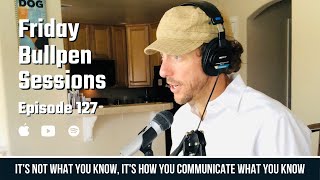
Andy Neary (episode 128) delivers a short, first-person lesson about the power of communication and storytelling for business growth. He recounts a February 2017 breakout-session where, despite only ten attendees, his polished presentation led to a conversation with Duncan McAlef, Director of Total Rewards at PepsiCo—illustrating that how you communicate knowledge can open high-value opportunities. Neary contrasts traditional insurance selling (product pitching) with a message-focused approach and ends with a call-to-action for his "Agency Brand Mastery" program.
Chapters
Hey. Hey. Welcome back to Friday Bullpen Sessions. My name is Andy Neary, and this is episode 128. All right, how are you doing today? Hope you're having a fantastic day. Wherever this episode finds you, I apologize if I sound a little nasally today. I am battling some allergies. I normally don't have allergies. But I'll tell you what, out here in Colorado, these cottonwood trees are absolutely, absolutely killing me right now. And as I always do, I am doing this episode live from the beautiful confines of our living room. All right, let's dive into today's topic. It's not what you know. It's how you communicate what you know. My goal today is I'm going to share a powerful story for you with you that impacted my career, and it's what elevated my insurance career to what it is today, where now I spend my time using my gift to help advisors and insurance agencies become better communicators, better storytellers. So today, I want to share a story, a lesson that I learned about the power of communication. And I want to pass it on to you because I think it'll help you whether you sell insurance, you sell dishwashers, you sell.
Manufacturing parts. I don't care if your job is to get somebody else to like you and trust you and buy something from you. I think this is going to be a powerful, powerful episode for you as well as anybody who's just trying to persuade somebody to do something that they. They want them to do. So let me set the stage. So if you've been listening to my. My podcast for a while, you know, I've been. I spent over 18 years in the. In the health insurance space. And about.
Six years ago, I decided that I was going to make public speaking a big part of my marketing strategy. It's something I've always enjoyed doing. I've never backed down from a microphone that was handed to me, and I just thought it would be a great way to stand out. You know, at the time, Amy and I had just moved to Colorado a couple years before. I was in a market really, where I was still kind of brand new. And I felt that public speaking would be a great way to get people to really know me much faster. Because, let's face it, when you're public speaking, right, you're talking to a whole roomful, sometimes a whole auditorium full of people, and they could all be your target prospects. And so I really got serious about public speaking. But one thing, and one thing about public speaking is that the best speakers that you have, have watched, the best talks you've attended are the speakers who are just master communicators, master storytellers, right. And.
There was a lesson I learned in the power of communication storytelling here that I want to share. You see, at that point six years ago, I had really started to dive into public speaking. I had hired a speaking coach to take my keynote career to, to the next level. I joined the Speakers Academy as part of the National Speakers association down in Colorado, down in Denver. And so, yeah, I was just really ready to set the stage stage of using public speaking to grow my insurance business like I've never experienced before. So let's Fast forward. It's 2017.
And here's where this particular story, this lesson starts. I was picked to speak at a health insurance industry event down in Denver. And it was early 2017. In fact, if I recall, I think it was in February 2017. And it was an, it was, I was excited because the attendees were going to be potential target prospects of mine. They, they were not brokers, they were actually employers. And the conference was represented by human resource and benefit team professionals from potential target employers.
And so I was just excited that I got the opportunity to speak. I got this chance to, to get on stage in front of my target prospects. Now I had no idea who the attendees were going to be, but quite frankly, at that point I was just saying yes to anything. I' if I can speak, I don't care who the, I mean, as long as the audience is employers, I don't care who they are. I'm going to take this opportunity to speak. And so that morning I can, I can remember heading down from Fort Collins, we live about an hour north of Denver. And I arrived at the, the location of the event which is on the south side of Denver. And I knew I was going to be in one of the breakout rooms. You know, I wasn't main stage, but I was going to be with one of the breakout rooms where I was going to be talking about a specific topic tied to health insurance. And so I got to my room early.
The speaker before me had finished early. So there was the, the room was empty. And I got in and I set up, you know, set up my presentation. I got made sure my PowerPoint worked. I kind of had my, my bullet point notes that I was going to use as I went through this talk, I make sure my clicker worked as I, as I scroll through the PowerPoint. So I had everything set up super early. I was excited. Again, remember this is one of the first real speaking opportunities I had in front of my target audience. And so I am standing there in this room.
And I'm starting to wait. I'm waiting for attendees to walk in the room, right? It's, I think my talk was at like 10am it's about 9:50 at this point. And I am just excited, ready to welcome all these attendees, you know, welcome them to a crammed room. I'm going to speak to a packed audience and my energy, like the nervous energy was just rolling. Well, obviously, you know, now about five minutes before 10 o', clock, the attendees start rolling in, right? And I'm welcoming them, introducing myself. I have no idea who these people are. Like I said, I know they're in the HR community. I know they're in the. They may run a benefits program for their organization, but again, I don't know what companies they represent. I don't know where they're from. I don't know if they're just local or they're national. I have no idea.
Probably a little side note on my lack of preparation on who I'm speaking to, by the way. Anyways.
About 2 minutes before 10, I quickly realized I had a problem.
There's only like 10 people in this room. And I was, I quickly realized that I wasn't going to be speaking to a packed house. This room wasn't going to be filled with, you know, 40, 50 attendees as I had envisioned. In fact, I had handouts sitting in front of every single chair. But only 10 of those chairs were occupied. And so I was both pissed and a little nervous that maybe people didn't want to come hear me speak. Maybe this is a topic that really didn't interest them because mind you, they got to pick from two or three other topics that were being, that were going on at the same time. Remember, I was just a breakout room. So as I'm sitting there kind of wallowing in my pity that I only have 10 in this room, I made a very important decision. And that's. I said, you know what? I've been hired to speak. I know my topic well. I know how to communicate my topic well. I'm here to do a job. I don't care if there's 10 in the room or there's 100 in the room. I have to do my job. So I went up to the front of the room, looked at the 10 attendees that were sitting there, and I gave the talk of my life. You know, early on in my career, that was probably one of the Best talks I had ever given. I was on point. I was sharing strategies, communicating, and storytelling in a way that, you know, just felt so natural. And I credit a lot of that to my time with my coach and being part of the speakers academy.
But here is where things got really interesting.
When I wrapped up that talk.
And it was time for the attendees to head on back to the main room. I think they were about to break for lunch.
One of the attendees walked up to introduce himself.
And I am, you know, breaking down my PowerPoint, breaking down my laptop, starting to put my things away, quite frankly, getting ready just to head back home to Fort Collins. And this gentleman walks up and he says, you know, I want to thank you for your talk today. It really resonated with me. And he said.
The way you communicated the various aspects of our benefits program.
Was done in a way that, no, I've never seen anybody do before. And it just made so much sense when you explained things the way you did. I said, well, thanks, man. I. You know, I said, I. I've put a lot of time and effort into. Into speaking. I'm. So that. That means a lot of that. You have taken the time to come up and thank me for the talk and what it meant to you. And at that point now, the positive vibes of why I was down here to give this talk started to flood in. But this is where it gets even more interesting. So he says, you know, in fact, I really like what you had to say. If you don't mind, I would like to follow up with you, and I would like you to get on the phone with my team, because I would really like to see where you could help us improve what we're doing. So, okay. I said, why don't you give me your card? And what I'll do is later today, I'll follow up with an email, and we'll get something on the calendar. Said, perfect. So he hands me his card.
Now, if you hear me grabbing drinks, I apologize. As part of these allergies, my throat is scratchy and itchy, and it's just absolutely driving me nuts. So he hands me his card.
And I take a look at it, and I pause. And he probably even saw me do this. I kind of took a really big, deep breath and a big sigh.
Because I quickly realized that this event that I was so mad about Speaking to only 10 people, I was mad that my room felt like it was empty. What I realized was that this was actually.
A health insurance conference that was designed to be small. It was designed for very large organizations around the United States to come together and collaborate and strategize about how to improve the way they are providing their benefits program to their. To their workforce. Because on this card wasn't, you know, a small manufacturer company on. In the suburbs of Denver? No, no. This. On this business card was the name Duncan McAlef, which means nothing to you, but it was. What else was on his business card? I think that will begin to make a lot of sense for you. Not only did it say his name, Duncan McAlef, it said he was the director of total rewards.
For PepsiCo. Yes, PepsiCo, the fifth Fortune 50 company that everybody knows about their. Their beverage, their. Their soft drinks. We've been drinking for decades. Yes, that PepsiCo.
And in that moment, I realized I learned a very important lesson.
It was in my preparation to become a better communicator, it was in my preparation to become a better storyteller that I grabbed the attention of an organization as large as PepsiCo, a Fortune 50 company.
Here I am, this little old health insurance advisor in northern Colorado, and I grabbed the attention of one of the biggest companies in our country because of what I said. Not because of what I know it helped, but because how I communicated what I knew.
And out of that same speaking engagement, I earned the opportunity to connect with another organization that was in that room that probably represented 10,000 employees. PepsiCo was 50, 60,000 employees. But here's the important lesson I want you to learn. The only reason that I was sitting there having this conversation with Duncan, the only reason he felt impelled to hand me his business card again, was not because of the knowledge I had. It was the way I communicated my knowledge. And that is the lesson I want to pass on to you today. If you sit in a position where you have to earn somebody's trust to do business with you, I will tell you the quickest way to earn their trust is not by your knowledge. It's not by impressing them with your knowledge. It's by having.
A keen ability to communicate what it is that you know. It's that simple. Because I realized in that moment, I said, man, if I could leverage the power of communication, if I could leverage the power of storytelling, what kind of attention could I grab in this industry from the right prospects?
And I'll tell you, over the course of the next six years, leading right up to this podcast episode today, that's exactly what I've done, is I have used all the various platforms, whether it is public speaking, whether it is social media, whether it is emails, webinars, you name it, podcasts.
I have the business I have today and I feel blessed to have what I have today. Not because of my knowledge. Again, that helps. It supports the success, but it's my ability to communicate that knowledge.
You see, coming from an industry like insurance where we were just told or taught to pitch a product. We were never taught the art of communication, the art storytelling. We were just go see prospect, sell prospect, throw product at prospect. It doesn't work that way anymore. You have to become a better communicator, a better storyteller. So that's my lesson for you today. That's my message for you today as we wrap up another amazing week.
I want you to sit down today or whenever you have, whenever you finally get the chance to listen to this episode. And I want you to think about what it is you sell. Whose trust are you trying to earn so you can grow your business? And I want you to start focusing on becoming a better communicator of your knowledge and quit focusing just on attaining more knowledge.
There's a lot of smart scientists out there that are some of the smartest people in this world that we don't know about why they can't communicate what they know. So become a better communicator, become a better storyteller and I promise you're going to attract more attention from the right prospects. You're going to have more prospects, prospects loving your brand message and you're going to have more prospects trusting what you do and hiring you to do business with them. It's the that simple. So focus on the message, focus on the communication, don't just focus on your knowledge and good things will happen. And I want to wrap this up by saying this. If you are an insurance advisor, a principal of an agency, a sales manager within an insurance agency, and you're listening to this podcast today and you know your agency could probably do a better job of up leveling how you communicate the knowledge you have. You know, your producers could become better communicators, better storytellers. Heck, you want them just to become better public speakers so that they can shine in proposals, shine in presentations. I want you to do yourself a favor and I want you to click the link in the show notes and I want you to check out agency brand mastery. I have built a system, a marketing and a sales system, a done for you marketing and sales system built around the art of communication, the art of storytelling that's going to help your agency attract the attention of the right prospects, bring the right prospects into your sales pipeline using a very repeatable marketing strategy. And then when they come in the pipeline, you'll have a sales system that is always going to put your agency in the best position to win the business from those prospects. So click the link, let's jump on a call. Let's see where you need help. I promise. Agency brand mastery is the secret ingredient you're missing right now to having the agency you know you deserve. So go check it out today. And as always, you know what happens when clarity and confidence collide. Massive action happens. Go make it happen today.
More from Andy




If you want producers to succeed faster, help them create a sales message that creates confidence.

Sales isn't a zero-sum game! You can have tough competition and still grab a beer after



Option 1: Meditation, a fast walk, a podcast, and protein. The ultimate morning routine!

How you do one thing is how you do everything. Ill elite producers fuel their body.


Stop living in the gray of maybe! Your job in sales is to get a clear yes or no