128. Johnny Fasola: Paying Your Baseball Skills Forward
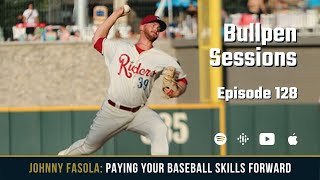
Andy Neary interviews Johnny Fasola (recorded July 25, 2021) about his baseball journey: growing up in Hudson, Ohio; being a Cal Ripken fan; starting college at Kansas State as a shortstop then converting to pitcher after injury; transferring to Kent State to work with pitching coach Mike Birkbeck; being drafted twice (later in the 31st round by the Texas Rangers as a pitcher); playing in the minors up to AAA (Round Rock) and later in independent ball (High Point). The conversation covers mentorship, the differences between college and pro preparation, the challenge of progressing through minor-league levels, rehab from multiple Tommy John surgeries, and returning to enjoy playing while working with Promentor.
Chapters
Hey. Hey. Welcome back to Bullpen Sessions. I am excited this week to have Johnny Fasola join us. I love Johnny's story. Very similar to mine and he's doing some great things, still actively playing baseball, which I'm excited to share. So, Johnny, welcome aboard.
Thanks, Andy.
Let's start right here. Johnny, where did you grow up?
Grew up in Hudson, Ohio. It's about 30 minutes south of Cleveland.
Ah, so you must be an Indians fan.
No, I grew up a Baltimore Orioles fan. My favorite player was Cal Ripken Jr. And I just was always fanatical about him. My room was full of Cal Ripken stuff. Yeah, my parents like the Indians, but.
I mean Orioles, I like it. Well, obviously Cal Ripken is a good man to be rooting for when you were a kid. In fact, I saw him. I was at a. We live out in Colorado. I was at a Colorado Buffaloes football game a couple years ago and his. I didn't know his daughter went to the college and he was at the game. Saw him walking outside the stadium. I didn't realize he was as tall as he was. He was like 6, 5. Like he was a big man. Really? I was surprised. Yeah, obviously he's looks different today than he did back in his playing days, but he's a tall man. I was surprised by that. Okay, so gotta ask you, because I know you started your college career at Kansas State. How does an Ohio kid from Northern Ohio end up at Kansas State?
I.
That's a tough one. I. There was a kid named Jason King from Columbus and he was the first, I believe, the first guy from Ohio to go to Kansas State. And it kind of started this trickle effect. He had a brother named Jared. Myself, another kid from Cleveland. He kind of, they. He paved the path and then they just started getting a bunch of Ohio guys.
Kind of the culture over there is similar. You know, the blue collar, work hard, you know, grindy, we're gonna outwork you type attitude that kind of mirrors, you know, the Ohio mindset. They just loved it. And so they took some players from Ohio and I just happened to be one of them.
That's awesome. So, you know, it's interesting in college sports where they, you know, one a school might find a hotbed somewhere in the country for recruiting. And you're like, how do they have all these kids from this certain geographic area? And like you said, once you find one, it can be a lot easier to find the others. And you keep coming back to the. Well, that makes a lot of sense.
Definitely.
And Big 12 baseball. Right. Big 12 baseball is very competitive and, and I failed to mention you're a right handed pitcher. And so you were at Kansas State and what was that like for you? I'm curious. This is. I always think of you young athletes that might be listening into this episode going from playing at Hudson, Ohio to playing Big 12 baseball. What was that, what was that jump like for you?
So I was a position player, I was a shortstop. I was drafted as a shortstop. All I knew was infield, I threw hard. So they, I pitched a little bit in high school, but I went there full intent on being a third baseman and you know, playing in the big leagues in the infield. And I ended up hurting my back and just kind of never got the swing back. It was very frustrating time in my life and my arm was still strong. So they said, you know, let's convert you to a pitcher. And that's kind of how that all started. But competition wise.
You know, you have that thing in your head, oh, I'm in the Big 12. These guys can hit you, you know, and it takes just one little piece of success to say, okay, you know, I can hang with these guys like I belong here. But.
Yeah, it's just a lot of positive reinforcement and trusting in your ability and yourself and that just, that mirrors the whole way up through baseball.
I'm curious because you brought up a really good point. Was there a moment that you can remember when you were at Kansas State, that moment where you realize you belong? Because like you said, all it takes is a little taste of success and then you realize, okay, I belong. Can you recall that time?
Big 12 tournament. So talking pitching wise, Big 12 tournament my freshman year and I didn't have a tremendous experience there at Kansas State. I don't want to, you know, throw shade, but they burned my red shirt with one inning at in the Big 12 tournament. And I went in against Texas A and M and they had just a whole slew of big leaguers now, you know, Naquin was the three holes center fielder and I threw. I didn't have command for my slider. I didn't have good command back then. But I threw hard and I was getting, I was walking guys and then I walked them, chucked and I got out of it with only fastballs and that was like, you know, these guys know what's coming. They're the best. You know, this is the semifinals in the Big 12 tournament and I'm getting them out with fastballs. I was like, okay, like if I have this and the change up, I Know, I know it'll play. That was, like, kind of my moment, my epiphany, where it's like, all right, I can play here.
That's awesome. I love that. Yeah, for me, it was my freshman year. I beat. Beat Notre Dame, and UWM normally goes down to South Bend and gets their ass kicked and.
Right.
And so when I beat him, it was like, okay, these guys are usually ranked. I belong playing at this level that I think every athlete has that moment where they finally can take that breath, and they're like, definitely, I belong here. Well, now fast forward. You decide to. So you. You go from being a position player.
To on the left side of the infield to pitching, and then you decide to actually transfer back towards home. So you transfer from Kansas State back to Kent State. What precipitated that decision were you, you know, obviously, Kent State has had a lot of success in baseball in the Mac Conference. Was that kind of a coming home for you?
Yeah, I was. You know, I was a big recruit out of high school. You know, I. My sophomore year, we had one of the biggest recruits in the country named Tyler Scalina, and we had a ton of scouts at our game. And as I kind of progressed and got better throughout my high school career, kind of put me on the map as well. So I, you know, got a lot of good offers and, you know, some good exposure thanks to him, and then eventually led to my own. But Kent State was one of my final three schools that I was going to pick from. It was Kent, Penn State, Kansas State, and Obviously the Big 12, you know, the land of milk and honey, I thought. So I had had, you know, like I said, a bad experience at Kansas State. We just didn't mesh well.
I was injured. I was in a new position away from family. I said, I'm going back home.
I know Mike. Mike Birkbeck is, you know, the best in the country at what he does as a pitching coach. So I said, if I'm going to commit to this as a pitcher, you know, what place better to do it than in my backyard with the guy who had just won coming off the College World Series, the assistant coach of the year. I said, that's it. That's all I needed. I'm good.
Well, that's. That's. Yeah. And for those who do listen to the podcast regularly, last week I interviewed Michael King, who was on that Kent State, that team that made it to the. The College World Series. Johnny, you transferred in, right? The year after.
Correct.
And by the way, is that Mike Birkbeck. Same guy pitched in the. At the major league level.
Yes. He had success in the big leagues with Milwaukee. Also played in Japan. I mean, he's a. Just a guru.
Yeah, no, I remember being a Brewers fan growing up. The name Birkbeck definitely resonates. So cool you transfer back. And I think it's such an important topic to talk about because today with the transfer portals and all that stuff, I mean, I was talking to my. My former coach at uwm. I had him on the podcast just a few weeks ago. He was telling me something like, right now, in the. This off season, there's over 1300 players in the transfer portal.
That's incredible.
It is absolutely astonishing. And you know what else I really like about what you said there is when you actually were coming out of high school, you had Kansas State, Penn State and Kent State and Big Ten baseball. Let's be honest, isn't that nationally prevalent, as it might be in football and basketball? But you chose Kansas State because, hey, It's a Big 12. But then you decided to come back to play Mac baseball. And what I love about college baseball, I think more than any other sport is I don't care where you go to college, you have a chance to get signed. Look at the first, just the first kid, first outfielder drafted this year, Sam Houston State.
Right.
I mean, doesn't matter what college you're playing at, it can be Division 2 or Division 3.
Absolutely. And so especially with technology and, you know, social media, if you can play, they're going to find you.
They're good. And I love that because we're going to talk about what you guys are doing at pro mentor. So you had a successful run at Kent State and it allows you to get drafted a second time in the 31st round by the Rangers, which is a little ironic because I just interviewed Mike last week. He too signed with the Rangers.
Which I love. The fact you, you're one of the few guys I've talked to that was drafted twice, but for two different positions.
Yeah.
Once as a position player, once as a pitcher. What was that like the moment you got drafted?
Relief. It was.
A lot of, you know, I've had been through injuries. You know, I had a bad college experience and, you know, to finally see it all come together again. And, you know, I didn't even listen because I didn't want to get let down. So I just went and did my own thing. I was playing golf with a couple buddies. I said, dad, call me if it happens. You know, if not you know, I'll be on 18. So it was just a. It was a breath of fresh air. And it was like, okay, you know, no one can ever take this away from me. Let's see what I have. Let's see how far I can go. You know, this is always something I've dreamt of. Just, Just really excited to have an opportunity.
That's awesome. So you actually had quite a successful run in minor league baseball. I'm curious because I ask anybody I've talked to that's played pro baseball, what were the differences you've noticed from playing college baseball to now you're getting paid to play baseball. Did you notice any drastic differences.
Obviously, apart from the competition, which is, you know, bottlenecks as you go up?
I'd say fortunately for me and Mike and guys that went to Kent State, you know, we had a big league staff. Duncan was our head coach. He played four years for the Mets.
Birkbeck played forever for in Japan. He had professional experience. Brandon Larson was our third base coach. He played in the College World Series in five years for Cincinnati. Our staff was a big league staff. So they ran Kent and their practices like professional baseball. So I'll never forget it. I called Mike Birkbeck Day 1 After I got signed, I went to Spokane, Washington, and we get there and it's like, hey, PFPS. Right into this, right into that BP sprint done. I'm like, holy, holy cow. You know, this is, this is Kent State. I called him, I said, hey, thank you so much. I mean, you prepared me as well as I could be prepared for professional baseball. It is the same blueprint that you guys do at Kent State. So I'd say apart from the competition, I was pretty well prepared. But I think the, the preparation of knowing your competition gets so much more in depth as you go up. They have these charts and these heat maps and analytics, and especially the way the game's evolving to now, it's just, it's ridiculous. But you can find out about somebody.
I was just having a conversation with my parents last night, and my, my nephew is a pretty good baseball player back in Wisconsin. And the fact within seconds I could pull up all his stats, you know, his 60 time, his, his, his ranking in Wisconsin as a shortstop or second like that just blows my mind because back when I was in high school, it was hard to get seen unless you were at, you know, in Florida, Florida, Georgia, Texas, California, and so.
Right.
Yeah, it just blows me away. The stats that are available today. You said something, though. I want to Go back upon. I don't want to. I don't want to. Left, leave undone. How important was. Because I, I agree my, my coaches in college, Scotty played it, made it to AAA with the Dodgers. Jerry Augustine pitched for the Milwaukee Brewers. Having those guys who understood what it took to prepare yourself at the professional level, now coaching you in college, I think was so important. How, how important was it for you to have that mentorship at Kent State?
Massive. I mean, it was.
You know, when you, when you're going through your career, you experience a lot of things for the first time, you know, and it's just no one to lean on or there's no one that, you know, that has been through it. And having, you know, had two years at Kent State of preparation of exactly what I was going to be going through, you know, as my job made it so much less stressful on me, which kind of gave me an edge over a couple guys that maybe were better than me or equal to me or. But because I had guys like I had at Kent State and my dad and Kazmar at Walsh, my high school baseball coach, I was very fortunate, you know, in my upbringing through baseball, that. That was kind of a differentiate differentiator for me.
Yeah. And your dad actually played a little pro ball himself, didn't he?
He did. He played for the Pirates for I think a year or two and then something happened with his ankle and. But he had a, he had a little, little taste of it as well.
Well, but, but to grow up in that house, because I always say this, my dad, he was a good college baseball player, but he became a really good high school coach. To have that mentorship, just growing up all through your youth is such an advantage.
Definitely.
It's such an advantage. And you know, by the way, I gotta ask, is that the same Brendan Larson that hit like 40 home runs one year for LSU?
Sure is.
Yeah. Yeah, that guy, that guy had an insane season.
He sure did. We could do a whole nother podcast.
Well, now you're in minor league baseball and you again started climbing the ranks. Right. I think at one point you, you got as high as you're at AAA and Round Rock, which is. Is near Austin. What was that like making it to AAA and where, you know, you're one, you're one phone call away from, from playing at the top level.
It was, it's exciting. I mean, we talked about that moment where you have that I can do this. I believe, like I can compete here. I had went from high A and I was pitching really well in my third season and I was in high A, and they sent me straight to AAA to fill in for somebody because I was get. I was getting promoted double A, but someone went down aaa, so they sent me there and I came in my fir. They flew me out and I. I threw in that day game in like the third inning. Our starter got hurt and I.
Excuse me. I. I pitched really well. I had like four or five strikeouts and two innings, and I was just like, yeah, this is a real possibility. I could get that call. And I ended up staying in AAA for quite some time and then back and forth that season.
But to get that call to the show was something that I had stopped worrying about because I was so worried early on about am I going to break with low A. I got to get promoted to high A because it's like that step, you know, I got to get to that next step. And once I stopped worrying about that and just, you know, controlled what I can control, you know, be a good teammate. All I can do is throw this ball and whatever happens behind me, what. It's out of my control. So all I can do is throw a good pitch and if. If he gets out, if he strikes out, if he hits home run, that's not. Not something I can control. If I get called up, sent down, part up, you know, it's just control. The controllables is something that I really harped on and just bought into, and it helped me immensely.
That's. That's awesome. I think you can get caught up in the. Trying to control the journey. I know, I know. The year I got released in spring training, that was my whole thing I wanted. I was so focused on going to Beloit in. Because it would have been 50 miles from where I grew up. My family, friends could be there. And you're just so focused on controlling the. The journey versus, like you said, control what you control as a pitcher. You have one job, throw strikes. That's it. And you can't. You can't control what happens behind you. And so I love that. I absolutely love that. You know, and what's interesting, Johnny, is I. I was just thinking about this today. You look at guys that are playing that just got called up, like Wander Franco from the Tampa Bay organization, they're calling him, like a generational talent.
Right, right.
Well, you look at him right now, he's hitting about 180 at the major league level. I know a guy from Wisconsin that got called up quickly. Jared Kellenick, same thing. Number one draft pick calls up, he hits about, oh, 80, and now he's back down. Like, I think people fail to realize how big that jump from AAA to the major leagues is.
Definitely, I mean, you.
Each level gets harder. I mean, when, yeah, I really start to, I started to see. Everyone talks about the bottleneck Double A, you know, when I got the double A. You good?
Yeah, keep going.
Oh, I'm sorry.
Double A was like when hitters started to get a real approach and I couldn't just beat people with fastball, lane, slider, like, oh, I gotta show a third pitch. I gotta, I gotta move in and out, up and down. I gotta really got a pitch. You know, these guys can keyhole in on you instead of, you know, three, four, five, only being able to beat you. Aaa. Their eight, nine hole hitter was the player of the year in Florida. You know, like, these are all the best players and they just continue to get better. And then, you know, obviously I've never played in the big leagues, but I've played in games with big league players and it's just.
You, you just are in awe of how talented some of these guys are. You stand there and watch, take watch BP or infield, and it's just astounding. Like two nights ago I was playing against Brendan Phillips, who's, I mean, what, 16, 18 years in the show, second base for the Reds. He's part owner of the Lexington Legends and he's out there making diving plays, hitting balls to the other way. And he's 30, 40 years, 38, 40 years old. It's just, it's, it's impressive with some of these guys.
Well, and your, your analogy of the bottleneck, so true because from high school to college, right, you get there especially as a pitcher and you go, okay, this lineup is basically all state guys one through nine back in high school. Three or four hitter might be great, but after that you can kind of coast. Now you get to the prep, you get the professional baseball. And now those are the top guys from college and high school. And eventually as you, you go up level by level and you get to that AAA level, it's like the tippy top of the tippy top, including guys that were already up at the top at the major league level, that are just back down maybe for a short period of time.
Yeah.
You just mentioned Brandon Phillips, Lexington Legends. You are still playing, right? Right now you're playing indie ball. Looking to get that chance to get back. Before we get to that, I'm curious because last year obviously was a year unlike anything else. There was no minor league baseball. I'm guessing, you know, there was no end of indie ball going on. How did you keep yourself in shape in a. In a year where there really was no season?
I got released in January, and I was in the middle of my third Tommy John rehab, so I was kind of just left floating upstream. And.
My agent, luckily had a good relationship with a guy out in Florida named Eric Cressy, and they kind of took me under their wing and allowed me to train there up. Up until about March, when the pandemic, you know, March, April, when stuff got really bad.
Then I was kind of on my own. I was.
At the apartment gym, thrown against a wall in, you know, some park in Florida, you know, just made it happen. I. And then I. I didn't get any calls. I thought I'd. Maybe I'd get a roster invite or something would happen, but nothing. You know, no one was really signing guys unless you had some time or were healthy. And there were a lot of question marks on me, truth be told, with my health.
So I. I understood it, you know, and I didn't really know if I wanted to continue to pursue the. My career. So I was kind of done. You know, I had one foot in, one foot out, you know, And I keep hearing from everybody, you know, you got to keep playing. You'll regret it. You know, don't leave any stones unturned. You know, see what you got. And I was just working for Promentor, and, you know, the phone rings, hey, the Royals want to see you throw. Well, okay, I haven't thrown much, but, yeah, I'll go throw. Hey, Indians are interested. Would you take a job in Mexico? I'm like, okay, so obviously my name is still floating around there out there, so my agent said, go pitch in High Point and, you know, see what happens. See if you still got it. See if you still have the passion for it, if you, you know, just roll it out there, see what happens. And, you know, knock on wood, I've had some success here, and I'm throwing the ball well, so. And I'm having fun again.
That's awesome. That's. That's the most important part, right? You're having fun again. And, man, I gotta tell you, three Tommy John recoveries. Geez. Yep. I mean. I mean, think about the. The back in the day, Tommy John himself, who. Who the surgery is named after, used to be that. That thing altered your career if not ended it. Right? And it's amazing today how. How efficient they have that procedure down and Absolutely blows me away. I actually think I'm making a bold prediction, Johnny. We get to a day where parents actually have their kids go through Tommy John surgery because so many kids come out throwing harder than they did before the surgery.
Unfortunately, that's already a thing. I've been approached by parents. I've done some coaching.
Because I've had time. So I've just been, you know, giving back to the game. And, yeah, I've had that question, should I get my son Tommy John to throw harder? And you're like, are you kidding me? You know, there's such a stigma around. Oh, Tommy John gets you throwing harder. No, it doesn't. It's the rehab you do. I mean, you're strengthening muscles in your arm and shoulder and scap that you didn't even know you had. It's so tedious, and so, you know, you're doing so much stuff. It's. It's just a ligament, you know, it's not going to make you throw harder. But the 30 reps of scap drills in your shoulder and your forearm and your legs and everything stronger coming back. That's why you throw harder.
You know, that makes a lot of sense because I'm. I'm willing to bet those guys that do experience the increase in velocity, they probably weren't doing those exercises before the Tommy John surgery.
No. God, no. I mean, if you took. I bet if you took a guy in high school right now, it's not doing hardly any arm care, and you gave him the Tommy John routine, the rehab, you'd get three to five miles an hour.
Wow.
Guaranteed.
That's amazing. Well, let's talk about this, because I want now to go into. You're playing indie ball right now. You're helping out. You're doing some work, great work for Promentor, which I had Michael King on last week. Who's the foul? You know, one of the founders behind it. I want to get your perspective or one. For those who may not really understand, talk about what indie ball is. Like, what is it? Who are you playing against? I'm. You know, what's the talent level like? Because indie ball, it's a. It's a. It's something that's near and dear to my heart, as I shared with you offline, Johnny, because when I got released, I remember they. The. The director of baseball operations for the brewers put that list of indie ball teams in front of me and said, hey, where do you want to go play? And I said, no, thanks. I got my degree, truth be told. There's moments I look back and say, should I have gone and played a year or two in indie box? You never know where it would go, right? Talk about what it's like to play indie ball. You're in a high. Am I get. Am I guessing High Point, North Carolina. Okay. What is that like?
It's so. I've had the same thoughts about it. You know, you're playing an affiliated baseball, and you're like, I'm never gonna play any ball if that. If.
More from Andy




If you want producers to succeed faster, help them create a sales message that creates confidence.

Sales isn't a zero-sum game! You can have tough competition and still grab a beer after



Option 1: Meditation, a fast walk, a podcast, and protein. The ultimate morning routine!

How you do one thing is how you do everything. Ill elite producers fuel their body.


Stop living in the gray of maybe! Your job in sales is to get a clear yes or no