214. What The NFL Taught Me About Becoming An ENT with Dr. Samkon Gado
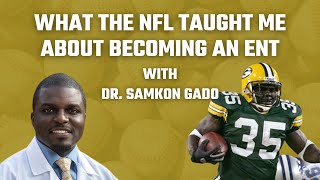
Dr. Samkon Gado came to the US from Nigeria in 1991, walked on to Liberty University's football team, and got drafted by Green Bay in 2005. On his birthday that November, he scored three touchdowns including a 64-yard TD, setting a rookie rushing record. He later became an ENT surgeon.
Questions this video answers
1991
November 13, 2005 (birthday breakout game)
171 yards (rookie rushing total mentioned)
Monday, November 21 (host references recording date; year not specified in chunk)
About six months old (first short visit)
Chapters
Next year if they get all their.
Guys back, the people that were injured this year. And how about Sam con Gado?
R.W. mcCorders can't catch him. And Sam Con Gado has just gone 64 yards for a touchdown. Are you kidding? You think Mike Sherman's becoming a believer in him now?
Hey. Hey. Welcome back to the Bullpen Sessions podcast. I can't tell you how excited I am for this one. This one. If you're a Packer fan like my born and raised in the Cheese State, this is going to be a special episode you want to hear. Because as I have said before, this podcast is dedicated to interviewing former college and pro athletes who had a lot of success on the field, but are also having a lot of success in a different field after the sports career is over. And today's episode may be the pinnacle of that. And I've got none other than Dr. Sam Khan Gatto joining me for the podcast. So, Sam Khan, welcome aboard.
Thank you. Thank you very, very much for having me, Andy.
Yes. And we are, we are recording this on Monday, November 21, eight days after your birthday. We're a happy belated birthday.
Thank you.
And we're going to talk about the Special meaning of November 13th and Packer history as well, which will be fun. But let's, let's start at the beginning. Sam Khan, you know, you were born a lot of people, especially Packer Nation, remember, You remember that special run in 2005. And.
Long before that, though, the journey started and it actually started in Nigeria. So let's, let's just start, you know, back at the day you were born, going up, you know, you guys, you guys found yourself have, you know, coming over to the States. You came at an early age. I think you went back.
Yes.
And then came back to the States. Talk to us about that journey being, being such a young age.
Yes. So this.
You know, I usually talk about. I came to the United States when I was almost nine years old. Really. The first time I came was when I was about six months old for several months. My dad was actually for a little over a year. And then we returned back to Nigeria and so we were there. That's where I spent most of my childhood. And my father was in medical or not medical training. My father was in seminary training. And he had this wonderful opportunity come up where he was given a chance. He was given a scholarship to the Columbia International University in Columbia, South Carolina, which was my hometown. And he came for to get his Masters of Divinity and eventually his doctorate, but left my mom and my three sisters at the time in Nigeria. So for about two years our family was apart from. But my father was attending a church and they were aware of my dad's situation and it just felt like that was just wrong that his family was, you know, 6,000 miles away in another part of the world. And so they made that right. They just a generous donation from that church and they were able to raise up funds for us to come. And so we joined them in 1991 and have been here more or less ever since. And so that was my introduction to the United States. It was. I remember seeing dad for the first time after not seeing him for two years. I remember being at. My sister and I were at a boarding school in Nigeria. And so even when we were in Nigeria, we were away from my mom and dad and our family was just kind of all over the place and it was just great to be back together as a family again.
That's awesome. What was it like? I mean, at first, obviously your true first visit over to the States. Here you may not remember being so young, but when you came back and you were almost nine years old, what was that like? What was life like?
How do I want to say this? Adapting from living in Nigeria to now you find yourself living in the United States.
Yeah, it was hard. I remember in Nigeria being there. Everyone in Nigeria wants to be in the United States. And I remember thinking, man, it would be amazing. And you don't really realize how hard it is to get started in the United States. It's a land of opportunity. But it really was that, that, that for a nine year old kid like myself, it was, it took some adjusting. School was hard. The cultural differences were very pronounced. And so I remember the first year I was there, I remember thinking to myself, I was looking forward to the day that my mom and dad would get me out of school and tell us we were going back to Nigeria. So that first year was really, really hard. But in time, I think through the church and, and through some friendships, it became a little bit more normal. And I spoke the language, but understood the culture a little bit and, and so it was rocky. It was very rocky. I got beat up a good bit in school and. But then my parents made the difficult decision to put me in a. In a boarding school that they felt like would be a good place for me to grow and develop. It was called Ben Lipen. It was a small Christian boarding school that was part of the seminary that my father was attending. And I think that's really where I Blossomed, I think I was given the opportunity to thrive and it was just a much better environment for myself and my sister.
We're talking offline about the fact there's about 200 million, roughly 200 million people living in Nigeria and there's about 350 million here in the United States. Give people a perspective of geographical sized comparing Nigeria to the United States.
Yes. So Nigeria is roughly the size of Texas, Oklahoma and Louisiana. So it's, it's still, I mean, it's, it's not a small piece of land, but compared to the United States, which is one of the biggest countries in the world by mass, it, it's pretty small, but it has about two thirds the amount of people in, in America. So it's the most populous country in Africa. It's one of the most populous countries in the world. But it's still, it's, it's, you know, it's got the world's largest economy and. But unfortunately there are a lot of things about it that just aren't, aren't good. That amount of people can sometimes overburden systems. And so one of the systems that's been overburdened has been really the healthcare system. Um, and it's, it's created a bunch of disparities in, in not just my particular field of ent, but in others as well.
Unless we're going to talk about that, obviously the work you're doing today as an ENT surgeon and the work you're doing to build Jonah's inheritance, which is just fascinating to me. But so as you were growing up here in the States, when did football first become a part of your life?
Yeah, football. So pretty soon after I came to the United States, I played after church and with my friends.
Just in, just in the yard without really any equipment. But I remember around at that time, the main sport that I loved and was was really soccer. And that's obviously understandable with the World cup going on. It's just the international sport.
But then as I began to assimilate into the culture, football became obviously a big part of that. And all my friends were playing it and I wasn't the fastest, but I was one of the faster guys. And so that obviously just gave me an advantage and I just enjoyed playing it because.
My friends were playing it and I happened to be halfway decent at it. So it wasn't until seventh grade when I really actually had the chance to play. And at the time, my father was visiting Nigeria and he was adamantly against me playing football for you Know his concerns just safety and it was just foreign to him and. But he reluctantly let me play and well, I mean I was on the team but I really didn't play much that year. And then that was my introduction seventh grade. So the following year I came up for the team again. I got to play a little bit more and um, I did, I did a little bit better actually. A lot better because I actually was playing this time and then it just began snowballing and my love just continued to grow.
That's awesome. And I think if I have it right, you were a 3, 3 sport athlete in high school, right? Football, basketball, baseball?
Yes, actually no. Football, basketball, soccer and track.
Soccer and track. Okay, I had that wrong.
When did you realize. Because by the time it was all said and done in high school, you were an all state running back. When did you realize, was there a moment that you.
Realized you had an opportunity to play football at the next level, at the collegiate level?
So my junior year I had a good year, but I was at a small school and so it was hard to really know how that year stacked against my other competition.
And so it wasn't until my senior year, having another year when I actually started getting recruited that I began thinking to myself I may actually have a chance to do this.
At the next level. And so my, of course every kid's dream was just to play at the best level at the time was Florida State. I wanted to go to Florida State. And they were, they were the perennial, they were what Alabama is now actually. Well, I mean they were good, but maybe not seven national championships good. But that opportunity presented itself with really a bunch of one double A schools and or FCS schools as it's known now. And I had a handful of offers and one of them was to Liberty University. And so it really wasn't until I actually started getting recruited my senior year that I actually thought that I had a legitimate chance of playing.
Yeah. And of course history shows Liberty ended up making know the move up to fbs and they've even had success at the FBS level, spending a few weeks in the top 25. It's, which has been really cool to see something you said. I want people listening in to hear though, especially if, if you have kids, if you're a parent with kids playing sports, you didn't get truly recruited until your senior year. And I think today, especially in the, the recruiting world that exists today, and especially in high school football.
Just because you're not getting recruited as a sophomore or junior doesn't mean that you don't have a chance to play at the next level. All it takes is somebody to see you at the right time.
Correct.
Would you, would you agree with that?
I couldn't agree more. I feel like I'm the poster child for that.
For, for, for that principle. My, it wasn't, you know, I, I think.
Working hard and growing in the quiet and being prepared for that moment, never really knowing when that moment will come, but when it does, just being pre, one of the most important things, that's, that's, that's proven to be true in my life. And that just didn't happen from high school to college. That was the same thing from college to pros. It wasn't till really the end of my senior year as a, as a professional, as a, as a college kid that, that I actually got that I was on anybody's radar. So it, it just, it took the right person seeing me. And, and granted, it wasn't necessarily what I was hoping for, and I wasn't ready to play at the level that I wanted to play, but the opportunity I got was the one that I took. And so that continued to leave the door open for other opportunities. And before I knew it, at the end of the day, I found myself in a position with the grace of God to be able to play professional football.
Yeah, no, I, you know, I, I, I, I took a similar road in college baseball. Didn't get recruited all that much. In fact, going into my senior year, I only had one scholarship offer, which was to a Division 2 program. And I got seen very late my senior year, which gave me a chance to play Division 1 baseball. But to your point, you know.
How many kids we see today that maybe didn't even excel in high school, but they hit college, somebody sees them, they get that one shot, they, and then they blossom. You know, that's where I think the transfer portal has actually been. A good thing is when you get a kid who does blossom in college, he or she now may have a chance to transfer up because they're competing at a whole different level now. So you go, so for you, you go to Liberty and at the time was a division, an FCF school. But here's what I love about the NFL. How many guys you have seen go on to play at the NFL level from the FCS level.
I mean, to say it's not a handful. I mean, it's, it's buckets. Specific organizations that, that really pride themselves in being able to find people that, that are at that level. I think of the Patriots. The Patriots are, you know, they're perennial super bowl champions and they don't care. They will play whoever gives them an opportunity to win, and they don't care where that person comes from. So I think they have on their team a person who wasn't even. I think he was Division 3 or NAI or something to that effect. So at that point, it doesn't really matter. It's results. And I think if you continue to develop yourself and put yourself in a position to produce some of those results, you will get that chance more often than not.
Yeah. And I think, and correct me if I'm wrong on this statement, but I think a lot of guys who are playing at the FCS D2, D3 level, they come with a chip on their shoulder, too, because they remember at some point somebody didn't see them. Right. They weren't recruited as highly, as touted as maybe that kid that went to Alabama or Clemson. So. So you have an amazing career at Liberty, yet you don't get drafted.
And then the day comes, you know, you have a shot with the Green bay packers. It's 2005. Walk us through that. Because that had to be a very special time in your life when all of a sudden you realize even though you're not drafted, you still have a chance to make it at the highest level. What was that like for you?
Yeah, so really, my. I was a. I was a productive player in college, and it was because of my relationship with my coach, I think we developed trust and rapport with one another that though I wasn't necessarily every down starter, I think he knew that. That. That I had the physical capabilities to do it. And I think.
And I think he trusted me in terms of what I could, you know, the disposition that I'd bring to a team. And so he made that call to the Kansas City Chiefs, and they had. They put me on through a relationship that he had with Al Sanders, who was offensive coordinator at the time. So I was able to make that practice squad, and I was on the team for about four weeks. But just as the natural process of NFL teams move up and they just shift their rosters for injuries and a bunch of other reasons, and so I was let go. And so I was at home and I was training and getting ready, and I get a call from my agent saying, the Green Bay packers have had a slew of injuries, and so they just want to bring you up and work out. And thankfully, because I was still training in the middle of the season and trying to get ready. I was able to run a very good time for the Green Bay packers. And I was very, you know, I was very thankful and for that chance, not knowing if I was ever going to get it again. And so they put me on their practice squad. And then through a slew of injuries, I mean, I'm on. Green went down, Najee Davenport went down, and Tony Fisher had a broken rib or cracked rib that caused him to miss a game. And Rashard Lee was a starting running back at the time, and so they had no others. And so they brought me up from the practice squad to back him up. And you know, through a series of unfortunate circumstances for Shard Lee, I was put in the game and I found myself just.
Playing against the, the soon to be super bowl champions that year, the, the Steelers and, and had a fairly decent game.
Talk about that because I want people to hear what you just said. You go first and foremost, you go to an FCS school, Liberty, and if we all heard you correctly, you were not a everyday running back. Every down running back.
Now you have a shot at the NFL, but you're put on the practice squad, which right there, very few people get that chance. But you're behind four running backs. Amman Green, William Henderson, Tony Fiser and Rashard Lee. Now, anybody who's a Packer fan that's listening to this remembers all four of those names.
But here, all of a sudden, you find yourself through unfortunate circumstances for the others.
In the backfield, staring down one of the best defenses at the time.
Yeah.
What was that like? That first time you ran on the field and here you are behind. Was I. I'm going to say something, I can't believe I'm asking. Favre was still the quarterback, correct?
Correct. Yeah.
One of the greats, the legends, is behind center and you're behind him. That first play you came in, what was that? Like.
That. So my, you know, interestingly enough, the panic stopped when I actually stepped on the field, because at that point that was actually the first time I'd ever been on an NFL field. So I was injured for training camp with the Kansas City Chiefs and I never played it down in the preseason. So the first time I'd ever stepped on a field was an actual game. And technically the first game I actually really played was the game before the Steelers game, and that was actually an away game with the bet with the Bengals. And I remember.
Brett Farb knew I was wet behind the years and a pass protection was called. And.
I remember thinking to myself, I know what my assignment Is. But. And ideally, you're not really supposed to kind of give away assignments because that cues the defense in as to what the blocking scheme is. Well, I think Brett Favre didn't necessarily know or trust me. And so right before the snap, he literally points out who I'm supposed to block. And I was like, what? Well, I mean, I understand why he did that. I think he wanted to make sure that. That I understood who I was supposed to block so that he wasn't sacked. But. But it obviously gave away our defensive. I mean, our offensive scheme and let everybody know that it was going to be a pass. But that was my first experience, and I only played about two snaps that game as a backup, but my first experience as. As a. Pretty much the guy was against the. The. The. The Steelers. And that was. I remember being a little bit afraid of Toy Palomalu because just the hair. And I heard stories. I'd seen him. And I just remember thinking to myself, I mean, that defense was just big and they were physical and. And I was. I mean, I wasn't panicked. I was a little nervous, but the kind that didn't. That wasn't, you know, prohibitive of a good performance. And, and when the ball was snapped, I just stopped thinking and it just. Just turned into reaction and it became just like any other game.
That's a great way of putting. I think a lot of athletes will agree with that statement. It's. Once the game the whistle blows or the whistle starts or the clock starts, you kind of stop thinking and you just start doing. And you're right, too, about that defense. Those, those. That defense had some bad dudes on it. And. And despite Palomalo's lovely flowing here, that guy could hit.
Yes, he could.
He loved to fly around back when you could hit without the. The worry about head shots and things like that.
Yeah.
But now let's fast forward that same season, right? It's 2005, and you had a very special day. Your breakout. Let's call it your breakout game, happened to also fall on your birthday, November 13th.
Yes.
Talk about that. That was. That was against the Falcons. You scored three touchdowns. What was that like? I mean, that had to just be unbelievable.
It really felt like a dream. To this day, I sometimes wonder if that really did happen or whether I just dreamed it. I think everyone was there. It was the closest game we were going to have to my hometown, my family, my. My coaches, all that. All the people that. Most of the people that were really important to me were there. And. And I remember Just, you know, after scoring that first touchdown, thinking to myself, well, that was cool. And then when the second one happened, I was like, is this really happening? And, and at that point this was, you know, I, I played a couple games before and so now it was starting to seem the game was slowing down for me considerably and I was, to this day, it just, it, I couldn't believe it was happening. And I'm not sure I'll ever have an experience like that again in my life.
So this is the point of the episode where Packer fan listening in says, all right, Sam Khan, I gotta know, that first touchdown, that first attempt at the Lambeau Leap, what was it like?
It was so my, my first touchdown at or my with, with my first attempt with the Lambo Leap was, was not until a few weeks later against Sunday night game against the Detroit Lions. And I was gassed. I had run a long way and I had run pretty fast to get there and my legs were shot and I, what I didn't realize is that the fence for the Lambeau Leap is not the same level. And so at the middle of the field, the fence is pulling probably about, you know, three or four feet, but then on the sides towards the, the ends of the, the, the ends of the field, it's, it's probably seven, eight feet. And so I, I, I go through the Lambo leap thinking to myself, it's going to be a five foot fence. And I was like, no, this is like 7 foot tall. And I just had nothing left in the tank and I actually had to get pulled up. So it wasn't really much of a Lambo leap, but it's still, I could, I can say that I actually did one so well.
And again, the reason you were gassed is you just got done scoring a 64 yard touchdown. So let's not forget that either. And so, you know, if you think about that, that short period of time from the moment you stepped on the field against the Bengals to rushing for a Packer rookie record, which I think still stands of 171 yards for a rookie running back, you be, I mean, let's be honest, you became like this instant phenomenon in the state of Wisconsin. Green Bay is not a big city to begin with. Packer fans are they, they act like they own the team and in reality they do because they have ownership. You had to become an instant sensation in Green Bay. What was that like?
I, I think if it was gonna happen anywhere, that's where I'd want it to happen because it really did Feel.
I mean, it felt like, you know, I was part of a small community. It felt like high school again. It felt like college again.
It was. It was special. It was meaningful. I really, to this day, love the Green Bay Packer fans just because there's something about them that's a little different. I ended up playing for six organizations all in all, but the support that you get from Packer fans is. It's just unlike anything that I think I've experienced to this day. In the sense that it's not a devotion.
Because of, you know.
This team is something that. It's not the same kind of devotion that you see with most other organizations. There's a much deeper level of commitment to it. And so it's not good. Win, lose, or draw, the same level of commitment, is there? And fans love and.
Endear themselves to players. And I think it was just. I don't know. It's hard to explain into words, and even now I'm searching for the way to describe it, but it really just felt like.
I was part of a small community that was rooting for me and you just hard to reproduce that in the league.
I think a good recent example of it, too, is Buffalo fans are kind of like that, too. And what they just did over the weekend, literally shoveling Buffalo Bill players out of their home so they could get to the airport to go play that, that's. That's Packer Nation. And I. I've always said if there's a fan base that uses the word we more than they when they describe a team, like, there's. For a lot of fans in sports, there's a. There is still a disconnect between the fan and the team. But I'd say most Packer fans literally believe, like, they're part of the team. Whenever you hear them talk about the packers, it's, we, we have to win this game. We. You know, so. So you're absolutely right about that. And. And as you said, you went on to spend another five or so years playing with a few other teams, and, And Sam Khan, you and I could sit here and talk about your Packer career for the rest of this episode, but that would be doing injustice to what you're doing today. And. And what I really want to know, we'll talk about this, is the lessons you learn making it to the highest level on the football field, how they. They have helped you today because what you did when. When you realized NFL career was over. I think a lot of athletes, whether it's college or pro, when that sports career is over. They don't know what to do next. You had a clear plan of what you wanted to do. Talk about that a little bit.
Yeah, I think part of the beauty of my story is it's. It's really not that I didn't want to play in the National Football League. I oftentimes it's. It's confused that, you know, I played in the National Football League and then made the decision after the fact to go to medical school, when in actuality, it was the opposite. Like, so when. When you're coming from a small school, like Ben Lepin High School in Columbia, South Carolina, and you go to Liberty and you're not really that highly recruited and you're a backup at Liberty for. For the whole time you're there, I mean, even though you play a good bit, you don't really. You're not deluded into thinking that you actually have a leader, legitimate chance of playing in the National Football League, and you can put all of your eggs in that one basket. So I think my story allowed me to really develop other interests. And I'd known for some time that I'd wanted to go to medical school and. Or I wanted to become a doctor. And so I had been working towards that end. And so the pursuit for the National Football League was only something that I could. That I did because I could still do both.
And without, you know, sacrificing the other. And so.
The NFL was such a welcome opportunity. I was prepared for that, but really I was preparing for life as a physician. And so when the opportunity to play for the packers really opened the door for me to play, you know, four more years.
I. It was. I couldn't turn that up. I couldn't turn that up. And medical school was always going to be there, and so when it was over, it was great, because at that point, the groundwork was already laid for me to pursue medicine, and that's what I did. And I'm so thankful that. That. That that was there that long before I ever started playing football that there was a purpose beyond the game itself. And it really added so much color and richness to my NFL experience, knowing that at least it wasn't just for this time in. In my life that this was actually going to serve as a springboard for. For other things as well.
I like that. I'm curious to know, you know, today we know you as Dr. Sam Congato, ENT specialist, ENT surgeon. And when you were, you know, going through med school, going through. Through all that, did you ever have a challenge, you know, because you had established a brand at this point as, oh, that's the NFL guy did that in.
More from Andy




If you want producers to succeed faster, help them create a sales message that creates confidence.

Sales isn't a zero-sum game! You can have tough competition and still grab a beer after



Option 1: Meditation, a fast walk, a podcast, and protein. The ultimate morning routine!

How you do one thing is how you do everything. Ill elite producers fuel their body.


Stop living in the gray of maybe! Your job in sales is to get a clear yes or no