232. Performing At Your Best When It Matters Most with Tom Mastny
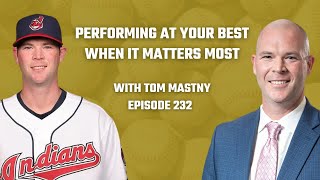
Tom Mastny pitched in MLB for the Cleveland Indians after being drafted by Toronto in the 11th round. Born in Indonesia and raised in Indiana, he didn't develop physically until late, then broke out senior year at Furman as Southern Conference Pitcher of the Year before moving from starter to reliever in the minors and getting called up fast.
Chapters
I had a buddy in town. We actually got in the car, drove up to Chicago to see the Cubs play. I was actually in the outfield in the bleachers during that game when they called me and said, hey, we drafted you in the 11th round. So I'm sitting there in a big league stadium and I got the call and I was like, okay, well, that's cool.
Hey. Hey. Welcome back to the bullpen sessions. I am excited for this episode because anytime I get to talk to a former pro baseball player, especially a pitcher, I'm in my element. So I'm excited today to be introducing Tom Massny. We'll call him Mr. Nasty or Nasty Masny. He'll tell you why in a little bit. But Tom is a former professional major league pitcher, relief pitcher, spent a few seasons in the big leagues with the Cleveland Indians and today Tom is the founder and owner of the Pennant Group, a health insurance advising firm in Augusta, Georgia. So not only does he speak to my heart as a former pro baseball player, he's also in the same industry I am. So I'm super excited to have him. Tom, welcome aboard.
Thank you, Andy. Appreciate the opportunity to get to talk to you.
You bet, man. I am going to actually ask question out of the gate because I always tell people, where are you from? You actually have an interesting story. You were not born in the United States. Is that true?
It's true. It is true. It's. I am the only. This little trivia question for you, right? Little only Indonesian born major league baseball player in the history of the game.
So what's the backstory on that?
Yeah, I wish it was more exciting. Right. But you know, my dad at the time was a controller for an oil company. He took an overseas assignment. You know, they, the company was acquiring, you know, other companies and Indonesia happened to be one of the, one of the places that they, they acquired. So we were over in Borneo, Indonesia, and we were there for I guess about three years. I lived 18, the first 18 months of my life over there. And my older sister was getting to the age where she was going to start school and they just decided that, hey, Indonesia is probably not the best place to, to raise a family. So they ended up moving back and went to Illinois for a number of years. And then when I was about five, we moved to Indianapolis, you know, a little suburb, Zionsville, Indiana, Northwest corner. But so my, my childhood basically was in Indiana, Indianapolis. But yeah, so first Indonesian born major league baseball player and I think first Indonesian born.
Japanese, you know, baseball player in their, their Professional league over there. So I've got two professional.
We'll talk about that. Because I know you spent a little part of your end of your career in Japan. So is it safe to say if Indonesia ever gets asked to participate in the World Baseball Classic, are you going to make a comeback?
Absolutely. I mean, I think I still got it. I mean, if they're, if they need a six, six out of shape, 270 pounds person that's throwing 75 miles an hour, I'm your man.
That's awesome. Well, it's funny you bring up Zionsville being like a suburb of Indianapolis. My nephew right now is in the midst of high school travel ball right during the summers. And I know I forget what suburb it is in Indianapolis, but there is a baseball complex there now that is massive. Like, the number of fields there blows me away. And they, I know they play there two, three times every summer, but it's. Indianapolis is definitely a baseball town. I know Indiana is known for basketball, but it's definitely a baseball town. Well, you know, you're a guy, you're the kind of guy I don't like, Tom, because, you know, you were given the, the, the gift of height at 6, 6 being a 5, 9 pitcher. I always envied guys like you. But when you were growing up in Zion's Field, because at the end of the day, in my research on Zionsville, it's not a huge town.
What was it like playing high school baseball in a smaller town where I'm gonna guess, and maybe I'm wrong, but I'm gonna guess that you were probably this one of the standout athletes. What was that like when you are, you know, literally standing out by height and talent growing up in a smaller town, playing for a high school like that?
Yeah, I think it was, you know, I was, I was by far a late developer. Right. So I was not your star athlete in Little League. I was not your star even through high school. It was probably junior. Senior year of high school is when I actually started to hit my growth spurt. I was, I was five, five as a freshman, you know, started growing my junior year. I think I hit six foot my junior year, and then by the time I graduated, I was 6, 4. And then after my freshman year of college is when I stopped. So I was a late, late bloomer, which was probably good for my baseball career because I didn't, I didn't get to pitch a ton. I had some bullets left in the arm by the time I got to college. So, you know, I graduated I was throwing 82, 82 to 86 miles an hour and just slowly increased, you know, through my freshman sophomore year. But it really wasn't until my junior year of college where I figured, figured out how to pitch and play the game. But you know, in a small town we were a, you know, Indianapolis is known for basketball. So basketball was the number one sport. But football at our school, we were a football powerhouse. Baseball kind of took a back seat.
You know, so I was, I put up good numbers but I was overlooked by most of the main mainstream colleges, you know, so it was kind of one of those self promotion things that I had to do. I don't, you know, we played around the same time. So recruiting back then was a lot different than it was today. I remember sending off VHS tapes to two colleges and you know, having to go down to the, the winter camps and self promote. So you know, I really had three, three choices out of high school outside of the small. I knew I wanted to go division one just because that's. I knew I was good enough.
But.
I wasn't.
I wasn't so ego driven where I needed to go to a big Division 1 school. I had an opportunity at Butler University, which is in Indianapolis, and I had a special walk on status at Ole Miss. And then everything else was small. But then I somehow lucked into falling on Furman's graces. So I self promoted myself to Furman just because I had a connection through my pitching coach. And their head coach actually grew up in Indiana, so he came up to visit and we just hit it off and they actually offered me the best scholarship and I had an opportunity to contribute my freshman year, which I think is what, what contributed to my growth is actually getting to play and develop and learn the game from an early, early standpoint my freshman year.
There's so many symmetries in our career. I have to ask you though, being that know by the time you finished high school you were six, four. Were you, were you also a football and basketball player?
No, I, I played, you know, so growing up I played, I played every sport.
Not well, I mean I was competitive, but my two sports were actually soccer and baseball. So okay, opposite seasons. So you know, soccer in the, in Indiana, Soccer was a fall sport here in Georgia for some reason this spring. But so I would play soccer in the fall and then dabble in basketball. You know, I gave up on basketball in seventh grade when I was short and fat and sat the bench. But so soccer in the fall, baseball in the spring, I guess really Just a way to stay in shape. But soccer was actually my first love. So I played soccer up through my sophomore year of high school, was Olympic Development Program as a kid. So, I mean, I was. I was competitive at soccer, but blew my. Blew my ankle out. Broke my ankle and tore my hamstring in the same year. And I said, enough is enough. And then my senior year, of course, I started hitting a growth spurt. So soccer team wanted me to be their goalie. The basketball team wanted me to come out and play. And at that point, I was. I was dead set on baseball and had some scholarship opportunities and didn't want to. Didn't want to risk it.
Well, first, you grew a foot in high school. Like, that's unbelievable. That blows me away that you had that much, that much of a growth spurt. But, you know, I. I laugh. When I was in seventh grade, I tell people I was the only kid that made the A team in basketball with B cups. I. I was a chubby kid as well.
But, you know, you talk about the recruiting. I wanted to bring this up for a second. Recruiting back then, 25 years ago, is very different in the Midwest and Great Lakes. Right. I was just talking about this with my dad. He's a longtime high school base. Back then, being a player, being an athlete in Wisconsin, it was a big deal if a kid got recruited to Minnesota or a school in the Big Ten, like that was a big deal out of Wisconsin. Nowadays, every kid. My dad lists off these kids at these high schools that, you know, this kid's going somewhere in the sec, this kid's going somewhere in the acc. And I think this travel ball has completely changed the dynamic. And I also believe it's absolutely killing Big Ten programs because they can't recruit anybody anymore because they're all going to Southern schools, right? Yeah. So you're at Furman. So you get. You go down to Furman in Greenville, South Carolina, And I know you. You played with Common Connection, Dom Francini. You talked about your junior year, you learned how to pitch. I want to. I want to focus on this for a second, because there's usually that moment for athletes when it clicks. And you talked about in your junior year, you learned how to pitch. I, too, got a chance to pitch my freshman year, which I think helped. But what do you, when you say, I learned how to become a better pitcher, talk about that for a second?
Yeah. So, you know, I had 400. Over 400 innings my collegiate career. So, I mean, I got almost 100 innings my freshman year, so it was, it wasn't a workload learning to pitch, it was a learning, it was more learning to compete and learning to control my emotions. You know, after my sophomore year I went and played in the Coastal Plains League, which played in Wilson, North Carolina and had an outstanding year. I mean I, you know, led the league in era, most wins.
You know, was starting to get looked at by a lot of pro teams. You know, they were like, okay. So after my sophomore year, going into junior year, going to be draft eligible, I was starting to pique the interest of these teams. So my, I thought that I was, you know, the next coming at that point, even though in realization I went to Furman university, I threw 86 to 90 miles an hour. I wasn't the next thing, but my ego kind of got in the way. So my junior year was absolutely terrible. But I learned a lot from that or, you know, I learned to compete with what I had and you know I'm going to fail, but if I keep putting in the hard work, eventually it's going to pay off. So, you know, my junior year really taught me a lot of self growth where it was, you know, I had high expectations and I didn't meet those expectations. So it was, how do I adjust from that to. If my dream is to play professional baseball, what it was, I was going to have to step it up and have a lot better senior year in order to get that opportunity. So I say it taught me how to pitch. It taught me how to pitch with dealing with failure.
I love that because if you look, if you go back and you look at your junior year and compare it to your senior year, I talk about, you know, it's the work you're putting in when no one's watching. Would you say there was definitely a difference between the work you put in off the field between your junior and senior year that led to the very different results?
Yeah, it was the focus, right? It was, it was in a, in a. And I said two things. Like one is I went to Furman University, which is a small Liberal Arts School, 2,600 students. Everybody knows everybody, so you can't get away with much, right. So academically it kicked my butt. My freshman year I had to figure out how to actually be a student athlete. My senior year I had a lot of distractions. So baseball was my competitive release, which was good. I met my wife my senior year. I overloaded in classes, so I took an extra class every semester and then I had to, you know, be a student athlete on top of that. So I was so busy that I hadn't have enough time to get in trouble off the field. The other thing that I did, I made a post on LinkedIn about having a mentor. It was interesting. I had a different pitching coach all four years at Furman. So my first year was Tommy John. The Tommy John, his son was a senior when I was there. So Tommy would come down from Charlotte and basically help us. So he taught us a, a lot about, about pitching in general and just how to, you know, be a student athlete. Then I had a different one my sophomore year and a different one my junior year. And then my senior year we had a pitching coach that was actually an outfielder. And our. My head coach came to me and said, hey, I want you to be basically the pitching coach. So he put a lot of responsibility on me, which made me work harder because I had to lead through example now. So, you know, if, if we wanted the pitching staffs to succeed, I had to be that leader and kind of mold the group and lead by example, which the combination of all of that together made me have a year where I didn't really realize what I was doing as I was doing it, because I was just trying to set the example for everybody else.
I love that that was a bold move by the head coach, you know, to put an active college player in as quasi pitching coach. Wow. Well, and for you, I know it paid off that, that's interesting because, you know, you look at your senior year again, I'm, I'm making notes on what I, what I researched. You know, you were the 2003 Southern Conference pitcher of the year. I believe you had some All American status as well that year, you know, on different, different lists and stuff like that. So do you believe. Just a quick answer to this question, the fact he put you in that leadership role, did that have a positive impact on those statistical results you had that year? I think you went, what, 11 and 2, 12 and 2, something like that on the mound.
Yeah, it's. You know, I had a. I think I actually had a 109 era, which.
Is unheard of, by the way, in college baseball with metal bats. That's unheard of.
Yeah, it was one of those. I, I didn't know what I was doing in the moment because I was. It was. My role was to set the example every Friday night for what we were going to do, and I would just take it and, and run with it and, and do it. So I knew I was having a good year, but my goal was to get drafted and the only that was my focus is go out, compete as. As hard as I can, don't worry about the results, but just show kind of my bulldog mentality and everything else will pay off. And luckily it did for me.
That's awesome, man. Well, that's kudos to you as a kid. You know, what were you probably 21 years old? 20, 21 years old. To be put in that responsibility to basically run the pitching staff. That's impressive. Not only to be able to run the staff, but then have the season you had, which, by the way, led to you. Not only are you in the Furman hall of Fame.
Yep.
You got drafted that year in the 11th round by the Blue Jays. Yeah. Talk to us quickly about what was it like when you got the call? What was that? You probably remember the moment. What was it like when you got the call that from the Blue Jays saying, hey, Tom, we'd like to draft you.
So it was such a surreal experience, right? Like, I knew I was going to get drafted, but where. And you've gone through this, where you're going to get drafted is just, you know, you just, you don't really know. So I, leading up to it, I'd heard second to sixth round.
And then I started getting phone calls the day before from scouts saying, hey, do you even want to play baseball? And I'm like, yeah, I didn't. I haven't even put together a resume. I mean, I graduated, but I don't know what I want to do. This is all I want to do. And I got phone calls saying, we heard you want to go to med school. And one person said, hey, we, we heard you're going to like, you want to be a, you know, engineer, like an astrophysicist engineer. I'm like, whoa, whoa. Like, no, I'm a business administration major at Furman University.
No.
So I think there were some games being played. So I didn't get the first five rounds go by. And I just said, you know what? I don't care about this. I had a buddy in town, we actually got in the car, drove up to Chicago to see the Cubs play, and that was the Sammy Sosa cork bat game. I don't know if you remember that, but that, you know, broke his bat and got found with cork in there. I was actually in the outfield in the bleachers during that game when they called me and said, hey, we, we drafted you in the 11th round. And I. So I'm sitting there in, in a big league stadium and I got the Call. And I was like, okay, well, that's. That's cool.
Right?
So then we started negotiating and they offered me $8,000. I asked for 10 and my student loans paid for. They said, how about $8,000 or you just don't play? I said, I'll see you tomorrow. Right.
Well, the only thing, I think they would have made that better if it was the Chicago Cubs who have drafted you while you were sitting in Wrigley Field. But that's awesome. Well, a couple things I want to ask you because obviously then you have a minor league baseball journey which ultimately leads you to making your MLB debut in 2006. Yep. Now, I might not have this right, so feel free to correct me, but, you know, my whole career up until minor league baseball as a starting pitcher, and then I got to minor league baseball and I became a reliever, which was a big time adjustment. Were you still starting in minor leagues or did you two get moved to the bullpen once you went into pro baseball?
No, I was a starter. So I started.
In short season. I started the full season and short season A, and then the whole next year I went to low A, started, made the all star team. I think I led the league in ERA that year.
But I played the whole year in low way. And, you know, so in my mind I was like, I'm leading the league in every statistical category. Why am I still in low A? Right. But again, senior, senior sign, no money given to me. I'm just gonna have to prove myself. And there's people as you.
As.
You know, when you get into pro ball, there's a pecking order, there's a business. It is a business. It's a business. That took me a long time to figure that out.
But.
So after that year, actually I traded in the off season for John McDonald, who's kind of utility infielder. And I was the player to be named later, but I was actually proctoring a test. So in the off season, as you make no money in the minor leagues, you find these odd jobs. And I was proctoring a test. I think it was actually an insurance test of all things. But I was the guy that just.
That's an eerie foreshadow of your future career.
But I got the call from our. The GM or the player development of the Blue Jays, and he says, hey, thank you for everything. I thought I was getting released. I was like, this is ridiculous. He said, thank you for everything. You've been traded. You'll get a phone call from the Indians. And that was it. That was the whole call. So I'm sitting there proctoring a test, don't know anything, and three hours later, the Indians called me and kind of told me what was going on. So. But, long story, I'll wrap it up is a. I started the next year in high A, but they came to us. They had traded for another. Another starter, and they didn't know what they wanted two of us to do, so they put both of us in the bullpen, and we would alternate starts so he would get a start and I would get a start the next week. I had a really good year in the bullpen, and they moved me to AA for the playoffs. And our director of player development at the time was a guy named John Farrell. I don't know if, you know, Johnny Cushed had a real successful coaching career later on, but came to me and said, all right, we want to make you a starter again. So mid, you know, two weeks into the year, this was 2006, he's like, we want to make you a starter again. What are your thoughts? And I asked him point blank, I said, well.
If you were me, would you go back to being a starter? And he said, yeah. And I said, well, what's my fastest way to the big leagues? Is it in the bullpen or as a starter? Because my. My. I don't care what I do. I want to be in the big leagues. And he says, well, if that's your goal, then you want to be a reliever. I said, well, keep me in the bullpen. And then six weeks later, basically, I was in the. In the big leagues.
So, you know, I kind of. And it's just been a testament of what I've. I've done. I just like to take things in my own hands, and maybe it's a control freak in me, but it's really. You control your own destiny, and you know what you have to accomplish. As long as you know where the guidelines are, then you can go ahead and do it.
No, that's cool to hear, man. Because I'll be honest, as someone who did not take control of their own destiny in pro baseball, that's. It's. It's cool to hear that you said, nop. This is the route I want to go, because I know what my future is. Quick question on the whole relieving starting, because I know for me, I'm a. I'm a creature of habit. So I had a whole routine before I'd start. And then now you're in the middle relief, right? I was middle relief. That, that habit, that ritual, that routine prior to getting out on the mound literally gets compressed 90% of the. By 90% because in some cases you're up, you're, you're, you're from up the bullpen to start warming up into the game in minutes. In some cases. Was that tough for you to make that adjustment at first because you had been so used to being a starting pitcher or.
No, it. Not really. I suffer paralysis by analysis, right. So I suffer a little bit from anxiety. So I think if I would have known that I was pitching that day as a bullpen guy, that it would have messed with me. But being, not being not a priority guy is what they would call because they didn't have a lot of money invested me that it was a. You get your opportunity when you get your opportunity. And knowing that I always had to be ready allowed me to create a routine that put me in a position to be ready. Right. So my routine stayed the same pregame, right. Got to the field the same time, did the same, you know, exercises and workout and got myself ready so that when I was called on, I knew that within five minutes, you know, I could be ready to go. You know, you just have to learn to adapt. It took me a little bit of time, but, you know, not a whole lot. I was kind of one of those, just don't, just don't tell me the end result. Just let me go do it and figure it out and, you know, just tell me what your expectations are and let me figure out my own routine.
I like that. So you got called up. Did you get called up to the big leagues from double A?
No, I actually.
Six weeks in aaa? Okay, yes, maybe two. Two weeks or three weeks in Double A, six weeks in aaa.
And then what was that like? Getting the call, getting the notice that, hey, you're going up, you're going up to the Indians.
You know, it's funny is I, I was, I was super pumped. I didn't see it coming. I knew I was having a good year. I mean, I guess oblivious, but it's having a good year. And everybody was, you know, saying that I should get an opportunity, but I wasn't a 40 man guy. So it was like they had to make room on the 40 man and call me up. But I remember we were in Buffalo. Tory Lovolo was the, the manager at the time. Scott Radinsky was a pitching coach. They called me in after, after the game and basically told me that I was going up the next day. And yeah, I immediately call my wife. She doesn't answer right. He's studying. She's studying for the bar, so she's not in any.
She?
You just.
More from Andy




If you want producers to succeed faster, help them create a sales message that creates confidence.

Sales isn't a zero-sum game! You can have tough competition and still grab a beer after



Option 1: Meditation, a fast walk, a podcast, and protein. The ultimate morning routine!

How you do one thing is how you do everything. Ill elite producers fuel their body.


Stop living in the gray of maybe! Your job in sales is to get a clear yes or no