3 Keys To Sales Success With Your LinkedIn Content
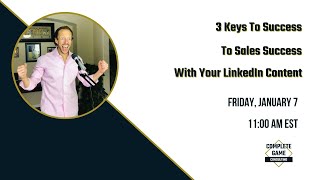
Andy Neary's webinar explains how to use LinkedIn to grow B2B sales by treating your profile as a personal website and connections as a community. He gives three keys: pick a medium (video/pictures/articles), choose what to post (five buckets: calls to action; case studies; credibility/toot-your-horn; subject-matter expertise; personal stories) and set a consistent cadence (start once/week, aim earlier in the week). Tactical advice: prioritize views over likes/comments, prefer short raw videos (≈2 minutes or less on LinkedIn), send a brief personalized connection note and a 60-second voice message after acceptance, repurpose content across email/YouTube, and use pictures for facial recognition. He cites that LinkedIn provides ~80% of his business and shares client results (examples of six-figure wins). He also briefly promotes a Broker Branding Academy starting Jan 19.
Questions this video answers
About 80% of his business.
Keep LinkedIn videos to about two minutes or less; longer videos can go on YouTube with short LinkedIn clips driving traffic.
Up to 60 seconds.
Starts January 19th (promo mentioned).
Calls to action; case studies; credibility/toot-your-horn; subject-matter expertise; personal stories.
Chapters
About every year you should have what he calls a masochi. I think it's a Japanese word. But one thing you're going to do this year, that it's going to be super uncomfortable but you're never going to forget it. Now that could be personal. Going on a trip, doing some kind of experience or business. Today what I am going to talk about is that one thing that's going to be uncomfortable for a lot of people and that's this LinkedIn social media content. And here's what I want to start by telling you guys today I'm going to share three, what I believe are the three keys guys to use LinkedIn content effectively. But before I get to the three things what I want to explain, I want to talk about some I think mental barriers that keep people from showing up on LinkedIn. The first one is the basic I hate social media. I think a lot of people are there, I think right now a lot of people are burned out with social media because.
It'S kind of part obviously it's playing a role in the social society today with everything we got going on. So I think some people are burned out with that. But there's also a lot of people just have a belief I don't like social media. Most of us on this call did not grow up with it, right? So I don't want to be using it. And I'll tell you guys, hands down, I share this a lot. I'm on LinkedIn every day right now. It helps grow my business. It's probably responsible for 80% of my business right now. I don't like social media. In fact, if I could, I would not be on it at all. I think it's annoying. But I also know that I have to be there and that leads to the first part of this is mental mindset shifts I want everybody to make on this call. If you are somebody like me who quite frankly doesn't really like social media, what you've got to remember is if your prospects are there, you need to be there.
So think of it this way. They don't care what social media doesn't care what you think about it. If your prospects like it and they're there, you need to be there too. And for everybody on this call, when you think of social media, we've got multiple different platforms today, right? LinkedIn, Facebook, Instagram, TikTok, you name it. Honestly guys, for your business you just need to be on LinkedIn. It's the true business to business platform on social media and it's the only place you need to be. Now the question becomes, okay, cool, Andy, you've convinced me. I need to start doing it. Where do I even start? And that's the purpose of today's webinar. What I want to help you guys do is at least create the. Start the foundation of what you can be doing to put yourself out there.
So what I want you guys to start thinking about is, number one, I want. Here's what I want. How I want you to start viewing LinkedIn. As you know, the platform is built this way. You have connections, right? And you can post content on it.
I want you to start thinking of your LinkedIn profile this way.
Your LinkedIn profile is your personal website. So you might work for an agency or an industry partner that has a company website, right? But LinkedIn is your personal website.
And your connections are your community. So I want you to think about.
You being the mayor of this community, of this town. Your connections are your town. You might have 300 connections, you might have 15,000.
But that's your town. And here's your job. Your job is to grow that town and let the right residents come into the town. What does that mean? Well, the right residents are the people you can do business with. We all get these random invitations from people that want to sell us something, right? We've all seen it. You don't need to. You can ignore those. Your job is to make sure the right people are connecting to you and coming into your community. Now, part two.
Is every time you post a piece of content.
That is the equivalent of you putting up a new billboard in your town. Because if you put the right billboards up in your town, your residents are going to see it and it might attract the right new residents. And so that's what LinkedIn really is. It's growing your town, growing your community with the right people. Because when you start posting content and putting your billboards up, the right people are seeing it. And if the right people see it long enough, guess what's going to happen? They're going to start liking you, or at least know you for hands down. They're going to know who you are because they're seeing you all the time. And when they start knowing you and your content starts resonating with them, they're going to start liking you.
And when they start liking it and liking you, it's so much easier to do business with them and have them do business with you.
So that's where we're going to start today, is this is how you guys use LinkedIn effectively. If you are using any of these automated bots, companies that are automatically sending out a bunch of connections, I am literally going to tell you to stop. It doesn't work. You have to show up as yourself.
I don't like the automated campaigns that you send me a connection and I know within minutes I'm going to get the message from you that has this sales pitch on it. Don't be doing that stuff.
Your job is just to connect with the right people and post good content. So today we're going to focus on the content. What can you be posting? So I talked about the three keys and if there's any questions, guys, feel free to ask them at the end, just write it down. I'll take some Q and A at the end. The first key is this. When you realize you need to be on LinkedIn posting content, the first thing you need to ask yourself is the question.
How?
What do I mean by that? Okay, Andy, I know I need to be putting content out there. How do I post content?
3 Types of Mediums you want to think about.
Video.
Pictures.
Or articles.
When you look at LinkedIn, there's really three main mediums of posting content. It's video, pictures and articles.
Now, if we're going to get into the algorithm and the science behind what gets promoted the most, I would tell you if I had to make a guess. Right now it's probably pictures. I think pictures are getting promoted more than videos. It used to be video and articles. Probably not as much as video or pictures. But here's why articles are important, guys. You have to remember your audience and you have to ask the question, how do they digest content? Some people love watching video. I'm a video guy. I love going on YouTube and watching educational content. Some people love looking at pictures and reading posts, and some people like reading.
So the purpose of making content for all three mediums is you're gonna hit your audience broader because they receive and digest content in different ways.
That's why it's important is the ideal is if you can create content that includes videos, pictures, articles. That is the nirvana. Now to get started. If you're somebody sitting there saying, andy, I'm just getting started, pick one. There's no wrong answer.
I personally feel video is the most effective because when you create a video.
You get to see me and you get to hear me, and you also get a good feel for my personality. I think that's the most effective way to get somebody to know you and like you the quickest. And here's the best part about video in 2022, honestly, people don't want the fancy edited stuff right now, people. What really gets attention right now, guys, is you going, picking up your phone, hitting record, and just talking to your phone and then posting it.
People just want raw. They just want to see you. And as long as what's coming out of your mouth is good and effective, people will watch, people will like it.
Now, part two to step one, which is how I post. How do I post is. As you know, there are LinkedIn metrics, right? You've got likes, comments, and views.
The only metric I want you to care about.
Is views.
Somebody could hit mute. Somebody's making a little rather loud sound there. All you care about is views. Guys, here's why. Views means eyeballs.
So if I post a video And I get one like, and I get one comment, but I get 700 views, that is a good post because I just got 700 eyeballs to see that video.
So if there's one piece of advice I could pass on is do not get caught up in the likes and the comments. Views are the only thing that matter. And case in point, I told you about 80% of my business today comes from LinkedIn. The people who reach out and ask how my coaching can help them are the people who never comment or like on my stuff. But they're watching, and that's all that matters. That's why the views metric is the most important metric. So the first question is how? First step, first key. Again, pick one, lean into it. No, wrong answer. Second question you want to ask.
Is.
What.
What do I post?
And this is the part that you can really separate yourself from everybody else. We're all in the insurance industry, right? And when I think about the health insurance industry specifically, you probably have seen some of your peers go on LinkedIn and post content around. They do a little insurance company bashing, they do a little healthcare system bashing. And I'm here to tell you guys that stuff doesn't work.
It may get your peers fired up, but you're not grabbing the attention of your ideal prospect. Your prospect, if you're a broker, is a cfo, CEO or an HR director. If you're an industry partner, your prospect's the broker.
That's all you care about. Guys, go on LinkedIn and create content for them. It's not to get reactions out of your buddies.
And so the question becomes, what do I post? And this is the most important part of this webinar, guys. There are five categories. Some of you have probably heard me say them already if you've been on past webinars, but this is a great refresher you do not want to forget. I believe there are five categories you should think about posting the first one, and I'm going to work backwards. The first ones are the proverbial call to action, where you are asking your audience to do something. What could that action be? It could be, hey, we're hosting a webinar. Here's the link. Go register. Hey, would love to schedule a call with you. Here's my the link to my calendar. Let's jump on a call that's you're asking the audience to do something.
Calls to action should take up probably the least amount, at least the smallest part of your content. You don't want to be throwing a bunch of calls to action up there, but once in a while, try to call, call your audience to action. There's nothing wrong with it.
The second category is case studies and credibility.
This is the part where you have to let people know you know what you're doing. What do I mean? If you got a case study of a client you have worked with that has had massive success.
Because they've worked with you before they started working with you, they were struggling. They went through your process. Now they're having a ton of success. Share those successes. A lot of people are hesitant to share them. Here's why. I don't want my competition seeing that ABC Inc. Is my client and I'm sitting there going, really? If you have a client who's letting you put up a case study on LinkedIn, guess what, guys? They're never leaving.
My competition can call that prospect, that client all day long. That client ain't leaving. So share case studies. Credibility.
Is another way of letting your audience know you or your agency knows what it's doing. Have you guys won an award? Were you featured in an article? Were you featured on a podcast? All of those mediums are ways that your audience will look at you and say, okay, if they were featured in this article or they won 40 under 40 or whatever it is, man, they must know what they're doing. That's credibility.
So it's important I call it the toot your horn posts because nobody else is going to toot your horn for you. Let your audience know your clients are winning and you're winning. That was one of the hardest ones for me to post. Guys, I don't like tooting my own horn, but I realized you have to because nobody else is going to do it. For you.
The third bucket.
And this is where most of us go, is subject matter expertise.
This is where you get to be the expert. This is where you get to teach.
Don't be afraid to go on camera. Maybe you write an article and just talk about ways your prospects can win. What are some of the strategies you're helping your clients incorporate? Pick a very top of mind current event in our industry.
And put a post out there about it. That's your subject matter expertise.
If you just spend more time teaching with your content, you're going to have more prospects who see that content and are going to find that content valuable. This is again where a lot of advisors get hesitant because they're afraid that if I go on and teach and I share an idea or I share a strategy, my competition is going to see it and they're going to use it against me.
My advice on that is twofold. Number one, your competition most likely is going to do nothing with it because they're too lazy to do anything with it. And number two, they may even work for an agency or a company that doesn't even let them do what you're doing.
But most importantly, with the subject matter expertise post, he or she who teaches the most will win the most. I want you to remember that.
Our buyers are smarter than they have ever been.
So we have to spend so much time teaching today before we ever get hired.
And so if you would take time with LinkedIn content again, it could be an article, be a video, could be a picture. If you just take time to teach, it is going to bring a ton of value to your prospects, your town. Remember, you're the mayor of the town. And eventually, when they see enough of it, it's going to be so much easier to reach out to them to schedule a meeting because they already know who you are. They've already seen the value you brought. They like it. And now it's going to be so dang easy to schedule a meeting with them.
The fourth bucket.
Is, in fact, I should say, I take this back. I made a mistake. Case studies, credibility are two separate buckets. We actually have four buckets already. We have calls to action, case studies, credibility, subject matter expertise. The last one, guys. And I think this is the game changer. That's why I saved it for last.
Personal stories.
This is the one where 90% of us are too afraid to go.
Every single one of you on this webinar today has a story to tell.
If you've seen my stuff, you know, I talk about things like my baseball career or the fact I love cycling, or the reason I do that is because every event in our life, things that have happened to you in your past, they could be the most monotonous daily things, have taught you a life or business lesson, right?
And if you share that with your audience, here's what happens.
Number one, they definitely get to know you. But if your story includes life lessons.
They start realizing you are just like them.
And there is not a more powerful way to walk into a prospecting meeting with a leg up on the competition when that prospect has already seen your stuff and they already know you and he or you and she are exactly alike.
The challenge in the insurance industry is we all think we have to be perfect.
Unflappable to win business.
But I am telling you in 2022, that could not be farther from the truth. Especially over the last two years, that CFO you're trying to go after, that CEO you're trying to go after, that HR director, they've all gone through the same thing we have.
They experience the same setbacks we experience. So when you share that stuff and the lessons you learn from it, they're like, this guy's just like me. This woman is just like me. She gets me. Guys, that is the most powerful content you can post. And here's where I had my aha. Moment. I want to share this real quick. I've been speaking for about five or six years, and I always would share my baseball stories, but I always share the fun, successful ones. And here's what happened. I got frustrated early on in my speaking career. I'm like, I thought, I think I'm sharing some good stories. I'm a good speaker. Why? Why don't I have people coming up to me afterwards being like, that was a great talk. And then it hit me.
When I share baseball stories about my pro career, how many people in the room played pro baseball?
None. They don't get what I'm talking about. So I said, aha, let me try this.
My next talk. I said, you know what? I'm going to talk about my pro baseball career, but I'm going to talk about why I failed in pro baseball.
I feared comparison, I feared judgment, and I feared failure. How many in the people in the room have had a fear of comparison, judgment, and failure at one point in their life?
100%. And you know what happened, guys? After that talk, I had people coming up to me, hugging me.
I share that because now let's equate it to content. If you let people get to Know you by talking about your life a little bit and maybe some of the vulnerabilities and the lessons learned from failures, they're going to go, you know what? I had that happen, too. You're just like me now. They're not going to be able to give you a hug virtually. But my point is when. Now when you get an opportunity.
To sit down for that discovery meeting with them, you've already got a leg up on the competition because they know you and they already like you and you haven't even started talking about doing business yet. So with personal stories, guys, why I think they are the most powerful. I want you to think about things that have happened in your life. Again, they can be monotonous and boring, but the more monotonous and boring, guess what? More people have gone through them. And what life lessons, what business lessons have you learned from those moments?
If you can create those types of posts, guys, it will be the most powerful thing you ever create on LinkedIn, I promise you.
So I urge everybody, as a homework assignment, sit down and think about events. What are some things that have happened to me that I could talk about? And what was the business or the life lesson that's come out of that? Okay, cool. Yeah. Because what's going to happen is that's going to attract.
People to your message because they realize you and them are aligned. You and them are just like, I have a client right now who has done a great job that they just won a $200,000 account January 1st. Because when they walked in against the big boys.
Because the board of directors they are presenting to had been seeing their content from day one, they already looked different.
Now, here's the best part of this, guys. Those are five buckets I shared with you. If you just spend your time right now teaching, being a subject matter expert.
And showing up once in a while to share personal stories with life lessons, you can do that one, two, punch for the remainder of your time on LinkedIn and win. And win big.
Because if there's one message I want everybody to remember today, it's that humans buy from humans. They do not buy from logos on business cards. No one cares about the logo at your agency.
They want to know you.
Will. I'm staring at you, man. I can see you. You happen to pop up on my screen. I remember when you made that post about your ultimate Frisbee career. That got people to know you, that got people to resonate with you. Guys share that stuff. I post content once in a while, but my. The fact I Love cycling. Why? Because I know there's brokers out there that love cycling too. And when they see those posts, they and I are that much closer.
Which leads me to my third part of the third key.
I'm going to call this the way. Okay, cool. Andy. I now know I want to use video or I want to use pictures. I now know I'm going to talk about being a subject matter expert and I'm going to share personal stories. When do I post? How often do I post? This is the best. The punchline. Guys, there's no wrong answer. If you haven't started posting content yet on LinkedIn, start simple. Once a week.
But if you're going to start simple once a week, here's what I would urge you to do. Be consistent. If you do Thursday mornings, stick to Thursday mornings.
I have a lot of clients I work with that want to go from not posting at all on LinkedIn to I'm going to do it four days a week. And I said, hold on. Oh, you're not. Because what's going to happen is you're going to get overwhelmed after a couple of weeks and you're going to stop doing it. It's going to be frustrating. Start simple. So ask yourself, how often can I post before it gets uncomfortable? Once a week. Okay, that's easy. Twice a week. Yeah, I could think I'd do that. 3. Okay, cool. Right there. Stop. Do twice a week. So, guys, when you think about when you post.
Just start with a frequency, a cadence, and stay consistent. Because the most important part is consistency.
And as far as when you post throughout the week, again, I don't think there's a right or wrong. If I could make one suggestion, Friday's probably the slowest day. So if you're going to get the slowest amount of views, Friday's probably going to be that day. Monday and Tuesday are very active. LinkedIn days kind of goes like this over the course of the week, I think people just get burned out. So if you're going to make a post once a week, focus on the beginning of the week.
Question came up. What day of the week and time is best for folks to see your food? Just that. I'd say Monday, Tuesday. If you're going to focus on one day or a day or two of the week, focus early in the week.
And you may again mornings over afternoons. But guys, don't get really hyper focused on that. Just start posting. Pick your medium. Video, audio, video, stories, pictures.
Determine what you're going to say. Again, personal stories, subject Matter. Expertise is the two the two most powerful things you can do and then determine how often you want to post and when you want to post. If you just stick to that consistency over the course of the next three or four months, you will start to see activity from that 100% guarantee. The consistency is the key. Now, the last thing I'm going to share with this before I go into some Q and A.
Pictures of you are also very powerful. A lot of people are afraid to put up pictures of themselves, but here's what you want. Why pictures of you are important. I put up a lot of pictures of myself. I hate doing it, it's uncomfortable. But here's why it's important. Top of mind awareness, facial recognition. You see when they see posts from you, they watch a video, they see you. If there's a picture, they see you. That facial recognition and that top of mind awareness are the two most important things. Because you have prospects who are not ready to buy today. But when they're ready to buy or maybe change their advisor, guess what? They're going to remember you first.
That's why pictures of you are important. They're not egotistical. It's just important to put some stuff out there so they see you. It's part of your branding. So with that being said, I see a hand up. Anybody who has a question, you can either put it in the chat box or just unmute yourself and ask away. We'll go about another five minutes here.
Questions will unmute yourself. Sorry, what about sharing? What about sharing content and then reposting stuff that you already made? Like yep, great question four times a week or something like great question if you're going to share somebody else's post, guys, make sure you put your own editorial. Write your own editorial. Don't just hit share.
Two. What you're referring to, Will, is repurposing content, right? Guys.
The LinkedIn community has a short memory. If you literally reposted the same thing three or four weeks later after you posted it the first time, nobody remembers that you posted it. So don't be afraid to re regurgitate or repurpose a post you made a few weeks back because people had forgotten that you actually posted it. So yeah, there's nothing wrong with that.
Karen, A lot of my prospects are not active on LinkedIn succession as to how to share the post. I know for some markets, yes, you're not going to have a ton of prospects on LinkedIn.
Just focus on putting it out there. Karen, stay consistent because people will see it, the right people will see it, I get it. Not everybody's there. You're gonna have some prospects, they're not there. But here's what's shifting, guys, and I don't want us to forget this. Our buyers are getting younger, right? The 62 year old CFO is starting to be replaced by the 39 year old CFO and the new buyers are all over social media. So if you feel like not every prospect's there, here's a way to solve that. Karen, thank you for asking this. If you want to hit all your prospects, but not every Prospect is on LinkedIn, if you make a social media post, put it into an email and send it to your prospects. Like if you do a video for LinkedIn but you know not every prospect's there so they're not going to see it. Just link it into an email and send it to your prospects that way. That's called repurposing. I'm taking a video that I made for social media and now I'm just going to repurpose it into an email. There's absolutely nothing wrong with that and it makes your life easier because you're killing two birds with one stone. Is there a minimum or maximum length to a video? Great question, Tom. If you're going to do a long video, like 10 minutes to teach nothing wrong with that, put it on YouTube, create a YouTube channel. That's what YouTube's for, is the long form videos. LinkedIn. Try to keep your videos if you can, to two minutes or less. So let's say you did a long video, 10 minutes, put it up on YouTube, take a two minute clip, put it up on LinkedIn, then drive people to the YouTube chat video where the whole 10 minutes is. But try to keep your LinkedIn video to two minutes or less. If you go three, three and a half, no worries. But the shorter the better because people, obviously we know their attention span on social media is very short. How should we send invite connections to prospects? And what should we say? Oh, this is the game changer, LinkedIn connections, number one. Guys, when I send a connection to somebody, here's literally the message. Hey, Karen, I'd like to connect with you here on LinkedIn if you're open to it, that's it. I don't use the generic LinkedIn connection, I just send that personal message. Karen, I'd like to connect with you here on LinkedIn if you're open to it. Now here's the game changer. When Karen accepts there is a, there is a feature I hope everybody is aware of by this point. That allows you to send first connections, a voice message up to 60 seconds long. Once Karen accepts, I'm going to send Karen a voice message that says, hey Karen, Sandy, just wanted to thank you for the connection. If there's anything you need from me, feel free to reach out now that we're connected. But just wanted to say thank you. I don't sell, I don't ask for anything. But because I sent that voice message, I already have stood out in Karen's mind because nobody's sending voice messages. Some of you, I've done it too. I know I have. That's a great way to stand out. Guys, in your prospect's eyes, once they accept, send them a voice message. Now they're in your town, they're in your community, they're going to start seeing your content and eventually when you reach back out and be like, hey, Evan, you know, we haven't connected in a while. Let's jump on a call. Evan's a lot more apt to say yes because he feels like he knows me. Now, guys, we've all been taught in this industry to pick up a phone and cold call people who have no clue who we are.
I hate it. I suck at it. This is why LinkedIn is so effective. It's a way to get people to know you before you ever pick up the phone and call.
Now, last question. Do you think that Facebook and Instagram can be used in the same manner? Yes, Brandon, I believe. But just know Instagram, you're starting to see more insurance people on there, right? But Instagram still that I'm going to take the perfect photo. But yes, you can start using Instagram. Facebook. Here's where Facebook's effective for somebody in our industry. If you sell Medicare, you sell individual plans. It is a great tool because guess who's all over Facebook? The 55 to 70 year olds because they're looking at pictures of grandkids. So if you sell products to that market, I'd be on Facebook because they're there all day. I'd be running ads to the seniors in your market to get their attention. But Facebook, for what we're doing, if you're going after the typical business, I wouldn't spend a ton of time there.
Last thing I want to mention, guys, if I may, hope this was helpful. First and foremost, remember, just go, okay? Do I want to use video articles or pictures or a mix of everything? What am I going to say again? For now, guys, stick to teaching, stick to sharing personal Stories and then when do I want to post again? Don't judge if you're once a week. Focus on earlier in the week versus later and slowly work your way up from once to twice to three times. However you want to go. But start slow, just go. What can I start with that's going to allow me to be consistent and confidently?
You do that well, guys, you are going to stand out from your competition. The bar in our industry is so low with LinkedIn content, trust me. So if you just get consistent, it is going to work. And let me share a couple examples, guys, I have some clients right now that here is the results they're getting. I have a pair of teammates who sell together. They closed $225,000 this last year and have over almost 500,000 in verbals for this year. Second guy just won rookie of the year at his agency that he joined in March sold 345,000 and another sold 730,000 in one quarter. Fourth quarter.
Guess what, they're all on LinkedIn. They're all doing the work, they're all staying consistent.
So my urge to you is just jump in guys and I'm going to make one quick promo. Some of you have probably heard me talk about my broker branding Academy. It starts January 19th. We are going to go super deep into LinkedIn. That's one of the main topics I, I have two spots left.
All three of these people I just mentioned have gone through the Academy. So in the chat box I just put my calendar and you're going to get an email from me right after this. If you want to learn more.
Jump on a call. Let's figure it out if it's a fit for you. But guys, this is how you're going to win moving forward. Trust me, I know. We still have to pick up the phone and we have to make the cold calls, but if you find other ways to prospect LinkedIn being one of them, here's what happens. You're getting more people to like you early on. It's going to make your cold calls warmer. And the best part about it, guys, it makes prospecting fun. When you shouldn't just show up as yourself, let people get to know you, you get to teach. All of us love teaching to our prospects in a sales meeting, right? That's all you're going to do on LinkedIn now. If you do that, you will win. And so that's what the Academy is dedicated for. Guys, I tell people this. These people have written six figures. The cost of the Academy is the equivalent of writing a 10 life group. So if you want to know more, click the link, jump on and I will see if it's a fit. But we got two spots left, so don't delay. But I hope this was helpful. Guys, last question. Do you ever go on Facebook page prospects. Wait, do you ever go on Facebook, a Facebook page of prospects to see who they know? Good question. I would actually do that on LinkedIn. So go to a prospects page to see if they have common connections. That's more effective on LinkedIn than Facebook.
Again, guys, Facebook, if you want to post the same stuff you're posting on LinkedIn, go ahead.
But Facebook is just going to be a lot less effective for what we do specifically. So hopefully this was helpful. Guys, pick the medium. Video, audio or video, pictures, articles. Just start posting personal stories and start sharing teaching because you're already good at it. And then just start getting consistent with it. If you do those three things, guys, this is going to work for you. Trust me. Trust me. Trust me on this. So with that being said, guys, the end of week one of the new year, I hope you guys are ready to have a freaking amazing year. If you've got any questions, ping me.
Other than that, let's go kick some ass.
Thanks, andy. Awesome, guys. Let's go. Have a good weekend. Take care. Thanks, andy. See you, andy.
More from Andy




If you want producers to succeed faster, help them create a sales message that creates confidence.

Sales isn't a zero-sum game! You can have tough competition and still grab a beer after



Option 1: Meditation, a fast walk, a podcast, and protein. The ultimate morning routine!

How you do one thing is how you do everything. Ill elite producers fuel their body.


Stop living in the gray of maybe! Your job in sales is to get a clear yes or no