71. Marshall McFadden: From the NFL Trenches to the NASCAR Pits
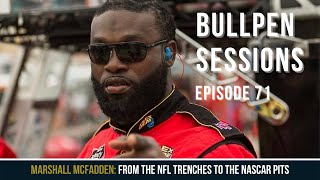
This is a recorded interview (Bullpen Sessions) where host Andy Neary interviews Marshall McFadden about his journey from a small-town high school athlete to South Carolina State (HBCU) standout, then to the NFL (signed after a scout encounter—Dan Rooney of the Pittsburgh Steelers is named), and later into a second career on the Chip Ganassi Racing NASCAR pit crew. Key moments: MVP performance in a North–South all-star game that opened college doors; a depth-chart breakout at South Carolina State that led to pro scouting attention; injuries (dislocated wrist/elbow in college; hip surgery and groin issues in the NFL) but ultimately three NFL seasons with Pittsburgh, Oakland and the Rams; post-pro exploration including playing in Canada (Toronto) before retiring and joining NASCAR. The interview emphasizes hard work, humility, teamwork, and the pit-crew discipline (changing four tires and refueling in ~12 seconds) as transferable athletic skills.
Chapters
Foreign.
Hey.
Hey. Welcome back to Bullpen Sessions. My name is Andy Neary. Each week I sit down with abundant thinkers who are kicking ass in life. And we deconstruct the formulas they have used to have success in business and in life, to help you unpack your life, your business, so you can do the same. So put a smile on, grab a pen and a paper, get ready to take a ton of notes because you, my friend, are about to go on a wild ride. Here we go.
Hey. Hey. Welcome back to Bullpen Sessions. I'm excited this week to sit down with Marshall McFadden. He's got a really cool story. As you know, one of my goals here is to make a bigger impact on younger athletes, make an impact on those athletes who are transitioning from whether it's a college career, professional career in sports, and now they're trying to move on to the second phase of life. And so this episode definitely fits that mold. Some of you may know the name Marshall McFadden. He spent a couple years in the NFL playing for the Pittsburgh Steelers, the Oakland Raiders, the St. Louis, now Los Angeles Rams. So he had successful career in the NFL. But here's what's even cooler. He now has a successful career in NASCAR. That's right, NASCAR. You see, Marshall McFadden traded his NFL cleats for a gas tank lug nuts and now he's working in the pit crew for the Chip Ganassi racing team. So for the NASCAR fans out there, Chip Ganassi represents Kurt Busch, represents Mat Kenseth amongst a few other drivers in their stable, and Marshall McFadden's part of the pit crew. I had a chance to meet Marshall a few weeks ago at an event I did, men's retreat, where we got the chance to watch the Chip Kanassi pit crew team work as one well oiled machine. We got to meet with Marshall and his teammates and it was just fascinating. So I wanted to have Marshall on the episode to talk about, number one, his rise to NFL stardom. You see, Marshall came from a small town, South Carolina, played at a very small high school. We don't get a lot of attention. Then he moved on to South Carolina State. Not a big name, not South Carolina Gamecock, South Carolina State, where he didn't get a lot of attention, but it was an interesting conversation he had with a Pittsburgh Steelers scout that changed everything for him. I'm excited to share that conversation with you. And it ultimately led him to playing on the NFL fields on Sundays. And so he knew what it took to Overcome adversity, overcome doubters when you're not getting the attention you deserve. And he always found a way to show up when it mattered most, and now he's doing that as part of the pit crew and the Chip Canancy Racing team. Get this, these guys have to pit a car, change four tires, fill the gas tank with gas, all in under 12 seconds. So we're going to talk about that as well. So this is exciting because Marshall McFadden has had NFL success, and now he's having success off the field in a completely different sport, the sport of NASCAR racing. So I'm excited to bring this conversation to you. This is exactly what Bullpen Session is about. Athletes who've excelled on the field and athletes now who are excelling in other areas of life. All right, here we go to today's episode. Shift your mindset. Marshall McFadden, welcome to Bullpen Sessions. How are you today?
I'm great, man. Can't complain. Can't complain. Great day so far.
Awesome. I'm excited for this episode. If you're listening in, Marshall's had quite a career in sports. Two very different sports that you probably think would never go together. But Marshall's now competing in a second sport at an elite level as well, and I'm excited to talk about that. So a lot of people may know the name Marshall McFadden obviously spent time playing in the NFL, but why don't we take it all the way back, Marshall, to, you know, your childhood in South Carolina, growing up. What was the early life of Marshall McFadden like?
Whoa. Well, I mean, just like, you know, a lot of, you know, players that came up, especially African Americans, I think I should throw that out there. That just had to struggle, especially with single parents, you know, growing up with a single parent mom, you know, she did. She did what else she could do. And fortunately for me, you know, as I got older, I had Kathy and Joe gaining to come into my life, you know, because. Not because of the athletic ability, you know, what I did on the football field, because I wasn't there on that type of level yet. But they just seen a good person, a good kid that was trying, trying, trying his best. And fortunately, they was able to help me, you know, as I grew into a young man and I applied that to them and, you know, was a mediocre high school guy, you know, going through, you know, school, you know, wasn't a big time athlete, you know, but was a guy that always just worked hard and, you know, just try to keep up with the rest. Well, I know you heard it saying before and everybody else did, you know, hard work does plays off, and you are, you know, what you hang around. I was hanging around a lot of guys that would start athlete and had that potential. And I always dreamed and wanted to be on the same level as them. And I always figured out, how can I, you know, get to that point where I kind of had, you know, didn't have the head start where they had father figures that was able to teach them at a young age, throwing a football or playing basketball and even understanding the game. You know, once I got to a point where I was able to start learning myself, you know, especially in high school now, I started to kind of use my ability along with the hard work. And when I. Even when I became a senior in high school, I started to develop. Who was this kid? Who is this guy? Because I never had the household name and people were starting to see a little bit, you know, what type of player I could be or I could become. Wasn't getting a lot of college scholarships at the time, but at the end of my.
High school, I was selected to a North south all star game, and they had college coaches and stuff like that. Let me backtrack a little bit, because I did go to a 1A school where you had about 22 players on the team. My senior class, we graduated like 53 people in my senior class. So it was a very, very, very small school. And you didn't have a lot of scouts to come out there and see, you know, 20 people play. You know, 20 people play. They'll go to the 5A school, the 4A schools, you know, so on and so on. But at the end of the year, I did get selected to the north south all star game. And I'm not gonna go into a long story, but at the end of that north south game, I was the MVP. And you had school. You had people from 5A schools, 4A schools. And then after that, scholarships started to roll in. I wasn't aware of, like, colleges, you know, because from my background, my family, nobody never went to college or, you know, so I wasn't aware. So what I did is I was like, all right. And I'm getting college letters from.
Each and every direction. But what I did, I was like, well, I'm gonna go where my friends going. And all the. All the seniors that I played with that year, they all went to South Carolina State because their stuff was limited, not mine, but I was like, I'm going with these guys. And you Know when you build the bond and such. And such. So I went to South Carolina State, small school, hbcu, and not knowing that I could have went to a Maryland or Carolina or Clemson and I would have just been on a bigger scale.
That's interesting.
That's if I could stop you quick because I wanted to ask you that question of, you know, we'll get to your NFL career as well. You look back, especially when you come from a small school, and I was going to ask you, do you look back and say, man, I could have played at South Carolina. I could have played a. Heck, it could have been Clemson back then. I don't know. But in that case, you just didn't even know what you didn't know.
I just knew what I knew, you know, and that's how that situation came about. And I remember asking my uncle, I mean, have no clue about football, never played. And I'm like, man, I'm like, man, this school, he was like, ah, that's in the mountains. No, you don't want to go up there. I'm like, all right, that's out. But then again, I don't think anybody knew that the potential I had at the time, they knew I was a good, but they didn't think that I was going to be on that scale in the next four or five years. They had a clue. So I'm not saying they didn't take it serious, but they look like, ah, man, Marshall getting a scholarship, good for him. Pat on the back, do you think?
Let me ask you a big question. Did you know you had the talent and the ability?
I'm going to be honest with you. And you know, I still think about this to this day. Where I come from and even what I was able to accomplish in high school, knowing that I was playing on a smaller scale, I had no idea. It never crossed my mind that I'd be able to play for one on a college level, but for two on an NFL level. It never crossed my mind. And I know we'll get to that point, but it was one particular moment when I had to sit down and breathe like, wow, I got an opportunity.
Well, absolutely. A couple things, you know, that I think of is, number one, it's interesting because it's kids. You look at kids today that are athletes and the ones that go on to play at the collegiate level today, nowadays, they're on travel teams. This journey has been kind of planned out. Parents have, let's be honest, parents have spent a lot of money making sure they're Getting the attention. Yours was the exact opposite. You didn't, you didn't know what you didn't know. You didn't know you maybe had the talent to play. It just all of a sudden, your senior year, after literally one game, it hit you that, holy crap, there's a chance. And here's why I love that story, Marshall is my journey is similar in that fashion.
Now this is what I want to.
Hear because playing at my senior year of high school, I'm a pitcher. I was five foot nine, not, you know, didn't throw over par. I just wasn't recruited heavily. I had accepted one scholarship to a Division 1 school or division, Division 2 school. Excuse me.
Okay.
But what happened was I had a playoff game my senior year starting the, you know, starting pitcher that night. And I had one chance to prove it to a Division 1 school because that night the UW University of Wisconsin Milwaukee coaching staff was there. So I had one last chance, right? And that night I threw a one hitter. And that's what got me the opportunity to go play uwm. Yours was very similar. You literally went. Your season had ended. You literally went into the all star game, which I know up in Wisconsin usually was during the summer. I don't know if they did that in South Carolina. Carolina too.
No, no.
But you had one game, one last game to prove yourself, and you did. That is such a cool story. Now here's the question I want to ask you. Growing up the child of a single parent, you know, is there anything you learned that you still either apply today or helped you on the football field that you learned from watching your mom?
Well, I do and, and I do thank her, you know. You know, depri. Appreciate her for what she could, what she could, what she done for us, you know, she did all she could, you know, and don't, you know. But at the end I had some takeaways from that because sometimes when you go through obstacles and obstacles in life, such as football, Football is a physical sport and you got to train and most people over train well, you go through in some situations where you think about giving up in football, you know, because you're going to play against guys bigger, stronger, faster, and especially as a kid, because sometimes kids mature faster than other kids. You could be a sophomore in high school and still only 170 pounds. But the point that I'm trying to get at it are times out there where you just don't have anything left and you just want to walk away one you feel like you can't Compete. And for two, I mean, ain't nobody really going to help you unless you help yourself. But I always go back to that moment where I did had a single parent mom. She was making minimum wages and she had to carry five kids. And I think that when you're going through things, if somebody can endure that.
And her kids can be successful, such as me. Now, don't get me wrong, as I got older, I had help along the way and they helped me out in a major way. And I always, you know, Kathy Gainey, Jo Gaines, my pops and my mom. But just to look back on my, at the beginning stage and I can take away from that is if she can do it, why not, why not me? You know, why not take that motivation with you? Because I think her struggles and her pain was a lot harder than mine. And I'm just out here on the football field just getting winded, you know, so sometimes you just take those situations with you and they can get you out of the toughest moment. And that just one of the takeaways that I can take from that. And it's a lot more that I learned from situation, from her, from my upbringing.
Well, and again, I love hearing these stories because I often tell people I don't have those stories. I came, my childhood was easy. My parents were great, both teachers. I'd consider myself the definition of average. Like, I don't have that story. But one thing I love, Gary Vaynerchuk says it all the time. The one reason he feels he's so successful today is he come he came from the dirt. He came from tough beginnings. He knows what it's like to be there. And that's now his competitive advant.
Oh, man.
And so for you, here you are now at South Carolina State. So I love your story. You go from super small high school.
Oh, yeah. Oh, yeah.
Now you get them playing at the next level of the collegiate level. But South Carolina State's not a big school. It's an hbcu.
Yeah, yeah.
Tell me what it was like when you got there and now you realize you're playing the game at a completely different level.
Well, obviously when I was getting recruited, obviously they're recruiters, they tell you anything. So it was like, oh man, you're gonna be a great player for us, yada, yada. But when I got to South Carolina State, guess who I was? I was on the back of the totem pole, just another guy with a number. And they gave me some horrible. I think I was like number 50 something, you know, I Wasn't a cool guy. And not knowing, obviously, there's 100 players on the team, so they tell you things just to get you in. And once I got in and once I signed on the dotted line, when I got there, like I said, I was just another name. And until I was able to prove myself. But now I'm in this big world. I'm by myself, no family, no friends. I'm off to college. And once again, this is hbcu. So it wasn't like Clemson or Notre Dame or Florida State was like, oh, man, you there. You about to go to the. You about to go to the NFL. Because I went. But I didn't go there. So it was just me just, you know, just filling it out and trying to figure it out. And when I got there, I quickly saw that this is not gonna be easy. You know, I got my work cut out for me. And I just remember we was at practice one day and obviously I'm on the sideline because, you know, you have your seniors and your juniors and your red shirt freshmen, all of that stuff. I was just on the sideline. And obviously the guy, the two guys that was in front of me, they wasn't getting the job done. And I had coach end up getting upset with these guys. One of them was a senior and another was like a racer junior. And they wasn't getting the job done. And then coach said, marshall, I'm like, okay, I got this big jersey. I'm come out there flapping. I'm coming out here flapping. And so they ran. They ran a play. The first play when I got in, I'm nervous. Seniors, you know, I'm 175 pounds. I'm like, oh, God. So.
The first play, they ran it directly at me and it was like an ISO play. And the fullback came towards me. So I had to take on this big, mean, scary fullback. And so we met. I blew this fullback up, man. Blew him up and made a tackle in the backfield. Coach, the head coach like, oh, God. Hey, who is that guy?
Who is that?
He say run it again. He say run it again. And that very next play, they ran it at me. I done exactly said blew the guy. The guy, he mad, he angry. Now I'm scared. So he running back at me. Cause I embarrassed and exact the same thing happened. And from that on, I never. I. I was in that spot until I left there.
I was gonna say, was that. Was that your defining moment? When you're like, yeah, I belong here.
That was mine. I didn't really know yet. I didn't know what I was doing. But coaches them like, this guy is a player. And guess what? The senior that was, the senior that was in front of me in there in the red shirt. Junior. You know, I felt bad for those guys because they worked so hard to get to that point. But at the end of the day, this is a business, and those guys respected the fact that this is a really good player and he can help our ball club. And it was a smooth transition for me. I started as a true freshman, and I ended up gaining a nickname called the Natural. You know, just a guy that just came in and started making plays. And that's how things started happening for me. I didn't know what was going on. I didn't know how I did it. It just happened.
And, you know, I'd love your perspective on this. And for those listening in, if you're not familiar with what Marshall's referencing when he says hbcu, that's Historically black Colleges and universities.
Yes, sir.
Right.
Yes.
Yep. And so here you are proving that almost sounded like a remake of the movie Rudy. Like, you put Rudy and he blows up. Like, who, what?
And what would you tell a high school football player today? Because I think something that impacts young athletes today, and I don't necessarily like it, is they go to college because they're so hyped these days with these expectations.
Yeah.
And if they don't walk in their freshman year with a starting gig, they transfer, they're out, or some people quit. What advice would you give that kid who hasn't experienced what life is going to be like at the collegiate level? They might be dominating the, you know, the football field in their small town. What advice would you give that kid right now to be prepared and ready for what life's gonna be like at the collegiate football level?
Or for me, I'll tell a high school. High school kid from me to them is. And I think you hit it on the head. Don't believe the hype. Cause sometimes parents and relatives can hype a kid up so much and spoil them to a certain extent to make them out to be something they're not. You know, and when I go to these schools, I tell people is especially kids, you work hard and you pretty good in the little division you playing in. But do you understand it's a million more people across the world doing the exact same thing. And sometimes when mommy and dad are not pulling on that coattail anymore and they in the college atmosphere and they got up and they're seniors and red shirt freshmen and red shirt juniors, juniors and sophomores. And those guys just as good as good, 10 times better than they are. And some kids that can't maneuver through that because of the confidence level, they never had to endure that before. They lose confidence and they transfer, they drop out. They're not performing at the level that it was supposed to because of all what happened back at home. So I always tell people to humble yourself. You know, I don't feed up into the hype. And I just think people that don't, kids that don't feed up into the hype, they can go to, on a college level, understand that role because you don't want to. You don't want to rush it. You know, do what the program wants you to do. And trust me, they. They want to win as more as you want to win. Just go there or abide by the laws and you'll become a great player whether you want to or not. But you find those rules, humble yourself and it'll make a difference, you know, for a kid, because once again, before you hit on it, kids get spoiled with the stuff that. With the traveling ball and the nice clothes and, you know, they put rankings on people and stuff like that. And they feed into that.
Yeah, absolutely. I think what you said, hit it. I remember playing at UWM and the biggest change I saw, whether a kid. Kid continued to excel at the collegiate level or they phased out, they burned out. Number one, time management. You know, when you're in high school, everything's done for you. All time, everything's organized. You go to school, you go to class, you go right to practice, you come home, do your homework, go to bed. College, you have more time. So time management is always an issue. How are you using the time you have? Number two, it's the realization that, guess what? Every kid on this team was a high school all star.
Oh, man. Oh, man.
And are you okay with that? Can you step up to that? Or are you going to back down? Because now you're no longer the top man on the total?
So your story. I'm starting to get the theme of the story here. High school, you have that one big moment, All Star game. You take advantage of it. It ended up landing you at South Carolina State, standing on the sidelines. First two guys on the depth chart don't do their job. You come in, you absolutely blow people away. So here you are, freshman year, starting at South Carolina. For those that don't know, Marshall played linebacker.
Yep.
Was there a moment then At South Carolina State, where you're like, wait a second, I think I actually take this to the next level.
Yep. I would be glad about that. I'd be glad to share that with you. Similar to your story, almost. Well, at a HBCU smaller school, and sometimes we. We play bigger schools, not because competing, which it could be, but we play it for money, you know, it's a money payoff for the college, you know, to support all other sports program as well. We don't go to a game thinking we gonna win, which we know that playing against a team like Clemson, it's a slim chance. There's a slim chance that we'll, you know, get the win, you know, but we go in there with pride. And we. We had Clemson on the schedule this year and. And we had to go in. We had to go in the battle. Just don't care. Big, small, fast, slow. But you know, as a team, as your brothers, you go in and the battle and that exactly what I did, you know, now we got beat 52 to 0, whatever the score, whatever the score was. But I went in there with the mindset is that, hey, these my brothers and I'm going to fight with them. And the score didn't indicate my performance, you know, and during that Clemson game as a linebacker playing against C.J. spiller and, you know, all these Jacoby Ford Davis and all these guys, you know, I was able to stand up to the occasion and put on a pretty good performance. And not only that, scouts was. Scouts was there. And so I guess they kept track of the games I played in that year. I guess I became on the radar. And that following year, when I was eligible, I was a junior next year, and I was at practice not knowing that I was gonna make it to that level yet, but I was at practice and just hanging out. And obviously this was like doing like the. The training camp. The training camp or whatever. And I was at practice, but I wasn't playing because I dislocated. I dislocated my wrist and I was out for the season. But the scouts didn't know that at the time, but I was. I was at practice just chilling, hanging out, and somebody came and tapped me. He had on all this Pittsburgh Steeler stuff, and he was like, you, Morrison McFadden? And I was like, yeah. He was like, I come here to see you. Like me? He was like, yeah. He was like, I'm Dan Rooney, head scout for the Pittsburgh Steelers. And I was like, what? And so we just had a conversation. He was like, Well, I come to see you, obviously you're not even dressed out to do anything, so I can't see you. So let's, let's talk. So we talked a little bit and he was like, he mentioned the game against Clemson. He was like, I thought you was a physical, downhill player. You was doing some things that a lot of linebackers can't do. And I think you a second round draft pick. And when he told he think, he said, I think you could be a second round draft pick. And I was like.
Yeah. And that's the moment. I was like, wow, I got a chance to play in the NFL and it just brung, you know, even though I ain't play that year, you know, I was able to come back from that and have a pretty good season. And believe it or not, you know, that's when my season was done and over with, when it was opportunity for me to play at the next level. That same guy came back and put in, gave me a workout with the Pittsburgh Steelers and I was able to get on that roster. And my first year with them to play. My first game was a Thursday night game against the Baltimore Ravens. And it was just, it was awesome. And my journey kind of went from there, but that's the moment I knew that I was able to play at the next level.
There's so many parallels right now, Marshall, that I didn't expect in this conversation because I can remember my senior year at uwm. I didn't think again based on my size. I didn't throw overly hard. I didn't throw 95 miles an hour. I'm like, you know, here's my senior year. It'd be nice if I had a chance at the, at the next level, but honestly, I don't think I'm going to get there. I mean, that's truly how I was feeling. And it was when my pitching coach, who had played in the major leagues with the Baltimore Orioles and the Philadelphia Phillies, said, hey man, like, if you can get, if you, if you can accomplish these couple things this year, you're probably going to get signed. And it was the moment he said that, it was like, it clicked like you just had when Dan Rooney said, by the way, I think you're a second round pick. All it takes is somebody who's been there, the credibility, right, of saying, I've been there, I've seen it, and you've got it.
Boom, boom.
It just takes your mental ability, your mental capacity to the next level, and then it just shows itself in what you do on the field. That's awesome. So, yeah, go ahead.
But. But now, yeah, it did, man. And. And don't get me wrong, it wasn't all peaches and cream for me in college. And I want people to think that, oh, man, Marshall went out here, he did this and he did that, and he was great. No, I had two season. I had two season in the injuries in college as well. You know, one was in 2000, in 2007, and another one was in 2009, you know, dislocated my elbow, put me out for the season, and dislocated my wrist. So I had my battles, and I had my battles cut out for me, and, you know, I could have laid there, stayed down and weep, but I was able to come back, and it just made me stronger. Every battle I ever been through, I just came back stronger. And it just shows my capture, show who I was, you know, just to come back and say that I belong here and I'm gonna help my teammates do whatever I do in the classroom and on the field. And it just ended up working in my benefit, man, just overcoming the obstacles that I had. Because like I said, I always reflect back to the single. A single mom, and if she can endure it, you know, this stuff is easy. And I just. I just took that with me and I got an opportunity in the NFL and, you know, took advantage of that situation and able to play for three years. AWU was with Pittsburgh, Oakland and Rams, you know, take three years to retire, you know, so I had a couple injuries, you know, in the NFL with the hip surgery with Pittsburgh and a couple groins and stuff like that, but I was able to walk away from the game healthy, you know, I was able to retire, you know, something that my kids can be proud of their dad of, you know, as they get older and so on and so on. And that just how that journey went for me. And it was a blessing at the end of the day, especially where I come from.
So let's put a bow on this part of your career, and if you can, I'm put you on the spot, if you can put this in one sentence, one statement, starting at playing at a very small school in South Carolina at the high school level, playing at a smaller HBCU school in college, and then here you are playing on the footballs, the world's biggest stage in football, and with one of the most historic teams in the NFL, the Pittsburgh Steelers. If you could all crunch that all down into one statement, what do you think allowed you? What is it you did that allowed you to excel at all of those levels.
Well, one thing that I always had was confidence. I was always confident in myself, you know, no matter what I've been through or what I had, you know, I was a confident, confident guy. But I don't think I would have got thus far if it wasn't for the hard work that I put in. I never. I didn't have. I wasn't the biggest, wasn't the fastest, wasn't the strongest, but the work that I put in to put myself in position to take advantage of the opportunities. And I'm going to just keep it simple. It's hard work pays off. And that's a true statement.
That's awesome. I mean, that's. I just put a post out today on social media about what work are you putting in when no one's watching? That's what it all comes down to. So here's why I have you on the podcast. This is the next part of your story, which I absolutely love. I love talking to athletes who excelled at the highest level, and now career's over and they're excelling at something else. Now. You are still in the world of sports. I am, but not something people probably would have expected as you're part of the pit crew on the Chip Ganassi racing team, which is. Which is such a cool thing. You and I got a chance to meet a few weeks back.
How did that happen? How does a former NFL player end up on a NASCAR pit crew?
Man?
I'm going to be honest with you, man. Even after the NFL, I went. I went to play in Canada for two years, you know, so I went to play for the Toronto Ugandauts for a while and suffered some injuries over there. And that's when I really decided to hang the cleats up. And as I was driving home from Canada after I decided not to play anymore, as I was driving back to Charlotte, North Carolina, only thing I was thinking about, like, man, what I'm gonna do next? What I'm gonna do next? And as I got home in that first year was it was a little different because I was working with the NFL, trying to find my niche of what I wanted to do. And, you know.
Playing football since you 5 years old and now.
You 30 years old, and this is your first time really actually being in the real world where you have to figure it out and you got so much time. You don't have that time when you in high school, college, pro, you know, because of meetings and practices and workouts and Traveling, and. And you. You've been doing that all your life. So now you get home, the world actually slows down for you where you waking up and you don't got to clock in for a workout. You don't got to clock in for a meeting. Like some people, a lot of guys go through, you know, that.
A rough stage. I don't want to say I want to, you know, because some guys excel at, like me. But it was. I say it was different. It was different for me that I had to get accustomed to. You know, I'm a regular civilian now, and, you know, I gotta adapt to the everyday world. And I'm not saying that it was easy, but I was taking the right steps to put myself in a situation, to find out something that I like and I can do and I can enjoy as much as I did with football. And I'm so. I'm trying all these different things, maybe trying to coach. And I was a manager at FedEx and just. Just put my hand in a lot of different things. And one day, a mutual friend of mine, he was like, hey, man, you should come check out nascar. It's right up the street. Because he was working there at the time. And I was like, I don't know nothing about nascar, but I go check it out, you know, So I went out there, and obviously you met Peter, Mike Metcalf, Sean, Pete, Mike Metcalf. So I go out there, you know, I'm this big NFL guy, and, you know, I see all these guys. There's about 20, about 25 guys, and obviously the two coaches. So as I'm looking, I'm like, wow, these guys are really performing as a team. And then I started noticing the camaraderie, guys cutting, jokes, playing, and I was like, wow, this reminds me of the locker room. Like, okay, you know something. After that practice, I said, I'm gonna come back. And talking to Sean and Mike, they was like, yeah, man, come back. So I found time in my schedule to keep going to their practices. And one day, you know, I was out there and obviously just now I'm kind of seeing what's going on. It's fun. I'm getting. I'm learning guys names. And one day Coach Pete was like, marsha, get in there. I was like, me? He was like, yeah, grab a can. So a gas can is what I gassed the car with. So I grabbed. I grabbed the can and, you know, I did the best of my ability to make sure it was right. And it was a little shaky, but it was okay. But after that practice, Sean Pete and Mike Metcalf called me to the office. They was like, hey, Marshall. Because they didn't see so many people come and go, because they didn't. It's a process. You ain't just gonna come in and get it like that. And they want to see character. They want to see who this person is when nothing is on the line, no money, no anything. They just want to know what type of human being that we possibly could be signing here. And one day they called me, the office. They was like, marsha, if you serious about this situation, you know, down the line, that could be a contract waiting for you, you know? And I was like, yeah, man, I like it. I like what's going on. I like what's going. Going on here because of the workouts, the treatment, the trainers, and so on, so on. So eventually I kept going, kept going, and that following year, I ended up getting a contract and I'm in. And now after this weekend, I finish up my third year at Chip Ganassi Racing.
That's awesome. So it's funny because, you know, when we came to the headquarters there to learn a little bit about more what? More about what you guys are doing, you know, it was a little surprising at first. You're like, wait a second. It's a whole pit crew full of athletes, basically, right? And I think a lot of people listening in might think NASCAR and they think the pit crew is made up a bunch of. A bunch of car mechanics, but that's not the case, Right. NASCAR is actually trending in a new direction where they're looking for athletes, correct?
Yes, sir. The times with a pit start are extremely fast. Now you talk about changing four tires, full tank of gas, and make adjustment under 12 seconds.
That's impressive. And you got no room for error, you know, and so how you make those time faster, you go and get faster people. So who you target, you target college, NFL, baseball, basketball. You target, you know, the elite players. And that's what NASCAR trending to now. They hosting combine, you know, for guys to come in and pit a car, you know, so you're exactly right. It's trending with, you know, a lot of. A lot of athletes in the pit crew area.
That's interesting. I'm curious. So you guys heard him, right? They changed fork tires, put gas in, all in under 12 seconds. Yeah, I got. I got the chance to experience this. And we had a team competition at our best. Just to let everybody know and put this in perspective, I think we hit 30 seconds was what was. Was our best time. And they're doing it under 12.
But here you got, you know, Marshall, you've got, what is it, about six, seven guys around a vehicle in a very intense situation. What, what does it require? What teamwork is required? What skills does that team have to have? Camaraderie? Does that team have to have to be able to pull off that type of change with tires, with gas in under that, you know, in under 12 seconds in such intense.
Situation? What does it take? What does that team have to have?
Well, the first thing you got to have is that brotherhood. Everybody got to be in sync because, you know, you can't do one job without the other. So one thing we teach, one thing we teach his head, one thing. I think the first thing Mike and Pete does is just hire the right people, you know, with the right people that can understand, you know, people who they working with. And then not only that, hiring people that care about what college you went to or, you know, what you've done in life, but hiring people that, you know they're gonna get the job done in the right way, you know, so. So you already walking into, you know, in a program that's already built, you know, for success. And.
Once the people get there, now you got to be in tune with yourself and you got to be in tune with your teammate. And now with that being said, you can build that chemistry, you know, with what they already got built at that program. Building chemistry with your, with your teammate is one of the best things that you can have in NASCAR because everything is so in sync. You know, the changers got to know when the Jackman got a good peg, and the Jackman got to know when the changers got all five lug nuts tight. The gas man got to understand when the changers come around the car so he can unplug and then plug again. So all of this tie into to one another to make 11 second stop and that take practice. Practice, you know, going out to eat with your buddy, getting to know that person, know their strength and weaknesses. And that's what we teach at our program. And I think that's one reason why we so successful as a pit crew team.
And I think what's so amazing is in that sport, the difference between first and ninth place, which is the difference between millions of dollars, is not even a second.
In some cases, not even a second. In some cases, it could take a split second, you know, to go from 1st to 10th split second. Imagine that.
Wow.
You know, talking about pressure.
So now that you're, you're, you've, you're, you're having fun, you're living life, loving life as a pit crew member here three, four years beyond the NFL career. What advice would you give an athlete who, you know, I think you said it so well. The sport defined your life. And then, and then one day it's over. And I think what's interesting, you retire, but I remember when I was let go by the brewers, my last vision of professional baseball was somebody literally telling me I'm no longer good enough to play. What advice would you give an athlete that's in that moment right now? They're ready, they're trying to move on to the next chapter after the sports career is over or whatever that might be. What have you learned now in this transition to the career you find yourself in the NASCAR circuit?
Well, this is what I tell anybody, and even my two sons, is that sports in general don't last forever. I don't care if it's baseball, basketball, football, nascar, you know, and so on and so on. Eventually, one day as an athlete, you got to walk away from the game. And it may be in high school, it may be in college, it may be in pro, but at the end of the day, it is what it is, and you got to move on with life. So I like to tell people is that, you know, find something else that you, you know, enjoy, you know, and on your free time, when you're not playing football or you're in an off season, you know, figure it out, prepare yourself for the future, you know, Cause football, the average year in football is two years. You got a whole nother 40 years to live, you know, 60. 60 years to live. 70. So find, find something that you like so you can enjoy and you can create, you know, a path for you and your family, you know, And I think that's where I take it, you know, find something else that you enjoy that'll get you up, everyone out of bed, you know, and you can be successful at because you'll be surprised how much happier you can be outside of playing a sport. And I played at the highest level, but the point I am at, the point that I am at now, man, I'm happier than I ever been in life. And it just feel good going to sleep at night and waking up in the morning knowing that I have that, you know, happiness because, you know, I'm able to learn and figure out other avenues that going on, it going down, you know, in the future.
That's awesome. It's so important because I think you're right. The sport becomes the identity. The other thing about athletics that people don't understand. To your point, you were retired out of football and you were barely 30.
Yeah.
You have a whole life to live yet.
More from Andy




If you want producers to succeed faster, help them create a sales message that creates confidence.

Sales isn't a zero-sum game! You can have tough competition and still grab a beer after



Option 1: Meditation, a fast walk, a podcast, and protein. The ultimate morning routine!

How you do one thing is how you do everything. Ill elite producers fuel their body.


Stop living in the gray of maybe! Your job in sales is to get a clear yes or no