Black & White Truth About Benefit Advising Ep 4: Commit to the Process
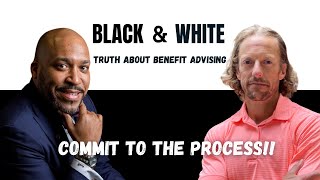
Andy Neary and Kareem Cage use sports and career stories to argue that long-term success in benefits advising comes from having a repeatable process and sticking to it. They identify three core agency processes: marketing, sales, and account management. Most agencies fail because they rely on one person's style instead of building something duplicable.
Chapters
Hey.
Hey.
Welcome back to the Black and White Truth about benefit advising. As always, I'm joined by the one, the only, Kareem. Kareem Cage. Kareem, what is up?
Hey, I got you twisted today already, Andy. I like it. I like.
You got the ca going, the club.
I got everything going on, baby. It's a full. All right.
So now people are like, okay, dude, you got a Super bowl trophy in your picture. What's going on?
Yes, yes, yes, yes. Well, today's topic. I mean, let's just talk about today's topic. Commitment to the process. Commitment to the process. So we've heard that. I know over the years, even the. The 76ers, that was their deal, is that they were going to commit to the process. They were to stick with that process. And what's interesting about it, Andy, is that as much as we see these trophies, this was year, what, 55. I think it was this year. 55th Super bowl or something along those lines that living in a city like Detroit, and I'm not calling my. My Detroit is. I love my Detroit family. But you know, when you live in a city where you've never seen one of these, then you start wondering, well, why is that so elusive? What is it that's different about the teams that have acquired him versus the folks that don't have one? And one of the things that you and I just talked about, Andy, is that everybody starts the season out the same way. They all. Everybody's got their sights set on this. This is the goal. Why play if we're not going to be in for the long haul and what the goal is. And it's interesting because in the beginning of the season, we've got preseason, and I know it's even happened here. And I'll talk about my city again. I love y', all, Detroit, but we'll go five and oh in the preseason. And, man, the year, same year we went 0 and 16, we went 50 in the preseason. So that preseason, we started out fantastic. We were there. But once the regular season started, man, man, everything changed. We ran into some turmoil, ran into some challenges, and I don't know that the commitment stayed with the process. And so today, I just wanted to bring that up and just say, as we're talking about this, man, go Chiefs. First of all, I know everybody's talking about.
Talk a little bit about, where did you get the trophy? People are like, dude, how did you get your hands on a Super Bowl?
Hey, man, you know, in our business, always about, it's not what you know, it's who you know. Right. And so I just happen to know somebody who knows somebody. And I've got my man Travis Kelsey's signature on here. Take Go Chiefs. And so I'm excited about that. I had to have that as a part of my collection, but it really just is a reminder of the process and the commitment to the process. And so as you and I were talking about this discussion, what it means in our business and business, I mean, any type of business, where you're looking for success, I think people miss out on the fact of those two things and commitment and process. So I'm thinking, Andy, why don't we start talking about process? I know, again, I'm always thinking back to you having a Major League baseball career and wondering what that process looks like and how you've been able to take that process and add it to what you're doing here today in helping advisors across the country actually live out their goals and the things that they're talking about.
Great, Great question. Because, you know, what we're going to talk about today is process first, then commit to the process. Right? Have a process, then commit to the process. And to your point, I think a lot of people today don't have even. Don't even have. They don't want a process. Just give me the secret so I can have success tomorrow.
Right?
And I look at my baseball career. I just did a podcast episode on this, on my bullpen sessions where I thought about, you know, I earned the chance to play pro baseball, Kareem, when I was 21 years old.
Wow, that's awesome.
In the grand scheme of things, I'm still very young at that age. Right? But if you really break it down, and I get it, when you get older, you develop more skill because you grow and you get stronger. But I started playing baseball when I was 4.
Correct.
I didn't play pro ball until my 17th year of playing the game of baseball.
That's big. Think about it.
Think about. Think about that analogy, though. When you're four years old, you're playing T ball, right? Your dad's teaching how to throw. You're learning how to catch, swing the bat. You're doing that same thing when you get hired for your first job.
You are, you are.
And once you're taught a process of how to get better at that game or the game of baseball or business, your commitment to that gate process is what's going to determine your success. Because now, when I'm 10 years old, I'm going to Be better. And if I keep committing, when I get into high school, I'm going to be really good. Then maybe I can get all conference in all state. And then if I keep it up, I have a chance to play college baseball. And then if I play college baseball and continue to commit to the process and in year 17, year 17, now 17, I hit the, not quite the penultimate of playing in the big leagues, but minor league professional baseball, but it took 17 years to get there.
And the question I would have for you, Andy, is even in that. And you remember those kids that you came through with that started t ball middle school, high school, and somewhere along the line they may have even had more talent than you, but they did not put in the work to end up in the major league baseball.
You just nailed it on the head. If I, if you said, andy, I want you to go back to little league.
Yes.
And can you think of a kid in little League that was the stud of the little league program but didn't even play high school baseball? Yes.
Yes.
Now go to high school. Can you think about that kid that freshman sophomore year was like, oh, my lord, this kid's good. But by the time his senior year was done, he had kind of flamed out. Absolutely.
Absolutely.
Can you think about the kid that came into UWM in college, where I played at, that was the recruit everybody wanted to know. But by the time he was a senior, he was average.
Average.
And the difference was commitment to the process.
That's good. That's.
Let's. Let's tie this to business now.
K. Yes.
Talk about, because I know you've talked about your career at length about early on was not, it was not successful.
Correct.
But like, talk about where. Now that we use the baseball analogy, right. Yes. Where are we seeing that apply to business, whether it's in the insurance industry, where we come from, or just in business in general?
Well, I think that when you look at having a process, I'm always reminded of, I had a mentor talk to me at one point in time, and what he said to me was, I can teach you the process. What I can't give you is the commitment. And I never forgot that he said, I can teach you the process because our process is standardized, but I cannot teach and, or give you commitment and, or attitude. Those things are things you've got to bring with you because I know that we watched this process unfold with many people, so we know that you can be successful. However, your commitment to the process will be different. And so when I've looked at spaces in business where I first started out, as we've talked about this before, Andy, I mean, yeah, they had given me a process, but somewhere along the line, I felt like I could kind of circumvent the process because I felt like I had this talent, this gift, this gift of gab, whatever you want to refer to it as, and that I was just going to go out there and just get it done. And what I realized was that the process was the shortcut. They were trying to take me through a process such that I could understand how did I get to my desired end. And I just was not willing to follow it in the beginning. And what happened for me was failure. Now, what we're looking at when we're talking about process is we're talking about a process, whatever that process is, for whatever it is that you're doing, because we know that everything has a process. We know that there's going to be a process for growing, for developing, for getting the type of success that you want to have. It's going to take that time. And so what I had to look at is to say, well, wait a minute. These folks have been doing this for some time. I'm looking at their name in the sales bulletin. I'm seeing that they're number one, not only here in my region, but. But heck, they're in the top five in this region here. And then if we look at a national basis, heck, they're number three. And I'm looking at me, I'm nowhere on this board. So I might want to listen to the process, right? And I might want to figure out how I tweak what that process would work for me and my learning style, my behavior traits, my personality, all those types of things. But the process, man, was the deal. And so when I think about us thinking through business and we're thinking about specifically talking about our industry, I find with a lot of young advisors and even some of us that have been around for some long period of time, one or two things, either that we're not engaged in the process, or the craziest thing, in my case for older guy, we know that the process worked because we've done it before, but we stopped doing the damn process. And I don't know why that happens, right? I don't know why we. We stopped doing what actually works. But somewhere along the line we went back to saying, oh, I think I got it now, and I don't need to follow through with the same process. I'm going to take out step Four and step five, you know, And I remember my guy telling me, same mentor always telling me, he said, you know what, Kareem? If you're making a cake and you leave out the sugar, you no longer have a cake. You have a loaf, bro. And that's it. You know what I mean? You have a loaf, bro. And I'm like, wow, taking out one thing in that process and change the entire thing that we're looking for on the back end. And so man, that, that has just been it for me and looking at process. So when I think about it and looking at what you're doing and talking with advisors, where do you find that advisors miss it in the process standpoint? I know they may have the commitment they are jacked up to get in the business, but where do you find that they miss it in the process?
Eric, before I answer that question, have you ever thought about putting a book together of all your one liners?
You know what I should.
Where there is no sug, you only get a loaf.
That is.
So to answer your question, here's what I think and I like to keep things simple. Karim, if I'm an advisor, hell if I own an agency.
Yes.
You have to have three main processes. What's your process to grab attention? Marketing.
Yes.
What's your process to sell? Convert those prospects to the clients. And then what is your process to make sure you're executing on what you promised them? Called account management.
Makes sense to me.
And here's the interesting thing. So for a producer, what can they control? Well, number one, what is my process to prospect to get sales opportunities. And then when I get them, do I have a process to convert them to clients?
Now you could argue that's the agency should be creating that process. Right? And I think that's true. The problem I see though is either at worst, agencies have zero processes. They hire these producers and they just kind of expect them to go create revenue out of thin air.
Correct.
But here's what's interesting, and I've been arguing for this lately. In our industry, we all know what an HRA is, right? It's a health reimbursement arrangement. And what's the benefit of it? You raise your deductible, make a promise, you're going to reimburse some money and if they never use it, you don't lose any money.
Great opportunity.
Agency owners need to start applying a pra. A producer reimbursement arrangement. Here's how it works, Kareem. Quit paying your producers God awful salaries and then give Them zero training. Now when I say God awful, you pay them way too much.
Pay them a little less. And then how about you take the extra money and set aside for a PRA so they can go get the personal development they need.
Wow.
Imagine if they choose not to use it. You don't lose it.
You don't lose it, and you can recycle it. So here's what's interesting when you say that, being that I started out and then started an agency. And I'll tell you, the biggest challenge I had was I had no process to show new agents. And my, my, Here was my process, Andy, here's my process. My process was meet me Monday morning at 8am don't be late, be professionally dressed. We're going to get out in the field and I'm going to show you what I do. This is my process. I'm going to show you what I'm doing. They're like, great, I get a chance to go out with you, Kareem. This is fantastic. I'm like, yeah, I get him in the car and I simply go through my normal day of what I do. And whether that is, I always refer to as shaking hands and kissing babies, kind of moving through and, hey, this is it. But everything that I was doing, Andy, was personality driven. It was my personality. It was what I was able to do for me, but it was not a transferable skill set that involved a process. And so what I found in that time frame was that, yeah, sure, I could go out, but when I look back, and I started looking back over the course of a year, man, there was so much carnage back there from probably good people that could have made it had I provided a process for them. But I'm like, this is the process. Do what I do is the, you know, the thing. Just, just watch me, you know, gonna pick it up. Just watch me. And then, of course, what ended up happening, right, is that you've got that. As we talk about sports analogies, and you sit back and you look at, like, if I look at this kid, John Morant, man, this kid is amazing. This, this, this young man is unbelievable, right? And I think for myself, I might be a teammate that every now and then gets caught up watching the action because it's so amazing. Not that I'm engaged, but I'm just sitting back like, that is amazing. So what ends up happening is that those young producers then start thinking that they could not do it because what they had just done in my world, they had gone out with their job. Morant they had gone out and seen this thing in action and were like, oh, there's no way in hell that I could do this. And nor did I have a process for them to follow. So when you talk about that with agency owners specifically, and it's the old adage again that all great salespeople don't make great sales managers, and that's truly what we normally do, is we take the best salesperson, she or he were the best in the office, and we said, damn it, I know they can teach Andy because, I mean, they've been top of the table the whole time. But if there's no process, and there's not a process that's duplicatable and replicatable, it's more of what we're looking at. Right. There's not something that we can go back to the game film and say, hey, if I was to look at the entire process, you missed step three. And because you missed step three, it was almost those if then statements, though, since you missed this, then we're going to go over here to this other spot. And so you missed what would have taken you through the sales cycle, appropriately, because you took out a couple of things. And so I realized really quick that, damn it, we need to have a process in here. And, and, and here's the last thing. And I want you to chime in here, Andy. And what I also realized was, you know, what's crappy about this is God forbid something happens to me and I'm the head guy producing everything. Everything dies. The whole business dies. Because there is no process to come back and replicate me when it should not be me. We're replicating. It should be the process that.
So I love that you said that because with the agencies I've had the chance to work with over the past two years now, we spend most of our time on the marketing and sales side.
Yeah.
But sometimes account management conversations will come up. And to your point, I will tell you the number one challenge. Number one problem every agency in this country has is they don't have an account management process. So each account exec or account manager does the things their own way, whether it's renewals, you name it. Well, what happens if that producer's out or they decide to leave?
You have no pri. Especially in the fourth quarter.
Especially in the fourth quarter.
You have no process that you can just plug and play the next person. The old phrase in sports, next man.
Up, next man up.
You can't put the next person in to run the process because you have no process.
Because there is no process.
Now here's where it gets even worse. Cream. And then we're going to get into the solutions.
One of the other big challenges I see is you have a process, okay, But a lack of commitment to it.
There you go. Now you spin out this fantastic process of marketing, sales and account management. But then something happens. A client leaves, you didn't get the big sale you were expecting. And then all of a sudden the agency throws the process out with the bath water because they go into this reactive mode of holy, we gotta go write business today. And you know who is most guilty of that? Nine times out of 10? The person who created the process.
The process, I mean, exactly. That's it. That's that. That is it. And once again, I've been there because I look at this and say, what the hell? And what I would do is then take the process that I thought I created, which I had not, and go out and say, jump in the car with me and I'm gonna show you. Everything that I told you is what works, you know, And I'm. I'm gonna prove it to myself. That, damn it, we do have a process here. And really, when I looked at it, we didn't. We had this hodgepodge of things because I'd been to this sales and marketing over here, at this mentor over here. I had this thing. I learned this great process at New York Life when I got started and I went to Colonial Life and I learned another process. So I had a hodgepodge of all of these things that worked for Kareem, but most of the time they worked, Andy, simply because I was able to learn from what I had done wrong with it. So now I'm taking this process and, and I'm giving you just this. I mean, this is just bad, man. This is just. It's like all the dinner from this week and we just threw it in a bowl, right? You know, hey, here's it. Here's what we cook. Monday, Tuesday, Wednesday, Thursday, Friday, we're just going to try to eat it all. And you're looking at this thing said, there's no way we can repeat this. Now when we start talking about the commitment, we start talking about the commitment. Commitment to me is a place where you want to get me fired up, Annie. I'm like, damn it, don't come in here and not be committed. I have a challenge with non committing parties when we're talking about investing time in one another, right? So now I'm saying, hey, you're in my agency. I'm going to show you what's going on. I'm going to invest some time with you. The thing that will burn me up more than anything is your lack there of commitment to the process. Now, you and I talked about this and I think you bring up a great point, Andy, as to maybe how we've gotten here. Because I keep asking my question, you know, how did we get here? Not. Not only is industry as a country that everybody wants it immediately, it's supposed to just happen like, I mean, because nothing has ever happened like that for me, so. And I don't think that I'm the sharpest guy in the room, but hell, I sure ain't the dumbest guy in the room.
More from Andy




If you want producers to succeed faster, help them create a sales message that creates confidence.

Sales isn't a zero-sum game! You can have tough competition and still grab a beer after



Option 1: Meditation, a fast walk, a podcast, and protein. The ultimate morning routine!

How you do one thing is how you do everything. Ill elite producers fuel their body.


Stop living in the gray of maybe! Your job in sales is to get a clear yes or no