Claims Advocacy is Your Greatest Competitive Advantage | with Clayton Matthews
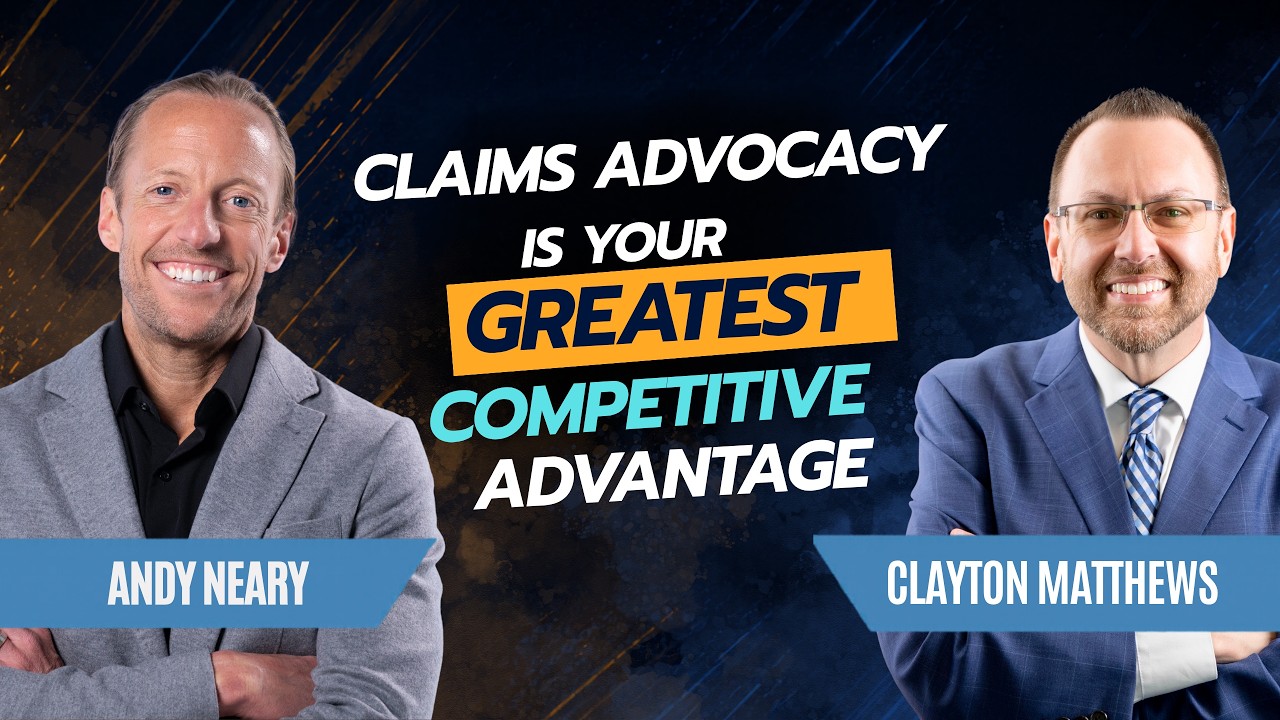
In this episode of the Accelerate Your Insurance Sales podcast, host Andy Neary interviews Clayton Matthews, Director of Strategic Claims Advocacy at OakBridge Insurance. The conversation explores why claims advocacy can be a powerful competitive advantage for insurance agencies. Clayton shares his unconventional career path—from political internships and pizza delivery to radio DJing and catastrophe claims handling—illustrating how diverse experiences shape his approach to advocacy. The duo discusses how communication breakdowns between agents, adjusters, and clients create friction in the claims process, and they argue that effective storytelling, empathy, and transparent expectations are essential to make claimants feel heard. Clayton critiques the traditional agency role as a redundant middle‑man that often adds no value, urging agencies to become proactive translators between clients and carriers, build genuine relationships with adjusters and underwriters, and focus on people skills over purely technical credentials. They also touch on industry challenges such as increasing catastrophe frequency, evolving risk exposures, and the need for better training and support for new producers. Practical habits, personal routines, and recommended podcasts/books are shared, concluding with Clayton’s invitation for listeners to connect via LinkedIn.
Chapters
Hey, hey, welcome back to the Accelerate Your Insurance Sales podcast. Andy Neary here, CEO and founder of Complete Game Consulting. I am excited today. I am joined by Clayton Matthews. Clayton is the director of strategic claims advocacy for Oak Ridge Insurance in Georgia. You are about to listen to one of the most outgoing claims advocates I think I've ever met. Clayton, welcome aboard.
Thank you so much for having me, Andy. Yeah, I got told that I broke the mold.
Well, I think we're going to have a fun conversation about claims because you and I could both agree it is an often overlooked part of what an agency does. And a poor claims experience could have a client looking for other advisors.
Absolutely. It's, it's the nitty-gritty. It's where the promise meets the road. And the biggest part for an agency, it can be It can be a moneymaker or it can be a money loser. It can be a time suck. It can be just so many things, or it can be an advantage. And I think that's where a lot of agencies mess it up is they look at it as, they look at it as being a hindrance when they're really missing out the opportunity to really set themselves apart.
Couldn't agree more. Now, before we dive into it, we're going to get to know you a little bit before your insurance career. Told me offline that you interned in college for the Tennessee General Assembly and the Speaker of the House, and your first job was working out of college, in college, was working for the clerk's office of the Tennessee House of Representatives. So, before this career called insurance hit you, did you have a goal of getting into politics?
Yeah. Politics or political science or into law school, one of the three. Wasn't sure which angle I wanted to go. So, I was trying the government and working in the legislature route first. And that's where it started. I'd always had a love for politics and I always had grown up kind of being a geek about it. So it was, it was a perfect fit for me. I was a political science and history major out of college, so pretty natural fit to me.
How did you end up finding yourself in insurance?
Oh, I guess like accident, like everybody else. Met a girl, fell in love, had to find a real job. Not a real job.
We can blame her.
A job that pays better. How about that? Government work, while very rewarding, also very poor paying, especially when you're just a lowly clerk in the House office. So yeah, I had to get in it because, like a lot of people, it was a promise of income. And it was an opportunity. Honestly, when I came out of college, it was during one of the down periods. Not fully like the recessions of '08 and others, but it was a tough time coming out. Just weren't a lot of places hiring, especially not for people with a political science degree. So that's just not exactly, you know, businesses aren't looking for that. And unless you're really going— and medical's not looking for that. So unless you're really going into law school or something, political science is kind of a niche field. While it does give you a wide base, people don't typically think of that as something that you really take that and make a career out of.
Yeah. I think one of the things about the insurance industry though, that is appealing is we take everybody, all shapes and sizes, right? And no matter where they came from, they can have a successful career. What I find interesting is when you got in, to your point about a lot of us, myself, were probably sold the financial dream, right? But you got in and you actually did a, you weren't just doing insurance to make ends meet. You were also a radio DJ and DJ'd at weddings and other live events like that. Talk to us about that. I promise the audience, you're the most outgoing claims advocate they'll ever meet. What was life like as a radio DJ?
Ah, I feel like I've lived a bit of a charmed life when I started thinking about some of these things because it is a lot like that movie Big Fish in a lot of ways when I think about, think back a lot of the ridiculous things that I've kind of done in my lifetime because I find that I've had a lot of experiences that people haven't. I got into DJing about like everything else, it seems like, by accident. I was delivering pizzas one night. I was working for a pizza firm. Again, not sure what I wanted to do with life, so what do you do? You go deliver pizzas. And I happened to deliver to a local radio station one night. And don't know, hit it off with the DJ, and all of a sudden he got me a job washing vehicles, washing vehicles at the station. And then all of a sudden, one night someone went out sick, and all of a sudden it was like, okay, it's your turn, be here at midnight. And work from midnight to 6:00. But it was a challenge during college because most of the time my shifts were Midnight to 6 AM, or when I was working in some of the clubs, I would go in at, you know, say 9 PM, 10 PM, the club open till 3 AM, and then have class at 8 AM. So it was a tough life. I can't say I didn't enjoy it. There was a lot of great things about it. Everybody loves a DJ, right?
Sure. It also included a lot of late night caffeine.
Whole lot of caffeine, man. Yeah, I can't do it anymore. It gets to be 9 o'clock these days and I'm I'm heading for the bed, man.
All right, so I gotta ask, if you were still DJing today, or maybe take us back to that, you said that was like late '90s, early 2000s.
Yeah, yeah, yeah.
One song you're putting on your list if you're DJing that, you know, that late night radio segment, what song's going on that list?
All right, all right. Yeah, uh, the one too you got to go to now, it's got a little bit of a, a, a, a term that you really can't say out public, but it is Juveniles, back that thing up. That is an automatic, I don't care, young, old, white, Black, Hispanic, you start that dum dum dum dum and just instantly fills the crowd, man. I mean, that is, that's one of the songs that you know you can kick it off right there and it doesn't matter what else you did, you did that right.
Yeah, it's almost kind of like speakers, you know, have athletes have walkout songs, right, in baseball. When you come up to play, you have your walkout song, that was your go-to kickoff to get the room going.
Oh yeah, especially when you're coming out of something, maybe you had to clear the dance floor for some sort of a little event, maybe you're having, you know, the bride or somebody wants to say something, and then maybe you get them out, and that's a sure way to keep them on the floor, because that's the real challenge for a DJ is getting the crowd, keeping the crowd, but not wearing out the crowd to the point that they all sit down. It's a real challenge. And then if you're working on the retail side, you would think that a DJ's job is to keep people dancing. No! A DJ's job is to sell beer. So I got told that early on. He said, my first manager at the dance club said, what are you doing? I was like, man, the dance floor is crowded. He said, you haven't said one promo about one drink we've sold yet. He said, sell some beer, man. So I learned it is great and everybody wants to have a good time, but man, you gotta, you gotta have some money, you gotta have some cash flow. And I was there to generate cash flow.
Well, you gave me a little nugget. Not that I'm one to be found late at night where there are DJs, but I'll know next time I see one, I know what their ulterior motive is, to sell beer.
Yeah, they're always— a lot of DJs are really good at psychology, man, because you've got to be able to read a crowd quickly, instantly. And sometimes, and be very put in very unexpected situations because a lot of times, like anything else, a lot of events don't go as planned.
Well, that is a really good segue, my friend, because we're here to talk about claims.
Oh yeah.
And I think we'll dive into, I'm sure I'll ask you, there was, I guarantee there was a tie, you know, when you were communicating as a DJ, either on the radio or at an event, there's probably some lessons you gleaned in that communication that you have to actually use today when you are trying to help a client resolve a claims issue. But let's start here. You know, claims typically equals friction. It's just something has happened. A loss has happened. A client is probably— it's unexpected, most likely. You said offline when we first met that most claims friction comes down to communication. What do you mean by that?
When I say communication, it's because people can't speak the same language anymore. And I don't know if it's gotten worse, but it definitely seems as we've become much more fragmented in the way we communicate with each other via text, via online messenger, via email, via all these things, it is becoming very difficult to find the, I guess, find the right path to find communication with the adjuster, with the insurance carrier. In fact, I was talking with someone just a little while ago, who was saying, "Hey, I think this particular company says they think that they can solve the solution for the problems of carrier communication." And I said, "Well, if they can do that, I want in on the patent because we're about to make a billion dollars." Because that is the billion-dollar question, is how do we keep communication with the client but not have so many people adjusting claims that we got people sitting around twiddling their thumbs. And that's always the challenge you have with claims is you never staff for what you have. You're always in arrears, you know. You never want any people just sitting around. And so you constantly have that friction. You have adjusters that unfortunately, because of the business, we become a bit jaded to, "Yeah, I know this is your first car accident, but it's probably the 7th one that this adjuster has talked to today." And yes, they love to hear the story and want to hear about that deer that came out of nowhere. They're looking to just move the claim down the road, sadly. And a lot of times I think that generates some friction there. People want to be able to tell their story. I find so much, so much of my job now, especially, is I don't come up with solutions a lot of times, but what I do do is I allow people to tell their story and I make sure that their story gets heard. Because genuinely that's what it comes down to is people feel like they haven't been heard. And if they can feel like they're heard, even if you disagree with it, even if they get the answer they don't like, at least they feel like that they were respected. And I think that's what it comes down to a lot of cases. People just don't feel like they're heard, they're not respected, and that the other part about it is, listen, it's their money, it's their stuff, and it gets real personal real quick.
Yeah, I could see there being those several areas of disconnect to your point. Although it might be that first big loss for that client, that adjuster has seen that kind of loss every single week, or if not every single, you know, every single month. So there could be a lack of empathy issue, right? Because the adjuster is just so used to seeing those types of claims. But I, you know, I think a very underappreciated skill in our industry is the power of telling stories, whether that be trying to win a new piece of business, trying to sell a client to an underwriter, or in your case, trying to sell the story of the claim to the adjuster to make sure you create the most positive outcome you can.
100%. I believe we must be good storytellers. I felt, I feel like, well, even when I worked on the carrier side, every claim is its own story, right? I mean, you can have the same situation, you can have the same scenario, but there's going to be something unique about every claim, and it's going to be its own story, and it's going to have its own cast of characters, you know? It's gonna have its main moment of conflict within it. It's gonna have its resolution. Hopefully it's gonna have a happy ending. Sometimes it doesn't. But yeah, it's a great, you know, yeah, claims is just, you know, that's the thing I like about claims is every time I open up, it's new. It's new. I think what the problem though is, is so many adjusters don't have the time really to reflect on each individual book. Okay. They're having to hit the Cliff Notes of a lot of literature. And I think a lot of times, if adjusters just had a little more time or took a little more time, just another minute or two with people to allow people to tell that story, I think we would resolve a lot of the communication problems that we have. I really do.
Well, and for the folks listening in, for clarity's sake, we're talking about commercial claims, right? Hence why we're using the term adjuster. You know, but I do equate that a lot to what you see on the benefit side, Clayton, with claims. Because, you know, a lot of the big carriers out there have case managers and things like that, that whose job is to help with claims that have occurred in the healthcare system. But because they are so serving so many clients, it's hard for them to understand that one specific claim. To your point, just like an adjuster on the commercial side, they're just trying to get that claim through. And unfortunately, that doesn't mean— it doesn't always mean it creates the kind of outcome it should.
Right, right. Yeah. It— yeah, because every insurance company has got a lot of processes in place.
Yeah.
They have to. It's a job that— very regulated, fiduciary responsibilities. You can't just have anybody and everybody is doing whatever they want. I get that. There's a process that has to be followed. And the carrier, you know, if you follow the process, then, then the outcome will be what it's supposed to be.
How do you balance, given your role at Oakbridge? Because if I had to guess, you're in between working with the adjuster, but at the same time you're supporting the producer, the advisor who owns that, you know, who owns that client. Because on the advisor side, you also have, I guess, maybe the disconnect where they just, they want a certain outcome no matter what you have to do.
Absolutely.
How do you help an advisor from your position understand the process of a claim so that they're not just sitting there harping at you saying, this is the outcome we need to create. They're actually understanding the process.
Yeah. Yeah. I tell people jokingly that I feel like I am the most, the highest paid translator in the country because I help people speak adjuster and I help adjusters speak agent and people. Because it is different languages. A lot of what we do in my job now, yeah, is setting expectations for people. Because, you know what, we're in a business where unfortunately not everything is covered. Not everything's covered. I have also used the saying of sometimes, you know, our job is giving bad news. And having someone thank us at the end of the day for giving that bad news. You've got to have that level of empathy while also balancing the responsibility of a contractual language. And when you're trying to balance contractual language against somebody's feelings, woo, howdy! That's where the— there's where it is. There's your friction. You know, and the challenge always is, is because especially for these producers, man, and I think if I could help adjusters understand anything about agencies. I wish more adjusters understood the work it took into maintaining a book of business. And the amount of work it takes to replace a piece of business. So listen, I was an adjuster for a long time, got a lot of phone calls from agents. This is my best client. This is my FedVit and all this. And again, you become a bit jaded to it because you're like, okay, yeah, they're all your great clients. Yeah, I get it. They all are. But again, I wish adjusters would take that into consideration a little more of just understanding, yeah, we all agree this is not covered, but we've gotta find a way to manage this so that I don't lose my reputation with my client or lose my client altogether. Uh, because that's real money in a producer's pocket.
Yeah. I think what you just said, I hope everybody heard. It's the— you're the translator between the feelings and the facts.
Yeah.
Right. Unfortunately, sometimes there are facts of the loss. This is what we have to do per the contract. But at the same time, you're trying to alleviate the feelings that go into it, whether that be the producer's feelings, the client feelings. You said, you know, you were an adjuster, so you're an adjuster turned Director of Strategic Claims Advocacy at Oakbridge. How has your past really impacted the role you play today? What advantage does it give you?
Yeah, Andy, I think I've always had a technical knack for insurance claims and contracts. I've always been kind of nerdy in that way. I think that I was probably ready early on from the technical side of claims to lead organizations and things like that. But I'm very thankful for the opportunities I've had, especially probably here in the last 15, 20 years. To be in the field with some of these instances. Of course, I'm here in Georgia now, and I was leading a claims organization for a company that is primarily based in Georgia during the period where we had about 4 or 5 hurricane years in a row. Handled the largest catastrophe events for companies had ever seen. Let me tell you something. People, you know, if you ever want to lose hope and humanity, come on out with me on a catastrophe duty sometime. I mean, because you will see people at their absolute worst, in the worst absolute position, okay? I've walked up on houses, trees laying all over houses, everything inside of soaking wet. They don't have power, hadn't had power, and I'm walking in, I'm pulling up, and they're asking me if I need a drink. They're asking me would I like to stay and have something to eat. I feel it's my honor.
Yeah, it is.
Our CEO of our company, he says, you know, it really is. It is an honor and a privilege that when bad things happen, our clients choose to call us first. And I've taken that to heart. So yeah, that's why I've always, you know, whether it be weekends, weeknights, weekdays, holidays, it If I can try to help make somebody's day better in some way, that's what I want to do. And I think that's made me very effective at this job because, yeah, I've seen those moments. And I see what happens with people. And I see what happens when claims go good. I see what happens when claims go bad. Yeah, I've got a pretty unique vantage point. And I think that— I think COVID actually probably accelerated having people like me in positions like this, honestly. Everybody's time and responsibilities become so tight that you need someone to be able to kind of be there in the middle for your people, you know, because you don't want them to just get lost in the shuffle. You don't want to just get stuck in AI, you know. How about somebody— you need somebody that can hold your hand and say, man, I get you. In fact, you know what, I know a tree company. Let me get you a phone number.
I know you're in Georgia, which is in obviously proximity of North Carolina. Were you guys involved any way, shape, or form with—
was it—
I'm going to get the hurricane— was it Helene that hit Asheville?
Yeah. Yeah.
Were you involved with that at all? I mean, I had friends who went to support and help that, and they said the devastation was beyond anything you could ever comprehend.
Tough. Yeah. We had a number of clients affected. Those are tough instances. Of course, I worked— I'm old enough to remember Katrina. And actually, I was in Mississippi when Katrina hit. I was working in Mississippi. So when all that started happening of, is it wind or is it rain? Or is it floodwater? You know, and what coverage applies and what doesn't? You know, I, you know, who would have thought that we'd have floods in the mountains like that? You know, I think that's the challenge that we have as an industry is, is we're having more and more of these who would have thought instances. And the previous way of underwriting, or even the policies we currently have, are not keeping up with where we are. If you really want to get wild and wacky out of there, you know, I'm almost thinking we're getting to the point that you're almost having to do ex-fire, ex-wildfire, and have a standalone fire policy, wildfire policy, because some of these things are just becoming uninsurable. These catastrophes are becoming uninsurable. The money has to come from somewhere. And our traditional system isn't working. It's broken. And I think a lot of people know it. And I know there's some very smart people in this industry that can fix it. But we've got to do something because we got to catch up because we're not meeting the expectations of clients. We're not.
Yeah, especially with these well-publicized catastrophes. Insurance often gets thrown in that bucket as, you know, the side of the coin that is screwing people over and not paying what they should be. And I think what you said about 5 minutes ago, I hope everybody heard. We have to remember whether, you know, it's so easy to look at a claim, Clayton, and just look at it as a number on a piece of paper, right? A dollar amount. And I see a lot of my peers on the benefit side, you know, the whole cost containment movement of look how much I saved you. But what we have to remember is behind that number is a human. Behind that number is a family. You know, that, that claim, that accident where that family may have lost their father who was a worker for the employer you have, you know, your account, whatever that might be. It's so easy to get caught up in claims as just a bunch of numbers, but at the end of the day, it's a bunch of humans. This episode is brought to you by True Captive Insurance. What if you could take full control of your healthcare strategy without the financial burdens of traditional insurance. At True Captive Insurance, they make that possible. As the only captive in the nation that puts up the majority of collateral on your behalf, they provide financial flexibility from day one, making them an advocating partner for their customer success. True Captive's fully customizable plans and cost-saving strategies ensure you never have to choose between affordability and quality care. It's time to break free from the limitations of conventional insurance. Take the next step today. Visit TrueCaptive.com and discover a smarter way to manage healthcare. That is TrueCaptive.com.
It is. And, you know, I guess for my part, personal experiences going into that, you know, because, you know, personally, I was hit by a drunk driver when I was 19 years old. I was, to be very transparent, I was young and dumb, didn't have insurance. So I think part of the great circle of how things are, I think it's kind of ironic. And actually, some of my friends from high school have even said that, "Imagine that, Clayton's now helping people with risk, and he was always the guy riding around with no insurance." I mean, yeah, it was dumb. And so I've been there. I've seen what happens when things don't go well. And so I really look at it, man, I'm going to help you through this no matter what it is. Good, baddie, and indifferent. We're going to get through this.
Yeah.
And I think that's probably the best thing we can do. Treat people with respect and dignity.
Well, I'm going to ask you to put your thought leadership cap on here. And if you're willing to share, you know, let's talk about just what good claims advocacy looks like. Where do you think a lot of agencies are missing the boat when it comes to claims advocacy right now?
I think most— Agencies are missing the boat in that you are only acting as a middleman and adding no value. Okay? I think a lot of agents— listen, and I started out on the producer side, agency side, years and years and years ago. And I remember how we reported claims even then. You know, you call your local agent. You know, your local agent, we may fax it in. Email it in. I'm dating myself now. We even had to learn that inside of OakBridge. We had to come to the realization of some of these legacy things. What value are you adding? So, agency, you're reporting claims for your clients. Because why? Because you always have, right? 30 years ago, you had to, because a lot of people didn't have email. They didn't have a fax. They didn't have this. But now, when you have most carriers have cell phone apps. Listen, agent, you're in the way. You're doing nothing by reporting that claim for the client, because if anything, the adjuster is just going to have to repeat all that information again. Give you a real-life example of what we don't understand for customers, alright? And this is real life of what customers face every day. Customer has a real simple incident, backs into a pole, alright? Real simple, you know? So they call up their agent, maybe they get the front desk. Hey, front desk, I've hit a pole. Okay, what's your name? Okay, who's your account manager? Okay, let me transfer you. Account manager, hey, what happened? Back to pole. Okay, hey, let me get you over here to our claims department. They'll help you get that reported. Claims department, can I help you? Yeah, man, I need to report a claim. I backed into this pole. Okay, hold on, let me get the carrier on the phone for us. Okay, now I got the carrier on the phone. The carrier's saying, okay, can you tell me what happened? For the fifth time, I backed into the pole. And then they'll add insult to injury because without a fail, that poor little rep is going to say something like, "Did you call the fire department? Was there any ambulance? Do you have a police report?" You know, and by this time the client is just seething. You know, you can hear it in their voice boiling. And it really made me stop and think of, what are we doing? I'm in the way. If the client was just able to get to the carrier right away, most often these carriers have instances where they can just take over the repair or get them into a shop right away. I'm slowing things down. I think that's probably the next frontier for agencies is realizing, don't be— you've got to add value somewhere. And if you're only showing up at renewal, And you're only showing up just to take them out to dinner and say, hey, everything's great. Hey, oh yeah, we brought your claims down. Aren't you happy?
Yeah.
I mean, my group is.
We arrived at, you know, there's a lot of people in the industry that love to poo-poo service nowadays as table stakes. And I would admit at one point I was probably that person too. And, but at the end of the day, I can tell you sitting from the seat I sit in now with as many agencies as we work with. Hands down, the thing that's going to keep a client or lose it fastest is good service or lack of. And you can sell me any cool idea you want, but if you don't have the service, a.k.a., I don't have the experience I expect, I'm gone.
100%.
And we could argue a claim, that experience during a claim is probably one of the most important experience, good positive experiences an agency, a client has to have. So let me ask you this. I think I might be asking an obvious question. How important is it that the client understand the claim process? Not, hey, I just turn it in and they take care of it. And if, if you agree that is important, how do you help a client understand the claims process?
Sure. Great question. I always taught reps, even on the carrier side, that there's two, two ways of going away, going about things. You can either. You can either explain it on the front end, or you can make excuses on the back end. Either way, you're going to have to have the conversation. So which one do you want? I think, again, when I go back to the beginning of the conversation, we all, you know, as much as we're in the production business of closing claims. I mean, that's replace widget, call it a claim. I mean, but that's what every insurance company does is tracks the number of claims open, number closed, how fast, how much. All that's tracked. And the people that are on the production line, a lot of them forget that, oh yeah, well, my job is just to put this wheel on this lawnmower, and it goes on down, and doesn't realize everything that went into making that riding mower. And so sometimes you'll have that one little guy there on the wheel, he'll cross-thread it on there and he'll say, pfft, somebody else will get that. That's somebody else's job. So I think agencies, we've got to do a better job, and adjusters as a whole, we've got to do a better job of walking people through things. I mean, the average person has a claim once every 8 years. I'm trying to think back 8 years ago. That's pre-COVID. Man, lots changed since then. Even if I did have a claim then, So, you start thinking about your clients now. Even work comp has changed. You know, everything is just changing even quicker as time goes on. And I don't know if it's because I'm getting older or if technology really is getting this fast, but we better get it, we better get in front of it.
Yeah. Good way to put it. Going back to communication, right? Communicate early, communicate often. Why do clients leave? You know, I've seen it happen. Everything could be good with an agency and a client has one bad claim experience and all of a sudden RFP goes out or they're looking for another broker. Why does that happen? I think a lot of producers who are on the, you know, who have those clients, who are making the commissions on those clients, that baffles them. Like, wait a second, you're leaving? Why is that one bad claim experience so impactful on that client?
Hmm. Because I think at the end of the day, you know, insurance is sold on a handshake and a promise. A lot of times these producers go into these people's offices and they sit across from somebody and they say, man, something bad happens, you're going to be taken care of. And then something happens, and they're not taken care of because it's possibly not covered, you know. I think a lot of times, customers leave, not necessarily because of a bad claim, but possibly because their producer or agent has not fully explored the, the account to see the coverage gap. Or doesn't understand the industry well enough to be able to set proper expectations for how things should move forward. So, because listen, at the end of the day, again, carriers are gonna deny claims. They're gonna deny claims. You and I are not gonna change that.
I'm gonna try.
For my client, I'm gonna try. But at the end of the day, they hold the paper and they can make the decisions. So, you know, I've gotta try to do what I can for my clients. And make sure that they know. And again, it goes back to, I say this jokingly as well, and I'm not going to put any names on this, but I'll say, listen, I want them to be mad as heck at X insurance company and love me to death. I can remarket them. I can put them with another carrier. I don't need them going to another agency. So, you know what? "Sorry, insurance company, don't mean to do it." Behind the scenes, I'm probably throwing you under the bus too. I mean, a part of this is a little, you know, it's theater. A lot of this is theater because people want to feel like somebody went to bat for them. And again, that again goes why a lot of people leave. It's because, and often I get bring in on phone calls now for clients because they haven't had that. They haven't had somebody that was willing to go fight for them. They had that one claim where all of a sudden, you know, the police report and everything said they're not at fault, and all of a sudden they're getting notice that $1 million is going out, and they're like, "What?" There's just so many opportunities for us to just be honest and open with people and set the expectations. People can handle bad news. They can. You gotta know how to deliver it. It's gotta be delivered timely. And you've got to be able to still, again, I say it, you got to respect people.
Two things I'm hearing loud and clear from you. What makes you successful as an agency in a claim situation is your ability to have a hard conversation and your ability to be completely transparent about what's happening and what's going on at all times.
Yeah, I would say, you know, Unfortunately, a lot of times by the time my team finds out about it or we get involved, a lot of times the decision's already been made. You know, think about it. Again, this is the— I think is the beauty of my job. I actually jokingly told some friends of this. They asked me, what do you love the most about being on the broker side now, away from the carrier side? I said, well, the best part about it is I no longer report to a C-suite. I no longer have to tell them about reserves. I no longer have to be responsible for the payment. All that's off my plate. I don't have to make the coverage decision. And they always say, well, what do you hate the most? I can't make the coverage decision. I can't cut the check. I can't tell them what it's worth. And that is the— that's the yin and yang, I guess, of where I sit.
I'll tell you, though, you know, sitting on the production side for 20-plus years, I think one thing that holds a lot of producers back, I being one of them early in my career, is that fear of having a hard conversation. You know, whether it's a big renewal increase that you're holding off on because you're afraid to deliver it, which now puts the client in a bad situation, which ultimately has them talking to other brokers or a claim which may not create the outcome the client necessarily wants. But your responsibility is to be able to have that hard conversation. Yeah.
Yeah. And honestly, listen, I'll be a little critical of my own business here. I think that that is something we fall short on because We too often look for people that are technically sound, but have no people skills.
Say that again, please.
I have people that are very technically sound, but they could not tell somebody the sky is blue without generating a complaint call. Yep. I've had people in my career, listen, I worked for a carrier that we hired a lot of people straight out of college, right? Man and woman. And I would send people into body shops that did not have a clue what a hood was, right? They didn't have to. We had people behind the scenes that could, you know. But, you know, when I look and I think about all the opportunity that those people have to be able to learn this business, I get frustrated by people that wash out of the business. And I'll say one, I guess, and I didn't mean to get off topic, but I got one thing again to say about the industry. This is something I don't understand about the adjusting world, or even the carrier world, okay? Listen, I can go online, get a course, 40-hour course, go take a test, and I'm a public adjuster, or even an insurance agent. Why do I have to have a 4-year degree to work for an insurance company? Why do you have to have a 4-year degree to be an adjuster? But that often is one of the— that's the first washout question. You gotta agree, yes or no? And if you don't, so many people can't even make it past that threshold there. We're doing a whole disservice because listen, yes, this is a business that requires a lot of skills. There's a lot of skills and a lot of these things that are very white-collar skills. But you know what? There's a lot of people out there that know how to communicate to people. I can teach them the skills. I can't teach people how to be nice to others. I can't teach somebody how to be a good salesperson, how to be able to read someone. I can teach them what a hood looks like, but I can't teach them to tell somebody and look them in the eye and say, I'm sorry this happened to you.
It's a great way to say that, Clayton. Yeah, I agree. I mean, I think we get so impressed with somebody's resume, especially collegiate resume. And even when people hire producers from other agencies, they get impressed with the resume of where they were, but it says nothing about their ability to communicate or have the skills they need with people to be successful.
Yeah, we have—
I don't need a college degree. I don't need a college degree to be kind and know how to interact with people.
100%. And you know what? Listen, I was at a store going through a drive-through last night, and I will say this gentleman was getting it. There was a man behind the counter at this little fast food place, and one of the other workers actually commented and said, "Man, you are really getting after it." And he just beamed and said, It's my fourth day. And the guy was just, you know, getting after it. And I wish we had that kind of people with that kind of enthusiasm that would bring that kind of enthusiasm daily to what we do. Why can't we? Can't it be our first day every day?
Yep. That's one of the reasons why Complete Game Consulting exists, to be honest with you, is I saw— I was frustrated with the number of producers that wash out, using your terminology, because they don't get any help, they don't get any training.
Yeah, it's a tough business because we are in such a world now where everybody wants instant gratification. It's so tough because, as you know, insurance is a long game. Insurance sales is a long game. Yeah, you sell it once, hopefully, and you keep it, but it's not a get rich quick scheme by any stretch of the imagination. And while we've made a lot of inroads to help new producers with programs to try to help them while they learn. It's still— I think we still got opportunities there to try to find ways that we can try to subsidize people for a period of time so they can start making a real living. We're doing— we're barely one step above car dealers right now.
Yep. Well, I'm gonna ask one more question. And we're gonna dive into getting to know you a little bit if you're okay with it. I did not prepare you for the rapid-fire questions, but you'll be able to answer them. Last question. If there's an agency listening in who just doesn't have the luxury of having a guy like you on their team, what would be your recommendation about for how an agency can go about being more proactive when it comes to claims advocacy, specifically commercial claims where there's adjusters involved and things like that?
Well, I think one of the things that never hurts is, is if you can try— now, we'll say some, some carriers, it's very difficult. With some of the, maybe the larger ones. But if you can try to develop a relationship with anyone within that claims organization, I don't care if it is just the med pay rep, I don't care if it's just the work comp rep. Find someone that you can have a conversation with. The agents, the producers that I see have the most success, they get the most things overturned, are the ones that don't come from the angle of, "What can you do for me?" Most of them have already built a relationship over years of just checking in from time to time, even when a claim's going well. Just saying, "Hey, I just was checking to make sure everything was good on that one." You start building that relationship because insurance is a relationship business. It's always tougher to tell somebody no when you know them. And so, I think if any agent wants to do anything to advocate for their client, get to know people in claims.
That's great.
And they're not scary, although, you know, I will say a lot of adjusters always get a little nervous whenever agents get to calling because they always start wondering, "Uh-oh, what did I do?" But I think if we can just have a dialogue back and forth that we are on the same page. And I always try to go to people, "Hey, this is our client. It's not your client. It's not my client. It's our client." So what are we going to do to help our client?
Yeah, I think it's important that you build a relationship with an underwriter and an adjuster just like you do with your clients. Those aren't just people that you yell at to get the result you want. You have to build a relationship with them as well. That's really, really well said. All right, we're going to wrap this puppy up by getting to know you a little bit. You cool with that?
I'm ready.
So I'm a big, big believer in habits, rituals, and discipline, Clayton. So I'm going to go to town on you asking a few questions on, your habits and rituals. All right. I'm a big morning routine guy, so I love my morning routine that I use to put myself in the best position to win the day. What does your morning routine look like?
Yeah, I'll be the first taken out by the hitman because my routine is pretty set. I'm usually at the office early. I'm usually the first one here in the mornings, but before I ever get there, I start off the day, I check my email right away. That's usually the first thing I do when I get up.
Wow, you're one of the first.
I do. I do. Well, I think it's because claims. I don't know what's happened in the middle of the night.
Got it.
You know, so you got to, you got to check in, just make sure there wasn't a tornado that came through in North Alabama somewhere. But from there, you know, I'm like a lot of people, I've got my little stop that I make at my little gas station. I get my little energy drinks, I get my little pastry or whatever. But then usually when I come in, and I'm usually early, that is my opportunity really to set the table and see what do I got really going on that I need to focus on just me, just me. Because a lot of producers and everything, they start rolling really, you know, 9 o'clock-ish, something like that. They really start getting into their meetings and things. And I know that's when my day is really going to start cranking up is when they start hearing from the businesses that have started opening up. So honestly, like a lot of people in the business, I find that I have to do it in the off hours. But I've always said that, listen, I chose this career. I chose this profession. I knew that it's a 24/7 business and I love it. So why wouldn't I do it?
I'm a big believer in moving in the body, exercise, getting out there and getting your body moving, burning some calories. If you had 60 minutes to move the body, what are you doing?
I would love to say that I am on the treadmill. Love to say I'm on the treadmill. Lately, not a lot. How about that?
Hey, I'm all about transparency too, so I appreciate that. Last question: any podcast you're listening to right now or books you're listening or reading to that you highly recommend?
Oh man, I'm always a nerd on how things work or behind-the-scenes things. I'm like a lot of people, I like a lot of the crime, a lot of the crime podcasts. I will say there are a couple that are fantastic. I think one of them is In the Red Clay, fantastic story about the mafia down here in the South. Fantastic story. Beyond that, I will occasionally dabble into a little bit of fiction. Um, if I do, I will take after my mother and I may pick up something by Stephen King.
Ah, so you like the crime, the horror. Interesting. I would have not, I would not have pegged you for that.
No, now that you think about it, that's very macabre. Yes.
No, it's not because of your personality. I would not have pegged you as a, you know, and I would not have, I guess I didn't, I would have never put mafia in the South. Together, because you hear mafia, you think of New York, Chicago, right? Like you, I would've never put the South and the mafia together.
Uh, there was a lot of things running. There was a lot of moonshine. How about that?
Good point. Well said. It's all you had to say.
Yep.
Well, it's been an honor to have you, Clayton. If, if somebody, maybe another claim adjuster or, or another, uh, claim advocate is listening into this and wanted to reach out, what are, what is the best way to get in touch with you?
Oh, you can find me online. Uh, just Google my name. You can find me on LinkedIn. It's Clayton Matthews. You can find me by phone numbers on there as well, my email, all of those things are available. Please, I'm getting to the stage in my career I really feel like I'm becoming a bit of an ambassador, and if there is anyone in this business that I can try to bring you up and help you have a good day, listen man, that's what I am about these days. There's enough ugliness in this world, I'm not going to add to it. So if you need a little pick-me-up, man, give me a call. I'm that guy.
It'll take folks 3 minutes to listen to this to know that that's who you are, man. It's been an honor. Clayton Matthews, everybody. Be good.
Thank you.
More from Andy




If you want producers to succeed faster, help them create a sales message that creates confidence.

Sales isn't a zero-sum game! You can have tough competition and still grab a beer after



Option 1: Meditation, a fast walk, a podcast, and protein. The ultimate morning routine!

How you do one thing is how you do everything. Ill elite producers fuel their body.


Stop living in the gray of maybe! Your job in sales is to get a clear yes or no