How To Write Effective Sales Email 5.19.2022
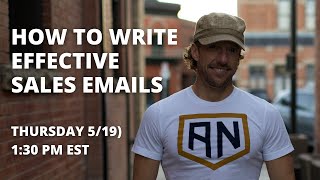
Andy Neary teaches how to write sales emails that work: keep paragraphs short, use white space, and pin multi-email sequences to a specific asset like a webinar or white paper. A six-email campaign should move from delivering the asset to problem and solution, then objection handling, testimonials, and a final call to schedule.
Questions this video answers
May 19, 2022
30 minutes
5–6 emails
Average around 8–10%; very good emails can get 25–30% (open rates)
June 21 (year implied by context)
Chapters
Hope everybody is doing well today. We got 30 minutes and what I am going to go through today, by the way, I got a lot of people are like, dude, you need to bring your webinars back. So I am bringing them back. That's why I'm doing these because they were very well received at the end of last year. We just got busy, now we need to bring them back. So what we're going to talk about today is how to write emails, sales emails that people want to read. And this is a very important topic because.
I gave a talk yesterday down in Georgia, Georgia association of Health Underwriters, and I was talking about marketing and the number one mindset shift that I was telling the audience they had to make when it comes to market marketing is your own personal bias is the enemy. And what I mean by that is I will get advisors, agency principals who will tell me a lot like, number one, I hate social media. That's, that's a very big one. I hate emails because we get so many emails every day, which these are all, all these thoughts can be true. Here's the problem. When you bring your personal bias to marketing, it can cause a very negative effect on your selling. Because what I want you to remember is even though you might not like social media, you might not like emails, you might hate webinars by now because we've done them so much for two years over the pandemic. What's up? Mary's here. Can somebody turn their sound off, please?
No matter what you think about, you're biased around marketing. Your prospects don't care.
If you, if your prospects are on LinkedIn, you need to be there too. If your prospects open emails, you need to be sending them emails. If they're going to attend webinars, even though you might not like them, you gotta do webinars. So the first thing we gotta do is eliminate.
Our personal bias from marketing. Today we're going to talk specifically emails, but our personal bias we can't bring to marketing. The second shift I want us to make before I dive into the emails today is.
Consistency is key.
Your ability to show up week after week after week after week with a marketing message, even though early on no one may be listening. Your ability to keep showing up is ultra important because it's so easy. I've talked about this in the past. The insurance industry at large have been in it for 21 years. The insurance industry at large has a very short term framework. So we try something once or twice and if it doesn't work, we stop it's that ability to show up week after week, even early on when nobody comes. In fact, this, this webinar guys I'm running right now is a great example. When I first started my webinars with Complete Game Consulting, you know how many people showed up? Like three or four.
But we kept coming back. We kept coming back. Today we've got 75 signed up. Why? Because we're coming back. We keep coming back. So that's the second thing. Consistency is key and it's going to apply to emails. The third mindset shift I want you to make before I go into the emails is you can't be all things to all people. So today we're going to talk about emails. If you try to craft a message that is all things to all people, it's going to be a very bland message. It's going to talk about too many things. It's going to be too wide, too broad. And when it's broad and bland, nobody is paying attention.
The more hyper targeted you can be, the better it is. I see. I think Scott Addis signed up for this webinar. Scott, I know you're going to agree with me on this. You're a big, big fan of oh my God. I'm thinking Seth Godin. Seth Godin wrote a book called this is Marketing. In the book he says smallest viable market, you want to get lasered in on the right people. And what I'm going to talk about today with sales emails is I want everybody, if you have a pen and paper, I want you to write this down right now. When it comes to writing a sales email or a whole sequence of sales emails.
Always stick to one goal.
And one problem.
So what I'm going to go through today is actually not only how to write effective sales emails, but actually how to write a sequence of effective sales emails. But the most important thing you've got to remember is throughout that sequence, whether it's 5, 6, 10 emails, one goal, one problem.
If we try to introduce too many goals or too many problems into an email, we start confusing the prospect.
And when we confuse the prospect, we lose the prospect.
And when you choose to write a sales email.
Here'S the one thing you don't know. Especially if you're sending this email to a list of prospects, right? Whether that list is 100 people, 500, 1000, you don't know what their goals or problems are right now. Right. You're actually kind of making an assumptive guess on the goal and the problem.
But what you're going to do is if it's a goal or a problem your agency is extremely good at solving.
Guess what?
The right prospects who have that goal, have that problem are going to raise their hand from your emails, which means you're going to be talking to the right prospects more often, which makes your selling easier.
And so what I want to talk about today is how do we use emails.
To drive the right prospects to our business, Specifically sales emails.
So the first thing I want to talk about before I get into how we do it, let's talk about some email don'ts.
What you want to avoid with sales emails are huge, drawn out paragraphs. I don't know if any of you have ever gotten emails from people where you open it and right away you see a paragraph that's about this thick. What's your first reaction?
I'm not reading this thing. It already looks like it's going to take a lot of my brain power. So we instantly close that email and move on, right? So first and foremost, when you write sales emails, heck, emails in general, I'm a huge proponent of the shorter the better. And what I mean by short is the overall length of the email might be a little longer, depending on what it is you're talking about. But I want you to challenge yourself to write in short, sweet paragraphs, no more than two sentences.
In fact, I would encourage you to do the same thing. If you're using LinkedIn or you're creating social media content, write your social media the same way. Short, sweet paragraph. Sometimes it's just one sentence because when people open that and they see a lot of white space, easier to read. And when it's easier to read, the odds that they open it go up.
So no matter the subject, the topic of the email make your paragraphs short and sweet white space is your friend. Second thing with all emails, we're going to talk about a sequence here. Leverage the postscript, the ps. So you write an email, get to the bottom, put your email signature in. Don't be afraid to add the PS underneath that for whatever reason, behavioral science says people read the ps. So if you put a call to action in your email, state it again in the ps.
Now let's talk about. Okay, cool, Andy, that's all great and dandy, but what should I say in the emails? What I'm going to go through right now is two options, two different paths you can go down writing a sales email. Number one. First option is you just want to write one email that gets somebody's attention. Just one. The Second path is, hey, what can we do to create a whole sequence of emails that a prospect's going to get that tells a story over the course of those five or six emails? So if we start with the one solo sales email.
What you want to make sure you do in that email is cover a couple things. Number one.
Talk about a problem you help your prospects and your clients solve.
So think about right now. When I, when I look at our industry, if you're, especially if you're on this call and you're in the benefits space, 10 out of 10 of our prospects right now are struggling with the problem of finding good people.
That's a topic I would spend some time on.
So you start with the problem. Now, here's the key. The problem is twofold. If you, and if you work with me right now, I've got several clients on here, you know, we've talked about this. We've got the external problem, which is the obvious problem. So in the benefit space, it might be rising health insurance cost. It might be we can't find good people. It might be uncovered risks. If you come from the property casualty world, I know there's even some financial planners on here, maybe it's just horrible returns right now.
That's the external problem. But when you address the problem in the email, you can't forget to address the internal problem because that's what's really driving them. The frustration, the doubt, the uncertainty, the anger, whatever it might be. That external problem is creating an internal conflict for that prospect. You have to address both.
Now, once you go through those first two problems, the second part of a Solo1 email campaign is I'm going to talk about the process I use to solve it.
We work with a lot of CFOs in the Denver, Colorado market who are trying to accomplish this. They can't because of this. This is the problem. We have a process we call blank that solves it. And here's how the process works. Step one, step two, step three. By the way, I talked about the visual effects of an email. I'm going to go through those steps. Bullet points. Bullet points are easy to read. And I'm going to keep them short and I'm going to keep them sweet. So I started with the problem. I started with how it's affecting you externally and internally. We actually have a process we use called blank. You'll notice I say call blank. I am a huge proponent of naming your process.
And it does these three things. And you'll notice I said these three things when you Have a process that you use that turns prospects from unhappy prospects to happy clients. Keep them the three steps. No more than four.
People memorize things in three. Somebody unmute themselves. When I ask what number do I call in a case of an emergency?
911-911. Why does it call 9 1? Because we remember that number so easily.
People remember things in threes. They don't need the nine steps you do. That's gonna confuse them. Just three. Then the last part of that sales email, I'm gonna go into the result that process creates.
And when we work with clients and they go through this process, here's what their life looks like afterwards. So if I'm gonna write one sales email right now I'm trying to hit a home run with that one email. I'm just gonna go through our process. Here's the we work with CFOs in the Denver market who are trying to accomplish this. They can't because of this problem. And here is how. They are frustrated, they are upset, they are angry. And we have a process we call Empowered Health. It does these three things. And when they go through this process, here is the result it creates for them.
And I'm going to do that with a lot of white space. Fewer words are better. I'm going to keep it short, keep it sweet. I'm going to use bullet points for that email. And at the bottom of that email, right before I get into my email signature, I'm going to put a quick call to action.
Love to jump on your calendar for 15 minutes to show you how other CFOs in your market are accomplishing the same thing.
So that's one option.
That'S probably less effective because you're trying to hit a one time home run.
Now what about an email sequence? Sales email sequence.
With a sales email sequence.
The goal isn't as much as okay, what am I going to write exactly in every email?
The goal is what is the topic or theme of each email in the sequence.
So here's what I'm talking about. If I'm writing a sales email campaign.
The campaign itself is probably going to be about five or six emails long. And I'm going to pin that sales email campaign off the back end of something. So I'll give you the most classic example. Anybody on the on this webinar run webinars right now if you run webinars on an agency, as an agency, webinars are a great way to generate leads, right? Why? Because if I sign up for your webinar, I Have to give you my email address. So you now have my email address.
Well.
After I host the webinar, what I'm going to do is I'm going to pin a sales campaign right off the back end of that webinar.
And here's how it's going to sound. If you write one thing down, I want you to write the theme, the sequence theme. Email number one.
Is what is called the delivery of the assets. So if I just did a webinar, the first email you're going to get from me, and that probably will come the same day as the webinar, is you're going to get the recording from me. Oh, by the way, every one of you who signed up for this is going to get the recording from.
That's email 1. You don't ask for anything. You don't try to sell them. You don't. You just deliver the recording of the webinar. Short and sweet. Thank you for attending today. Wanted to provide the recording. Here's the recording. Let me know if you have any questions. Here's the other reason that's important, especially with a webinar gang, you have a lot of people who sign up, don't attend.
There's still a good opportunity with them to send the recording. Because.
Email number two.
The second email that's going to go out a couple days after is going to focus on the problem and the solution of the webinar. So think about a webinar if you're going to do this. For example, some of you guys might use. Some of you have written books and I know you guys have your books on your website. People can go download the book. They've got to give you their email again. You could run the same kind of campaign off the back end. Email number two addresses the problem number one problem and the solution you have that fixes it.
Problem solution. Not nine solutions. Problem solution. Remember, the solution is your process.
Email number three.
Overcome an objection. That's the theme of the third email. I want you to think about your ideal prospect sitting on that webinar or downloading that book or that white paper you gave them. What could an objection be that's going through their head? I'll give you a classic one I think of from my time, right? I loved helping companies build great health plans that saved a bunch of money, right? So an objection I might put in an email is, andy, I know we could save money, but that sounds like it's going to take a lot of work and it's going to be very Disruptive to my employees. That's an objection. So I want you to think about the problem and solution from email to.
In an email. Three, overcome, right, objection your prospect might have and talk about how they can overcome.
Email number four.
Testimonial or case study. This is where you're going to insert a quote from a client or a case study of a client that you had solved, that you have helped solve that problem and solution from Email number two, that's going to go on. Email number four, a case study of a client who has done it successfully.
And if you can get a quote, a video, something that is gold.
Email number five, we call it the paradigm shift. Think of paradigm shifts as the to from statement. You used to think this. Now you think this. Now because you're getting our emails. You used to think this, now you're thinking this. You went from being concerned, uncertain, with a lot of doubts. Now you're certain you can do this. This is the paradigm shift. Email 5 is dedicated to. Okay, you saw the problem we've talked about. You didn't think there was a fix to it. You didn't think you could solve it. There was a lot of uncertainty. Now that you see our process, you know that you have what it takes to fix this problem, to achieve this goal.
And then the last email number six, if you're running a six email sales campaign.
Is the final call to action.
It's you kind of looking at that prospect through the channel of email saying, listen.
You'Ve gotten all our emails. We've talked about this problem.
I shared this testimonial quote from a client. You can put that back in again on number six. I've shared with you our process and you list it again, that fixes it. It's time for you to take action.
And at that end of that email number six, you're going to bring it to one contemplative question.
At this point, you have two choices. What are you going to do? You can keep doing what you've always done.
And achieve and see and continue to see this failure, or you can schedule a call, a schedule an appointment today so you can start taking the path to success. So that sales email that last one little longer, but it's you looking the prospect square in the eye and saying, we've talked about the problem. We showed you how our process, this is our process to fix it. Here's how easy it is to take that next step. You now have two choices. Which way are you going to go? Do you want to keep experiencing failure or Would you rather try to have success? And you lay that out in an email.
You see what you've done in these six emails.
Is you've walked them through a story.
And based on if you know my business, this is what our business is built on. When you tell stories effectively, people do things. They do the things you want them to do.
And if that 6email campaign walks them through the story from the delivery of the asset, whatever it is they wanted through, what is the problem they're dealing with today? Your process to solve it, the solution it create the solution you have you overcome and help them overcome a mental objection they might have. You give an example of a client you have that has done this well, so they get to see, oh, somebody else has done it. I believe we can do it too. Now you give them the paradigm shift. Now you used to think this, now let's get you thinking this. And then you come back with that last sales email, that last call to action.
If you pin that off the back end.
Of webinars white papers. Again, if you guys somebody on, if you have a book you've written and people can down anything, people can download or register for that, they give you their email. As a result, you can run that campaign. And here's what it does. All of a sudden you now have prospect meetings appearing in your calendar that you didn't work to get because they went through your sequence and one of those six emails hit them at the right time.
And it made them hit the schedule an appointment button. And now you've got meetings popping up on the calendar because of this campaign. So when you think about the campaign, couple more tips.
Your call to action should be schedule an appointment. And you should have some link to your calendar somewhere they can go fill out their information to schedule a meeting. I prefer giving them the ability just to put themselves on my calendar.
Number two, all those emails outside of the last email should have a PS a postscript.
And what really helps postscripts in a sequence is use the postscripts the PS to preview the next email that's coming next week, I'm going to share this.
Now, the frequency of how you send out those six emails, that's up to you. If you want to send out all six over the course of two weeks, an entire month, that's up to you. I don't think there's any magic sauce there. The point is, when you write the sequence in that fashion, you're going to walk people through the story. You include calls to action so they can schedule appointments with you now you have another channel.
Where people can get on your calendar without you having to constantly pick this up, constantly send emails, or constantly be out networking. So that's what I wanted to share today, is that sales campaign more than anything, guys, when done well, is going to be effective. And if you guys have marketing departments that are not on this call, take this recording, share it with them because it's going to help them write better emails.
So we've got three minutes. I keep these to the short 30 minutes. Any questions anybody wants to ask, just unmute yourself. Now's your chance to ask.
Going once.
I got one.
All right, Kelly, you're up. Hey.
So I know everything you're talking about makes total sense. And what I am sitting here thinking about is as I am targeted by marketers, I think sometimes my biggest issue is I ha. And I suspect that this is with many of our prospects. I don't even get to the like the second sentence or the second word of the subject line half of the time unless it really, really hits me.
Yeah, yeah.
Otherwise I'm just delete, delete, delete.
Yeah. Here's what I would tell you guys. I'm glad you brought this up. One thing I want people to remember too, with emails they open, the average open rate for emails right now is around 8 to 10%. If you have a really good email, it'll get upwards 25 to 30. Is hitting a home run 25, 30% open rates. Now, you can't always trust open rates, but here's what I want you to remember, Kelly. Even if they don't read it, here's why emails still work. Today, Kelly Madison is sitting in that prospect's inbox. They're seeing Kelly Madison's name.
Just the name sitting in their inbox reminds them Kelly's there. What we want is in the sales campaign. Yes, it's going to lead to meetings, going to lead to some people scheduling appointments. More importantly, it's name recognition. And as long as every email coming out of your mouth, coming out of your inbox is not please buy my stuff, please buy my stuff, please buy my stuff. And it's actually valuable. You're going to get more people to open them. And so a sales campaign written as a story, not as one constant call to action, is going to get more people to open. And then when you use the postscripts to preview what's coming next, again, you're just setting them up there. Hey, I am sending you another email just so you know. And so, and the best thing about it guys, is when you get somebody who replies and says, stop sending this to me.
They were never going to buy from you.
So you can take them out. So, Kelly, your point's well taken. It's hard to get people to read full emails these days, but at the same time, showing up in their inbox consistently is still very effective.
Okay, thank you.
You bet. Anything else? I've got one quick question. Any tips on the signature do's or don't use your normal signature? Yeah, just name, name, name of the company, contact info. I won't go into it today. One thing I'm a very big believer of, Brian, we've talked about it in the academy. We did actually talk about this week, the one liner. You know, I'm a big proponent, guys, on how do you craft a good elevator pitch? There's a way to write a good elevator pitch, a good one liner that should actually be under your name in your email signature. And then again, I'm not going to get into one liners today, but I would include that too, Brian. Okay. Yeah. What we worked on on Wednesday. Got it. Yep.
Is the testimonial or case study, is that specific to the. Maybe the problem that you are.
Yes.
Okay, so it needs to be specific to that, not just any testimonial.
Exactly. Bingo. Who? Allison. Thank you for asking that. That was awesome. Yes. Remember guys, the whole campaign, the same goal, same problem, the whole campaign. So yeah, the testimonial you want to be revolving around that problem and that goal. Yep.
Well, awesome, guys, we are done. If you got any questions, hit me up. I will say this. I want to make one quick promotion for the females on the call. If you know any females on your team, give them this information. We are opening our first all female broker Branding Academy June 21, a League of Their Own. So. So if you're a producer marketer, want to know more information, hit me up. We're excited because it's the first one we're running that's all female. Sorry, guys. We're going to try this. But anyways, let me know if you want more information. But the recording will be on its way. So everybody on the call will be getting a recording from today. So feel free to share with your teams.
Thank you. Awesome guys. Have a good afternoon. Thank you.
More from Andy




If you want producers to succeed faster, help them create a sales message that creates confidence.

Sales isn't a zero-sum game! You can have tough competition and still grab a beer after



Option 1: Meditation, a fast walk, a podcast, and protein. The ultimate morning routine!

How you do one thing is how you do everything. Ill elite producers fuel their body.


Stop living in the gray of maybe! Your job in sales is to get a clear yes or no