Mastering C-Suite Event Keynote [Denver - September 12, 2019]
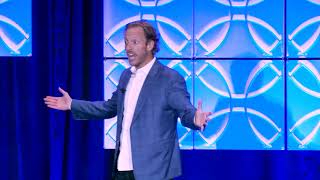
Andy Neary uses baseball metaphors to teach C-suite executives about confidence, competence, and action plans. He draws on his own baseball career to show how these principles apply to managing healthcare costs and engaging leadership.
Chapters
And you will love what he's about to do. So show him in advance your appreciation. Andy Neary.
Am I on? Hey, Lester. Yes, sir. How are you, man? Can you come up front for a sec?
So I heard I didn't make it here in time, but we all sang. Lester, Happy birthday. Right? 805, you were born. So I want to do something special for you. Did you guys give him a cake at all? All right, now, I don't know the fire restrictions in this building, but I did get you a little cake, little candle. So let's all stand up and give Lester another happy birthday. So I wanted to give you a cake, man. Happy 40th.
Now hold on, you're not done. You guys stay standing. Hold on, you're not done. Put the cake though.
Grab this baseball for a second. All right, Lester, I want you to do something for me. You stay right about there. I want you to hit my glove, okay? Now while you do that, you guys do me a favor. I want you to rip the crap out of Lester. Heckle him, yell things at him. Alright, you guys ready? You guys start yelling at him. Let's go. Good. All right, Lester.
That wasn't bad. All right, give him a round of applause.
You take it. That's yours, man.
Now, first of all, Lester would have never made it in pro ball because that was about 45 miles an hour.
Question for you guys, especially for my baseball fans out there. Do you guys mind if I'm down here versus on stage? I'm not a big stage guy. What is the most effective pitch in baseball? Does anybody know? Oh, got it. I will go up on stage. What is the most effective pitch in baseball? Anybody know? Change up. Change up. Okay, that's a good thought. The one that works. Another good thought. How about one more? Anybody any thoughts? Deb, what'd you say? Curveball, Curve ball. All good answers. The most effective pitch in baseball is the first strike.
When you think about.
Baseball statistics. Think about this. In baseball, when a Pitcher throws ball one, when the count's 1 0, the batter has a 38% chance to get on base.
If the batter throws a strike and he's ahead in the count, 01, that goes down to 25%.
So it is imperative as a pitcher that you have to throw that first strike. My entire career depended on it. If you guys notice, a lot of you know my story, so I'm not going to spend a lot of time regurgitating it. But I stand in front of you at 5 foot 9, I weigh 165 pounds. And I did not have an overpowering arm. I was not what you call an intimidating presence on the mound. But I grew up in a baseball family. My dad was a college baseball player and also an extremely successful baseball coach. In fact, he was the longtime coach in my hometown. I played for him and he's now one of the winningest coaches in Wisconsin State history. And so I grew up in a family that was surrounded by baseball. I had the mentor, I had the knowledge, I had the tools to become a great baseball player. And by the time I was in high school, I had my first chance to play big. You see, it was my senior year of high school baseball. Going into my senior year, I had accepted a scholarship to play at the University of Winona State, Winona State University in Minnesota, Division 2 baseball program. But I was not okay with that. I wanted to play bigger. I wanted to play Division 1 baseball. But again, I had this challenge right. I knew my path to college ball was on the mound, but I was 5 foot 9 in high school. I was 145 pounds and I didn't throw 90 miles an hour.
But up until my senior year, I had developed the confidence, the competence and a course of action to make me successful. And going into the playoffs my senior year, I had one last chance to play bigger, to prove myself. It was the first game of the playoffs and I remember this game like it was yesterday. I knew that the University of Wisconsin Milwaukee was coming to watch ME Pitch Division 1 baseball program in Wisconsin. And so that night I went on the mound knowing again I had the confidence, the competence and the course of action to be successful. And that night I tasted what it meant to play bigger. Because that night I threw a one hitter. I literally gave up a hit on the first pitch of the game. And that was it. Now, the statistic I was more proud of that night and it's why we're here to talk about talking to the C suite. Today is that night. In a seven inning game, the baseball fans in here will get this. I threw 77 pitches, 65 strikes.
Now that earned me a scholarship to play Division 1 baseball. One chance I hit it. Here I am playing college baseball. Now, when I got to college, I thought playing bigger literally meant getting bigger. So I hit the weight room, pounded the weights, gained 30 pounds. My first two years of college baseball, 30 pounds of muscle. Any college athletes in the room. I took this magic powder back then called creatine.
It was the legal way to get bigger. God knows what the long term effects are. And I gained 30 pounds. I was 5 foot 9, 175 pounds. But now I had a new challenge.
See, when you're a pitcher, the last thing you want is a muscle bound bicep. And so my first two years at UWM were terrible. And by the time my sophomore year was over, I wanted to quit. I just wanted to give up baseball. Has anybody ever been there in business? You're like, I can't do this anymore. Maybe you who were here in 2008 when we knew the Affordable Care act was coming. But then something happened. Between my sophomore and junior year, I was named captain. And getting named captain changed my mindset. It gave me that confidence back that I needed because I knew I had the confidence to be successful in the mound. And so the next two years, I worked on my craft, I worked on my mechanics to become a better pitcher. And by the time my senior season was over in college, I had one more chance to play bigger by signing a contract pitch in the Milwaukee brewers organization.
Now, I wish I could keep telling you success stories, guys, but this is where the success ends. Because when I got the pro ball, I lost my confidence. Here I was playing on the same field with other players from lsu, Texas, Georgia, you name it. And I let that get to my head because they were better than me. They were from bigger schools than I was. But more importantly, I got away from the course of action that made me successful. And for me, it came down to one thing. Throwing strikes. Because I, again, did not have an overpowering arm. I was not imposing at 6 foot 6. I had to be accurate. And here's the thing, guys. In baseball.
You can teach mechanics.
You can teach delivery, you can't teach accuracy.
And so my career in pro brawling lasted two years. In fact, I remember going to spring training after my second year. And on the last day of spring training, I got released. I got cut. And the interesting thing about that guy you talked about, you guys have all had childhood dreams, right? I was one day away from breaking camp to go play for the Beloit Snappers in Beloit, Wisconsin, which was 50 miles from my hometown. And I was three promotions away from pitching for the Milwaukee Brewers, 30 miles from where I grew up. You talk about a childhood dream, right? And it was over. And when I look back and I reflect on that day, I got released. I learned a lesson that day, and I, unfortunately, didn't learn it right away. But what I know now is, guys, when you want to play bigger.
You have got to have the confidence, the competence, and One hell of a course of action.
Because for me as a pitcher, to be accurate, to throw that first strike, which keeps me in the game, keeps me getting outs and keeps me having a job, it comes down to mechanics, pitch selection and follow through.
So that is what we're going to talk about today. Now, whenever I put these talks together, I always think about what can I say on the stage that the audience wants to hear. But I don't think that does you justice. I like talking about things you need to hear. You're talking about what our prospects need to hear. I call these the hashtag truths. Guys, in my new role right now, coaching, it's been fun. I'm talking to a lot of brokers around the country right now. And when you think about what I just said, the mechanics, the pitch selection and the follow through, I'm making some observations right now around the industry that I want to reflect on. If you guys are cool with this.
With this new movement to the C suite, we gotta be careful.
It's great to have this new language, but we have to have context around it. You can't walk into an office and say, I want to talk about your ebitda.
Because I'm waiting for a CFO to go, yeah, tell me about my ebitda. And all of a sudden we have no response for that. We gotta be careful, guys. You have to have context behind this language. It is a game changer. The second observation is what I see right now and I think you guys struggle with this. We all struggle with this is in playing bigger right now. How many of you are going, okay, I need to open more doors to bigger accounts. I need to have the confidence to know what to say when that bigger door is open. And then when I win it.
How do I keep it? And that's a challenge. I see right now we're winning business with the right language. But you've got to execute. You got to have the systems in place to be able to manage the counts. You're winning. And so that's what I want to talk about today. Today my focus is going to be on that message. When you are in, what's that open talk we can chat with the CFO CEO about. Does that sound good? So what I want to do quickly, guys, is in your workbooks. In fact, I'm going to come down, you've got some takeaways. I want to quickly walk you through some of the takeaways, guys, that I'm going to share with you today.
When you think about pitching, hitting your Target with your first strike. When I go back to being a pitcher.
First of all, it all came down to preparation. You guys have been talking about preparation for the last day and a half, right? You have to be prepared when you get in that C suite and what we have with the Internet today, if you're going after a prospect that's a publicly traded company, all the information sitting out there to be prepared, right?
Because when you talk about, you get that 30 minutes with a prospect and that prospect sitting in the C suite, your first pitch.
Has to wow them. It has to be accurate. It has to be a strike. So if you look at your message, a powerful story.
For those of you taking notes, lays the foundation for a message that resonates long after you've left the building.
I see some of you, and I'm humbled. I want to take a back step for a second and tell you I'm humbled to be doing this, because I'm looking around this room and there are some of you right now. I just want to recognize that are crushing it.
And so I don't want to forget that either, because some of you right now are probably out there already executing what I'm talking about. And that is awesome. But I want to share this with you. For those of you that might be struggling, you got to start with a message, guys. A story that has a powerful message. And here's what I'm here to tell you. Every one of you in this room has a story, and every single one of you has a message that everybody you ever meet with can learn from that story.
You also need a script.
You see professional athletes practice the same motion over and over until it becomes a habit. When I was a pitcher, I had to work on my mechanics, guys. You know, I spent hours doing this.
You have to work on your mechanics if you're going to be confident in the C suite.
Because your pitch is your motion. You have to practice it until it's perfect. Kim, I think you said it. You practice by constantly getting outside the box and putting yourself in the C suite. Were you perfect at first, but you practice, practice, practice. Now you feel confident about it, right? It's almost becoming second nature for you.
And you have to walk the prospect through the customer journey. Folks, when you think about the customer journey, it's very simple. Every time you meet with a prospect, you have a character, right, that has a problem, who meets a guide you, that gives him or her a plan.
To help him or her achieve success and avoid failure and create transcendence. Where they believe they can do it. That's the customer journey. So every time you're going to create a talk for your prospect, think about that customer journey, answer the question for them, what will it look like for me?
And don't take a meeting unless you are prepared to ask for the the business.
With a strong call to action.
So a powerful message means nothing unless you call them to action. One thing I want to share with you today too, that I'm going to talk about is have any of you guys gone into a prospect and said, I can save you 40%?
And it's like in one ear out the other year. Guys, that call to action is not believable. When we start sharing savings, that's almost too hard to believe. They're not going to take action. You have to create believability. That's the transcendence piece, is you have to make that prospect feel like, not only do I love what Tom is saying, I think I can do it.
And last but not least, you have to leave them wanting more. Take your prospects to a place of transcendence where they feel excited because they truly believe that they can achieve great things. Guys, and I'm sharing this with you as probably the most guilty of that mistake of anybody in this room. When I joined the Mastermind, I got all excited about these strategies. I hear Gary Becker telling me he can save 70% on drugs. So I go tell people and I'm like, why isn't anybody listening? It's because they're not believing it. You're dealing with people who have dealt with 10% increases for a decade, and now you come and tell them you can save them 70%.
I think Jeff Hayslett said it yesterday. Bullshit.
So what I want to share with you guys today, if you're cool with it, I want to do an open talk for you. I want to show you If I had 15 minutes with a prospect, a CFO, what I would walk him or her through. And I'm literally doing this on the spot, guys, because I Normally use a PowerPoint. Do you guys want. You guys want to hear it? All right, cool. So I want you to imagine you have now 15 minutes with a prospect, 20 minutes with a prospect. And I'm gonna preface this by saying you've already done your job on the fact finding. You're sitting with the prospect, you've asked him or her what their challenges are, what their dream, their two year goal is. What are the challenges preventing them from getting there, what are the opportunities you can leverage, and what are the strengths you can take advantage of. And now they look at you and they go, stephanie, tell me what you do.
What do you say?
This is where I go back and say, walk them through that customer journey. You see, if you're a CFO out there right now, this is a little different, because you guys are not CFOs or prospect staring at me. You're looking at your sales right now, aren't you, in your organization? And your sales are doing one of three things. They're increasing, they're decreasing, or they're flat, right? But no matter what your sales are doing, there is something happening inside your income statement every single year that's eating away at sales. And that's called your healthcare budget. Think about this. If you're a CFO and you have a $2 million health care budget and you accept that 10% increase, how much are you adding to your budget next year? Murray.
I just forced you to do some math. You do it. You're adding $200,000 to the budget, right? Guys, think about this CFO's world. If the $200,000 is added to the budget, what's getting taken away from the bottom line? How much? $200,000. And if that CFO has his organization, has a 5% profit margin, he has to replace or she has to replace that loss next year with $4 million of sales.
Do you think anybody has told a CFO that before?
That every time you accept that 10% increase, you have to accept create $4 million of additional sales next year just to offset that increase? And here's the challenge every CFO faces today. Number one, health insurance companies are misaligned. And we know this because the Affordable Care act, right? In 2010, when it became law, we had this rule known as the medical loss ratio rule. And the medical loss ratio rule simply said for every dollar a carrier brings in, it has to spend a certain percentage on claims, right? If it spends anything less than that, they have to give money back. Now, back in the day, I don't know about you guys. I remember giving checks back. Ain't happen anymore. You know why carriers stopped caring? They said, hey, if we let claims go over that percentage, we don't have to give money back. And at that point, they stopped caring. And we all know this. We can validate it with stock prices, right? I know. Anybody see my video the other day about how to accurately show the stock Prices? Anthem was 56 bucks on March 23, 2010, the day the Affordable Care act came out yesterday, I think it closed at about 250, 260, they're doing pretty well. Second challenge you face is the healthcare system is misaligned, right? Most of the system today is still fee for service. They get paid for what they do to you and how much they do to you. They're arbitraging against you. Their wholesale cost is here and they're charging you this. And you, Mr. CFO, Mrs. CFO, live in the world of arbitrage and you're trying to do the opposite. And then the third challenge you have, I don't have it on me, is the medical ID card. Every year you hand that medical ID card out, it is nothing more than an unlimited company credit card because you give your clients, your employees, excuse me, an access to a PPO network and they can go wherever they want and spend whatever they want within that network. And here's the end result. Right now.
You think the only three ways you have been taught the only three ways you can save health insurance costs today is by shopping the carriers, increasing deductibles and out of pocket limits, or just asking your employees to pay more. And here's the problem with that. Right now your employees on average are making $40,000 a year. And with their deductible, they're out of pocket. And their premium that accounts for 20 to 25% of their growth take home.
So we're here to fix that. Here's the mindset shift we're going to create to help you fix that. Today you stop buying insurance and you start managing risk.
And there's three areas of risk you want to manage. Number one, finance risk.
How are you financing your health plan? You have to try to get to a level of self funding if you can, guys, that's the only way you can control your cost and create the transparency you want. The second area of risk you need to manage is catastrophic risk. You've got these claims on your plan right now that are making 70, 80, $100,000 that you're being told you can do nothing about. Those days are over. I'm going to show you how you can take a $100,000 claim and make it 50. And the last area of risk you need to focus on is health care purchasing risk. Figure out how your employees are accessing the health care system and help them buy those services better.
So how do you do that? I have a process I call ebitda.
Now, in your business, EBITDA is the, in simplistic terms, is the value of your company, right?
This process called ebitda is going to help you determine the value of your health plan to your employees.
So let me share with you what the acronym EBITDA stands for. Our six step process. Number one E is empathy.
I forgot. Gee, I thought you said this yesterday, but you didn't. 90, I think was one of the C suite executives that were up here 90% of all performance. Financial performance I think is based off of empathy. And here's the challenge C suite executives have. Your average employee is making $45,000 a year and their out of pocket limit is eating up 20 to 25% of their gross income. Right. But from the empathetic standpoint, the challenge is you might have a CFO making 300,000. That means nothing to them.
So C suite executives have to understand a $7,000 out of pocket limit for their employee is like them having a 30 or $40,000 out of pocket limit. Empathy is step one. We have to understand what our employees are going through.
And then the B.
Better compensation model. And I'm sorry I could not come up with a better word than better.
Broker pay. Guys, we're going to align our pay with your ability to save money. I know some of you are doing an unbelievable job of that right now, but I'm going to align my pay with your performance of your health plan.
The I is insurance financing. Now we're going to start looking at how you're financing your health plan. Or is it financing Trey financing? We're going to figure out how you're financing your health. And are you fully insured? Well, okay, then we need to get you to a better model if we can, whether that's level funding, self funding or captive. Now we got the T because if we are empathizing what our employees are going through, you're aligning your commit, your brokers pay with your goals and you're moving to the right insurance financing arrangement. Now you're creating transparency. The T is transparency. Now you're seeing your claims. Now you know exactly how your health plan is performing month in and month out, which leads to D. Now that you have transparency, you get to make data driven health care decisions.
You know what things cost in your plan, whether it's medical drugs. And now you can start making smart. Helping your employees make smart data driven healthcare decisions and then reward them by making those services free if they do the right things. Which leads to the last letter of ebitda, which is A and I call it arbitrage elimination.
What are the hospitals doing to you right now?
Their services cost about 10 grand internally to perform that procedure and they're charging you 100,000 random, right? We're going to eliminate that.
There's people out there selling drugs for 80 grand. We're going to eliminate that. We're going to teach you and your employees how to hedge the price of healthcare purchases. So you can have surgery for 20 grand instead of 80. You can buy medication for 25,000 instead of 100. You see, guys, if you put the EBITDA process in place, you empathize with your employees, you align your broker's pay, you start financing your insurance better, you create the transparency, you make data driven decisions, and now you start buying health care services more effectively. I promise you, you will have a better health plan and spend less money for it. Because right now you, Mr. And Mrs. CFO, have one of two choices.
You, you can keep doing what you're doing and look up and keep getting frustrated, or you can look back and celebrate that you have a better health plan for less money with smaller out of pockets than you did three years ago. The choice is yours because you're going to be in that spot one year, three years, five years from now.
So just like you use EBITDA to value the OR to calculate the value of your company, let us help you use EBITDA to show you the true value of your health plan. Thank you.
Questions? We got like three minutes.
Thanks. Can I, can I really? Can I admit something to you guys? That acronym came up. What day was that? Thursday. In the shower. Was it yesterday? Yesterday morning I texted you, didn't it? You guys totally steal that. I think it's great. I just came up with a yes, J. Like even that's perfect. But no, guys, I'm gonna say one last thing and then I'll get off stage. Go back now how I presented. I'm not doing this to do this. I want to share with you. How did I start? You, the character, cfo, CEO, coo, have a problem or problems. Here are the solutions.
My process is your call to action.
Because if you do that, you will win. And now you believe you can win. Transcendence. Guys. When you do that in your open talk, you get that down. If you have multiple producers, they're all saying that it's game over. So hope that helps. That's all I got. Nelson.
More from Andy




If you want producers to succeed faster, help them create a sales message that creates confidence.

Sales isn't a zero-sum game! You can have tough competition and still grab a beer after



Option 1: Meditation, a fast walk, a podcast, and protein. The ultimate morning routine!

How you do one thing is how you do everything. Ill elite producers fuel their body.


Stop living in the gray of maybe! Your job in sales is to get a clear yes or no