Mastering Discipline: The Key To Success On And Off The Field (with Colton Storla)
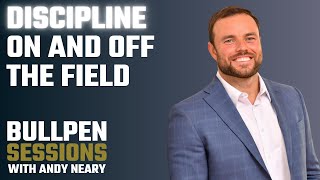
Colton Storla, a former college football running back from Cedar Rapids, played at Coe College after a high school career that included a seven-touchdown game. He moved from strength and conditioning work at the University of Iowa into employee benefits consulting, crediting discipline built through wrestling from age four.
Questions this video answers
Episode 291
Cedar Rapids, Iowa
Seven rushing touchdowns
About 350 yards
Chapters
Hey.
Hey.
Welcome back to the Bullpen Sessions podcast. My name is Andy Neary, and this is episode 291. Today, I am excited. I actually got to sit down with Colton Storla, an employee benefit consultant with North Risk Partners in Cedar Rapids, Iowa. And even better, Colton and I got a chance to sit down in person as we were. I was hosting a workshop for his team. So I wanted to have Colton on today's podcast because he is one of the up and coming rising stars in the employee benefits arena. But more importantly, I just love the drive and the discipline that Colton has when it comes to being a student of the game, both on and off the field. And so I'm excited to bring his story with you. As a former college football player and started his career as a strength and conditioning coach at the University of Iowa and then became a benefits advisor, he's got some great professional and personal development lessons he's learned as a strength and conditioning coach at the University of Iowa and just share some great stories of how he continues to use the drive and the discipline that he had on the football field to excel in the employee benefits arena. So I'm excited to bring him to you. Here we go. Episode 291. Colton Storla. I've got the man. Colton Storla with me. We are actually live Rochester, Minnesota. We're doing a workshop this afternoon.
Sure.
So I thought we'd take the time time to get him on the podcast and you could get a chance to learn a little about this guy. I really love the way he ticks. Former athlete at a high level, played college football, which we're going to talk about. So, Colton, welcome to the show, man.
Yeah, thanks for having me.
Yeah, you bet. So for the few people who don't know who you are because you're on LinkedIn a lot and you are definitely creating a presence in the benefit space. Introduce yourself, tell a little people a little bit about yourself.
Yeah. Colton Storla, born and raised in the Cedar Rapids, Iowa area.
You know, grew up there, went to college there and just really haven't, you know, moved away and. Yeah. Now working in the employee benefits field at Northridge. Partner.
So I gotta ask. Okay. Cedar Rapids, what do they call it? The City of Five Seasons.
The city of Five Smells.
I was going there next, but what is it with the five seasons? I've heard it referred to as the city of Five Seasons. That right?
Yeah.
What's the fifth season?
I don't even know. I just know it as Five Smells because we Got Cargill. We've got Quaker Oats. So Coke College is right. By Quaker Oats. And so we always knew when it was Crunchberry Day.
Ah. But the whole. The whole. The air would smell like Crunchberry.
Crunch berries.
That's interesting. So I grew up in a town where we live back in that same town now. We had a plant in town called Brownberry. Yeah. And Carnation. So two separate plants in my grade school was literally in between them. So there would be days Brownberry was baking raisin bread.
Oh, yeah.
And Carnation made, like, chocolate. Chocolate milk stuff. Okay. Like malted milk. So you'd smell chocolate and then you'd smell raisin bread. It was. That was a good smell. Yeah.
Yeah.
Okay, so you mentioned co college. Yeah. You went to college there? I did. Right. So talk about growing up, because you. You definitely were an athlete as a kid. By the way, I never asked you, Iowa, were you a wrestler?
I was. That was actually like, one of my first true sports. You know, my dad was, you know, very much, you know, supportive in that realm. I think I got into it when I was, like, 4 years old. I still have my first singlet. It's tiny.
And traveled around with one of my good friends from church that, yeah, we got a lot of trophies. And I just actually recently came across the big tub with all my trophies, which was kind of cool. But then, yeah, I started playing all the sports. Baseball, football, basketball, did track. But once I got to high school, all my friends played football and basketball for the most part. So I quit doing baseball, I quit doing wrestling, and, you know, I kind of. You know, that's probably one of my bigger regrets. I was good at both wrestling and basketball, but I went to basketball route. But, yeah, everyone always asks me, it's either a toss up, are you football or are you wrestling? But, yeah, I loved wrestling.
I have the same regret. I was not a big kid in high school. I only weighed, like, 145 pounds. When I left high school. My regret is I quit playing football after my sophomore year. Yeah, I wish I would have spent more time getting bigger. Like, knowing what I know now, like, I wish I would have kept playing football.
Yeah. My parents, I mean, they were constantly in the gym, working out and things like that. I remember.
Okay, so your dad's kind of a fitness buff too?
Yeah, both my mom and my dad, I would, you know, ride my bike to the gym with them, and I'd have to go to daycare. So once I hit that 14, I was like, can I get a membership I even remember my dad would give me a pager, and so while I was in daycare, so I'd know when he'd come pick me up.
That's awesome.
But, yeah, by the way, for you.
Young advisors, a pager is something you wore on your hip.
You know, it's funny you talk about wrestling. So my dad was the JV wrestling coach in the town I grew up in. Really good wrestling coach. But he never wrestled a day in his life. Yeah. Just learn the sport. My exit out of wrestling wasn't as regretful as yours. I think I was in first or second grade. Our town had a really good wrestling. Youth wrestling program. And I went to a meet. I went to a tournament. I think I got pinned in, like, 30 seconds. And I'm like, I'm done. I'm playing basketball.
Yeah. I mean, neither of my parents played sports.
Wow.
And neither of them went to college either, so.
Wow. Yeah. Yeah. I mean, for those that don't know, I mean, Iowa is just a wrestling haven. Well, nowadays it's Pennsylvania with Kale Sanderson at Penn State.
But we still sell out every home meet at Iowa.
I would love, you know, I'd love to go to a Iowa Penn State match. Yeah. If Penn State's at Iowa. Because I remember the stories about. So my mom grew up in Iowa, and obviously Dan Gable was a legend there. And the stories of. Was it the football, the away locker room for Iowa football, or Iowa wrestling painted pink? Football. Football. It was football. Okay. Okay. So you get to high school, you're playing football, basketball, and base baseball, or.
Just mostly football and basketball? I did track my senior year.
When did you realize that you had a legit shot to play football at the college level?
Because I know you won't admit it, but I've heard stories. You're kind of a local legend in the football realm.
In Cedar Rapids, my freshman year, I actually got brought up. I was running back. I got brought up to play sophomore, and I started most games as a sophomore and scored touchdowns and all that good stuff. And actually, our varsity team went to the playoffs that year, and they brought me up as a freshman. Yeah. To just run, you know, scout offense. And so that was kind of that point where I think I remember my coach specifically saying, hey, you know, this is, you know, really good opportunity for you. You're probably not going to play in the game, but, you know, we want you to really run the scout offense, and then maybe next year, as the sophomore will have you play varsity. And so that's what happens.
Were you pretty built as a freshman? I mean, to come up as a freshman in football, it's one thing, like in baseball or even basketball, but to come up in football where size is a thing. And at running back, were you pretty built as a freshman or.
Yeah, just going back to my parents and instilling that, you know, know health and wellness early on and going to the gym. I think my freshman year, even of high school, I was getting, you know, some personal training stuff at the gym. Just some weightlifting and speed agility. So I was constantly trying to work on that. So, yeah, I was. I think I was probably 190 pounds.
It's a freshman.
Yeah, because you're not.
I mean, you're not extremely tall, so that means you were built out. Okay. Wow, that's impressive. So sophomore year, end up playing varsity.
Yes.
Starting as a running back.
Barca didn't start.
Okay.
But I split time with another really good running back.
Okay. So let's look at your high school career because we're going to talk about college because you ended up playing running back at CO College. Yep. Right. Looking at some of your high school accolades. So by the time your career was done, I've got to know some things. Like, okay, most touchdowns in a game.
Seven.
Seven touchdowns. Dang. All running or receiving too?
All rushing. And actually one of our family friends is Carrie Bender and he went to Marion High School where I went, and then went to Coke College too. So I kind of looked up to him. I was 24, growing up my entire life. But he retired his jersey in high school, so I went to 28. And he had six wrestling touchdowns, one receiving. So I matched the total in a game.
But you got the seven rush. Most yards in the game.
Most yards in the game was. I don't even know the exact, but I think it was like 350.
Did you. I mean, by like your junior senior year, were you at kind of the top of the list when it came to most yards in a season? Most touchdowns in Iowa?
Yeah. Okay. Yeah. There's another kid up at Union, Westburn side. Him and I were always like trying to just battle for number one place because they had that online stats thing where you can look up every week. Yep, everybody's that. So.
Yeah, that's pretty cool, man. What was it like for you? Because CO CO's D3, right. What was it like for you? Was it a big jump for you to go from high school football to playing at CO College?
Playing in the backfield wasn't, you know, a huge jump I do remember, you know, getting in that mindset, like, I'm going to play college football, like, these guys are going to be bigger than me. Maybe, like, I need the, you know, protein and lift weights and all these things. And I. I got to co. And I think I was like £215 and like, as we were.
So you were freaking running around.
My. My running backs coach was like, yeah, I think you need to lose a little bit of weight. You're a little slower than what I remember. So I was playing at probably 198, 195.
Yeah. And Cole, remind me the conference CO was in it, that it was the IAC at the time, which is Iowa, because obviously I come from Wisconsin.
Wisconsin.
I was at the time. You. Were you playing college at the time? Whitewater was kind of at the peak of their Call it dynasty.
Yeah, we made it up there.
Okay, what did you notice? I'm curious, because I played college baseball. And, you know, the thing I noticed the most in college with sports is for a lot of kids, it's a tough transition because they were the all state player from the hometown. I call it the hometown hero. Right now, you're on a team of guys who were all Allstate.
Was that the same for you? That same experience for you where you saw, okay, now everybody. You're playing at a level where everybody's good.
Yeah.
Did that. Did you have to make a big transition? Like, did you notice a big transition playing running back, like, with things like the speed of the defense and the talent at the linebacker position compared to what you were playing high school football?
Yeah, definitely. I mean, we ran a much different offense there, so that was kind of a learning curve. And yeah, just even from a strength conditioning standpoint, you know, I was definitely bench, squat, deadlift kind of guy. And strength conditioning coach, he was, you know, very, you know, you know, triple dimension movements, you know, hangs, cleans and things like that. So that was learning curve. And I was, like, already, you know, in the gym all the time. So I was him. And I didn't have the greatest rapport right away. Like, what do you know, Like, I'm big.
Okay.
So him and I became really good friends, and that's what kind of got me into strength conditioning later on. But yeah, from the, you know, the, the speed of the game, definitely there's, you know, some big linebackers I had to go toe to toe with, and I'm the more of the type of person. Person that's not going to try and juke you.
You're gonna go right through.
Right through.
Yeah.
So I got stuck a couple times.
Yeah.
That's awesome. Did you notice, you know, I. I also believed, you know, when you play in high school, a lot of guys can get by with its talent alone. Yeah, Right. And they get to the college level and it is about the work you put in off the field. Did you notice that difference, too? That to your point? No. I actually have to put a lot of time in at the weight room and stuff like that if I'm gonna.
Yeah, for sure. And I was grateful to have, you know, the strength conditioning coach that we had. You know, he was. I was, you know, in my hometown, you know, at where co college was too. So, you know, even during the summers, we'd get a group of guys together and just constantly try and, you know, push each other and, you know, get better.
Talk about that a little bit. Because obviously when you graduated from Cole, you didn't get into insurance right away. Was it with this strengthened conditioning coach, did he have an impact on where you wanted to go with your career because you actually started in strength and conditioning.
Yeah. So just like most kids going to college, you don't really know exactly what you're going to do. I went back and forth with, like, law enforcement and, you know, architecture. Engineering, because my dad actually owned a construction company growing up. So I was, you know, I like the. The working with your hands, manual labor stuff. But yeah, I got into, you know, co and got to know Coach Walter and, you know, he was an awesome coach and mentor and started, you know, going down that path of physical education with an emphasis on strength conditioning. And, you know, some people ask me, you know, about games and practice and things like that. I'm just like. It was more so like the preparing for the season and, you know, yeah, games are fun, you know, when you're scoring touchdowns and stuff. But I think I was more just, you know, into the preparing. And that's really cool.
You kind of feel the same way now. I know you still exercise a ton of. Yeah. Do you, like, are you into as much into exercise now than you were back then because of that fact that you just like to prepare?
Yeah, absolutely. You know, just starting my day off with the workout. Yeah. And, you know, starting it off on the right foot. I. I really enjoy it, you know.
That's a really good point you just brought up because I've noticed, like, in the last four or five years, I've signed up for things like a race or a bike, you know, bike race or a run. Thing. And I found myself actually enjoying the process of getting ready for it more than the actual event. Yeah. It's like almost the event at the end of the day is a. Is a. Is a non event. Sure. Because you actually enjoyed the journey. That's. That's a really good point. So talk about. Okay, so you decided. It's funny too. I wanted to share this. Architecture. I actually went to college for architecture. Now here's what's funny. So sophomore year, you start studio and I went to UW Milwaukee's studio was 1 to 5pm Tuesday, Friday afternoon, I think. Well, I was on scholarship for baseball. Yeah. And my fall practice started free. Get out early and I went up to the studio, our professor and said I have to leave early on Tuesday and Fridays. Like I have practice. And he said, well, I think you need to make a decision. What's more important, architecture or baseball? Next day I was a finance major.
Yep.
I said, I'm here because, you know, they're helping me pay for school and sorry, I guess I'm gonna have to change majors. But out of high school, I want to do architecture for sure. Okay. So strength and conditioning. Talk about that. You actually got a degree.
Yep.
Had some opportunity. And you actually had opportunity to work at the University of Iowa, which is pretty cool. Yeah.
So my strength condition coach at co College, he had some ties to the University of Iowa. And so coach Doyle interviewed with them and coach Braithwaite at the time. And so I was working with the Iowa football program after.
More from Andy




If you want producers to succeed faster, help them create a sales message that creates confidence.

Sales isn't a zero-sum game! You can have tough competition and still grab a beer after



Option 1: Meditation, a fast walk, a podcast, and protein. The ultimate morning routine!

How you do one thing is how you do everything. Ill elite producers fuel their body.


Stop living in the gray of maybe! Your job in sales is to get a clear yes or no