Taking "The Big Leap" Towards Sales Success
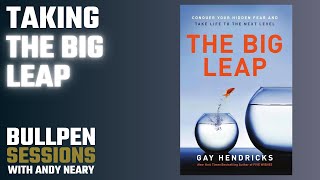
Andy Neary walks through Gay Hendricks' four limiting beliefs that sabotage success, using his own insurance career as proof. He spent a decade stuck before moving to Colorado in 2014 and rebuilding his mindset around discipline and accountability. The core idea: you have an internal thermostat that keeps you from breaking through, and owning your results is the only way past it.
Chapters
Hey. Hey. Welcome back to Bullpen Sessions. My name is Andy Neary and this is episode 304. Today we are talking about limiting beliefs. Yep, they impacted my career for a long, long time. And I betcha they're probably having some kind of impact on yours. Today I am going to review a book I just read called the Big Leap, written by Gay Hendricks. Because this book had a huge impact on me, just observing my behavioral patterns in my career, comparing this, the guy I am today versus who I was 10 years ago, and what I had to do to really break through some limiting beliefs so that I could continue achieving more success. You see, one of the things that keeps people back from success in the insurance industry is, number one, self accountability and discipline and drive. But two, even when success starts hitting them, limiting beliefs can sabotage them and bring them back down to that level of mediocrity and comfort that they're used to. It's like that thermostat in the room, right? If it's supposed to be set at 72, but you're playing at 78 now, it's easy to bring it back down to 72 because it's comfortable, but it keeps you stuck. And so we're going to talk about that today. I'm going to share my journey in my career. So if you're a producer trying to get it back on track right now, or you're having a hell of a lot of success, but you feel some of those limiting beliefs holding you back, I think you're going to love today's episode. Let's dive in. Episode 304. Hey. Hey. Welcome back to today's episode. Andy Neary here. How are you? Well, in today's episode, I'm going to help you break through what I might call the mental barrier. Just got done reading a book recently which I'm going to go through today called the Big Leap. And this book really has had a profound impact on me in the last couple weeks. And I wanted to talk about some of the main lessons out of the book because I think they not only apply to my career, but they can definitely apply to you. This is gonna be a really good episode for you. If you are an insurance advisor who's trying to rekindle a flame under you to get going again. Maybe you've lost a little love for what you do, but it's gonna be very helpful if you are that advisor. Kind of like me, super driven, super competitive, trying to take your career to the next level. I think you're gonna find this Very, very helpful as well. I'm gonna share my journey a little bit today with you in hopes that my journey helps you uncover maybe where you're holding yourself back right now. I have no script. Normally I sit down and I outline the episode. But today I am literally coming straight from the heart because after reading this book, I got done with the final chapter yesterday. I really want to share this with you because it really unlocked some.
Mental barriers for me where I see myself holding myself back. Especially historically. I'm much better today, but man, I still hold myself back in so many ways. So I wanted to share this with you. So a few weeks ago I went to my bookshelf here and said, all right, what book do I want to read now? And quite frankly, I didn't know. And I kind of oscillate back and forth between reading some kind of self help book and reading an autobiography. I love reading about other people's journeys and their stories. In this case, I said, all right, I want to lean into a little more self development. So after staring at my bookshelf for about two minutes, I came upon this book, the Big Leap. And now this is a book. I think somebody may have actually mailed this to me.
So took it out of the mailbox, unwrapped it, put it on the bookshelf, really never touched it. And for whatever reason, this book just spoke to me when I was staring at the bookshelf. So it's the Big Leap, written by Gay Hendricks, and it's about how to move, how to remove obstacles, mental obstacles from your life so that you can achieve that next level of success. And just to give you a little background on this book, I'm going to share four limiting beliefs that are focused on in this book. Because I think for most of us, one or more of those limiting beliefs are holding us back from success. So to take you back in my history, I got in the insurance industry in 2001. Now growing up, I didn't have a lot of self confidence. My self worth wasn't very good. I guess partly maybe because I was a chunky kid, I had a lot of self image issues growing up. Today I could still argue that the reason I work out as hard as I do is I. I don't want to be that fat kid again. But I grew up without a lot of self confidence. And so when I got in the insurance industry.
I didn't have the mindset that it took to succeed. You know, I got in in 2001 from a family friend who suggested I Give this insurance things, insurance thing a shot. I started selling life insurance, annuities and financial planning and I was really bad at it, just wasn't good at selling life insurance. You know, it's a product that not that people need but not necessarily have to have. And me just at a 20, at a, at age of 22, 23, trying to convince somebody that they need life insurance was, was really hard for me. And honestly at the time, if I'm being, if I'm admitting it, I didn't like sitting at kitchen tables at six o' clock at night. So if you're listening and you're a life insurance producer or financial planner, I give you a lot of credit. I just was not good at it at the time. So I made the leap after a couple years over to the commercial and benefit side of insurance. I went to work for a company by the name of Federated Insurance. Tremendous training program. It's there I learned how to sell insurance to businesses I really like the more the day, the nine to five hours. But again I still was terrible at selling insurance. And.
From there after failing at Federated because I couldn't sell life insurance and that's really what their whole promotional system was built on, I moved to an independent agency and helped them grow their benefits department where again I'd argue I failed. So the first 10 years of my career in insurance were terrible. I was a failure. And when I look back on those first 10 years, I had all the talent, I was capable of creating successful results. I didn't have the mindset. And where this really became clear for me was just a few weeks ago hosting a workshop with former clients of ours, Chris Beyer and Chris Bolling. And Chris Bolling said something on the workshop that I was like that is it. And it really described my journey. He said, Andy, the reason we have been so successful in creating social media content, which was the topic of the workshop, he said, is because when we came to you for help, we already had confidence in our ability to sell.
And I had never heard somebody say it, say that to me that way before. And it just clicked because when I look back at my career path going back to the fact I didn't have a lot of self confidence, my biggest issue is I didn't have confidence in my ability to sell. I had a lot of mental limiting mental beliefs about my capabilities at the time and that is why I was not successful. That is why 10 years into my career I was still living paycheck to paycheck. You know, you get in the industry, and they tell you, man, if you make it for three, make it three to five years, and you just rely on your ability and you can last, you will do financially. Well, that's full of shit. I'm here to tell you that's not the case for everybody. I was living paycheck to paycheck 10 years into my career. And.
When I look back at that, it was because of limiting beliefs.
And, you know, reading this book, the Big Leap and. And where Gay Hendricks outlines the four limiting beliefs he sees most common. I look at the four, and I say, man, most of these definitely impacted my career. And I'm going to talk to you about those in a second. But I share this background with you because.
Who I am today, I'm very proud of. I'm a very competitive person. I'm a very driven person. I have a lot more confidence today than I did just 10 years ago.
But it wasn't because I was born that way. You know, when I moved to Colorado, Amy and I moved in 2014, yeah, it was a chance to kind of wipe the slate clean, start over, create a new journey, a new chapter in my career. But the most important thing I did at that, in that moment was shift my attitude. You know, when we moved out there, I said, man, this is your opportunity to start over. But if you're going to have success, it's all on you. No one owes you anything. You can't just win by showing up. You got to put in the work. You got to become a student of the game. You got to outwork your competition. It was there I learned drive, discipline, consistency.
And today, the only reason Complete Game Consulting exists is because of that. It's because I made a determination, a decision to own my results. And I share that with you. Because if you find yourself in a place right now that you're not happy.
Maybe you're selling a product you're not really in love with called insurance. If that's the case, number one, go find a new career. I don't say that condescendingly. I say go find a new career. Go find something that's going to light you up. You know, most of us got in the industry because somebody else said we should give it a try. So if you're not enjoying it, no harm, no foul, if you go find something else. But if you're committed, you want to make this a successful go, the first thing you got to do is start between the ears, and you got to start owning your results. You got to start taking more Self accountability. Stop relying on somebody else to create success for you. No one owes you shit, and I apologize for being direct on that. No one owes you anything. The only way you're going to have success is if you own up to owning your results and you take full responsibility for creating them.
Now, when I read this book, the Big Leap, I realized that even when you're having success, so even when things start coming a little easier, money starts coming a little easier, success starts coming a little easier, you're still gonna bump up to limiting beliefs that can keep you down, where the temperature gets to a certain degree, and then your beliefs go, whoa, whoa, whoa, whoa, whoa, it's getting a little hot in here. Cool it back down. And before you know it, you're kind of capping your success. I know I was doing that even as I started making more money, having more success. So in the book, let me go over these four limiting beliefs Gay Hendricks talks about. He said the first barrier is the false belief that we are fundamentally flawed in some way. If we carry this feeling within us, we sabotage our success because we think we're essentially bad. If something good happens, we must mess up to offset it, because good things can't happen to bad people. You ever felt that way? I know I've made choices in my past where I guess you could argue I was a bad person when I made those decisions. So for a long time, when I would have successful, I would immediately sabotage it by saying, do I really deserve this? Am I a good person? That's a big barrier a lot of us deal with. Second barrier is the false belief that by succeeding, we are being disloyal to and leaving people in our past. If we harbor this feeling within us, we sabotage our success because we think it's disloyal to our roots to soar too far into the stratosphere. Ooh, that's a big one I dealt with. You know, when you're just getting started in your career and you're not having a ton of success, there's going to be a lot of people cheering you on. They want to see you win. But something really interesting happens when you start having success.
The cheers go away. When you start exceeding other people's expectations, when you start proving other people wrong or maybe even rising higher than they've ever gone, they're not cheering you on so much anymore. And I think whether that's friends or family, it's easy to sabotage yourself because you don't want to become too successful.
If you grown up in a family that maybe has a lot of limiting beliefs around money, like money's root of all evils. It's. It can be really hard to have success because you start feeling guilty about that success if you're making too much money.
You start hearing the comments from family and friends, ooh, must be nice that you can do this or go on this trip or be able to afford this, in that those kind of comments from the crowd can quickly have you sabotage your success because you realize, man, if I continue to achieve more success, I may lose these people. And it is a huge limiting belief that a lot of people deal with today. I know I have. The third barrier is the false belief that we are a burden in the world. If we carry this feeling inside us, we sabotage our success so that we won't be a bigger burden. Now, I haven't really dealt with that one all that much, but that might be one you resonate with, feeling like you're a burden on others. I think that belief, or that barrier alone can bring a lot of undue mental health, stress, discontent. And the fourth barrier is the false belief that we must dim the bright lights of our brilliance so we won't outshine somebody in our past. If we hold this feeling inside us, we tend to hold ourselves back from expressing the full potential of our innate genius. If you ever held yourself back or limited your abilities because you don't want to make somebody else look bad, kind of coincides with barrier number two, the false belief that by succeeding we are being disloyal to and leaving people behind in our past. This is probably the one I have struggled with the most. I think what happens is.
As you decide to make changes in your life, which I know Amy and I did when we moved to Colorado, and you decide that you're going to do whatever it takes to succeed, you're going to do whatever it takes to level up. Not just one area of life, all areas of your life, whether it be your career, your health, your relationships. There are going to be people who fall by the wayside, and it's going to be uncomfortable. There's going to be people who you thought were cheering you on that no longer really want to see you succeed. And when that happens again, it's easy to bring yourself back down to that level of where you used to be again. It's that thermostat analogy, right? Your thermostat has always been set on 72. All of a sudden, you find the temperature at 78 because you're having a ton of success. And before you know it. You sabotage it by bringing it back down to 72 because that's where it's comfortable. That's where people accept you more. And I going to challenge you if that's where you find yourself today, you got to push through it. Keep that temperature at 78. Hell, keep that temperature rising.
My point in sharing this episode today is that if you are committed to success and you're going to do whatever it takes to win, just know it's not going to be comfortable. Number one, you can't have success unless you create self accountability, unless you own your results, good and bad.
But number two, if you're going to commit to success, just know that your outside world is going to change. If you become more disciplined with your, your lifestyle, how you take care of yourself from a health and a diet perspective, your friendships are going to change. There's going to be family members that you have been close to for years that just really aren't interested in seeing you succeed like you want. And you have to make a tough decision at that point that, hey, are you going to deal with them that deal with that and understand that this is what happens when you are committed to success or are you gonna let other people's opinions bring you back down to where you've always been?
And I share all of this today because I have to tell you, when we are talking to an insurance advisor who is, you know, looking at us for potential help from a coaching consulting standpoint, one of the things that frustrates me more than anything is talking to an advisor who is not committed to their success. I call it being casual about their success. They're making good money in this industry, giving a good, getting a good paycheck. But you can just tell in their voice, in their emotion, in their energy.
They'Re not that interested in actually going above and beyond to succeed. Which is easy because we operate in an industry where money has historically been the North Star. We get in because we're told we can make a lot of it. And when things go south or not go our way, if we don't love what we do, it's really hard to keep pushing again. I know that's where I was early in my career. In fact, in 2010, I was days away from quitting this industry, going to do something else. So I get it. But.
More from Andy




If you want producers to succeed faster, help them create a sales message that creates confidence.

Sales isn't a zero-sum game! You can have tough competition and still grab a beer after



Option 1: Meditation, a fast walk, a podcast, and protein. The ultimate morning routine!

How you do one thing is how you do everything. Ill elite producers fuel their body.


Stop living in the gray of maybe! Your job in sales is to get a clear yes or no