Teeing Up Success: How Discipline Drives Exponential Growth with Casey Strunk
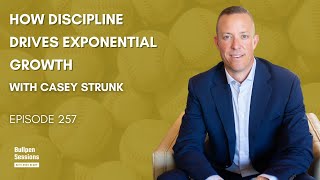
Casey Strunk, who runs his father's Phoenix insurance agency, credits golf and a strict fitness routine to his business discipline. He wakes at 4:15am, trains four days a week, and tracks every metric. He says the agency's edge is simple: 'we give a shit' about execution and client care.
Chapters
Hey. Hey. Welcome back to Bullpen Sessions. I am excited to have a gentleman who I have had the honor to get to know here probably in the last month or two, and a gentleman who is one of the good ones in the industry and doing some amazing things down in the Southwest in Phoenix, Casey Strunk. Welcome to Bullpen Sessions.
Andy, thanks so much for having me.
You bet, man. Now you are down in Arizona. For the folks that don't know who Casey Strunk is or the Strunk Insurance Group. Were you born in the Valley?
Yeah, I was born and raised here in Phoenix, but both my folks have Midwest roots and my father started the agency back in 1982. So we just celebrated our 40th year in business.
Awesome. So you're generation number two.
That's correct.
Do you have any siblings in the business or is it just you?
I do. I have a sister who runs our finance and accounting department. So.
That's awesome. Well, this will make a lot of sense to me then, because we're going to talk about. If you're watching this on YouTube, on our YouTube channel, you might notice behind Casey is a set of golf clubs. So your parents have Midwestern roots. Where are they from?
My dad is from the middle of the cornfields in Peoria, Illinois, and my mom's from Flossmoor, a suburb of Chicago, so.
Okay. Okay. So they come from the great state of Illinois.
Is that how you ended up at Northwestern? Because we're going to talk about your golf career a little bit. You played major Division 1 golf at the University of Northwestern. Did you end up at Northwestern because of the tie with your folks back in Illinois?
Yeah. You know, I don't know if you and I talked about this or not, but my father played football at Northwestern and so.
Okay.
It had been a dream of mine to get back there in a different sport and play a little golf.
So.
Interesting time to be a Wildcat football fan, isn't it?
Yeah, my. My group text chats with. With my buddies. My dad's buddies have been blowing up the last three weeks or so.
If you're listening and aren't familiar, Northwestern's going through quite a. Call it a haze hazing investigation and it's. It's created quite a stir in the, in the. Within the entire athletic department.
Yeah. It sounds like from top to bottom, they're. They're kind of going through it and Coach Fitzgerald had a tough deal there, so.
Yeah. So let me ask you this because I'd be very curious in your opinion. So when you were in high school. What other sports? Did you play any other sports in high school outside of golf?
I did. I played baseball in high school as well.
Okay, when, when did you realize? Because there's always that point, you know, for me, it was in baseball. You, it was in golf. When did you realize you had an opportunity to actually play golf at the next level? Is it something you were just always talented in or was there a point where you're like, hey, if I take this seriously enough, I could actually play this sport at the next level?
Yeah. Raising two girls right now and trying to understand what competitive athletics looks like for them. I think back often and I say, you know, when did I start to become serious about golf? And it felt like it was later than most. You know, I knew I wanted to play in high. And then once I get into high school, I had a couple top 10 finishes and state events and realized that, man, if I put a little bit of energy behind this, there's the possibility that I could play at the next level.
Well, and that's interesting because the perspective I wanted. So I had a guy on, an industry peer on a couple weeks ago, Chris Carter, and he played in the NFL and he grew up in Texas high school football. So he's like, when you're growing up in Texas high school football, like you are already kind of at the top. I mean, it is the cream of the crop. When I think of golf growing up in high school, golf growing up in the Phoenix area, I've got to believe the level of competition in Phoenix, even in high school was tremendous. Yeah.
I mean, if you think about cities around the country where golf is certainly a year round sport, this is at the top. And junior golf here is, is huge comparatively. So it was a very, very competitive scene.
Okay. Yeah. So the, the other question I would love to ask you around.
Your sports because you have an interesting mix of golf and baseball. And here's, here's where I'm bringing, coming up to or where I'm getting at. So my whole life I grew up in team sports. And then when I got a little older, I started doing like triathlons. I got into cycling a little bit. Very individual sports.
Did you notice a big difference between playing a game like golf, where it is you and your mindset, and that ball versus playing baseball where it's you and eight other guys on the field?
Yeah, certainly, you know, a lot of.
Sports, in my opinion, team sports, it can be subjective, it can be political. There can be motivators around who starts and who doesn't that you can't control. The really interesting thing about golf is when you go out and try to qualify for an event or qualify to play in a tournament at the collegiate level, the scores are the scores. There's. There's nothing political involved with who might play in that sense. And so, you know, I really enjoyed that aspect of it. Just trying to. To get a number down.
That's a really good perspective, I don't think. I thought of, like, if there's any sport where you get to control everything, but maybe the elements, which is the weather, the day of the. It's golf. And you are 100% responsible for your outcome.
Yeah. You're in control of your own destiny, that's for sure.
I have to believe that's a good feeling. I'm kind of a control freak. Now. Here's what I'm curious. So you go on, you play college golf at Northwestern, and I'll be honest, I'm unfamiliar with the level of talent in the Big Ten and things like that. Because you came from the valley of the sun. You came from Phoenix, where high school golf was hyper competitive. Did you notice a difference in talent getting to Northwestern?
Yeah, I mean, I was. I was somewhat lucky to. To end up on that team. I mean, there were kids that were playing at a high, high national level. All of a sudden on my team, Luke Donald, who was the number one player in the world Ryder cup captain in Rome here in a couple weeks, he was on my team. And so I really did get to see what the best of the best were doing inside and outside the golf course.
Yeah, that had to be an interesting, a fun perspective to be able to play golf around a guy like that. Yeah.
I mean, you could just tell on those days when it was blowing 20 or 30 and guys are coming in shooting 78, 79, 80. Luke would walk off at 69 or 70. It was just a completely different deal.
So I got questions asked about the game of golf, if you don't mind answering these. Yeah, so I'm a competitive player. If I actually took the time to practice more, I think I could be really good. But admittingly, I don't put enough time in. And one, it amazes me that how your round can be absolutely determined by the number of putts, that's number one. Like if your score can quickly add up just because of putts. But what. What blows me away in this sport is, Casey, is you see some of these guys, and they're not that big and they're hitting 320330 yard drives. What is it about their skill, their form that allows somebody who looky, look at and they're like, you are not big at all. And then they can go out and just hit monstrous drives.
Yeah, I mean the game has become about speed and it's interesting. People of different statures can generate that type of speed, whether they're, you know, 5, 8, 5, 9 and slide or 6, 3, 6, 4. And so, you know, a lot of it just comes down, down to the efficiency in that movement, obviously a great level of technique. But over the last 10 to 15 years, there's just been a huge emphasis on gaining that speed through physical fitness, which never really existed in the game of golf.
Yeah, it blows me away. Like I said, I think guys like, if I remember Justin Thomas, people like that, they're not that big, but they go out and just hit these monstrous drives. So I'm curious as well. So you played at Northwestern, which means you played against Wisconsin. Did you ever get a chance to play at University Ridge?
You know, I don't know that, that I was up there, but we did travel all around the Big ten and there's a lot of cool university golf courses out there.
Yeah, it's. There are some in Wisconsin in particular. It's. I think it's kind of a hidden secret with some of the courses we have up here. Same thing with Michigan, there's some amazing golf courses.
If you were to play one course down in Arizona right now, where you are, what's your go to course in the Scottsdale, Phoenix area?
Yeah, I mean it seems like in and around the Phoenix Open every year I'll get to go out to the TPC of Scottsdale. And while it might not be the best course in the greater Phoenix area, it sure is cool to go out there when all the stands are up, to go out there on 16, the Coliseum, when that's all built up. So, you know, I would say getting out there in and around the waste management is pretty fun.
Have you been able to play 16 when the stands are up?
Yeah, absolutely. A couple days after and a couple weeks before. It's pretty cool.
That has to be awesome. Well, I'm curious now looking back on your golf career because obviously you still play golf, but when you look back at your career, playing in college and you look at like just playing today, I guess is a better way to ask all the things that go in. There's a lot of lessons in business and life that come out of golf. And when you look at Playing the game of golf and you compare it maybe to what you're doing in the health insurance industry today. What lessons do you take from playing a round of golf and say, I could apply this to my business?
Yeah, absolutely. I mean, golf is a game of discipline.
Just like anything, you have to be hyper focused on doing all the small things well in order to string together around. And it's sort of those incremental changes that you make over a period of time that you might not see adding up that all of a sudden do at the end of the day. And so, you know, in our business, we're just trying to get a little bit better each and every day in everything that we do because we believe those are the things that truly set advisors apart.
Yeah. You know, it's funny you bring that up though, that incremental.
Growth that you don't see every day. It's kind of, it's, I think in the game of golf goes back to what I said. I don't put enough time into practice to put the reps in to become better at it. It's those small things you've got to do when no one's watching in the game of golf that make you better. And it was funny because I, I took my dad up to play Century World here in Stevens Point, Wisconsin last weekend, which they just had the Senior Open up there a few weeks ago. And I could see him kind of start to spiral down. One shot after one, bad shot after another can lead to another. And I said, dad, you know, there's an old adage I was taught in baseball as a pitcher, throw up sticks, don't throw up crooked numbers. And what that means is if you're going to give up runs in baseball, keep it to one run and inning. Don't give up three or four. Which means if one thing doesn't go your way, figure out how to stop it. Don't let it spiral out of control. And I think the game of golf, do you agree, could be the same way where it's like once you start feeling that momentum going against you, it's easy to let it get out of control.
Yeah, I mean, you see it with sort of newer players to the sport all the time. And it's just what you're talking about. You can afford to make a bogey, but it's those doubles and triples that really hurt. And so chip out, take your medicine, get back on track. Ultimately, that's the best way to keep your score in check.
So I'm a curious because I'M a competitive sob. What does a typical round look like for you these days from a scoring standpoint?
You know, I'm only playing about 12 rounds a year on my own ball. I'm still, you know, a scratch golfer, so it's in and around par depending upon where I'm playing.
So if you're listening and you've got an outing coming up, get this guy a call. He is that he is the winger you want on your team. The guy that comes in and you're like, really? You brought Casey along? This isn't even going to be fair.
I get my share of scramble invites.
I was just, you said, you said my own ball. I'm like, I will in the bet. You are a go to on scramble day. So. Well, let's talk about your insurance industry because you are agency, because you guys built a heck of an health insurance agency down in the Scottsdale, Phoenix area. And one thing I love about just how you kind of view what you guys are doing at Strunk Group. And I asked you a question one time, I said, what makes you guys unique or different? And you said, we give a shit. And this, this is going to be, this topic isn't sexy. But that statement I think said a lot. Because when you think about how we take care of our clients, it's easy to say we take care of our clients. It's a different story to actually do it. And when I heard you say that, I was like, God, I'd love to know what that means. So for you, when you think about, oh, we give a shit about our clients, what does that mean to you?
Yeah, you know, I was having breakfast this morning with, with a competitor who's been in this industry for 40 plus years at independent shops and large national agencies. And what we were talking about was the fact that you can go out there and you can design the best benefit program under the sun with all the bells and whistles and cost control tools that there are. But if you can't effectively administer that plan, communicate it, take care of those employees on a day in and day out basis. That employer's not getting their ROI on their investment. And so for us it just means, you know, being really passionate about doing all the mundane, really, really well day in and day out and taking care of the folks that, that we have the luxury of servicing.
Yeah, I would love your perspective. You know, when you look at the health insurance landscape right now, I think what you just said is very important for others to hear because there is a definite.
Almost what's the word I'm looking for mobile type of mentality of, oh, we got to go out and fix the healthcare system and blah, blah, blah, blah, blah. And the reality is if your actions can't back up with your mouth is saying you're in trouble. And I think we have a lot of people in the industry who can't, who aren't doing that. And how important is that for you? When you think about a lot of these outside the box ideas everybody's talking about.
How important is it for you? That, yeah, that's great to talk about it, but we got to make sure we execute. Did you know the ideas shared on this show are things we actually specialize in helping you implement? If you're an insurance professional and you want to turn your credibility into consistent client acquisition, visit completegameconsulting.com and schedule a free strategy call. Again, that's completegameconsulting.com to request your free strategy call. All right, let's jump back into today's podcast episode.
Yeah, I mean, we can talk about fixing the healthcare system and fighting back against the Bukas, but really we are the intermediary for that end user that's having some sort of experience inside the medical system and this massive landscape that exists out there. And so before we can even think about fixing the system, we have to make sure that that end user feels like they're being taken care of. They're being guided through the process. And when they have a problem, not if we're there to step in and help them.
Great point. Not if they have a problem. When. Because it's going to happen in this industry, there are going to be problems and your ability to fix them in a positive way is very important. I'd be curious to get your take on this, too, Casey. You know, you and I haven't known each other all that long, but you're a second generation, which is common but not common in the industry. But I see a lot of second generation, sometimes third, come in with high expectations. I will take over the agency for at some point. Maybe I don't have to put a ton of effort in. I don't see that with you. When you look at where you are today, you've built a hell of a book. When you look back on your career, what do you think has allowed you to get to the point where you are today? Because you could have easily been that one that says, yeah, I'm second generation. When my dad's ready to go, it's mine. But you don't have that mentality, what would you attribute to your success?
Well, you know, I've been in the industry for, for 19 years now and only bought the agency about five years. And so the first 14 years I was largely working under my father and you know, he was my mentor. He taught me everything I really know about this industry. But he made it very clear from the beginning that nothing was going to be given to me. You know, I started making about $24,000 a year living at home, and he gave me a desk and said, you know, you better figure out a way to go sell something. And you talk about that's how it is for new producers. Back then it was the way that it was for me.
It was never understood that that opportunity would be mine. It took me a while to mature as a man, as a leader, as a consultant, and at some point in time it was clear that that was my intention, that I had a lot of drive towards that. And my dad and I worked out a deal for me to buy the agency. But I have a bit of a chip on my shoulder being second generation, that this was maybe handed to me, that maybe I didn't work to get to where that, you know, who knows what type of job Strunk does. So we're out to prove a lot more than just being around for 40 years. We're trying to be relevant in our space.
Do you think there's any parallel there with how you were as a golfer on the course? Did you go, did you play golf with a chip on your shoulder as well?
You know, Pat Goss was the coach at Northwestern and I rolled into Evanston with my Chevy Tahoe and I think I thought I was a little bit special. And the minute I got on campus, the message to me was, you are not special, you are not extremely talented. And if you want to be a part of this team, you better show me through the work that you do in the classroom and on the golf course. And he put me in check pretty quickly. And I'm so thankful for that type of leadership over a four year period because I think it really set the tone for the rest of my professional career.
I agree. I think. Well, and correct me if I'm wrong, I mean, going to a university like Northwestern, you can't slack off academically.
Not, not whatsoever. And I agree with you because I know when I got on campus at UWM we were mid major D1. We weren't high D1, but all these guys coming into the team, same's true for female sports. We're all hometown heroes. Right. We were all the best player on our team. And I think that realization that you're now coming to be a part of a team where everybody is as good as you are, some handle it well, some don't. And I love the fact your coach kind of level set you even before you got started to be like, listen, I don't care what you did down in Arizona, you got to prove yourself.
Yeah, 100%.
Yeah. What advice? You know, again, one thing that attracted me to you, man, is just how disciplined you are. If we had a young advisor, whether, let's say you're about to hire an advisor, 23 year old, maybe just coming in the industry for a first time, or we have one listening in, who is in the industry for the first time, what advice would you give them? What do they need to do and focus on to have success in this industry?
I have a great property and casualty partner in town. He's about my age. And we often talk about the fact that, you know, this industry looks easy when you look at someone who's been in it for a while. But the reality is, is that, you know, you have to work for a long time in the business on yourself, on your network and all these intangibles. At the end of the day, to be successful, you have to surround yourself with great people and peer groups. You have to develop strong relationships in the philanthropic community. I mean, all of these things to be thought of as a trusted advisor. And it's not just as simple as picking up the phone. So it's really all the things that you don't see inside of the industry, I think that you have to do to be successful.
I'm also curious and I apologize if it feels like I'm bouncing around, but these are all just great questions that keep coming in my head when I try to think about how golf has impacted you. And I'd be curious to know this because I think if there's one moment in sports more pressure packed than anything else, it's a golfer hitting an important putt. Especially if you're in the pros and there's people watching or millions watching on tv, but having to hit that putt, being in moments like that, pressure packed moments. I think about me having guys on second and third and one out. Has that helped you perform when it matters most in business?
Yeah. I mean, I still get nervous right 19 years in. I'm sure you get nervous every time you go on stage, but from a very young age, I was playing for money that I didn't have, I was trying to win tournaments. I was doing things that were really uncomfortable. And so everyone always says you have to get uncomfortable or comfortable with being uncomfortable, but it's the truth. Right. And so competition is a great way to do that from an early age.
Yeah, that's awesome. No, it made me, I thought of that as you were talking because I'm like, yeah, if I think of any sport out there that requires as much pressure in a moment, it's that right there, that putt that you got to hit to either send it into sudden death or win the round or heck, just win the hole.
Let's talk about this for a second. When it comes to discipline, we've used that word a couple times and again, this is what I love about you. What is your typical day look like? Because I feel I don't know the answer to this yet, but I feel like you'd be a pretty discipline guy from, from sun up to sun down. Knowing you are a parent of, of two, two two daughters. What does your typical day look like to help you stay disciplined?
Yeah, I mean it's really, it's really shifted a lot in the last three years. I've got a coach that, that works with me on sort of all aspects of my well being. But you know, I'm training four days a week and with a five year old and eight year old at home, my alarm goes off at 4:15 so that I can get to the gym by.
I can get home with them, have breakfast, take them to school. And so you know, I'm in the office by about 7:45 and then I tell friends of my age all the time that you know, if you want to have any semblance of normality with your family, you really have to maximize the hours of 8am to about 3:30 because then all of a sudden you have to start being a parent again and you're involved in pickups and sports and dinners and book time and bed and all those things. And so it's really about maximizing time and being really efficient in the way that I'm going about things.
I'd be curious too with that because I agree maximizing time is everything and I'm not a parent so I don't have to have that. Working with kids in the morning, you know, getting them up and being dad at the end of the day. But how important is it for you especially probably at the end of the day taking off hat of owner, you know, CEO of Strunk Insurance Group and becoming dad Again, has that been a difficult transition for you, or have you been pretty good with that?
I made a conscious decision about three years ago that I needed to lower the perceived level of stress that I was carrying around. And some of that was a part of a fitness journey. But ultimately, I just had to stop caring. At whatever time it was when 3:30 or 4:00 o' clock rolled around, there was nothing else I could do for my business and for my clients until that next day, because I had to take care of myself and take care of my family in order to show up for them. So I've really tried to leave it at the office when that happens, and some of that comes with time and some success, but it was definitely a focus.
Talk to us about your fitness journey. I know you shared that with me on another call. I think it's had a profound impact on who you are today.
It really has. I wasted a tremendous amount of time and talent, in my opinion, between these ages of about 18 and my early 30s. And I woke up about three years ago and I was overweight, I was eating poorly, I was probably drinking too much, and I was not showing up for those around me. And so for the last three years now, I've tracked steps, sleep, macronutrients, prescribed training, and it's a huge focus of what I do every single day. Just training to get a little bit better physically and mentally for the work here at Strunk.
Yeah, I think that is one of the most important if I look at what has helped me succeed in the last three or four years. It's just that constant commitment to fitness. And fitness includes what's going into your mouth. You know, I even have a rule. I have a rule of thumb this, you know right now that I don't drink alcohol Monday through Thursday. Some people are like, why? And I'm like this because I look at myself like an athlete still, and I got to give myself any competitive edge over the competition I can. And if I'm able to wake up every day in the best possible shape or mental shape, I've got an advantage. And it comes back to that word you've been using, discipline. I was thinking of what the topic of this episode is going to be, and we just uncovered it. Discipline. You are where you're at 19 years later, Casey, and you've fallen off the track. We all have. But it comes back to discipline.
Yeah, I mean, that. That stress, that anxiety that people talk about, a lot of that goes away when you can look yourself in the mirror at the end of the day and say, I've done everything I can today to be the best version of myself. And you go to sleep really easily.
Well, and I think about this. This might be a twisted parallel, but think about a round of golf, right, to bring that back through 18 holes. How many ups and downs do you have? Right. It is a constant up and down. You got to forget that hole, celebrate that hole. But don't get too much. Don't get too caught on X. Got the next hole, and before you know it, you walk off 18 going, did I leave it all on the course? Just like you. And just like you end a day and end a week in business, you got to look back and go, did I leave it all on the field? If I did, I did everything I could to win.
Yeah. I mean, winning days lead to winning weeks, winning months, to winning years. And that's how it goes.
So, yeah. Well, let's wrap this up. I've enjoyed this conversation, man. I wanna. Let's. Let's answer one more question, and that is, I know it's a cliche question, but then I'm gonna go into a little rapid fire with you, if you don't mind. We're gonna have some fun with this at the end. You're 19 years into the business. I'm 22, I believe. Yeah, 22. If you could go back and talk to Casey 19 years ago, what would you say to him as he got into business?
You know, it really has to do with developing those habits that it took me way too long to learn, in my opinion. I just never really thought those small things would or could add up because you can't see them along the way. But I would have taken a lot more time to develop the habits and routines that lead to success.
And I love that, because I bet you you had some amazing habits on the course, which is why you played at Northwestern. And you probably got away from some of those habits when you got into business, because I know I did. It took me a while to realize, wait a second. I got to get back to what I did to have success in the sport of baseball and apply it to business. And that's when everything changed.
Yeah, you don't have to be perfect, but you have to be consistent.
Ding. Boom. There you go. Don't have to be perfect, but you have to be consistent. So, all right, let's have a little fun.
If you could play one course in this country, where are you playing? If you got 18 holes, you could play anywhere you want. Where are you playing?
You know I would love to go up and play one of those new band and courses. I was there about 20 years ago and haven't seen the three or four new ones. So that would be my golf destination.
Is that on the course of Oregon? On the coast of Oregon Band and Dunes.
Yeah. Okay. In band and Oregon.
Now I'm going to narrow it a little bit. If you could play one hole.
What would you play?
Well, maybe the 18th at Pebble. I watch that tournament each and every year. And look, guys, look at guys challenge the water there on the left. Just an iconic, tough finishing hole.
And you've got a best ball tournament tomorrow.
Who are you calling? If you could bring in one guy on a best ball as your partner, who you bringing in?
Well, I don't think Luke Donald's going to be available, so I might call my, my former teammate Tom Johnson, who's still playing and teaching in the California area.
Awesome. Awesome. I tell you what, man, the game of golf, this is why I don't think I've ever had a former college golfer on the show before. So I appreciate this because I love today. It's a sport I like, I love, but I struggle at because I don't put enough time in. And I laugh at how people don't understand, I think, how good the pros are. You know, we got a course here, 25 minutes away. Aaron Hills and Aaron Hills. If I, if I went and played with a group of guys, we would be like, crap. We'd struggle because it's, if you're not in the fairway, you're trouble. And then you have the pros come in like they did a couple years ago and complain that the course is too easy.
And it's like, oh, the level of talent these guys have today and the technology with the clubs and the balls. It won't be long. Casey, do you agree these guys are hitting 400 yard drives at some point?
I mean, we're getting close now we see guys moving at 350 out there. So who knows?
Awesome. Well, man, this has been a joy. Thank you for taking the time to do this. If you're a business in the sun, in the valley of the sun down the Phoenix, look this guy up. If you want to find one of the hardest workers in the insurance industry, look no further than Casey. I mean, again, today's topic was discipline and you're full of it, man. So I want to thank you for taking the time to join Andy.
I sure appreciate your friendship and your coaching and had a great time today.
You bet everybody else, be good. Take Casey's advice. Model is discipline.
More from Andy




If you want producers to succeed faster, help them create a sales message that creates confidence.

Sales isn't a zero-sum game! You can have tough competition and still grab a beer after



Option 1: Meditation, a fast walk, a podcast, and protein. The ultimate morning routine!

How you do one thing is how you do everything. Ill elite producers fuel their body.


Stop living in the gray of maybe! Your job in sales is to get a clear yes or no