The Broker's Voice: Jay Booth, President - Capital Group Benefits
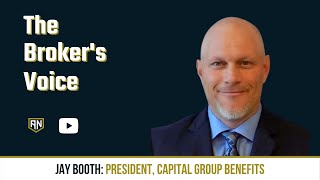
A recorded interview (Jan 28, 2021) on the Broker’s Voice podcast where Andy Neary interviews Jay Booth, president of Capital Group Benefits. Jay recounts his path from W2 employee and restaurant work to founding his agency, discusses his client philosophy (favoring “pro-employee” employers), emphasizes clear employee education and storytelling, and predicts growing transparency in healthcare pricing and contracting.
Chapters
All right, welcome back to the Broker's Voice. I am excited this week to have a super, super successful benefit advisor on. I've gotten a chance to get to know this guy. He's also a super human being. But before we dive into this week's episode, want to make a shameless plug here for our sponsor Agency Annex. If you are an insurance agency and you know your website needs to be upgraded a little bit, but you want to make sure your website becomes your extra salesperson you never had look up Agency Annex. Steve Conka and his team do a wonderful job with the website so you will not be disappointed. They do mine and I couldn't be happier. All right, let's dive into this week's Brokers Voice episode. I am bringing the man on. I have none other than Jay Booth, president of Capital Group Benefits in the Washington D.C. area. Jay, how you doing, man?
I'm doing great. Andy, how you doing?
Good. All right, Jay, as you know, Broker's Voice is a chance to let you other brokers in the industry, your prospects, everybody know who you are a little bit. Let's talk about get into, right into your story. I love your story of how you got into, or I shouldn't say how you got in the industry, but how you started Capital Group Benefits. It actually started with a drive you were making on the Turnpike around Washington D.C. tell the story if you don't mind.
Yeah, I'll be brief, but it's a pretty cool story that resonates with a lot of people. You know, I was relatively successful, a W2 employee actually selling food and and to restaurants like Rainforest Cafe, Doubletree Hotel. Loved what I was doing and just thought I could do something different and something better. So I got my insurance license on the side. Really enjoyed helping people having an impact on their lives. But I didn't know how to transition from being a W2 employee to being self employed. And what people don't know is I used to own restaurants prior to having a job selling food. So I wanted to go back to being self employed, but I just didn't know how to bridge that gap. And then I was thinking on the way home, after six months of doing insurance, a little bit on the side, what's the worst thing that can happen if I try this? And the answer was amazing. It's well, get a job. And it was that aha moment. It's like, wait a minute, I'm living worst case scenario right now, even though I like my job, right? But I was like everybody else, fighting traffic, dealing with Supervisors dealing with clients, W2, employee credit card debt, wonderful wife, kids at home, the whole deal. But I could do better. And when I asked myself that question, what's the worst thing that could happen? And the answer was, get a job. I've got a great resume, man. Sometimes in life you just have this really pure moment in your mind and body and soul and heart, and you just pull over the side of the road. And I called my wife Julie, and it's like, we're doing this total support, of course, right? You got to have a great wife, got to have great support. But it's like, we're gonna, we're gonna do this. And then we started the business in early 2000 and to kind of finish the story because everyone was like, okay, well how'd you do it? You have to pay your bills, right? Yeah, I have to pay my bills. Well, guess what I did. I got restaurant experience as a 30 year old. I went back to waiting tables six, seven nights a week. My wife was there attending bar with me, and we had a blast. We were very blessed to have in laws that would help watch the kids on the nights and the weekends. We could do double shifts. And I'm like, julie, I can do it in a year. I'll wait tables for a year. We'll pay the bills, we'll pay off the credit cards, get the old Honda car payment paid off, and I'll build this business by the day, I'll pay the bills by night. Well, it took two years.
Well, what I love about that story, Jay, is, you know, first when you had that epiphany on the turnpike that, hey, what's the worst thing that can happen? Was that like an 800 pound weight being lifted off your shoulder? Like, I can do this. I'm going for it.
Telling you, absolutely, it was the purest. It was just like, wow, amazing. And it was like all the fear and anxiety that you have of leaving a job that you're making really good money at, you're already doing well. Go back to zero, start over knowing that this is going to work. And I have a, I don't want to call it a plan B, but I have a safety net, if you will. I just get a job.
Yeah, I think that's important for a lot of advisors to hear because I talk to so many who, you know, maybe they have that goal of starting their agency, but that salary and that commission they're making right now is pretty comfortable and they're too afraid to make that jump, even if they're not completely happy with where they're at. So thank you for sharing that because that was freedom for me. Jay. It's why I went into the coaching business that what's the worst thing that can happen if my coaching business fails? I know there's an agency out there that's going to hire me.
Absolutely.
And so I'm glad you shared that.
Now, one thing many may not know about you is you are a, you're Boston, you're from Boston, you're Bostonite or Bostonian, I should say. And you're also a die hard Tom Brady fan. And you shared a piece of content on social media recently about how you are living your Tom Brady's worst nightmare. Talk about that.
Well, when Tom Brady was thought he was going to be drafted, I don't know, maybe third round or second round, fourth. I'm not sure what he thought he was gonna get drafted. That as we all know the story, he was drafted 199 in the sixth round. And he had a quote recently, you know, after the draft, shortly after the draft that said, man, I'm sitting there, I'm paraphrasing Tom Brady, of course, I'm sitting there on the couch and I'm thinking if I don't get drafted, I'm gonna have to sell insurance for the rest of my life. And I hear this quote years ago and I'm like, dude, that's what I do for a living, right? I'm so, I'm living Tom Brady's worst nightmare and loving it, by the way. Right? So everyone has their lanes to be in. Not that I wouldn't want to spend a future Sunday tossing balls around and winning the Super Bowl. That'd be kind of cool. But that's the story, man. Tom Brady.
Well, I want you to talk because we talked about this offline for the, the sports fans listening in. You know, I'm a Packer fan. Of course. I was upset Sunday with the result of of the Buccaneers going up to Lambeau Field and beating the Green Bay Packers. But there's also mad respect in the fact that, you know, Tom Brady's been in the league for 21 years and he's now in his 10th Super Bowl. Almost half of his career has been spent in the super bowl, which is absolutely insane. But you made a point about those two five year periods. Talk about that.
Well, I don't have the exact numbers in front of me, but there's two five year periods that Tom Brady has been into. Five Super Bowls, I believe, and one period has two MVPs. The other five year block, he has one MVP.
He's the greatest quarterback of all time in any one of those bucks, right? The first five years or the next. The other five years, we want to compare. It's just amazing what this, what this guy has been able to do. And it's cool because we have all seen the tape. All of us have seen the combine tape. I'm faster than Tom Brady, right? He's an amazing quarterback. He is not to be confused with the talents of one of your favorite guys, Aaron Rodgers, Patrick Mahomes, Deshaun Watson. He's not to be confused with those freaks athletically, but he is undoubtedly the best. He produces the results. I don't know what we can learn from that, but that's cool.
This is actually, we could, we could bring value to insurance advisors, the industry, in this question, in your opinion, to your point, he was drafted in the sixth round, 199. He is now arguing. I don't even know if it's a discussion anymore. He's the greatest quarterback to ever play the game. How is a guy from the sixth round who is, let's be honest, not completely athletic, now the greatest quarterback ever? If you had to put your finger on one or two things he's done in his career, what would it be?
I don't know. A couple of things come to mind off the cuff. One thing I say all the time is work works. And people are like, what do you. That's just so simple, Jay, right? Work works. The other thing that someone said to me years ago, a client, very large group of mine, and I never forgot it, and he says, jay, show me a guy with a 4.0 with not a lot of hustle. Show me a guy with a 2.0 and all kinds of hustle and I'll hire and bet on that. 2.2.0 and go is what he called him. 2.0 and go. And that always resonated with me. So you're. I don't know how to answer your question, but Tom Brady, how. How has he been able to do this? And you know the divorce with Bill Belichick, who's winning the divorce so far? Tom Brady. That story is not fully written yet. Let's be patient. But right now it's Tom Brady.
Absolutely.
So. And I've always viewed myself as a bit of a 2.0 and go guy. One of the compliments I get a lot is, Jay, you've taken a very complicated situation and made it simple for me. One of the best compliments I can ever get is that I once left a meeting, hundreds of employees talking about the benefits. I thought I did a phenomenal job of explaining the co pays, the coinsurance, exposure, the max out of pocket, all that stuff that we need to know about. She calls me back a couple hours later, says, jay, can I get 10 minutes your time? Yeah. I have an MBA and a PhD, and I have no idea what plan I should pick for my family. Can we just talk about it? And after just a few minutes, she said, you were able to take this complicated situation and break it down for me, and I know exactly what I need to do for my family now. She thanked me. So when I get that kind of compliment, here's the deal. I'm not a highly educated person. So for me to understand a complicated thing, I have to break it down into short stories or analogies. I got to bring what I call the street view. And then that's what I do for my clients and the employees I talk to. As I take this insurance world, whether it's fully insured, self insured, partially captive deductibles, co insurance, max out of pockets. We got to break this stuff down for people and maybe to kind of tie in the Tom Brady story. Maybe Tom Brady's been able to do that. No one else has been able to crack the code like Tom Brady. So how is he doing it? Maybe he just keeps it simple for him.
Well, and to your point, there's an art. Like, you and I have talked about this at length. Just the ability to storytell in our industry is so, so powerful because if you can take a very complex situation, which is whatever, you know, it's what we deal with on a daily basis, and make it simple for not only your decision makers to understand, but the employees that ultimately use the plans that the decision makers are providing, you are an asset, an invaluable asset to that organization. And I think, honestly, that's where a lot of advisors struggle, is they actually make a take a complex situation and keep it complex for decision makers. Now talk about this for a second, Jay. One thing you say a lot about the clients you love working with are those that are pro employee. What does that mean?
So there's a couple kinds of groups. For the most part, you're a pro employee group or you're a necessary evil group. Okay, so a pro employee group is, I want to offer benefits to attract and retain employees and foster a certain culture. Do we need to be inside your budget? Absolutely. Do we got to Control cost, no question about it. But we're doing it because we want to be pro employee. And there's a couple of questions I ask right out the gate to kind of gauge who am I working with? What culture do they have? Are they a pro employee group or they a necessary evil group? The necessary evil group might be a little strong term. Okay. But they're only offering benefits because society pressure tells them they have to. Or depending on group size. Former President Obama said, you have to do this under ACA slash Obamacare. And you know, we are helping those groups as to it as well. And we've got great advice on how to strategize. But we love working with the pro employee groups that they want to be pro employee and pro bottom line at the same time. And there is an absolute way of doing that. You can be great to your employees and you can control cost at the same time.
That's awesome. We're sitting here having this conversation. I couldn't agree more with what you just said. I know when I look at my book of business, historically, the groups I enjoyed working with the most are the ones who are trying to make the right decisions for the employees to put the right strategies in place that the employees can get high quality, low cost, access to care. I had never did well with an organization. That said, Jay, I don't care what we have to do. Save me money. I don't care what I have to cut. What, you know, those are the groups. Yeah. I can come in and save you a ton of money.
Yeah.
If you're willing to do it at the cost of your employees, by the way, who are probably making 40, maybe $50,000 a year. It's going to be tough for me.
To do that, especially easy to save a group money.
Anybody can do it. You're absolutely right.
How do you save them money then stand in front of the employees, whether it's 50 or 500, host those meetings, take all of those calls from the single dads, the single moms, trying to figure out their insurance, the families, the employees, and be great to them as well. What I love to do is I love to be great in the boardroom with the right consulting advice to control the cost, to create, control the message to the employees and then be great when we go talk to the employees. And that takes, that takes two different skill sets and I just love doing that. And it goes back to trying to keep things simple.
Well, and you brought back memories of standing, you know, in that warehouse room in the back of the machine shop. Or back in the manufacturing plant and trying to tell a bunch of blue collar employees why it's a great idea. They have a $5,000 HSA and they should be saving money.
Really?
Yeah.
Let's finish up here. Jay, I know you're a busy guy. We're talking on January 28, 2021. We've obviously been in a very strange environment for the last almost year now. Where do you see the in health insurance industry going from here? What big changes? What's on the horizon, in your opinion?
Well, transparency, that is. It's happening as we speak. The hospital transparency bill is being played out as we speak here on January 28, 2021. So we'll see what the impact is there. We need transparency. We need business owners to understand how to manage this supply chain. And if we don't let them have a peek under the tent to look at all of the pricing and how it's built out. Your individual stop loss, your aggressive, your admin cost, your network fees, your RX rebates. The industry has to level the playing field and let the CEOs and the HR managers understand how all of this is priced out. And what I say to my groups is, isn't it cool that you can finally pay what you deserve? And they look at me a little funny. What do you mean, pay what I deserve? Well, if we have all this data at our fingertips, I can help you pay what you deserve. And if you don't like the price that's coming back, we've got data to take you in other avenues. So you can pay the price that you would like to pay. But having them at the seat of the table and understanding how things are priced out, very powerful for the business owner in the HR department.
Yeah. I think one thing you're masterful at is the education piece. I know you and I have talked about that. When you walk into a prospect, first thing you often have to do is educate them on what they may not know. They've been so used to making decisions a certain way that have been the wrong way, let's be honest, for many. And I love what you said at the beginning of this conversation. What I love about this gig in our industry is you can take the smartest CFO with all the designations behind his or her name, who went to Wharton School at Penn, and they may be just as naive of a consumer of health care as every single one of their employees.
Yeah.
And I think that's important for advisors to hear that because so many walk into the boardroom and are afraid to have that conversation. And you've got to own the fact if you know what you're doing with health insurance, you know more than the people sitting at that room. In that room. Most likely. Bring them value, educate them, and you do a great job of that. So, Jay, want to thank you for your time, man. This was a great, great conversation. Like I said, I use broker's voice to highlight great people doing great things, and you are absolutely one of them. So any last words of wisdom, we cut this thing off.
No. Thank you for your time. I appreciate it.
Awesome, Jay. Have a great day, guys. You know what happens? Last thing I'll share. When confidence and clarity collide, action happens. Go make it happen today, guys.
More from Andy




If you want producers to succeed faster, help them create a sales message that creates confidence.

Sales isn't a zero-sum game! You can have tough competition and still grab a beer after



Option 1: Meditation, a fast walk, a podcast, and protein. The ultimate morning routine!

How you do one thing is how you do everything. Ill elite producers fuel their body.


Stop living in the gray of maybe! Your job in sales is to get a clear yes or no