The Broker's Voice: Niko Caparisos - Principal, Prosperity Benefits
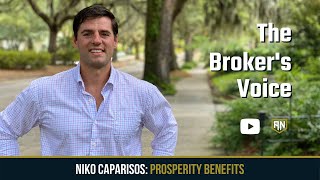
YouTube interview (Broker’s Voice) with Niko Caparisos, principal of Prosperity Benefits. Caparisos recounts his personal background (from Savannah; married with three daughters; lives in same neighborhood), his 13 years in group benefits consulting, and buying his book of business at age 26 to found Prosperity Benefits (now ~9 years old). He describes steady, mostly double-digit growth (one flat year), having 5x'd his business since purchase without adding staff or heavy overhead, and emphasizes organization, systems, mentorship (podcasts, industry figures), credentialing (Health Rosetta), and working with independent vendors/GA partners to provide service. He recommends employers consider self-funding and outcome-focused vendors, and invites listeners to connect via LinkedIn or "nikonico prosperitybenefits.com".
Questions this video answers
13 years.
26 (bought his book of business four years into employment).
About nine years ("nine years and two days" phrasing used).
About 5x the business since he bought it (while adding little to no staff/overhead).
"nikonico prosperitybenefits.com" (as given in the transcript).
Chapters
Hey, welcome back to the Broker's Voice. I'm excited this week to have one young gun in this industry that I think everybody needs to know about if you don't know about him already. So I am excited to bring him on. But before we get there, I do need to make a plug for our sponsor Agency Annex. Listen, if you are an agency, an insurance agency, there's a good chance your website is outdated. In fact, there's a good chance your website still says today what it said five years ago. And it's talking all about you. It's not talking to your prospect. That sounds like you. You need to hit up the guys at Agency Annex. In fact, I am putting Steve's website right here. Steve Konka and his team at agencyanix build websites specifically designed for the insurance industry. They've built my website, and I couldn't be happier. If you want a website that becomes that extra salesperson you never thought you had hit Steve up, shoot him an email right now, get ahold of him, get on his calendar, and see what Agency Annex can do for you. All right, let's dive into this week's episode. I'm gonna bring on the one, the only, Nico Caparisos with prosperity benefits. Nico, how are you feeling?
Good, my friend. Glad to be, as always. Yep.
Now, Nico, if you can't tell, is wearing a shirt that says world's okayest boss, which we're going to talk about okayist. And the problem with settling for. Okay, Nico, for the few people in the industry who don't know who you are, tell us a little about Nico Caparizos. Where you live, what you enjoy doing when you're not working, all the good things that are, Nico.
Yeah, that make me me. Besides insurance, Right? So from Savannah. Still live in Savannah? I live in the same neighborhood I grew up in. I am married. I have two kids, about to be three. All three girls. I have a golden retriever sitting to my right here. Cora. And I've been in the insurance group benefits consulting business for 13 years. First job out of college, went to UGA, not for risk management, but found out I had a knack for sales and wanting to do something professional, you know, business related. And kind of cut my teeth a little bit selling papers door to door in college. And then I realized I had what it took to hear a lot of no's, and I was going to go into staffing sales, interestingly enough. But the owner of that company had several different arms to his business. And so he said, why don't you Try selling employee benefits. I think that you'd enjoy that, and it might be a good fit for you, and it'd be maybe easier than staffing in some respects, and I think you'd like it. So I tried, and it was kind of sink or swim, and I had some mentors, and back in the day, it was big national gas and ancillary carriers and medical reps that kind of inculcated me into the world of benefit selling. And I bought my book of business about four years into being employed. So I bought my production, I started Prosperity Benefits, and now it's been nine years. Nine years and two days since I founded it. So it's been a fun ride.
Well, a couple places I want to go there. Number one, three girls. And then I forgot, your dog's a girl, too.
I thought you would at least have a male dog if you've. Or in a household filled with females.
Yeah, I know something I need to work on.
I guess I have a lot of.
Bros.
Let's talk about this, though, Nico. You said you've had prosperity for nine years. You're not that old of a guy. Like, how old were you when you actually bought the book and started Prosperity?
Yeah. So I guess backing it up 27. But I told my boss at the time, even in college, I was like, I always wanted to go in business for myself. That's what I'm shooting for. And he was amenable to that. And so, yeah, I took a loan and bought my book at the age of 26.
That's impressive, man.
Yeah, thanks. It was a little scary, but less so than some other businesses. Right. Because I was buying an annuitized income stream, so I kind of knew that I was going to have X or so every month. And I took a pause, man. I mean, I took a pause for a good six months or a year, figuring out what my branding was, my image, how I was going to be different. I created my own logo. I got my family and friends feedback on that, but there were several iterations of that. But, yeah, I just had to figure out, all right, I'm 26. I'm an insurance agent. How can I be different than everybody else? And so that journey has kind of continued on, obviously, for years and years and reevaluating every two or three years and seeing, all right, what can I be doing now? Who can I learn from now?
I like that. Constantly evolving yourself. I think a very, very important lesson you could teach, especially if there's a young advisor watching this. So you bought the book at 26 and you've now had it for nine years. I'd be willing to bet you this was not an overnight success type of thing, right?
No, no, there was one year. It was pretty much always double digit growth year over year. Except for one year I was about flat because I had two bigger clients that I lost and I was kind of sitting on my laurels. It was maybe five or six years into self employment, so still trying to figure things out but you know, things happen obviously. But yeah, there was one year where I grew, you know, it was like 20 some odd percent and it was really, there's the story of bamboo, you know, and it does Nothing for like 10 years and then it just shoots up and you know, I've, I've pretty much 5x the business since I bought it without adding in any overhead, less a couple little subscriptions here and there, some technologies, but no staff, you know, no office. I work in my, my carriage house. So it's kind of defined space. But yeah, it's 10 years ago I didn't think that I could grow it by five times without hiring someone.
That's impressive, man. A couple places then, then to dovetail from that number one, when you look back at that 26 year old version of you to who you are today, this nine year journey. What? You know, if there were a couple lessons you've Learned in those 9 years that have allowed you to 5x the business where it sits to today, what would they be? What would those lessons be?
Gosh, a big one is to find the people who are like how you want to be. I mean obviously there's this whole thing, you know, just always trying to reinvent myself and being a self help, you know, kind of junkie. I mean you should see the books, you know, and it's probably similar to your book collection too. But I would say to find the people that have done it, you know, the way that you want to do it and really kind of try to learn from them. So I've had so many unwitting mentors over the years listening to a ton of podcasts, I mean like devouring on two and a half speed almost any industry podcast that I could find. Subscribe, you know. David Saltzman, Shift shapers. There's so many. And then really, you know, I was kind of introduced to the right people and a lot of that happens socially too, you know, social media. I mean people are part of a tribe. You go to conferences, you kind of figure out who are the movers and the shakers and you connect with them. Right. And it's been kind of nice to, to have that model where I figure out who some of these people are. I learn from them as much as I can without contacting them. Not that I'm afraid of that, but just, you know, I learn who has the goods. Right. And then I'll meet them at a conference. Oh, I know so much about you. This and that. And usually because I'm such an open book about myself and I'm flattering to a degree to them because, you know, I respect what they've done. They always want to talk. I mean, no one shuts you down, right. So I would say to a young producer, find out who's already where you want to be and what makes them different and just learn as much as you can and learn how to be different too. I mean, you can't, like for a while just looked at people and I was like, oh, they have a huge book of business. Like, wouldn't that be nice? It's like, I mean, I can't sell on resources. Right. I mean, I could sell an intellectual capital better than I can. I have an office of 30 people that are going to be on your account all the time. That's just not the world I work in. Right. So it's figuring out your strengths, what you have, focusing on those strengths and you know, getting a lot of your messaging from some of the people that have already done it. Really?
Yeah. Quickly, I want to ask, what is one book inside the industry and one book non industry related to have really shaped your career?
Can I look?
Go ahead and look. Yes. You got to make it right there.
Now, now I'm testing my eyes a little bit. But.
You know, cracking health costs was one of the big ones where Al Lewis. Yeah, Al Lewis and Tom Emmerich, I believe, co author. And it's, it just. That's a great one because it just shows you kind of what has been proven to work, scientifically speaking and using the numbers and not just the fluff. Right. I mean, because everything looks nice.
Right.
But to dive into the numbers and I'm not a number scientist, like a lot of people in the industry aren't either. Right. They just see nice, pretty flyer and they kind of believe everything and take it at face value. But I like that one. The company that solved healthcare is another one. If I can cheat a little bit, that's another industry book. But John Tornas and Sarah Graf, that was a great story. A company that figured it out. Right. And then you could just loosely base Your approach based upon just that incentive based plan design and transparency and you know, building plans the right way.
Gosh.
The other one. There have been, there have been so many. Just.
What about a non industry related book? Yeah, I know.
Thinking. I mean like a lot of the authors I really like, I mean John C. Maxwell, organizationally speaking, I've read, you know, his books and that was probably 10 or 12 years ago that I dove into that. So there's a lot.
He's only written like 80 of them.
Yeah, I mean like probably the most popular ones. Right. So I'm a sellout but you know, making things work, there's something along the line of that. But it's a, it's a sequel book. But I did read both of those and anything Tony Robbins, I mean I've just gone down that rabbit hole and it's just so inspiring. And I wouldn't say there's one, but maybe unlimited power would be like a really eye opening one that I just stuck with me. You know, I need to reread it. It's one of those things. It's just like, it's like more of a working manual than it is a book you just read once, you know.
Yeah. And I, the, the company that solved healthcare really hit home for me because one, it's, I think it's probably the first book out there that really started tackling healthcare costs and how to apply them to health insurance. But Saragraph, the company that John Tarunas ran that was a half hour from our agency's office, that really hit home for me. You said something earlier that I want to go back to. You have built a hell of a little practice here at Prosperity without all the overhead. And I think there's this belief in our industry, the old school belief as we call it, that you got to build this team internally, go hire these people, these account managers. What have you done? Like, what are your thoughts around that? Because you've built a heck of a practice right now without all of the internal overhead. What are your beliefs and your thoughts on how somebody can build an agency today?
Yeah, a little bit of it comes down to who I am as a person in terms of being organized and wanting to just know where everything is. And maybe it's a little bit of an OCD tendency, but I'll say it circles back to organization and systems. Right. So if I showed you my files, every client has a folder. It's by year, it's by line of insurance researching every year, it's by solution vendor. I mean, I know how to find anything within 10 seconds. Right. And so that's really helped. On the service side, I'll say that leveraging other people's time is very useful as well. And a lot of people want to tread lightly around that. Like I don't want to push the account managers too much, you know, at the health plan or the ancillary carrier level, but I really kind of adopted that model. And so on the ancillary side especially, there's a general agency with whom I work and I just place pretty much all my ancillary through them. And, and then when I have a hey, Susie's fired on the third, you know, I can just forward that email, have a little screenshot, send it securely, say hey, Susie's terminated. These are the carriers. Attach the welcome letter that has a group number and it's done. Right. So I've kind of figured out like that's a micro of what it looks like. But just being organized, like it took me so long to figure out what do I need to put here. Like what about sales efforts? Like how do I organize that? Like how about solutions vendors, like primary, secondary solutions and then by client size, you know, so I know where to look and I'll just have like 80 folders of like all these pharmacy and Ben admin and tech solutions. I kind of know exactly where to look to find any of the, you know, again, hundred plus vendors that I would call upon, you know, at the right occasion or want to reference or want to recommend to a client, you know.
Yeah, it reminds me, one of the guys I follow is Ryan Serhant. He's. He's been on, he's on Million Dollar Listing New York. He's a real estate broker. The guy's sold. He has sold. He sells a. He bought a billion dollars a year. It's insane. But he, in his book he talks about organization being his key to success. In fact, he says when he has so many Inbox folders now that his assistant runs Microsoft literally reached out to him and said, you, we are pretty sure you have the most Outlook folders of any Microsoft client we've ever had.
Wow.
Because it's organization.
What was his things like always expanding. Like expanding.
He uses the phrase on the, he used the phrase on the, on the show Expanding always in all ways.
That's it. Okay, so I knew who you're talking about. I didn't know his last name, but I hadn't seen the show enough. And then that line stuck with me obviously.
So first like he, he actually has really Two really good books. Speaking of books, sell it like Sirhant is actually a really good sales book. And then he's got, he just came out with a book called Big Money Energy.
Interesting.
And it's not about making money. It's about who do you need to become to make that money.
And that's fake it till you make it. I mean that's a phrase, right? And it's like it's true to a certain degree. It's like you feel good, you walk a certain way, like you have confidence and you know, and then eventually that.
Will become how you are exactly become it today. In the future you will be happy. So let's, let's bring it on home. Nico here with some thought leadership. Your shirt says World's okay estate boss. And we can both agree that employers around the country have accept okay health plans. In fact, some would actually argue we're just trying to get to okay right now. When you look forward at the industry over the next three to five years, what are some things employers have to be looking for right now to really build a better health plan for less money?
Yeah, you know, I have a unique approach, you know, that I kind of triage clients through, you know, especially prospects. I say you need to, you need to do certain things to realize a better health plan. But you know, on, on the macro level, you know, not looking to the largest entities for all the solutions, right. Because I mean, when you think about, you know, what the laws look like, you know, shaped by lobbying money from, you know, the big, the big industry, right. When you look to the big industry itself, publicly traded companies, they go on a margin. So it's just the cavalry is not coming from Washington or the carriers. And that's just the fact of it, right. I mean they don't want to spite themselves, save a client money to receive less on their own. And so I would say to employers really that the grassroots is where it's going to start. And it starts by realizing that you have to start winning the game of insurance. Right. You need to look at the financing, right. Don't just think self funding is risky. And that's not to say self funding is for every group, but I mean I've self funded groups down to two, right. And like, and they have plenty of tail insurance baked into the contract. So none of my clients have ever had to pay anything after the fact. Right. So I would say, you know, look to self funding, find someone who maybe has some credentials, who's done this dozens and dozens of times, who's Renewed these things. Who has some sort of underwriting methodology and process. Right. You know, so that's. That's just general. General advice. Working with independent vendors, working with vendors that kind of make big promises, but they can actually follow through with them. And some of that does come down to working with, you know, an accredited advisor that kind of knows, you know, the space, and that can show you a different vision. Right. Because if they come in, if I come in and it's me versus XYZ big broker, insert the name there, and they're talking all about themselves, and I'm just talking about the client and what I can do for them, that's going to be a different message. But that's. You want to. You want to talk to a lot of people, right?
Yeah. And I think you've done a great job with accreditation, being part of Health Rosetta and doing. I think you hit it on the head right now. Advisors need to be getting paid for results. And you've shown that it's possible to build an agency that doesn't need all the people in house because you can't compete on true resources. You don't have the same number of employees as other agencies or houses. But what you do is you do something very unique that actually creates results, and that doesn't require a team of 30 or a team of 50 to get that done. The biggest does not always mean the best. So, Nico, let's wrap it up here, man. If there's a young advisor, somebody in the industry that's watching this and is like, dude, I need to get a hold of this guy. He seems like a cool dude. What are the best ways to do that?
Yeah, so a couple of ways. I mean, I pontificate on LinkedIn all the time. Nico Caparisis. Maybe there's a show notes section or something. You can spell my last name, but, you know, find me on there, Certainly connect with me. I have several different handles and different projects and different agency contacts, but the easiest one would be nikonico prosperitybenefits.com There it is right there. And I'm in lovely Savannah, Georgia. So any of those folks that find themselves near, reach out, have a coffee, have a conversation, you know, I'm all about that stuff.
And Nico mentioned his carriage house. He lives in a lovely southern home with the carriage house in the backyard. It is pretty damn cool.
You know? Absolutely. So, Nico, with that being said, man, thanks for joining Broker's Voice. I really appreciate it.
All right, thanks, Andy.
And if you're an advisor listening in, guys from clarity and confidence, Clyde, you know what happens. I hope you took notes from Nico and got that clarity, got that confidence, because you will take massive action. Go make it happen today.
More from Andy




If you want producers to succeed faster, help them create a sales message that creates confidence.

Sales isn't a zero-sum game! You can have tough competition and still grab a beer after



Option 1: Meditation, a fast walk, a podcast, and protein. The ultimate morning routine!

How you do one thing is how you do everything. Ill elite producers fuel their body.


Stop living in the gray of maybe! Your job in sales is to get a clear yes or no