The Broker's Voice: Shawn Russell, McConkey Insurance & Benefits
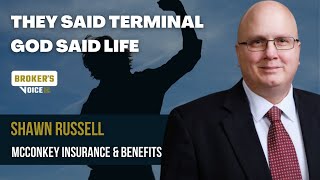
This YouTube interview (part of The Broker's Voice series) features Andy Neary interviewing Shawn Russell (employee benefits consultant, McConkey Insurance & Benefits) about Russell’s 2017 diagnosis of stage four prostate cancer and his subsequent recovery. Key points: Russell accessed a nurse-navigation program and a Johns Hopkins clinical trial, adopted rigorous lifestyle changes (plant-based diet, exercise, supplements, journaling), leaned on faith, entered remission within roughly six months, stayed on maintenance medication for about six years, and has since been taken off meds while remaining undetectable. He wrote a memoir titled "They Said Terminal. God Said Life" and now mentors other cancer patients; the book is available from major retailers.
Questions this video answers
2017
Stage four prostate cancer (with metastases to ribs, hip, spine).
Approximately six months.
About six years.
They Said Terminal. God Said Life.
Chapters
Hey.
Hey.
Andy Neary here. All right. We are revitalizing the Broker's Voice. If you've watched past episodes in the months in the last couple years, I was using our Broker's Voice to interview other industry professionals to talk about their journey in their insurance career. We have decided to make a really massive pivot to the Broker's Voice and share very inspiring stories from people within the industry. And so you can be on the lookout for these to come out every couple weeks, every month. And I'm going to be sitting down with some people who have persevered, some very big life challenges and are just inspirations to hopefully you and others who are watching these videos. So today I'm kicking off with one amazing human being. Sean Russell, employee benefit consultant with McConkey Insurance and Benefits. Sean, thank you for joining me on the Broker's Voice, man.
My pleasure, Andy. My pleasure.
So we're going to get to your story here in a second.
For those that who don't know who you are.
Your journey really started in 2017.
Describe Sean Russell prior to 2017.
Guy going through the motions, you know, has a decent job, family, home. Seems like everything should be okay. Not managing his stress too well, though. Worrying about his clients every night to the point where he can't sleep well, not taking care of himself physically the way he should, not eating the way I should.
Letting life kind of roll me over a little bit rather than me taking control of my life.
That's awesome. Thank you for sharing that.
So you. I said that's awesome because that's exactly where I was just a few years prior to 2017. Somebody going through the motions. Waking up every day felt like the same. Probably letting stress of the job get to me too much. Not enjoying the journey of it because of the stress and the anxiety.
But you were given a wake up call and that wake up call happened in 2017. Walk us through the beginning of that journey.
Sure.
Started waking up through the night unable to sleep, having back pain, rib pain, couldn't find a position to sleep where I could actually sleep through the night.
Kind of pushed it off for a while as being related to what I was going through through stress. My wife convinced me it'd be a good idea for me to see the doctor. Doctor sent me, local doctor, that is, to get a CT scan. And my world changed. I was diagnosed with stage four prostate cancer. Right out the gate, the cancer had already spread to my ribs, my hip, my spine. Went to a local oncologist. That local oncologist pulled out a Whiteboard, wrote down a few drugs, how many months they would last, and basically said, at that point, I'm out of time.
What was your mindset at that point? Here's a doctor basically saying, all right, stage four, which doesn't take a, a scientist to know that that's a very bad diagnosis. But here they are giving you a list of meds to go get and, and send you off your way. What was your mindset at that point?
Well, my wife and I are people of faith and we talked about it and we're also very determined people. And we said, that's not good enough. And I told my wife, I said, hey, I'm in benefits. I said, we have a patient navigators, part of our programs that, that we offer employees and we actually have access to it as well. And I said, I'm going to reach out to them and see if they can get me some recommendations on a center of excellence to get better, better care, if you will.
So called them. And the nurse said, oh, absolutely, you need to go to either Johns Hopkins, Sloan Kitterling, Mayo Clinic, somewhere that has the best tools available. Johns Hopkins was about an hour and a half from my house down the road. I said, let's get Hopkins. The nurse advocate went up and beyond. She actually contacted people she knew at Hopkins, gave them copies of my scans. They got me in to get biopsies within a couple weeks. Next thing you know, they're telling me, hey, we got a clinical trial that we think might be right for you. At the same time, I made a decision that I was going to do everything I could to live, and found a book called Radical Remission. In this book, it looks at people that beat the odds and what were the commonalities between those people. And I said, I'm going to do every one of them. And most of them were like, lifestyle changes, you know, making sure you exercise, eating mostly a plant based diet, figuring out a reason to live, not that you just don't want to die, and a better spiritual connection. And so I started embracing every single one of these fully and not like half heartedly. I went cold turkey. I'm like, bacon is no longer part of my life the next day. You know, I haven't had it for seven years. So did all of those things and amazingly within six months, I was in full remission. Now they kept me on maintenance meds for about six years and the latest change is now that they've taken me off of all cancer meds because I've been undetectable and all Scanned and all blood work, and they don't even know what to do with it because they have nobody like me that they can use as an example to say, hey, this is how long we do this, and then we know you're okay. So we're in a new terrain. But I'm believing that I'm going to be that guy who beat the odds, because that's what everything looks to be showing.
Well, there's. There's three components there that I want to dive into because I'm blown away by the fact that you went from stage four to remission and six months.
Yep.
I mean, that's, that's unbelievable. But let's not overlook where it started. You know, you said that, you know, Maconkie offers a nurse navigation program to its clients, but you as an employee also have access to the same program. Talk to, talk to us a little bit about how important that access was, because most employees, let's face it, when it comes to health insurance, they get access to a PPO network. They have no navigation support. How important was it, having that access to that tool?
It was huge because that clinical trial was giving me access to the latest breakthrough drugs that were coming out. In fact, I ended up talking to the local oncologist a couple years later, and he still didn't even know the name of the drug, even though it had been FDA approved after the trial that I was in. So he didn't even have the tools that Hopkins was already having years in advance. So getting access to the best care while you have as much time as possible is critical because too many people will go local until the doctor throws their hands up and says, I can't do anything more. Maybe you should try one of these other guys. I say give the best people all the time and all the tools they have to give you the best shot possible.
That's. That's awesome. How about the mindset, man? You know, I asked you about the Sean Russell prior to 2017. You know you're going on seven years in remission.
Yeah, I, I could no longer just go through the motions. I had to live my life fully alive, fully engaged. I. I took a plant based cooking course because I didn't know how to eat that way or how to cook that way. I did tons and tons of research, started looking up for, you know, not any random website that just says, hey, drink baking soda and stand on your head. But I found good clinical trials, peer reviewed college level papers on which nutrients were the most effective, and if there was good research to support It. I started incorporating those foods and those supplements into my routine. I also. Yeah, go ahead, Andy.
No, you're good. Keep going.
Okay. Yeah. And then I. I also said, you know what? There's better results for those that are physically active. So I'm like, I'm going to take responsibility. So I'm like, okay, this is hard, but I'm going to work out four or five times a week. And I've been doing it since. And everything improved. Not just the cancer, but cholesterol, blood sugar, energy levels. So everything in my health improved. And part of that was me taking responsibility.
I'm going to ask you a tough question. I don't mean to put you on the spot, but you. Okay, I heard three clear things. You've got access. Having good access to the right health care was key. Mental, the perseverance, mentally, to overcome a challenge like stage four cancer. And then you have the physical, the health, taking care of yourself physically. Can you point to any one of those? As man, that was the thing that sent me over the top in overcoming this. Or do you think it was a combination of all three of those that allowed you to have some. I'm going to call it miraculous. Six months out of stage four, do you think was a combination of all three that allowed you to create that kind of result, or was there one more than the other?
I'd say there was one additional, and that's going to be the spiritual side. I. I really felt like pressing into my faith gave me the strength to pull all the other components together, almost like it was like coordinating them and making them all weave together so that I had the strength mentally and physically and emotionally to. To. To do what I needed to do to get through this journey.
That's. That's. I think you said it well right there, because I see a lot of people, I've had family members go through, you know, cancer and illnesses like that. And I think a lot of it is, you know, there's a difference between somebody who says, woe is me and the person who says, I am going to make it through and I'm going to make any changes that I make, need to make to make sure this happens. And I think between what you've done mentally, physically, and now spiritually, I mean, it's almost like you're an unbeatable person today, man. I mean, I don't want to make you regurgitate something you said earlier. But describe Sean Russell today.
Well, today I have a greater level of empathy for patients on the healthcare plans that I Represent for my clients, because it's no longer just about thinking about how do I bring down the cost, but how do I make sure that those employees have the best possible care. And when somebody has a big claim, I don't go, oh, man, they're driving up costs. I go, oh, man, how can we make sure that person gets through this as well? So greater level of empathy.
I don't just go through the motions. Like I said, I live my life fully. I do the things I want to do, and I. I don't take it for granted. I love the people in my life.
And I try to help others. Since this journey, I wrote a book about my journey. And because of that book and other people that have heard about it, Cancer patients have reached out to me. And so far, I have never turned anyone away that's reached out. I talk to them on whatever level they're willing to connect with me, Whether it be the diet, the care, the spiritual side, Whatever they want to talk about. And my goal is to give them some tools that might help them have a better outcome than if they. They go into it without the right tools.
Talk about your book for a second, and I want you to hit it upon. Hit. Hit it upon two different angles, if you don't mind, Because I love how you came up with this. I won't spoil the title. I'll let you say it because it's such a great title. But you also talked about it came about the fact you were journaling. And I'd be curious to know what. How or what part journaling played in your journey to overcome cancer and how it led to you creating the title for the book. Saying the title of the book is so powerful.
Sure. Well, journaling was one of the keys that I had read about that people were able to do to help with their mental health and to kind of see the challenges they've already overcome on the cancer journey as it might have ups and downs. And personally, for me, I thought this might be something for my loved ones to see what was going on inside of me if the outcome wasn't what it is today. But ultimately, I had the victory. And that journal ended up becoming an outline for writing a book about what I was going through from day one until I was in remission.
The title of the book, because of the spiritual side of it, is they said terminal. God said life, because the original doctors said it was terminal. But God has said a different thing in my life, and I'm living life fully new.
That is unbelievable. I love what you Said to me offline, it's almost, I mean, your, your battle has been so victorious. Even your own doctors who worked on you are sending patients your way to talk to you about what you've done to overcome that.
That's correct. My, my local family doctor has seen it to be such an inspiration to certain patients that he knows that when he has someone that's newly diagnosed with cancer, he's like, hey, you got to reach out to Sean and he will tell you what he did. And the patients that I've talked to then are getting tools for their journey that help them. And he keeps doing it. It must be helping them have better outcomes because each time he has a new diagnosis, he says, hey, call Sean.
So that's phenomenal, man. I'm inspired just listening to you, I gotta be honest. And I've never had to come over, I never, I've never had to overcome a challenge as great as that. But I'm inspired, you know, and I want to ask two more questions as we kind of wrap up here about perseverance. You know, going through what you've gone through.
As you look ahead and, and, and deal with today's battles.
How is your view of perseverance different today than it was before? So if you over, if you encounter another challenge in today's life, could be personal or business, do you look at that battle or that challenge much differently today than you may have seven or eight years ago?
Oh, absolutely. It is now a molehill and no longer a mountain. When you think about problems of life and death versus, oh man, this is running a day behind or I'm stressed out a little bit, they don't even compare. So now when I have a problem, I have much better perspective. I don't allow it to eat me up inside. I break it into little bite sized pieces and tiny take care of it.
That's awesome. What advice would you give somebody else out there who might be listening, who is also going through a challenge? It could be cancer, it could be some other form of life challenge. What advice would you give that person?
Well, the, the key is the mind. I mean, if you have the mind that says, I can beat this, I can overcome this, that mind can then lead you to the different components you need for that journey. So it might be you need to improve your fitness, you need to improve your lifestyle, and it might be I need better doctors or I need better resources. So once your mind is clear, you can see a path forward and then you can embrace that path to have a better outcome.
Sean, I want to thank you for taking the time to do this. Like I said, we. We decided to kick off a series, an inspirational series around this. And I don't think there was a better way to do it than with you. You have a very inspiring story. Like I said, I am still absolutely amazed how quickly you overcame stage four. For some, I hate to use the phrase death sentence, you, what you've done to overcome that is pretty miraculous. And so if somebody's listening in number one, how can they get a copy of your book?
It's available. Amazon, Walmart, Barnes and Noble, any of the online places that you would buy books, you can order it there. If you're in a situation where you don't have the money and you really need it, you can email me and I would even send you a copy for free.
That was going to be the second way to reach out to you. The book again, guys, as they said, Terminal God Said Life by Sean Russell. I absolutely love that title. Sean, what's your email address if somebody.
Wanted to get in touch with Srulek McCuny.com awesome.
Well, Sean, thank you so much, man. This was phenomenal. Your story, I think, is going to be an inspiration for others who are tuning in. And I want to thank you again for committing the time and the willingness to share that story.
My pleasure, Andy. And thank you for sharing inspirational stories because, you know, finding the examples of others that have already paved the way makes it easier to believe it's possible.
Yeah, it's phenomenal. And for everybody else listening and look, be on the lookout for more of these in the future. There's a lot of good things going on in this industry from amazing human beings who have overcome a lot of challenges. Sean's just one we have. We're going to have so many more to share, so please tune in as we continue to roll out the 2.0 version of Broker's voice. Be good, take care of yourself. And Nishan's advice? Stay strong mentally, stay strong physically, and you can overcome any challenge and stay strong spiritually.
Thanks, Andy.
More from Andy




If you want producers to succeed faster, help them create a sales message that creates confidence.

Sales isn't a zero-sum game! You can have tough competition and still grab a beer after



Option 1: Meditation, a fast walk, a podcast, and protein. The ultimate morning routine!

How you do one thing is how you do everything. Ill elite producers fuel their body.


Stop living in the gray of maybe! Your job in sales is to get a clear yes or no