The Broker's Voice: Tommy Gaffney, VP National Sales - Evolved Benefits
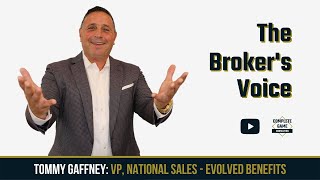
YouTube interview (The Broker's Voice) featuring Andy Neary and Tommy Gaffney (VP National Sales, Evolve Benefits). Tommy recounts entering insurance ~17 years ago, suffering a severe financial collapse that left him homeless in his car for four months, and rebuilding via business-reading, mentorship, and shifting into employee benefits. He explains Evolve Benefits' niche: ACA-compliant, low-cost plans for blue-collar employers with seasonal/variable-hour staff, plus expertise in government prevailing-wage and local wage ordinances. He positions Evolve as a broker partner that helps grow revenue, protect clients, and serve employees often excluded from major medical coverage; offers contact paths (website, LinkedIn).
Chapters
Hey, welcome back to the Broker's Voice. This week, I am super excited to have on Tommy Gaffney with Evolved Benefits. If you are unfamiliar with who the heck Evolved benefits is, you're going to find out very soon. But before we jump into this conversation, I got to make a quick plug for my guys at agencyanx. Listen, if you are an insurance agency and you were to look at your website today, is it look pretty good or because it use a tweak, an upgrade? If so, I want you to do yourself a favor and get a hold of the guys at Agency Annex. Steve Konka and his team built my website. I couldn't be happier about it. And they have an entire company dedicated to helping insurance agencies build websites that attract their best prospects. So do yourself a favor. Here's Steve's website right here. Steve's email address. Go email, email Steve today. Connect with him. He'll pitch in with an audit. Learn how you can upgrade that website so it starts selling more business for you today. All right, I'm excited to dive into this week's episode. Tommy and I were talking offline, and he's got some powerful stories that I'm excited to have him share with you guys. So, Tommy, welcome aboard.
Thanks, Andy. Appreciate it.
Yeah, man. You know, normally as I talk to you offline, I said one of the first questions I like to ask people I interview here on the Broker's Voice is how did you get in the industry? But where I actually want you to go is kind of a mix of how did you get in? Because you were doing something a little different in an other. In the other part of the insurance world.
I was.
But I also want you to talk about that first rock bottom moment you hit shortly after getting the industry. I thought that was so powerful. So let's talk about those early days, man.
Sure. Hey, thanks for having me on. And, you know, I tell you, anybody that's successful, they. They track their failures because failure is a huge part of success. I mean, look at all of Michael Jordan's missed jump shots compared to the amazing shots he made in clutch moments. So I got into the industry roughly 17 years ago in my first, I guess, gig was farmers insurance. I was young, ambitious, ready to do something different. And I, you know, a farmer's recruiter embraced me. We got fully licensed, and I went on the grind for, gosh, a little under three years, about two and a half years. And right around that moment, everyone in the USA remembers this thing called the house of cards fell. And that was everyone on A stated income loan. Once they got their, what they call their balloon interest rate, all of a sudden they couldn't afford to live in their homes. And many people lost their homes and even their cars and a lot of things. So within two months time, about 90% of my book vaporized. And I went from finally kind of getting on my feet and being able to have my own place to live and food in the fridge and I got a vehicle while I'm driving and all the things that we do and we evolve and grow.
Everything, it hit me really hard. So the result of that, long story short, I ended up having to leave farmers. I wrote them a check for $5,000 to cancel my contract in, in response to them wanting to loan me $150,000 only if I spent it their way. And so I decided not to do that. And I ended up being homeless, living out of my car for four months. What, what I had for myself was I had a $2 a day budget. I ate two Del Taco bean burritos every day. And I had a subscription to 24 Hour Fitness that I still to this day don't remember where I got that membership from, but that's where I was able to take a shower every day. I owned a couple bottles of Febreze spray and that was kind of my dry cleaning. I would spray my shirts and my pants off and I'd go in the steam room and whisk them around in between weekends at the laundromat. You know, part of the reason why I could only afford bean burritos because I had to have money for laundry, I had to have money for gas. And you know, at that time, Andy, I ended up having about what I call three and a half part time jobs just to keep everything going well, man. Wow.
When you shared that with me off offline, I was like, wow, I've heard some rock bottom stories in this industry, but to the point where you're living out of your car, showering at 24 Hour Fitness, if you're listening in, I hope you heard that. I mean, as an entrepreneur and whether you own your agency or your company or not, you're still an entrepreneur in a way, man, that's powerful. Tommy, thank you for sharing that. But here's what I loved about that same story. You hit rock bottom, but you also made a comeback. And let's start talking about the comeback. I mean, the fact, let me by me, don't want to cut you off. When you were living out of your car, showering at 24 Hour Fitness, Steam drying your clothes in the locker. Like, it would have been so easy to give up.
Sure.
But you didn't. So how. Where did you pivot and start to make that comeback?
You know, I gotta be honest, Andy. I didn't unders. I didn't realize how emotional I'd be feeling right now. Man, that was a tough time.
I tell you, living out of my car, I experienced a lot of anxiety. I don't know, there's a term that I. That I've learned called kind of like morbid reflection, where you, you know, you have these moments where you're thinking about all your mistakes, you're doubting your. And I tell you what saved my life is business books. I started really getting around successful people in the industry and really asking them, hey, what do you do on a daily basis? What are your disciplines? How did you start? Did you ever have any failures? And I never really let anybody know that I was asking that. I was living out of my car. I didn't want anybody to feel sorry for me. I was looking for real answers, and I was also not looking for an easy way out. I could have easily thrown my hands up in the air, went back to my old life, back when I found myself in a position where I realized I wanted more. I could have taken some warehouse job running a forklift or. Nothing against anybody that does that. That's not what I wanted for me, but I didn't do that. So I got to tell you this. I read business books. At least two a month. Right? Okay. And. And back when I was living in my car, I had this one guy, and. And. And, you know, I. I'm not sure what his. What the anonymity rules are in here, so I'll just say he's a guy that's still my mentor today, and he's very famous and he's very wealthy, but back then, he was building it himself, and he gave me some business books to read. And I'll never forget, in that four months, I'd be reading these books, crying, just. Yeah, man, it was. It was hard, man. But. But I would. I would look in, you know. You know how you have your. Your flap for the sun visor and there's a mirror there?
Yeah.
I would literally read something and not understand what these words meant. But I knew that this is the way you're supposed to talk. They call that vernacular. I would pause for a sec and look in that little mirror and just practice talking like that.
Wow.
You know, I just wanted this so.
Bad.
That Is phenomenal. I think everybody in their life probably has a rock bottom moment, some more severe and dramatic than others. But what I love about rock bottom moments, and I know you got a little choked up, was like, it's also what you use as fuel to drive you because you never want to go back there again. And so talk about, you know, you kind of made a pivot and decided to try this health insurance thing. Why did you want to get into the health insurance industry?
You know, great question. I'll never forget this. When I was still at Farmers, somehow, some way, an anthem Blue Cross rep got a hold of my contact information, invited me out to your Belinda to attend a meeting that she held at a Starbucks. I think like twice a month she had a standing meeting at the Starbucks. And anybody in the employee benefits world who wanted to come, she. She'd buy you coffee and give me an update. Me, I'm like, hey, let me go. You know, maybe I'll meet some people. And so I end up sitting next to this guy. This is funny because I ran into this guy 10 years later, and he was very successful at the time. He was in the beginning of his health insurance career, just like I was in the beginning of my personal lines career. And I remember hearing about health insurance, and then I remember looking at this guy and going, hey, man, what made you decide to go this route? And he goes, you know, I'll tell you, I've looked at everything and simply this type of business, aside from it being lucrative, it's a type of business that's family friendly. I operate during business hours. You're a farmer's guy. I guarantee you don't operate during business hours. And, you know, if that's cool with you, good. It's just not cool with me. And I'll never forget that made me think. And so once I. I had that huge failure at Farmers, I remember having that conversation with that guy, and I started really researching and getting involved in the health insurance world. And that's what kind of got me here. I had a career at colonial Life, and I did very well. Received awards and, you know, blah, blah, blah, blah, all that kind of stuff. And. But my journey in colonial life, in order to get good at implementing voluntary benefits in an open enrollment at a major medical scenario, you have to know exactly how that major medical plan works in order for you to find out where those products fit. So I found myself actually knowing the benefit plan designs way better than the brokers that were inviting me to the enrollment meetings. And I'm like, Wait a minute. This person's making all this money and I know their own information better than them. I was not even mad at them. I'm like, what the heck am I doing wrong? And so Andy, that's, that's really what kind of like the light bulb went off. I'm like, you know what? This is such a journey now. Operation. Let's, let's start getting better at health insurance. And that's kind of how that started.
Yeah. Thank you for sharing, man. You brought back memories for me because I started my career in the financial planning and outside of sucking at it horribly, I didn't like having to go sit at kitchen tables at 6 o' clock at night. And I decided to make a move to more business insurance, both property and casualty and health insurance at the beginning. But it allowed me to operate during business hours. That was definitely one of the big reasons I made that move. So I appreciate you saying that. And you're talking about. It's funny, I talked to so many carrier reps that eventually make the leap. And a common reason is I was sitting there watching these brokers make all this money and I'm like, I know they're playing their stuff better than they do. If they can do it, I can do it. And so it's funny you bring that up. Okay, so let's fast forward.
Sure.
We're blessed that you're in the industry because that was one hell of a story. And if you're listening and you have had that rock bottom moment, I hope you can appreciate what Tommy talked about. So here we are, Tommy, it's 2021. You're at Evolve Benefits and you guys are doing some really cool things. And I'm guessing there's not a enough brokers out there who know about Evolve Benefits. Tell us about what the heck you guys are up to.
Yeah, absolutely. Thank you. So Evolve Benefits, what we are is we are a niche GA and we specialize in the employee benefit space, but everything outside of major medical, we specialize in ACA compliant plans that are really targeted towards the blue collar companies out there that have large populations of variable hour seasonal low income employees that just cannot afford to be on a major medical plan. And the struggle across the nation, especially post pandemic, a lot of these companies, the lifeblood of their population, if you look at it, most of it is part time, seasonal, variable hour. You got home health care, hospitality, restaurants, et cetera. They're really looking for people to first of all get off unemployment and come back to work. But they really need these folks healthy. It's not just physical health that's important anymore. Mental health is a big ticket item. And so we provide very affordable solutions for employees in this status to access all the acute services they need for physical and mental health. And then we also specialize in a few other areas that not a lot of brokers are savvy in, and that is government contracting, Davis Bacon act, prevailing wage, and also special wage ordinances. Like, if anyone listening here is up in the Bay Area, up in San Francisco, I'm sure you're aware of the healthcare security ordinance, or it's coined the hcso. We're subject matter experts in these type of areas. And across the nation, not everybody knows really how to talk about this particular solution. Andy and I believe that's our first barrier to entry is first of all just doing, making a valiant effort at having conversations with brokers and really just helping them at their own pace and in their own type of way just understand what our solution is so that they can now cast a net over the entire employee population. A lot of major medical brokers, if they look at their book, they'll find out that with a 22 Life Group, there was actually 179 employees on the roster. What are we doing with those employees? Not a lot of people know how to answer that question. And so, you know, in a nutshell, Evolve Benefits is here to serve that particular population. And it's also a really great retention tool for any broker out there. I mean, essentially, if you want to know what our purpose is, we help brokers grow their book, increase.
New and more important, the huge.
Hey, Tommy, My Internet.
Might have froze Andy.
Tommy, we repeat, repeat that real quick. You, you went over two or three things you help brokers do. Could you repeat that?
Hey, Andy, can you hear me?
Yes.
Can you hear me okay? Yeah.
Yes, I can. You had mentioned. Okay, there's two or two or three things you help brokers do. What are those two or three things?
Yeah, absolutely. So we, first and foremost, we help brokers increase their book of business, grow their revenue, and most importantly, third thing, we help them build a fortress around and protect their most important clients by help them cast a net over the entire population. You know, I can't even count on my fingers now on a weekly basis how many incoming calls I get from brokers and agencies asking us to teach them how to have this conversation because they are on a prospecting mission and they're looking for a wedge in. And this is an amazing wedge in for particular industries where these Companies exist. There's nobody else that has this conversation like we do. And so we're agnostic. I'll work with anybody, you know, anybody that invites us to the dance, we're going to the dance and we're going to do a needs analysis with that company and find out how we can get these employees access to the care that they need.
Well, and I think it's important for brokers to understand, number one, it's an opportunity to grow your revenue without having to write new business, write new accounts. Number two, there is this problem in our industry that if you're unfamiliar with a product or an opportunity, you don't talk about it. Therefore you miss out on an opportunity to grow your revenue. And to your point, I saw it all the time. I laugh when I hear agencies and producers talk about, oh, I wrote a 100 life case. Well, how many were actually on the plan? 25. The problem with those accounts, if you're not leveraging programs like you have it evolved, is you now have a group that you're getting paid to for a group of 22. But I'm willing to bet you're doing the work of a hundred.
Correct.
And so have it. Having a partner like you is huge because it's an opportunity to bring value to that group and grow your revenue.
Yeah. And Andy, let's be honest, you've been, you've been on the other side, just as I have. What one thing you need less of is another carrier inundating you with making it just a monumental task to implement their products. I know this. I used to be a broker. I've been on the carrier side, the GA side. I don't want to say I've seen it all, but I've seen a lot. And so I understand that and I'm empathetic to that. I believe the biggest advantage and the biggest value I believe we bring to brokers and groups is our backend administration. Our in house TPA does all of the heavy lifting. Our software, there's nobody out there who has invested the millions that we have in our software. It's a proprietary software built specifically to handle high turnover industries and we make it very easy to do business with us, not only to implement on the front end, but we have a huge customer service department. We're very hands on, bilingual, very friendly and our employer portal and employee portal is very user friendly. Everything we do is always considering the end user, which is the employee. And I know not a lot of people do that, but that's exactly where we start. We want to really consider what's the experience the employee is going to have. What's the experience that the employer is going to have by having to implement this into their company because they already have a major medical plan in place. And of course, what's the experience the broker is going to have. We considered all of those things. We reversed engineered from that experience to where we are right now. And I believe that's why we're so successful.
Well, and just to repeat what you said earlier, when we think of the, if you're a broker going, okay, what kind of industries does this apply to? Restaurants, home healthcare? Heck, let's be honest, cannabis is becoming a more and more popular industry. You got seasonal type work, landscapers, you name it. Where there's seasonal variable hour work, this is a huge opportunity and there's more and more of those types of businesses around. And I know Tommy, you guys are based out of San Diego, but you work with brokers all over the country, right?
Correction. Wide. And you know, I think one of the misconceptions is when you look at the rates of our plan C in the major medical world, brokers are used to getting paid a particular percent commission on the premium. And so when you first get a look at how low cost our plans are from that state of mind, you're like, what am I going to get a 42 cent commission check? Like I used to in the dental days when I sold a one life dental group. It, it's very. So.
You know.
So.
Looking at this from an altruistic point of view, you know, once we do the right thing.
And do a needs, keep going.
Okay, so once we do a needs analysis and we work with one of these groups where we do have that delta and we end up enrolling 60, 70, 100 employees in these plans, you'll find out that our commissions are on par and in those scenarios actually outpace the major medical commissions that brokers are used to receiving.
Well, yeah, and, and so let's, let's wrap up here because I think again, when I coach the, the agencies and advisors I work with, I see there's a huge missed opportunity, whether it's in voluntary benefits or whether it's in, you know, a niche market like yours where you're serving those industries where there's a lot of seasonal variable part time. If you could pull out your crystal ball, Tommy, and kind of just put your thought leadership glasses on for a second, where do you see our industry going in the next three to four years? If I were to ask you Give me one piece of advice you throw out at brokers today. What would that be?
Great question. If I had a crystal ball, gosh, life would be great if I had that. If I could use that crystal ball and rub it right now, I'd say the industry is evolving as we speak. The pandemic had a huge effect on the way everyone does everything, including what we're doing right now. Virtually most of the world has adopted a virtual way of doing things. So I'm going to see a lot of entrepreneurs and more on the rise coming up with solutions that can be handled virtually. I see a lot of different self funding, self funded type of scenarios being looked at. Not just at the 5,000, 10,000 employee level, but down to the, you know, the 100 life employee level. See a lot of self funding and I also see solutions like ours, you know, that are outside of the box and really attract, and really attract these blue collar companies who are, I mean, come on, we've all, we've all worked for a living. We know that in America the blue collar companies across the boards are a huge part of our nation's success. And so they're the ones that need the most help across the board. So I see, I see a lot of entrepreneurs, you know, coming out of, coming out of this and you know, Andy, you mentioned in that comment before, you asked a question that you know, all the brokers you work with. Hey buddy, you know, you've been my coach for the last 90 days and I never knew I could really do a as good of a job making an impact with brokers through the, the techniques that you have taught me to reach out. It's not, it's not about reaching out, just to reach out. I have a message, I have a compelling story and you really helped me create a workflow and design a very reliable daily system that really takes the whole cold, cold, cold part of the cold. Calling, cold, calling out. I really feel like every phone call I make, man, it's lukewarm or warmer. And I appreciate you.
It's my pleasure, man. Thank you. I don't usually ask people to make the coaching plugs, but I appreciate everything you just said and fine. By the way, if you do have a chance, go check out Tommy on LinkedIn. He's creating great content now. His videos are on par. Reach out to him, connect to him. Tommy, what is, what are the best ways if I'm a broker, I'm watching this and I'm going, I've got a lot of restaurants or, or home health Care or income clients where there is a seasonable variable employee base. And I know I'm not leveraging that opportunity. What are the best ways to reach out and connect with you?
Best ways is we have a, a website, evolved benefits.com. there's a. Com, there's a contact page on there. You can always look me up on LinkedIn.
I believe my profile is Thomas Gaffney or T. Gaffney. 33. 33 is my number. And you, you can also find me on LinkedIn through the contact. If you use Sales Navigator, you'll find my phone number on there and everything. And I'm very easy to reach. I make myself very easy, easy to find. Those are probably the best ways. You know, if I could just say one more quick thing, Andy, kind of coattailing off something we talked about earlier is, you know, any of the listeners out there, hey, if you're new to this business or if you had a failure similar to Andy and I, and you're just crushed and you're rock bottom, reach out, man. I'll have that conversation with you and, and we'll talk through this and we'll get through this if you're in that position. But you really want this thing, but it just seems like it's hopeless. It's not reach out. I'll have a conversation with you on a Saturday, Sunday. I don't care.
That that's really important to me. I'll open my door to anybody that.
Wants to love that. Tommy, I love that. That's what this industry is about, is about giving and pushing others forward and pushing others up. So also, if you want to reach out, Tommy's emails right here, I put it on, put it out there. Hey, if you're listening in, you're a broker, partner of the industry right now. I hope you were inspired by Tommy's story. We've all been there, we've all had our rock bottom moments, different versions of it. And so keep fighting, keep pushing on. And like, again, if you know you might be missing out on some opportunities with your clients where you've got these groups that are, you know, have a ton of part time, variable hour type employees. Leverage, evolve, benefits, leverage, voluntary benefits. Guys, these are missed opportunities. You're, you're missing out there just because you're not talking about them. So, Tommy, want to thank you for your time today.
Looks like Tommy froze again. I'll wrap it up here. Hey, if you're a broker, you're listening in. You know what happens when clarity and confidence collide? Massive action happens. Go make it happen today.
More from Andy




If you want producers to succeed faster, help them create a sales message that creates confidence.

Sales isn't a zero-sum game! You can have tough competition and still grab a beer after



Option 1: Meditation, a fast walk, a podcast, and protein. The ultimate morning routine!

How you do one thing is how you do everything. Ill elite producers fuel their body.


Stop living in the gray of maybe! Your job in sales is to get a clear yes or no