The Insurance Agent Sales Playbook: The 3-Step Process To Go From Unknown To Unstoppable
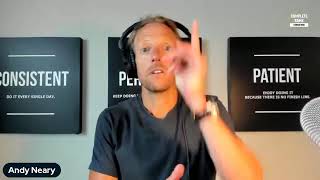
Andy Neary (speaker) delivers a ~30–35 minute keynote aimed at insurance professionals explaining how to go "from unknown to unstoppable." He argues the main barrier is lack of attention and prescribes gaining attention through confidence and consistency (and patience). He introduces Complete Game Consulting's marketing playbook (four phases: Clarity, Capture, Content, Convert—focus in this talk on Clarity and Capture/Content), practical tools including the Five-Star Prospect Profile (who/why/problem/process/result), the Story-Selling/Brand Script framework (position prospect as hero; advisor as guide), and the Triple Crown of Exponential Awareness (what/message, how/format, where/channels). He gives tactical guidance (focus on psychographics, create exponential rather than linear awareness via public speaking, social posts, webinars, email, podcasts) and a statistic: it now takes ~18 phone calls to reach one prospect. He closes with a call to action to connect on LinkedIn and an invitation to an upcoming academy in mid-August.
Questions this video answers
It takes 18 phone calls today to reach one prospect.
Clarity; Capture; Content; Convert.
Who are you talking to? What are you saying to them? Where are you saying it?
Chapters
Hey. Hey. Hello everybody. I apologize, I am eight minutes late here. That's on me. Had some technical difficulties getting this set up, but welcome. If you are joining me here on LinkedIn right now, you happen to see me in your feed, I hope you stay a few minutes because I'm about to deliver our my one of my signature keynote talks. The Insurance Agent Sales Playbook Three Step process to go from unknown to unstuck Stoppable. I'm going to go for probably 30, 35 minutes, but what I wanted to share with you is some content that I think is going to be super helpful for you. So if you are an insurance professional, whether you sell health insurance, commercial in risk insurance, life insurance, disability insurance, doesn't matter where you just came out of halftime, we've got six months to go. Now if you are well above your goals right now, keep doing what you're doing. But if you're sitting there going, okay, I'm still on my goals but I'm feeling the pressure. Or worse yet, I am way behind my goals and I've got to figure out what to do between now and the end of the year. You're going to want to listen into this because what I'm going to share with you guys is.
A message that you need to hear right now. And it's a message not enough folks in the insurance industry are sharing with you.
Now. In order for you to have success.
The final six months of the year, I am going to use the wise words of the wall behind me. You need to be consistent, you need to be persistent. But most important, you need to be patient. I know that sounds hard, especially with six months to go, but you have to bring confidence and patience to your strategy. The second you lean into desperation, it gets ugly. And so what I'm going to share with you is three steps to help you go from unknown to unstoppable. Now I am going to.
Share my screen because I am going to go through some slides with you. So let's talk about the three step process to go from unknown to unstoppable. Before I dive in though, here's what I want to remind you. If you are in the insurance industry right now, I want you to recognize how important your job is.
Because it is easy to feel like you are in a thankless job right now. I know that's how I felt many times in my career. Think about it. Especially if you're in the health insurance industry, right? Every year you're probably delivering some form of bad news, right? And you often can Feel like your ability to complete the mundane day to day activities for your prospects and clients is more appreciated than the advice you're giving. But I want to remind you real quick how important your advice is.
Your advice can help keep a business's doors open. Your advice can help an individual avoid filing bankruptcy. Your advice can literally be the difference between somebody getting the health care they need or waiting until it's too late. Your advice matters. Now here is what I'm going to ask you to do.
I need you to get more attention with the advice you're given.
The only thing that is keeping you and your business from reaching its full potential.
Is not enough. People know you exist. You're not getting enough tension with the advice you're given. And today I'm going to teach you how to do it. However, getting attention requires two things.
It requires confidence and consistency.
Now I'm on stage teaching you how to grab attention. But my goal in the next 35 minutes is to get yours. You see, when I was a kid.
I hated attention.
And when you look at this photo.
You could see why. Yeah, I was a chunky kid. Most of the attention I got was negative. Kids picked on me. Girls were definitely not attracted to me. And before mental health was a mainstream issue, companies like Levi's made it very clear they had built a gene size just for me. Size husky.
And as a kid, I avoided attention at all cost. Those glasses you see me wearing? Yeah, they were thick enough to burn ants. I was the only basketball player in seventh grade to make the E A team wearing B cups. All the attention was on me. But all I wanted to do was be anybody but me. My enemy in grade school was not the bully on the playground. No, it was the annual Presidential Fitness test. And if you're old enough, you remember the annual Presidential Fitness test. Maybe they still do it today. I don't know. I can remember walking into the gym at Park Lawn elementary and you'd see the pull up bar, sit and reach, box ropes hanging from the ceiling. And I can remember sweat would just come down pouring down my face because I knew what lie ahead. I could barely do any push ups. I couldn't do any pull ups. My sit and reach could be measured in inches or excuse me, centimeters, not inches. I didn't really know how to jump rope and climb the rope. Hell no. And again, all the attention was on me. And all I wanted to do was be anybody but me. Kids mocked, kids laughed. And when I look back at my childhood.
It was easy to look past me.
I was a complete unknown because I avoided attention at all costs, because all I wanted to do is fit in.
And that's what I want to talk to you about today. Because I, as a kid, I was full of potential, but I was nowhere close to reaching it.
And that's where your business exists right now. Your business. You are full of potential.
But you know you haven't achieved it yet. And I'm going to tell you, the secret to reaching your full potential starts with getting more attention. Now, as I said earlier, getting more attention requires confidence and consistency. And this is a problem in our industry.
Far too many advisors walk into the insurance industry fired up and two years later leave burnt out and dejected. Why? Because nobody's helping them.
Our industry has some challenges right now. Number one, we lack patience.
We want to take what somebody has learned in nine years and we want to apply it. Nine weeks. Hell, nine days.
Right? I know when I was early in my career, the only thing I ever reached was the end of my guaranteed salary because I wasn't patient. All I wanted to do was fit in. So one of the biggest challenges we have in the insurance industry is we lack patience. The second challenge, and possibly the biggest challenge, is training in this industry is outdated.
I was giving a keynote talk last fall in Salt Lake City at an industry event. And I can remember standing in the front of the room and I looked to my left and there was a gentleman sitting over there who looked to be in his early 70s. And I said, sir, how long have you been in the industry? Kind of sat up straight, proudly said, 45 years. Said, when you got in the business 45 years ago, how were you trained to sell insurance? He said, I was given a desk, a phone book, and a plan to go door to door.
Just as I thought he would say. I turned my attention to the senator room. Right in front of me is a young woman, probably in her late 20s, early 30s. I said, Ma', am, how long you been in the industry? Said, three years. So when you got in the industry.
How were you trained three years ago?
Her answer wasn't all that different than his. That's a problem. You see, the reason we're not adapting, the reason we're not training people how to win in 2023, is we fear our own change. Just like you get frustrated with your prospects fear of change, you fear change. We know the way we sell has changed. We know the pandemic has changed everything, yet we don't want to change. Why? We're not consistent and we lack confidence. We're too afraid to put ourselves out there for fear of what people might say.
That's how I live my life. As a kid. I feared judgment, I feared comparison and I feared failure. And that is where you are sitting today. The secret to hitting your goals, to blowing your goals out of water, is getting more attention. But you're too afraid to do it because you fear judgment, comparison and failure. And when you mix that with a lack of patience and a poor foundation of training, how are you ever going to hit your goal? Now, here are some other challenges I see in the industry right now when it comes to what we are doing to go get attention from our prospects. Number one.
We'Re trying to go after anybody. And the reality is if you try to speak to everyone, you end up speaking to no one.
You do not have a clear picture of who your ideal prospect is. Right now. You're just trying to spray and pray a message. Any which direction you can hoping is it lands on the person at the right time. You can't do that. You have got to get clear about who you're going after.
Number two.
The majority of your prospecting today is still too heavy on direct marketing.
Historically, this is how the insurance industry has prospected. Go buy a big list of leads and then just punch them with phone calls and emails and phone calls and emails telling them how great we are over and over and over again.
And at the end of the day, nobody's listening, nobody cares. And you are a complete unknown in your market.
Now.
2020 changed everything.
The way we prospect changed forever three years ago.
It is not as easy to cold call anymore. It is not as easy to build a relationship as it used to be. But if we still keep applying the tactics and the strategies we used in 1995, they're not going to be effective. Here's a, here's a statistic. It takes 18 phone calls today to reach one prospect. I want you to think about this for a second. That means it takes 180 phone calls to reach 10 prospects. If you're a speedy cold caller and you can hit a call every two minutes with voice messages, it's still going to take six hours to reach 10 people.
And this is where I stood early in my career. For the first 10 years of my insurance career, I sucked. Why? Because all I wanted to do was fit in. I didn't want to stand out. I wasn't grabbing any attention. I feared judgment. I feared comparison. I feared failure. I had no tools, I had no training and I felt like an absolute failure. And I was doing anything but stand out.
Now what changed my career forever was moving to Colorado in 2014 because I realized I have to leverage a strategy, a better game plan to get attention.
And that's when I landed on what we call today a complete game consulting. The complete game Game marketing playbook. And the playbook has four phases. Clarity.
Capture, content and convert. Now, today I'm just going to cover clarity and capture, clarity and content.
But here's what I'm going to share with you when it comes to marketing prospecting. An effective prospecting game plan comes down to three questions.
Who are you talking to? What are you saying to them? And where are you saying it?
So let me share my story with you. It's 2014. Amy and I decided we're moved to Colorado. So off we go. May of 2014, I go to work for an independent agency in Colorado. And about two to three weeks in my role as a producer, I realized I had a problem.
I'm responsible for selling. I work for an agency that hasn't had to use marketing. And I'm in a market where nobody knows who I am. Oh, crap.
And at that point, I had a choice. I could do it the way I was taught, which is smile and dial, go pound the pavement.
Or I can try something different.
And what I decided to do was try something different. And what I did was I started going outside the industry.
To learn what other industries were doing with marketing.
And that's when I realized that social media marketing is actually a good idea. I learned how to run webinars more effectively. I learned how to run email campaigns more effectively. Public speaking is actually a thing if you put enough time into it. And I've leveraged all these different strategies and I brought them back in. Now that took a few years. Those first couple years in Colorado. Here was my problem.
When I went into the market, all I wanted to do was puke my knowledge all over my prospects because I thought I had a competitive advantage. I had been doing self funding for years. The the Colorado market was still fairly new. I'm just going to leverage that advantage. And off I went, puking on my prospects. But guess what happened? I got a lot of good first meetings, never went to meeting number two. And I was frustrated because I was like, what in the world is happening? I'm smart. Don't they get it? Why don't they want to move forward with me?
And here's where I realized my biggest problem is I was talking to the wrong people. These people weren't interested. I Was just trying to talk to anybody. So I had to sit down and I had to get really clear. And the lesson I learned my first year, two years in Colorado, is when your ideal prospect is clear, your path to exponential growth is near.
So here's what I did. I'm going to walk you through an exercise we do today at Complete Game Consulting. We call it the five star prospect profile. Today I sat down and I said, all right, I'm managing this book of business. Who.
Is my favorite client today?
So I looked at my book and I said, which client lets me do my best work? Which client.
Is the one client I wish I could replicate and make every client look like that. So took a look at my book, picked it out, because here's the reality. Look at your book of business right now. There is a favorite client. There is a client you love the best because they let you do your best work. And I will be very clear about this. I know I get resistance with this. I'd rather have a half million dollar book of people working with people I love versus a million dollar book of business where half my clients frustrate the living hell out of me. But get clear on who your favorite client is. Now, question two, you gotta answer, why are they your favorite?
The only answer you can't give is, because I make the most money on them.
You see, no. When you sit down and you ask yourself the question, why are they your favorite client? And I'm gonna actually pull up a different presentation here because I actually realized I have the wrong presentation up as I walk through this.
You have to answer three questions.
When you answer why they are your favorite client. There's two ways to answer this question. You've got demographics and you've got psychographics.
Now, you and I have been taught how to identify an ideal prospect, demographically. Size, location, number of employees, revenue, you name it, industry. But demographics alone cannot identify your favorite client. Here's why I have never had a broker say to me, andy, my favorite client is ABC Manufacturing because they're a manufacturer with 75 employees. Owner is kind of a jerk. They don't listen to anything I suggest they do. They kind of treat me like crap, to be honest with you. They're not respectful. But they, they're my favorite because they're a manufacturer. 75 employees said, nobody ever.
You see, the gold is uncovering the psychographics. The reason they're your favorite client is because of the psychographics, because of who they are, what they stand for, what they believe in, how they View your products, you sell.
You see, if you look at your best clients right now, the reason they're your best is because you are psychographically aligned. You believe what they believe. When it comes to what you sell, they stand for the same things. Now, I'm not saying politically and religiously. I'm saying they just are people you align with. That's why they're your favorite. And the punchline is they let you do your best work. Your job is to go find more people who let you do your best work. So what other questions do you have to answer? Well, what's your problem? You solve for what is the one problem that lights you up? What is the one problem when you encounter you're like, yeah, I'm about to enter my zone of genius. Well, Andy, I know we solve a lot of problems. Yeah, I get it. What's the one that lights you up? What's the one that's going to make you sit in your zone of genius, let you do your best work? That's what you got to figure out.
Then you got to ask the question, what's your process for solving it?
You and your team have to come up with some form of repeatable sales process that you can rinse and repeat to help your ideal clients win. This is a game changer because even in the insurance industry, which has been very product focused, you're not selling products, you're selling a process. And when you start selling a process, what happens is you start interviewing your prospects.
For the process. And you interview them as much as they're interviewing you. So what's your process for solving the problem, and what is the result your process creates? You see, this is the five star prospect profile. Who is your ideal prospect? Why? What are their psychographics? What's the problem you solve, what's the process you use, and what's the result it creates that sets the tone for your marketing message, your prospecting message. That message can drive your LinkedIn, it can drive your emails, your webinars, even your cold calls.
Because at the end of the day, here is the truth. The riches are in the psychographic niches.
So you need to get very clear about who are you talking to.
And what are you saying to them.
Talk about the problems, talk about their goals, talk about your solution, your. Your process, talk about the results. But most importantly, use your prospecting message to tell their story, not yours. Nobody cares how long you've been in business. Nobody cares what year you were founded. Nobody cares about all the preferred arrangements you have with carriers. Nobody cares. Tell their story.
Now.
When it comes to what are you saying.
You gotta be able to tell stories. And the book that changed my career was Building a story Brand written by Donald Miller. I read the book six, seven years ago. I fell in love with it so much I became a certified guide by Story brand. And we call the process the brand Script Story Selling Formula. See, every story ever written has been told this way. A There's a hero who has a goal but has a problem that needs a guide with a plan, a process to avoid failure and have success. Your marketing message has to tell this story. But here's the key. Because this is a problem in the industry, you are not the hero. Your prospect's the hero. You are just the guide. Tell the hero's journey. This is how you write good marketing content. Whether it's in an email, on a marketing slick, in a webinar, on stage, in your podcast, in a video. I don't care. You gotta follow the story selling formula because here's the reality. The right message directed at the right prospect will lead to more wins with fewer prospects. Yes, when you bring the right prospects into your orbit.
Your sales conversation is going to be a heck of a lot better.
Pushing them to the finish line is going to be a heck of a lot easier. You're actually going to win with fewer prospects in your pipeline.
It's quality over quantity.
Now let's answer the question. Where.
Are you going to say this?
Let me share a story with you. It's 2017.
This was my battle. Remember, I'm in Colorado. About three years into my producing career. I've started to build a nice book, but I wanted to take it to the next level. So in 2016, I made a big investment. I invested in my speaking career. First thing I did is I signed up for the National Speakers Association Colorado Chapter Speaker Academy six month program. Teach you how to speak and run a speaking business. Second thing I did is I hire a speaking coach.
So I went heavy on public speaking and then I started going after speaking opportunities in the industry. Fast forward January 2017, I'm picked to speak at a benefits conference in Denver. Truth be told, don't know much about the event, but I saw it was a benefits event. I wanted to speak, so I put my hat in the ring. I got picked. So on a cold January morning, I drive down from Fort Collins through the traffic to south Denver, get to the event. I'm getting ushered into the breakout room. And as people start coming in, I'm setting up my stuff and I'm welcoming and introducing myself to everybody. And as the 9th and 10th person come into the room, they shut the door, and I'm like, what Now? I'm disappointed. I'm like, really? I came down here through traffic just to talk to 10 people.
So I walk over to the corner of the room.
Give myself a little pep talk. Said, hey, man, you want a public speak? This is what you want to do. Let's get going. So I delivered my talk on how to build a better health plan for less money. And when the talk was over, I start putting my stuff away, and one of the attendees walks up. He says, hey, man, that was a really good talk. We've never heard somebody talk about health insurance that way.
Like to have you meet with my team. So said, sure. And he hands me his business card. Now, the name on his card isn't going to mean anything to you. Its name is Duncan McCalef, and he was the director of Total Rewards. But the company he worked for will make a lot of sense because he worked for a little Fortune 50 company called PepsiCo with 50,000 employees. Now, there is a sad ending of the story, because I did not win that account because I know where your head's at. Because I was too small, they contractually couldn't work with an independent agency like me. But I learned a very important lesson. I said, huh?
The right message directed at the right prospect.
Just got the attention of a Fortune 50 company.
What else could I do?
And that's when I leaned into a concept today that we call exponential awareness. You see, when it comes to your prospecting, you need to spend the majority of your time creating exponential awareness because it leads to exponential growth. How do you do it? We call it the Triple Crown of Exponential awareness. Yes. I'm a baseball guy, so there is a lot of baseball themes in this thing. All right, what does that mean? What is the Triple Crown? Well, number one.
What are you saying?
What are you saying to your prospect?
Talked about using the story selling formula. Two, how are you saying it? Are you going to be using email? Are you going to be using the written word, video, audio? How are you going to say it?
And then the third part of Triple Crown is the where. What channels are you going to use? Are you going to be on social media? Are you going to put the message on in email and public speaking and webinars and podcasts? My answer is, you should be on all of them. Put it on a YouTube channel. I don't have YouTube on that list. Why? Because that is exponential awareness, that is getting one message in front of a lot of people at one time. Let me do the math for you. If you pick up the phone and make a hundred phone calls today, how many prospects can you reach? A hundred. That is a linear awareness. Every time I make a call, I can only reach one person.
If I send out one email to a prospect at a time, I can only reach one prospect at a time.
But if I use these channels, one LinkedIn post can get thousands of views. One email can go out to hundreds of prospects. I can stand on stage in front of hundreds of people. I can do a webinar for dozens of people. My podcast can get hundreds of downloads. That's exponential awareness. That's how you get a lot of people to know you fast. And it creates name recognition. And that is the name of the game. It is no longer about your Rolodex and who you know, it's about who knows you. So that's my challenge for you, is where are you going to put this message? Outside of the traditional phone call, outside of the traditional direct email, and outside of the, dare I say, door to door.
Because here's the reality.
Consistent content creates consistent connections, and consistent connections create consistent clients.
Let me go back to the two words I used at the beginning of this talk.
Confidence and consistency.
The reason.
You'Re not reaching your full potential in businesses, you're not consistent enough and you're not confident.
And if growing your business requires attention.
A lack of consistency and a lack of confidence are going to be big time hurdles.
Your job is to show up every day.
Your job is to show up with confidence that you can help people solve their problems. But at the end of the day, this is a game of attention. Your prospects cannot buy what they can't see. And if they can't see you, they don't know you exist.
Take it from the fat kid who hated attention because it was always negative.
Attention is the oxygen to your business today. Without it, you can't survive. But it requires you to show up every day with content and it requires you to do it with the confidence that you are creating impact.
And one thing I can tell you from somebody who has experienced it is when you focus on content that focuses on impact, that the income will follow.
But my challenge to you is, are you going to be consistent enough? Are you going to do it every single day? Are you going to be persistent? Are you going to keep doing it when everybody else quits? And are you going to be patient? Are you going to enjoy the process?
If Anybody asks what has helped Complete Game grow the way it has for the last two years, I just turn around because that is it right there. And that's what your business needs. So I hope today was helpful. I hope today I gave you permission to say, damn it, I know I should be doing more to grow my business. But you know what? I'm doing a little much sitting in the weeds because I don't want to get any attention. I'm doing a little much in the weeds because I don't want to be annoying.
All right? But nobody sees you, therefore nobody's going to buy from you. And I know what we do here at Complete Game Consulting is not traditional. There is nothing traditional about our training. But it's what works in 2023. Now here's what I urge you to do. If you're sitting there and you say, all righty, you've sold me, I get it. Got a little fire lit under my butt right now and I need to get going. But where the heck do I start? Here's what I urge you to do. I'm on LinkedIn Live right now. You see my profile? Go right to my profile. If you're not connected with me, connect with me. If you are, send me a message. Let's schedule a call. We've got our next academy coming up, Starting on think August 16th, 17th, sometime around there.
Let's see if we can help. All you are missing right now is a plan. All you are missing right now is clarity. Because if you know exactly what you're going to do every day to be consistent, be persistent, you're going to have confidence. You're just missing a good process. You're just missing a good plan. So go connect with me on LinkedIn. If we're not connected, if we are, shoot me a message. Even if we're not connected, shoot me a message. Let's get a call. There is a link in my profile to schedule a strategy call. Because time is ticking.
You're not hitting your full potential when you should be. You're too damn good not to get the results you're not getting.
So go schedule a call. But at a minimum, take what you learned today. I'm giving you permission to put yourself out there. Your business needs attention.
Who are you talking to? What are you saying to them? And where are you saying it? So here's to an amazing second half of the year. You just came out of the locker room, hopefully made some halftime adjustments. Now it's go time. If you know you need help, we're here to help. Go schedule your call. Otherwise, I wish you the best final six months of your career. But again, do the things you can control. Be consistent. Be persistent. Be patient. Peace.
More from Andy




If you want producers to succeed faster, help them create a sales message that creates confidence.

Sales isn't a zero-sum game! You can have tough competition and still grab a beer after



Option 1: Meditation, a fast walk, a podcast, and protein. The ultimate morning routine!

How you do one thing is how you do everything. Ill elite producers fuel their body.


Stop living in the gray of maybe! Your job in sales is to get a clear yes or no