The Workers' Comp "Wedge": How to Win The Whole Book Of Business
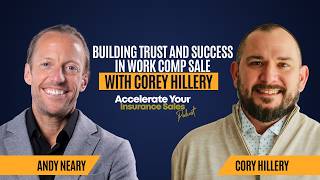
Corey Hillary, director of business development at WA Group, explains how workers' comp can be a strategic entry point to win entire client relationships. He started in insurance at age 11 on an airplane and now positions agents as risk-management advisors, not just policy sellers, through listening, credibility, and fee-based consulting.
Chapters
Hey, hey, welcome back to the Accelerate Your Insurance Sales podcast. Andy Neary here, founder and CEO of Complete Game Consulting. I'm excited today because I am joined by Corey Hillary, director of business development at the WA Group. Corey is also known as the Work Comp Guy, which we're gonna talk about. And Corey is a, uh, is an expert in the workers' comp space. So we're definitely gonna have a conversation about how to use workers' comp in a sales conversation to create create expertise that builds trust and credibility with your ideal buyers. But, uh, Corey, welcome to the show, man.
Man, thanks for having me, Andy. I've been looking forward to this since we went back and forth a few different times to figure out our crazy schedules. But I love having conversations with thought leaders and people out there helping our, uh, us peasant salespeople, you know, run around and try to figure out this entire insurance game.
Well, I, I'm excited for this because I think I told you even before you joined the team, I had actually done some work with some folks at WA, like Ron Linneman and others, and I really have a respect for what you guys are doing. So yeah, it'll be fun to see the level of expertise you're bringing to the team. Um, cause I know you guys have only grown substantially since you've been part of the team, but here's where we're gonna kick it off. I always ask my guests, tell me something that's unique about you. And you said you secured your first insurance gig on an airplane at age 11. You gotta tell that story.
Yeah, man. It's, uh, it's quite wild. So I grew up in the insurance world. But I did not end up working for my parents by any means. They were part of Wassa Insurance or Wassa Insurance Companies until Liberty purchased them out. And I think I heard Experience Mod rolling around when I was in like 8th grade around the dinner table. And the whole time I was like, I'm never ever doing this insurance thing. Like it sounds boring and awful and terrible. And I was convinced I was going to be a pro golfer or something that I wasn't even very good at. But the funny part is we took a trip down to Orlando, Florida. And we had one of those situations where we had 4 seats together and then 1 seat all by itself. And of course my dad was going to go sit in the 1 seat by himself. And I'm like, nah, I got this. Andy, I used to be a kid that thought he was an adult, relatively annoyingly, where I would want to have conversations with adults. I thought I had a seat at that table. I didn't realize it then, but I didn't. And so I sat down, I took the seat all by myself. I couldn't wait to talk to the person who was sitting next to me. and it was a gentleman in a 3-piece suit. And, uh, we just started, we, we started chatting, started having a conversation, and I was telling him about what I wanted to get into when I got older. At that time, I had shifted it a little bit more to, uh, business. I knew I wanted to be in business of some kind.
At that time, you're 11. At that time, I've already shifted.
Right, right, right, right. Well, I, I, at that time, I had learned where things come from, right? I wanted all these, you know, new baseball bats and cleats and golf clubs and I knew you needed money to do it. And I was like, where do I make the most money? My mom was like, you're either going to be a teacher or you're going to be in sales and you aren't going to be a teacher because you like things too much. And I was like, okay, I guess I'll be in sales. And so we started chatting and I started having a conversation and turns out this gentleman ran an agency that was affiliated with Liberty Mutual at the time. And he said, when you graduate college, give me a call, I'll give you your first job. I was like, all right. And I just took that to the bank. I wrote his name down. My mom knew who he was. He was flying out of Wausau, Wisconsin, where we're originally from. And about 6 months before I graduated from from the University of Minnesota. I looked up his phone number, I called him, and I was like, "Hey, I want that job now." And he goes, "Are you kidding me?" And I was like, "No, no, no, you told me you were going to give me a job." And he just started laughing. He goes, "Man, interview on Monday." I said, "Sounds great." I interviewed, started working about an entire semester before I graduated. I just did online classes and night classes and got this whole insurance thing off and running.
[Speaker:JUSTIN DONALDSON] That is really cool. It reminds me of like the kid, the athlete who gets recruited in 8th grade. You know, and it's like, okay, this kid is going to go through so much of a growth spurt in the next 4 or 5 years. Like he's going to be— where will he be when he's a senior? The fact you followed through all those years later and said, yo, I'm here, let's go. That, that right there, honestly, man, speaks volumes. I haven't met you in person before, but that alone speaks volumes of the type of person you are from a, let's call it a follow-through perspective. No wonder you're successful. You set a goal at age 11 and I mean, what was that? Pretty much a decade later, you still focused on that one thing and said, all right, let's go.
Yeah. It's a fun fact about me. I secured my first deal at 11.
That is unbelievable. I didn't know, by the way, you're from Wausau.
I am from Wausau. Yeah. I grew up in Wausau. We spent a few years out in Hartford, Connecticut for my mom's job in insurance. And then we moved back and I went to high school there. The only difference between the two scenarios you gave is 8th grade athletes are recruited because they're really, really good at something. I had a guy who wanted to shut me up at the end of an airplane ride that said, call me when you graduate in 10 years, assuming he'd never hear from me. So there is a vast difference between a talented 8th grader in a sport and me. But nevertheless, here we are.
Yeah. Which high school did you go to in Wausau?
Wausau West.
Wausau West. Okay.
I mean, it was crazy. Dan Hein ran that program. I think he was our— I want to say he was our athletics director too. And he was the coach of the team. And he had some sons that were just animals. And, uh, I forgot the gentleman's name, but there was a guy that graduated right before I started high school, and he just— I think he wrestled like 140, and he might have won state 3 years in a row. He was just like a psycho. I don't even know where he went off to wrestle in college or anything, but yeah, they were very, very good at wrestling. Hockey was another one.
Hell of a wrestling program at one time, if I recall.
Just all in the same conference beating each other up.
Yeah, people don't know this about me, but my dad was actually a wrestling coach in high school. I never wrestled. I wrestled up until like 2nd grade, but I, uh, I stopped at that point. But my dad was a wrestling coach, so was very ingrained in wrestling, high school wrestling. And I can remember a time about early 2000s, mid-2000s when the top 3 programs in the state were Wausau West, Wisconsin Rapids, and I think Merrill. And they were all in the same conference.
I mean, it was crazy. Dan Hein ran that program. I think he was our— I want to say he was our athletics director too. And he was the coach of the team and he had some sons that were just animals. And I forgot the gentleman's name, but there was a guy that graduated right before I started high school, and he just— I think he wrestled like 140, and he might have won state 3 years in a row. He was just like a psycho. I don't even know where he went off to wrestle in college or anything. But yeah, they were very, very good at wrestling. Hockey was another one. Just all in the same conference beating each other up. Yep. You know, there's, there's no doubt. And then as my mom and dad would always joke, most likely to be returned after being abducted because they didn't, they don't want to deal with, you know, I mean, it's, it's crazy, but You know, it's, it's funny that you bring that up because I have these conversations all the time. I still maintain some of the best salespeople I've ever met in my life are true introverts at heart. And the reason is I'm 40 years old. I didn't learn until I was maybe 34 or 35 that it was really, really important to listen. I told people it was important to listen, and I told people I was listening, but I wasn't listening, right? And extroverts have that about themselves. They just want to talk. They just want to get on a train and go because that's where their comfort lies. The reality is if you can't listen and you can't pay attention and you can't have empathy for the people around you, you're not going to be very successful in sales. You might grind it out. You might find some successes because you're likable, but you're missing a huge cue. So I'm a big fan of the introverted salespeople finding their ground and their voice because I think it's, I think it's one of the best assets you can have. I think if you put 10 people in a room and you and I coached them for 2 weeks, and you had 5 introverts and 5 extroverts, the 5 introverts would be more prepared and better prepared to go out and hit the ground running 2 weeks later than the extroverts would be. I think it takes a lot longer for an extrovert to— it's like extroverts have their voice, right? We talk about being yourself, having fun, right? If I want to wear a hoodie with our logo on it and a hat to a prospect meeting, that's what I go in. You have to, you have to find a way to be comfortable in your own skin to go do this job. Extroverts have that advantage, but all of the parts that relate to the empathy of the people that you're working with, that comes down to your ability to listen, that comes down to your ability to relate to others. It's a hard thing for extroverts to do. It really is. It's a, it's a, it's a challenge that they need to work on. Every extrovert I've ever met and had this conversation with would agree that you have to really put some work in to get there. And so I think it's a huge advantage. I think introverted thinking people, introverted acting people have an ability to gain more credibility faster. I really do.
Yeah, yeah, that, that was like the SEC of high school wrestling in Wisconsin. But okay, so your background's funny. I love talking sales with a guy like you because I was the opposite. I was an introvert. You go look at a bunch of, you know, a lot of pictures of me as a kid. I'm hiding behind my mom's leg as a stranger's trying to say hi to me. You sounded to me like the kid that was most likely to be abducted. Do you think that is— you know, I actually haven't thought about that much, Corey, as like what is Because I spend a lot of time with people who I know are introverts saying, hey, just because you're an introvert doesn't mean you can't be successful at sales. You just have to approach it maybe a little differently. But you just said something I don't think I've even thought of. Do you think it actually can be an asset to be an introvert in sales because of the ability to listen more?
Bingo. I mean, I, I couldn't agree more. We do, we do role plays. It's a big deal at our agency. I want people to be uncomfortable. I want people to be in situations. And what you just talked about, especially if you don't have the confidence around either the technical ability or the sales ability, you find yourself waiting to say the next thing that's on your brain. And I will drop nuggets and clues, and I'll open up the roadway as wide as I can, and people will skip right over it to go to the next thing they need to talk about. And I, I'll just stop, and I won't say anything, and I'll make them think about it. Because listen, if someone is admitting something, if someone is talking about a challenge, a fear, anything that they're dealing with should be something you're hearing and addressing instead of Well, hey, I've got this cool pamphlet. Let's slide to go to page 7 and see what it says next. Like, that's not the point of a conversation. That's not how conversations work.
That is a really good point. You just gave me some coaching, man. I appreciate that. You know, I agree because I, even as an introvert, I know I was guilty of this early in my sales career. How many producers are going out to a discovery meeting and they're not really listening? They're just waiting to have the chance to talk again. And I think so many producers are guilty of that. Is it, are you truly listening? Listening for the buying signals the prospect is giving you, or are you just shutting up long enough to get your next great idea?
That's absolutely— without a doubt. And you have to keep that empathy while also still having a chip on your shoulder and being confident enough to stand up for yourself. And that's a hard thing. It's like you're— it's this oxymoron. You're, you're, you're challenged with this balance back and forth. But the reality is, I— we talk about cold calling and how to get into doors, and I just— I built my whole career off of cold calling. I did it when nobody would want to do it, and, uh, it was terrible at first, and it became something that I looked forward to doing every day. And some salespeople will say that and they don't mean it. Some salespeople say it and they absolutely mean it. But for me, the rejections became almost fun. I mean, seriously, like, there was times where people would be like, yeah, I'm not interested. And then that's where that chip on your shoulder came back. You're like, what aren't you interested in? Well, whatever you're calling about. But you don't know what I'm calling about. And people would get really, really frustrated But you, if you could turn that conversation into an actual legitimate conversation, you get off the phone. It's not about conquering sales. It's not about conquering that person. It's about the fact that you put yourself in their shoes for a minute. You stood up for yourself and you were able to have a conversation that eventually led to value, right? It, it eventually led to a meaningful conversation. And for me, that just, it, it just kind of revolutionized the way I look at my job and, and sales. And I don't even like the term sales. I don't. I, I never have. Um, it, it, it, because it's not sales, it's, it's, it's being a person is what it is. It's being yourself.
Yeah. Well, but I think you're also bringing up a bigger point. It's also not, well, it's now minute 15 of the discovery meeting. This is the point you bring out the flyer. No, it's, you know, we teach a, we have a, a framework we teach to help producers succeed in the first meeting. But to your point, ours is simply a checklist of If you were able to check these boxes off, you had a successful meeting. The meeting could go any number of ways, but we're not going to teach you the script. There is no script. We're not going to teach you what to say here. No, no, you have to have the ability to go in and just shut up and listen. One of our top clients we work with, Corey, has an $8 million book by himself. And he said, you know what my number one advice is with for sales meeting? He goes, you know what I've done my whole career? He goes, I bring this stupid notepad that's blank and a pen, and I shut up and I listen. That's how I've sold $8 million. And it's so true how overcomplicated we make sales when, to your point, is just be quiet, have empathy, and listen for the buying signals.
Without a doubt. I, so, oh, we, you wanna do a whole hour on this because I'm, I'm a big believer. This has nothing to do with what I'm wearing. Right? This has everything to do with how I feel and how I want to portray myself, not in a professional or casual capacity, in the capacity that I'm going to do what I'm going to do. I'm not here to— I'm not here to serve everybody else's interests in my day-to-day. I'm not here to make my CEO or the president of the company that I'm working with feel good about themselves because of what I'm wearing. What I'm here to do is to make an impact, to put my head in books, to put my head in law and litigation and policies and endorsements and figure out how to be the best risk manager that there is. And if I wake up one day and I'm like, man, I want that cozy fit today because this is how I'm feeling, I want people to know that. One of my biggest pet peeves, to your point, is someone asks you, how's your day? And everybody says what? What do they say, Andy? What's the same thing everybody says? It's good. Yep. That's the primary one, right? You might get a busy.
I agree. I even don't even like hearing it. People ask us, you know, my business Complete Game Consulting, so are you guys sales coaching? And I'm like, I just hate that phrase. I just— yeah, we can help your producers win more sales, but that's not— we're not, we're not sales training, sales coaching. I just, I just don't like that phrase at all. So I totally agree. Now you said something I want your opinion on, and I think some others need to hear this. So if you're watching this episode right now, you see Corey, you're wearing your WA sweatshirt and your WA hat, and you made a comment about if I'm confident enough, I can go out even if I'm wearing this and still conduct a successful meeting with a a prospect, a buyer, a business prospect. What would be your advice to executives out there who would look at that and go, oh, I don't know, Corey, I mean, you still got to have the suit and tie on if you want to get any kind of respect with the C-suite.
Yep, yep, right. People ask me, how are you doing? I'm like, you know, rough morning dropping the kids off, they were not behaving, wife got a little bit upset with me because I didn't do something I was supposed to do. Like, I'm just being honest, wasn't the greatest start to the day, but I'm turning it around. Answer honestly, be yourself. And so, for me, when I bring this up, I do it because I know that thought leaders like to think about things like this and have conversations. But the reality is I don't have a single client that thinks of me differently if I'm in a tie or not in a tie. And if they do, I didn't do a very good job with that client. If the way that I appear is above and beyond the relationship and the expectation level that I've driven for them to be a trusted advisor, and risk manager for their company, then, then what are you doing? And frankly, if I walk into a business meeting or a carrier networking event or any type of coin networking event, and someone looks down on me based on the way I'm dressed without ever having a conversation with me, I can assure you I don't want to network with them and I don't want them to be in my book of business. I get to choose who I work with, just like other people get to choose if they work with me. And so for me, it's, it's just a no-brainer. I did the suit tie. I used to love throwing on the three-piece with like the tie and, you know, doing the whole thing when I was a little bit younger. I still enjoy doing it when that's the vibe and the mood I'm in. It just depends how I feel.
Busy? Oh man, it's busy. Or it's good. I'm guilty of it. I know, I know my fiancée will say like, well, how was your workout today? Or how— that was good. What does that mean?
Andy, I've done some social experiments on this. Okay. So we're members of a larger insurance group conglomerate, right? And we go and it's the same thing. Like you said, those checkered jackets, I mean, you could put them all in a row and no one would be able to figure out whose jacket was whose, right? And I literally went one time, it wasn't a hoodie, but it was just a pullover. And I didn't even wear a collar underneath. I just did a pullover kind of zipped up a little bit, you know, relatively casual jeans and like gray shoes. All right. I looked nice, but I was not dressed to the level of everybody else. And there was everybody's getting there and they go to the hotel bar, right? And there's just a kind of a bunch of people And there was like 7 of us sitting there and everybody was closed off like this. And I had my chair open just a little bit like this, and I'm in my casual clothes. Every single person that walked in, I was the furthest from the door. Every person that walked in that tried to get to know somebody, who'd they walk up to every time? And it was, it was nonstop. It was just, hey, oh, are you here for— and I had my badge on, right? Oh, you're here for— they could have gone up to anybody at that table, but nobody wants to go up to somebody that looks stiff or somebody that looks like they took you know, an hour and a half getting ready to go down to the hotel bar. They want to talk to the person that's there ready to engage, ready to be open. So, you know, again, clothes is one thing, but we could have a whole conversation around body language, right? And nonverbal cues and all these pieces that make such a big part of sales. Sales.
It's actually a really good relevant point because I kind of jokingly say, you know, if you, if you, if you go to an insurance conference today, As a male, you have one requirement. You've gotta wear the new type of checkered blazer with your pocket, your pocket square, because that's how you're gonna fit in at a conference. And I, I'd be curious to know how many guys go to conferences knowing they are so uncomfortable in that suit, but they think that's what they have to do to fit in. I'd love to hear 'em.
Without a doubt. I mean, there, there's no question that your attitude and your confidence is gonna drive everything. And frankly, I think that's where sometimes I have a bit of an advantage in the way that I will just wear whatever it is that makes sense to me. Because if you are approachable and you're confident, it's the best of both worlds. And frankly, if you look at the world we live in today, a suit, a tie, even like that, really those really nice jackets, and I like them, I own one or two of them, right, with the pocket square, the whole deal. If you're wearing that, you're not as approachable based on societal standards right now, right? You are somebody who is successful, who might have money, who might not have time for other people, right? That's not the world that I live in day to day. It's just, it's simply not. I have customers and clients that if I walked in in anything other than this, they'd be like, is it, are you, are you, you got an event after this or what? Where are you going? You know, like, is everything okay? Right? Because it's just not the expectation that we've built. I want my words and the work I do to matter a hell of a lot more than what I'm putting on over my head. I saw, it might have been something you published, but there was a guy that wrote a whole post and He said, by the way, I'm putting random ass words into this post throughout from top to bottom, like zebra and random stuff. He goes, I just want to prove it wasn't AI that did it. But this goes back, I mean, 18 years ago I figured it out. I've always been pretty well spoken. I don't skip many words. I don't stutter a whole lot. I don't use a ton of filler words. And so I was leaving voicemails for people that sounded almost automated and I was so proud of myself. I got through that whole voicemail. I killed it. I nailed every single thing that I wanted to nail and no one was calling me back. So one day I get on the phone, beep, leave your voicemail. This is, uh, so my name is Corey. I kind of forgot why I was calling you, but it's about insurance, you know, and I kind of tried to make it funny, but I stuttered on purpose, Andy, because I needed to know. 4 return calls on 40 voicemails that day. I've never had 4 return phone calls on 40 voicemails. And I was like, what's going on? People want to reach out to real humans and they want to help people that are struggling. So I had people calling me back. Hey, don't worry about that voicemail. Why is it what you were calling? I profusely apologized. I took a, you know, almost a pity approach to it. Was it a little manipulative? It was. There's no doubt about it. But I needed to know. I needed to know why I wasn't getting phone calls back when I'm showing you that you have money left on the table, that your experience mod is high, and I can help you. I had this perfect pitch. No one was calling me back and I couldn't figure out why. Turns out people want to work with humans.
I would love your thoughts on this though, because where I think you're— what I think you're talking about, because we talk about this a lot in our business. Is so many in our business feel credibility is built when you're wearing the right things or you're looking the part. I know people make fun of me because I have a man bun. Like, I've had, I've had, I've had agency executives say, well, I'd never hire you on my team because of that. I'm like, okay, really? But it's all energy, you know. I remember hearing, uh, a gentleman we follow, a real estate mogul that we follow, talk about his— it's his superhero suit. Now, in his case, he does look love putting on a suit with a tie, but he's like, when I put that on, I know I'm 100% confident, and that energy is what conveys the credibility to the prospect. Your suit, your superhero suit, might be a sweatshirt. Your superhero suit might be something other than a suit and a tie. But now when you're in that confident energy, that is what is creating the credibility with the buyer. They feel that confidence. Would you agree with that?
Couldn't agree more.
Yeah. So well said. We were just having a conversation as a team before the, us recording this podcast about, you know, we have a division where we do content for people and right now with platforms like LinkedIn and other social media, it is such a move to everything's gotta look perfect. Hence why AI is automating everything that our belief now is we want, you need to look more human than ever, even if it means screwing up. Why? Because making mistakes, we were literally talking about like a grammar mistake in a post or something like that. It tells them you are human.
Oh yeah. So side story to that, to be clear, I've never once had a sales manager in my career that's ever even remotely helped me. Never. I have two mentors that I owe my entire career to. Never had a sales manager because in my opinion or my experience, the sales managers I worked with were not locked in. Either they didn't succeed in sales or they did relatively succeed, but then they moved into management and they forgot what it was all about. I will never lead without also selling. I cannot do it without putting my money where my mouth is. I have to be. It's a, it's, it's when I was approached at WA shortly after starting, that wasn't the goal when I got hired to take this role. We had long discussions about that and I will forever and always be hybrid.
Yep. And that was true 20 years ago. I say it's even more relevant right now with everything going on, 100%. So let's, let's go back to your career a little bit. Remind me, I know you're running, you're helping run business development at WAI. Are you still growing your own book there too?
So yes, I'm developing, maintaining my own book and then coaching both of our EB and P&C teams. So, uh, Wausau Insurance Companies, right? Mainly workers' compensation, right? Even with the Liberty Build, that's what they were known for and what they wrote as a monoline. My family was just involved in it. I told you I heard about Experience Mods when I was younger, and so that's kind of what got me into insurance. And I worked 2 years at that agency that I secured on the airplane, and I called my mother, who was my greatest mentor until we lost her in 2016. She helped me with everything that I did in my career, and I called her after 2 years, and she was a blunt woman, Andy, okay? And I called her and I said, hey, um, I'm 2 years into this. I've written a good amount of revenue for a guy that just got his license 2 years ago and still doesn't understand anything about the industry, but people are trusting me with their business. I hate it. I'm not having any fun. My mom was like, what? And I was like, yeah, I don't know. I hate reviewing policies. I don't like insurance. It's really boring. I don't want to do it anymore. That's what I said. She said, is there anything you like? I said, this work comp thing. I said, you know, they got an experience mod. It's people. It's actual people getting injured, not a vehicle or a property or whatever. And I said, I'd really just like to do work comp, but I can't. 'Cause you can't just go sell work comp only at an agency. You gotta be licensed in all lines. And my mom— are you allowed to swear on here? Okay. My mom said, okay, dumbass, when you figure this out, call me back. And she hung up on me. I was like, what the hell is that? I called you for help. So I sat and I thought about it for 2 hours and I was like, I called her back and I was like, you're telling me I should just go tell an agency I'm gonna do only work comp and then become the best at it and then take over the whole work comp arena. And forge my own path. And my mom was like, thank you. I don't know why it took you 2 hours. And she hung up again. And I was like, okay, fine. So I start researching, right? I come across an agency in Minneapolis that was starting to develop their own work comp brand outside of the agency. I gave him a call, talked to the president, CEO. I said, hey, this is where I'm at. This is what I've been doing the last 2 years. This is where I want to go. And he was like, all right, let's go. So he hired me right away. And I walked in and met my first mentor. It was a sales guy that was working directly with, under the CEO. It wasn't a large agency, maybe $7, $8 million, and they were branding and developing this whole work comp program. And this mentor took me under my wing, or under his wing, taught me everything I needed to know about an experience mod and proactive processes and occupational med clinics and how work comp isn't insurance. It's really financing. It's so different from all the other lines of insurance. And, uh, I just hit it hard. I hit phones, I studied, I read up legislation and learned about aggravated inequity and subrogation statutes. And I just, I went full headfirst. And when I did that, I gained all that confidence. And all of a sudden I started setting appointments left and right. And then we would go out and we would close appointments left and right. I think we were up to about an 80% close ratio for a 4 or 5 running tally a year. We probably wrote organically off of my cold calls, maybe 1.2. Over a 4, 4.5-year span. I mean, we were really rocking and clipping. And then I wanted to expand. I wanted to do multi-state, you know, every work comp in every state is like a different language, right? Italian, German, Spanish. And, uh, the agency owner didn't want to do it. I also saw a sale coming down the road. So I teamed up with a guy. It was the hardest move I've probably made in my career to leave that mentor and that agency owner. But I switched agencies, went to one of the big boys who promised all the capital in the world to get this program underway. Program got underway, capital wasn't there. So I made one more change and that actually was a really good fit. It was a good agency. It was a good program. They had me running their work comp specialty program. Little difference of opinion in succession plan.
What led you to gravitate to work comp? I know you made the comment of being the work comp guy. What was behind that?
Well, I'll tell you this. It fits into the overall risk management strategy in the least insurance-applicable way that you can imagine. I'll tell a story that will get my point across. I had a networking person that, that reached out to me and said, hey, I know this company. They're paying a lot of money for their insurance, but they're struggling with their work comp. I know you're the work comp guy. Call them. And I did. And we talked for an hour and a half, and an hour and a half later, I had signed AORs for their entire insurance program. I want to be clear, we never once talked about anything policy related. Not one comment about policy. It was all about not understanding what their people should be doing before, during, and after a claim. The fact that they weren't educated, the fact that they didn't understand the financial implications to a work comp program in relation to their bottom line, right? And so you think about all this and then the soft costs associated with their employees getting injured and having to replace them and so on and so forth. We didn't talk about their policies, their, their coverages, their endorsements. And an hour and a half later, they hired me. That should tell you how much workers' compensation is related to risk management and not insurance, right? Because they saw the light that this isn't about that bottom line premium number. Everything you do that drives the actions of your people and keeping your people safe is what drives that bottom line number at the bottom. It's bidding and quoting will never help you in work comp ever. Might, might save you for a year maybe, right? But it's never gonna fix the problem.
Of course. Well, so at WA Group, at WA Group, I, I know you guys lean into the back process and you guys are big proponents of risk management over just selling insurance. So in your opinion, given your background, where does work comp fit into that overall risk management strategy? Because I think there's a lot of agencies that are still stuck on just finding the right carrier, look at dividends, who's gonna give the best dividend experience, blah, blah, blah, blah, blah, loss runs, but they're not really trying to figure out how comp fits into the overall risk management strategy. This episode is brought to you by True Captive Insurance. What if you could take full control of your healthcare strategy without the financial burdens of traditional insurance? At True Captive Insurance, they make that possible. As the only captive in the nation that puts up the majority of collateral on your behalf. They provide financial flexibility from day one, making them an advocating partner for their customer success. True Captive's fully customizable plans and cost-saving strategies ensure you never have to choose between affordability and quality care. It's time to break free from the limitations of conventional insurance. Take the next step today. Visit truecaptive.com and discover a smarter way to manage healthcare. That is TrueCaptive.com.
Without a doubt. And if you care about your people, like genuinely care, understand this. I have a job because the work comp system is so far from perfect. It's not even funny, right? The, the entire industry, the entire system is relatively broken from a financial perspective and from a claims management perspective. And when I say that, I, I mean the stories I have, there's one I can think of where a gentleman was injured, claim was misdiagnosed, surgery was botched. The whole deal happened. He ended up being off work for 12 months when he never really probably should have been off work. Or had surgery in the first place. And a year later, he's foreclosing on his home and getting divorced from his wife. Now, are they entirely all related? I don't know. I'm not in that guy's household. What I do know is that didn't help, right? People's lives become unraveled if they go down that black hole of work comp without anybody supporting and helping them. If an employer isn't educated enough to do it and a broker doesn't give a shit enough in order to help, where you at? 80% of the risk that any company faces is uninsurable. That's what it means to me. It means that 80% of the risk, the true risk that they are facing, they cannot buy an insurance policy for. So if you are a risk manager and you are only talking about the things that pay you commission that cover the other 20%, the easy stuff, general liability, auto, work comp, right? If you're only talking about that and you're not talking about contracts and you're not digging in to how to mitigate, how to transfer, how to utilize risk in your favor, How to finance it, right? If you're not having those conversations, you're probably not really acting as a risk manager. You're just falling somewhere on that spectrum of insurance broker. That's what it means to me.
Well, I think about— so when I was still selling, I actually had partnered with somebody WA knows really well, Ellerbrock Norris out of Nebraska. And we used to put on workshops where Andy Neary and Elliot Bassett would talk about the impact frequency of work comp claims can have on your overall bottom line. And I'd come in and talk about the impact the severity of healthcare claims can have on your benefits bottom line. And it just played so well because at the end of the day, you're right. I mean, work comp isn't just about the carrier you're shopping. It's what are you doing on a daily basis from a risk management perspective to make sure claims don't happen? And if they do, the impact financially is as minimal as it possibly can be. I think a lot of producers and agencies love to tout, well, we sell risk management, but I don't think a lot of them truly understand what they're saying or actually executing. In your opinion, Corey, what does that mean to you? If an agency's going to sell risk management, what does that mean to do that effectively?
It's a lot of fun. And I think where it really took off was 3 or 4 years into that first agency I started with. Um, I started writing fee-based consulting. So someone who was already paying somebody $10,000 in commission through a work comp policy paid me $10,000 more to bring services to them that they weren't getting from their broker. And they couldn't move. Maybe it was their brother-in-law was their broker. They were with a direct captive carrier that, you know, didn't assign agents. Whatever the case may be, there's plenty of reasons why I couldn't become the broker. And I wrote for a period of time, I wrote much more fee-based business than I did place workers' compensation. And my retention was 100%. Unless somebody closed the door, which ended up happening a couple years down the road, nobody left. The validation and confidence you get from charging a separate fee to go in and do the things you're doing and then have people constantly renew, even once you've built those really hard to build internal processes and aligned med clinics and trained their people, they were like, no, no, we need to have this. This needs to be constant. The validation that that gave was really the the piece that threw it to a new level. I would say 90% of it, within a year, you would get the agent of record on everything. Not always. Sometimes, sometimes they couldn't move. I mean, I literally had a gentleman whose brother-in-law was his broker and he's like, he's not very good, but I mean, you know, I'm very happy with my life and my wife. And so like, you know, what do you need? And I mean, for 9 years, I think we worked together until he retired.
So yeah, I would agree with you. I think I think unfortunately there are some terms that are pretty cliché in the industry that we— it's kind of like saying we have the best customer service, right? Where it's like, oh, we, we do risk management. And when you look inside or look under the hood, they're not doing anything at all in regards to risk management. And so I just love the fact you have a niche, you found a niche, and it started with— because Wausau sold a lot of work comp, but you've built a, a model, what we call a a blueprint for brand authority, all built around risk management of work comp and how to use that to your advantage to not only shave, save dollars from an insurance standpoint, but impact your bottom line and the safety and the health of your people. That's really cool to see.
Yeah. Yeah. Number one, without a doubt, above and beyond any other trait that anyone can have is awareness. Awareness. And it, that's such a vague term, but I, I mean it so sincerely where What I'm looking for is somebody that is aware of what is happening around them, around what people are feeling, the ability to put themselves in other people's shoes, to be able to relate to a situation or a problem or a challenge that they're facing. I used to think it was really funny when you interview, you know, the age-old interview question, tell me a time that you last had a problem and then how you fixed it, right? Like people ask that, you know, it used to be like this thing in interviews, but it's one of my favorite things to do. And I don't ask because I want to know how they fix the problem. I ask because I want to see the mindset that they were in. When the problem occurred, right? I want to know how you're approaching said problem, and is it something that stresses you out, gives you anxiety? Insurance sales a little different than every other sales industry that I'm familiar with, and I mean that because it is so technically proficient. If you are not technically proficient in insurance sales, you're probably going to run into some significant challenges along the way. You're going to have some problems no matter how good you are in a room, how good you are at closing a sale. You're going to have some problems. And so, being aware means that you are probably organized. Being organized means that you probably prioritize. Prioritizing means that you stay relatively organized in your day-to-day operations. And so, I sum it up as awareness.
That right there is the definition of having intellectual property. That's something we stress with the people we work with. If you want to build thought leadership today, you have to have intellectual property, which IP, in my definition, is a process you use to help people fix a very specific problem. And when you have businesses who are willing to pay you above and beyond the commission they pay their broker to execute your IP, that tells me you have very strong IP. That's, that's awesome. Let's shift back one more time before we dive into— we're going to get to know Corey a little bit here at the end— back to the, the sales leadership. So let's put that hat back on. As you continue to try to find good producers for the team today, what are some of the habits or traits, characteristics you're looking for in a producer here today?
I love that analogy. And I would say the other piece of it is really simple. I don't know who first said the quote, so I can't give credit. I just know, I know the quote, right? But it's not who you know, it's who knows you, right? It took me a long time. To figure that out. It really did. I mean, I thought, I thought I knew it, but I really didn't understand it until I, I took a deep dive into the way I was interacting with individuals and this perception model that we all build for ourselves. It's not who you know, it's not how big is your network, it's not how many people you touch base on. It's who knows you, who trusts you, who believes in you, who wants to help you succeed. And that goes internally, that goes with your your family and your friends, that goes through your network all the way to your customers, right? If someone can understand that statement, there's a really high likelihood I would like them to work with me. I think it depends on what you're trying to accomplish. I've had the opportunity for 20 years to really, really hit LinkedIn hard, and I haven't. And it's because of the road and the path I've taken. It's because of the fact that I have been able to generate business in a way that has— I would call it a more intimate approach through and through. Would I have written more had I taken a different path and built a bigger brand for myself personally? Yeah, I bet I would have. Is it something I wanted? Not necessarily. No, no, I'm pretty happy and content with where I went. Then again, I got to start in 2007. Now it's 2026, to your point, and you've got a lot of people out there who are putting their face and their brand out there. And so it's interesting because I'm starting to realize that the way I'm coaching or the way I'm talking or the way that I'm telling someone how I think something could work for them is different. It's much different even from when I started 20 years ago. And that realization has actually been a bit of a challenge for me because I don't know how much time someone should spend on this.
Organized and prioritized also leads to consistency. And I think that's also one of the big things missing in insurance sales today. But you bring up a really good point. What makes selling in our industry a little bit unique is you've got people who are really good storytellers and then people who know how the watch is made, right? Some people love to tell you, tell you what time the watch works and that it tells time. The others love to tell you how the watch was built. In our industry, you have to be able to tell me that the watch tells time in a very compelling story to get my interest, but you also have to be able to tell me how the watch was made for me to fully have trust that you're my guy, you're my woman to handle my insurance. So what's your thought? I'd love to get your opinion on this. You know, we preach brand, today, right? You gotta have a brand that people recognize because you need to get people to know who you are. So you've done, you've had so much success in the industry, let's call it tactically, picking up the phone, sending the emails, doing the networking. That phrase, people, do enough people know you? How important is brand awareness in 2026 in your opinion?
What I do know is that credibility is all that really matters today. You used to be able to go out and earn it, right? You sent me an email about this podcast, right? I don't respond to emails like that from anybody. I just assume they're all spam. But I knew your name. How did I know your name? Well, because I follow different gentlemen that you've had on the show before, and I've talked to them. And the minute you reached out to me, I reached out to a guy that we both know, and I say, hey, tell me what's going on, Luke. I need to know who this guy is. Oh, he's good. He's the real deal. Okay, perfect. And we engaged, right? It wouldn't have happened without you having your brand, right? And so it is different now in 2026. I do think it's more important, but I think it's probably more important for me to teach it than it is for me to necessarily do it because I'm at a point in my career where I'm going to kind of keep going with the route I'm going, and I'm not sure I want to— I don't think I want to change anything.
Well, but at the same time, if you're at a place where your business is growing the way you want it to and you're doing it off of inbound leads or referrals, things like that. I tell people you're in the best position you need to be. You actually probably don't need to build a brand whatsoever. Keep doing what you're doing. That is the place we all want to be. It's so funny, Corey. I love clients who are built, who are thriving off of like referrals and inbound leads from referrals. And it's almost like they'll poo-poo their success because it's referrals. And I'm like, that's actually where you want to be. This is the best case scenario. Stop, stop downplaying your success. You've actually, you've, you've achieved the pinnacle of success. That energy, they feed off your energy.
Yeah, that's the best case scenario. And it's funny, the pinnacle. And it's funny because, um, one thing you didn't mention about continuing to do is making cold calls. See, I still do. And the reason I do it is because while everybody else is out there practicing brand, I'm the guy calling the business owner, having a direct conversation, not by their choice, by mine, because I picked up the phone and dialed, which by the way is a dying art form because everybody's coming up with their AI-generated emails hoping people get back and paying lead generators and blah, blah, blah, blah, blah. And I say, hey, I'm sitting 17 miles away from your office right now up in Champlain. I work out of my basement. I'm the work comp guy. I promise you, have me come in for 15 minutes. If you don't learn something that you will implement in 15 minutes, I will literally walk out of your door. Not many people say no to that because the confidence is there, right? You, you're telling them I'm here. Right. I'm a real person. I'm here. This is what I'm doing. And so it's funny because everybody else is kind of going away from it. And I'm like, ooh, if someone just got really good at cold calling, right now is a good time to do it because no one is doing it the right way.
Right.
None. None of it does.
Well, and you bring up two very, very relevant points. And this is where we can kind of finish this conversation before we go into getting to know you. It's what you just said that I want everybody to hear. Your job as a producer, you have 3 priorities every week. You have to reach out to people who don't know you. You have to reach out to people who do, who like you, who can send you business. And then you do have to spend time getting more people to know who you are. The piece you can't forget is you have to reach out to people who might not know you yet. That's the calls, that's the emails. Heck, you might do drop-ins. I think what happens is people get so bought, caught up in I'm building my brand, which we We teach, but if you're still not putting in the activity, none of it matters. And the number one piece of advice I'm going to give you in that activity these days, just be human.
100%. It's funny, I guess one last comment on it. People always say, if someone asks you if you know the answer to something and you don't know, we were always taught, just admit that you don't know the answer and go get it. That's not good enough for me. Tell them why you don't know the answer. Be 100% transparent, right? Hey, I've only done this, this, this, and so many times this. So I'm going to go back, I'm going to educate, I'm going to learn, I'm going to teach myself, I'm going to get all your answers, I'm going to bring it back to you. People respect that honesty. They respect that transparency. You want to talk about being human? Be human. Wear your heart on your sleeve. You said we're going to talk about me, right? I went through a crazy level depression in 2020 when COVID started, right after we had our first daughter. I lost my mother to suicide, right? Like there, there's a lot of things that that I've gone through in my life that have helped me grow. And the only way to do it was to be human, to be human and own things that you've gone through in your life in order to try to help to get better. So, I love where you're going with the podcast and where you want to take this because that's what it's about.
So, that's a great place to wrap, Corey, because that right there is the title, the topic of this entire conversation because I think that's where people are going wrong is they're just so So caught up in all these tools and what they should be doing when at the end of the day, it's, you still got to put in the work we've always put in. Thank you for sharing that, man. I'm sorry to hear you had to go through that, but thank you for sharing that. Well, do you mind if we wrap, we wrap by getting to know you a little bit? I'm a big believer in habits and rituals, and I love to get to know others and kind of what their habits are. I'm a morning routine guy. I love to do certain things. It's kind of, I view myself like a business athlete, right? What do I need to do to get my ready? Myself ready for the day. What does a typical morning routine look like for Corey?
Absolute chaos, man. I got a 6 and a 4-year-old, 6 and 5. She just turned 5 last Thursday. I got a 6 and a 5-year-old at home. You never know when they're gonna get outta bed. Never know if the wife has a 7:30 meeting or a 7:45. So it all falls on you. I do all the drop-offs and pickups. I do most of the cooking around the house. I work from home, so I do a lot of the cleaning too. It's, it's absolute chaos and it used to be so structured. But what's funny, to get to your point, My morning is chaos and I never know what to expect. We have a ritual, we, you know, we got to brush teeth and do hair and this and that. But what's funny is my ritual from the minute I dropped my second daughter off, the minute I dropped my second daughter off, I don't pull out of her parking lot. I review my calendar one more time, even though I do it the night before when I go to bed. I make sure I know exactly what's going to be on my calendar and I pick the number one person that I can have a conversation with in the car and I talk to them for for the 12 minutes back to my house. And I find that that ritual every day, and if I don't have anybody to talk to, I call our CEO and I'm like, hey, I need my 12 minutes. I need my 12 minutes of time. Let's chat about where this business is going, right? Something that's gonna lift me up. But I have a conversation with somebody every single morning when I drop her off and I drive home because that's what gets me going, right? I'm somebody that gains more energy from that interaction with human beings. And so that gets me going pretty well. The only other piece I'll say is because I have such hectic schedules in the morning and the evening because of my kids and events and all this stuff, I do one heck of a job of staying organized. I've got a spreadsheet up right here, right above where I'm looking at you, and it is color-coded by important renewals, internal projects, personal prospects, random to keep information, and I'm rocking it out. I'm color-coding it. I'm knocking things out. That's what one of the things that I think I'm pretty religious about. Right.
That's awesome. I don't want to overlook what you said is I plan my night. I plan my day the night before. Also very important, always looking at tomorrow the night before, because when you go to bed, your brain starts doing the work of what it's gonna, what it needs to help you with to make sure you get it done. I love that. Well, given your chaotic schedule, I might have to skip question 2. Do you even get a chance to break a sweat during the day? Like, I always love to ask about people's exercise routines, but you might not even have a chance to have one.
Yeah. So no, no, no, I do. In fact, I don't know if you can see it. I, I got a little, I got a little workout system back here. Got a little bike, I got a little bench, I got my dumbbells. And, uh, so yeah, lunchtime is usually when I try to get after that. I'll be honest, we've been doing a lot at the agency lately, so I, I bet I'm in at maybe 1, 2 days a week.
Okay. I would say when you get a chance, what's your, what's your go-to workout?
Yeah, so it's 20 minutes on the bike. Uh, I used to be in some pretty good shape back when I met my wife. I'm sure she wants me to get back there. Um, but it's 20 minutes on the bike to get that heart rate up to where I want it to be. And then I'm just doing, you know, 4 or 5, 6 different sets on different lifting. I'll do a few wall sits, I'll do some lunges. I'm a big calisthenics guy. Like, I want to just get my body working for me. And then, believe it or not, I spend probably about 10 minutes a day swinging these golf clubs right over here to try to get that muscle memory down because I started casting the club too much. I need to get that back inside. And so yeah, I do things, but not as much as I would like. The cool part is the girls are 6 5 now. Now they're riding bikes, one without training wheels. Now we're finally able to start doing things. I think we went for a bike ride for 2 hours on Saturday. So now I'm starting to finally feel like we're, we're getting rocking and rolling in that element as a family too. Oh boy. Yeah, it's one of two things. You're right, golfing is one, right? But the second one, the second one will surprise you. I'll probably play video games.
Yeah, I like that. Well, I may know the answer to the next question. You get an afternoon to yourself. So no family, no kids. What is Cory doing?
Yep. So I have two younger brothers that are 10 years younger than me. They're twins. And I've got a bunch of buddies from college that are scattered all over the country. Right. And the way we all stay connected is by playing a couple of different video games because that's what we grew up playing in college and high school. And it's a way for us to get together. No one cares how we do on the stupid game. It's about connecting. It's about having fun. It's about doing something relatively. Really?
Okay. Okay. Interesting. Yeah. Yeah. Some trash talking. Yeah.
Yeah. Some trash talking, get competitive together. And so I still stay connected with people that way. So if I have a whole afternoon, I'm probably sending out a few texts like, hey, you want to hop on the game for old time's sake, play a little Tiger Woods, you beat someone's ass, you know, that kind of thing. So that would be the other one if I'm completely uninterrupted because I don't get that time to spend and talk to my friends again.
Yeah, that's cool. That's a good way to actually hook up with friends. I didn't think about that. Last question, books, podcasts, anything you've been listening to lately that you'd recommend?
Yeah, so not a huge reader, mainly because of time. I used to, you know, just pound through books in the early stages of my professional life. But no, honestly, one of the podcasts and one of the people that I've been following the most, even before I got an email, was you and Spencer and Luke. I've been following Luke quite a bit too.
Cool. Thank you. Oh, Luke from Christensen. You said Luke and I'm like, Luke. Oh yeah, Luke from Christensen.
Okay. Correct. Yep. Yep.
I just called him out the other week. I said, Luke, what happened to you, man? I haven't been seeing the content lately. You got to get back on, on it.
Yep. That's who I called. That's who I called when I was asking about you.
He's making— he made a little pivot. That's why I think we— he's gone behind the scenes a little bit.
I know I, I haven't talked to him in a little while. I gotta connect too, but, um, I'm sure he's doing well. He's always doing well.
Yeah. He'll, he'll have more to talk about, but we'll let, I'll let him share it. Yeah.
Oh, he did. Okay. I, I definitely have to.
Yeah. Well, but I also think it's, it's important when you do listen to podcasts or books, it always comes back to what do I need right now? What is the most important thing I need to hear right now? Because it might not be from the podcast I listen to every week. It's knowing your intention of what you're looking for and then going and finding the episode episode or the book that's going to help you out. I think people just listen for the sake of listening, to consume as much as they can. But it's like, but are you consuming the stuff you need to hear the most right now?
Okay. Yeah, yeah, yeah. More than— yeah, I'll have to reach out to him because it's been a little while. I know how busy he's been with different things, so I can't wait to hear it. But, um, for me, it's more of a situational— who's saying the things that matter to what's going on right now. And for me, thought leadership, the way people are approaching sales, um, you and I both know because we have very similar mindsets to how this is supposed to work. There's keywords, there's things that really catch my attention, and they'll get a follow. And frankly, if it doesn't stay good, they get an unfollow because I don't want to see things that don't have anything to do with where I'm heading.
Oh yeah, that's deep, bro.
100%. 100%, right, right. And if you want to go real deep, the majority of my time when it comes to self-help, self-educating falls into individuals like Ram Dass, Meditation, things along those lines, because I learned, I learned a long time ago that people like me, people like you, our brains don't slow down when we want them to. They don't just, they don't just take breaks. And so for me, especially with dealing with what we went through with my mother 10 years ago, for me, that self-help, taking care of yourself, understanding, being aware, being able to recenter, those are keys that have helped me. Screw the professional life. Into being a better father and a better husband. That's the truth. Those are the things that made it so my kids could come home and my wife could come home and they could have the worst days in the world. And I just got done having the worst day in the world and I can have a genuine smile on my face, be able to turn it off and move forward into that family function.
Well, Corey, it was an absolute honor to have you on the show, man. I knew we could just have a very casual conversation. I didn't have to prepare you a whole lot because you're just very conversationally driven. If somebody was listening, got inspired, just wanted to reach out to you, maybe chat or learn more about, you know, you or whatever. Where is it easiest to find you or what is it, what is the easiest way to get in touch with you?
Yeah, absolutely. You can hit me up on LinkedIn, obviously. I might be the only Cory, C-O-R-Y, Hillary, H-I-L-L-E-R-Y, that there is in the world. Might be the only one. WA Group is our company. So, you can go to our website or you can reach out to Andy Neary and he'll give you my cell phone number. Either way, it's all good. But yeah, and anybody that is listening, I'll say this much. I think everybody's got their own likes in this profession. Everybody's got the thing they're striving for. I found in this 100% employee-owned ESOP, CEO's talking to pretty much everybody in the company, but we're still a $10 million shop striving to be $15, $20, $40. There's a flexibility in this world with where we're doing it. And what I'm trying to drive is people that want to take control of their career and have a voice, have a say. And that isn't for everybody, and that's okay, right? Because you take on a lot more pressure, but you also get quite the reward. So more than happy to chat with anybody who wants to talk.
Well, I'm sure there's a lot of agency executives, sales leaders, producers that, uh, are going to be greatly impacted by this episode. So thank you, man.
I really appreciate the time, Andy. You too. Thanks, bud.
Corey Hiller, everybody. You were awesome, man. That was a great conversation. Be good. Have a good weekend, guys.
More from Andy




If you want producers to succeed faster, help them create a sales message that creates confidence.

Sales isn't a zero-sum game! You can have tough competition and still grab a beer after



Option 1: Meditation, a fast walk, a podcast, and protein. The ultimate morning routine!

How you do one thing is how you do everything. Ill elite producers fuel their body.


Stop living in the gray of maybe! Your job in sales is to get a clear yes or no