How To Conduct Effective Client Meetings | 7 Figure Annuity Sales Podcast | Ep. 250
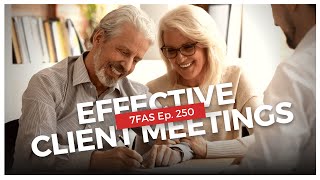
A spoken podcast episode (conversation between Chad Owen and Caleb) about how to run effective client meetings and consultations for annuity/insurance sales. They describe two main phases—preparation (pre-call fact-finding, preliminary case design, product/case education) and presentation (product education, final needs analysis, Q&A, next steps)—and share practical tips for engagement, communication style, cultural sensitivity, and handling audibles or delays.
Chapters
What good is it that you called? Okay, first of all, you got the lead, you called, they answered the phone, but then you show up and they're there. Now what are you going to do?
Right.
You know, that's the important thing to understand is so hard to sometimes just to get to the house and have them actually be there. But it's even worse if you go through that entire process and it's a very infectious, ineffective meeting.
Right, I agree. It's almost better for them not to be there and have it rescheduled for a different time.
If they show up and you get through all that, they're like, why the heck do we just have this meeting? This doesn't help me with anything.
Yeah, now you're out of time and you lost the deal. Yeah.
Okay. Well.
Hello, Chad.
Oh, this is Chad. I'm Caleb. We're having fun today. We are definitely conducting effective client meetings and consultations. It's funny though, that you say that's really cool, though.
That was like the most awkward pause I think we've ever had.
Dramatic. Dramatic. Well, they say that that's like a mass. Like you can master the pause.
No.
Yeah, like people like public speakers, they'll master the pause for dramatic effect. So they'll make a big statement and then they'll just let it sit.
No, I wouldn't. Okay, okay, let's get to this.
It is funny that you say, though, that you've gone through the process, you've made the call, you've booked the appointment, you go out to the appointment, and then you botch the actual appointment. Because the way that you do your calls. Right. It actually sets you up for an effective appointment.
Agreed.
Right. So when I was. Yeah, when I was looking at this, I thought, okay, there's kind of. There's kind of two phases to having a good meeting, a good consultation, a good appointment, and you've got the preparation phase and then you have the actual, like presentation phase.
Like when you're actually expectation and then initiation when you initiate the actual appointment.
That's all like in the pr. That's all in the preliminary. Yeah.
Okay. Because I don't know how you sometimes you have this segmented. You're really good at training, but sometimes I'm going, dude, you just spent 20 minutes explaining something that I could have done in like three.
That's true. I do tend to over explain.
You do?
I try. I'm trying to get better about it.
And we'll see.
I've got preparation and then you've got presentations of preparation. Think of it as everything before the actual appointment. Okay, so you've got preliminary needs analysis, AKA the mini fact finder that you're doing on the phone. Right? Preliminary case design. So you're actually taking the mini fact finder info, and now you're going to run an illustration, put together a product recommendation that to the best of your knowledge, looks like the best fit. And then you take that product recommendation or the product that seems like it's going to be the best fit for the client, and you do whatever product or case education that you need. Right? So maybe the client, you got the information. You've got a client that's got an inherited ira. Maybe you're not familiar with how inherited IRA distribution rules work. Well, you need to study, you need to learn so that when you do go out and meet with them, you're actually capable of having a good conversation with them about it. And then whatever the product is, you need to obviously learn it and study it, know it inside and out, be able to articulate.
Preparation phase.
Exactly. That's preparation.
Okay.
Then you get into presentation. Right? And this is going to be kind of broad education, okay. Explaining the type of product. So if you're using a fixed indexed annuity, you're explaining how the fixed indexed annuities at large work, the concepts of them, the structure. You're going to go into kind of a final needs analysis. This would be like the full fact finder.
Right.
I'm just literally modeling this after your flow of appointments. So you got the full fact finder that's going to verify all of the initial information you got in the first place. Are you actually bringing out what's best or do you need to call an audible and shift it up in the appointment? Hopefully that doesn't happen.
I don't know, though. There's times absolutely where I think something's going away and there is a curveball thrown in.
Sure.
You know, I was helping a client. They have a 501C3. And I'm like, you know what? I don't think I've ever done an annuity with the 5 1C3. So I. I mean, it took me a week to get all the information I needed to make it to where I don't mess them over.
Right.
But I told them from the beginning, I said, it's the first time I've done one of these. I know the tax rules, the laws, things like that pretty well. But I want to make for sure, for sure I'm not making a mistake on this one. So I Verified with three different tax people. I called insurance companies. I found out who can do what. I mean, it took a lot of work, but yeah, there. That was a big audible, right? That was a delay of game.
I think it's true.
We had to cancel. We had to continue next week.
And you have to just be real with the client about the situation. Right. You have to just tell them straight up, hey, I brought this out because based on our initial conversation, this seemed like it was going to be the best fit. But this is something that I. We didn't discuss and it's adjusting what's actually going to be the best. So I'm going to need to take a week, go work with my team back in the office, whatever the verbiage is, and actually put together the best plan that's going to build trust, at least it should.
It's kind of like what happens with the Dallas Cowboys when they show up, when they realize that other team actually showed up. They have to call an audible and they go, we can't play. Right. I'm totally joking. I did that because our producer is an avid.
Oh, yeah.
Avid Dalad Cowboys person.
But did the Broncos make.
They never showed up last year. No, no, they didn't show up either. I think they. Yeah, they have it for eight years. There you go. The first time you're ever going to hear his voice and probably the last time, but he's probably going to put.
Some text right here. They have it for eight years.
It's so true. Denver. Denver. Just. Oh, my gosh. What is going on with him? Yeah.
Anyway, you do that final needs analysis, verify that what you've taken out is the best fit for them, or if you need to change it up, you need to change it up. Then you get into specific education actually explaining how this, the individual product that you took out works. And quite honestly, you don't need to go into all the depth on the features if you're going to miss the benefits. So the features just create benefits.
Oh, my gosh. So when I first got into sales that the guy, he ever heard this, sell me this pen.
Oh, yeah.
And I'm like, oh, man. And that was where I learned the difference between features and benefits. And I understand. I mean, it doesn't matter. The pen. If you need a pen. The most valuable time to sell a pen is when that person needs a pen.
Right.
That's the reality.
Right.
But I would focus on the features. Features, features, features. And then I didn't do anything to do with the benefits. And once I Understood that it was a game changer because really clients care most about what's in it for them. And they should, it is their money, so they should get the benefits. Totally. But when you focus on the features, and often the features are just what's in the brochure, the benefits are how does it apply to, to their situation, how does it benefit them?
Exactly.
Agreed.
Exactly. Go into a Q and A and then outline the next steps. And that's the presentation. You got preparation and you've got presentation.
Those.
That's the general flow that you apply right. From the preparation, the presentation. That's the general flow that you apply in both scenarios. But I want to talk about some very specific tips to make those effective. And I've just literally got a bullet point list here.
Come up with that hic. Accent. Tips. Did I say that? Tips. Yeah. You didn't hear that?
No, I did not.
Oh my gosh. That went southern.
Maybe it's just certain words.
Yeah, tips. It's tips.
Tips.
So, you know, I'll do my best. Northern. Northern folk.
Well, I'll do my best on that. Thank you. Out to my air stream. Make you a margarita. Blow your horns off.
I love it. You know, the people that have been with us for a long time, they know we are the worst at doing the scripting. And I make funny is if I go into one of these webinars where it's like, hi, Caleb, how are you doing today? Great. Chad, what are we going to be talking about today? Well, and I'm just like, okay, we're done. I, I don't even watch the webinar. Nobody can accuse us of that. We've got an outline and about 90% of the time we don't stick to the outline. But you know what? That was one of the funniest things I've heard. I'm not an out. I don't laugh out loud a lot. But that, that was good.
Nailed it.
Yes, you did.
All right, tips.
I'm even a little more disturbed that something like that is in your head.
Well, It's a Matthew McConaughey. Oh, yeah, he said that. So I can't claim that quick wittedness on my own.
No, you can't.
Okay, let's get to things that matter.
All right, well, tip number one, this is a thought I had a while back about agents need to be both good leaders and good educators. Right. I think oftentimes we lean toward one or the other, but you actually need to be both. You need to lead the conversations that you're having. And you need to educate in a way that simplifies often complexity in their.
Language, how they understand it.
Exactly.
Sure. I agree.
Exactly. Use plain English and not jargon.
You pause there because I said I agree with you. You're like going, what? How often does that happen? That just happened. Okay. Yeah. So.
But to your point, using plain English.
Well. And I'll say things like, I don't speak in financial ease. I speak in English. I wrote my book in English, not financial ease. Why I could use acronyms all day long. That's going to confuse the snot out of people. And I don't want to do that. What good is it if I give them a product that gives them peace of mind but they don't understand what they got? That doesn't make sense.
That's true. I agree. I agree. Make good eye contact.
Except I will say the fact finder is one area. You don't.
It depends. Yeah. So are you willing to lose all of your money, some of your money and none of your money? I'm looking down. If you guys aren't watching YouTube, which you should be watching YouTube, you should go to our channel. She subscribe like and ring the bell. But I look down. And then depending on the client, I'll look up and I'll look him right in the eye. And because I sometimes want to just see their facial reaction to that or when I'm asking something that's a tougher question, like how do you intend to pay for long term care? You know, those can be some sensitive topics. If you have a parent that ended up and had Alzheimer's or dementia or Parkinson's. You know, sometimes those things can trigger responses.
Right.
And so it depends. I do. There are some. I will look direct eyed. And there's other type of direct eye contact. Direct eye. And. But there's times too where I'll just look straight down while I'm filling it out. You know, it's, it's a very tricky thing because there's so much psychology and behavioral.
Man like almost study on how to interact with people. And it could be culturally, it could be regionally. I mean, you just said dibs. You know, that's a very regional thing right there. And so there's people that will relate differently due to eye contact.
Right.
I mean there's countries I've been to where you do not do a firm handshake. It's insulting. And some of it, it's threatening. Like there's an African country I went to. If you did a Firm handshake. That was a fight. Let's. Let's go now. They had grace to the. To people who didn't know that, but it would be. It's too aggressive. So you would shake. I mean, I'm not joking. Oh, gosh.
I. Yeah, I have a hard time with that.
Which. A Southern person, you shake like that, they're like, you know, you've lost respect 100%. And I mean, when you have women down here that shake your hand so hard, it can hurt it, you know, like, going. That's an important thing. So you want to be a relatable person to that circumstance. New Yorkers. I mean, I love getting New Yorkers because there's no question about what they're thinking.
That's true.
They just let you know it is. What. Well, city folk. I mean, if you go up in northern New York, it's a different. Yeah, it's a different. So it's important to have that. And that is honestly something that does come with time. Yeah. You know, I can relate to pretty much anybody. There are some groups I still have a little bit harder of time because it's a cultural thing. And I just still don't understand why I can't break through to that group. And it's very frustrating because I don't care where someone's from. I don't care. Male, female, doesn't matter to me. I want to help people.
Right.
And so, yeah, no, that's good.
Be physically, mentally, emotionally engaged. Just ultimately be present.
Yes.
Right. People recognize when the person they're talking to is intentionally paying it. They're. They're just there. They're present in that moment versus they're spaced out. They're thinking about something else. They're checking their clock, waiting to get to the next thing, whatever it may be. Physically be.
Were you talking? Yeah.
Yeah.
That is the most frustrating thing for me, too, is when I see my client pick up a phone and they start scrolling through Facebook. So the first thing I do, if that happened, the first thing I do is I realize I lost engagement with one of them.
Sure.
I take full responsibility for that. And I'm like, okay, what was I not doing that made them get distracted? Sometimes it could be the spouse belittling their input. So then I have to steer that really quick and go, you know, and I can get them engaged once I realize that happened.
Right.
But if I miss something, it's my fault. Yeah. And now I have to steer them back so that. I agree with that. That's. Yeah. Playing stinking Candy crush or something while you're talking, like, how important is this?
You ever, like, the first thing that comes to mind is like, I can come back if this is a bad time.
No, I can't. No.
But to me it's like a bad. It's like a sarcastic thing. It's not. I don't actually mean, like I would actually come back, but it's like, you.
Can'T give me a time. Very busy person.
Smile and laugh. Be human when it's appropriate. Right. Obviously, you only have $25,000.
That's. That's the wrong time.
That's bad timing.
That's bad timing. Yeah.
But you, you do cut up. And.
Most of my clients, we have a lot of fun. Like, they'll say, you know what? I don't worry about long term care. I'll just find a gun and I'll end it. I'm like, if you remember where the bullets are. And then they always laugh, you know? Oh, yeah. Or I'll say something. You know what? She's a little eager for you to pass away. She's got a shovel right out there with your name on it. And yo, we have so much fun. My wife does not like that sense of humor. But you know what?
Well, she's. She's such a peacemaker.
She is a peacemaker. She does the fact of somebody dying and digging a hole. Yeah, she doesn't like that. Although there was a time she's watching some dateline shows a little too much and I was like going, hun, is there something I need to worry about here? You're watching a lot of murder mysteries and how people got away with things.
You're like, checking your life insurance policy. Is this irrevocable beneficiary or like I was.
Yeah, for sure.
Don't be afraid to challenge clients. This is one thing I consistently see agents avoiding is because they don't want conflict. Right.
But it's not conflict. You're saying the right thing.
Right.
You're saying you're being honest, and I'll take honest. That hurts more. What was this? Say a ugly lie is. Excuse me, Ugly truth is more important than a beautiful lie. Yeah, yeah. And it's like, you know, you don't want to be honest and you end up not answering a question or avoiding the answer to a question because you don't want to say what you know is right.
Right.
You're the expert. Assuming.
Yes.
Say it. Say what they need to hear. Yeah, it happens all the time where I'm like, no, that's not how that works. No. You cannot get those type of returns guaranteed. You need to make sure you have enough income to live off of. Are you concerned that when she passes away the entire pension is gone? What are you going to do? I'm going to just go back to work. Okay. Sir, you can hardly get out of that chair right now. And I've said that before, say you're going to go back to work. Well, maybe not so. I mean, most of the time they'll respond back, but absolutely be truthful.
Yep, that's exactly right. Tell them what each next step entails along the way.
I even have a sheet that I hand out that tell them what the steps are.
That's right.
I mean, they get that in every kit I leave. It's what to expect and it's the complete, complete process from the phone call all the way down to the policy delivery. Yep.
And then you do that.
Yep.
You don't just give it to them and then go off the beaten path and chasing rabbits and things. You do the thing, you're going to tell them you're going to do something. Do it. I mean, then the last one that I noted, I'm curious if you can think of any others. But don't be short, but do be efficient. Right? I don't mean being curt and cold. Just be efficient with the way you communicate. Don't waste their time.
100%. Yeah, no, I could not agree with that more. So, yeah, I think that's it.
That's pretty good.
I think we nailed this pretty good.
Yeah.
And I bit of joking around.
I always like to add one more thing at the end.
Of course you do.
So I would say that each step in the process determines in some part the effectiveness of the next. In other words, your calls and your ability to have good calls is often setting your appointments up to either be effective or be ineffective. And then your first appointment is often setting your second appointment up to either be effective or ineffective. Now obviously there's pieces and parts you have to play in each step respectively. But the step before often positions the next one to either be really good or really bad.
Boy, that was really deep and profound. You have to do good so they'll meet with you again. In essence, I just literally summed up everything you just said. Yeah, okay.
Well.
You'Re. What?
I said I'm a sage.
What's a sage?
Like an old wise man.
Oh my gosh, another term. Or I'm just ignorant. I've never heard that one before. So that's probably what the case is.
Could be our band, the Ignorant and the Sage.
Have a nice day. Happy selling.
Sam.










