The 3 Pillars Of A Strong Year Pt. 3 | 7 Figure Annuity Sales Podcast | Ep. 232
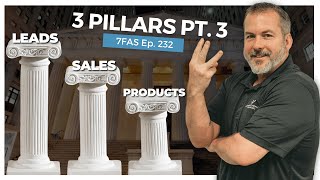
This is a YouTube podcast episode (Chad Owen with Caleb North) focused on the third pillar of a successful annuity-sales year: selecting the right product solutions. They recap the three pillars (leads, sales process, right product), argue that a good product must serve three parties (agent, client, insurer), and offer a short checklist of product-selection factors: financial stability, product benefits, customer service, and payout/growth potential. The hosts stress thorough fact-finding (client needs vs wants), caution against products that favor only agent or company, and promote mutually-beneficial decisions for long-term sustainability.
Chapters
On this week's episode, we're going to talk about three pillars to Strong Year Part three.
Hello, everyone. Welcome back to this week's episode. I am Chad Owen. This is Caleb North. North.
That's right.
Headed north two hours ago. So what is that? Ice Age.
That's right. Yeah.
The. The. Yeah, the Sid. The sloth.
Yeah. I wanted to say it was something.
From Lonesome Dove, but no, definitely not. We don't watch dumb movies like that. We almost got a fight right here called Lonesome Doves. Dumb.
So good.
But it's funny. I have a couple kids that they can talk really good, like said the sloth. And when you get all of the. All four of them talking like said the sloth, it's so funny. If you have not watched Ice Age, if you have kids or grandkids, even if your kids are old, we still watch Ice Age. And it's funny. But funny. Okay, so this one part series, which was supposed to be one podcast, turned into three part. And as I said, you guys have heard this before. As soon as I heard what the title, because he comes up with these ahead of time, I'm like, this is definitely. Each Pillar is going to be a podcast. It.
It. I should have designed it that way from the start.
You should be fair. But see, that's. I mean, it makes me feel important that I actually can bring wisdom into the situation and doesn't have a young whippersnapper always moving. 50. Well, actually, I'm moving.
I was gonna say you. I usually am a little more methodical.
Yeah, I'm the one that just.
Okay, so the right product solutions.
Okay, so the first one was leads. The second. The second one was sales process. And the third one is the right product solutions.
All three are critically important, contrary to popular IMO belief.
That was an awkward pause.
Yeah.
What was that?
The power of the pause. Have you ever heard about that?
I have not.
You say something and then you just let them wait.
That's dumb.
And you just let them linger in.
You know, and I've heard that too. I've heard when people close a deal, they said, you don't be the one to speak. I have never followed that, ever.
Yeah, you've had some pretty good success not following that.
Yeah. Because it's like if. If you're waiting for the pause. Awkward pause. Awkward moments allow weird thoughts.
You know, if you're in the middle of something that you're very uncomfortable with, which most people are when they're talking about. About money.
And then they start to feel I don't know if I'm going to retire. I'm concerned. I don't know, I'm scared. I mean, if you have a doctor that goes, yep, you've got cancer.
So it's not funny. But the pause is.
I know it's a serious topic, right? And if you were once again on the YouTube channel, you would see what I was doing. But it's that weird moment where you know what, you have a problem with your retirement pause.
Help. You know, you've got to move into it. And honestly, in my thought process and belief is the pause or the. Or the. But the. Those are fillers that me to me seem like your subconscious. You don't know what you're talking about. You know, I am all about. I trained to be an EMT for years. I actually was an emt and until I got to a few ride alongs and I realized there's kids in those sometimes and I just could not handle. God bless the people that can do that because they can, they can separate that. But man, ran into a couple cases with kids and I just, I couldn't do it. I just, I, I wanted to go be a firefighter. And when I realized that 90% of firefighting was EMT traffic accidents, I was like, okay. Or helping people get out of homes that are in medical conditions, I was like, man, I would have been a paramedic if that's what I want to do. But an EMT firefighter, I want to go put out fires. Right. You know, so. But when it comes down to it, you know, you don't want to get that pause and you want to feel confident in the solution you have. So that talks about, once again, the leads. Then we're talking about the solution and now we're into about the right product. Right product. You've got to be confident.
Now, one thing I will add about the firefighting.
What's that?
It's probably a good thing that you didn't become a firefighter.
Probably be dead.
Well, either you'd be probably dead because of what I was going to say. The fire would have burned unnecessarily longer than it needed to because you would have been standing in the building just like watching it for a little bit.
Like backdraft watching backdrop. You just. I love fire. It is now not enough. I hate what fire does to memories. Like, if I could watch a house burn down that had no sentimental value to anybody and everything of value or sentimental value is already out of it. And there was a couple propane tanks in there and everything. That'd be so cool. Yeah. Like I always said, anybody who ever. If my house catches on fire.
Put it out from a big distance because there's a lot of ammo and things like that in there. That it's going to be fireworks display, you know, just rounded around. But how did we get into this?
We were talking about the pause.
Oh, yeah. And then we got into this. See, this is why you guys either love or hate us. We. We have rabbit trails.
We do.
And sometimes we shoot the rabbit and we pause and we eat dinner and we make a stew out of it. So that's what we're doing.
Tasty is tasty.
Tasty is tasty. Okay.
So contrary to popular IMO belief, there is a best product for each situation.
Always a best product.
Yeah.
And I think I do want to add that, though. The best product, there's always got to be three pillars to success for everybody. Not just three pillars. We're talking about for a big year. But the agent needs to do well, the client needs to do well, and the insurance company needs to do well. And it's in the same order. Because if you had a great product with a great insurance company, but the agent made nothing, in other words, cannot support a family. Can't do anything. That's not going to be good.
Right.
If you have a great commission, a great product, but it sucks for the client, that's not good either. Yes. If you have a great client, a great agent, but you have a poor insurance company or sucky insurance company, that's not good either.
Sure.
You want the client to be successful, you want the agent to be successful, and you want the insurance company to be successful. Yeah. So you've got to have products that align with that. And the reason why I say this, because I remember this one product at one time came out. It was a decent product. It wasn't great. And I was a good agent, but. And it was okay for the client. But the commission stung. It was like 2% on an Fiat. Right. And it lasted for a short time because I'm going, you know what the cost of my leads are.
Right.
And there's no way I can ever even afford the leads or operating a business off of that commission, vice versa. I've seen things that have super high compensation, but they are dog products for the client. Right.
And don't sell those.
And I'm like, no way. I mean, I. No way. I remember one time I was at this awards conference, and this guy, yes, I judged him, but I'm like there's no way this guy qualified for the conference off of writing business. I mean this guy was dumb as a. Just dumb, just.
Not smart at all. Like maybe an IQ of 5. And I'm like, there's no way he could have done that because he was saying things like, yeah, I just said this had a big bonus on it. And I put my clients, I said, do you, have you ever looked at the index strategies on this product? No, why would I do that? There's a huge upfront bonus. It was a 14 year product with a 14% bonus with the doggest of dog index strategies. So you guarantee the client 1%?
Yeah.
And there was no way they're going to make more than that. But he goes, I just told him to get about the 14% bonus.
And he won an award for that. He won, he got. Oh, I don't get it. Okay, so enough with my rant. Make sure the product is good for you, the client and the insurance company. And like I said, the clients, probably to me I can't even say the clients are the most important of that because you've got to make sure the insurance company is stable and never goes away. So I would say the insurance company.
It'S a three legged stool that you don't want one to be shorter than.
The other two, all to be the same because you know, you also don't want the insurance company making a ton of money, being greedy and things like that. But it stinks for the client, it stinks for the agent too. So it's got to be that balance.
I would also add that there are products that accomplish a similar result and are marginally different. But even within that marginal difference, and a lot of times IMO's want to try and train you to look past the marginal differences a lot of times.
Example of a marginal difference because I like where you're going with this.
Okay, a 10 year versus well maybe, maybe that's not considered marginal because that's four extra years of surrender. But I was going to say a 10 year surrender product versus a 14 year surrender product. Or let's talk about a company that the product, maybe that you've got two products that are the same and one product has. I say they're the same. One product has six strategies and another has eight.
It's like, yeah, or you have an insurance company that's B plus plus versus one that's a minus.
Sure.
Now I won't go below B plus plus and there's many reasons why it's a whole Nother conversation. But I even think about things like you have one that has a higher bonus and a lower payout percentage, but then you have one that's lower bonus and a higher payout percentage. But they really accomplish the same thing. I mean, there's all sorts of things you can talk about that are marginal.
Those, those subtle, those subtle differences that in a lot of scenarios won't make half a dozen one way or six the other.
Right.
But in certain scenarios they can make a big difference. And so it's doing good fact finding. This goes back to process again, doing good fact finding. You're going to get more detailed information. You're going to be able to determine what product is actually the best solution to the problem. I wrote down the four things that you consider financial stability, benefits of the.
Product, best customer service, financial stability, best benefits. Right, comma, you forgot best benefits. Well, that's why I said you didn't say best. I mean, if you're going to quote me, you got it. Yeah.
Well, I wrote down best benefits and I said something different.
Okay, so let's do that again.
Financial stability of the company. Okay. Best benefits of the product. Best customer service of the company. Highest payout or growth potential.
Yep.
That those four things you got to bear in mind, they assume that the product design and the details of the client fit the need that the client has.
That's a good point.
Right. So it's not just looking for A plus plus rated carriers with crazy benefits and good customer service and great high income.
You know what? It's not interesting. The companies. And I know why. So don't write in the comments. Well, there's a, it's most. The A plus companies don't have the best products for the clients because they.
Can compete on their ratings.
I know that's why, but it's just interesting to me.
Yeah.
Why don't you have an A plus company that has the best product?
Because I, I believe that it's because they don't have to.
That that could be. That definitely could be. I mean there's a lot of reasons why, but it's just, I think you've got to have that balance. Like if you look at the financial stability and this is. I put this out there for many, many people and nobody's ever found this for me. Find me a B + rated or higher fixed insurance company that has disappeared in the past 100 years.
You know, I haven't had anybody and I've spent. God, man. Sometimes things I would just do for fun. I would I would Google trying to find out. I would even go incognito. I would even try, you know, I'd try different search engines. I try it all, I'd reword it a little different. And I haven't found any that have disappeared. I've found some that have been acquired, sure. But I haven't found anybody that I've went into receivership or disappeared. So if you can find that, please put it into the comments or email us. You know, be a good case study. It would be a good case study, but I went back to the latter 1800s and I couldn't find it. Yeah. Now I'm not talking property and casualty, I'm not talking about health insurance, I'm not talking about variable companies. I'm talking strict fixed insurance company. You know, it's just because there's, there's like AIG got in trouble. It wasn't because the insurance side of it, because the mortgage side of it. So I have clients that go, well, what about AIG? No, AIG was not. There were 400 employees. There was a small group of people that made some stupid decisions and it was the mortgage issue. Yeah. And, but American General said American Valid were all still very high rated companies there.
There is an inherent bias toward higher rated companies from clients and from agents.
Yeah, it's weird to me because to me one of the reasons why I won't go below B plus plus is because most good errors and emissions insurance companies won't cover that. And to me, my thought processes and I do not know the exact reason there but I will tell you, if they're not going to cover, you know, on that, why sure. You know, it's just, that's just my.
You're not speculating the reason. It's just a good question to think about.
It's. And I've never honestly took the time to dig deep into that because that answer to me was enough for me to go, that makes sense.
Good enough question.
You know, because some companies that are lower, they have different errors and emissions but I'm like, why wouldn't omissions, not emissions omissions, but why, why would they not cover that? So just a thought to me, yeah, it's true.
I will add, and this is a controversial thing that we've done a whole podcast on before. But the right product is not always what the client says they want.
What do I mean by that? Oh, their financials may indicate that what they need is something other than what they want.
I don't need an income rider. Really. Because if you die, the lower of the two social securities goes away. None of your pension passes on to your wife. Tell me why you don't need an income record. You know, it's just. And her Social Security is not. Even when she gets the higher of the two is not going to be enough to afford everything. And yeah, it.
Right.
I agree with you. There are so many times I based the decision. That's why one of the. Actually there's quite a few annuity companies that say, was the. Your decision to buy this annuity based on the agent's recommendation? And I always click yes on that. Yeah, I'll take full responsibility for the company I picked.
Yeah.
And I'll have an entire fact finder to back that up and a solution or the reason why I picked that product based off of the solution to their problem. I mean it's, it's like I hope to God this never happens. But I feel very confident in any legal type situation I could justify why I put the person in that situation. Because number one, number one, my heart is always in the spot of I want to do what's best for that client. That's why I will walk away from a multi hundred thousand dollar deal, million dollar deal in a heartbeat if it's not what's best for the client. And I did that with a $20 million client. And granted it probably only would have been a five or six million dollars deal, which is a lot. But man, just the way he was talking and how much he needed to live off of in his private jet and this, I'm like, there's no way I'm putting any of this money into annuity. And. And he was a jerk. Yeah. He's like literally didn't care. He had four young kids, four or five young kids. His wife was probably 2/3 his age, if not half his age. And he literally reaches over and goes, I don't care what happens to my family when I'm dead. I'm like, I'm not being a part of this whatsoever. And so you just. In my heart I wanted to write to happen well. And I want to do what's right for the client and all the clients. Not just the guy, but the gal. And not just the gal, but the guy. I want to do what's good. Because whatever they want now where I do listen, if they say their primary concern is income versus death benefit, sure. I mean that's a plan for living, a plan for dying, but.
And then you still do full fact finding after that. Always you don't let that be the determiner of income rider versus nurse.
No reason whatsoever. I do not do a full fact finder in every single appointment. Even if I find out from the beginning that this isn't going to work.
Right.
I mean, when they pull out their annuities and they look like they're very new and I'm like, they said, oh, all of our money's in this. I'm still doing a full fact finder. Yeah, it does. Even though I look at that, I'm going, dang, those are new policies. I'm not replacing any of those. I mean, I still do the full fact finder.
Yeah. So, yeah, everybody needs to be the right product is one in which all part kind of goes back to the mutually beneficial thing of the lead company. It's like all parties are mutually benefited.
Yeah.
Maybe not to the same extent, but everybody's taken care of the way they need to be taken care of to continue whether, if it's a client, to live without stress and concern about what the market's going to do and are they going to have enough to retire if it's the agent, without questioning, am I, you know, am I going to be able to stay in business? And for the insurance company, it's the same thing.
All my business decisions from here on out will based off of mutual benefit. The worst business decisions I've ever made is where I was looking out. You know what, this person's in a bad situation, I'm going to try and help them out. And that person's genuinely in a bad situation because of how they do business. Sure. So I need to make sure now the only time that that doesn't work out is relationships, is obviously there's plenty of times where you do something for that person where it is purely for their benefit. Now, your benefit is you did the right thing and you helped them. But when we're working with clients, we've got to remember everything has to be mutually beneficial. And anybody tells me otherwise, I go, okay, fine. Then from here on out, you do your job for free.
From here on out, it doesn't matter how successful the insurance companies. From here on out, it doesn't matter how successful the client is off this. It's got to be everybody working together.
And I could make an argument that the agent being taken care of and the insurance company being taken care of is actually a client benefit.
Oh, 100%. I mean, my clients knowing that I'm still in business 15, 18 years from now and they can still get in touch with me on my cell phone tell me that's not beneficial to them. Right. That they know at any time as long as I have cell phone service. And if I don't or they leave a message, I will call them back. I just. I've had clients tell me that all the time. Chad, you're the only financial person I've ever dealt with that always returns my calls back.
Not to mention that the clients that you helped in 2022 are benefiting by you being in business because of the clients that you had in 2021 and 2020. Yeah, like there's, like, there's a sustainability that takes place. And then the insurance company, obviously, if insurance companies are going under, that's mega. Not good for clients.
Yeah, that's. That's a whole nother scenario. But. Okay, well, that was the part three of a part one series. Can I add one more thing?
I know we're already over one more thing.
Go ahead.
If you want to. If you want to talk about what we have found to be very common, top product solutions for a wide array of different client scenarios, reach out to me.
Oh, yeah, I know exactly what you're talking. See, that was good. You brought that up. Because there is one product out there right now that for. Since August of 2019, it's been a big part of my business. And it's because I don't get beat. I mean, it's. It's got. It's the best. I can honestly say. There's one other product out there that I can say was very well rounded and someone I used before August of 2019 because it was another really great, really well rounded product. But I would say this is in the top. I'd say this is the top one I've ever. In 18 years ran into. That's this well rounded. Yeah.
So that's how I describe it.
Yeah.
It's the student in. In class or in school that gets, you know, mid to high Bs, low A's and everything, versus the one student, you know, that has a high A in one thing and then Cs and.
Everything else, and it ends up working at McDonald's. Yeah, I say that because there's a guy I know in school, he was the smartest guy ever, and he never did anything with it. And he literally had above a 4.0 average and he just didn't do it.
Wasted potential.
Yep. Okay, well, I hope this helps you. You have a great day and happy selling.










