The Three Pillars Of Annuity Sales Success | 7 Figure Annuity Sales Podcast | Ep. 286
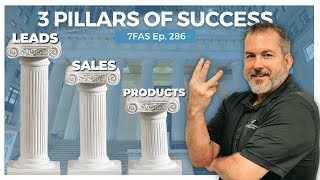
This is a March 4, 2024 YouTube podcast episode (7 Figure Annuity Sales Podcast, Ep. 286) hosted by Chad Owen and others, centered on "the three pillars" of annuity sales success: (1) having people to meet with (leads/marketing), (2) a repeatable sales process (training, technique, flow), and (3) the right carrier/product solutions to best solve client problems. Speakers argue that the combination of high-quality lead flow, disciplined process, and optimal product design enables agents to scale to multi-million-dollar premium production; much of the discussion focuses on process/technique, training, and practical analogies (athletics, fighting) to emphasize technique over raw ability.
Chapters
I tell agents all the time there are three pillars to annuity sales success.
Number one, you got to have people to meet with. Yeah.
Have a Chad, have a chat.
Number one, you gotta have people to meet with.
Number two, you gotta have a sales process. And number three, you've got to have the right carrier and product solutions. So those are the three pillars.
If these pillars are so embedded into your head, how come you had to look them over every single time? You had to look over at what?
The pillars.
I have a little bit more than just those three on each one. Right. So like, like number one, people to meet with. Well, okay, well, what does that equate to leads and marketing? Right. You got to have, you got to have some kind of opportunity there. Where are you getting your leads from? What are the marketing strategies you're using? Are they actually efficient? What's the ROI on those? So you need to try and have those maximized as efficient and as high in ROI as you possibly can. But a ton of the ROI comes from your sales process.
So you're still looking.
I am looking. And your sales process, dude, off the.
Top of my head.
And your sales process is largely tied to training, right? Chad, I think about your kind of your.
I don't know what the right word would be, your progression, your evolution or whatever in the annuity industry. Because when you were starting out and you were selling insurance and you were cross selling a couple million a year in annuity premium, and then in 2008 you transitioned completely over to the annuity side, sold about 6 million or so in premium. The very next year you were up into eight digits and you've not been down below eight digits since. And you've, you've scaled, I mean you went from literally 10 million, I think or approximately that in 2009 to now you're selling, you know, 30, 30 or so million a year. Yeah, I mean you beat as far as returns go.
Well, and that's, that's progressing like this though, with the stock market still increasing for the most part. And the funny thing is is I, when, when I was in the process of the move, I found some of my old fact finders which were very, I mean, bare bones nothing and how that's even evolved. And you and I both know that's still the most evolving piece I have is the fact finder. And I'm always looking at what is the best way to relate to people in newer situation, different environments.
Right.
And I'll tell you.
It has been quite an amazing process, you know, because this this system, I mean the, the concept of this is what you do. You find a problem, find a solution. That's really. Everything comes down to that. No matter. From the very beginning, my first lead to now that, that is always the thing. But how smooth are you when you're talking? In other words, where's the flow? Not smooth as a slimy kind of. I'm not talking about that. I'm talking about like the flow. Do you say. But ah, you know, do you feel, do you have those subconscious indicators in there that it will let someone know that you maybe don't know as much as you think you know or they think you know because you have fillers. I call them word twitches or man, what is it called what you're doing right now? Glitch. Yeah, no, it's. Yeah, because my brain is like, I know it's there.
Tick. It's like a tick, a word tick. So it's, it's this thing that you have that you don't even realize you use as a filler, a subconscious filler. And the subconscious of the client will pick that up.
Right.
And if you're thinking about, well, I have a client that, for example, I had a client I'm talking with. Where they have a. One of the beneficiaries is. I don't even know the proper non woke word nowadays. Handicap, special needs, whatever you want to call it. You know, they have something that they can't get this money given to them because they are, they're having assistance. And right off the bat I knew what to do right there. But if you sit there and go, well man, you have automatically given them a subconscious, if not a conscious.
Red flag that you may not know what you're talking about there.
Right.
And that comes into product knowledge, that comes into solutions, that comes into problem solving. You've got to have that smooth thing. And that's where I think the pillars come into play there. Because the whole process of the pillars have to transition smoothly and they need to know that you know what you're talking about. And I think that's honestly what has been a big attribute of why the sales continue to get bigger and bigger.
Yeah, I agree. And I've had the privilege of looking at your systems, your processes, your lead flow, your applications, your issued business. Like I've seen all of your stuff and I've gotten to see that for agents all across the country that are writing 5 to 15 million a year in premium.
Yeah.
And you consistently see these three things in place every single time. And you can add on to these three things because they've always got good branding, right? They've got a web presence. There's a few other things that they always have. But I like to bring it back to these three main things because you could have an agent that maybe doesn't have all the bells and whistles for their, for their, their LLC or what they could be an individually contracted agent where commissions are being paid out to them, 1099 from the carrier, not even going to an LLC. But if they've got these three things, I don't see any reason why somebody wouldn't be able to write 5 million plus a year in premium. And again, it goes back to leads and marketing. I tell agents all the time, you want to get to 20 leads a month as quickly as you can. As quickly as you possibly can. What were you going to say?
I remember what you're saying when you first started getting in this business. And you're like, I do not understand how somebody, if they have a good lead flow. I don't understand how someone can't write 3 million, 4 million, 5 million a year. Because it is, I mean, if you follow and I, and I tell people, if you followed the process of what I'm doing to write 30 to 35, 40 million a year, why wouldn't you be able to do 10, 15, 20 million a year if you're following the same process?
I agree.
You know, if you're following and that's, that's the key.
I agree. That's the key. And I'll bring some practical thoughts to that as well. If you're being trained by somebody that's writing $10 million a year in premium and you were to do everything they do to a T, then in theory you could be quote unquote, half as good and write half as much premium. So if they're writing 10 million a year, if you're doing everything the same way they are, but you're half as good, you would write five. Okay, if somebody's writing 30 million a year and you were to do virtually exactly what they're doing with their leads, and you were to generate a similar number of leads, which, granted, that would be a tall task for somebody to generate as many leads as you're getting, but you're efficient with those leads as well. So if they were to implement the process and they want to write 5 million a year, well, instead of being half as good again in air quotes as Chad, you need to be 1/6th as good as. So the greater the production is by the person that's training you. If you're going to duplicate what they're doing, then whatever your goal as a ratio of their total production is effectively how much worse you could be than they are naturally at the thing and still write the business.
There is a realistic. There's a realistic side to it too. Not everybody's cut out for our industry. I mean, if you tried to take me, you know, 5 foot 11, 212 pounds, and you try to teach me right now from the. An Olympic class high jumper, you know, I don't care how much I learn from them, I'm not even going to be close to what they can do for a high jump. But I know for a fact I could high jump more in six months than what I could right now.
Right.
You know, I, I was watching this thing on Instagram the other day, and this lady literally is just sitting there grabbing anything and she's doing pull ups. And I'm going, man, I don't even know. I could probably only do like maybe 10 pull ups right now. And back in the day, I used to be able to do 30 plus pull ups. Not now, but if I started training right now, I could probably double my pull ups in six months. Maybe. I don't know. I mean, it's been, it's not even that important to me anymore. But the point is, if I'm trained by someone bench pressing. No, I remember bench pressing. It wasn't fully about strength. It was about technique. And I would watch these guys that would do these heavy, heavy bench presses and granted some of them would have, you know, the straps that you put on your shoulders that kind of bring your shoulders in and it kind of gives a little bit of balance. But it's the guys that don't use that. And I'm going, their technique is so good that a clean and jerk, you know, that anybody you talk to about that, it is all about technique.
Right?
You got to get that weight up to your, up to your what, waist right away. And you got to flip that up just right. And the technique is there.
Yeah.
Even fighting, I mean, doing years of Krav maga fighting, I'm telling you, the technique was often you'd have someone way stronger, way quicker. But if you had the right technique, you're always going to win. And if they're drunk, you, you win from the beginning.
They could even be a skilled person and they could be drunk and you could. You know, I always told someone, if you ever want to get someone in a bad situation, Meet them outside of a restaurant like after they've fully eaten. They don't want to get hit in the stomach. Yeah, yeah, yeah.
I don't much like getting hit in.
My stomach at any time, but yeah.
Much less after I've eaten. I tell each go ahead.
But it goes back to the technique that, which all refers to the system in the process.
Right. So the, basically the way we've equated this before is like if leads are fueled to the car, your process is what determines the fuel efficiency. So you can get all the leads in the world and if you're terrible with those leads, you're not going to, you're not going to do nearly as much as somebody else could with those leads. On the flip side of that, if you have an incredible process, you're fantastic with clients, you could get a few leads and write more business than somebody else that has a terrible process and has more leads. So what happens when you have these three pillars and what I say is agents that write top tier production, they have all three of these things operating very, very well. They've got a good.
So go over them again.
Yeah, good system for leads and marketing. Okay. You've got the actual sales process and training. So you know what you're bringing them into. You know what you're doing with them. Once you've got them, it's mapped out, they're coming into your flow. You're not just bending over for whatever their flow. You know what, what that wants to be bending over backwards for them. It's like some agents try and do that client ends up being the one in control of the whole thing and they feel like they're, they're dealing with somebody that's not an expert, your process can greatly impact their ability to perceive you as an expert. And then number three is the right carrier and product solutions and actually being able to solve the problem the best way possible. I like to tell agents all the time, hey, there are a bunch of products out there that could probably benefit the client's situation, put them in a better position than they are now and not hurt them. But there's only one best solution. There's only one best case design. And it's like, what are you actually using for this individual? Can you actually hang your hat on the idea of this being the best? Because I guarantee you, if you go up against another agent and you've got an okay product that is doing what it needs to do, but maybe not the best, and they've got an okay product that is doing what it needs to do, but maybe not the best. It's going to come down to process. Going to come down to who's better in the process, for sure. And so all three of these things work together to create a scenario where I truly believe just about anybody could write 5 million a year in annuity premium. I do believe that if you have these three things in spades and then if you start to tack onto that, you've got somebody with a real natural knack for sales, a real great interactor with people. They're not overly analytical, but they understand the things well enough to. To explain questions as they arise. And that's probably one of my biggest, like, faults or flaws is my age is tough and I tend to be a little bit more analytical. I like the details. I like.
And this.
And the air quotes.
No.
Oh, the face. That's the only shot I got is that face right there. Are you kidding me?
My mama worked hard on this face.
She had to make up. She had to make up a lot of ground from. From what my dad did.
I'm gonna have to send him this podcast.
Dude, you gotta say that.
So you're saying your mom carried. Carried the team?
My mom carries the team.
Yeah.
Dad.
Dad would admit that 110 times out of. Out of 100, man, he'd tell you she. He outpicked his coverage with her.
I guess the good ones usually do, though, I mean, you did too, so.
Oh, there's no doubt.
There's no doubt my wife carried the team. No doubt. So. Well, cool.
We'll leave on that.
We'll wait.
I do want video of your dad smacking you, though.
He's gonna.
He's gonna knuckle bump me and agree. Yeah, he's gotta guarantee what he's gonna say is, oh, yeah, Caleb, that's the.
Way the Northmen do it.
We marry up system in the process, son.
That's all.
It's about leads, okay?
The opportunities, the process you use. Hey. And then the goods to close the deal. The right products.
Okay, well, we'll leave on that. You guys have a great day. And of course, happy selling.
Sat.










