Virtual Appointments vs. In-Person Appointments | 7 Figure Annuity Sales Podcast | Ep 210
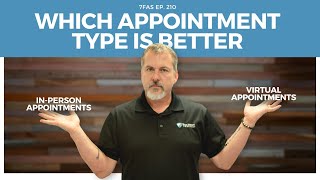
Chad Owen and co-host compare virtual and in-person appointments for annuity sales. Baby boomers prefer meeting face-to-face, while Chad sold roughly $2 million in premiums virtually during 2020. Large cases and trust still favor in-person, but virtual is here to stay.
Chapters
On this week's episode, we're going to talk about virtual appointments versus in person appointments.
Hello, everyone. Welcome to this week's episode. I am Chad Owen, the annuity sales coach owner of retirement realized financial owner of retirement realized agents academy.
And.
And I know I say that every single time because we always get questions. How can we become a part of your organization now? If you're like me, though, you're gonna actually open up the YouTube. And that's where we are. A lot of us just listen, or a lot of our agents actually listen while they're driving. So they don't know they're not gonna open it up. They just go from episode to episode. I've had people literally binge on us for multiple weeks, and I feel so bad for them.
Yeah.
Like, I really do to hear your voice all the time. It's just. You guys, actually, you guys, I remember when we're going through the platform and we're going through these podcasts and they're editing them. The people that constantly have to hear my voice and your voice, that has got to stink, man.
Yeah, we're getting. We're getting ready to start, you know, doing a, even a revamp of the training platform, the academy, and I just, I assume I'm going to be incorporated even more on that in some way, shape or form.
I need to figure out how to do something really nice for them. Yeah, I'll figure it.
They deserve it.
I know what they like. I'll figure it out.
People that we stick our voices in their ears all day long.
Yeah. But actually trying to work on something really nice, but we'll see what happens. Okay, so why are you stalling? Get your button gear. Let's start talking about what we're.
Well, that is actually a good, A good thing, though, that you say about the.
The.
The YouTube. Because if you're just listening to the podcast, you should definitely go watch us on YouTube and you can actually see our faces. And you can see my fun shirts that I wear. So.
And you can see my same shirts I wear every single time. Literally.
Chad's uniform.
That's what Leilani calls it. She says your uniform. I actually tried to go to a restaurant the other day. I. Because we. I got down from work and we're going to a restaurant. And she goes, what are you gonna wear? I'm like, I got this. This looks collared shirt. And she goes, no, you're not wearing your uniform to the restaurant. And I'm like, this is not a unif.
She make you pack One of your Lululemon button down.
She brought one for me. Yes. And those are by. The. Were brought to you by Lululemon. Yeah. The most comfortable shirt. Oh, yeah. Hey, maybe I can talk to. Maybe they'll sponsor. Yeah.
So virtual versus in person. Now, before. Before we go deep dive into kind of what you do, I think it's reasonable to just kind of weigh out some pros and cons. So I, I typed out some pros and cons, and I bet you I have. I have very strong opinions about this, but.
Well, because we have agents that actually are successful doing both.
Yeah.
You know, there's one that's clearly more successful, but we do have agents that do very well.
Yeah, it's true.
It's funny, though. And I know you're getting. I'm going to keep interrupting you, but there's. I like the concept. I just talked to an agent just recently and I said, why do you want to do virtual appointments? Well, the purpose they want to is they want to be able to travel the United States. And they can do that if they do virtual because all they have to do is have a strong WI fi signal. Now think about this. If you're able to take your young family and you're able to go and travel the United States and you're able to work maybe three days a week, I mean, what other industry can you do that in?
Totally.
And you never have to worry about the client that's ticked off because the stock market started falling.
Right.
They're like, oh, man, this is perfect. This is exactly what I needed. And I love that because just the thought that you could do that virtually from wherever you went when I got started, you could not do that. No, I mean, I still. I had to actually have a map in my truck to know where to go.
Yeah.
And then I remember going to MapQuest or something and then printing out turn by turn, sometimes where I needed to go. And then I had a laptop on my. Actually sitting on my center console that had a GPS tracker. So, I mean, times have changed.
It's wild.
And I do believe the virtual appointment is going to gain more and more traction as people age because there's still the. The baby boomer generation. For the most part. They like the handshake.
Right.
They like someone being there face to face. But it is turning.
Yeah.
And you do need to stay on top of that.
It's true. It's true. And I would argue even be on the cutting edge.
Agreed.
You know, don't be reactionary to it.
We have A. A virtual presentation. You got to be a part of the academy. And then if you want it branded for yours, it's going to cost you.
But yeah, well, and that's. Agents ask me all the time, well, how does you know, what does Chad do? And you know, because you did virtual in 2020. You had about two weeks there where you did almost everything virtually. And you actually sold $2 million in annuity premium in two weeks virtually, which, you know, is actually right on par with your. Even this year. Your weekly average this year is about a little over a million in production per week on average. But that said, you didn't have a drop off. The virtual worked and we do train on it. We've got an E course called Chad's Virtual Appointment Process. We go over all the gear you use. But what I love about the process is that it's not a different appointment. It's literally the same appointment as you.
Do face to face.
It's just now you're having to adapt it to a digital delivery.
Well, and I know right now people are going to saying, well, if he can do about the same amount of volume virtually as he can in person, why aren't you doing everything virtually? I'm a handshaker by nature. I'm a physical touch person. So I like meeting with people. I like really watching their body language, seeing where their biggest concerns are. And yeah, I could probably sell more because I could definitely do more appointments. Because right now a packed day for me is four appointments and two policy deliveries. If I'm just doing straight virtual appointments, I could do seven or eight virtual appointments a day. But I just love driving. I love seeing people's places, getting to meet new people. I just, I love looking at people's pictures when I walk into their house. I get to meet some of the neatest people. And I just, I don't see that changing for me.
You see some cool places here in Central Texas, too.
Cool places, neat people I really like. Plus the drive time alone is kind of my time to get away.
Yeah. So fair enough. So I noted some pros and cons. And what's interesting is if you really break it down, the pros of virtual are the cons of face to face, and the pros of face to face are the cons of virtual. I mean, they're.
They're pretty. That's interesting.
Yeah. Okay, so I mean, you look at the pros of virtual. No driving, less time per appointment.
See, that's not a pro for me. No driving. That's, I think For a lot of.
People it would be.
I, I agree.
Uh, and then you just the convenience aspect. So. So I mean you, you block out like for a first appointment, you block out a three hour block on your schedule because you've got a factor in time.
Yeah.
If you're doing something virtually, you may be able to realistically cut that in half.
Yeah, I could, I could do an hour and a half, no problem.
And that's not the actual length of the appointment. Your typical appointment length is what, 45 minutes to an hour, depending on how many questions they have.
I think if you took, on average it'd be about an hour, 15 minutes.
Okay.
I don't know if I've ever tracked that. That might be a good one to try.
Interesting one to know.
Yeah. But it's. So, I mean, I will also take. I was an hour late to appointment. I'm rarely late to appointment. But this person just had a very tough situation and you could tell they were stressed. So I was like, okay, I'm taking extra time.
Yeah.
And when I called my next client to know that it's going to be a little late, the response, no problem, I appreciate that. And yeah, that's good. Don't just leave and show up an hour late. You know, call and let them know that you're going to be running late.
Yeah. Well, then you've got the cons of the virtual. For me, this is. You've got more points of drop off, not even by intention. You send a client an email that has the link or whatever it is to the, to the appointment and they lose the email. They don't know how to operate the system that the appointment is on. There's a lot of points where they can even inadvertently and unintentionally not make it to the.
And then you're on the phone going, yeah, you need to hit the unmute button on the bottom left hand side. Yeah.
It can be a pain. Can generally because you have the technology barrier you're probably going to be dealing with. It's. It's more of an uphill battle to gain trust. Yeah, you're gonna have more of an uphill battle trying to build connection, I think, and you generally dealing with a smaller average case size. And I think that that actually ties into trust because if you face to face, belly to belly, and you're asking them flat out, what do you have.
In IRS go belly to belly?
Well, you know what I mean, it's.
Called knee to knee, not belly to belly.
You get some tummy time with your Client?
No, I'm not getting tummy time with my clients. This is knee to knee.
Oh, my God.
Yeah. Where did you come off? The same. Belly to belly.
I hear agents call it that all the time.
Oh, my gosh.
Belly to belly. Yeah.
We got some weird agents.
Yeah.
You know who you are?
Yes, yes. If you said belly to belly, you're weird.
But I do think that the smaller average case size is probably tied to the. The trust thing. Right. I mean, it's harder to get people to disclose all of their financial information, which naturally affects how you actually lay out the case.
Well, and I think, too, you know, there's times, obviously, where someone says, you know, I'm not sure about that. Let me go get that. I'm right there in the home with them. Yeah. Statements, or they don't fully understand what I'm saying. So I'm able to point and show them right here when I highlight everything. So when I'm showing them where the fees are, the account value, the guaranteed, the hypothetical, the surrender charges, I highlight everything. Right. So that way, if somebody said, you never told me about that, why is that area highlighted right there? Because I went over that. So I highlight everything. I go over.
That's right. Well, okay. So the question at that point, honestly, it becomes, does increased time efficiency, more convenience, does that justify having potentially more missed appointments, less trust, less connection, and smaller average case size? Like, do those things, more convenience and less time per appointment justify losing some of those other positive things? Yeah.
You also have to think, though, that could be debatable because certain people are way more comfortable with virtual. Especially when we went through the COVID thing, there are some people they just didn't want to meet, but they. They go, hey, you know what? The market's falling in March of 2020, and they want to protect it, but they didn't want to meet with anybody. So it's true. You know, it's very situational.
Yeah.
If we had another shutdown, again, which I don't think we ever would, I think the United States would throw into a hissy fit. I mean, I think anybody in the entire world would.
Yeah.
That's why this. I just saw the monkeypox thing. They're going, we're thinking of doing a shutdown for monkeypox. Last I saw, there were a thousand cases in the entire world. 7.7 billion people, and there's a thousand cases. So just hit the monkey, beat them up, throw them away, and then there you go. But, you know, it does depend on the situation. If you have someone who is immune compromised and they just aren't healthy in general.
Right.
If you do have something, whether it's Covid or it's something else, you know, even just not feeling well, I mean, we've had some really bad flu seasons where people are like, you know, I just can't meet right now. I just had open heart surgery, surgery six months ago. And I need to be careful. So yeah, I, I think the virtual will continue to gain traction.
It will.
And especially with technology. I mean, as we get higher technology, higher quality, clear, better connection, which our Internet is. Internet is not one of those better connections. It's. That's a whole nother thing. I'm not going down that road talking about get hot so much money trying to get that fixed and. Yeah, but as technology continues to build, I do believe we'll see more and more people doing virtually. I mean, when I got started in life insurance, life insurance, even over the Internet was a non existent thing. Now it's pretty easy to get life insurance. I don't think annuities wind up quite going to that area for a long time just because life insurance, you're dealing with a high premium of $150 a month, a low premium of $15 a month. But in annuities you're talking usually hundreds of thousands of dollars and retirement. So I just don't see that being a normal thing.
And that point to me when I have conversation with agents that have been selling annuities for 5, 10, 15 years and more. Some of them, they almost always do face to face. The agents that I'm talking to that are real set on this virtual appointment process stuff are the Medicare and life.
Insurance cross sellers, which they're used to doing that.
Exactly.
Yeah.
You can sell Medicare and you can sell life insurance virtually and it translate, I mean, just about perfectly. But what I always tell agents is you got to understand the client mindset is different when they're buying Medicare and life insurance than it is when they buy an annuity.
Completely agree.
Yeah. And that mindset difference can largely impact the effectiveness of the virtual appointment. Can you do it? Absolutely. Do agents have great success doing it? Yes, 100%. Can everybody do it as well as they can do face to face? I don't think so, no. And, and I still think that with the demographic of retirees that we have right now, that face to face is still king.
And maybe there will be someday where we're all in a metaverse and we're sitting in the living room in the metaverse. And selling annuities that way. I mean, I actually could see that. I think so someday it will be like that.
When, when this industry becomes that. Chad, take that as my resignation.
It just happened today, so bye. Bye, Felicia.
Your dream's true.
You dream came true. Just happened. Wow. Okay, next week's episode, we're going to have someone else as the host.
But fun with that.
I, I do, I really do think someday we'll have like virtual meeting rooms.
It pro. I mean it's the inevitable future.
I mean you're getting, you'll get to virtual assistants, you'll get to all that. And between people, I, I will still try. I think I will always be a face to face person. I think so.
What's going to be interesting to me is at that point in time how doing things face to face can be a competitive advantage the old fashioned way. You know what I mean?
It's like, I think it still is there right now. I mean, depending on what you do. If you're a seminar person, I mean, try and picture this. You got a seminar full of people on FaceTime or Zoom versus a seminar full of people in your room. I mean, what do you do? Doordash meals to everybody or what? Hey, dude, that could be something. We're going to do a virtual seminar and I'm going to doordash you your meals.
Somebody you can use that. I want credit for that. Mark right here. Yeah. Doordash the food to the food people. Yeah. That might grab on and hope they.
Show up to the Or.
Yeah, that's true. They just eat the meal and everything. They never show up to the. Yeah, that's funny.
You got plat liquors already.
But I do not call them plate lickers. That's the mean people that say that.
Mean people.
Yeah.
Pardon? Caleb's a mean person. Yeah, he is.
So. But yeah, it's, it's really important to understand. I think the virtual will grab more and I've already said that, but I would say if you really want to write big numbers, face to face is absolutely more important because to me I can be more people. See my compassion, my empathy, my. I do, I really do care about people making the right decision and I really do care about me being the expert and knowing that I'm putting them there. And man, when you're sitting across the table and somebody starts crying because they didn't think they could retire.
Yeah.
And because the product you picked and how you structured it, they can. Oh my gosh. That's a precious, precious moment.
I'VE seen you after a long day of appointments you put yourself into it.
Hi it's I. It's a tax definitely get tired that is a very good point so because you feel their emotion you feel their hopelessness you feel their frustration when they've met with so many people and they tried to tell their broker they want to put the money in safety and then they lose 20% and they can't figure out why their money wasn't in safety that just happened last week. Oh that so yeah they thought they told their broker I want to be in safety they argued with them and three months later they weren't safety and they had 20% less money so okay well I hope this helps you once again I'm not saying I'm pro virtual or pro in person me personally I love in person but hey if you can make the virtual work and your circumstances then go for it. Yeah but hope this helps you. You have a great day and happy selling.










