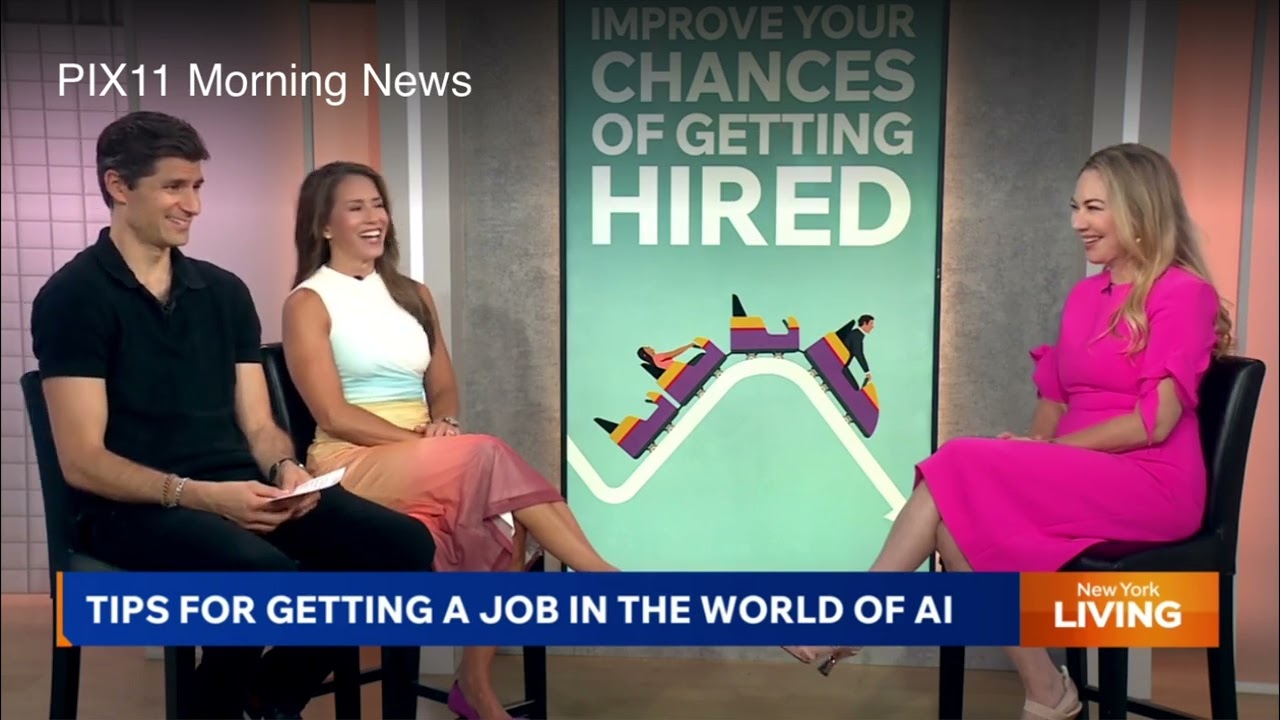
Networking, AI & Landing Your Dream Job with a Former Wall Street Headhunter | S1 E17

Michelle Perchuk, a former Wall Street headhunter, explains why job boards fail and what actually works: network with intention, give value first, and tell your career as a three-chapter story instead of listing dates. She uses AI for brainstorming and interview prep, not as a replacement for real relationships.
Chapters
But it's true, right? It's like it shouldn't be this hard, right? And I think you— did you say it's harder than dating or dating is harder? There's something that you said.
Actually, I said something. I went to a conference for coaches and there was a social media expert and she asked me a really funny question because she really didn't understand what I do. She said to me, what's harder, to find a husband or a dream job? And I said, a dream job.
Agreed. I agreed with that. I actually do agree with that because the dream job too takes time.
Yes.
A husband you could find in your 20s, right? Yes. Yes. But like a dream job, a lot of times it's something, especially if it's more senior, I mean, you're not gonna get that at 22, right? You can get a husband. I like that.
Absolutely.
Absolutely. Hi everyone, and welcome to Unglamorous in the City with Smitha Rao. Guys, So exciting. First of all, love the red, love the necklace, love the look.
Thank you.
So very excited to have Michelle Perchuk here today. She's the founder and CEO of MTV Coaching, which I have to say, I love the name. Being a '90s gal, MTV, right? Very easy to remember. So welcome to the podcast.
Thank you for having me.
Absolutely. So Michelle, you know, we have so much to dive into. What you do, it's such a hot topic right now. I know so many people who who are gonna find so much value out of this, right, who are job searching, just wanting to navigate the job market. So, first, let's start off, though, by telling everyone a little bit about Michelle.
Yes, thank you so much for having me. And I actually love talking about my story because I feel that a lot of job seekers see inspiration in it. So, without boring you through a play-by-play of my career, my professional life could be told in 3 chapters. So, the first chapter is corporate recruiting being a hardcore headhunter on Wall Street for Silicon Valley clients, just getting them the talent that they need day in and day out. So that was the first chapter for approximately 12 to 15 years. The second chapter is about me starting my own company, my own recruitment company. When we had a downfall with the economy, the mortgage crisis, there was no business. Companies were not hiring, and I decided to do things right. Started my own recruitment company, so that was chapter 2. I did everything very high quality, world-class service, got smaller companies really the talent, and I really did the matchmaking very, very well. So I understand because I sat on the other side of the table helping corporations hire. I understand how they hire and what job seekers need to do. The 3rd chapter, which is my favorite, which I'm in right now, is all about being an advocate for the job seeker. The job seeker journey is very lonely, and they're very often misunderstood. And I do what I do, that is the impact I want to create in the world, is really help people find happiness in the workplace so they could thrive, so they could run to work in the morning, and they could make a lot of money in the meantime.
Yeah, and I have to say, I think, you know, it is such a skill again. And I like what you just said, it's lonely, right? Because I know people even right now that are looking for jobs, I've actually, you know, now of course, I'm in my 40s, I've gotten my career figured out. But in my 30s, I mean, it was hard because I transitioned from TV to PR. I was unemployed 3 times, which I'm pretty vocal about, in like weird circumstances, right? But I'll tell you, it is tough when you're navigating that because you hear all the advice, oh, try to enjoy the time off. You hear all this stuff, right? But it is very lonely.
Yes.
It's also very insulting, right? Because you feel rejection over rejection over rejection. And then sometimes, you know, the ghosting and all this stuff. So What is, what's kind of, what are you seeing? What are the trends? What's going on right now when it comes to, you know, just people, job seekers in general?
So job seekers are making the mistake. They're listening to various people for advice and they're not really taking the time to seek out experts who understand the entire space of talent acquisition. So when I talk about what I do and how I help people, I really always come from a point of education. versus giving advice. You know, I'm not a dating coach. So it's all about educating the job seeker of what they need to do today. Most make a mistake. They go on the job boards, they put a resume, and they sit there and they say their little prayers, hoping that their dream job is going to land in their lap. And unfortunately, it's not that easy. Even if they do fall into a job, they wind up settling It winds up not being the perfect match. They're unhappy. And 6 months down the road, they're looking again. So, it's just a revolving door that doesn't help the employee, and it certainly does not help the company.
Absolutely. And I will say, I think, like, job seekers, right, probably do so many things right and then do so many things wrong. Yes. And I feel like you have a strong opinion on that. So, tell me.
Yeah, tell me. What they do wrong is they really hope that they're going to find something on the job boards. They dedicate all of their energy to the job boards, and they neglect the activity that really gets them the jobs, which is networking, and which is being the referred party inside those conference rooms. So instead of investing the time into an activity, that will yield the highest result, they keep on going on the job boards. It's almost like buying a lotto ticket and hoping that they're going to win. It just simply doesn't work. Look, I get it. Sometimes people do find things on job boards. Sometimes there's a lucky event. Make sure that when you are applying on job boards, it's so important for your resume to capture what you want to do with clarity. And there's one thing on the resume which a lot of job seekers make a mistake and they remove it. The one thing that has to be on your resume is an objective. Because if you don't have an objective on your resume, do you want the hiring manager to actually guess what kind of role you want?
That is such a good point. Because I feel like too, like people always have these rules. Oh, I want 1 page, I want 2 pages, whatever the case is, right? And you're right, that's the first thing that kind of goes. And that's one of the most crucial things on the resume, because that's also the first thing. I mean, now we know, of course, AI scanning and then people and then the human that's actually scanning it. That's— I mean, you're right. Why do you have to guess? And when you're getting, you know, hundreds, even thousands of resumes, right, at some jobs, why do you want to, like, give people an opportunity to have to go look up? No one's going to do that.
No one's going to do that. They just skip over your resume if there's any kind of unclarity on your resume or they are Wondering, oh, what job are they applying for? I'm not really sure. They were a director and now they're applying for C-suite. How does that make sense? They're just going to pass over your resume. So the idea is, what do you put on your resume that's going to get people's attention almost like a billboard?
Ah, I like that too. Almost like a billboard, right? Because you're right. And you have such a few— you have like a few seconds, right, to make an impression really when someone is actually physically looking through the piece of paper that is your resume.
Yeah. And I— when people say to me, you know, give me the magic resume that I'm going to get a job on the boards, I'm like, do you really want people to judge you or hiring managers to judge you just from the piece of paper? You don't come attached with the resume, so they're going to make their own conclusions on their own, and that probably is a mistake. So, if you want to participate in the job boards, make sure that your objective is connected directly to the job that you want in the future.
Yes. And I want to go back to what you were saying about networking.
Yes.
Because I've heard that. I mean, I went to, you know, a journalism school, Syracuse. I always shout out Syracuse every episode. So we have, you know, what we call the mafia, the Newhouse mafia, right? So I've always said, I mean, networking is number one, right? I've known that from a very— I've known that in my 20-year career from a very early age. But I feel like even more so in today's AI world where there's just so many applicants. I mean, that's crucial.
Yes. So networking is a big word. It's like saying cuisine. You don't know which food you're talking about. Networking with intention is what I teach my clients how to do. You know, networking is not going on LinkedIn, reaching out to former colleagues and bosses and say, "I'm looking for a new job." Why is that their problem all of a sudden? I mean, most people like to help, but they don't really don't need that heaviness of helping you get a job. So when you're networking. Not only do you network with people that you know, you should also look to grow your network and reach out to leaders in companies where you think you could make an impact and then offer something. You know, I'm the queen of acronyms and I always tell people, when you're looking for a job, don't ask for a favor, look to give away a favor. And giving away a favor is your expertise.
And you know, it's funny because I get a lot of messages on LinkedIn, right? Just from people asking for help and advice and I transitioned from TV to PR.
Uh-huh.
I get a lot of people asking that, right? But you're right. Like, for me, it's like, okay, I'm always happy to respond to messages. I'm always trying to help, like, help when I can. But I think this is a pet peeve of mine. Sometimes people will be like, oh, if you see any jobs that are a good fit for me, let me know.
Yeah. Like, you're gonna be sitting there 2, 3 hours a day looking out for jobs for them. It's really not effective.
Right. And I mean, if it's a friend of mine, you know, it's a little different. But if it's like someone I do not know, a stranger, yes, I will always, if I see a job and I'm like, wait a minute, this might be a good fit for so-and-so, I will always try to help. But it's funny, like, it's sometimes those conversations are very Interesting to me because it's right. They should listen to you and they should listen to people that have the expertise because sometimes I feel like even those conversations without maybe the intentionality are a little off-putting.
Absolutely. And, you know, you may not also know, even if it's a friend of yours, you also may not know exactly what they've been up to recently. So you don't want to get it wrong when you go and you recommend them at your company. So a good way to Reactivate your network is to reach out and say, hey, you know, your name popped up on my feed. I just want to know what's going on in your world. Have a virtual coffee, talk, understand what the person's up to. If there's a synergy and they happen to ask you, oh, look, you know what, I'm looking to transition. Are there any opportunities in your company? You at least now have the updated information.
And I've heard that tip too, that you should really network all the time. Right? It doesn't matter if you're looking for a job or not looking for a job, right? You should always be networking because then, you know, when you are unfortunately in a position where you kind of need a job as soon as possible, those people will remember you because you were networking before. So it's not so— it's not transactional.
Absolutely. And networking is not only to get the outcome of a job, it's to collaborate with other companies depending what role you're in. Maybe you're in a business development role or PR, whatnot. You should always reach out to other companies that are committed to innovation in your industry. So networking is not only about, hey, can you help me get a job? Sometimes you're not even looking for a job and a company may come at you and say, we're very familiar with your work. Can you come and talk to us?
And you should always have those conversations, right?
Absolutely. It's like going to the gym. You should never stop.
Yeah, exactly. And I've heard that too, right? You should always, even if you're not looking, and it's fair to be transparent and say, I'm not looking for anything, but happy to have a conversation. Right? Because you just never know. I've heard that tip too.
Or you could actually know someone in your network who may be interested in this opportunity. So, networking is like breathing. You just have to. It is what it is. And sometimes I get senior executives that say to me, you know, I'm an introvert. I don't really feel comfortable networking. I'm shy, or, you know, I stutter, or whatnot. I am really big on providing frameworks for people. So they could use that as a scaffolding when they're trying something new, when they're leaving their comfort zone. And as a coach, I hold their hand while they're practicing. They have an opportunity to practice inside the cohort where it's a safe space. And then when they're ready, they start venturing out. That's how you acquire a new skill. You try it with people that care about you first. You see that you don't die from networking, and you can now— it's safe enough to go out there and meet new people.
I love that. You do not die from networking.
You do not die.
Yes. Yes. I can understand, I mean, for me it's not, but I can understand it being scary for people.
I understand.
To your point, who are introverted, right? I can like that being daunting.
Mm-hmm.
Or, oh my God, this is a VP or an SVP at a company, right? But you're right. And I actually, this is always one thing too. People are a little more willing to help, I think, than people, other people give them credit for.
Mm-hmm.
Right? And I mean that like sometimes the most executive, like the most like highest ranking person is actually more willing to help. than others. Like, I— and again, I realized that early on in my career. I feel like I'd reached out to some of these bigwigs, right, at companies, and actually heard back because we had a commonality. Maybe it was a mutual friend, maybe it was college, you know, whatever it was. I feel like people are more willing to help than I think people realize.
You're absolutely right. Also, it's what you're doing in that conversation. If you're giving away your expertise and you are confident in what you can give them, then you don't need to be shy about it because you're giving them a gift. If you're asking them for a favor, then it kind of puts you in a little bit of an awkward situation because you're asking and they may say no.
And you're doing it right away.
You're doing it right away. How may I help you? Even in your messaging, even on LinkedIn, on DMs, always give away a favor versus asking for a favor. Because when you're giving away a couch, you got a lot of people lining up. When you're asking for someone to help you move, everyone's like, oh, I'm not— I'm on vacation, I'm busy. Correct.
And actually, those AI messages that pop up on LinkedIn, what do you think of those?
Which AI messages?
So like sometimes you can like say, use AI to help me write this message to somebody, right? What do you— yeah, I have a theory on what you probably think, but what do you think about those?
So I read literally 2 days ago that there are certain watermarks that are being introduced to messaging where now people are gonna be able to tell if it's AI written or it's written by a human being. So I think that AI is starting to get some rights in this world of ours. I personally think that it's great to use AI as just brainstorming, as a sounding board, but then to take that extra step and rewrite it in your own words. You may want to— those DM messages, you may want to look back at the person's background, connect to them through their school, through their bachelor or master's degree, through an article that they wrote. AI is not going to be able to do that. So it's great to get started with AI, but then make sure that you customize so that person doesn't think that you just did a quick job or you have an automation set up or you're just trying to sell them something. Yeah, I always say focus on the quality of messages that you send, Versus the quantity.
That's true, because you can have a good one and that gets you it, right? It's like dating. I always joke it's like dating. You just need one.
Absolutely. Absolutely. I joke around about that all the time.
I think I've seen some of your clips and I've seen that. But it's true, right? It's like it shouldn't be this hard, right? And I think you— did you say it's harder than dating or dating is harder? There's something that you said.
Actually, I said something. I went to a conference for coaches and there was a social media expert. And she asked me a really funny question because she really didn't understand what I do. She said to me, what's harder, to find a husband or a dream job? And I said, a dream job.
Agreed. I agreed with that. I actually do agree with that because the dream job too takes time.
Yes.
A husband you could find in your 20s, right? Yes. Yes. But like a dream job, a lot of times it's something, especially if it's more senior, I mean, you're not going to get that at 22, right? You can get a husband. I like that.
Absolutely. Absolutely.
I like that. Yeah. And I saw that. I think I saw that somewhere.
Yeah. I did that like a little funny reel.
I like that. It's true though. Very wise words.
Yes.
All right. Well, Michelle, let's get to some of our questions. Like I always say, these are just more here as a guide.
Of course.
Of course. We already chatted through so much of this, but, you know, some of this we've actually already answered. But of course, going to the name of the podcast, Unglamorous in the City, what was the most unglamorous part of leaving corporate life and becoming an entrepreneur? Because you shared your journey, you shared the steps.
Sure.
But what was the most unglamorous part?
The most unglamorous part is that you don't have a salary coming in. You know, the uncertainty can sometimes be suffocating. And it's scary because you sit in a room or you sit with a business partner and you're looking at each other and you're like, we now have to rely on ourselves. We don't have a big brand to hide behind. We now have to develop our own reputation. And distinguish ourselves from the competition. And you have to be accountable to yourself in the mirror. There's no hiding. You have to eat, so you have to make a living.
And it's scary, right?
It's scary.
Was it? I mean, that transition, because to your point, to like from a corporate job with a salary, with benefits, to doing something. And I've had— I've actually— most of the people who have been on this podcast have been entrepreneurs or have a business. And a lot of people are doing the main job and the side hustle because the side hustle isn't Quite there to be the main hustle. So that transition, I know, like, that's tough to do that. And of course, in a city like New York, right, even more so because the cost of living is so expensive. And then you're betting on yourself too, right? Because there's no guarantee in this.
Well, look, when people ask me this question, how did you do it? I said, well, if I worried about all the scary stuff, I wouldn't do it. What I actually worried about And thought about and put all my energy towards is the outcome, the vision, the payout that I'm going to get. And I often say it is not for everyone. Running your business and all the different parts of running a business is very difficult. So make sure that you really, really love it. And if you love something, you can't suck at it.
I like that.
So you're going to correct and you're going to stay up till 2 o'clock in the morning and you're going to keep reaching out to people. For help, and you're just going to keep on working it and working it and working it until it becomes a masterpiece.
You have to have that passion and that drive. You have to have the passion. Right? And you just— and maybe passion, like, you just have to have so much, you know, you have to believe in yourself, number one, and you have to have that passion, that drive, and that willingness. Because a lot of it, I mean, if you're still working your full-time job, right, if you're doing that while trying to do that, I mean, that's a lot of time.
Yeah. Yeah.
Purpose.
It's bigger than you. Like, my purpose as a career coach is bigger than me.
Yeah.
It's not even about me. It's about Being an advocate for the job seeker who's alone, worried, scared, you know, having issues with family or, you know, having to make tough financial decisions. Those people are out there and they need me. So that is my— that's the reason why I wake up every morning.
I love that. And I know obviously you've changed lives. I mean, really, you know, jobs—
I have changed lives.
Absolutely. What's— any of these stories stick out to you or any examples? I'm sure there's so many.
So many. I've saved people from divorces, from bankruptcy, from pulling children out of private schools. Most recently, I had a client who had a dream to move to Europe because he's in scientific research and he wants to raise his children in Europe. And it was such a difficult search because it was so specific. And we did it. We did it. It took a little bit longer. But he just kept on being resilient and kept on listening to me and autocorrecting, and we did it. He found his dream job.
I love to hear that. And it's true, you have to be resilient, right? You have to be. Because you can't— I mean, obviously you're putting in the work and you're gonna get the results, but it could take a little time, right? It's not gonna take— it's not gonna be overnight. Nothing good happens overnight.
Nope.
Nothing great was built overnight, right? And I always say it's— I've said this on the podcast before where it's like, you know, overnight success? No. That is not true. Like, it takes work and determination, and it's the same with a job search, right? You're not gonna apply and it's like, oh, we love you, you know, we're gonna hire you tomorrow on the spot.
Yeah. When clients tell me that, oh, I'm getting an offer one interview, I'm like, be warned, easy come, easy go.
Ah, well, that's true because, I mean, that's actually— that's a red flag.
It is a red flag, right? But a lot of people fall for it because they're looking and they've been looking for a long time and they're Kind of exhausted, and everyone thinks that, I'm a good person, I'm gonna get lucky. Doesn't work that way. Do not rely on luck when you're job seeking. It has to be very strategic.
It's that desperation too, right? Unfortunately, I feel like people get a little desperate.
Yes.
And after, like, I know after the 6-month mark, right? Like, I feel like there's, like, there's kind of like marks, right? After 6 months, like, that's a long time, right? To be every day looking for a job, 9 months a year, whatever it is, right? So I think I can definitely see that people saying, oh, This is amazing, right? Like, why wouldn't I say no and, and come to you and you'd be like, no, this— it seems too good to be true. I feel like it's also too good to be true.
Yes, absolutely.
Yeah. Wow, that's great. God, there's got to be so much in there, right, when people are navigating it. What is your biggest interview tip for people?
You gotta have your story. Every single interview starts with the infamous question, so tell me about yourself. And if it's not clear then you've lost that interview. You have 3 to 5 minutes to captivate them. You have 3 to 5 minutes to have them fall in love with you and continue to pay attention to you. So I don't know if you've noticed, I used my infamous 3 chapters of my professional life, which all of my clients use. I write it with them, I interview them at depth, and when they send me their interview recordings I literally hear high-power hiring managers saying, wow, that's so creative. I love it. And that gets you the uniqueness during the interview process because for a lot of these high-power roles, they're interviewing 4 to 6 people and they'll forget your first name, but they will think of you, oh, talk to us about the guy with the 3 chapters. So it's a very distinct way of introducing yourself. Of curating your career, removing dates, removing titles, and just leading with your expertise.
I love that so much. And I did notice that. And you're right, because it's all like, as a journalist, right? Former journalist. It's all about storytelling.
That's right.
And it's what's memorable because you're right, these people are interviewing, you know, especially for these like really high stakes jobs, multiple, multiple people. Right? So it's like, what is— and may not even remember your name in the moment. Right? But it's like, oh yeah, that one that had the 3 chapters that had that And then you're right, and it's easy to remember versus a vague, oh, I've worked for 25 years and I've done this and this and this. Right? And do you ever think you should throw anything personal in that when that question comes up? You know how— yeah.
It all depends. I mean, when I craft this with my clients, I sometimes decide to make it personal. Like I had a client the other day who is a mad scientist, you know, AI genius, but his actual Pathway in education started with music education.
Wow.
And we decided to include that for him to differentiate himself from all the other applicants. And actually, one of the hiring managers said, I'm a classical pianist. So they had something in common. The commonality.
The commonality. I always tell my clients to find the commonality.
Yes.
Right? Whether it's where you went to school, whether it's where you're from, your hometown, you know, whatever that is, or your hobbies, right? That is great. Yeah.
The 3 chapters actually does something magical as well. It starts to build rapport with whoever you're talking to. And when there's rapport, the other person feels comfortable opening up, and that's when you could ask your questions even though they're interviewing you. You kind of reverse that. You start interviewing them, you get to the bottom of their problems, and then you just offer yourself a solution. And then boom, you have the job.
Well, it's going back to what you said, right? Where you— what are you offering?
Yes.
It's not just what am I taking, it's what you're offering in that moment. Those are the candidates that I'm sure stand out.
Absolutely.
In that process.
Absolutely.
Because I've interviewed candidates as part of a hiring process, and you're right, sometimes they all kind of— it's just they're doing so many. Okay, yes, this is obviously the person has the resume to get in front of you, but it's then that stuff that stands out.
It's all about being different.
Yeah, and having that story.
Having that story. Yeah.
And knowing what your story is, to your point, because you work with a lot of executives who have, you know, 20, 30, 40 years of story, right? In the world, in the job world.
What I've also observed is a lot of times when people are not prepared to tell their story, they actually sabotage their own success. They wind up telling too much. They are meandering through the process. And what that does is it confuses the hiring manager. So let's just curate. The experience of you for them so they will see firsthand what you will be like if you work there.
Right.
And no one else is doing this unless I'm their coach. So you're going to win this competition.
Right.
Right.
Well, exactly. Because then you're obviously coaching them to not only do it, but to do it well.
Absolutely.
Yeah. Oh, that's cool. And what's a program with you? And we'll get, of course, to, you know, at the end of the podcast, you'll tell people how to find you.
Yes.
Like, what is the process from start to finish? Like, how long does it take? What's kind of the whole— because I'm sure there's a lot that goes into it.
So just to explain kind of the process, because it goes horizontal and vertical. So it takes as long as 6 months. But what we've studied, because I'm a big data person, I've noticed all through 2025, most of our clients are graduating at the 90-day cusp. Okay? Have I had people that got dream jobs in 3 weeks? Absolutely. But when I talk to potential clients, I always tell them, look, Really account for solid 3 months. Will it take you a little bit longer? Possibly, especially if you're working full-time, so you can't really dedicate yourself completely to the job search, but 90 days is really the magic number. The process is I start with identifying what is their dream job destination. If people don't know where they're going, they're never going to get there. So we first need to understand What you love about your current job, what you loved about your former job, what you hated about it. And then let's identify your transferable skills and see how that can be mapped to something new. And that takes time.
Yeah.
It takes time. I do that in 1 to 2 sessions. Once you know what you're looking for, now we can teach you how to market yourself. Now we can teach you how to craft your story. Now everything matches. Because most people, they lose the attention from the hiring manager because they're meandering. The more clear you are, the easier it is for them to understand you and say, huh, that's what we're looking for. Great. He's the perfect person.
Right. Right.
And it's so simple, but so many people—
It's so simple, right? It's so simple, but it's, of course, when you're going through it and you need the proper coaching to make sure that you're doing it effectively.
Yes. So being a former headhunter for Fortune 1000 companies and now being a trained coach, I combine those 2 things. It's not only about the tactic of looking for a job, but it's also the mindset that you bring to the journey.
Mm.
If you're thinking that it's gonna be hard, guess what? It's gonna be hard. If you're thinking that, oh my God, the job market is so hard, there's very few jobs, You have a scarcity mindset, guess what? You're never going to find a job. If you have an abundance mindset, like I said on, on, uh, um, New York One, I said there are an abundance of business problems today with AI, with cybersecurity, with data breaches. There are so many problems, more problems than ever before, and companies need people that could solve those problems. So, when you work with me, you're not looking for jobs anymore. You're looking for problems.
Right. And you're also an asset, right? Like, that's always the thing to remember, right? You're an asset. Like, you have the experience. You're coming in with something. You're offering something, right? And that's actually a good point, because for anyone who's watching or listening, maybe who's kind of in the midst of a job search, right? And let's say it's been 6 months, right? That frustration, the rejection. Maybe this person, you know, almost got a job, right? And was so close, had 7 rounds of interviews, and then it went to someone else. What would you say to kind of motivate that person or to keep that I mean, you just have to keep going.
There's no— you don't have a choice. Sometimes it's really important to step out, step out of the jar. I often say if you're inside the jar, you can't read the label. So you have to kind of stop what you're doing and take a setback. Get an expert that's going to help you. Very often people try to accomplish certain difficult tasks like doing their own taxes, like trading their own portfolio, cutting their hair, whatever it may be. You try to do it yourself and you wind up doing really a mediocre job. If you're looking to do something that's difficult and job search is difficult, Get an expert that could guarantee you results, that does this day in and day out. They know the industry. Get them, do everything possible to work with them, get it over with, and move on. There's no point to keep doing the same thing over and over again and expect a different outcome. That's called insanity.
That is literally insanity. And I will say, like, as we're talking about this, I can think of a couple of people, like, I'd love, you know, who could use your help because you're right, it gets so frustrating and you're doing the same thing. You're doing all the right things.
Yes.
Like I have a lot of talented friends who have been working for 20, 30 years, right? Doing all the right things, have the experience. But you're right, if something is not working, you just, you need to bring in an expert. It's like anything else because trying to do it over and over and over. And I wish I had known you when I was unemployed because I probably would've reached out because you're right. Like it's, you're doing the same thing. You're doing all the right things, right? On paper that you hear you're supposed to do, but you're not doing it as As you should be doing. And that's where an expert like you comes in, I feel. Yeah.
And in addition, people sense that energy. The way you interview month 1, when you're all like doughy-eyed and all that, is very different than the way you interview unemployed after 6 months. People feel that energy.
Yes.
Yes. And there's nothing that you can do. There's this frequency that a hiring manager feels. You're not interviewing like yourself. You've got an inner dialogue going, oh my God, it's the 5th month that I'm diving into my savings. You know, it's very interesting because when I talk to people about the investment into my program, people just don't understand that it's 10x. Invest in yourself and get the outcome. People won't invest X. To get back on the horse, to be earning at their full capacity.
Ah, because it's everything, right? Like, I know on TV we used to have agents, and agents are— I mean, they're notorious for getting you a better opportunity than you could get on your own.
Yes.
Right? They have the contacts, they have the expertise.
Yes.
And when it comes to salary, like, obviously you're investing something in it, but you're seeing that ROI because you're getting also a better job than you would at a higher salary, right? You're getting maybe that negotiation. I mean, I'm sure you help with the whole process from start to finish.
Yes, I do. I do.
So with the negotiation, right? Because everyone should Negotiate, right? I mean, everyone—
Absolutely.
Yes, absolutely.
Absolutely. But a lot of people in the industry think that there's going to be that magic recruiter that's going to get them the job. So here's what I want to say to the audience about recruiters today. First of all, you don't know where they are. You don't know if they're real. They could be AI. They could be looking to steal your identity. People put addresses. People put their zip code. Everything that you need in a full address and a phone number and your name and your middle initials, and that is enough.
And sometimes Social Security number. Sometimes it's crazy. Like, I've been asked because, I mean, yeah, I've gotten some of those weird messages too. And yeah, I've learned to ignore them now. Yeah.
And recruiters, um, you know, when I work with clients, I actually give them a vetted list of recruiting firms. How do I know? I used to be one. Okay, so I know who are the best and the best. Don't trust every recruiter that calls you. They will sabotage. I had a client tell me a story a couple of weeks ago that the minute they spoke to a recruiter, the recruiter said, okay, great, we have a few jobs, we'll be in touch with you in a couple of weeks. Then they turned around and called HR and said, oh, we heard that you need to backfill this director of operations.
Uh-huh.
My client got called in and said, are you lo— looking to leave? So these recruiters have no allegiance to you. These recruiters, all they care about is making their commission. So when you work with me, I actually developed a framework that's going to help you put a recruiter through a litmus test so you know if they're real, so you know that they have your best interest at heart. Recruiting is not what it used to be. So you have to make sure that you're talking to a legitimate resource that has a company email, that has a LinkedIn profile, that they're talking to you about a real job and they're not pulling your leg.
Well, and I'll tell you a funny thing. I work at a big company and I get messages sometimes from the same company.
Yes.
Which are clearly fake. Yes. Like, oh, are you interested in working here? Right. And it's like, well, like, but it happens all, I mean, it's actually happened more than once, which is kind of, which is scary when you think about it. Right. Because clearly that's fake.
Yeah.
There's absolutely no way that somebody who works at the company wouldn't know that I already work there. So that's a good reminder actually, cuz—
But if people are, if people are tired and they're worried about paying, paying their bills, they may not see this and they may actually get caught up.
Yeah.
Yeah. And it's very unfortunate, but this is the reality of the job seeker's journey today.
That's really a shame, right? Because you're right, it's sometimes that desperation that kind of wipes out the common sense, right? Where it's like, this doesn't make sense, this email. And sometimes if you really look closely, like let's say it's Google, right? It'll be like @Google, but it'll be like misspelled, right? Like it's actually sometimes very clear that, and really, I mean, in that case, I mean, should you even report those people? 'Cause that's obviously like, I've gotten those messages on LinkedIn and there's, I think, a way that you can say like, hey, like this is not a real person and this is obviously Obviously something shady. Yeah.
But if you're networking with intention, following my system, you ignore those. You don't rely on recruiters. You don't need them. You've got 2 or 3 people who are willing to help you. They know what you're an expert in, and they're actually going to talk to their upper management about you, and they're willing to give you their employee number so that you could apply for internal jobs.
Exactly. And you don't need those messages. And you don't need them. And quite frankly, you're right, you could get in trouble outside of just the initial, right? Because you're right, they can have your private information.
That's right.
There's fraud involved with that, right?
That's right.
scary and frightening when you think about what people can do today in like today's day and time, right? Like what they can do with just some of that basic information.
Yes. Wow. Yes.
Wow.
It's a dangerous world out there.
It is.
Well, poor job seekers, right?
I was gonna say, yeah. And again, I have friends, you know, who are watching and listening who are going through this job search right now. Some have jobs, some don't. And I feel for them because it's tough. I get a lot of people in TV who want to transition to PR.
Yeah.
And that's a tough— like, it's just tough Yeah. So I empathize.
Transitions are tough. Transitions are tough. And when you're looking to transition into something new, I always say identify your transferable skills. What are your core values? How can you take your particular skills from one industry and how can you actually map it to a new industry? And I've got some transferable skills for your listeners. If you guys are ready, remember the equation: 4 Cs, 2 Ts, and 1 L. So the 4 Cs stands for collaboration, communication, creativity, coaching mindset, having the patience to teach others on how to do new things, teamwork, excellence in technology, and the L stands for leadership.
I love that. And it's so concise too.
Yes.
Yeah.
4 C's, 2 T's, and 1 L.
And easy to remember. I love acronyms too.
I love acronyms.
I mean, MTV, again.
Yes, yes.
That's great. That's easy to remember.
Yes.
Yeah. Okay, that's great. Thank you for that tidbit.
Of course.
I think that's really helpful.
Of course.
Yeah. Like I said, I just, I know there's so many people that this can help. I'm so passionate about this too, because again, I've been through my own journey in my 30s. Now I'm in my 40s, but in my 30s, I went through this journey and it is, I mean, it is really like, I remember just being frustrated and I'm fortunate I have a family that can help me. If needed, right? Like, thank God, but not everyone has that.
Yeah.
You know, or whatever, spouse, whatever the case is, right? But not everyone has it. And that is the scary thing, I think, when you're going through a job and you're worried how you're going to pay your mortgage, how you're going to pay for your kids, whatever the case may be, right? I mean, it's terrifying.
Yes. Yes. But if you know what you're doing and you stick to a system, then it's not so terrifying after all. You could take some calculated risks. You're not alone. This is really the game changer. You're not alone. Um, I always find time to reflect and listen to what my clients are telling me. And for several years, my clients were telling me that I feel very lonely in this journey. Um, I wish I could talk to somebody aside from you. And I've been listening to what they've been telling me, and I'm very proud that I am always naturally curious And I always look to do things better that will enrich people's lives. That's just baked into my personality. So I decided around 2 years ago to launch a community pillar of my program. So when you're in my program, you get education, which is an online course, you get one-on-one work with me, which is very strategic, and then you get introduced to our community. So I like to call it our secret society. It's the entire cohort of job seekers that are working with me at any given time. So it's anywhere between 30 to 50 people. We all meet once a week and we all use that as a mega networking event. So someone at Amazon may know someone at Nvidia, may know somebody at Target, may know somebody at Condé Nast. On those calls, people introduce themselves, they exchange LinkedIn, LinkedIn handles. They actually establish buddy systems. They help each other. It's like— I hate to use this comparison, but it's like an AA meeting. Everyone knows what hardship the other is going through, and everyone is so vested to help. And people are getting jobs from, from these meetings. People are getting incredible introductions, and they are using each other to help prepare for interviews. People are saying, oh, I interviewed at this company and this is the questions they— these are the questions that they ask. If this helps anybody, here's a great recruiter in St. Louis that helped me. It is so powerful. Sometimes I get teary-eyed on those calls because it's always a Zoom call, but everyone just wants to help. And it's like my favorite quote of all time: if you want to go fast, walk alone. If you want to go far, you walk with people.
I absolutely support this so much. And to your point, right, when you're all going through that same journey too, and just, okay, let's say somebody's working at one of these companies, right? Maybe not a good fit for you, but it would be perfect for Michelle, right? It'd be perfect for this person. And so you can help so much, right? Like, and we were talking about Sex and the City earlier, and I don't know why it reminds me of this, but there's like an episode where it's basically like, I don't want to date him, but you can.
Yes. Yes.
Yeah.
I actually just thought of that when you said that. I think it was Charlotte that were recycling the boyfriends.
Exactly. So it kind of reminds me of that, right? It's like, this job may not be right for me, or this company might not be right for me, but I think it's perfect for you.
Yeah. But you know what? At the same time, you go to an event or you go to a wedding and you sit next to this great guy and he's really not for you. But you know what? He could be the best guy for your best friend.
Yeah. I've had friends who have tried to do that. It's like, you may not be right for me, but my friend, you should meet her. Yes. No, no. And, but I love the community coming together cuz I think you're part of like, that's That's part of the experience too. It's obviously not just all the expertise, but it's that community that forms from this too. And that's a good point too.
And we all celebrate together. So tomorrow we're celebrating 2 incredible offers, which are truly dream jobs. So we get to celebrate together. And, you know, success is infectious. So when other people— there's no jealousy in our community. So when other people get these dream jobs, the whole group is happy for them. And that positive energy creates great opportunities for the others. So we're using it for celebrations. We're also using it to ask the difficult questions like, what question am I struggling with? Perhaps if I ask Coach Michelle about that, who else can benefit from it?
It's like a classroom.
Yeah. It's almost like utopia. So, you know, on this call it truly is because there's no jealousy. There's, you know, no negative feelings. Everyone is there for the same reason. Everybody invested in the program. Everybody trusts me. Everybody is comfortable with leaving the comfort zone. Everybody's there to work. And in this community, 1 1 3. Yeah.
Yeah, exactly. And I just love that because the camaraderie too, right? Yes. Yes. It's building something as well.
Yes.
Oh, that's great. Now, for anyone watching and listening, I always like to give tips from, like, you know, for entrepreneurs.
Yes.
Like, you know, obviously, as we talked about, this doesn't happen overnight. Is there anything you wish you knew when you got started? Because I know people, and you said this too, you kind of alluded to this, I think, where it's like if you knew what you knew, you may not have done it. Right? Like, you may not have taken all the risks, because if you know, like, I've heard that from entrepreneurs before.
Yes.
But any tips for someone who's like, oh my God, Michelle is so inspiring. I wanna do something similar, whether it's in this space or another space. Any tips?
Yes. The biggest tip, don't try to do the hard stuff yourself. If you stand up and you raise your hand and you say, I'm having difficulty doing this, just start in your community with friends, neighbors, former colleagues. Just get comfortable with being vulnerable. There's no need to do the hard stuff yourself. If you raise your hand and say, I'm having a hard time doing this, I really need help, can someone help me? People will come out of the woodwork to help you. I made this mistake in my recruiting business for 2 years. I tried to do it the hard way over and over again. I just kept on making the same mistakes. I couldn't see the label outside because I was in the jar and I was stuck in like this honey. And I couldn't get out. And slowly but surely, I started understanding that I need to talk to people who are running similar businesses. When I opened up my coaching company, I immediately had a network because I finished the Leadership for Executive Coaches at Rutgers University, and it was our cohort, and it was 26 people. So I immediately had individuals that I could reach out to that I could use as a sounding board. I hired one of the coaches in the program to be my mentor. So the way that I'm running the coaching business is very, very different than I ran the recruiting business, because when you're in your own head trying to solve problems, you can't show up as the best version of yourself to your clients. When my clients get me now, they get me on fire every time. They don't get like Michelle at 85 percentile. They always get me at 120.
You're on.
I'm on. I'm on and I'm thriving and they give me the energy.
That's amazing. And you're right though, you shouldn't do things alone. Right? Like that's the whole point and that's how— that's growth.
Yes.
Right? Is to have a team, to have a support system, to have people that help, that expertise, bringing people together who can all just make everything better. Yes. That's amazing.
Okay.
I'm keeping an eye on the time for us.
Yes.
I know we have time for a couple more, maybe 1 or 2 more. So we've already answered most of these, to be honest. But I love this question. So for someone in their 40s or 50s who suddenly has to job hunt again, where should they start?
I'm going to make that recommendation. Really identify your transferable skills. Sit down and write it out. You could probably talk to ChatGPT or Claude to help you hash it out. Don't expect Claude or ChatGPT to give you the answers, but use it as a starter. You need to identify your transferable skills because if you're looking to pivot and there are a lot of new professions that are born every minute, actually, roles that existed maybe 2 years ago no longer exist and new roles are being invented. So it's really important to understand what problems you could solve for a potential employer and then reverse engineer your transferable skills. You lead with those transferable skills on your resume, on your cover letter, during your interview. Transferable skills are like your core values. They're your foundation as a professional. If you don't have them identified, you're going to be wobbly. You're going to have nothing. You're going to be a 3-legged chair. You're not gonna be able to stand on anything. So if you're looking for a career pivot, and I've known people that have gone through several career pivots, understand what is it you bring to the table, what are your transferable skills, like problem solving. If you could problem solve, all you need to do is kind of learn the industry, but you already know how to do that thing.
So true.
Yeah.
So true. I like that. Yeah, I like that. And then I wanna ask one AI question. AI question.
Oh, I'm ready.
I know. I was gonna say, I know, I feel like we could have, we, I know we're like getting close to time. I'm like, we could have kept going on, but AI, you already said a really like cool point, right? That now like companies are gonna be able to tell if they can't already, because sometimes I think companies can tell because they must get a lot of the same type of stuff when it comes to AI, right? Like they must see the same language, like, you know, like in the COVID letter, like you have to put a description, right? Mm-hmm. I'm sure that they see the same verbiage. So it's very clear, I'm sure, but now there's like tools you said that'll actually really be able to tell it. What is your tip when it comes to AI and someone using AI? I know you've talked a little bit about what people should do, but any kind of like play off of that or anything further?
Absolutely. So I have one of the most famous quotes of like my career, and I've been quoted, you know, from TV and articles and so forth. You gotta make AI your pal. Think about how we use friends. When you call your pal or you call your close friend, you're not really calling them to tell you what to do because no one wants to take that responsibility. You're calling your friend to give you advice, to offer you several perspectives, to get you started. A lot of times my friends will say to me, well, you know what, why don't you look at it like this? Or, have you ever thought about doing it this way? It gets you started. Same thing with AI. Use it as your pal. Do not expect it to do things for you because the minute you ask it to do your resume for you, it's not authentic. You won't be able to speak to it. If you want to use AI for resume writing, do the research on your transferable skills and then write the resume yourself. Do not look to replace the work that you need to do. With AI. AI is there to help us, to supplement what we're doing. But a lot of people are still very torn about AI. A lot of people are angry that they may lose their jobs. They're not losing their jobs to AI. AI doesn't have like the secret plan to destroy us. Okay? But those people are losing their jobs to other executives that have embraced AI skills.
I've heard this from a lot of executives. You're exactly right, where it's like the— like somebody was talking about the World Wide Web, right? When the World Wide Web came out, right, there were people that embraced it and people who didn't. And who do you think was left behind?
The people that didn't. Yeah. It's like the grandmothers that said, I'm never going to use the ATM machine, right? It's going to take my money. It's the same thing. We need to just welcome innovation. AI is a great tool. I teach all of my clients how to use it. I have actually incorporated certain tools into the program to make you feel comfortable using it. I've been growing my own AI. So when you become a client, you actually get an AI companion. It's like getting my brain. So if you are like up at 2 o'clock in the morning on job boards and you're wasting your time like doom scrolling, talk to Michelle's brain. And within 5 minutes, you're going to stop doing that and you're going to go to sleep. You're going to conserve your energy for your interview tomorrow. So we always give the AI companion to our clients because they can't have access to me all the time. But if they have the companion that is actually my content, and I've been growing that AI for a year, there is that level of support. There is that white glove service where they don't feel alone. Now, does that AI replace me? Absolutely not. Will that AI help you negotiate your salary? Absolutely not. But it will give you a level of comfort. And a level of not being lonely in the job search.
I absolutely love that because you hear a lot of people saying, oh, AI is gonna take my job, this and that. And obviously AI is here and it's here to stay, right? So you need to learn how to adapt it, how to embrace it. I like that word, how to embrace it, right? Because it can also help you.
Yes.
It's such a good tool.
Yes.
To help with our jobs. Our jobs are so much more efficient.
Yes.
In many cases because of AI, right? So not embracing it.
It's a supplement.
Yeah.
It's a supplement that is supposed to have you be more effective and being able to process more information. Some examples I could give is using AI to transcribe meetings, using AI when you're writing something, kind of talk to AI, give the riddles as prompts, I always recommend give it a humanistic prompt because it likes when you talk to it like you're a friend. And then use that to get you started. It's like a starter kit. It's fantastic.
Isn't it crazy? 2 years ago, it really wasn't like— it's kind of amazing to imagine how far we've come, right, in a relatively short amount of time. Because I think now how much I use AI, to your point, to start things off, right? Because I never want to finish things. with AI, but it's, it's like such— it's embedded into our lives right now.
Yes. Yes. And, um, it's also when you are in your professional life, not in academic life, because AI and academia now, there's a lot of controversy, like, you know, publishing rights, you know, who's really writing the paper and all of that. But in a professional life, it's especially for executives, you may not see certain Perspectives. Like when you are doing a particular strategy, you may not see the downside of that strategy. And it's very important for you to talk to an entity that can actually punch holes in your theory. So use AI to kind of question yourself, and then you can adjust and make your strategy even stronger. Because you don't want to be ambushed in the meeting. If you brainstorm with your AI before the meeting, you will be more prepared.
Okay, Michelle, I feel like we could keep talking.
Absolutely.
And I'm like, I'm sad. I always say this. I'm always sad. I'm like, I'm looking at the time and I think we have to wrap up. Any final words? And then of course, where can people find you? I have to say, you've really offered a lot of amazing tips. And for free. So thank you. Yes. Yes. You're welcome. Thank you, Michelle, for that.
You're very welcome.
Yes. No, but I really, I will say, I think I've learned, and I feel like I have a good handle on this kind of stuff, right? But I've learned a lot here. And again, I just empathize with anyone out there who is watching or listening, looking for a job. Like, I just feel like your tips are just so spot on and can really help people. And to your point, change lives.
Absolutely. So what I want to give the advice to everyone who's listening, do not go through the hardship alone. There is so much help out there. You could definitely come to me, have a consultation, talk to me about your particular situation. Everyone is different. So come to us, let us help you, let us in into your world, and I promise you, you will land your job in record time.
Amazing. Okay, where can people find you?
You could find me on LinkedIn, first place, under Michelle Perchuk. You could find me on Instagram. I give away so many incredible tips. Uh, you could find me on YouTube. So YouTube we're using to house all of the testimonials. So if you go on YouTube, you could literally see dozens of people talking about the experience of working with me and my team. Um, and you could find me on my website, mtvcoaching.com.
Excellent, Michelle. This has been such a pleasure. Again, thank you for sharing your wisdom and all your expertise, right? I think just, you know, again, anyone watching, listening Going through a job search, listen to Michelle. But thank you very much. This has been a wonderful conversation.
You're welcome. I enjoyed it very much.
Me too. And as we were saying at the top, like, it always goes by so fast.
Yes. I didn't even think about it and we were at the end.
Exactly. Well, thank you again. And of course, to everyone, my audience, you know, thank you as always for watching, listening, for all of the support. And of course, I will leave you with this. Please remember that some of the most unglamorous moments in life Are usually where the real story begins. So guys, take care. Thank you. We'll see you soon. Bye.
More from Michelle

ABC7 Eyewitness News Mornings @10 segment ("A.I. Job Scams," 7 On Your Side with Nina Pineda).


Executive Career Coaching Success Story | David Auslander’s MTV Coaching Testimonial
Why Executive Career Coaching Works | Stephen Bush’s MTV Coaching Testimonial
Executive Career Coaching Testimonial: Stephen Bush’s Experience with MTV Coaching