Pantheon 2026 | Run your Business, Not Your Software
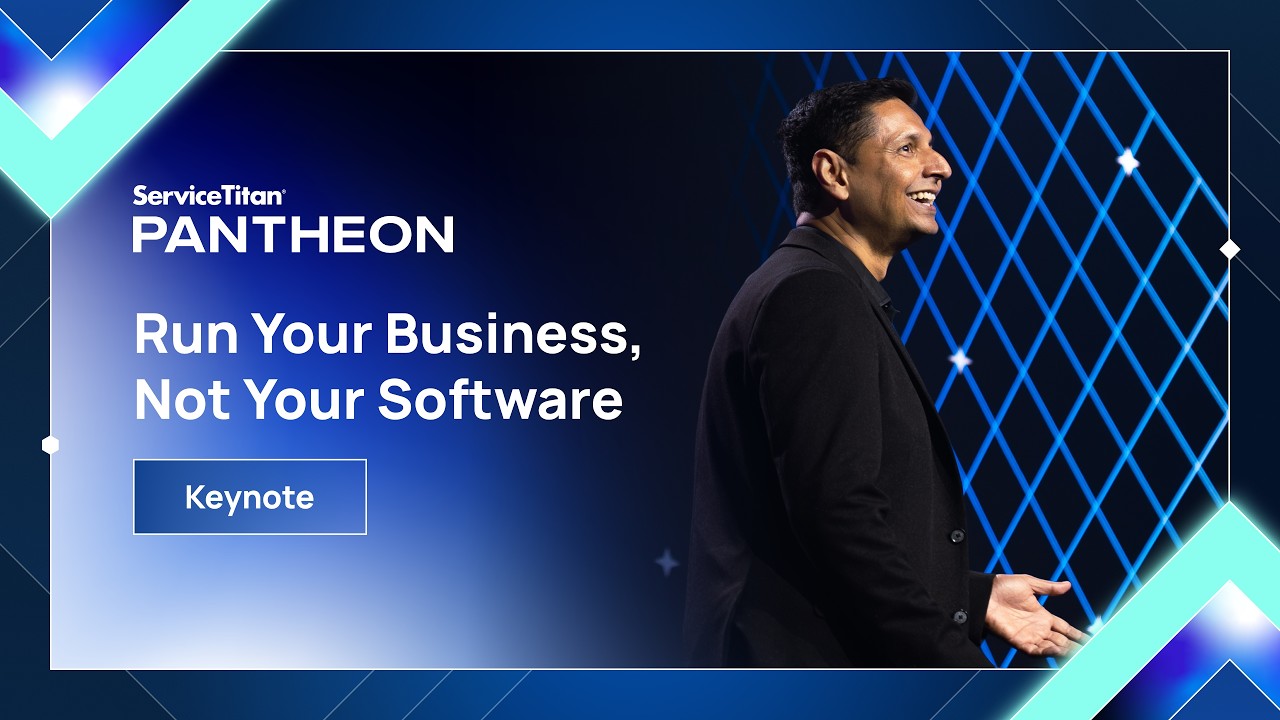
In the Pantheon 2026 keynote, ServiceTitan’s Chief Technology & Product Officer Abhi Mathur, joined by presenters Vincent and Tamar, unveiled the company’s AI‑driven operating system called Max and its conversational layer Atlas. The talk framed the trade‑service industry as being at a pivotal moment similar to Kodak’s missed digital transition, arguing that businesses must adopt agentic AI now or fall behind. Max is described as a suite of 30+ autonomous agents that handle demand generation, lead scoring, dispatch, financing pre‑screening, field assistance, estimate generation, invoice review, and continuous business insights. Atlas provides a ChatGPT‑like interface that surfaces the “company brain” for every role, from CEOs to technicians. A new AI Command Center aggregates real‑time metrics such as revenue realization (the gap between actual and potential daily revenue), booking rate, ticket size, and capacity, allowing automated goal‑driven actions like adjusting ad spend or reallocating technicians. Live demos showed how virtual agents can book, reschedule, and fill gaps without human intervention, how field technicians can use voice‑enabled Atlas to record findings, create equipment records, and receive AI‑generated, personalized estimates that incorporate homeowner preferences and financing pre‑approval. Automation agents also monitor invoices for missing line items and correct them before sending. The presentation highlighted quantitative outcomes: 9.4% of maintenance calls were fully automated, 2× year‑over‑year revenue growth for Max users, and individual techs achieving 34% ticket‑size increases. The overall message was that Max and Atlas turn software from a tracking tool into an autonomous business partner that frees leaders to focus on people, improves efficiency, profitability, and scales without adding headcount.
Chapters
Last year at Pantheon, we sat in this ballroom. They start to talk about what Max could do, and I sent a text back to the office and said, I need more money. Of course, I got the response back, how much?
You know, all this.
And I said, it doesn't matter. We want to be on the cutting edge of this. We don't want our peers getting it before us, and it serves our business goals. The answer was basically find a way because it is what we want and we need it. We knew we had some super talented people in our leadership team, and there was no way to reproduce them or double the number of people of that caliber. But what we could do is take It has made us more efficient, ultimately made us more profitable, but primarily it has bought back the time of our leaders. The part that I'm most excited about with more automation is I just get to spend more time with the actual people, talking to the technicians, talking to the customers. I get to spend more time being a servant of the people than I do pressing buttons. Coming home from Pantheon last year, we focused first on the demand side of MAX— scheduling, marketing, and dispatching—
where we were able to take a lot of the burden off of our leaders.
We're able to reach out by SMS and email to recurring service customers, include a booking link, and then automatically assign them. And so that full demand circle gave us 9.4% of maintenance calls were reached out to, booked, and assigned. When the technician was arriving, he was the first human involved in the call. Max and Atlas make me more successful because I'm prepared. When I dispatch into the job, I get a job brief from Atlas basically telling me all the past jobs, what has been done there. It's saving at least 10 minutes before each call. I'm sure that's close to 1 call a day and 4 or 5 a week that I was spending time actually just getting background information on the call before I went to it. One of the biggest challenges in being a technician is communication. But when you have an AI system that is able to help you along in those skill sets that you might be lacking, all it does is improve. It's another person, in a sense, next to you watching and listening to what you're doing. In a way, that can be very beneficial in teaching you and getting you ahead. AI is really important for technicians in the field because it gets us back to serving the homeowners well. It takes care of all the small details that get in the way of us just making the repair and connecting with the homeowner. Anyone hesitant about adopting AI may compare to a ChatGPT, ask a question and get an answer that's wrong. And yet that's not ServiceTitan, that's not Max. Max and Atlas are designed specifically for the trades and quality tested by really good companies. If you care You don't care at all about your business, you care about the quality and the reputation you've built. Every level of Max changes every element of the business. A dispatcher would love Max because the new job value prediction capabilities takes all of the factors that I am looking at in trying to put people in situations to succeed and putting them all together. We're able to have a marketing department that runs with no people. We're able to get the tech that's best suited for the homeowner to the call every time. When you compound it, it's hard to compete with. Anybody not adopting AI for the trades is going to get left behind. Since we've started using ServiceTitan, it took the lid off a jar of possibilities. Not only are our dreams for the future possible, but also they've invented new dreams for us because of seeing what it can do. Ladies and gentlemen, please welcome to the stage ServiceTitan Chief Technology and Product Officer Abhi Mathur.
Kodak invented the first digital camera. In 1975, but they buried it and stayed with film. Everyone else moved to digital and Kodak filed for bankruptcy in 2012. They didn't lose because they lacked technology. They built it before anyone else. They lost because they couldn't accept that the world had already changed and they protected their old ways instead.
instead.
We saw the exact same thing happen in trade industries 15 years ago. Businesses that clung to their own carbon copy invoices, dry erase dispatch boards were left behind. We are in a similar moment right now. How we do business, how we market, how we sell, how we use software, all of it is changing and is changing faster than ever before. Technology cycles are shrinking from decades to days. Last Pantheon, Wahi laid out our 3 to 5 year vision of making the transition to the agentic operating system for trades. Now, Wahi is really wrong. But I'm happy to tell you that he was wrong about one thing, how long it will take. One year in and the future is here. And it's my honor to show you what the team has built over the last year and how it's already driving success for many of our customers. I'm Abhi, ServiceTitan's Chief Technology and Product Officer. Though honestly, up here, I feel like an intern again. Every one of you in this room knows something about your trade that I'm still learning. In 25 years of building software, I have never seen a group that works so hard and cares so much about making each other successful. We'll talk about a lot of new features today. But I want to start by sharing my number one priority. I think of reliability, uptime, performance as the most important feature we ship, and we ship it every day. That's not going to change as we build more on top of it. Over the past few months, we have invested even more heavily in making the day-to-day experience faster, more dependable, and that investment will continue. That's my promise to you. Before we go into the features, I want to share what I've learned by talking to all of you about running an efficient trade business. It comes down to 3 things. First, grow demand and book it fast. Create the best lead capture them, respond to them before anybody else does that. Leads come from dozens of places, paid searches, local ads, Yelp, a number of channels is not the only hard part. It is that the right answer changes every day. How much you spend, where you spend, and when you spend is a very variable thing. When the heat wave hits, the phone rings on their own and you are paying for leads that you would've already gotten for free. When you are running under capacity, you should be spending more. Most businesses do not recalculate that every day. So you overspend and underspend in the same month. Once you have the lead generation algorithm right, They have to capture leads that come through any channel. They could come from email, SMS, phone, web chat, and at all hours. Great efficient businesses are able to do that. Second, you have to grow your ticket size. Every technician should sell like your best technician. Your best technicians aren't brochure, They know when to raise financing. They notice things that they weren't sent for, a broken panel, an aging water heater. They write it in their notes so that they become leads. Your best technicians don't have these as personality traits. These are patterns. Now the problem is it takes years to build this pattern. And when your tech leaves, you start all over again. The question is not to hire the best tech, it is to give every tech the best tech instinct on day one. Third, great efficient companies have a great efficient back office. But this is where your money can quietly leak. Invoices that go out without all the parts incorporated because the change order never made it to the ticket. A price book that is 6 months old. A part that was not on the truck which made a 1-day job into 2. None of this show up as your lead count or your close rate. It shows up as the money you earned but never collected. Now, doing all this is really, really hard. It requires 30+ processes to go all exactly right all the time. So businesses stitch together a pile of point solutions from different vendors as the new needs emerge. And this can get hairy. I watched it myself in my second week in the company. One of our customers had a production issue. IT staff who had built their different parts of the systems from several different vendors had moved on, and for some of the system, no one even knew the passwords. No one in the company had the full picture of how the system interacted with each other. It took CEOs of 4 to 5 different companies to come together to resolve the issue. That should not happen. I spent my career building systems that run at scales of billions of users every single day. And the lessons from all of this is the same. Simplicity is what makes the systems predictable and safe.
Scalable.
Every connection you add is a place it can break. For every product in your stack, it needs a reason to exist. How will it connect with the rest of the systems? How will you maintain it right now and more importantly, 2 years from now? So add tools without discipline and you'll end up with something that nobody can operate. That is why we built Max. We have always been the operating system for trade. Over the last year, we built it to autonomously do the work for you, not just track it. We built the agentic operating system for trade. Max is all of that agentic power with 30+ agents. Connected with a self-improving company brain in one package across your business, from demand generation and capture to making your field better to office efficiency. And it is all accessible by Atlas, which is our ChatGPT-like interface that brings and harnesses this power for everyone in your team. Now, this is not a roadmap. It's all here. We announced Max last year, and the customers who have come on this journey with us, a big, big thank you. We could have not done this without your help. Our agents have helped recapture millions of unsold revenue, dispatched millions of jobs, and handled millions of minutes of AI voice calls. This has helped customers increase their leads, leads capture, increase their average ticket size, and thus increasing their revenue and more importantly, their profit. Some of our customers using our Pro and Max products saw a 2x faster year-over-year revenue growth compared to their non-Max peers. Here is why they get these results. 4 things. First, insights. You are not short of data. You have more reports than you will ever open. I can promise you that. The problem is that the number that matters this week is buried in the mountain of data where no one is looking. We connect the dots for you, surfacing what changed and what it means, and more importantly, what you should do about it. Company Brain can highlight that booking rate is lower in one location, install capacity is running low in the next, receivables are drifting past 60 days in a different location. The difference is not more information. It's catching what you would have caught in many, many weeks now, or you would have never caught this. Max enables that for you. Second, automation. Everyone in this room has a playbook. Now it might be documented in a binder somewhere, but in reality it often lives in people's head, which means it only runs when the right people are paying attention. What stops most owners from running 5 locations isn't demand or capital. It is that every location you add needs one more layer of people to hold that standard in place. When the system runs your playbook, it doesn't dilute as you grow. Your 5th location runs like your first. So if you want repeatable quality, then you have to automate it. Max helps you automate. Third, a connected brain. Most software treat every step as its own island. When it's one system, information gets used everywhere it's useful, not just once. For example, in Max, when a lead comes in, it gets scored. That score moves the dispatch board so your strongest get tech goes to the biggest opportunity. A financing check runs once so that tech already knows the, what homeowner can afford and he's presenting a good, better, best estimate rather than guessing at the customer's site. Now these are not new features on their own. It's the same information, but it's finally reaching the person who needs it when they need it. And the fourth thing, personalization. Max allows you to personalize. No 2 businesses in this room run the same way. You have built your business over years and your business has a feel to it. That's why people call you over the next guy. Software should not make you generic. Take our voice agent. Out of the box, it books jobs, but you can teach it what to call your membership plan, what is your unique priority of a no-cool job in July, and when to put a real person online when the customer is angry. Same voice agent, but it is yours. Use Max out of the box, customize what doesn't fit, build it, build more on our APIs, or bring our certified partners to make it more powerful. Max makes your practices in your unique business stand out. So that's Max, a package of agents, that work together, do business for you autonomously, bring insights, automation, connection, and personalization to your trade. Now let's walk through a fully automated business that runs on Max and what it looks like, where AI helps you generate a job, accurately sends out the invoice at the end from start But before we bring Vincent and Tamar up on stage, I want to emphasize one thing. Everything you are about to see is real and in production today. We are not sharing a roadmap. We are not sharing where AI is going. We are showing you how it works right now. For that, please welcome Vincent to the stage to show you how a fully Max-enabled trade business works. Thank you, Bill. Generates and captures demand. Vincent.
Thank you, thank you, Abhi. All right, before I show product, let me talk to you about my favorite metric, which is revenue realization. And it's really super hard to say for a French person, so when I mess it up later, don't get mad. Revenue realization is effectively the amount of money your business makes on a daily basis versus the amount of money it could be making, and that delta is very interesting. And as you can see here, the average in this room is about 60%. We see the best businesses Be high 80s, low 90s. So that means that there is, you know, like roughly like 30-40% to capture. In other words, in every million dollars you make, there is about half a million dollars to go get. Now that half a million dollars is really hard to get. It's not a big operational failure or one thing to change and magically it appears. It's hundreds of small decisions daily that have to happen perfectly and that only, you only achieve it with the end-to-end automation Ara talked about earlier and that Abhi just talked about. So it means that we move from a world, and the products you're going to see, stops optimizing for single KPIs but it's optimizing for business outcomes. And an example I could give you is There is one last job on the dispatch board today for HVAC service. A call comes in and it's for maintenance, you know, job. In today's world, the agent would be, okay, great, like we have a slot, let's book it. And, you know, like, great, I've done my job, I booked what I, you know, had to do. In tomorrow's world, the product I'm gonna show you, it doesn't do that. It's like, hey, hang on, like, you know, like I know that there's a more valuable job that's gonna come later. because I know the marketing campaign is running, because I know the history of the business, and therefore, although I could book that job right now, I won't because I'm gonna save that spot for something more valuable that's gonna come later. And that's exactly what, you know, like business optimization means, and that's the difference between what you're gonna see today and the old world of, you know, point automation. So now, To do that, you need a new kind of experience, and wish me luck because I'm gonna demo this in real life. This is your new AI command center, and we had to build this because with 30 agents running at a given time, it's impossible to try to manage all of them separately, and you need to understand what they do and how they work together to achieve the outcome. So what you're gonna see here, you're gonna see your revenue, the leads, the booking rate, the average ticket margins, and my new favorite metric, revenue realization. You will be able to look at the year, but you will also be able to look at the day, and you're gonna have like in real time a great feel for how your business is performing and a prediction of of how it's going to perform in the future. You will be able to see your forecast and the capacity. You will be able to see how your agents are performing. So you see here speed to lead, revenue solicitation agent, voice agents, how they're doing. You'll be able to understand their performance versus humans, benchmark them, understand how they're working together. I think you've noticed here that you see performance versus goals. So we will actually let you upload your goals, and it's going to be super easy because you will just be able to upload a file, whatever format you have it in. AI is going to do its magic, it's going to process it, it's going to understand what's in it. It may ask you a few questions if it doesn't understand everything to make sure we get the right outcome. And then it's actually gonna spit out your goals across all the metrics that matter on a given day, week, month. So then, woohoo, indeed. So then when you go back to your command center, you actually know how you're performing. Now, your goals may be wrong or maybe too high or too low. So we're also going to help you benchmark your performance against comparable businesses. So you will see how you're doing. Maybe you thought your revenue goals were great. Actually, maybe you're growing, but you're not growing as fast as competitors. Therefore, you're losing share. Same across all of these metrics. So you will not have to worry about this anymore. You will have AI monitoring your business every minute of the day, understand how you're tracking for the day, for the month, and not only do that, but actually help you get back on track or optimize. So you see here on the left, think of that as your AI chief of staff, and here you see what would be an owner view, let's say, but each person in your business, within their roles, will have their own version. So if you are a CS manager, if you're a marketer, if you are a sales manager, you will actually see a version of that with the metrics that matter to you and the recommendation that helps you extract more performance. So you see here, it's gonna go from very simple things to, hey, like, you know, like there are 4 jobs that are invalid addresses tomorrow, to one of the CSRs has booking rates that's being low and we should coach them with an ability to review their calls. You're gonna see things like this, which is you know, like one of my new favorite features, we're monitoring the intent of your customers outside of what you know. So you have a customer, and in this case, they've actually been doing Google searches for HVAC replacements. You didn't know that. We caught that, we're flagging that, and we're telling you, hey, you may want to talk to Mark and Kelly in this case and have a discussion because it seems to be that they're in the market for HVAC replacement. That's great. So we're helping you find opportunities you would not have found otherwise. We're gonna help you improve the system with technician missing skills, flag if some leads don't get answered, and in this case, if the virtual agent or speed-to-lead was not set up, help you set it up, call it if you have AR, add your address, etc. So you don't have to think or guess what's the biggest problem. AI assistant is going to tell you what matters the most at any given point in time to deliver the best performance possible. Let's look at this one. So HVAC maintenance forecast is 52 hours short, so we need to do something about it. Let's move back to the slides, please. I can practice saying revenue realization while they do that. Okay, awesome. So now we're going to take action. So you see here demand orchestration saying, hey, like, we actually have more capacity in this particular job type, so we're actually gonna increase our Google Ads, and we're not doing that randomly. We're doing that very precisely because we know how this Google Ad campaign has performed in the past. We know the ROI on that campaign, so we can be very precise and say, hey, we have 52 hours to fill. If we increase it by that much, we're gonna get 26 jobs. We're not overspending, we're not overspending, we're doing it just right. We're also— so like, here we go, 26 hours. We're also gonna do the same on email. So we're gonna launch that email campaign, and again, we know the history of this email campaign, we know what they've done, we manage the audience, and we tune it to get exactly what you need. not more, not less, just what we need to get what was missing and to fill our capacity. So assume that worked. Now customer comes in, like you see here, like it's a Google Flow, they send their lead. Our speed-to-lead agent, which was configured to start with SMS, And then follow up, he's gonna take it over. Of course, that agent could have started with voice. Some believe strongly that voice is the best way to start, others believe it's SMS. You can tune it to whatever's best for your business, but the agent's automatically gonna follow the flow that you set. So we have the conversation over SMS with the customer, and then the customer needs to talk to their spouse, and then they say, okay, let's check back in later. Nothing to remember here because the virtual agent knows that conversation and then uses voice to call them after, talk to the customer, and books the job. Now, the decision to book the job at the time we did is a very interesting one. We used the new lead scoring engine to assess the potential value of this job very precisely. So you see here, the possible outcomes, like going from $95 to $12,000 for replacement, with the odds of each happening and which technician to send to actually change the odds. So the decision to say, hey, that could be a very valuable job, we're gonna prioritize it for today, and we're gonna send a specific technician— all of that happened automatically With the goal to actually maximize our revenue realization. Now, the customer called and like we were underway and say actually like you know like sorry can you come this afternoon instead of this morning because I have a problem with my kids. No problem. In this case, the virtual agent took the phone call, but because it was the same day. cancellation or appointment change, it actually is gated to a human, which is how the system was set. If you want the virtual agent to fully handle it, of course you can. So great, the virtual agent takes care of it. It sends it to the human CSR who sees the entire history of the conversation and the customer. When did we talk to them? What happened? What were the jobs? And the human CSR is going to reschedule. Now that just created a 4-hour gap in our dispatch board. So the system is automatically now going to go fill that gap with the most valuable, valuable job it can find to actually pull up. And whether the job was marked as risky because it's in the future and it could be valuable, or the customer said, hey, if you can come earlier, feel free to come earlier, I work from home, all these tags are going to be on the jobs. And the system is gonna find the one that has the most value and that's the most efficient to pull up. It's gonna hold the slot, it's gonna tell a virtual agent to contact the customer over SMS, the customer is gonna confirm, and then now, like, we don't have a gap anymore. All of that happened automatically in a few minutes without any human having to intervene. Yeah, woohoo, that was a good one. All right, these were lots of conversations like human, virtual agents, SMS, voice, etc. So what you see here is the new CS Intelligence view which effectively allows you to keep a pulse on everything that's happening. So every call, every interaction is scored based on what matters to your business. Sorry, I advanced, but anyways, like, so you will have a full view of these conversations and you'll be able to coach the humans and you will be able to tune the CSRs to get the best outcome. And now, like, you know, we go back to our command center. We see that we're now, like, at our capacity goal. We're tracking well, and what was red before is now green, and the business is on track. All of that happened with virtually zero human intervention. So I show you the product because it's the best way I can, you know, make it come to life, but effectively the agents all worked make that happen with no to very minimal human intervention. And that's the magic of this orchestration, and that's how we get that delta of revenue realization, which really only can happen if we do everything perfectly every time, every single day, every decision. And that's, you know, the magic of the experience. But there's more magic. So now we're gonna move to the field and and see how the story continues. So Tamar is going to come and tell you the story. Thank you.
Everything we build for the field is about giving your techs the ability to do more, to sell more, and in turn earn more, to deliver an even better customer experience while removing the work from their plate. Less screens to navigate and click, less things to remember to do to ultimately make them happier in their work, focused on the things they really enjoy doing. AI can serve as a really intelligent assistant. That rides along with your tech all day, helping them with every aspect of their job. It can connect the dots across a lot of different data sources. It can take inputs like voice and text and photos and observe exactly what's happening in real time alongside them, and then use that knowledge to handle the documentation and to guide and prompt what needs to come next, to guide every tech to run the job the way your best one would. Your best job on every job. This is the power of AI in the field. Last year, Vahid showed you where the field experience was headed 3 to 5 years out. I'm excited to show you how much of that is already here by continuing the job into the field. 2 windows decide how a job goes before the tech shows up and once he's in the door. Financing used to be a total unknown before he showed up. You wouldn't know who qualifies until the tech's standing in the living room going through the application with the homeowner, and even then they may not feel comfortable bringing it up. But now you can know before they even show up. With our new automated financing prescreen feature, You actually can now know the minute the job is booked. The platform automatically runs one soft credit pull to check financing eligibility through your preferred lender. Then from there, that intelligence goes everywhere it's useful. On the dispatch board as you're assigning technicians, it can be used in targeted marketing campaigns, and it's visible to the field. So before they walk in the door, your technicians now have this really valuable new data point. But there's so much more valuable context available for a seamless handoff to the technician before they walk in the door. Gleaning this context used to require listening to a CSR call recording, maybe scrolling through different screens, hunting and digging for any useful information. That's a lot of work and time for the tech to piece together, and they're on the clock. They're moving job to job. And this is how they feel about it. Atlas now connects all the dots with the new and improved job brief. This new version has expanded to cover 14 different data sources, and then it distills just the most useful insights into a single 30-second audio clip.
Hey Mike, this one's a no-cool call for Daniel Brooks. He's been a customer since 2019 and is on an active maintenance plan. Cooling's been coming and going, and the outdoor unit won't kick on. He's working from home with back-to-back meetings, so we'll have a tight window. It's a 2006 unit running R-22, with the capacitor and contactor both replaced in the last couple years. Daniel's pre-approved for GreenSky financing up to $18,000 if a bigger fix comes up.
Atlas has pulled from a lot of different data sources up until this point, but once he's inside, your tech becomes your eyes and ears. That used to be a black hole in your data, right? What the homeowner says, what the tech sees in the inspection, what upsell opportunities might exist. And it's understandable why. Their hands are full, the customer is standing right there, they're anxious. About their issue, the next job's already on the board. Stopping to type is the last thing they have time for. Atlas closes that gap now with built-in voice recording. From the moment he walks in the door, with continuous recording, Atlas can be listening, taking note of the homeowner's concerns, additional history about the unit. We'll see in a bit how this information from their conversation is then used in real time on the job. But Atlas isn't just listening. Atlas is also assisting and doing. And Atlas has voice now, so your techs can interact with Atlas as they work hands-free.
Hey Atlas, I'm at the unit.
Great, talk to me as you go and I'll create findings, equipment records, and fill out any forms. Send me any pictures too.
Here are some photos.
Can you use the nameplate to create the equipment record for me?
Creating your equipment record.
Line voltage is 208 across the disconnect. Add it to the no-cool diagnostic form.
Updating the no-cool diagnostic form.
I'm noticing some wire corrosion and some rust on the unit. Create a finding for them.
Finding logged. Everything is ready for you to review.
An equipment record, A form, and a finding, all logged without opening a single screen. No dreaded paperwork left to do from the truck at the end of the appointment from memory. No valuable details are missed.
The compressor isn't starting. I checked the voltage, capacitor, and contactor. What should I check next?
Here's what I'd recommend. Confirm that full voltage is reaching the compressor while there's a call for cooling. If it is and the compressor still won't start—
He didn't have to call a service manager. He didn't go look at videos on YouTube because diagnostic support is built in. All the information up until this point is then immediately used to guide what comes next. The sale. At this point on the job, the situation calls for a replacement quote. In some of your companies, that's the service tech building the quote, but in others, he's already texting the comfort advisor. Neither changes what happens next because everything he captured is on the job. It's not in his head. So we'll still stay with our service tech here. When it comes to selling, your best techs know how to read the room. They intuitively know which options to build, how to position financing. But your newer techs, they may default to only one option, maybe the cheapest option. They may fail to suggest recommended upgrades, potentially leaving thousands on the table because that instinct takes years to build. AI Estimates is a major new capability now available in the field. It's designed to ensure your selling standards and practices are consistently followed when building and presenting estimates. And it's fast. So the tech isn't leaving the homeowner to go to the truck, spend 15 minutes scrolling through templates to find the right one, tediously adding and removing items to fit their situation, only to end up with a suboptimal lineup that doesn't meet your standards. It starts with a new guided estimate building experience. The technician just inputs a few parameters about the system, type, the size, and then the system automatically produces a comprehensive set of options that meet those parameters. These options are generated based on your historical sales, your defined selling standards. So for example, rules like always adhere to a 3 or 4-tier structure, make sure the options have meaningful differences in efficiency, equipment, or add-ons. And perhaps the most exciting part of this is a beautiful new presentation layer, something you've been asking for for a long time. But here's the really magical part. It's not just a static presentation. It's fully personalized to the customer's unique context based on everything the system is learning in real time while the tech is on site. So the assessment of the condition is generated based on the recordings and any other information logged on the job. The homeowner concerns that we just heard 5 minutes ago in the recording are highlighted in the presentation, and then the options are laid out to order features based on what they revealed matters most to them. In this case, they noted comfort, noise, and air quality. A table layout makes it easy to scan and compare the differences across the options in a very visual way and in a language they understand. And finally, optional upgrades are consistently included and guided as a discussion point with the homeowner. The tech didn't create any of this. The system automatically built it for him. That same context The homeowner conversation, the data collected on the job are also used to interject real-time coaching as the technician prepares to present to the homeowner. So a recap of the situation, objections raised, and guidance on what to do next in the conversation. As they talk at the kitchen table, The pitch is comprehensive, it's personalized, and it naturally guides the tech to each talking point. The financing application is integrated into the presentation, and they can confidently go down that path knowing the homeowner is already pre-approved. He just closed a great sale, not because he was pushy, but because he helped the homeowner see what mattered to him And presented the options to address it. Because everything was handled in real time while he's working, he heads right to the next appointment as soon as he gets back in his truck. In the meantime, something else is happening in real time. Those same recordings of his conversation with the homeowner are used to deliver coaching insights to his manager. Sales managers get instant visibility into what's going on, on the job in real time, and they're able to jump in if support is needed. But reviewing every single call is not practical, so we summarize themes and trends that sales managers can use as they head into one-on-one and team meetings. And those happy moments of praise are easy to find and celebrate. Every piece of that job— the financing, the brief, the inspection, the pitch— used to depend on which tech you sent, how much he remembered, how comfortable he was closing, how much he was willing to write down at the end of a very long day. Now the system does the heavy lifting for him. It connects the dots before he arrives. It captures everything while he's there. It guides him through the moments that used to separate your best tech from everyone else. And his manager sees it all as well, so he can personalize the coaching each technician receives. That's the whole idea. Your best job on every job. Some truly incredible results from real technicians out in the field using some of these tools as part of the MAX program. Julian from— Jeff from Bill Joplin's with an 82% close rate. Julian from Airworks increased his average ticket by 34% year on year. And Austin with a 67% recording rate, creating so much opportunity for continuous learning and improvement. So the job is sold. And this is where office automation takes over. A voice agent may reach out once the equipment arrives to book out the install. But install day comes, and even your techs, the ones who do the job exactly like the one you saw, get busy doing the work. In this case, the installer completed the job completion checklist and noted that a smart thermostat Upgrade was installed. But that item never made it onto the invoice. Not to worry. The invoice review agent is keeping an eye on things. So for each invoice, it reads the job, the estimate, the notes, the equipment, the job completion checklist. It compares what was sold, what actually happened, and what's about to be billed. The agent caught the discrepancy. The completed checklist had the upgrade, but the invoice didn't include it. It recommends adding the missing item before the invoice is sent. And then it drafts the corrected invoice and waits for someone to approve it. With one click, it sends the invoice— the corrected invoice out, protecting revenue that was already earned. That's demand, field, and office all working together. Now I'll turn it back to Abhi.
What do you guys think? All the features you saw today in the field demo will be available on the newly updated Field mobile app. The team has invested a ton of energy in making that experience better and integrated. Let me go back to the 4 things I put together at the start and you saw throughout the demo. The command center surfaced the job bookings were light before anyone in the Office noticed. From hundreds of hours of interactions that happen every day, the sales manager saw the most important insights about the technicians who needed help or were doing an exceptional job. That is seeing what matters. One more thing about getting great insights. I am super happy to announce that we are launching a standalone Atlas Office app to deliver this insight on your phone wherever you are on the go. Atlas app is going to be your personal chief of staff for everyone in your company. Ask Atlas anything about your business, sales performance, revenue, why the number moves last week, and what should you do about it. It answers from the same company brain that is running the rest of your business. Not a static report, an actual conversation with your data. You don't have to be at your desk. You don't even need to run a report. It will reach out to you, alert you when there is something worthy of your attention. Over time, Atlas app will replace the current Office app, and we'll continue to add more functionality and make it more powerful. The initial feedback from the pilot customers has been phenomenal. Wahi is going to go deeper in this later today. Please do not miss that. It is going to be an incredible demo. We saw automation. The dispatch board rebuilt itself on a 20-year old no-cool job. Maintenance jobs were moved, customers were messaged, your best tech got sent out to the biggest opportunity. Nobody asked for it, but with your rules that happened. That is automation. But one more thing on automation. I am super pleased to announce that we are launching a brand new Automation Hub for all ServiceTitan users. We launched it to our customers in exterior trades recently, and the response has been super positive. Automation Hub enables you to build your own automations and customize them uniquely for your business. You can automate the creation of a purchase order when a job is sold, You can create automation to send out notification when membership plans are expiring, or you can assign a project manager when the task changes status. All of this through a visual tool without writing a single line of code. Your best practices are now codified in your tool. That is automation. We saw that the financing check run ran once. It showed up in the dispatch board. It was available to the technician to create the best financing offer that they were presenting. You saw that when the invoice went out light without all the parts included, the system caught it, priced it, and it was available for a human to approve. It was able to do that because the company brain had access to all the information from different parts of the business. An incoming call, the technician's notes, the job visit recording. That is the whole thing working end-to-end all the way from getting paid. Earlier this month, we announced our partnership with Ramp. So now you can connect your field spend and vendor payments into ServiceTitan, giving your team even more accurate job costs clearer margins, and a real-time view of where your money is going. We will continue to bring context from other places outside ServiceTitan as well, so you get a holistic picture of your business, what is going on, not just part of it. We saw examples of personalization, the good, better, best options that the technician presented, came directly from your sales history, your selling standards, your templates, not generic templates. This is making it your own. But one more thing on personalization. For all the builders in this room, I am super pumped to announce that we are launching our brand new— I see a high five here— our new ServiceTitan MCP server. In plain terms— In plain terms, you can use Claude, ChatGPT, or your own code to directly work with your ServiceTitan data. Tell your MCP server to find a price book item that has not been used for a bit, delete it, update your price book in bulk, Or even when you get an email from your vendor on a new price, import it directly into ServiceTitan, all with simple English, no coding necessary. So that is the whole power of end-to-end Max. I started today with Kodak. A company that had its future in its hand but delayed operationalizing it. They didn't lose to a better competitor. They lost to their own comfort. That is the choice in front of every leader in this room today. Nothing breaks on Monday if you do nothing about AI adoption. That's what makes it hard. The costly decisions are never the urgent ones. The future is not coming, it's already here. The contractors who embrace AI today aren't just getting small efficiency boosts, they're setting themselves to dominate this market in the next 20 years. I hope we get to make that AI transition journey together. Let us run your software so that you can focus on your business. Thank you so much for listening to us.
More from Bill



ServiceTitan Virtual Agents: Simplify Before You Scale | Podcast Ep. 110 | Mastering ServiceTitan
Life After Live Events: How to Turn Post-Conference Energy into Real Profits | Podcast Ep. 297