99% of Agencies Are Full of Sh*t | Nikhil X Erik podcast
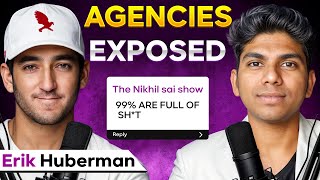
In this episode of The Nikhil Sai Show, host Nikhil Sai interviews Eric Huberman, CEO of Hawk Media. The conversation begins with Eric’s childhood anecdotes – a spirit‑animal story that inspired the Hawk name – and his early entrepreneurial hustles selling family items, Beanie Babies, and lemonade. He recounts his post‑college ventures, a failed real‑estate stint during the 2008 crash, and the launch of his first online music company in 2009, followed by e‑commerce brands and consulting work. In 2014, frustrated by a fragmented U.S. agency landscape (24,000 agencies, 99% he calls “full of sht”), he founded Hawk Media with a mission to be both excellent at marketing and easy to work with. He explains the Hawk Method – a three‑step playbook of Awareness, Nurturing, and Trust – and how positioning the firm as an “outsourced CMO” differentiated it from generic agencies. Eric discusses scaling challenges: building culture, maintaining a high‑quality team, and financial discipline (gross margins of 50‑70%, profit margins 10‑20%). He shares his philosophy on why most agencies fail (financial over‑extension or leadership giving up) and how Hawk avoids those pitfalls by staying bootstrapped, avoiding private‑equity, and focusing on founder drive. The interview moves to acquisition strategy, describing a “reverse franchise” model and acquihire deals that prioritize founder ambition and cultural fit over pure financial metrics. AI integration is a major theme: Hawk AI processes data from 6,000 companies for real‑time SWOT analysis; Gumshoe.ai provides geo‑ranking insights; and internal tools like sturdy.ai monitor client sentiment. Eric emphasizes that AI amplifies high‑skill marketers rather than replacing them, and he outlines current and future AI use cases within the agency. The conversation closes with personal insights: Eric’s daily routine balancing family, travel, and training; his view that headwinds (COVID, tariffs, AI) are opportunities for bold action; and advice to stay optimistic, focus on building great work, and keep profit margins healthy. The episode offers a comprehensive look at building a high‑performing, data‑driven marketing agency in a crowded market, the importance of culture and founder mindset, and practical frameworks for scaling and acquisition.
Chapters
Why Hawk Media? How did you think about it? I'm curious about the psychology or the thought process.
Yeah, no, I was 7 years old and I had a Native American chief tell me that my spirit animal were red-tailed hawks.
Everybody has that humble beginning. Can you give us a rough backstory of yours?
6 years old, I grabbed a bunch of my family stuff and walked door to door trying to sell the things I decided my parents didn't need anymore.
You didn't really start the marketing agency.
There are 24,000 marketing agencies in the US and about 99% of them were full of shit.
If you have to reset the clock and start your business in 2025? What's your game plan to start a business?
I would probably start a company that goes into businesses and helps them figure out how AI can create a ton of efficiency. You actually have to go do a ton of work on headwind like COVID or the raising interest rates or the tariffs. Like, oh cool, another chance for me to win.
What's up everybody? Welcome back to another episode of The Nikhil Sai Show, which is hosted by me, The Nikhil Sai. And guess what's going on today? I'm back with another incredible guest. This guest is very close to my heart. I mean, I learned a lot from this entrepreneur who's jumping on. I mean, I was in Nashville in this very cool summit where we are talking about doing M&A deals and buying agencies, doing mergers and acquisitions and scaling. And there were many speakers and he was the one I really liked personally because the journey was incredible. I mean, I'm talking like an 8-year-old entrepreneur who started his business at a very young age, you know, like with some funny stuff to actually building successful marketing agencies, bootstrapped it to over $100 million in valuation, worked with over 5,000 brands worldwide including Red Bull, you know, Evite, and many, many big companies. Talking about Forbes 30 Under 30 honor as well. And he created the Hawk Method and they actually right now process over 8,000 brands and manage over $500 million in media spend combined between all of their companies. and this guest is probably going to share a lot of valuable nuggets in buying companies, selling companies, scaling digital media, using AI and disruptive marketing and whatnot. Let's not waste any more time. Let's welcome the CEO of Hawk Media, Eric Huberman. Hey Eric.
Hey man, thanks for having me.
Yeah, absolutely, brother. Stoked to have you on. Thank you so much. You finally can make it happen and this is going to be fun.
Let's do it. Yeah, yeah.
So first of all, I'm curious why Hawk Media, like you, you got the bird and the clothes, like Like, how did you think about it? What, like, I'm, I'm curious about the psychology or the thought process.
Yeah, no, I was 7 years old and I had a Native American chief tell me that my spirit animal were red-tailed hawks where I lived in Ojai, California. And so they were always circling overhead. And so growing up, I always thought that I had these hawks watching out for me. So when I went to name the company, I was gonna add a few other names that were a little overcomplicated. Got some good advice to keep it simple. And so when I was thinking through it, it was just, yeah, what is something that resonates with me? And red-tailed hawks were always that. So Hawk Red. Pretty straightforward, right?
Nice. You got that on your hat and the background, and you kind of have that in all your names, your AI company, your marketing company, and whatnot. Now I've given like a brief introduction, but I know there's more to your story, right? I mean, everybody has that humble beginning, you know, to you actually building businesses that are both over 9 figures as a portfolio and whatnot. So would love to kind of get a glimpse of your journey from your own words. Like talk us through your journey as an 8-year-old entrepreneur, you know, who kind of started that business or like kind of did that little gigs to actually building these successful enterprises and whatnot. Can you give us a rough backstory of yours?
Sure. Yeah. I don't think the childhood side of it was that atypical. Like, there's a lot of kids that do the lemonade stand or sell candy or whatever it is and figure out a way to make some money when they're a kid. And I think that's great. I think that's why, you know, there's a lot of, you know, future entrepreneurs out there. And so I was exposed to sort of the intrinsic value of money early on and the idea of just building and growing and investing in all these things and had a dad that was an entrepreneur that was also a great investor. And so, You know, at 6 years old, I grabbed a bunch of my family stuff and walked door to door trying to sell the things I decided my parents didn't need anymore. Uh, 8 years old, I started the Beanie Baby business you're talking about. And I, it was just because I got a couple as a gift, uh, a couple years before, and the ones I got as gifts turned out to be valuable. And so then I'm like, wait, there's value to this? Like, who cares? There, remember at the time, I think there were $4.95, but with tax in California, it was $5.34 for a Beanie Baby. And the first one I sold was $450. And I'm like, I like this math. I'm going to keep doing this. And so. Started buying and selling the ones I thought were going to get hype around them. And it's kind of like LaBooBoos right now is the same exact thing. Like, and I was, I figured out places I could buy them and I figured out the ones that would get the hype. And so I made a few thousand bucks as an 8-year-old doing that. But the motivation was my, uh, I wanted to be a rock star and a guitarist. I still have 4 guitars and a ukulele sitting right behind me right now. And my dad, I went to my dad and said, I need an electric guitar so I can be a musician like Eric Clapton. And he said, great, get a fucking job. And as again, if you hear someone say that to an 8-year-old, you could probably look at them and What the hell's wrong with you? But as an 8-year-old, you go, okay. And so I didn't take that as something my dad being crazy. I took it as I better go get a job. And so that was, it was selling lemonade, selling flowers on the side of the road. I used to run in front of cars to, because I knew they wouldn't run me over and then they'd have to, I wanted to make people say no to me. I learned that really young, which I think actually lent itself to a lot is like, get, they may force a no. Cause people hate saying no, especially to an 8-year-old kid selling things on the side of the road for 5 cents. Just tell the kid no, like you're a dick. So, uh, but I still didn't make a lot of money doing that. And that's what led me to the Beanie Baby thing. Then I ended up buying the guitar, bought a BMX bike, saved some money for a car later, and then started playing. But I was around 12 years old. I realized I wasn't that good at playing music. I enjoy it, but I'm not that good. So reconciled with the idea of a hobby is okay and started getting more interested in business. And then, yeah, I mean, work jobs all through high school and college, try different things. Came out of college, went into real estate a week before the entire banking industry collapsed in the United States. In 2008 and started scrambling to figure out what to do next. And then started my first online company, an online music company about a year later in 2009 and raised $1 million in 2009, which was crazy in hindsight. And we— and I was off to the races. I was one of 3, you know, e-com businesses I built next to a t-shirt company called Swag of the Month and a women's activewear brand called Ellie. Sold both of those. And then this now brings us to about 12 years ago, started advising and consulting for a bunch of brands because I'd figured out how to grow things online. And again, this is 2013 and started advising consulting. And about the end of that year, basically January of 2014, realized I needed to bring on a team to actually help these companies because the real nascent of Hawk Media was discovering that at the time there were 24,000 marketing agencies in the US and about 99% of them were full of shit. And the few that were any good were really hard to work with. They were expensive on long contracts, high minimums. They only want to work with the Fortune 2000. And so it left the entire growth side of things, the entire SMB landscape fending for themselves in this sea of crap. And I was like, there's got to be There must be a way to build an agency that's the best at what they do, but also easy to work with. And that became the mission of Hawk. And fast forward, we're 250 people. We've worked with almost 6,000 different companies. This will be with, you know, knock on wood, this should be our record year and continue to grow and build. And it's been fun.
Yeah. Congratulations on all that success. I mean, it's really, really fun to see, like you didn't really start the marketing agency like most marketing agencies do start with, which is the intention of, oh, I want to make money. Okay. What can I sell? Oh, you could just air up a marketing agency name and start selling.
Yeah. That is the issue and the problem. And it's an issue for everyone because the funny thing is like the person that starts that also doesn't end up making any fucking money because they blow their money trying to pretend that they have money because they think that's what you're supposed to do. It's like I've said this ad nauseam at this point, but so many of these guys fall into the same thing of like, I'm going to show off a Lamborghini and it's going to make everyone believe I'm rich and they're going to want to learn from me. And it's like, I don't have an employee that makes less than a Lamborghini's monthly payment. I don't have an employee here that makes less than that. So, and I have 250 of them. So the fact that a Lamborghini is a sign of wealth is like, are you fucking high? Like, the only people you're attracting when you do that shit are other idiots. And so it's like, by the way, I'm a car guy. I've got some nice cars. I like to race. I grew up racing. I was racing autocross when I was 17. So like, I like— I'm actually a car guy. So it's not that I care about cars, it's that I care about people that use it as some sign of like, buy my course because look how much money I can make and you can make money like this too. And they rent some fucking house to do the filming and it's like, it's absurd. But that's the industry we're in. And so You deal with a lot of the stuff that exactly people get into it because they get about the money. And like, I got into it because I built, I love building companies. And I found that the hardest part of building a business was marketing and sales, not because there isn't ways to figure out a baseline, but because it's infinite opportunity cost, you can always do better. And I thought that as a business owner, that was super important. We can always improve this, we can always do better. And so I focused on it and then I realized I had a talent for it and that people, other people wanted to learn. What I was doing because we had been successful at it. And so, and then I got to build a business by building other businesses, which is super fun for me because growth is inherent in me. I like to always feel like I'm growing and building and learning. And so that's what drove me to do this. The idea to do this for the money, like there's years I've made insane money and there's years I've lost money and it's just part of the, if you're trying to grow and build, that's part of it. And if you're not, good luck in this business because you're probably going to be out of business pretty quick.
Yeah. Yeah. I mean, we see marketing agencies come and go. Like I could just imagine just in the COVID I've seen thousands of agencies flood in and Like really, maybe a dozen barely I know, I remember are still around. It's crazy.
Well, it's to the point when I started it was 24,000 agencies just in the US. Now it's 90,000. So like it's been 12 years, but like in 12 years it's almost 4x the amount of agencies just in the US. And globally it's 430,000.
Jeez. I mean, yeah, it's crazy. Now this is probably the toughest thing, right? Like actually like attracting clients as a marketing agency and you've had the track record of building e-commerce companies, raising funds and already consulting companies. Probably that have kind of like helped you transition into a media company much faster. But if somebody's building a media company right now in 2024, if you have to reset the clock and start your business right now in 2025, what would you be doing? What's your game plan to start a business and scale it?
Yeah, I've said this to a few people and I know a few people actually running down the path with it. I would probably start a company that goes into businesses and helps them figure out how AI can create a ton of efficiency. I feel like that's super relevant now. I think there's a business model to be had there that can be scalable and repeatable, but also really, really help with this wave. And like the way we're built, we're not going to do it. It would really screw with our brand, even though I think it's a great opportunity. But like you look at the big consulting companies and I think it's like 25 to 40% of each of their revenues now coming from AI consulting. Like I think that you still got quite a few years of that needing to proliferate and also get through the SMB side of like, I don't know, do I need— I don't have a bookkeeper, but like, do I still need a bookkeeper? Do I need all these different little pieces? Do I need this software, whatever? Like, and if you can become an expert, and this is the key, you can't just go sell a bunch of people to hire you and go figure it out and fucking, you know, stumble into a bunch of AI. You actually have to go do a ton of work on what are the tools, what are the systems, how do I actually operationalize this? But if you can be good at it and actually have a talent for sniffing out good AI and good softwares and good best practices, then I think someone's going to do really well there.
Makes sense. Yeah, I mean, I definitely see the opportunity in the AI infrastructure and implementation space. I think it has a ton of TAM in the long run. I'm kind of curious from an acquisition standpoint, like you've had so much success in the media space. You bootstrapped your company to very, very high levels of revenues and valuations. And I'm assuming there is something you're doing different than 99.9% of marketing agencies who never got to, you know, crazy valuations like you did. So where do you think the differentiation comes in? Is it like the client quality? Are you like going after like SMBs and that's like the primary thing? Or like where do you see the biggest difference coming in for you to become—
We aren't full of shit. That separates us from 98%. Like, seriously. And like, as bad as it is, that is a big part is like our clients stick with us. We have massive companies that didn't start massive when they started with us and are now massive that have been with us for a decade. So it's really, that's what I was kind of saying is like all these people that jump into agency world because they think they can fake it till they make it. Problem is if you don't figure it out and don't end up being a good marketer, then you never get to that make it part. You just end up on a hamster wheel of churning, basically conning people. And churning through business. And so why we've, you know, as far as independent goes, we're one of the biggest at this point because we haven't taken on private equity money either. It's because we try to do the right thing for the right reasons. I mean, our mission is be the best at what we do and easy to work. So, you know, a high level of quality and delivery while continuing to be very easy to work with. Most agencies sacrifice one or the other. They're either not good at what they do or they become really pretentious about who they work with. It's very rare they have an agency that allows for both. And so differentiator, it is that simple. It's that we are one of the best at what we do and we are easy to work Makes sense.
I mean, you, you build that team and the systems around fulfillment that allow you to like rely on your team and they could scale. But initially when you are learning the skill, I, I think that's like the quality education and the intent of execution are two different things. Like it is not really, there's a lot of material on marketing and sales. We've got one of the best marketers in the world ever done a book launch just recently. And there's so much marketing books written on like attracting clients and selling them and converting them, high ticket, low ticket, all this jazz. But there is not a real solid marketing playbook which will allow you to become a better marketer so you can actually make money for your clients. Or maybe there is, I would love to know, like, we wrote it. Yeah. So walk us through, that's exactly what I would love the audience to learn, which is how to actually not be full of shit and be good at what they're claiming to be. So give us the playbook of Hawk Method.
Yeah. So I mean, Hawk Method is Modern Marketing 101. So it's taught at NYU and Columbia MBA programs. Like we've done a, I feel like we've created a great Bible around marketing, but it's the basics. It's not overcomplicated. It's just, it's actually more for like the high level, how to understand marketing and breaks it down into the 3 principles of marketing: awareness, nurturing, and trust. So awareness is how do you let someone know you even exist that didn't and introduce them to your company, your organization. Uh, nurturing is what do you do once they know you exist to get them actually become a customer and then continue to repeat purchase and come back. That's the nurturing piece. And then trust is basically brand, but before you build a brand that people know and trust, You've got to use third-party validation to gain trust because 75% of people won't buy from a company they don't inherently trust. A lot of that comes from word of mouth, but you want to be able to create that. That's PR, that's influencer, that's testimonials, reviews, all that. So, you know, brushing through it, but going back to your point of like, how do you get into it? It's like anything else. Like, would you pick a career as a chef if you suck cooking?
No, not really.
Yeah, correct. But with marketing, people think they can fake it and it's like, no, your customers will find out just as much as a chef's customers will find out. They'll taste your food at some point. So it's, it's really putting in the work. Like I always make it, I get hit up by a lot of young, younger guys that, and girls that want to get into it and go out, you know, they're 17, 18 years old and want to start their agency. And I'm like, don't do that. Go work for someone, go build something else. I didn't start a marketing agency till I was almost 27 and I, 27 is still young, but I had insane amounts of marketing experience because of how much time and effort I put in. The whole 10,000 hours thing. If you haven't had 10,000 hours doing marketing, I don't think you should be starting it.
Makes, makes a lot of sense. So like you, you want other people to focus on getting the reps, getting good at the marketing skills first, get the fundamentals right before they start a business because otherwise you're selling yourself as the product.
You're the marketer. You're supposed to be knowledgeable. If not, you are conning. So the idea is you've got to get out and learn. And again, I'm okay with someone learning on someone else's dime, but do it in an employment situation. Go get a job or go build your own business. Go start your own e-commerce brand. Do something where, you know, but don't just con other people into giving you money so that you can try to learn and figure it out. Like, unless you are very talented, generally you're just burning a poor small business's money. And that's not good.
Yeah, I mean, I've seen so many marketing agencies start as an agency, then immediately pivot in a few months into like, hey guys, I'm so successful at marketing now, I'll teach you how to build a marketing agency type of thing.
And I always look at that and I go, who the fuck is hiring these people and paying these people for it? But okay. Like, yeah, I learned that lesson really young and not to jab at him, but you know, the book Rich Dad, Poor Dad, very famous book. And I read it when I was 17 and I was actually teaching school in India and I read that on my trip. I came back all fired up and I said to my dad, I read this book, Rich Dad, Poor Dad, and it's all about this and it's about starting businesses. And my dad goes, you know how that guy makes money, the writer? And I'm like, how? He goes, selling fucking books. Guy doesn't know what the fuck he's talking about. Like, it's interesting principle, but he's like, my dad's like, stop it. That guy didn't make money doing anything but selling books. If he was so bright, he wouldn't be writing fucking books and pushing because he would be doing the things he's telling people to do. Robert Kiyosaki, by the way, I think he ended up, he is a pretty, there's a bunch of back and forth. Like he was super successful in real estate, but he also had a ton of debt. I don't remember where that ended up, but, but that the whole book thing, like it ended up like that was his business was selling books and board games, et cetera. Like for us, like when I mentioned it's taught at NYU and Columbia, we give the students the book for free. Like it's not my business. It's just actually something as a giveback that actually my goal was to actually proliferate knowledge around marketing so that people wouldn't get conned as much and people wouldn't have as much bullshit. And like, it's like, here's how it's laid out, just go do this.
Makes sense. That's, that's, I mean, Richard Porter has changed my life and I actually read it when I was 18 and that's exactly my way into entrepreneurship. But I think it's a great book. Uh, there's a lot of debates around.
Very good book. It's just good to remember the person on the other side.
Yeah. Yeah, for sure. And if it can add value, then why not? That's kind of how I see it.
I agree. Definitely.
So now I'm curious, like you kind of shared the story real quick when we were at DealCon 2025 and like there's so many marketing agencies who have this BS marketing wrapped around the same services over and over and you kind of created a disrupting marketing message for Hawk Media that really took you, took your brand Hawk Media viral in the space. And can you talk a little bit about like how you found that viral positioning of the thing about your company going big into branding and actually attracting a lot of leads with the wrapper of your market.
Yeah. I mean, it was your outsourced CMO. So it was our tagline, is our tagline. And that came up. I mean, this is where people overcomplicate this. Like the best way to go figure out how you should talk about your business is go talk about your business in person and watch people's body language and like actually have a little bit of EQ and sensitivity to how people are responding to you. A lot of people like will go do their pitch and not pay attention to the other person and like black out. And it's like, no, talk about yourself, your company, or, you know, get people intrigued. Watch if there's intrigue. Do they ask questions? Do they Do they want to stay in touch with you? Do they follow up? Do they answer your email when you follow up? Like, what gets people really interested? And I watched when I would say, oh, I'm starting a marketing agency, people would run because again, most marketing agencies are full of shit and they just have a bad reputation. So nobody wanted to hear that, or digital agency or digital marketing company. Like all these things were not interesting. But the moment I said Outsource CMO, which was just inspired by at the time a bunch of fractional CFO companies were calling themselves Outsource CFO. And I was like, oh, that's interesting. No one did it for marketing. So I'll just do the CMO version. That's all it was. It was inspired by all these finance firms saying that. I was like, well, we're your outsourced CMO. And it was just timely because people had been used to hearing it on the financial side, meaning my main target were founders. Founders had heard of a bunch of outsourced CFOs, but never a CMO. And so when I said that, they're like, wait, that's a great business. I, like, they got it immediately. They understood that it was elevated compared to an agency because it's actually strategic too. And it was like, it just clicked. And so when I saw that, again, it's about being sensitive enough to watching your potential customers and the people you're talking to show intrigue. I went, all right, double down on that. It's working. And went from there.
Sure, makes a lot of sense. I mean, I think that's really important for marketing agencies because it's a very commoditized space if you don't know what you're doing. And I think having that clear fulfillment capabilities with real intentions and having the right marketing, you know, material for your company really exploded the growth. Now, uh, let's go back to 2014, 2015 when you started that company and you kind of exploded in terms of revenue and growth and the brands you work with. And trust, like, very, very big brands, like we're talking Red Bull, etc., were known to do disruptive marketing, have collaborated with your company and whatnot. So I'm curious, like, walk us through what was the key difficulties that you were going through when growing this brand and let us know how you actually solved those key bottlenecks when you're scaling Hawk Media.
Just the general key difficulties of Hawk Media growing it. All right. I mean, they change. There's always like that. That's welcome to running a business. There's always a fire. There's always something you have to improve. The only time there's not is when you've given up because everybody wants to improve and do more and build. And if you don't, it's already the beginning of the end anyways. And then that's your fire. That's your problem is that you don't have any drive. So I mean, culture is always a big thing. Um, I've learned a lot about building culture in the sense of, it's a funny word, but to me it's the type of people you would attract and motivate is a big part of how, what your culture is. And so I've become more and more intentional with the culture that I want here versus a culture, like there's been periods of Hawk where I've really placated to try to make this a great place for everyone and people please and fix every problem for every person, including the biggest complainers in the company. And then you realize, I don't really want to world of people that just complain all the time about shit that doesn't matter. Like I've now fed that culture because I've tried to make them happy. And instead, all I've done is, you know, fed the beast and now they're even louder. And so you, you find that the best thing to do is to build the company you want to build and make sure you bring the people in that are aligned with what you're trying to build, not try to build for everyone else. That, that's my experience is like have clear vision of what you're trying to do and the type of people you want to do it with. Because, and I, I repeat this a lot publicly, but I think it's important is companies fail for two reasons. Either they get underwater financially, financially. So you raise too much money, you take on too much debt, you take on too much overhead, or the— and/or the founder gives up. Or the— I should say the leadership team. Sometimes founders replace themselves and hire a CEO, but the leadership team gives up. That's it. That's how they fail. So if you don't get underwater financially and you make it to a place that you want to work all the time, your company's not going to fail. Might shrink, not going to fail. So there's something really simple about that, that it's like, okay, so all I got to do is be careful of how I manage my finances. And I have to make sure that I like coming to work every day. So how do I do that? And so that if you make that your focus, company's going to survive forever. Wow.
I love that. I mean, that's like the playbook to make any business successful in like two lines. That's very—
well, and again, what was successful, you'll see. You might bet on the wrong horse and it doesn't get very big. But the end of the day, if you love what you're doing and like, you know, the barrier to paying the bills is pretty low for an entrepreneur.
Yeah.
You should be able to make enough money to pay your fucking bills unless you're in the So, and so that, that checkbox, if you get that combined with you're doing something you love, you're, you made it. There's nothing else to talk about. So that to me is again, a really easy bar to aim for.
Hmm. Makes sense. I have an interesting question. I mean, after talking to hundreds, if not thousands of agencies to this point, this is weird levels of revenue bottlenecks. Some entrepreneurs are stuck at $30K, then some are stuck at like below $100,000, like a million-dollar run rate. Some are stuck at below $3 million. They could really not scale past that. Operational efficiencies, it could be churn, it could be, or the marketing costs go so high that they're actually losing money. The retention sucks. Like there's so many bottlenecks. I'm curious, at Hawk Media, what allowed you to scale? If you have to contribute the success and like, hey, these are the 3 things, you know, that actually contributed to success, what would that be?
Number 1, be a better marketer. That solves everything because there's 2 pieces that you just— that cause what you're saying, which is getting stuck. You said one, churn or a lack of new business. If you're actually a good marketer, you should not have a shortage of new business and you shouldn't have churn, bad churn, because you should be doing good work that then makes money for your clients. They're not gonna fire you. So it really, that goes back to like when people get stuck, they've probably hit the limit of their ability to basically push people into their funnel and their churn is caught up. So at some point your churn catches up. I don't care what the business is. Even if you, you, let's say your retention, average retention's 10 years. Well, at the 10-year mark, your churn's gonna catch up unless you figure out a scale sale. So it's, it's just a function of where you cap out is where you're not able to retain business as fast as you can sell it. Or sorry, you churn business faster than you can sell it. So the, so again, it's, it really comes down to if you're doing great work and communicating well, then your retention shouldn't be an issue. And then when you add clients, they should stick around. So it's one or the other. You're either falling apart on sales or you're falling apart on churn or a combination of both.
Right, right. And I think the financial model of how If like founder is, or the leadership team is managing the company's finances, does also play a key role because I've seen founders who get greedy, take all the money from the company and the company dies, or else they basically throw around a bunch of people who are overpaid and underdeliver and then the clients don't retain anyway. So how would you, like, if you have to think about a company and say, let's say if it generates $100,000 in revenue, how would you look at like which departments you allocate how much? How would you look at that?
Yeah, I usually look, it depends on what you're serving. 'Cause like it could be your gross margin should be between 50 and 70%, meaning you should spend 30 to 50% on the team managing the work depending on who you're serving and what kind of work it is. Um, that leaves you enough room to have a good sales and marketing budget, a good overhead budget and profit. So gross margin's the biggest metric. The rest of the stuff can ebb and flow. How much you spend on sales and marketing and how much you spend on overhead. Do you have an office? Are you remote? All those kind of things. But that, that's generally what I look at, but it also depends on your business model because a lot of companies can spend more than that on the gross margin if the people running the projects are the ones also bringing in the— so like an Accenture doesn't run at 70%, but that's because the people that are the sales and marketing are also a part of that gross margin. So then you can spend 70%, you can reverse the numbers.
Makes sense. Makes a lot of sense. Now in terms of profit, what do you think the founder should aim for to be, to keep the founder's sanity while keeping the company profitable and not letting it bleed?
I mean, most agencies I see are between 10 and 20%, uh, that are actually, as you said, keeping sanity, but also to have a good team. When I see higher than 20, you can, I'd say, sorry, you can get 25 is not that unattainable. We've done it too. But once you start getting above 25, something's coming loose. Like there's someone's not making enough money. Someone's something's not being served well. They're not reinvesting somewhere. Like that's depends on the business and the scale too is really important. But when with all the agencies we look at the smaller side, you know, the sub $10 million, if they're over 25%, it's usually because the founders are doing all the work and don't have a lot of back.
Makes a lot of sense. And you kind of mentioned this about like the private money or the VC money and the mismanagement of funds, and you primarily have chosen to not raise any funds and bootstrap the company. Uh, why?
Uh, haven't needed it. Like now we've had some conversations that there, if I find the right financial partner, there's a chance we'd bring on money just because of all the M&A and all the scale we could do with some, with a bigger, uh, war chest. But until I find a great partner, which is hard to find in the finance world because because you deal with a lot of people that have never operated a business that think they know better than every operator. And yeah, I'm not, there's no ego in it for me, but there needs to not be an ego on the other end because I am happy to be wrong about things and to hash it out. But I have to have someone that will argue with me and hash it out, not just be like, well, I, I brought the money, so like, because that's bullshit. And we've never needed it. We've been profitable. So that's why I think a lot of people, I got another good line from my dad, but I was told young, when I was young, money's expensive. Like, you know, if I, if anyone willing to give me money is making a bet that I'm, their money's going to be worth, going to have a great return on their money. That if they give me $50 million, that that $50 million is going to be worth $500 million in the next few years. Well, if they're right, I should have never taken that $50 million because that's my $500 million. Fuck that. Like, you know what I mean? It's like, that's, that's a bit of it. So the only time it makes sense to me to take money, or it really, it's how I'm looking at it, is when I haven't identified where money can make us both a ton of money, where putting a fire or gas on the fire can really work. I feel like we have some of that now, but then it becomes like, well, who am I going to get married to? Because I'm not looking to just sell. That's not my goal. My goal is to like partner up and really keep going. I'm 38 years old. I've got a long ways to go in this and I don't have something pulling at me to get out of it.
So makes sense. Makes a lot of sense. You don't, you don't want some big check gray guy trying to like control the company. You want somebody who's more like a partner.
By the way, I don't mind that as long as it's rational. Like if they have great ideas and a great purview and we're We're talking about it and having rational discussions and then I'm wrong and they're right and we can have a good discussion that leads to that. Fine. I have no pride in ownership and no pride in my, you know, my own opinion, but they better be ready for that. I watch a lot of these guys, like, you know, it's a lot of private equity likes to run the same playbook over and over again. And what it does is it mitigates their risk because they know the playbook, but it also mitigates the upside because they're never going to end up building the next big thing. They're just going to have over and over again, which is It's great for a private equity fund, but for the founder, it really mitigates the upside. So you gotta be careful with that.
Makes, makes a lot of sense. Now let's, let's talk about your way of acquisition. I'm assuming you've invested in a lot of companies yourself. You're, you're merging them, you're doing great things. Give us a little bit of preview on how are you leveraging your marketing experience and your media company to play the M&A game and PE game on your side?
Yeah, I mean, we just found that again, back to the 90,000 marketing agencies in the US, there are some great great diamonds in the rough out there that are great founders that haven't been able to get past that scale, that have hit a roadblock or something, or just responsible for every piece of the business and can't get their head about— above water. And we come in and try to give them the platform and do what we've kind of called a reverse franchise where it's like, hey, we've got the whole playbook, we've got all the infrastructure. Why don't we jump in with you, help you build this out and scale it? And 1 1 can equal 3 because you can get all this off your plate and go focus on growth and grow this a lot faster. And it's worked. It's been a really good part of the business. So that's, yeah, an aspect of how we continue to grow this.
Hmm. Makes sense. And what do you look for when you're actually investing in a founder or a media company? Like, are you talking raw, raw numbers or are you talking more about people, the brand potential or like, or the IP they're bringing in? Like what's— let's look at the best deal you've done from a perspective.
All the above. It's the founder has to be sales-focused, want to grow, want to run through a wall. That's the bet. That's what drives it. Everything else. It honestly can, because if it's a new service, that's great. We expand our service offering, we can expand into that. Awesome. If it's an existing service, great, then it integrates really easily because we already have a team doing it. Now their team becomes our team. So it's not really important that those pieces aren't important. What's important is the founder is actually doing this because they really want to build and grow. And then because that's where we're able to fulfill that and help them fulfill that. It's when we get founders that come in and then just take their foot off the gas and hang out because now they don't have the pressure. That's when it's kind of a waste of time.
Makes sense. And that's a big issue, right? Compliancy, like, you know, like getting compliant, like compliance with like, okay, like I'm complacent with my growth. I really don't care about the company anymore. Like they used to, especially after getting that multi-six-figure income checks and the penthouses, the things that they really wanted, the cars and whatnot. How do you ensure the drive still exists in entrepreneurs? For example, for yourself, when you build that, raise that million dollars, build an e-commerce business, why did you even take the risk? To build this media company and scale it to crazy valuations and now partnering up with so many bigger brands. Like, how do you keep that drive as an entrepreneur? That's really important and I'm curious.
Yeah, it's driven me from pretty much my entire adult life and even some of my childhood has been driven by I want to experience everything life has to offer. So where I go nuts is if I feel like I'm doing the same thing over and over again. So personally, professionally, family, all of it's driven by I want to try everything, do everything, see every place in the world. Like everything professionally, build the company, start a fund, invest in companies, sell companies, uh, buy company, whatever it is. Like, these are all cool things that, like, when it's exciting for me is when we're breaking new barriers and doing something new. I'm on a software company now, you know, we invested in tons of things. I'm the owner of a sports team. So a lot of times I don't know what that next thing is going to be. Um, right now I'm focused on building a really good foundation at Hawk Media with a new leadership team and a lot of new executives. To really be ready for the next set of scaling. And so we have a, you know, I would say it's kind of funny because from sort of the sexiness of it, it's the least exciting period in Hawk Media because it's like all like process and infrastructure and like things that aren't that exciting to talk about. But I know we, with everything, like our plans for this quarter, when we finish the quarter, we should have frankly a lot of infrastructure and leadership in place that we're ready to really step on the gas. So like this is already going to be a good year. Like 2025 seems like we're going to end pretty good. But 2026, I think, is going to be pretty insane for Hawk with everything we're putting in place. We've gone from 10 people in office a year ago to over 50 again.
Wow.
And so we're scaling in this office again and we're kind of building, uh, you know, rebuilding that culture and rebuilding in a different way that's moving forward for what we think the future looks like. And it's, it's really exciting cuz I think we're calling it right. And I'm, I'm seeing the results of it already. Our activity in the business is through the roof on all aspects of the business. And the, again, the culture, the camaraderie, everything, I'm just watching it really become reborn after this sort of COVID remote era that I think is a really hard way to build a longstanding company. I think you can flip a company remote, no problem, but for real culture, I think it's really—
Yeah, I mean, agency is still like humans brainstorming and doing stuff. It's not some code that anybody can write on Zoom, right? So exactly, definitely some creativity there in terms of— and in terms of like actually fund allocation and scaling, like, you know, you kind of shared a very interesting playbook on how you actually use funds to acquire business, and that was like quite fascinating to even realize that you can actually buy great businesses with like really interesting and creative ways. So I would love you to share some creative ways you acquired some businesses and I would love to hear a story.
Yeah, I mean, it's in terms of how we acquire, it's actually we pretty much acquihire, like it's like, come work with us, we're going to build a plan that's got upside for you. But the truth is an agency doing under a million in EBITDA isn't worth any cash. Like good luck. And if you get someone dumb enough to pay you, congratulations. But like And whatever that cash is, is probably miserable anyways. So like, to me, it's just, it, it, they're just, they, they're in this position where I can actually give them a lot of upside and the other options aren't really there. And so, yeah, without disclosing too much, I, it's really about being creative with each person depending on what drives them. I think that's the really important way to build a deal is like, what is making this person tick? And encouraging them to be honest because a couple times they haven't been, and then we set up a deal that has nothing to do with what they want to be doing. And we're kind of looking at them like, you signed this deal too. Like, what did— why did you sign this contract? So that's happened, but most of the time we get it right because we're really, you know, forthcoming about it. And it's just setting it up to make sure that it works within our vision and what we're trying— and our priorities, but it, you know, the deal really matches what their, you know, dreams are and what they want to focus on and can help encourage that and give them an upside there.
Sure, makes sense, Eric. Now this is an interesting space for like where businesses are realizing the power of AI and how important it is. And we talked about about AI integration as a service and the boom about it. I'm curious, how are you guys leveraging AI right now and where do you see the industry as, as a marketing industry evolving with the power of AI in the next few years?
Yeah, I mean, we started building our own AI systems more than 10 years ago. So we've got Hawk AI, which is digesting about 6,000 companies' marketing, media, and revenue data in real time. So you can plug in an individual company, do an immediate SWOT analysis, watch entire portfolio of brands to actually look at like how everything's changing. So we have a ton of agencies using it, franchise, et cetera. So that's been really powerful to help kind of be our backbone. And then we invest in a company called Gumshoe.ai, which helps with GEO and we can do like an immediate analysis of how you're ranking on the LLM. So I only had this go wrong once, but if you look at like best marketing agency in the US and best marketing agency in LA, Hawk Media, ChatGPT sings our praises. It's pretty cool. Um, except for one guy I told all about this and then I had him actually look and he's like, you're not coming up. I'm like, fuck. The one time. But yeah, I just literally had someone call me this morning, uh, from Dubai and said they went on ChatGPT and said, we need to work with a great marketing agency.
Who?
And apparently we showed up. That's— so we do that for brands now too. And so this is something that's becoming much more relevant quickly is that more and more people are using ChatGPT and Gemini and, you know, all these perplexity tips. Yeah. And so instead of search, so if you're not already leaning into that as to how do you show up when they use that, you're going to miss out on a ton of your market. And so we leaned into that very quickly. And so I think that's a really good example of how to lean into it because there's so much bullshit, so many distractions, so much crap. Worse than the marketing industry now is the AI industry in terms of all the BS that's out there. And so like start with the basics, look for something that really solves a problem that makes sense. Don't try to see around corners on this one. I think it's just like solve stuff right in front of you. And like, thankfully the majority of people have not pivoted to using ChatGPT for search yet. It's still, Google's still gonna beat it, but it's a start. So like, you know, start looking at it, start investing in it. Don't let it run away from you, but also don't get too like bent out of shape and scramble for it.
Makes sense. And I've heard complaints about like the services which were used to be sold as a marketing service is now irrelevant because the tools and ChatGPT can basically do the same thing for a click of a button, right? And there's this whole marketing agencies that are being flushed out because AI is getting so much better. And where do you see the industry moving forward?
Like, like, dude, if you're really shitty at what you do, you're gonna be replaced by AI. That's what I would say. Um, it's, it's true. It's like when I heard— I had a bunch of agencies I was talking to, it might have been at DealCon, talking about how they replaced their content team with ChatGPT. I'm like, God, you must have made terrible content. Like, don't get me wrong, like, after a lot of work, ChatGPT can do a decent job, but like, again, it's just all going to sound the same, and then you ruin the reasons for having that content. Have to be creative still, and it can help. It's a great thought partner, it's a great partner in general, but it's not replacing. It's kind of like when someone— Adobe Photoshop came out, people were saying it would replace all art directors. It's like, well, someone's gotta fucking use the tool. So like with ChatGPT, it's like, you mean a CEO of the company now is gonna use all these tools? Like, no, what's gonna happen is higher quality marketers are gonna be even more powerful 'cause they have more efficiency to do more. And that's thankfully how it's manifested in our business. We have less headcount and the company has grown because we are able to leverage all this technology to make our people even better. But you still need those people. And I don't think that's change. I'm not, I don't buy into the world where nobody's working anymore and it's this utopian, in that case, I think it might be dystopian, like capitalism collapses and all this. I think it's actually going to be that we find even more efficiency amongst people in a good way. Not that people have to work more hours, but that now the 40 hours someone puts in becomes way more powerful, way more lucrative. We, you know, it's, it's an interesting time where like the rhetoric on TikTok is that everybody's fucked and nobody can afford a and then when you really dive into the numbers, it's not as bad as people are. Yeah.
Make it sound—
dwelling on. Yeah. And it's, it's funny because I watch like my own employees who make, you know, some make good money, some make decent money, some make great money, but like buying houses, buying condos, doing all the things that supposedly their generation can't do. And it's not because I'm some benevolent leader that overpays everyone. In fact, we just did a pay study and I think we're like right in the middle, like we pay on average. So the fact that I have a bunch of employees buying places, it's like, okay, So that's all bullshit. And when I looked into the numbers, sorry to go on a tangent, but I think it's important because when you're looking at data, it's important to look at the full picture. So I saw a thing that said basically based on inflation, the affordability or the cost of a house has gone from, let's just put it this way, the affordability went up 71%. It costs 71% more than it used to, to buy a house. But the other number that's really important in that is the average square footage of a house also went up 50%. So you're actually paying for more space is a big chunk of that. You take those both out, it's up to like 21%, which is still a problem, but not that big of a problem comparatively. Yeah. And it's like, okay, so we're building houses too big 'cause it costs materials to build bigger houses and more land and all that. So it's like, it, it's just a funny thing that it's like, it's really easy to look at the headline and get stuck on it. And it's like, you know, actually where I think we're, we're all gonna be okay. And I really believe that. And there's a great book by Peter Diamandis called Abundance, and he was one of the guys that encouraged me to get into AI 10 years ago. And it's about like, we live in a world now where like people, most, almost everyone can get access to food and water and shelter and all the things we need. Like we actually do have most of the things we need, which is recent. That's not been a co— that is very, very past 30 years. Poverty in the world has dropped precipitously, but so has social media. Social media has climbed so much that it's not about having your needs met and being okay. It's become, well, why can't I have the highlight reel of all my friends? Friends, which is a problem. Like, one friend has the Lamborghini, another friend has the vacation house, another friend got married, another friend sold his business. I don't know, another friend took a trip to Europe. You're like, well, why can't I have the Lamborghini, the vacation house, the marriage, sell my business, and go to Europe? It's like, you just talked about 5 people's fucking priorities and said that you should have all of them. Like, that's kind of the— I think part of the problem we live in these days versus, you know, having some gratitude, being cool with what you are, knowing that it— the world never is never as scary as we can make it up in our head.
Yeah, 100%. I think the, the, the nature of social media and the news have created that negative narrative, and I'm not falling into that. And I believe optimistic people like entrepreneurs who move the needles and actually do stuff and create opportunities, I think they're not fearful of the situation either. We are excited. I'm excited. Like I'm, I'm more excited than ever before about AI and how it's changing and whatnot. So let's, let's talk about how you as a person and individual are leveraging AI. AI, if you can talk a little bit about that, like how are you leveraging LLMs? Like, do you use that to like maybe due diligence or like look at numbers and data about like a deal or like what are the key functionalities you're leveraging?
We're working on a lot more infrastructure on it now. I'd say we've underleveraged it compared to a lot of people that are doing a great job. Um, I use ChatGPT a lot. I'd say the most common use is when I'm debating something with my wife and we just stick it in the middle and have like, but ChatGPT, what about this? Well, what about this? She's a master's in biology and a partner at a private equity fund. She's crushed it. So it's fun to have debates.
That's a tough debate for sure without ChatGPT to win.
Yeah, she's— yeah, it's good. Um, but yeah, work-wise, like, I, I do have, uh, we're currently working on a system where it can pull in all our systems and actually, like, quickly ping it for, hey, I want this number, what do you think of this, and start to have that. But we, we haven't created all the data feeds, so we're, we're starting to build that out, um, where the business operations can run with AI. I would have had a conversation about it today, um, and I, I would say we're behind from the early adopters, but we're we're way ahead of most in that sense. Sure.
Yeah. I mean, it's easy to just sign up for the next new shiny tool and say, hey, I'm using AI, but in reality, like how much of it is relevant and how much of it is actually contributing to an outcome is a big question. Exactly.
But that's where like, this is going to be like all the questions I find myself asking my executives all the time, throw it into AI. Like, you know, where are we today on our billings for this month? I can probably ping AI, have it tap into Ping AI. There's a company, uh, built by a really brilliant guy named Jerry Simpson called Atlas up that we're looking at. Uh, that's an AI. And then another piece of AI that we do use that I really like is called sturdy.ai. They, uh, monitor all our client communications and actually ping us when something feels off, like a client's communicating in a way that seems like they're angry or put off, et cetera. Because having an employee raise their hand or even sense that it's wrong is really tough. And again, we use this as a way to jump in and help, not just— Yeah, exactly. But it gives us a heads up of like, hey, you got, you know, we have 550 clients. Hey, this client seemed to be a little put off on this message. Heads up to their manager, you might want to jump in and give them some assistance because there might be something needed here. And so that's a huge one for us.
Yeah, that's, that's quite interesting because as the project manager or the client services manager, it's really hard to gauge that emotion and that relationship built in, but AI has no bias. So it easily pull in like the communication.
Exactly.
Can you, I mean, I kind of see like you travel a lot, you speak on stages, you have your family stuff. I see you with your kids a lot of times, you know, having fun and whatnot. So what's your daily routine look like, like running these companies, doing M&A deals, like having this passion? Packed schedule, like walk us through like an average day or like the, the, the ideal day you would like to live.
Well, that's the thing. There's no ideal day cuz every day has to be different by nature for it. But I would say I try to spend like 7 to 8:00 AM every day with my kids and try to be there 6 to 7 for dinner, like 2, 3 times a week and then weekends. So I'm usually out 2, 3 nights a week at events, working, that kind of stuff at work, you know, 8 to 6, 5 days a week. And then, oh, there's a decent amount of travel. I probably travel a week a month. So that falls outside of that. We're in, who knows? And that, that isn't consistent, meaning I haven't traveled in July or August. September, I think I have 5 flights. It's ebbs and flows.
Average out.
Yeah, exactly. So a quarter of the time I'm probably traveling throughout the year. It used to be half the time, maybe even two-thirds. And then I, I'm generally answering emails at night. Late weekends, keeping up, probably having meetings here and there. Just depends. Like, I don't mind, like, let's grab a coffee or a lunch or something on the weekend too. So that, that comes in as well. And then I frankly, for my own sanity, train for different— like, I just did the LA Marathon, I'm training for a triathlon, I do a bunch of tactical training too and got my private security certification and do a whole bunch of stuff on that side too. Um, and just find things, things I can achieve outside of work that I, I'm really addicted to the sense of achievement and advancement. And I find that when I'm doing things outside of work that scratch that itch as well, then when there's stressors at work, I can manage them way better. Cause I feel like overall in life I'm progressing, even if I'm going to step back at work, it really helps me rationalize through it and make, take the right action. Um, and then, yeah, I mean, I really love spending time with wife and kids. Thankfully I have a great wife and kids. So we're all going to Mexico next week for the week. But good example, like while I'm there, I'm working Monday, Tuesday, Wednesday. So we're going down Saturday to Sunday, going to work 3 days down there. But you know, our team's 50 people in the office, 200 people remote. So it's not that big of a craziness, but for me, that's enough of a reset that I'll take Thursday, Friday off, go do some surfing, have some fun and come back for, you know, the end of summer basically. So that, that stuff like isn't irregular for me. Um, finding the sort of work-life harmony is what I'm always looking for is like, how do I not give up the progress and the momentum that I want at this company while also really enjoying every other aspect of life.
Yeah, I mean, that's really like, I would say, well-maintained life, like from a family and business and like not compromising any area, even self-discipline. That's, that's—
I just saw a whole thing about Hermozi from someone that works with him closely about how like he sacrificed everything. Like his wife is his, you know, CEO, so he doesn't have— that isn't of an issue, but— or I guess I don't know if it's an issue, it doesn't seem to be. Um, but he doesn't have that many friends, he doesn't have that much of a family life. Like there's nothing else but work and it's I was like, yeah, I mean, the guy's been successful, but the issue is, and this is where, take this with a grain of salt, but it's just true. The line once you make, and I've studied this closely, 'cause I was always curious when I was younger, like what is that line where like money doesn't really matter? And it really is like $1 to $2 million a year, which means if you build a $10 million agency going back to 10 to 20% profit, like you probably are fine.
Yeah.
If I know he just made $100 million, I'm eating at the same restaurants as him, driving the same cars, taking the same vacations. The difference is when you have that kind of money, it might be a bigger jet, more cars, a bigger house, or a bigger boat.
Yeah.
Other than that, there's not that much unless you're, again, or you're buying sports teams and you're playing that, the business game changes obviously, but the actual personal benefits from it are gone. So knowing that, 'cause thankfully I've made enough friends of billionaires and watched how they live and gone, I'm again, I'm going to the same places doing the same shit. Like not really a big deal. I, and I like the game of it. So there's a chance at some point I may, like I said this to a few friends that I think the day I die will probably be the richest day of my life. 'Cause I like the game of building and growing. Accumulating, but from an income standpoint, I think it's really important to know that like that bar is not very high and then, then you're good. And so if you're going to sacrifice all the other things life has to offer just to make more money, yeah, you can make more money. But I think, I don't think, I think you missed the memo on that one.
Yeah.
I've had a few friends like, again, build a bigger business but lose their family because of it. It's like, and I actually had this conversation again with my wife, like, yeah, yesterday it was. And I remind her like, hold me accountable if I ever say I'm doing this for you. That's It's fucking bullshit. Because like our mortgage, we're good. Like we don't live beyond, we don't even live close to our means. So I'm like, I'm not worried about our mortgage or our car payments or food on the table. We're thankfully past that. I'm doing this because I want to fucking win. And thank you for being along for the ride. We'll both benefit from some pretty cool shit. But like anytime that gets thrown at a family, I'm like, fuck off. You're doing this because of your ego or because of what your, your drive, your desire, your passion. And that's all good, but it's for you and that's okay.
No selfishness. Yeah.
It's just that it is 100% selfish. My, my daughter would live in a tent with me and know if I would stay home every day and not come to work. Like, she'd love— now she gets it. She, you know, it's all about like, I want to go to the office with you. Like, she's now— she keeps saying, I need to make pink money. You go make some pink money. She's turned 3 in 2 days. So it's fun. But, but like, again, you, you, you reminding yourself you're doing this for yourself and then finding that balance that works for you. And by the way, nothing to shit on Hermozi or these other guys that went for it. Yeah, their priority is to build business and they don't care about the other. Their shit.
Yeah.
And as long as they're doing it consciously and not a victim about it, like, oh my poor me, I don't have a family, it's— well, you didn't have to fucking do all this stuff. As long as they're like consciously making that decision, I'm all for it. Do whatever you want.
Totally. It's an individual choice. And, uh, just being conscious about your time. Are you like on the dot for a minute? Yep. Okay, perfect. Eric, thank you so much for jumping on. This was really, really awesome to have you on. Like, what a power-packed podcast. And can you leave us with one last advice before we close up the whole episode?
Oh, what What would it be? Yeah, just keep going. Like I talked about this with someone else earlier about the paranoia of what's coming and like fear of the future and pessimism. You've mentioned optimism too. And what I've realized is we talked about why businesses fail, but at the end of the day, now when there's like some headwind like COVID or the raising interest rates or the tariffs, to me, I look at all of those now and it's a really, this is not some complex thing. It's just like I go, Oh, I bet a bunch of my competitors are going to shit their pants and not know what to do here. And this is a great opportunity for me to win again because I'm going to move more aggressively and I'm going to move faster and I'm going to win. Oh, AI is going to take half the jobs we have. Well, I'm going to lean into it and invest in AI and get ahead of it because that means all my competitors are going to get wiped out and I'm going to have an opportunity. Like, that's how I look at it. And I think that mindset really helps because it also leaves all the anxiety of like, oh God, the sky's falling, the next thing that's going to kill me, it's more like, oh cool, another chance for me to win. And that happened. I used that from an investing standpoint. When the tariffs happened, again, easy to be nervous about my business. I thought I was going to get tons of phone calls of people freaking out. We got ahead of it, but I also took a bunch of money and dumped it into the market when the market dove because I'm like, it's not the end of the US economy. I don't buy it. And it made me a lot of money. Like, I, it was a great time to get into the S&P 500 and everything because I was like, I, I think that people are overreacting. I think that there's opportunity. And here we I love it.
I love it. There is a great quote, which is, when everybody is fearful, be bold. And that's where the money is made.
I think everyone says that until everyone's fearful and then people fucking forget. So I finally took that advice and it worked out really well.
Okay, great. Appreciate that, Eric. Thank you so much for jumping on and I'm glad you guys are making moves and congratulations on all the success and see you at a much bigger event in a much different location.
Thank you so much. Thank you. Have a good one. Bye-bye.
More from Nikhil










BURNED $1.5M in his 17years online #digitalmarketing #entrepreneur #onlinebusiness
