Art of raising, leveraging capital and attracting investors on scale | The Nikhil Sai Show 70
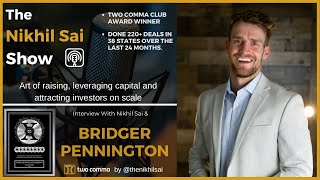
In this episode of The Nikhil Sai Show, host Nikhil Sai interviews Bridger Pennington, founder of Investment Fund Secrets and a two‑time 2‑Comma Club award winner. Bridger shares his journey from a modest upbringing to launching multiple investment funds and a successful online coaching business. He explains what a fund is, the different types (real‑estate, private‑equity, hedge, crypto, etc.), and how to structure and scale one. The conversation covers practical capital‑raising tactics, the importance of a compelling deal, leveraging personal networks, and the mindset needed to attract high‑net‑worth investors. Bridger also details how he built his education platform, the marketing funnels, tools (ClickFunnels, ActiveCampaign, Monday.com, etc.) and hiring practices that enabled rapid growth. He offers daily routines, advice for young entrepreneurs, reflections on his biggest achievements, failures, and motivations, and promotes a free course on funds with pathways to higher‑ticket coaching programs. The episode serves as a step‑by‑step guide for aspiring fund managers and online educators looking to raise capital and scale their businesses.
Chapters
How would you like to learn the secrets of two Kama Club Award winners on how they have built successful online businesses from almost nowhere to now running multiple 7 and 8-figure businesses by following the simple fundamentals of life? And let's see how they have used the powerful funnel systems, processes, automation, and social media to help their business grow at a different pace. Let's dive into their journey to grasp the strategy, mindset, action plan of how they have done it from almost nowhere to the way up to 7 figures. We are going to uncover and pick their brains of the top performing entrepreneurs on this show, how they have done it and how you can do it too. You are listening to D Nikhil Sai, the host, and welcome to The Nikhil Sai Show. What's going on? What's going on everyone who's actually listening to this podcast right now? First of all guys, welcome to The Nikhil Sai Show which is hosted by me, The Nikhil Sai. And guess what's going on today? We are back with another amazing multiple 2 Comma Club Award winner. This is going to be a crazy, crazy story, guys, so make sure to stick around. If you are someone who is into business, wants to grow your business to the next level, and you require that capital, or you're, you're wanting to build that fund which can— where you're trying to network with high-worth individuals and raise capital and build predictable income, this is going to be a crazy podcast. Right now we're having a guest who started his journey when he's 22 years old This is going to be crazy story. In the last 2 years, he has done over 290 deals in over 38 states. So this is going to be amazing, guys. So make sure to stick around. So guys, let's not waste any time, and actually let's welcome Bridger Pennington, founder at Investment Fund Secrets. Hey Bridger!
Hey, how's it going? Good to see you.
Absolutely good to see you as well, brother. Thank you so much for joining us today.
Well, thank you, man. I'm excited to be honest because it's an honor to be on your show. It's gonna be fun.
Absolutely, Bridger. We really appreciate your time today. So Bridger, let's not waste any time. Actually, let's dive in. Like, people— most of the people in the capital investment, you know, funding space, they think about like this is the old school thing, like the 60 years old do this, the, the Berkshire Hathaway does this, you know, the Warren Buffett does this. No young dudes do this, right? But you're breaking the entire industry. You know, you started your journey when you're 22, so we would love to hear your backstory. Can you please start with your backstory, like how did all of this crazy journey started?
Yeah. Well, no, it's fun to be on it. Let me, yeah, I'll kind of just clarify a little things too. So I ran 2 investment funds. We're launching a third fund. I'll talk about what that is in a second. We also have launched an education program and that's where we got our 2 comma clubs for. We didn't get 2 comma clubs from investing stuff because I just don't think that counts very much. So we have a coaching business that we sell. It's called Investment Fund Secrets. So those are separate companies. Investment Fund Secrets, we've done just over 4 and a quarter million in the last 18 months. Hit our first two comma club in about 5 months since launching. So it's been fun. It's been fun to be a part of. So we can talk about both sides, you know, the investment fund world and then also just running a coaching online kind of business as well. So anyways, yeah, back to your question, how do I get started? And do you want to hear more about the Investment Fund Secrets side or more about the fund side? Both.
The more, the better.
Okay, let's do it. So I started out, I grew up, I'm from Salt Lake City, Utah, and I got into college super ambitious, probably like a lot of people listening. I started 6 businesses my first years of college. I did Chinese tutoring. I did wholesale 2 houses. We did forex trading. I built websites for people, did some ClickFunnels stuff there. Finally, my dad grabs me and he's like, Bridger, You're kind of like a chicken with your head cut off. I want you to go meet with one of my business partners. I think this guy can really help you. So I said, okay. So I go drive to this guy's house. I pull up to this, you know, we, by the way, I grew up in a very, I would say, very average house. My dad drove a pretty crappy car. We had a nice house, like nice family and everything, but just nothing too special. I drive to this guy's house and it is a huge mansion. I pull up. I'm like, holy crap. We're in a gated community. It's on the hill. It's got a beautiful view. I'm like, who is my dad's business partner? This guy is crazy. I get out of my car. I walk up to the door. I'm like a little worried that a butler is going to come and kick me off the property. Like, you know, be gone, peasant, get out of here. Because I just didn't know. Anyways, I knock on the guy's door. I come in and, you know, he's got— and Bridger, come on. And he brings me in. He's got the wine cellar and the basketball court in the basement, the cars in the garage, and he's got the pool in the backyard, the whole thing, right? So we come in, sit down, we start to chat, and finally I go, how did you get all of this? Like, how did you do this? And he goes, Bridger, it's funny, not a lot of people ask me that question. And I was like, oh shoot, sorry, I don't know if I offended you or something, but that's the only question I have is like, how did you do this? And he goes, it's a good question. And he goes, no, no, it's fine, I'll tell you the answer. He goes, when I was in my 20s, I was a lot like you. I started a bunch of business, I actually had moderate success, but then I go, then he goes, then I figured out the secret The Secrets of the Ultra Wealthy. And he goes, what the ultra wealthy do, these are the Vanderbilts, the Rockefellers, the, I mean, these mega wealthy families and today's wealthy families as well. He goes, they send their kids to the best universities. They hope their kids go work in two fields, consulting or investment banking. And they hope eventually that those kids will go and work at a fund. So private equity, hedge funds, venture capital funds, or that the kids will come back home and run the family office. And he goes, that's the world of the ultra-wealthy is they play in the fund world. I didn't even know what a fund was at the time. I was like, what is a fund? And he goes, that's what we— so he goes, a couple of years ago, I met a guy who ran a private equity fund. He goes, well, he's one of the wealthiest guys I've ever met. And he said, and at that moment, he said, I don't care how long it takes. I don't care if it takes me 1 year, 5 years, or 20 years. I was going to figure out what a fund was how to start one and how to scale one. And he goes, that's what we did. And he goes, me and your dad, a couple of years ago, we launched a fund. And he goes, that fund is blown up like crazy. He goes, currently— and by the way, today they are currently 10 times bigger than Grant Cardone's funds. So if you think about Grant Cardone, right? They manage Cardone Capital. Think of how big Grant Cardone is. They are 10x Grant Cardone size, same asset class. They buy real estate. They They do apartment buildings, all that kind of stuff. And I was blown away. I was like, holy crap, these guys are insane. And I was like, wow, I want to learn about this space. That sounds amazing. Like, this is awesome. And I go, hey, I've always heard find a mentor. So I said, hey, can you be my mentor? I'd love for you to teach me about this. I'd love it. And he goes, Bridger, he goes, go talk to your dad. Your dad knows way more about this than I do. I said, no, no, no, my dad's poor. He lives in a small house. I want to learn from you. And he goes, He goes, Bridger, me and your dad make about the same amount of money. And I was like, huh? And he goes, yeah, we're pretty much equal business partners in this. And my chin about dropped to the floor. I was like, come again? And I left this dude's house. I drove straight to my dad's house. I was like, Dad, what the heck? Like what's going on? Like you're making all this money. Like why haven't I been able to order a soda at Chipotle for the past 10 years because it's too expensive? And yet you're making all this money. And so anyways, he kind of laughs. He goes, Bridger, he goes, yeah, we're doing okay. And anyways, long story short, I'm going too long. He sat down and started teaching me about funds, how funds worked, what a fund was, how to put them together, how to structure them. And for people listening to you guys might not know what a fund is. In the most basic sense, when I say fund, all I mean, a fund is a pool of money. Investors put money into that pool. Us as fund managers draw from that pool and we can go make investments or buy assets. Whenever those assets make money, they return to the pool of money and then we split them between ourselves and the investors. It's like the oldest business model in the world. Like Christopher Columbus had that. He went to the government and said, hey, give me some money. We'll go to the New World. We'll get a bunch of gold. We'll come back and we'll split it. Like that's the— it's the oldest business model in the world. And it's created more wealth than any other business model ever. I mean, it's the most lucrative business model on the planet. This is the world of private equity, of hedge funds, venture capital, real estate funds. And you can do it all over the place. For people that are listening, you guys are probably all online marketers. We've helped funds that go and buy Amazon businesses. They set up a fund. They go buy up 10, 20 Amazon businesses and group them together. They'll go buy up online real estate, domains, NFTs. I mean, they can do, you can do a lot, any, it's whatever you want to do. It's just a pool of money that you get to work from. If you need inventory for stuff overseas for your e-commerce brand, like it's a pool of money, you can use it for that. We have guys that do that in Brazil. They trade container ships. From Brazil, just like dropshipping. They just do it at, you know, million-dollar dropships at a time. That's how big they— it allows you to scale. That's all a fund allows you to do. So anyways, we can talk more about that if you'd like, whatever. But I know probably this audience doesn't care about funds as much. But anyways, he talked to me, taught me about funds. I learned about funds about 8 months later. I was working at a company. I was at school at the time and I was doing internship and working. I saw a great opportunity to launch a fund. I thought, this is amazing. I took it to my dad. We mapped the whole thing out. We put it together. And I was like, shoot, this is going to be amazing. And for whatever reason, I overlooked one of the biggest things you need for a fund is investors, is money. Like that's what you need. Like that's what a fund is, is like— and for whatever reason, I overlooked this. And so I thought, well, shoot, what am I going to do? And I thought, aha, my dad is rich and doesn't spend his money. Like my dad would love to invest in this thing. And so I remember it was a late Sunday night. I went and knocked on my dad's door and I said, Dad, I've got this fund idea. I want to thank you so much for helping me. And I said, my best pitch voice possible, I said, Dad, how would you like to be our first investor into our fund? And he kind of smiled and laughed, kind of like you're doing right now. And he said, Bridger, I love what you're doing. But he goes, if I invest in your fund, it would ruin the experience of you raising money on your own. Because your first investor is your hardest investor to find. And if I invest in your fund, it'll be a crutch that you'll never be able to recover from. And he said no, and he kicked me out. And, um, I kind of walked out with my tail between my legs and he said, go do this on your own. So I took him up on the offer. I went out and I pitched everybody I knew. I was 22 years old at the time. And I raised a whopping $49,700. Just teeny amount. Like, if you guys know anything about funds, that's a teeny small amount. But it was enough to get started. And I was so excited. We got this thing launched and going. And we were doing these microloans. They were loans like $1,000 to maybe $10,000 a loan. We started to do these little loans. And our first group of investors, we got them a 64% return on their investment, which was amazing. We then closed that fund. We launched a second fund. Our second fund did incredible. We raised and deployed millions of dollars out of that fund. We just sold that fund and now we're launching a third fund right now in the crypto space. And it's going to be— we have a lot of investors lined up. It's really fun. We're launching that right now. So during that process as well, we had a lot of people ask myself, my dad and my— I didn't mention this. My brother is a securities attorney. He's actually an attorney for funds. And he actually previously worked at a $700 million real estate fund and now just launched his own fund. They're raising $150 million to do RV parks. So a lot of people asked our family, How do you guys do funds? Like, how do you, how do you do this? And so we, we start, start an online program called Investment Fund Secrets to teach people. And none of us went to Harvard. None of us did the Ivy League route. We're just regular entrepreneurs that have done this. And so we launched a program to go out and do this. And we've got about 4,000 students right now. We'll probably talk more about that in a minute, but it's been incredible to run. We ran it for about 18 months. It's been awesome. And it's just, it's been awesome. So anyways, that's kind of our story too. That gives you the whole, the whole view of what we've done.
Yeah, absolutely, Bridger. And really appreciate the kind of intro, man. Like, I think, I think this is opening up a lot of people's— like, I believe a lot of listeners are having these new neurons popping up and jumping around because they were literally talking about at max like 5-figure and 6-figure level cash scene is more like a dream income for most people. And now we're talking about 9-figure funds, 10-figure funds, and you're talking about people who are 10x bigger than GC funds, which is crazy. So now this is kind of showing the possibility of what could happen when you have the right knowledge with implementation. So Bridger, I really appreciate this intro, man. Like, it really helped a lot of audience to get kind of very clear outlook on what you're doing and how they can get into this. So let's get more into little detailed questions about funds and what they can understand more about raising capital and stuff like that. So can you talk a little bit about fund? Like, what is a fund and how does that actually work? You already covered a little bit, but a more insightful way where you give like a quick intro of these types of funds and how that look like. That would be really insightful.
Yeah. So I mentioned earlier, a fund is just a pool of money, obviously. Investors put money in. So what does this landscape look like? You hear words like private equity or hedge funds or venture capital. Like what do those actually mean? All those businesses, business types are all actually, they're all very, very similar. The only difference between a hedge fund, a private equity, a real estate fund, a debt fund is all those different types of funds, an Amazon buying fund. The only difference is what they invest into is what they buy. So a very common, a very obvious one is a real estate fund. A real estate fund is a pool of money that goes and buys and sells real estate at scale. All fund does is allow you to scale. So instead of flipping one, we have a guy in our group, he flipped 1 to 2 houses a year. Now he has a fund. He flips 72 houses every year. That's the power of a fund. Okay? It's a real estate fund. Private equity. Okay? Same pool of money. The only difference is private equity invests into privately held businesses. That's it. Private equity or private ownership. A great example is Sycamore Partners. Sycamore Partners is on Wall Street. They actually own, a lot of people don't know this, they own Staples, like the companies, you know, the big company, Red Box stores. They own Staples. They own Nine West Shoes. They own Aeropostale, the clothing company. Last year, they were trying to buy Victoria's Secret. That's all the same company. It's a fund. It's a private equity fund. We have other funds that are smaller scale. They buy up restaurants. So imagine a restaurant and you have a fund that buys up all your neighboring restaurants.
Okay?
That's a private equity fund. Or you buy up Amazon businesses or you buy up— I have a guy that buys funeral homes out of his fund. It's incredible. He buys funeral homes. That's all he does. And then he groups them together and he sells them for about a 2x multiple every single year. So every year, he spends about $8 million and he buys up about, let's call them 8 funeral homes, $1 million apiece. He can sell them for $16 million a year later. He does it every year because he consolidates together. So he makes $8 million a year. Doing that. There's easy ways to make money and there's hard ways to make money. That sounds like a pretty easy way to make. Now he doesn't take home $8 million. He's got to pay off his investors. He probably takes home about $1.2 million he makes. There's a couple 2 Comma Clubs for you in a year buying 8 funeral homes. That's it. Like that's, it's not that crazy. That's the world of funds. So a debt fund issues debt. They issue loans. I mean that's what we're talking about. So you can do funds for pretty much anything, crypto funds, forex funds. All a fund does, it's a catalyst to you bolt onto your business to just scale. If money's the thing stopping you from scaling, a fund might be the best option for you. So that's, hopefully that answers the question a little bit, give you a little more idea of what we're talking about here.
Yeah, absolutely, Richard. That was really, really insightful. I think now the listeners are very clear and has a great setup on what a fund is and how does that work. And like really this is opening up the possibility to understand like how big the capital market is. Like people talk about, hey, hey, there is no cash flow in my business, but You know where the cash is, it's with investors. So the goal is to create a fund and attract right investors to help you grow. So Bridget, that's awesome.
One thing I'll add there too is just the money created in funds is insane. So one guy, like you see like Jeff Bezos or Elon Musk, right? Their stock price, Amazon and Tesla stock price goes up and their net worth goes up and it goes down, right? And it fluctuates a lot. Okay.
Yeah.
I'm not talking about net worth. I'm talking about income from a fund. There's, Citadel is one of many funds that are this size, but Citadel is run by a guy named Ken Griffin. Ken Griffin, take a guess on how much he makes per month from just his fund pays him, not his net worth, not stock price up and down. How much does he make per month? The answer is he makes— now this is not other investments, this is literally one income source. He makes $100 million a month. From one income source. That's insane. Like it's absolutely insane. When I talk about it's the most lucrative model on the planet, like I mean it. It's not, that's not personal investments. That's not his real estate portfolio going up and he made up. That is income, like cash from his fund, $100 million a month he makes every single month. You would need like a full-time team to decide what you're going to do with $100 million a month. Like how are we going to deploy this? What are we going to do? Like, that's how it's insane, like how much money is created in a fund.
Yeah, this is crazy. So I think listeners need to understand like the level of scale when we're talking about funds. It's not pennies you're talking about. Like you told like the $50,000 you raised, close to it, it's peanuts, right? It's really peanuts considering the market size. That's awesome, Bridger. So Bridger, one of the main problems, even though you had a good background and network of individuals who are steadily into funds and creating funds and scaling funds, you know, creating a fund and getting the right idea to understand what fund to be created is more like a real struggle. So we would love to learn more about like how the process looks like, like how to actually create a fund and how to get the right idea to choose if they should go and create a fund or not.
Yeah, um, you know, I— it's a good question. There's a lot of people online that teach how to invest. I don't teach how to invest. You can go find other people that— I teach how to structure a fund and build a fund. Now we talk about very similar to online marketing. You have red oceans and blue oceans, and you have a mix of both purple oceans, right? Um, we'll go into a red ocean, we'll find problems and efficiencies, and we'll go to a blue ocean and exploit that and find arbitrage. Same exact thing, we'll just do it at scale. What I tell most people though is this, um, number one, either you already have been doing something that's successful, you've already been buying real estate, you've already been investing in crypto, you've already been scaling up businesses. Um, actually the Hormozis, um, or they actually bought our course and they were looking at, hey, should we buy other businesses right out of this? Um, should we keep doing this? Like Alex and Layla, we hopped on a number of calls with them. Um, so I, I don't teach how— I teach you the, the markets. Okay, so number one, you're already good at something, or number two, you partner with someone who's already good at something. That's how I am. I— we're launching a new crypto fund. I, I'm, I'm an average crypto buyer. However, I found a partner who's incredible. He's done— he's mined Bitcoin since 2014. He was spending $41,000 a day in electricity in 2014 for mining Bitcoin. Like, that's the guy. And guess what? These people are— I call them broke geniuses. They're out there. They have great knowledge. They have no clue how to set up a fund, how to scale it, how to do it. And that's where I step in. I say, hey, I'll help you scale it. Right? So number 1, you're already doing— you've already found the niche. Or number 2, just partner with somebody who already has it and you can help scale the other aspects of the business that they typically don't have. It's the trader in the basement that trades all day, options and doesn't, doesn't know how to, you know, talk to an investor and raise capital. So that's what I advise most people on. I'm not going to teach you how to like do the strategies. I'm going to say either do it yourself or find someone who's already doing it. We can partner with them.
Yeah, absolutely, Bridger. So yeah, like we should think about this, like when someone is talking about really raising capital, collecting cash, there is no real value if you're just saying like, hey, I need $100,000, like for what, right? So you should really have that value, and that could only come with your own core expertise, or when you partner with someone who has expertise or can bring in the value. That's, that's really awesome, Bridger. Let's get to the next question. So one of the main problems people have when they have an idea to invest or raise capital, fund their own business, is really attracting investors and raising capital. I know this happened to you. You, you know, you had a great experience in getting through that phase and now doing over 200 deals, super amazing stuff. So we would learn, like, we would love to learn more about, like, your journey of raising capital. Like, how do you do it continuously? At a scale level?
Yeah, there's a lot. Number one, I'll say there's a lot of ways to go about it. You can— there's tons of different ways to do it. Typically in funds, you cannot use online marketing. You can't advertise your fund publicly, which that's why you don't see billboards and ads for these big funds because they literally— it's against the law for them to run ads, which is kind of crazy, right? Now, some funds you can run ads, but it's very, you know, smaller group. You have to file a certain way. Most funds don't do that way. The way they raise money is through their network, which is crazy to think, right? Through your network, you raise money. And it's not just that, it's a network of a network. And you go to events and parties and fundraising events, and you can do all that kind of stuff. You just can't publicly advertise your stuff. So when it comes to cap raising, there's a lot of different ways to go about that, right? It takes, you know, different flavor of different things, but the principles of marketing and sales apply whether you're selling a $2 widget or you're, you know, selling an investor for $500 million. The same psychology goes into it. Having a great irresistible offer, having a great message behind that offer. I mean, it's all the same. That's why it's so fun. I raise capital for our fund and we sell Investment Fund Secrets. And so it's actually, there's a lot of crossover between the two. So yeah, the example I'll give though, just back on the question of raising capital, I asked my dad this question. I said, Dad, No one's going to believe in me. I'm 22. No one will believe me. He goes, Bridger, I'm going to give you an example. And he goes, let's say me and you found a Lamborghini Aventador in Billings, Montana. Okay? And this car, it's— we've had a mechanical guy. It's amazing. There's a lady selling it. She's going into auction. She's going to sell the car for $50,000. Okay? And the car appraised, it's worth, let's call it $300,000.
Okay?
And we've already had a mechanical guy. It's whatever. And she says, I need the money by Saturday at noon. Okay? $50,000. My dad goes, Bridger, you can't use any of your own money. You've got to raise it. Could you find $50,000 by Saturday morning to buy this car in Billings, Montana? And I kind of thought about it and I thought it's all checked. He goes, it's already checked out mechanics. It's a legit car. She has the title. It's all, you know, she's going to own it. And we have a verified buyer that's ready to buy this car for $300,000 if we can get it to him. Bridger, could you find $50,000 by Saturday morning? And I kind of thought about it. And you know, like, you can ask yourself that same question, like, could I actually find 50 grand? And I kind of thought about it. I thought, you know what, like, former bosses, a college professor, friends from high school. And I was like, yeah, I was like, you know what, like, we're gonna make 250 grand this weekend. Like, I think, yeah. Yeah, I could find $50 grand. Like yeah, I'll stay up late. I'll fly. Like I'll get on a plane. Like quarter million dollars this weekend? Like I'm in. Like I'll figure it out. Like yeah, we'll find $50 grand. I don't care if it takes 100 investors. We'll find $50 grand. And I was like, yeah, I can do it. And he goes, what about $100 grand? Let's say the car was $100,000. Do you think you could find $100,000 this weekend? And I was like, yeah, you know what? I actually think so. And he goes, why? And I go, well, the deal is so good. It's such a good car. Like, you know, you have a built-in appraisal value. It's such a good deal. And he goes, aha, there it is. And I was like, what do you mean? He goes, 3 minutes ago you were telling me you're too young, you're inexperienced, you don't have the track record. And all of a sudden you're telling me you could raise $100,000 by Saturday at noon. Why? The deal was so good. It was so juicy. It was foolproof. And he goes, it's not a lack of resources, it's a lack of resourcefulness. Well, there's plenty of money on this planet. It's up to you to find a good enough deal that you believe in enough, just like you believed in that Lamborghini arbitrage, that you can go out and raise that capital. And I went, aha. And my mindset totally changed. And that's kind of how I started to approach capital raising is if you have a good enough deal, and yes, there's a lot of things that go into there. You can build a great team around you, whatever you need to do, but the money's there. And investors are looking for good investments all the time. They have full-time staff hired to find you, to find good investments. If you have a good investment, they're looking for you. They're trying to give you money. You just got to have a great offer and bring it to them and present it to them and, you know, and do the whole pitch and close and all that kind of stuff. And that's what it is. So that helped me a lot.
Yeah, absolutely. Thank you so much once again for sharing the amazing story. I think that's going to light up so many new ideas in a lot of people. Mind while they're listening to this podcast. Let's get to the next question, brother. So one of the main problems people who actually try to raise funds or have a fund actually, you know, faces is typically about capital utilization. Because most people, they cry over that they don't have the real funds to scale their business. Just in case if they have like a real funding coming in, dumping cash into the bank, then they start overspending on different stuff. So as you are actually, you know, experienced when it comes to fund management and creation, you would learn to take your two cents on like how does it look like when it comes to the capital utilization while you're scaling up?
Yeah, I mean, it's one thing like venture, like if you're taking on money from like for your company, if you're raising money through venture capital, I've seen that time and time again. They get like a $10 million check and they're like, okay, we got to scale our business. And they buy like, I had a company, they bought office desks that were all like $8,000 a desk. It was like, they bought like 50 of them. I was like, what are we doing? Like, you know what I mean? Spend money, you guys know, like spend money on stuff that actually produces cash. Now that's different in the fund world, right? When you're actually the one running the fund, you're in charge of deploying capital into— capital is your product, right? You're deploying capital into good places. And so hopefully when you set up your fund, you had a great idea of finding those deals or finding that arbitrage and whatever it is. But it can be interesting. It depends on your fund, but you want to be frugal. You want to be a good money manager, obviously. You want to make sure that deals are a slam dunk. And sometimes it's better just to sit. There's a lot of times no deal is better than a bad deal, right? So sometimes you're sitting there and you're like, man, we can't find a deal right now. You know what? We have a $5 million chunk of change right here. Let's just not do anything with it because we cannot find any good deals for our real estate fund to deploy that capital into. And so sometimes you're sitting on the capital. Now, and inside of a fund, you have a big separation between investors' capital and your own capital, right? You can't just go use that money for whatever you want. It's for the purpose of investing into certain projects that you've outlined. So there's a lot of, you know, definitions behind there. So you're just making sure that you're prudent in investing, deploying the capital into, you know, high-income-producing, yielding places, um, as well. So that's— I mean, that's the core of your— that's the product of your fund is how to do that.
Absolutely. Yeah, I really appreciate that answer. And Pritesh, like, one of the impacts you're actually doing with your business right now, which is your coaching business is really amazing. Like, you're literally opening up the opportunity to get everyone, people like normal people like you and me, to get into this funding business, which has so much more lucrativeness, trillions of dollars in cash. So we would love to learn more about, like, how did you actually scale up your coaching business coming from a fund background? Like, how did you approach scaling up your coaching business? Did you raise capital or funds to scale your business as well? How does that look like?
No, we didn't raise up any— we didn't raise any capital for this business. Still haven't. I'll tell you our failure. How about that? I'll tell you a coaching business we launched before this that failed. So we, 2 years before in launching Invest Fund Secrets, myself, not my— I have a business partner named Mason who's helped me a ton. I was just by myself at the time. We had an idea. I was like, I read Expert Secrets. I was like, I want to do a coaching business. And so— and I didn't know anything. I was like 22 or 21 at the time. And so what do we do? So I went and partnered with two experts. These guys had flipped houses. They had flipped 300 houses between the two of them. And I was like, dang, like this is going to work, right? And so we filmed a course on how to flip houses. We had a camera crew follow these guys around. They flipped a house like on film. And one of them had been on a TV show before. It was awesome, right? Like no way this thing fails. And they had me come in as like the newbie and they would teach me how to do it. And so I was the guy running the ads and the funnel and the webinar. And so we built this whole course, took us like 7 months. We filmed it, we edited, we built it, we got everything ready. So, okay, ready to launch, right? And so what we did is we, you know, we did the Russell Brunson thing, right? We, we did the ads and we ran the Thursday webinar and we did the webinar and then we closed it Sunday and like no one bought. And we did it again. We launched it again and we like, okay, let's try it again. You know, we spent the ad money and like Got everybody on, we're selling the— I think we sold it for like $1,000, this course, and like no one bought. And we, we ran this thing week after week after week, um, and we did different promo cycles. We spent about— was our— my first go, we spent about $12,000 and we made back like, man, I can't remember the number, like $8,000 or $9,000, something like that. We had like 9 people buy, um, hundreds and hundreds of leads, like just a lot of nos. And It was pretty depressing. And like, you know, coaching business, like you should be having like a 4x, 5x, 6x returns on ad spend. Like we were negative $5,000. And so I was like, shoot, like, and like, this isn't gonna work anyways. We folded that business. We ended up not doing it. And we, and we kind of stepped back after. And actually I joined a program, Steve Larsen. I joined his program. It's $15,000 at the time, put on a credit card. I was like, shoot, like, I don't know if it's going to work. Like, you know what I mean? And in there, He taught about Red Ocean, Blue Ocean strategy. And I looked at our business, I was like, it was called LiveFlip. I was like, huh? I was like, there's a ton of people that teach very similar things. Now I believed ours was better. We had a better product. I thought it was really good. Didn't matter. I'm like, you got Dean Graziosi, you've got BiggerPockets, you've got like Chris Crump, all these real estate people. Like, we're not going to just step into that market. And like, it's like And it's like online marketing, we don't think of that. Like if there was 4 coffee shops at a corner, you had Starbucks, Dunkin' Donuts, a local shop, and another shop, you probably wouldn't go put a 5th coffee shop on the same corner, except for a lot of us do that for our online businesses. There's, you know, 1,000 Instagram girl fitness girls, and I'm going to be the 1,001, and I'm going to make it. I have like 5 friends right now that are trying to be fitness models on Instagram, and it's just like, It is so saturated. Like you need a blue ocean. And so anyways, sorry, I'm on a tangent here. But Investment Fund Secrets. Okay? So I ran my fund for a couple of years and my business partner, Mason, he's like, comes to me, he's like, Bridger, we should do a course on funds. I was like, that's a great idea. And we said, instead of building the course for the next 6 months and, you know, getting ready and launching the podcast, like let's just start today. So we literally made, uh, uh, we logged into ClickFunnels. We made a, we made a landing page, page. We made a split test because we didn't know what people liked. We made about 8 ads on my iPhone. We made a checkout page. That was it. We made no backend. We didn't build a course at all. We, um, we launched our ads. We spent $1,000. We had a $1,000 budget. I think, uh, for the first weekend we spent $1,000 on ads and we just wanted to see if people bought. And if they bought, we sent them an email. We said, hey, the course is not finished. We'll send you a refund right away. Don't worry about it. But if you want to stick around, it'll be done in about 3 or 4 weeks. And the first weekend we turned our $1,000 into about $1,800. And we were like, shoot, like people like this. We're like, dang, like this is kind of working. And we start, we emailed everybody and only 2 people refunded. We sold a course for, it was $47, like a little mini course. Like people actually like this idea. And we started to tweak, we started to A/B test. Um, and we, I spent the next 3 weeks building out a little course and we asked people, hey, what do you want? What did you want to learn in this course? What can we add, include? Our customers told us what they wanted us to build them. And so we built them a perfect course that they wanted for $47. The next month we spent $80,000 on ads and we made back $40,000, excuse me, $79,500. So we lost $500 the next month, which was amazing. It was a break-even funnel. It was amazing. Okay? We had this little $47 course that we were running. We had, you know, a couple thousand leads now. We had a few hundred, I think like 800 buyers. I can't remember the exact number. And we were like, dang, this is awesome. We kept asking them, what do you guys want? We had no list. We had no following to launch from. And then a month later, we said, okay, we're going to start teasing a mastermind. So we started to tease this higher ticket, not like it was a course. That we were going to sell for $2,000. So we tease this whole thing up. We followed Jeff Walker's Launch. If you read that book, I love that book. We, uh, we did a webinar on a Thursday just to our list, just to our people that had opted in. Um, we did a webinar on Thursday. We closed it Sunday. We did $147,000 on that weekend. All really like it was $100,000. Like, I mean, there's no ad spend. It was all from that self-liquidating offer that we did 2 months earlier. And we were like, shoot, this is amazing. We had— and that one we actually had built some of that. We didn't like launch it without a course. We built some of the course and we kept asking, we kept building content, content. Um, from that date we hit a million, we hit the two comma club in five months. Um, we did, and we did, we followed Russell Brunson to a T. We did every week, we did a live Thursday webinar. We closed it Sunday and we relaunched it. And we did that for 38 weeks in a row. Um, we had done like $1.6 million and we, and then we finally automated it. And cause we were launching, we decided to launch a higher ticket, a $15,000 program. Um, so anyways, it was awesome. That was in February of 2020. August, we hit 2 Comma Club. By the end of the year, we hit $2 million. And then now we're, we're over $4.3 million, total $4.5 million, something like that. Anyways, whatever. It's been fun though. It's been really fun to grow and scale. And we, but we started literally no list, no following, just a 6 ads, split-tested funnel, and that's how we test out our content.
Yeah. Yeah, absolutely, Bridger. Yeah, thank you so much for the golden nuggets you're actually dropping. I think everyone who's procrastinating on creating their course or launching it to see if that's going to work or not, you should literally model what Bridger did, right? Like literally go model that.
Go build the freaking course. Like, that's how we failed. Like go test the other— a great tool, TubeBuddy. We love TubeBuddy. I go on YouTube and it's like, Chrome plugin. It tells you how often keywords are searched on YouTube. YouTube is the second largest search engine in the world. So we went and started to test out our content. What's competitive? Who's our competitors? Think about red ocean versus blue ocean. We found online there was a lot of people searching how to start a fund and there was very little content to back that up, to help that. And so we said, hey, there's a hole here online. On the online real estate, there was a hole for people that wanted this. And so that helped us a ton. And we had a bunch of different ideas. For headlines and hooks. And we just, we said, hey, we got a piggy bank, $1,000. Most we can lose is $1,000. Let's just see what happens. And dude, I would recommend every person stop with the, oh, I'm going to think about it and wipe and do a business model on a canvas and a business plan. Like literally just launch, like launch the freaking funnel and spend $500 of ads at it and just see what people click on. And get a little data. And we had no podcast, no— I mean, we had like nothing.
We literally—
that's how we started. And we made a bunch of little tweaks and iterations that whole weekend. We kept tweaking and iterating. We thought we were going to do it. We actually thought our best course would be a how to start a real estate fund. People didn't like that. We then launched one on how to start a forex. There's a lot of forex traders. How to start a forex fund. Nobody liked that one. How to start— we did another one. No one liked that one. And we finally found like our headline and niche that worked after a couple of weeks. And we just played with the house money and it was awesome. So yeah, that helped.
Absolutely, Bridgette. That was beautiful. Thank you so much for actually giving the entire information on how you actually launched this. So I think now everyone who's listening to this podcast has a clear idea on how they can launch without procrastinating. And Bridgette, let's get to the next question. So when you're talking about like raising and managing millions of dollars as a fund, as a team, you know, young person in the business, young entrepreneur, at the same time, Building up your coaching business and, you know, partnering up with Hormozi and all of this stuff, we would love to know more about like what kind of tools do you use to manage your projects, clients, or productivity? How does that look like?
Um, so like actual tools we use or just how we do it in general?
Yeah, you know, both ways. Like you can actually list down the strategies you actually follow to manage your productivity at the same time, the tools which comes in place to actually make it much more effective.
Yeah, um I have really good, really good, really good partners and good people. Um, I know people talk about it a lot at the beginning. No, it was just me and like Mason. We just ran things. And now we're, and we're in the people business, right, of hiring really good people. I love bringing on people that are young and hungry and want to make a difference and are like go-getters and can just manage their whole thing. And so we bring on really good people. Softwares we use, we use monday.com right now for a lot of our tasks and project management flows. We've tried Trello boards, we've tried a bunch of other stuff. I, I mean, it's— yeah, anyways, interesting. We— I don't know, we do a couple things that help our team. We're all remote right now. We do a 9 AM daily huddle every single day for our teams. Um, we all get on the same page, about 15 minutes. We just all collaborate really quick. Um, we're getting office this week, and so we'll be moving— hopefully that'll change things up for us. Um, as far as tools and stuff, I mean, we use like everything, right? Like, I'll just tell you the tools we use though. ActiveCampaign for our email stuff. We've used WebinarJam for a long time for our webinars. Our webinars haven't worked as well recently. We've now tweaked to a call funnel. So we send people to— so we've hired some salespeople, they hop on a call and they, you know, they get— they have a setter and a closer and all that kind of stuff. And that's been an interesting game. So we use like HubSpot, we use Hiros to track. That's Alex Becker's tracking software. We've liked Hiros, a little bit expensive, but we've actually really— if you're spending, you know, a decent amount of ad spend, like we spend, I don't know, near $75,000 to $100,000 a month on ad spend. So it's, it helps our ads a lot. Um, those are some tools. I'm trying to think of other tools. HubSpot, ActiveCampaign, we use Slack. Anyways, those are some like actual tools. Now as far as like people, talk more about processes. I personally love hiring people that I think could run the business one day. And so when they join our company, I say, hey, like you are literally going to be the president and CEO over this section of the business. Like, you're in charge. You make the calls. Yeah, check things with me, make sure it's done right, but I want to give you creative freedom and owner— you have complete ownership over this thing. If you want to make a decision, you own that decision, right? Like, if you want to, you want to spend money on X, Y, and Z, okay, but it's, it's your neck on the line if it works or not. Like, you got to own it, right? And I want you to be a really, like, grow this thing. And so we try to hire people like that, and that's helped us like crazy. We've brought on really good people, and we have a really good team. And, and so We're trying to keep growing our team. And that's even down to like our, even a setter, like we have brand new setters, like sales guys. And I'm like, dude, we're a small company. If you don't like your script that you have to sell, like let's rewrite a new script. Like think of a new script, give us some feedback. Like we need to grow and this thing needs to take off faster. And so, um, that's what we've done. You know, as far as managing people, I, um, I try to work at, you know, if you read the E-Myth, try to work on the business as much as possible, not in the business. Um, I'm always trying to get out of the business, like, not— I don't want to work on the day-to-day. I want to work on the business and help grow the whole thing. And so, um, anyways, it's, you know, that's part of business growth. Probably talk about that for 2 hours. I'm sure you have a lot of ideas on that too. But, um, those are, those are some tools we've helped. I have good partners, good people around me that— anyways, that hopefully that helps.
Yeah, absolutely. I really appreciate what you have mentioned and all the tool list and the kind of way you actually hire people. And I think It's really kind of building that accountability in your team's head as well. And that really builds that partnership even though they don't run a stake, they really have the skin in the game while they're giving that freedom of choice. That's awesome. So Bridger, I would love to learn more about like, do you follow any routines in your business? Like how does that look like?
Yeah, personally or in the business or everything?
Yeah, your daily routines, like the way you wake up, the way you get to the work and all of that stuff.
Gotcha, yeah. So I just had a baby. We had a baby about 6 weeks ago, so that's totally thrown off.
Congratulations.
But it's— no, it's been actually really fun to have a baby. I've loved it. I try every morning, I make sure to work out. I do something. I don't care if I— whatever. I make sure I do something, whether it's just push-ups or I don't know, whatever it is, a run outside. I need to do something to sweat and get moving. That's like my daily minimum. And now I try to do a lot more than that. That's like the minimum. I try to read something spiritual. I'm a religious person. I try to like read something or listen to something spiritual or religious. And recently in the morning, I have loved— I don't know if you guys follow like Wim Hof. I've loved doing a breathing technique for 5 or 10 minutes and then I take a cold shower and it pumps me up, dude. I come to work like freaking on fire. And something I was actually telling my wife, I literally this morning I was telling my wife, I'm like, so I do— I do— I've done cold showers in the past. I've done— I do intermittent fasting. I like that. Anyways, I test— I love testing out morning habits. It's like I test them out like crazy. So these are, I don't know, I'm always testing out new ones that I like. Those are a few that have stuck for me. The one I listened to Tony Robbins, it was a few years ago. He talked about power poses. Like he's like, and it was, I thought it was weird. He's like, if you stand in the mirror and like stand like Superman, just that's all you did, your testosterone and energy levels raise. For men, testosterone raises by like, I think 10% in about 5 minutes. If you say affirmations as well, it can raise up to 20% in 5 minutes, which is like crazy. So what I've done, and it's funny, like my wife has caught me, like I'll go in the shower, I turn on the cold water, and then I have a mirror right there and I do like a power pose. And I'm like, I'm like there and I'm like, ah, you're going to win today. You're going to kill it. Like, and I like yell stuff at myself and I come out of that shower like freaking hair on fire, just ready to go. It's so fun. I've done that. I've only done that the last month and I've just loved it. Like doing both those together at the same time. It's been real fun. We'll see if I keep it going for the next 6 months. Um, there you go. That's just me telling you all the weird stuff I do. Um, I don't know. I'm always cycling new stuff though. I like to try different things. Um, uh, we do a 9:00 AM daily huddle every day for our teams. I love that, especially remote teams. It gets everyone on the same page and make sure, and make sure everyone's working at 9:00 AM. Like you are on your call. Your camera needs to be on. You need to be ready. You need to dress like you need to be ready at 9:00 AM. And so, because when your people are working remote, it's easy to sleep in, or, oh, I'm getting back from the gym, or whatever. It's like, no, you got to be here at 9 on the call, dressed, ready to go. The day starts, right? Um, I like that. I like that a lot. Um, besides that, that's really the only, uh, for our like daily, daily routines, that's about it. Um, I would say so personally, that's the stuff I do. Um, and I like a 9 AM meeting. We have a bunch of other stuff throughout the day, but That's the main one we like.
Yeah, absolutely. Thank you so much. And yeah, that's really exciting. So let's get to the next question, brother. I know you're young, uh, you know, you're still in your 20s, so we would love to know more about like if there is one option to tell something to a 20-year-old you or a younger you or someone who's just getting started in business, what will be your number one suggestion for them?
Yeah, it's a good question. Um, I'll just tell you something that somebody told me and this changed my life. When I was about 20, I think I was 21 or 20, somewhere around there. You know, because most people go to college and school or whatever, and they're, they're gonna, you know, do that thing for a little bit. And then maybe one day they'll start their business. And this is kind of a few things that kind of hit me all at the same time, right as I was starting college. That really helped me. I had a mentor guy, he's a really successful multimillionaire, ran, actually runs a course, does really well. He says, Bridger, right now is the best time in your life to start a business. You don't have a mortgage, you don't have kids and a family, you don't have a big, you know, thing to hold. Like you literally live on like $200 a month. There has never been a better time to start a business than right now. You have nothing to lose. And you've got all the resources of a college and, you know, people around you. Like you have everything at your disposal to do this. And I think I actually heard a podcast from Russell Brunson talking about, He's like, risk for me now is way higher. If I risk and lose, 400 people, family, they don't have food now. They don't have money coming in. Like I have all these employees. It's a lot more. When I was 21 and I risked it all and I lose $5,000, that's all I have. Well, okay, I only lost $5,000. Like that's not, I don't have much to lose, so I can risk. Anyways, that helped me a ton. The second piece getting into college was My whole purpose of going to college was to make money. Like, what's the ROI on college? Like, if I'm gonna go to college and spend time here, like, and you know, the number one cause of divorce is financial reasons. The number one cause of stress in people's lives, financial reasons. The number one cause of suicide, I believe, is financial reasons. If I can figure out the money game, and people listen, you guys already know this, you're listening to this podcast, but if I can figure out the money game, my life's gonna be, now it's not, my problems aren't gonna all go away, my life's going to be a little bit, I think, easier, a little bit better to some degree. So when I got to college, I said, my goal is to figure out the money game as quickly as possible. I need to make— and I don't care how much you love your job after 30 years, and if you're broke, you probably don't love it as much anymore. Right? I would rather have a really successful, high-income-producing job for a few years and then live the rest of my life with freedom and I can do whatever I want. right? And so I went to school. I didn't take any generals at school. I didn't take, I never took biology. I never took chemistry. I took one writing class because I had to my first year. I literally, my first 2 years, 3 years of college, I took econ, finance, accounting, SEO. I took a real estate class. I took like an entrepreneurship class and I dropped out like that. And it was amazing. I learned a ton, you know? And I've, I actually spend money on courses and education. I've spent $110,000 on courses in the last, I don't know, year. I spend a lot— I buy a ton of courses. I love courses. I love learning from people. You guys, you guys are in this community though, you know that. I just think traditional education is getting less and less valuable every single day. And, and it's fun to learn from people who are actually doing it, the actual, the actual experts. And so, um, anyways, yeah, that's, that, that's what I tell myself. Go after it. And that's, that's— I'm happy someone did tell me that, and it helped. That's why I went and started 6 different businesses right in school, and I failed at almost all of them, but we did them, right? We got momentum, we got moving, and we got And it, it one leads to the next, which leads to the next, and eventually you'll make it. And I'm, I'm still in the journey, right? I'm— we're still launching stuff and still scaling. So that's where I'm at.
Yeah, yeah, absolutely. I really love it. Thank you so much for mentioning those two advisors, and hopefully they really, really help and, you know, really kind of relate to a lot of people who are actually listening to this podcast. So let's get to the next question, brother. So, uh, again, you're so young, but I would love to know more about like your life's biggest achievement so far and any next your bigger goals?
Yeah, biggest life achievement, marrying my wife. That was awesome, dude. I married up like crazy, so that's seriously a huge life achievement, and having our little baby. That sounds cliché to say, but truly, that is my biggest life achievement. It's true. It's not like, oh, it's nice to say, or whatever. That's actually true, okay? Number— and then in business, I would say, as far as life achievement, I think like, I remember our first year sending our checks to our investors and these are big high net worth investors that gave me some money. We sent them a really good size check back and they were just ecstatic. I got phone calls and like, Bridger, like I'm 22, 23 at the time. These guys, one of the guys runs a Fortune 500 company, invested in us. And he was like, dude, like good job. Like you did. Like, and to hear that from those high, like these are high net worth individuals that are worth tens of millions of dollars each. To say like, yeah, like, good job. Like, you did a great— you're one of our best investments I've ever made. Like, that was cool for me. And so, um, yeah, that was awesome. My, uh, next big goal, um, I want to launch a billion-dollar fund. That's the, that's the big goal. So we're launching funds right now. That's the plan, hit a billion dollars. So we'll, uh, let's go. Give me a few years, we'll get there. Yeah, we're gonna get there. So just need a little bit of time. That's all we need is just a little bit of time. We'll get there.
So absolutely, love the momentum. So we are very excited to see you raising that billion dollars and actually making investors much more happier, brother. We're very excited to see that happening. And this would be much more fun to answer. So I know you got into 6 businesses, you crumbled all of them, then you restarted, you created a course, it didn't work, then you started coaching program. But just to sum up, like what was the biggest mistake in your life so far, especially in terms of business?
Yeah, it's a good question. You know, I think a lot of— I'm actually grateful for the entrepreneur community to help rewire my brain and say, hey, failures aren't failures, they're just learning objects, right? That's helped me so much. I hope that helps you guys too. I'm thankful for all these entrepreneurs that like come and speak and like, no, like you're on the grind, right? You can do this. LiveFlip, we lost a lot of time and money on there. Biggest business failure. Yeah, we had it. I had a partner one time in my first fund, my very first fund. I opened up the business bank accounts and we were missing like $15,000, and he had taken the money out to pay his other company's employees because he was like, they were losing money. And I was like, shoot, like, and this guy is 45 years old, he's run like 10 businesses. I was like, this guy, I'm 20 2. This guy should know better. And I call him up. I'm like, dude, what happened? He's like, oh no, we were just pulling some money around. I got to pay this thing off. And I was like, no, like you can't. Like they have a word for that. It's called fraud. Like what you just did is, and that's where you go to jail. And he's like, oh, he's like, well, no, it's fine. We'll get the money back. And I'm like, you better. Like, and I'm talking, I'm 22 talking to this 45-year-old guy. He's a CEO of a big company. Like, dude, like, you made a big mistake. I'm calling you out on it, and I will personally sue you for this. Now, it's $15 grand. It's not a lot of money, but it is— it's a significant amount to our little small little startup fund, and this isn't right. And so, um, that was— that was hard, man, and trusting those guys. And anyways, we ended up working out that we actually got the money back. It took about 6 months, and they had to slowly pay us back this whole thing, and it ended up— it actually worked all out, which is great. Um, but man, at the time, dude, it was, it was really stressful. I thought I made a huge mistake and it's like, man, we, we suck. So, um, I've, I've wasted a lot of time on things and, and other things, but all, you know, those are all good learning, you know, learning things. And, and, um, you know, like they said, turn it into, you know, like part of the story, it's part of the journey, but it kind of sucks at the time. So those are a few things there.
Yeah, absolutely, Bridget. Thank you so much for mentioning that. Let's get to the next question. Your main inspiration for the success you achieved and key people people involved in your journey?
Yeah, main inspiration for success, I would say there's two. You have a carrot and a whip. You have a carrot of like, man, we're going to have like a private jet. I'm going to have like a Lambo. I'm going to have like the house. And not even, that's all like, just, that's just like things. I'm going to have lots of time to spend with my family, my kids. I'm going to do what I want. I'm going to have a life of freedom and I'm going to live life on my terms. I have this carrot of like, That's amazing. And I actually, I was grateful enough. Me and my wife talked, we grew up on the same street together, me and my wife actually. And so we grew up in the same neighborhood and all this stuff. And we lived in an area that was just below the really wealthy area of the city. Like we lived in a very normal, I would say a normal area, but the area right above us was these huge houses, mansions, all these successful people. So we were friends with all those kids. We all went to the same school. So we could see all these families that had tons of money, success. And so it was like, wow, like that's obtainable. It's there. And I have friends, these kids are idiots. Like I can beat them and their parent, like I can do this, right? That was awesome in my brain. I was like, okay, I can do this. And I had a great dad. I talked about my dad earlier. My dad's an incredible mentor. And to give me that, both those kind of categories, to give me that vision of like, you can do this. Like if you think about the history of the world, think about the 1200s, the 600s, the 1200 or 500 BC, Okay. It's pretty— like you had to be born in the right area at the right time that wasn't at war. You had food and you were born in the right situation to be able to have like a beautiful house on the hill with some land, right? Like that's like a lot of things had to line up.
Gifted.
Today, if you just work hard and apply yourself a little bit and follow some smart people, like you can do that. You can have the castle on the hill with the land and the house. Like, There's never been a better time in the history of the planet Earth to be born to be an entrepreneur. And like, that is just, it's just like, I can't, I personally could not live a life, 80 years or 90 years on this planet and look back and think, well, man, when I was 30, I was just a little scared and I didn't get in. And then at 38, I wanted to write a book and then I didn't do it. And then I was 45 and then, ah, you know, I just, I want to stick with my job. And then you, you end up at the end of your life and you're like, I had everything at my disposal. I had the internet, I had this emerging future of NFTs, crypto, blockchain, all this great stuff. And I just said, nah, I'm not gonna take advantage of it. I would be so depressed at the end of my life. We only get, as far as we know, we only get one life. All we really know is that we die at the end of this life, right? And so might as well live it up. So that's the carrot, right? There's also the whip. Yeah, for me, as far as like motivation is, you know, of, you know, failure and poverty of like, I've got to keep working and going. And that's, that's helped me, you know, you kind of see both sides of the coin. But anyways, I'm talking too long, but that's helped me a lot.
No, you're, you're absolutely doing great. Thank you so much for the insane amount of value you're dropping here, Bridger. We really love the vibe and enjoy the time spending with you. And Bridger, like, wow, what an amazing guest today we had, like blowing up our minds with talking about billion-dollar funds and crypto, real estate, whatnot. So people who are listening to this podcast might need help creating their own fund, scaling that out. So where can our audience find your mentoring, Richard?
Yeah, what, what we can do for you guys, we actually created a free course on funds where our— one of our goals is to make funds mainstream. We want more people to learn about funds, so we've made a course, like 40 videos on funds, and we have downloadable stuff, all that kind of stuff. It's, um, you— all you got to put in is your name and your email No, we're not going to just drill you with marketing stuff. The idea being, I'm just going to tell you straight up, the idea being you're going to come in the course, we're going to blow your socks off. You're going to be like, wow, it's amazing. I need Bridger's help. And you're going to ascend up our value ladder. That's the idea. That's just me being straight up. We have a $2,000 offer, a $15,000 like coaching, one-on-one coaching program. And then we have a $50,000 similar to like an inner circle type is what we have right now. So if you want to join those, great. But I would start with a free course. It's awesome. Get your feet wet on funds. What is a fund? Can it work for me? And it helps qualify to make sure that you feel like you can do this as well. Helps. And we're just trying to make this mainstream. We want to make funds a mainstream thing. So if you go to investmentfundsecrets.com/freegift, so Investment Fund Secrets, the name of our company, so investmentfundsecrets.com/freegift, you can go seriously put your name and I think it's name and email. That's it. And you hop in and you have the whole free course. You can watch all the videos, downloads, all that kind of stuff is all in there. Our gift to you guys. So there you go. If you want to find me on Instagram, um, Bridger_Pennington is my Instagram. Just send me a DM. I have a small following, so just DM me and I'll, I'll respond back to you guys on there. Um, and then that's— yeah, that's where we go. We've got— we've had over 4,000 students go through our stuff. We've got a couple funds that are— one fund over a billion dollars, two funds over $100 million each, and then a handful of funds for between $20 and $50 million. So we've, we've done— we've done this numerous times. It's been really fun. So there you guys go. Investmentfundsecrets.com/freegift.
Yeah, absolutely. Thank you so much for the free gift for the listeners, Bridger. I really appreciate that. So guys, you know what to do right now. So if you are interested to learn more about funds and how you can actually be like Bridger, so make sure to check out that free gift for you, and I think it will really help you out. Like, if you have some time to learn something, just like that extra hour, you would like to use it productively, even if you have no clue what fund is, go learn. Even if you don't want to raise capital, still learn something because that's going to help you to understand the abundance happening in this world. Because now you're really playing small numbers like 5 figures, 6 figures, max 7 figures. But you know what could happen? We are talking about billion-dollar funds here. So this is really, really lucrative and you could do it too, right? Just like Bridger did. So yeah, that was absolutely awesome, Bridger. Thank you so much for mentioning that. Any last word before we conclude the entire podcast session today?
Oh man. Well, thanks for having me on, dude. It's been, it's been really fun. Yeah. I, you know, I would say, I think I kind of said at the end there, like there's never been a better time. I mean, especially people that are in the United States, like, holy crap. Like you won the freaking lottery being born in the United States. They're like the worst. I'll just mention this in the end. Your worst case scenario, you go at it, you do all the things and you fail in the United States. Guess what you fail into? You have bankruptcy to catch you. You have food stamps. You have shelters. You have places. You have churches, charities that all help you. You still live better than probably 30% of the world. If you completely and utterly fail in the United States, you still live better than 30% of the entire world. Like, why not go after it? Like, why not? And like, For people like us, you're probably never gonna fail that hard. Like, yeah, you might lose some money, you might go up and down, but you're not gonna like fail. Like, to be homeless on the street, broke, like all that kind of stuff, like there are so many safety nets to catch you. There is no reason, like especially in this day and age, like there's no reason not to go after it right now. There's no reason not to take advantage of this amazing marketplace of the internet, of everything we have right now. And you have great people like, like Russell, like we have Russell Brunson who puts out incredible stuff and people online like Nikhil that brings on people on a podcast. You can listen to other people and connect with others very easily. It's like there's no excuse. So yeah, it might take you 5 years, might take you 10 years, might take you 20 years. Who cares? If it takes you 20 years to be a gajillionaire, great. That's awesome. Like that's amazing. Congrats. We get so tied up in our head like I need to be rich in 30 days. Like have a little bit of time. It's okay, like take the time, like it's all right. So anyways, that's what I'll leave you with. Um, go after it. Hopefully that's— I hope that works.
It is, absolutely. Richard, you are definitely on point. I think it's— this is the best time in the economy, so you should be risking it all. I mean, like it's not in a sense of mindless risking, but it's more about mindful risking, understanding what could happen the worst and what could happen in the best way. So you know, hope for the best, prepare for the worst, and you should have good days if you actually stick to the game plan, guys. So yeah, guys, again, Bridger, thank you so much for this amazing opportunity. It was really like having a fireball on this podcast today. What an energy, what a story, really inspiring. And I believe this really inspired a lot of entrepreneurs and upcoming fun creators who are actually listening to this podcast today. And guys, if you need more help, make sure to check out the free gift Bridger just mentioned. I'm gonna drop the link in the actual podcast description as well. So make sure to stick that up. And, uh, yeah, I think we are good for today, guys. So stay tuned for the next interview. I'm going to be coming back with another amazing True Karma Club winner. This is me, Dinesh Desai, and Bridger Hennington signing off for today. Peace out. Bye, Bridger.
More from Nikhil










BURNED $1.5M in his 17years online #digitalmarketing #entrepreneur #onlinebusiness
