From Chemical Engineer to 7-Figure Agency Owner | Nikhil X Mina
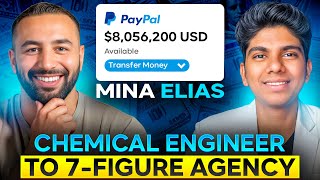
Mina Elias went from chemical engineer to running a 95-person marketing agency serving 200+ brands. She built it by fixing what traditional agencies got wrong: poor communication, lack of transparency, misaligned incentives. Her playbook includes a recruiting funnel modeled on sales pipelines, strict operational frameworks tied to compensation, and inbound marketing through YouTube and LinkedIn instead of paid ads.
Chapters
Why don't you walk us through your journey?
Yeah, man. So it is actually a brutal journey, a very brutal journey, but I learned a lot.
What was your learning curve?
So I had to jump back in, do my own sales, become really good at sales and like become good at sales as an actual salesperson.
How did you recruit them?
We mainly hire from South America and Europe. Like they have their own stuff.
So give us a little playbook.
Amazing. Let me get into this in super detail, right? Because this is going to be very actionable.
Walk us through your daily routine, like from the time you wake up to the time you actually sleep.
I wake up, get weighed, fill in my like notes for the, for the bodybuilding stuff. I open up, I have a notes folder.
Do you have any resource that you would like to share with the audience?
Yeah, if you go to my YouTube, I actually did a talk about how to generate leads for your business.
What's going on? What's going on? Everybody's actually jumping on this podcast right now. First of all, guys, welcome back to another episode of The Nikhil Sai Show, which is sponsored by me, The Nikhil Sai. And guess What's going on today? I'm back with another amazing guest. This time it's going to be a very interesting journey. I'm bringing someone who is absolutely beast when it comes to acquiring great talent, running and scaling operations, and scaling e-commerce businesses and whatnot. Every agency's worst nightmare is spending money on ads and not getting a return. The founder I'm bringing on today, he has built a successful agency without spending a lot on advertising by attracting clients through personal branding. So if you are an agency, and you're worried about how AI is going to disrupt you, this podcast can be a game changer. Okay. And we are talking about somebody who went from a chemical engineer to building multi-seven-figure Amazon seller. Okay. And let's not waste any time. And actually let's welcome Mina Elias. Hey Mina.
Hey, how's it going, Nick? Thank you so much for having me on the podcast.
Yeah, we are super stoked to have you on and we would love to learn the secrets of building a successful marketing agency, build operation systems and scale. Before we get into the meat, Mina, why don't you walk us through your journey? Because everybody sees you as like overnight success. Like, yeah, yeah, Mina got lucky, right? But I would love to know like what's been the journey like? Give us some context about who you are. How did you end up becoming this person who built a successful business?
Yeah, man. So, so it is actually a brutal journey, a very brutal journey, but I learned a lot. And so let me share, you know, in 2018, I was 5 years into working corporate, right? So I had my bachelor's degree in chemical engineering. I had a second bachelor's in chemistry. I had a master's in industrial industrial engineering. And I felt like I was a slave in the corporate world. I felt like no matter what I did, I wasn't kind of leveling up. I hated my life. Okay. And later on, I realized it was because I cared more about freedom than anything else. And so kind of actually, that's the first lesson is a lot of people are chasing a number, like money, or they're chasing a thing, right? Or they have something unclear in their head. The biggest thing that made me who I am today, so there's a lot of people who make the same amount of money as me or better money than me. But I would say 99% of people, the people that I look at, I am living a better life. And the reason that that happened was because when I started the journey, I sat down and I wrote exactly as if I was writing, making a movie, right? And I said, this is what my life looks like, right? Not what I'm doing, not the job, not maybe like how I worked, right? But it was like, this is where I live. This is how it's warm. This is how I spend my days. This is how I start my mornings. This is how I train. This I have a personal trainer, I have a chef, I do this, I go that, I travel here, and I painted this life. So instead of working to make a million and 2 and 3 and 5 and 10 and 20, which is like, okay, cool. Like I have a friend, right? A very close friend. Last year he took $3 million net profit in dollars. And he's looking at me and he's like, dude, how do you do this? How do you do that? Like he's not really living a life because he's just been optimizing for money, right? Making money. But he hasn't really been optimizing for life. So that's the kind of the first thing is I wrote down what's the life that I want. And I started working towards that, which means if you want like a life that's like X, Y, and Z, like if you want a life where you're impacting people, right, or something like that, you need to work towards that. So don't go and build a business that is more maybe money-driven. Maybe do something that is more value-driven that impacts people and makes you some money. Maybe you're going to make a little bit less money, but at the end of the day, you're looking at the whole life and you're optimizing for that. So anyways, I, I was, I hated my life, so I drew up my dream life and then I'm like, okay, I want to start a business. And I was an MMA fighter since 2003, you know, 5 years into that. And I was, I was on keto, so I needed electrolytes. Everything on the market had sugar in it. And I was like, well, let me just make one without sugar. So I made an electrolyte powder that didn't have any sugar. It was the highest concentration of electrolytes on the market. So sodium, potassium, magnesium were the big 3 electrolytes, and I had a very high concentration of each, higher than anything on the market by a lot. And then, you know, looked at the clinical studies, all this stuff, you know, using my degree. But, and then I had taurine. Taurine actually allows the absorption of electrolytes as good as sugar. And, and most people, you know, or most brands didn't know that. Most people didn't know that. Created that. And then I said, I'm going to do it at a very like economic price point. So because like, I'm like, I hate paying $30 for like sugar water basically. So yeah, I'm going to, I'm going to make it $20 and I'm going to make it the best on the market. So I did that. And, you know, obviously I created the brand and I didn't know anything about e-commerce, Amazon, whatever. I started going to gyms and stores, trying to get it into the gyms, into the stores, was a complete failure, complete disaster. And it was until an event that I was at and my friend was helping me out with that event. I was, I was hosting that event. This was like, You know, 4 weeks after the idea and September 14th, my dad gave me the idea to start the brand. September 21st, I made the first product at home. November 2nd, I went to that event and I was live with 40 units, sold 25 of them. And then we lied to everyone and said that it's going to be on Amazon soon. So that's what got me into how do I get this product on Amazon was the rejection and me lying to everyone. Started researching and this is where like the journey of like fail fast and fail forward started. So with MMA, one of the things that I learned was when I'm fighting, right, like, the coach is going to teach me a move. Now, guaranteed, 100%, when you do that move, you are going to do it wrong, and the person is going to get you, and you're going to get submitted and choked out or whatever, right? Most people in life are trying to avoid that. But the people that gain faster, that succeed faster in MMA and in life, are the ones that are like, fuck it, I know I'm going to get choked out, right, when I go for this shot. but I'm going to go for it because after I go for it, I know I'm going to get choked out. I'm going to learn and I'm going to get better and I'm going to go for it again and again and again and again until now I go for it and no one ever stops me because I've done it, you know, so, so much. Um, that's where I was like, I'm, I'm looking for information, but I was like, I'm just going to take action, make the mistakes, learn from it and unoptimize. And so just to give you an example, like the first 100 units that I sent out to Amazon, 60 of them broke in, in like shipping. Like not even shipping to the customer pretty much. And the reason was I didn't even do any quality control or any inspection. And this comes from a guy, I built it, like I was a chemical engineer. I built a hemostatic patch that's used in medicine. Like when you have a bleed or a cut, like from surgery, they put it in and it immediately coagulates the blood, it stops the bleeding and it dissolves. So like you don't even need to take it out. And you know, obviously I'm used to doing so much quality control and in my own business, I forgot that. I was making mistakes like that. But anyways, like I started, like I went into the Facebook groups and I started absorbing everything. I was just asking questions every single day. People would give me advice. It would be good advice, bad advice. I would implement it. It would be either right or wrong. I would document it and move forward. And so I did that again and again and again. And so now fast forward. So this is November 2nd, 2018 was when I was in the MMA event. November 22nd, 2018, I went live on Amazon. And then, you know, about a year later, so, or like, let's say 6 months later from that, I got fired. So April 30th, 2019, I got fired from my job. I think they finally figured out that I was working on my business. So I was like, yo, fuck it. I'm just going to go all in. So I packed everything. I sold all my shit, packed everything in one car, parked it at church, right? Because it's the only place I could park for free, really, for like an extended period of time. And I flew to Egypt so I can live off of barely— I mean, I was paying $500 a month and I was living like a king in Egypt. right? Because it's like the cost of living. My grandpa had died like, you know, in March. So I was like, I'll just go stay with my grandma, keep her company. And I just put everything into the business. And so 6, 8 months in, this is like August or September. By then I started seeing beginners in the group asking questions. And I was like, I already, I've made the mistake. I've fixed it. Like I know the answer and I just would start sharing my experience. And I started getting, you know, pretty, pretty big in the group. And eventually I got invited by the, the owner of the group to do a live. And that kind of started my journey into like getting on podcasts and stuff like that and sharing. 2020. So now December 2019, I go back to America and I moved to Los Angeles. I was in Connecticut at the time. Connecticut sucked. So I'm like, let me go to Los Angeles. This is where like the, you know, the dreams, the land of the dreams, whatever it's called. So I go to LA and obviously COVID hits like, you know, 2, 3 months later, December to March, like, you know, March, the whole city shuts down. So the city shuts down. And by then I had like already hosted 4 Amazon meetups and like I'm networking and I'm like, you know, trying to learn everything that I can from people. Everything shuts down and I'm like, okay, let me just get on podcasts and start sharing what I know with the world. I'm bored. We're sitting at home and like, why not be famous, right? Maybe it was the Hollywood effect. So I started getting on one podcast a week and 6 months later, and by the way, like around that time, like December of 2019, I was making $94,000 a month. So, you know, when I started, I would say like when I got fired from my job, I was doing $20,000 a month. Revenue, $4,000 profit. When I went to Egypt, by the end of it, I was doing $35,000 in revenue, $6,000, $7,000 in profit. So I was able to like now take money from the business and live off of like $3,000 or $4,000, right? Bills. And then moved to LA. And then, you know, by then I was making, you know, by December, January specifically, that's when, you know, the best season for supplements is, I was making $94,000 in revenue. You know, did the podcast. So 8 months in, this company hits me up. They are an aggregator. They raised $300 million. And they're like, we want you to come in and train our in-house Amazon team. We don't want to keep using agencies. We want our own team. I was like, okay, perfect. Gave them like my quote for consulting. They're like, okay, cool. But like, can you prove that you actually know what you're doing? We'll give you one brand, manage it. And so at the time it was me, one employee, and I had trained him on everything and he was doing everything for my own brand. Right. And so I'm like, fine, we could do it. So they were paying me a pretty good amount per month just to kind of manage the brand. I managed it, obviously grew it. 4 months later, they hit me up. They said, hey, let's have a call. We got on a call and they're like, look at you, your performance versus the 6 other agencies that we have right now on 6 brands, you outperformed everyone by 30%. And I was like, okay. And this has now been a year of people, you know, cause they have heard me on podcasts. They started reaching out, Mina, run my brand, run my brand. I'm like, dude, I only have, I have my own brand. I have one employee. I can't run your brand. And now this happens. And I'm like, maybe I should like have a, have, have an agency. So I decided in like in January-ish, I'm like, okay, I'm going to open up an agency. It was incorporated in March and I started announcing it to the world on all the podcasts. And then leads just started coming in because like they've been like every single time I would meet someone, they would be like, Mena, thank you so much. Your podcast and your videos have given me so much value. I wish you had an agency. And now like, now I was like, yeah, now I do have an agency. And I started like, you know, initially I was like, I'm charging everyone $1,000, $500 a month, $1,000 a month, very cheap just to get people in, just to get the reps in. And I kind of looked at it and I said, okay, what do I hate about existing agencies? And by the way, I got burned by agencies. Like back in the day when I started Amazon, just like everyone else, I was like, man, I can't do this PPC stuff. Like it's so hard. Like ads are so hard. They're so complicated. I got burned by a freelancer. I got burned by a consultant. I got burned by an agency. I got burned by software. So after you know, trying everything pretty much and, and like being burned. I'm like, this is the problem. I'm like the guy who doesn't know anything about cars that goes to the mechanic. I go to the mechanic, the mechanic says, oh yeah, your combustion modulator and your combi later and all this stuff is broken. Like, it's actually pretty bad. Like, you know, we have to fix it. It's going to be $3,000. And I'm like, dude, I just went to get a tune-up and now you're telling me I have to fix this stuff for $3,000? But because you don't know shit about cars, you know, they could do that. So I was like, that was me. And I was like, you know, I'm sick and tired of this. Like, no one's coming to save me. I'm a— I graduated top of my class as a chemical engineer. Like, I'm going to fucking learn this shit. So I just went super hard, learned it. And kind of that was what saved me. And I was like, I know what I hated about agencies, like the bad communication, like weekly calls or sending you email updates or the lack of transparency or the lack of strategy or the lack of being proactive. And so I was like, When I started my agency, I was like, okay, perfect. I know everything that I hate about agencies. I'm going to fix it. So I'm going to have number one, I'm going to get everyone on Slack. By the way, in 2021, most agencies were not on Slack. They were on email. So initially I got everyone on WhatsApp and I was chatting with them. Me and my team were updating them daily and sending screenshots. Now it's like Slack every day. We, every single day we're communicating. And then I'm like, okay, I got to send people screenshots. They don't need to go look for the data. I need to just always present them the data. Then I'm like, how can I put the data so it tells the story very easily? I started doing that. Then I'm like, okay, these people, they want a strategy. Like they're like, what are we going to do? So I'm like, let me sit down and let me draw a roadmap and like a full flowchart of like, okay, this is what we're going to do. And if this happens, we'll do this. If it doesn't happen, we're going to do that and then go here and then go there. And so basically I put myself in the shoes of my customer and I was my own customer because I was a brand owner and I created like my agency to be better than everyone else, you know, better communication, better analytics, better transparency, better strategy. And, you know, over time grew it, scaled it. You know, I started in 2021 with 1 employee. Now we have like 95 employees, I want to say, and just, just in the agency. And then I have like 9 other businesses, but just in the agency, about 95 employees. I had to master recruiting. I had to master operations and systems. I had to master, you know, marketing. I had to master sales. Sales was another one where like, You know, I remember 2021 to like mid-2022, I did every single sales call. The agency grew. And then I was like, well, now I feel like I'm chained because if I, you know, our overhead is growing, I have to pay employees. You know, obviously we have a certain amount of churn, which, you know, I needed to fix as well. And so I was like, if I don't, you know, close all the time, like I can't go on vacation. So I hired a closer, but I didn't understand sales. I understood how to sell myself because I get on a call and I give you all this value and I tell you I have a plan and our team is amazing and you believe me and, you know, and it works, you know, and so you become clients and we start getting you value. Now this other person who's not the Mena, the expert, the well-known, everyone knows about them type of person is trying to sell the company. And so I didn't have any good sales processes and the whole thing collapsed. And so I had to jump back in, do my own sales, become really good at sales and like become good at sales as an actual salesperson. Like, a lead comes in, you know, we qualify the lead, we ask them some questions, we get them immediately booked on a call while we work on an audit, whatever. We present them the audit, we show the opportunities, we get them on another call, we get them an agreement and so on. And like we keep doing the next call until they close. Just all these, like I had to basically like learn all this stuff. And same thing with finances. Like I was growing, growing, growing revenue and I'm like, what's going on with my bank? Like, why is it not growing as fast as I think it should be growing? Turns out like, you know, my profit and loss statements were all wrong and I wasn't doing it correctly. There's all these Software here, software there, this thing here, this spend there. And so had to become really good at finances. So that's essentially the story, you know, like now we're 95 employees. We manage over 200 brands on Amazon and I've finally started now to get a really good hold of like, okay, I know how to scale. I know what I need to do. I know how to get clients. I know how to, you know, keep improving the service. I know how to hire like really top level talent, tell them exactly what to do, set them with good KPIs, have a commission structure to incentivize them. To row the boat in the same direction of the business. And, you know, here we are. Wow.
I mean, so many learnings. Where do I start? I mean, this is exceptional. I think my biggest takeaway is being that agency owner who actually admits that you have to learn the skills of making your clients successful and be in the trenches to get that skill. Because like you said, otherwise you will hire people and they pretend to be working and your projects fail. Then you wonder that you're— why you're an unsuccessful agency owner. But if you know what needs to be done, That won't happen. Like you could really be in the trenches and I could see the death trap of agencies. Like you mentioned, when they outsource sales, they couldn't scale, the sales drop and they have to figure out fulfillment and whatnot. 95 people in an agency is no joke and managing 200 clients at a time. Insane. I would love to know what went, what was your learning curve? Like this one guy, you selling consulting to actually recruiting and building a powerful team of 95 people. To actually run the business for you so you have your time back and you are now able to run your operations smoothly? How did you recruit them?
Yeah, I would say, I mean, you want me to talk about my recruiting funnel or you want me to talk about how? Yes. Okay. So initially when I was doing recruiting, you know, it was haphazard. Like, hey, does anyone know anyone? Go on, you know, the job boards, post a job, whatever. Now we run recruiting exactly like a sales funnel. So we have all the main job boards of every single country. So LinkedIn is the biggest. Indeed is also pretty big. And then the different areas that we hire from, whether it's like South America or Europe, you know, we mainly hire from South America and Europe. Like they have their own stuff. So we start with a very simple job description. Now I have multiple versions of a job description. The actual description itself is pretty much the same. The titles change a little bit, right? Because think about it like ads. You can see a headline ad and it says lose 20 pounds in 30 days. And you can see another headline ad that says, you know, get in better shape, right? And you might be like, well, I get in better shape, but I actually want to do that. With jobs, it's the same. When I put Amazon PPC manager or Amazon PPC specialist or Amazon PPC account manager or Amazon advertising manager, they all attract different people. And I don't know why, but it is what it is. So What I started doing is we, for every single role, we're doing multiple titles, all same description, and embedded in that, the job description is a link and it says, to apply for this role, you have to click on this link and apply. Now, all of them lead into the same funnel. So you click on the link, it's a ClickUp form, you fill it out and you go to ClickUp. And I have basically like a board, think of it like a pipeline, a Kanban board. And there's the stages, new candidate, And then the thing that really made a massive difference in my hiring is we use something called the Culture Index. The Culture Index is a 91% accurate predictive personality survey. So basically, I'll give it to you, Nick. You'll fill it out. It just, it keeps asking you to describe yourself and you just keep clicking on words and it describes you. And then from there you say, me now I'm done. I go look at it and I can tell you how driven and motivated and push and go, go, go and aggressive that you are, or passive, non-confrontational, more relaxed? If you're extroverted and you can talk all the time or whatever, or you're introverted and you like to receive things in writing, you don't like to talk a lot. Are you impatient, like to move fast like me, or patient, methodical, step by step, like slow? Are you detailed and you will take things to follow through, or do you lack detail? Are you very casual? So anyways, you'll fill it out and I will describe you. And I've never— I mean, We haven't worked together and you'll be like, wow, this is 90% accurate. And that's exactly what it allowed us to do. So now when I get an applicant, let's say for an accounting role and they're low detail, I know that when I put them in this role, they're not going to be good at details. They're going to miss numbers. They're going to make mistakes. And it's been super spot on. So I looked at my org chart. I had everyone take it. And then I'm like, oh my God, our finance manager, low drive, low detail. I'm like, and she's making all these mistakes all the time. She went out, we got a new one in. I looked at my team, my team was split in half, the account managers. Half were high drive, half were low drive. So every single person that was low drive, all they did was complain and they were never proactive. They showed up to work, they opened up the accounts, they made some changes, and they didn't care. The other ones were all super competitive. They're always like, I found this new strategy, we're doing this, we're trying this. And all the clients loved them. And so I was like, wow, very clear pattern. We fired all the ones with low drive, replaced them with all people with high drive, high detail, impatient, move fast. Dude, our churn rate, like it went from like 11, 12% down to 3%. You know what I mean? Not exaggerating. Like these are real numbers. Yeah.
That's crazy.
Our churn right now sits between 3 to 5%. It's, it's, you know, very, very low. So anyways, all these people, they apply, it's a form. They fill out the ClickUp form. It automatically directs them to the culture index. They fill out the culture index and then they will say, okay, thank you. We'll reach out to you. All goes into this pipeline, the pipeline stages are new candidate, and then it's like, you know, resume, like culture index review, and then it's CV or resume review, whatever, you know. So did they pass the culture index? Do they have a good resume? Cool. Initial HR interview. That's with our recruiter. They sit down, ask them some basic questions, you know, what's your experience? What do you do here? What do you do there? How much money do you want? When can you start? All the basic stuff to qualify and see, is this a good candidate? If it's good, we then send them to the next stage, which is a technical interview. So our senior account manager gets on a call with them and starts asking them these very tactical questions. And if they do well, then they get placed on a final interview with my COO. Usually it's either me or her, and then we make a decision, hire them or not. And so that is how we manage recruiting, and it's literally, it's exactly like sales. So two things. Number one, we're applying for Glassdoor awards. We're, we're posting all this content like online and stuff like that to show how we're an amazing agency, how we're doing cool shit and how our team and stuff is great. On our careers page, we have pictures of our employees, videos of our employees, things like that, right? Again, it's marketing. I want to convince people that this is an amazing place to work at, you know, kind of convince, for example, I would never have to, if you loved basketball and you're an amazing basketball player, I would never have to convince you to play for the Lakers, right?
Like, it's true.
You're not going to the careers page of the Lakers and you're saying, oh my God, like they offer benefits. It's like, dude, no, you want to play for the Lakers because they're winners. And so we started showing like, yo, we're winners. Like we're winning, we're dominating. And then like that attracted people. They want to be part of a winning team. So we started doing that to market to employees. We started doing pretty much sales. So all the job boards, especially LinkedIn, we put up the job description and we start running paid ads to it. So, you know, remember multiple titles, multiple job descriptions, $10 a day. A day and whatever's bringing the best quality of candidates, we scale those ads and the other ones, we, you know, kind of scale them back down. And that's essentially how I've been able, not only did I get so good at this process, I actually opened the second business for recruiting. We don't recruit all roles. We recruit one role only. It's called a life manager role. It's basically an executive assistant, personal assistant, and travel assistant kind of all in one. Most business owners on my level don't have like a proper executive assistant. They're like, what's the difference between her and a VA? I'm like, bro, my life manager comes over every day. She runs through the whole house, makes sure everything is stocked, makes sure bills are paid, makes sure, you know, if the weekend is coming, like, there's drinks in the fridge for the guests. There's, you know, waters. There's this, all these little things. Not only that, I'm about to travel. She comes, hey, these are the days that you're traveling. This is what you're going to do. Here's all the outfits that you need. I laid them out for you. If you want to change anything, let me know. Let me pack your bags. Dude, you're cruising. You're like living like a celebrity. And then on top of that, they're managing your calendar, they're managing your email. Most people don't have this role. So I literally had to create a company dedicated to placing that role because I'm like, guys, you're my friends. We're supposed to be traveling, doing all this cool shit. You're fucking too busy because you're booking your own chiropractor, massage, physical therapy, you know, finding a new gym. Like some people, like literally you're sitting there, dude, I want a new gym. I do this, I say, I want a new gym and in 5 minutes I get 20 different options in a spreadsheet with Yelp reviews and Reddit, like reviews and all this stuff. And I can immediately make a decision. So anyways, that's kind of my recruiting process. I know I went a little bit on a tangent.
No, that was really, really helpful actually. If somebody is an agency owner, Mena, this would be like a golden playbook to build a successful agency because if you understand the fundamental truth of an agency, it's nothing but people doing stuff. And most agencies fail because there's no people and there's no stuff done. And you have absolutely given a playbook about how to recruit the best talent. And thank you so much for getting so much in detail. Now hiring great candidates, right, is one part of the equation. Then the next part of the equation is the team is only as good as the worst person on the team, right? Like if you put the bar low, like everybody underperforms, right? And I see so many agencies who go on this hiring drive, struggle with operations, accountability, and execution, right? And you, I'm assuming, have built a very strong operation system. So, and you are a very strong operator yourself who actually prioritizes freedom for yourselves while holding your team accountable to get stuff on time. And 95 people doing jobs is no joke. So give us a little playbook on operations and how you have done it successfully and how can somebody as an agency copy paste what you're doing.
Amazing. So let me get into this super in detail, right? Because this is going to be very actionable and I think this is going to add an insane amount of value to people. First of all, there's two sides of the equation here. Number one is goals, goal setting, goal tracking, and number two is actually systems and processes, right? So you start with the goal setting. I want you guys to do a very simple example. You have your company org chart. If you don't have an org chart, immediately go get an org chart, okay? And don't put anyone fake in the— like, I know some people will say, you know, if you're doing sales, put yourself there. It's like, no, no, no, no, no. Just draw like the different divisions, you know, so you, you're the company at the top and then the different divisions and everyone who's in each division. And if there's someone who's shared between divisions, that's fine. You know, you could just put them in the middle between the two divisions. Now at the top level, put the 1, 2, 3 maximum goals for your company. So, you know, your company, let's say Nick, you want $300,000 net profit per month. And you want 5% churn that tells you you're making money and that tells you that your clients are happy. Perfect. So let's break that down into each division, which will roll up into that. So when it comes to marketing, let's say you want 100 qualified leads per month, right? And they need to be doing $1 million or more in revenue. Perfect. You know what I mean? And if you're like, maybe if you're afraid of like being too dependent, let's say on Facebook ads, so maybe you have to say minimum instead of doing 100 leads. So do like, you know, whatever, 100 leads a month, minimum 2 sources. So if one source goes down, your company doesn't go down. Cool. Right now, number 2, you're like, let's move into sales. Sales, I want, you know, 100 booked calls per month. I want, you know, 25% close rate and I want average order value, $4,000. That's it. You know, or maybe you can add show rate too if you want. Next you go into fulfillment. You're like, okay, each account manager, I need them to be managing let's say $20K a month in MRR and I need churn to be less than 5% and I want them to get this result average for their clients. So Nick, what's your business? What do they do with clients?
We are a full-service marketing agency.
Okay. Like Facebook, Google, whatever. And for e-commerce brands?
Funnels. No, like we actually work with info service-based businesses.
Let's say info. Okay. Let's say info. So for info, you can say each, you know, account manager needs to be managing, let's say $100K a month or no, no. When it comes to retainers, it's probably less. Let's say like, $25K a month in info, in like revenue paid to you from info clients, 5% churn or less, and 50% year over year growth, or like you can break it down to like 4% month over month growth, right? So if they were getting like $25K a month in this info course for this one client, next month they're getting $104K, you know what I mean? So you're tracking that they're growing the clients, they're retaining the clients, and they're managing enough clients. Perfect. Then you move on to like, let's say finance, for example. You're like, okay, finance, I want it to be 95% lean, which means you've gone through all of the expenses and you have quantified this expense is necessary for the business. If I cut it, the business revenue will drop, right? And it will drop significantly compared to the expense, right? Accounts receivable, no more than 5%. So at any given moment, you look how much revenue needs to be collected you know, versus how much total revenue. So let's say you're doing $100K a month in revenue, only $5K is outstanding. $5K is outstanding. So like there's $5K invoices that were due, you know, in the last like a week or 2 weeks, whatever, that have not been paid. The other $95K has been paid. But that, that's kind of that recruiting. So time to fill the role, I would say 30 days. And then the amount of people that pass the 90-day probation. So we have a 90-day probation and at the 90-day probation, we have to make a very hard decision. Am I keeping you? Am I firing you? I could fire you earlier, but, you know, the KPIs need to be super clear. And so in that case, you're like, okay, the KPI here is 90% of candidates, people that we hire pass the 90-day probation. Perfect. So now every single division has very clear goals that will lead up into that $300,000 and 5%. Okay. Now, and then from there, you start going down. Okay. What does this manager need to achieve? What does the person under them need to achieve? And this is how you start to set KPIs for each role. So, At the end of the day, every single role in your org chart should have very clear KPIs. So my account managers, you know, I explained to you what the KPIs are. My finance person, the accountant, for example, this is her KPIs. My marketing team, like the SEO writer, maybe this is, maybe the SEO writer's KPI is to do this many, you know, articles per month and it needs to get this many keyword rankings and whatever because that's gonna lead up into the number of leads that I'm looking for. Perfect. So now I have KPIs. This is the biggest thing because when you put a KPI in front of an employee, you're like, this is your goal. You need to hit that goal. And if it's the right people, you know, the driven people, it's very clear. It's very black and white what they need to do. The next step from there is like, okay, cool. Let's start doing process maps for every single person, for every single division. So let's do something easy, sales. So with sales, you're like, okay, a lead comes in. Where do they come in? Well, they fill out a form on the website, or let's say it's Facebook ads. They fill out a direct form. So the lead comes in from here or here. Where do they show up? They show up here. Okay. Like they show up, let's say in HubSpot. So they start here in HubSpot. The next step is we need to qualify that lead, get them on the setter's list. Setter needs to reach out, qualify them. Are they qualified? If yes, get them on the closer. If no, ask them additional questions, downsell them here. Perfect. And then you build this whole process map. Once you build that process map, each step in the process map needs a standard operating procedure. So then once you have the full process map, you list all the steps in that process map, and then you sit down and you record a standard operating procedure, which basically says, hey Nick, watch me, right? This is how I'm gonna qualify a lead. I'm gonna open up HubSpot. I'm gonna click on the lead. I'm gonna go here. I'm gonna do a call. Here's the call that I'm gonna do. It's— I'm gonna ask them, hey, my name's Mina. I just wanna ask you a few questions before your call with Sam. Can you just— what are you looking for? What's the The biggest issue in your business right now, what have you tried in the past? How much revenue have you done in the last 12 months and last 30 days? Okay, cool. I'll make sure to let Sam know so that he's prepped for the call. And if they're not qualified, then we say, hey, I'm sorry, I talked to Sam. He thinks like you're a little bit too early stage for us, whatever. So now we have a standard operating procedure. Once you build that, the next thing you have to do as soon as you build it is how can I build quality control inside of that? What measures can I put to make sure that the steps are being followed? So if one of the process maps is, let's say, what is it like? I don't know. It's hard to come up. Okay.
Let's speak to lead, for example, how quickly somebody's calling the lead.
Perfect. Perfect. So one of the KPIs is speed to lead. You need to have a QC in speed to leads. An easy one would be you build a dashboard and that dashboard measures the time for every single lead from when they came in 'til they were contacted. Okay, you have that dashboard and then you make the team send you the dash— a screenshot of the dashboard every week so that you can quickly check and quality control and see they're hitting their speed to lead. So you're not going hunting for the information. They know, hey, I need to have speed to lead and I need to send every week Nick the speed to lead so he can audit it and make sure that I'm on point. That is essentially how I've built the team. Everyone is, you know, they have a process, they have standard operating procedures so that everyone does the work at a very high standard. Not only that, but the process map and the standard operating procedures, minimum, minimum every 90 days need to be reviewed and improved, right? And so part of the KPIs for the manager should be to find process improvements. And that's where the KPIs come in so handy when it's like, hey, you know, what's your KPI for marketing? It's 100 leads. Okay, cool. Show me the different lead sources and show me how many leads each one is getting. Well, you know, this one's getting 50, this one's getting 40, this one's getting 10. Why is this one getting so little? Is it worth putting resources in that one? If we took our resources and doubled it down, would it be better? Okay, cool. Or maybe, hey, you know, we got 150 leads, but only, you know, 50% of them actually, you know, booked a call. Why? You audit, you find that part of the process is we did not specify the number of times the setter should have been reaching out to these leads. Until they dropped it. So we found, I just found this like a week ago, the setter, 50% of the leads, he's been reaching out twice and if they don't respond, he drops it. And I'm like, that is nothing, dude. You need to follow up for like at least 30 days, at least a couple times a week, 2, 3 times a week, like Monday, Wednesday, Friday. And so we found like an issue. So we fixed it in the process map, you know, and we specified you have to reach this many times. And then when you no longer do this, you then put them back to the marketing flow. So like, you know, the different stages, you know, one is like strategy call booked, sales call booked, whatever, change it to push back to marketing. So in this case, it will automatically go back to a marketing lead that is a marketing list that is designed to keep warming them up. So we keep sharing with them value. We keep showing them videos of like useful stuff. We keep sharing testimonials and case studies, whatever. And eventually they're like, shit, maybe I didn't want to have the conversation because it was, I just wanted to get an audit, but it was not the right time. But after seeing so many results and like, I'm also not happy with, let me just get on a call with them. You know what I mean? So that's how we, you know, I've kind of standardized everything and the processes and all this kind of stuff. And the key here is every single employee's compensation structure needs to match their KPIs. So Nick, if you are a sales guy, I'm saying, hey, I'm going to give you 20% of cash collected. You're going to go collect more cash, right? If I said, hey man, you're going to get an $8K a month salary plus a small bonus, whatever bonus. Annual Christmas bonus. Why would you close more? Right? So most of our employees are on like this. Like when you talk to like, let's say the finance team, my finance manager, my controller, I'm like, you know, if you have this much, like your minimum acceptable leanness is 80%. If you drop under 80%, I'm writing you up. Okay, you now wasted 20% of my money. I'm writing you up. If you go to 90, I'm going to give you like your salaries, let's say average, whatever, $2K a month, I'm going to make it $2,400. If you go to 95, I'm gonna make it $3,000, right? 'Cause me knowing like if I go from, you know, 80% leanness to 95% leanness, 15% leanness is like $50,000 in net profit for me. So I'm like, okay, cool. If I'm giving him, I'll give him an extra $1,000 a month if he can keep me that lean, you know what I mean? So that is now how you have to think about every single role in the company. How can I give them a commission structure, you know, bonus commission structure that gets them to row the boat in the same direction? That I'm rowing the boat, which is I want more profit and I want my customers to stay with me long-term.
Love that. I mean, so many learnings. So you basically created very clear goals for the organization, created a flowchart for the entire organization, goals for each department and individuals, and created standard operating procedures and quality control and holding them accountable for execution because their incentives are dependent on their execution and KPIs.
Wow.
That was a Operations masterclass right there. Appreciate that, Mina.
And if you want the ninja hack, if you want the ninja hack, go get Trainual. Build the process maps in Trainual. Build all the SOPs in Trainual.
What's that again? Trainual? Can you spell it out?
T-R-A-I-N-U-A-L, like training manual, Trainual. It's a software, whatever. I'm not affiliated. I don't care if you use them or not. Use anything you want. But the cool thing about Trainual is once I build these I call them knowledge books, right? So what I did was I got with my Amazon team, right? And I said, guys, I'm going to run an insane training, 30 minutes a day for 8 weeks. So 30 minutes a day, 4 days a week, 8 weeks, 32 classes. And I'm going to teach you every single thing that you need to know to master Amazon. That got put into like Trainual, into like, think of it as a course, an internal company course. And I assigned it to the team. You cannot move from video 1 to video 2, skip. You can't do anything. You have to watch the whole thing. And after every few videos or every kind of section, there is a test. And it's not that easy. It's a pretty difficult test. And at the end of the whole course, there is a master, like, final exam. I call it the Trivium Bar. It's like the lawyer's bar. It's the Trivium Bar. You need to pass this fucking intense test so that you can stay in the company, or else I'm going to help you. I'm going to give you more training. And if you're still not getting it, you're going to get replaced. You know you're going to get replaced. And I made them do it every 90 days. So every 90 days they have to go through the training. And obviously, if you think about it, like Rufus just came up on Amazon, Osmo came up on Amazon, streaming TV ads came up on Amazon. So every single time something comes up, I'm going, I'm mastering it, talking to experts, whatever, bringing experts and making a training. So now, like one year from now, it's not like my company, the people in the company, one year ago, they were amazing. They knew all this stuff. 1 year later, 20 new things came out on Amazon. They don't know anything about it because I'm the one going to the conferences, talking to the other agency owners and experts and the brands that are doing, you know, $50, $100 million on Amazon. I'm the one doing that. They're not. So how do I make sure that that knowledge passes and they stay sharp? TrainUall.
I love that. I mean, I see so many agency owners, even though when they hire great talent, they don't do their knowledge transfer right. And that's one of the reasons that the teammates fail because they don't have, they don't know what the founder knows, but the founder, because he knew it, He believed that the agency team knew it, but it's great how you have created process in holding people accountable to continue their learning journey. Now let's talk about the big, big, big part, the biggest question most agencies have, which is attracting clients. I mean, you are not the traditional agency who does a lot of paid ads or crazy amount of outbound. You're doing the opposite. You're doing inbound lead generation by building personal brand. You kind of talked about a bit by saying how you were bored and you started doing podcasts and whatnot. But if you have to look at the power, meaning like what's the 20% effort you're putting in to get you the 80% of the leads in your business, and you have to give a personal brand masterclass, what would that be like?
Yeah, great question. So the short answer, right, which everyone's looking for, is YouTube and LinkedIn have been my biggest lead generators right now. The long answer is, let me get into, into the whole marketing, how my marketing works. First of all, it's content-based marketing. It's all content marketing. So I am identifying what does my ICP want to know about? What, what are their questions? What are their pain points? Where are they consuming content? And I'm creating a bunch of content to answer all of this stuff. Let's say like they want to know how to optimize their ads. They want to know how to optimize their listings. They want to know how to do SEO. They want to know how to increase lifetime value on Amazon. They want to know how to capture their Amazon customer data, blah, blah, blah, 100 different things. I am creating a lot of content around all of these things. To basically, you know, kind of like not educate, like I'm educating people, I'm giving them a ton of value and I'm telling them what they need to do. So I'm saying what they need to do, when they need to do it, and a little bit of how they need to do it. Right. I'm not fully withholding. I'm just saying I'm giving them like, you know, I just gave you guys a bunch of stuff on how to do it, but the full proper, like detailed execution, that's what we sell. So it's like, cool, Nick, I just gave you, you know, how to hire a life manager, right? You're going to open up the ads, do all this stuff. Or you could just pay me money and I'll do it for you. And now, because you know what needs to be done and you're having a conversation with yourself and saying, am I actually going to do this? Or maybe you do do a little bit and you see a little bit of success and you're like, dude, this guy Mena knows what the fuck he's talking about. Let me go hire his team. So that's how I kind of structure my content. Now I look at content in two ways. Number one, I need to be in front of people that don't know me. So fresh audience. And with a good call to action and get them into my network or of like content on all the channels. And then they'll eventually, you know, after seeing me and getting enough value from me, they'll come to me. So where can I hit people that don't know me? YouTube. If I do SEO properly on YouTube and I put the right videos, some videos I get 90% of the people who watch the video, the views, they're not subscribers. Okay. LinkedIn, you know, if you've ever seen a post that's like comment, you know, strategy, and I'll give you my exact marketing strategy, you know, after they put a bunch of value in the post. And it's like, you know, strategy, strategy, strategy, like 5. I mean, I just did one recently. I got 850 comments on it.
Jeez.
I swear, fully organic. I didn't do anything. I mean, I didn't even know. I logged in and I looked. I mean, I'm always getting like notifications. I'm not even paying that much attention. My team manages it, but I looked and it was like, dude, this post is going crazy. Like 800, 900 comments. I can't even remember. Anyways, so LinkedIn is another one. Another one could be if you paid ads. So if you have a list of brands that you're, or list of agencies or a list of course creators, another one is podcasts. So if I know like these 10 podcasts are talking to my ICP, like for example, I did one on the D2C Pod. The D2C Pod was one of the best podcasts I did because they had my exact ICP. I got on there, I gave a ton of value and it got exposed to a bunch of people that didn't know who I was. And then they're like, who's this guy, Mina? They found me on YouTube. They started watching my content. They saw other podcasts of me. They're like, yo, we should hire this guy. So that's kind of the way that I approach strategy is go and pick what, where you want to go. Now I'm a, I'm a video guy. So doing this is very comfortable for me. Doing YouTube is very comfortable for me. My own podcast is very comfortable for me. So all I want to do is sit in front of a camera and explain all the things that I already know. And then I'm going to have my team take that. And if it needs to turn into SEO blog content, we could do that. If it needs to turn into LinkedIn posts, we could do that. If it needs to get turned into Instagram posts, we could do that, right? Because they're syndicating or they're not syndicating, but they're taking my one form of my content with a lot of thought leadership and turning it into all the different forms. And so we're always measuring number one from the fresh audience, They're like people that don't know me, how much impressions are we getting on all of our content? So let's measure YouTube. Let's, you know, YouTube and, you know, the people who don't know me, let's measure YouTube. Let's measure LinkedIn. Let's measure, we're not doing Facebook, but let's measure podcasts if it's possible even. Let's measure, you know, new emails that we're acquiring from like lead magnets, you know? So like if a LinkedIn post does really well, you know what I mean? So we're measuring all of these different things. Making sure that I'm getting fresh audience. And then the mid-tier is making sure that I have this content that retains the audience across like omnichannel, right? And in all the different forms that people like to consume content, whether it's video, long-form video, short-form audio, long-form audio, short-form written content, short written content, blogs, guides, whatever, emails, you know, and just putting content out everywhere with always the same call to action. You know, we, we'll give you a free audit. Well, I'll go through your account and we'll tell you exactly how to improve it. And that's essentially how I've been able to get so many leads. We get about like people that contact us and want to work with us about 200 leads a month, 150, 200 leads a month in that range. And then leads that download the guide or whatever, 1,000 a month. This is all inbound. Yeah. All inbound, not a single dollar spent. And, and now I'm starting to do paid ads, but I'm not going to speak on paid ads because I haven't like achieved anything moving forward.
Walk us through the tools you're using on a daily basis to manage yourself, your clients, your productivity, your team, and everything.
Tools. Okay. Number one, Slack. And by the way, Slack is super powerful, not only for communication, but if you use Slack correctly, it's good for, you know, separating all of your channels, having all these different conversations. The canvas is great because you can have multiple canvases and they're kind of like Word docs that get saved. On your, in this like Slack. So let's say I have a Slack with let, you know, the marketing team. I can have like the Instagram strategy, the Facebook strategy, the LinkedIn strategy, the YouTube strategy, all like there. You can also have action items so you can build lists and you can like basically create a table and it's like, what are these tasks? Who's it assigned to? The due date, whatever. And like, let's say, you know, you send me a message and you're like, Mina, I need you to review this legal agreement because we need to get it out. I'm like, okay, Right, like I can do right-click, add to list, mean as action items. Boom. Now it's automatically added to my to-do list. I use ClickUp a lot. ClickUp is kind of where we manage our recruiting pipelines. And then every single employee does a login and a logout where they put for their day what tasks they expect to complete and at the end of the day what they completed. So kind of it should start with, let's say, 8 things you're going to do for the day and like maybe you finish 6, 7, or all 8. And if you finish only 6, there's 2 left and you know, they roll over to the next day and you add like 5 more things, for example. Now there's an AI tool that's called Cassidy that I love. What Cassidy does is I've taken every single video that, you know, that I've put knowledge in, you know, all my SOPs, all my trainings, all of my YouTube videos, podcasts, and I've created a knowledge base. Now what Cassidy does is it uses one of the AI models in a very closed loop. So it tells the AI, you can't go and get answers from someone outside. It has to be from this data that we feed you in the knowledge base. And I've connected it to Slack and I created something called Mena AI. And so now my team is like, hey, you know, I have a shipment that's stuck with Amazon. It's been 2 weeks, 4 weeks. They haven't, you know, started checking it yet. What should I do? And then I probably talked about that in an SOP or in a training or something. And I said, If that's the case and you're stuck, you should open up a case with Amazon. You could be, you know, able to get, you know, all of your money back, but also start working on a backup plan to do X, Y, and Z. And so now the team is asking these people questions back and forth, or not the people, the AI. They're asking, my team is asking the AI questions back and forth. And every time I do any sort of piece of content, the operations team knows, take it, you know, take this, make a transcript, put it into the knowledge base. And it's just getting smarter and smarter and smarter. And I've been like, stress testing it too with like difficult questions and it holds up pretty well. That's one. Serif.ai is another one. S-E-R-I-F.ai. That is an AI that I put into my Gmail. I want to say like after maximum 1 week, every time someone sends me an email, it automatically drafts a response. So you can see like I open up the email, I see an automatic draft, I click on it and the AI has already drafted a response and it sounds very similar to something that I would have said. I was shocked at how accurate it was. Today I was like, hey, I messaged my CPA and I was asking him like to look at some structure and stuff like that. And I'm like, like, did he answer? And then I went in to go write an email. There was automatically a draft in there saying, you know, hey Eddie, like you haven't gotten back to me. And I was like, wow, this is like perfect. So I just clicked send. So it just saved me a bunch of time from like writing a whole thing. So those are kind of the main tools that I'm using right now.
Interesting. You also mentioned the knowledge base tool, right?
Trainual.
Trainual. Yeah. Okay. Trainual. So those are the softwares.
And the Culture Index, I guess, is not a— the Culture Index is that predictive survey. We could call it software if we want, but it costs like about $9,000 a year plus $2,000 one time per person to get trained. But it is, I mean, $9,000 a year is nothing compared to the amount of money that we have saved and made more money.
Hiring the wrong people. Yeah, exactly.
Exactly.
Yeah. One wrong hire can cost you like $70,000 a year, right? Like if you're hiring a CEO.
Easily. Easily.
Yeah, that's crazy. So love that. Walk us through your daily routine. Like, what do you do from the time you wake up to the time you actually sleep?
Yeah, daily routine. Yeah, I mean, pretty simple, right? So I wake up, you know, I like— I'm on a bodybuilder diet, right? So I have to track my weight every single morning. So wake up, get weighed, fill in my like notes for the, for the bodybuilding stuff. I open up, I have a notes folder. In that notes folder, I have— remember how we were talking about the dream life? So I have like my 12-month dream life built out in 12, 10 or 12 categories. Spiritual, you know, health, family, business, skills, relationship, social, travel, environment, and one more. And so I read that because it's training my subconscious mind on what my life looks like by December. And it's insane because I will, I do this in November, like I did this in like, let's say November 2023. And then when I looked at it in November 2024, on every single category, I've achieved at least 50%. And some categories 80, 90, 100%. And they're stretch goals. And so when I look at it, I'm like, dude, my life significantly improved year over year. So I read that to continuously train my subconscious. And then I do a quick thing of gratitude, like 2 minutes. And it's just me, like, thanking God, right? I feel like gratitude is one of those things where the more you do it, like, you know, people are like happy, unhappy. Like, I'm not content, right? And which is fine, which means I want more, right? But I'm very happy. And every day I practice gratitude and I remind myself, like, you know, yeah, maybe I don't have, like, maybe this issue is happening in the business, whatever. But I remind myself, I have my health, I have my family, my family's healthy, I have my wife, she's amazing. I have this place that I live in, the cars, the gym, all of this stuff. You know, I remind myself and God, I thank God for all of the amazing stuff. Then from there, I make a pre-workout and do an hour of Slack. In that hour, that's where I'm like basically tackling all the messages. So when I start work, everything's going to be clean. Then from there, hit the gym. I hit the gym, I come back, I start my day. And my day is usually like, you know, 30 minutes of Slack, you know, maybe a 30-minute call, 30 minutes of Slack. And then inside of the day, there's at least 2 internal calls where I'm moving the needle on something. And so I do something like called Sunday business planning. So every Sunday I sit down and I say, okay, what do I need to do this week? Or what does the company need to do this week to move the needle? And so to move the needle in my agency, I need more leads, more closed deals. Lower churn and better A+ talent. So I'm like, what can I do to get more leads? And I tell the team, okay, hey marketing team, I need you to build me a list of 1,000 brands. I'm going to add them as a custom audience in Facebook and start retargeting them with value content. I also need you to make sure that we increase the site speed. I also need you to make sure that we add, you know, 2 new testimonials to our audit page, like so it converts better, whatever, something like that. Then I'm like, okay, sales, what do we need to do? Let's make sure that we have a dashboard that automatically shows us all of the leads that came in that did not get hit at least, you know, 8 times or whatever, or 10 times, right? And by the setter and make sure that we are getting on top of that. Let's improve our agreements. So like we take a few of these like wordy, you know, kind of pieces of the agreement that scare people away. Like, hey, you're going to be charged 15% late fee, which I've never charged anyone a late fee and everyone is fucking late. You know what I mean? Like basically I'm listing all that stuff out. Putting the name of each person who needs to do it. And then I put that on Sunday and then every day I have at least 1 or 2 slots. So yesterday the slot was scheduled to go with my executive assistant through every single bank transaction and validate that it was accurate, that it was not fraud, and that it is necessary for the business. And if it's not, take action by saying, hey, you know, John, we got charged $600 for the software. Are all of our clients active on the software? Do we need it? What happens if we cancel this software? And if he's like, no, no, no, no, it's gonna be a disaster, we're gonna lose money. I'm like, okay, can we test pausing the software for 3 months? And then sometimes we pause and it never comes back because it was never really necessary. You know what I mean? I do that, do my calls, then I'm usually done whatever, 4, 5, et cetera. And then I have my 5 to 9. So in the 5 to 9, I try to do like a couple of things. I, I have a second workout that I have to do. So I do MMA and I do regular lifting. I, I, it's either, yeah, it's either lifting and MMA or lifting and cardio. And then in my 5 to 9, I have other businesses that's not my main business that I tried to move the needle a little bit on one of those businesses. And I go in order of like which one has the highest likelihood of making me more money. And I do a little bit of education. So I try to like find a way to squeeze in just even if it's 30 minutes of an audiobook, podcast, whatever. Then by then it's like, you know, 8 PM, 8:30 PM. I put the TV on and I just, you know, usually pass out on the couch. Yeah. But that's my daily routine.
I love that. I mean, such an incredible dream life for most entrepreneurs, you know, who want to get there. That's so incredible. And what are the 9 other businesses you have? I'm thinking about that. That's back in my mind. Like, how can somebody be running such a big scale business with 90 employees and still have 8 other businesses that are actually running? Is this the entrepreneur itch you have to just start new businesses or like how does that go?
Well, yeah, you know, I did that back in 2019, 2020 and it was a very bad idea. And so I said, I'm never partnering with anyone again and I'm never building multiple businesses. I'm going to focus on one. And then in 2025, I said, you know what, let me go hard. Let me try it. But again, I need to make sure that my 9 to 5 is dedicated to my main business and it's growing. And then 5 to 9, I'm doing some other shit. Potentially partnering with people. Now that I have really good skills in recruiting, I have two softwares, the companies. One is basically we took our internal tools in the company that we're using for account management and we made it into a software. So it used to be macros, now it became a software. That software we're basically like selling to people, right? At a very low subscription, which is also lead flow for us. Now I built a second software which companies Amazon Brands will put into their account and it will monitor the health of all of their products. If anything gets suppressed, taken down, whatever, it automatically sends them a notification with an SOP on how to handle it. And if they can't, there's a quick button that says, hey, hire Trivium to fix the problem for you. And it reminds them of how much money they've lost by being down. Like if it's a product doing $1,000 a day in revenue, hey, it's been 6 days, you've lost $6,000 in revenue and potentially more if you don't get it back up and because you're losing momentum, let us fix it for you. Only for $500, something like whatever, $1,000, something like that. So those are the software. Then I have an Amazon course. I partnered with another Amazon course to build the most comprehensive, the best, biggest Amazon course on the planet. And the reason is a lot of the leads that we get right now, a big part of them was unqualified. They want our help. I'm like, dude, first of all, some of them, like they put the revenue range under $60,000 a year in revenue. So I'm like, there's nothing I can do to help you, at least nothing that you can afford. The only thing that I could do is give you the absolute best content on the planet and all the resources and all of this stuff and a coaching com— and community and all this stuff. And so that's, it's that one. Then I own 2 medical spas, 2 locations. And so second one just opened, third one is opening soon. And then I have the recruiting. So what is that? Uh, Trivium. And then there's the software, software course, MedSpa. And then there's the recruiting company, the, for the HR, for like the life managers, right? So we're doing the recruiting for life managers. Then I have 3 supplement brands or sorry, 2 supplement brands, MMA Nutrition, another one that's a female one, and then Wonder Fat, which is the one that I just launched. It's a face and skin moisturizer. And then I have a financial like software where basically for like brands, so not, sorry, for agencies right now, like you have to basically create a legal agreement, send it to the, to the client, they sign it, then they pay. If you're gonna use the payment method that's for in the agreement, first of all, sometimes it's hard to schedule. Different payment schedules. Like let's say they're going to start with package A today and package B like after 30 days. Sometimes it's hard to have like that. Like you have to pay the whole agreement at once. Then they force you to use Stripe or QuickBooks, which their processing fees suck. So basically we're creating the software to, as soon as like you're in the CRM, someone's ready to go. You add the services when the start date, what the end date, what the amounts, it creates the agreement, embeds information, payment information. Do you want to pay with credit card? Do you want to pay with credit, you know, ACH? And then from there, it's a one step, it automatically sends it back to the software where you manage all of the billing. So you can see all of the customers and all of the active subscriptions. And it also, for every transaction, it shows a separate transaction in the bank statement, which maps to the QuickBooks invoice. Now everything like versus like, you know, you see in your bank, hey, Stripe just deposited $15,285 and you have to figure out, Who's the money?
Which client?
Yeah. And what fees did they take and all this stuff?
It's a nightmare. Once again, Mina, thank you so much for jumping on. This has been incredible to get you on. And thank you so much for sharing your agency playbook. And guys, hopefully you enjoy, share this with your friends. And if you need some Amazon business help, connect with Mina. And do you have any resource that you would like to share with the audience, Mina?
Yeah, if you go to my YouTube, I actually did a talk about how to generate leads for your business. There's only one video that's not about Amazon. Everything else is Amazon. There's one video I did a talk at Agency Founders, check out that video.
Okay. Thank you so much, Mina. Appreciate you. Bye-bye.
Peace out.
More from Nikhil










BURNED $1.5M in his 17years online #digitalmarketing #entrepreneur #onlinebusiness
