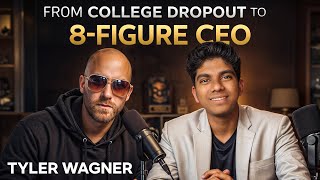
Tyler Wagner dropped out of college at 19 and built an 8-figure publishing company that's produced over 4,000 Amazon bestsellers and 100+ New York Times bestsellers. He shares his book-marketing playbook: hitting bestseller lists with massive email discounts and affiliate launches to drive 5,000-10,000 sales in week one, then scaling through partnership networks using website contact forms to reach tens of thousands daily.
Chapters
Before that, I would love to kind of know your journey.
Like, yeah, for sure. So I think, you know, when I was younger, my journey, like, walk us through who is Tyler.
How did you become the person?
My dad, he worked a job in like a Fortune 50 company.
How did you become the person?
He always used to tell me, just like, you know, if you can—
it is actually, it's an immoral brainwashing happening to all the kids.
Regardless, I decided to drop out.
Yeah, it's a peer pressure, right? It's more about the peer pressure.
At the end of the day, who gives a crap what other people think?
What's going on? What can everybody actually listen to this podcast right now? First of all, guys, welcome back to another episode of The Nikhil Sai Show, which is by me, The Nikhil Sai. And guess what's going on today? I got another banger guest today. I mean, we are talking about an insane journey, you know, like 19-year-old dropout just like me, and he built an 8-figure company. And we're definitely going to get into all the nitty-gritty. He's very, very good at book publishing. I mean, he built a company called Authors United where they have published thousands of books. Like, they have 4,000+ Amazon bestsellers, 100+ New York Times bestsellers, 800+ Wall Street bestsellers. I mean, I've never seen numbers like this, especially in book marketing. It's not that easy. And he has done over 2,500 podcasts by himself in the business for over 13 years. We are definitely learning a lot about book publishing, book marketing specifically. And not just that, the core, which is how they actually got so big, is through partnerships. So we will definitely discover on how they do that as well, partnering up with other people and scaling your companies together. Because the best part is you could get referrals without spending a ton of fortunes, you know, in advertising. So let's not waste your time and actually let's welcome the mastermind behind Authors Unite and partnerprofits.io, Tyler Wagner. Hey Tyler.
Yes, man. Thank you for having me, man. Grateful to be here.
Yeah, appreciate that, Tyler. I mean, we will get into the nitty-gritty stuff of partnerships, book publishing, getting a bestseller, how easy, how hard it is, and all of that good stuff. The barbecue parties we talked about. But before that, Before that, I would love to kind of know your journey. Like, walk us through who is Tyler. How did you become the person? I mean, it's 3 AM and you're in Vietnam, so we would love to know your story of where did you start? How did you end up there? Like, walk us through your journey, bro, from the scratch to where you are.
Yeah, for sure. So I think, you know, when I was younger, my dad, he worked a job in like a Fortune 50 company. I'll leave the name out just because, I mean, now he's retired and stuff, but I have some good things and not good things to say about it. So we'll leave the name of that company out, but everybody knows of this company. But either way, it was like corporate America, right? So like the typical 9 to 5. And I just remember when I was younger, you know, he did very well financially, but he always used to tell me just like, you know, if you can do your own thing, that's really the best way. Like the 9 to 5, and having somebody kind of dictate all of your actions, at least in a work environment, you know, is not the most ideal situation. So I think when I was younger, just like entrepreneurship was ingrained in me, and like these— because I saw what the opposite looked like, and it just looked very difficult and also kind of, in a sense, powerless. And, you know, like there's always a ceiling. And to be clear, anybody who's listening, Nothing against the 9 to 5 if it's something you like and you're comfortable with and you're crushing it. I think that's great. It's just like, I think for people like me and you, I'll just speak for myself, but for me, like having just the idea of even having a boss, I don't like it. You know what I mean? Like, I don't want to have a boss. Like I just, so regardless, you know, that was a kind of a first eliminator for me on that path. But regardless of that, I did go to school. I went to college and I only went for about a year, year and a half, and then I read this book called The 4-Hour Workweek by Tim Ferriss. You're probably familiar with that book, I would imagine, in most of your audiences. And that book just completely changed my mindset on everything. Like the thing in school, like, and I'm not sure about your school, but in my school when I was growing up, they would always tell you like 9 out of 10 businesses fail. So it's like a very risky thing. And so it's just ingrained to you like, oh, if you don't, if you step off, you know, off the beaten path of college, corporate America and going up the ladder, if you go this other way, you have a 90% chance of failure essentially. Right. And that's how they make it seem, you know, that, you know, it's kind of like brainwashing or not kind of it actually, if you will, actually.
It's immoral brainwashing happening to all the kids.
I know. I mean, that would take a whole other podcast.
Yeah.
If you want to do a part 2.
I would rant all day.
Because yeah, no, I've gone down that rabbit hole and it definitely is brainwashed. But so regardless, I decided to drop out and then basically my idea is like, I just always naturally I've been very outgoing and I'm a people person just ever since I was younger. People would always used to say like, you have the gift of gab, you know, like kind of like the, I guess you'd say like the Wolf of Wall Street guy, but without the illegal activity, let's say, you know, like something like that. So I would say, and either way, just by the way, for him, like I have nothing against the guy. I think he's great. Love the movie and I'm glad he's doing well now. So regardless, just to point that out. But basically I, was like, okay, I think I would do well as a public speaker. So I start going to all these conferences and we can get more into that if we want to. But ultimately I go to like hundreds of different conferences and most of them I'm actually going to for free. The first one that I went to, and this is like a full circle moment, is Tim Ferriss was the keynote speaker at this event. It was called Mastermind Talks. And I, it's after I bought his book, I saw on Facebook, like I must've got like retargeted with an ad with his face, right? So I click it and it's a guy, Jason Gaynard, running ads using his face because he is the keynote speaker. So like he had his permission, right, to use his face because he's the keynote speaker of the event. And I reach out, the event was like $5,000 or $10,000 a ticket, which at the time, you know, I just dropped outta college, I'm like $80,000 in debt. Debt. So there is no way I can spend $10,000 to go to a conference. It's just not in my cards at the time. So I reach out to the guy and I'm like, I just, I'm just honest. I'm just like, hey man, I'm a broke dropout, aspiring entrepreneur, and I want to come to your event, but I cannot afford it. Is there anything we can work out? Like I can help you for free, like whatever I can do to help you to allow me to come to the event for free, you know? And the guy says, dude, no lie, it worked. Like it works within the, within the next 24 hours, me and him are talking on Skype, like the founder of the event, Jason Gaynard. And then next thing I know, I'm in Toronto, Canada, behind the scenes, helping out the event. Tim Ferriss is right next to me. I'm like eating dinner with him, like in a group setting, not like one-on-one, but Regardless, like the guy that basically kind of changed my life in a sense, his book, I'm meeting now 6 months later in person. So to me, you know, it's just like, I'm fanboying out.
Yeah.
Yeah. I'm just like, this is nuts. And the thing with the conferences that's important is that I notice at this conference and all the other ones that I kind of, I call it maybe now a tactic. Though it was all real. I mean, I didn't have money to go to these events, so I was just being honest. And so for any younger kids out there in college that don't have money and want to go to events, try this tactic. If you send enough messages, I promise you it will work. Eventually you're going to get a yes and you're going to get to go to these events for free. Like, it really does work. But regardless, I notice all of this— I shouldn't say all, 99%. And I think this is legitimate. Of all speakers at these type of events are authors, right? So they're authors or bestselling authors. So in my head it clicks. I'm like, okay, well, I'm 19, 20 years old and, you know, I'm $80 grand in debt. Like, who is going to pay me to speak on a stage? Like, what value do I have to bring? Like, there's just, you know, they're going to pay me to, like, leave the event, if any.
You know what I mean?
Like, They're not gonna pay me to like teach people things. What I do is I write a book. My first book is called Conference Crushing. It's about basically how to network at events, like what to do before, during, and after. It's like a little guidebook, like 70 pages or so, but it ends up doing pretty well. Sells like tens of thousands of copies, hits bestseller on multiple lists like Amazon, Barnes Noble, which you gotta remember too, like 13, 14 years ago, Amazon bestseller at that time was actually kind of a big deal. Now everybody knows that, that list, and, and we can talk about that then. But regardless, in my small hometown in Pennsylvania where I grew up, me dropping out of college and becoming a bestselling author like 6 to 12 months later was like the biggest deal ever. You know, like I was getting hundreds to thousands of messages on Facebook, like, How did you do it? I want to write a book. My mom wants to write a book. My uncle. It turns out everybody wants to write a book, like, and I had no idea, right? So long story short, but this is just helpful. So how everybody knows how I got to where I'm at is long story short, I do the public speaking thing because the reason I became an author to begin with is to leverage the branding of that to become a public speaker. So that did end up working. I did it for about a year. I was getting paid like $3,000 for an hour keynote. I probably did like 10 to 15, right? But at the time, that was a ton of money to me. Remember, like, my rent's like $400 a month. I'm living in Iowa, actually. And that's a whole other story as to how I end up in Iowa. But regardless, you know, $3,000 and getting flown out to speak for an hour to open up an event, like, for me at like 20 years old, huge deal. Like, this is like life-changing stuff for me. But then what I realized is that there is way more people that are interested in me helping them become a bestselling author than there are people that want to hire me to speak. Just from a time perspective, you know, I can only do basically like maximum 365 speaking gigs a year. That's like, you know, one a day. Maybe you could do 2 or 3, but like that would be a little crazy.
So even 365 is sounding crazy to me. Yeah.
I mean, that would even be, I mean, and that, yeah, it's like, you don't want to have any time off, you know? Like, so that's like, if you really push it to the max.
Yeah.
It just clicked for me. I was like, okay, public speaking, I'll do it here and there, but it's not my main path. I'm not going to be the next Tony Robbins or whatever. So what I do is I completely switch paths. I start helping people with their books. I get a ton of testimonials. I figure out how all the bestseller lists work and I really master like book marketing in general. And then I master the other side of like publishing, the writing, like more not me, but more of like putting a team together. And then that's where things took off from there, you know? And then since, since then I've been running Authors Unite for like 13, 14 years. We've done over 4,000 books for people and that's a variety of publishing and marketing. And then the other business, Partner Profits, we've been doing that for like a few years under a different brand, but it was rebranded the last few months. So that's kind of the story, you know, I just, I kind of wrote a book and then people started asking me how I did it. And then it turned into this decade-plus long business.
Yeah, I love that. I mean, the first thing I should definitely congratulate is on the consistency. Like once you've found a thing that is actually working for you. You didn't deviate. So what was like the key factor? Like, I mean, you know, I've gone into a lot of shiny object syndrome. Once I got my service agency up, I felt that I'm an investor out of nowhere. I felt I could have 7 different hands to do 7 different things. I started a software company, burnt my ass to lose half a million dollars cash. So I'm curious, how did you stay so focused on like doing one thing?
Good question. Yeah, because it is very rare, especially that your first business works out. I think that is rare. Um, and yeah, that is so rare, the, the fo— especially this long, you know, like 13, 14 years. So I think for me, I'm trying to think how to answer it. Like, I honestly think it's just like once I found something that worked and it kept working, like in my head I was just like, for the first time I didn't have to worry about rent. I didn't have to ask my parents for money. I didn't have to like worry about, you know, all of my—
that's a relief.
Yeah. And like once that was off my shoulders, I was like, why? I didn't want to risk, like, I just like avoided risk, I guess, for a while. And I knew if I stayed on this path, I could scale it to pretty far. Like, I don't think Authors Unite's going to become like a billion-dollar company. I mean, that would be awesome, but I do think it can hit like 9 figures. And, you know, book publishing, we can get into that. We want just the whole industry with tech and stuff is changing rapidly.
Yeah.
But regardless, you know, like 8-figure company, I mean, I do very well at, you know, didn't happen overnight. Obviously I've been doing the same thing for 13, 14 years.
No wonder you're successful. Yeah.
But, um, I just think the focus came out of like me just finally feeling that comfortability of like, Holy shit, this worked. I made the right move because at the time when I dropped out of school, to me at the time, it was one of the scariest things I ever did. Thinking back, it really wasn't that big a deal. But, you know, at the time you're thinking, what if I fail and then I have to go back to college and then like I'm older than everybody and you know what I'm like, all those like—
It's the peer pressure, right? It's more about the peer pressure, like the society around us conditioned us to Just follow the path, you know, otherwise you are some, some random dude, you know, with ADHD or some, some neural disorder, you know, something is wrong with you kind of situation and you don't want to get there.
Totally. Yeah. And like I've been in college classes, I was in college for that like year and a half where, you know, randomly in a couple classes there was guys in there that were like 40, 50 years old. Look, I, now that I think back to it, I'm like, dude, if that's what you want to do, great for you. But I just, I know how the other kids felt about it and they always felt felt it was weird to like, we have one of those in the class, like somebody who didn't complete their degree before and now they're coming back decades. Like, I just, my ego didn't want to be that guy, you know?
Yeah.
But yeah, at the end of the day, who gives a crap what other people think?
Yeah, yeah, exactly. I mean, I, I have seen that. I have like, this is probably one of the most important successful people traits, like they don't care about what other things They have intuition, they have data to make decisions. They don't let other people decide how like individual will behave because that's just you giving them the power on how you should behave. I think just having that, like I had a crazy story to drop out of my college. Like I was going to this college, you know, just to satisfy my parents. And I was sitting in the class reading Steve Jobs' bio story. And I was the only guy who was actually reading a book. The remaining class was one guy was playing on his phone. The other guy was like chit-chatting with something else. Somebody was watching some movie. Like it was just, a shit show happening. I was like, okay, let me just use the time. The lecturer came to me and he grabbed my book and said, you can't read novels. I was like, what? You see that dude back? Like, he's watching a movie. He was like, no, no, you can't do that. And immediately, yeah, okay, this is not happening, man. Like, you know, I tried it, not happening. I took my bag, I walked away. That was like the last day in my college, and it's a terrible experience overall. But yeah, that's great.
Yeah, I mean, to me, college is more about like meeting people rather than the actual classes, um, you know what I mean?
Because I mean, I wish I was in Harvard to be able to say that same thing, but my college was like in the middle of nowhere city with, with most of my college mates are probably broke or they are underemployed or they are making $200 a salary. So it's crazy overall, but I'm glad I was able to escape. But I wish I could change the education system in a way where they could get to where I am happily. But we'll talk about that Tyler, good. You actually cracked one important skill set, which is marketing the book. If it wasn't for that skill set, you would never be here. In that, like, if I didn't learn marketing, advertising, sales funnels, high-ticket closing, I would never be where I am podcasting for a fact. So I'm curious if you could walk us through a simple playbook on book marketing. Give us a crash course. Like, how does book marketing work? Why is it important for somebody to not just publish a book but actually market it well? Because I think publishing is 20%. 80% of it is marketing because most books don't even sell like a dozen copies in my opinion. Like it's just so, you put all the effort, you write hundreds of pages for what? Like, you know, would love to get a crash course from you. Walk us through what works in book marketing in 2024 and beyond.
Yeah, for sure. And I think too, well, the first, and this is why I like, I like, I'm sure you know who this is too, is Alex Hormozi. I'm a big fan of his content. I think a lot of us are.
Yeah.
But, um, you know, basically if you want your book, I'll talk about two different things here, right? So short-term success and long-term success. So I, and I'll tell you how then, but I can guarantee almost any book short-term success. Right. And I'll explain how I can do that then. But as far as the long-term success goes, you know, that has to do with the quality of the book. So like, Ultimately, and there's actually a few books about this type of stuff. Like there's one book, I call him like an acquaintance of mine. He wrote a book called Never Lose a Customer Again. And what he talks about is, you know, that companies should put their marketing budgets or part of their marketing budgets, not into attracting new clients, but to making the experience of all of their current clients so incredibly amazing that by the time they finish working with you, they want to tell everybody they know, right? So it's like, there is— marketing isn't only about, you know, the new client. It's also about how amazing are your current clients' experience and then having that word of mouth effect take off. So regardless, what I would say though is ultimately, you know, one of the best ways of marketing a book is, is having a book. That is so incredible that if I get it into thousands of people's hands for you, that word of mouth does take off. Like 4-Hour Workweek type things, or, you know, the examples of this are like Atomic Habits, 4-Hour Workweek, Rich Dad Poor Dad. Yeah, Rich Dad Poor Dad, David Goggins' book. Like these are types of books that just have gone completely viral. Something about them, it's probably multiple things about them. When people read them, they feel compelled to share it with multiple friends for whatever re— and I think it's for each book, it's for a different reason, right? But you know, so, okay, so the content and that this is obvious, but I'm just saying like spend the time and write the best book you obvious that you can. I, I don't, I do believe in the thing of like the next, the new business card is a book. So like you can write multiple books. So if you wanna write one book that's kind of like more short and it's more of a lead magnet, cool, you could whip that out in a couple months, no problem. But like, if we're talking about like your book that you want to sell millions of copies of and like on top of the world, you got to take your time and you got to try to write the best book you possibly can. You know what I mean? It's just the reality. Now, having said that, in the short term, you know, I know how every bestseller list works, right? So Amazon, Barnes Noble, USA Today, Wall Street Journal, New York Times. There's a new one called C-Suite. There's LA Times, like there's a lot of different bestseller lists. I would say there's like a core 6 though. Um, and I can essentially guarantee all of them except one, and nobody can guarantee this one. New York Times is one that nobody can guarantee. The reason for that, um, I know how it works pretty much, and I can give any book, like, well, not any book, there are some criteria, but essentially like if the criteria line up, I can give a book a very high chance of hitting New York Times, but there is no way to guarantee it because it's not like a true bestseller list, honestly. 'Cause it's like sales is like a tiny part of the equation. There's so many other criteria, which again, that would take a whole other podcast. So if we do a part 3, we can talk about New York Times only. But the other ones though, they all work very similar, right? So like, Wall Street right now is actually on hiatus. It, it, um, and I won't go in the weeds on that, but regardless, Wall Street, USA Today, Amazon, Barnes Noble, those ones for the most part, there's a, some little caveats in there, but for the most part, they are based on sales and sales alone, right? So if you get 5,000, 6,000+ sales in one week, you're gonna hit all of those lists. Guaranteed you like won't miss, right? So that's where once I figured that out and those little like tricks, like for example, one of the tricks for USA Today, you don't want all your sales to go through one bookstore. You want multiple bookstores, right? So you want like 5,000 sales Amazon, 1,000 sales Barnes Noble, and then you're good to go, right? But if all of your sales went through Amazon, you would miss. Right. So it's like little tricks like that that you figure out. But regardless, so once I figured that out and I could literally guarantee people bestseller on all of these lists or a full refund, you know, it was a very easy—
best offer.
Exactly. And that's the thing that Hermosi— it's so funny. After I read Hermosi's books, I realized I was like, this is why everything I've been doing the past 10+ years has been working. Like, like what he wrote, not everything, but like, like I would say like 60, 70% of both of his last books, we've been doing those things. And I was just like, no, no wonder it's working. Like this guy proved out the theory. I just didn't know of his book before, you know, I, cuz this is like 13 years ago when I started. But, uh, so it's just so funny. That was like another full circle moment for me. I was like, If Hermosi is saying it works and it worked for me, it's gotta be pretty close to guaranteed to work. You know what I mean? Like at that point it's like pretty likely. So regardless, then this is how we got clients, right? So if you reach out to an author one-on-one, right? And you say, hey, like imagine like messaging somebody on LinkedIn, hey John, I can guarantee you bestseller on all the lists. Like hit me back and you know, let's hop on a consultation. That method doesn't really work that well, right? Because people don't want to be pitched, red flags go up, like too good to be true. This is a scam, all of those elements. For me, and that's why I love talking to people like you is like, and I'm sure you have other marketing methods, but for you, like funnels and, well, let's just say paid advertising and funnels, that, that method worked for you, right? And still does work for you. For me, I never got it to work, right? Like I tried it when I was younger and I kept trying all these different things. Ads, SEO, funnels, ClickFunnels, HubSpot, um, uh, Infusionsoft, everything.
Yeah.
You know, I tried all of it and it just never worked for me, at least not consistently. Right. And that's what annoyed me about it. It was like, sometimes I would get good leads and I'd get a client and then other months I would get a bunch of you know, leads that didn't have either way. It just wasn't consistent. It was like up and down every month. So I finally threw in the bag on that. And then the strategy I came up with is I was like, okay, my clientele for Authors Unite are obviously authors and people that want to be authors and they need to have money, right? Because our stuff is very high end, like for Wall Street Journal, just We have like 20 services. Wall Street Journal, we charge $60K guaranteed or a full refund. We've done about 700, 800 of those, right? So just so you can see kind of like the level that we're talking about here, like not many people have $60,000 to spend on their book marketing. So you gotta find the right peoples. How I did that is I started reaching out to every book publisher in the entire industry. Like I am not kidding when I say, My team or myself have spoken to every book publisher in the world that speaks English. And the only way we have not spoken to them is if they started an hour ago when this podcast started. Like, that is the only way that is possible. And then what happened is because book publishers, they don't typically do book marketing, and if they do, It's not at the level that we do it. So yeah, what happened is I just built affiliate relationships with all the book publishers. Most of them accepted. Some of them, for whatever reason, said they weren't interested. But I would say like we are partnered with easily tens of thousands of publishers in the industry. We have a referral agreement. They refer us their authors that have budgets for our campaigns, and then they get a commission or a kickback. Like if you do that at scale, getting to, you know, like, I think if I look at my journey, I started out doing book coaching and that got me to like $200,000, $300,000 a year. And then I got burnt out. Right. So like one-on-one coaching doesn't scale that well. Okay. So then next level was I did high ticket done for you and courses, but it was just me. I got to low 7 figures doing it that way. Then to get to 8 figures, I had to bring on a team to be able to handle more partnership calls, more reachouts. And that's how I got to now 9 figures. I don't know. In my mind, I'm just thinking bring on more people and do more partnerships. But like, I don't know if partnerships is like, you know, there's obviously other ways to do marketing. So maybe, maybe there's something me and you to talk about at another time, but For sure. Either way, basically that's kind of the evolution of how it worked. And then we just started picking other targets of people that had worked with a lot of authors. So like our top partnership people are book publishers, ghostwriters, editors, and PR agencies. These are all groups or people or companies that work with a lot of authors that can refer to us because we do things, we do some of the same things. So we're, we're competitors. But we also do enough different things where there is synergy as well. You know what I mean? And to me, to me, I don't view anything as competition really. I view everything to me, like, even if it's a direct competitor, I'm like, yo, bro, there's got to be one thing that you do that I don't, and vice versa. We got to find out what that is, and then we can refer and make more money together. Like, I just don't believe in this whole, like, competition and beating each other. Like, to me, I'd rather we all win. Yeah, we all just win. Like, why not?
Yeah, I love that. Love that, Tyler. I mean, that is a great mindset. I believe, yeah, like, abundance is probably the first principles to be ultra successful, in my opinion. Scarcity people, they're just working their job this week, uh, you know, to pay their bills. And the abundance people are the ones who are leading, you know, the world overall. Like, if you look at people like Elon Musk, he believes he could make it to, you know, Mars for no reason. And he has that abundant mindset, like, hey, if you bring enough people and we work hard enough, we could get there. So I believe you're right, like, when it comes to business collaborations. I mean, we'll get to a sort of set of questions in the last 10 minutes, but before that, if you could give a short answer on, like, what's, like, the playbook for referrals? Like, it's not— referral is probably one of the most— like, you could go and get a customer by spending 6 hours, or if you go and spend 6 hours to get one referral, he'll get you 6 customers every week. It's just a different level game, and you play that very well. So walk us through like the playbook on how to actually do that. Like, how does the kickback look like and how are you structuring it? Like, give us like a mini, mini course here.
Will do. And I do apologize because I realize, I feel, if it's okay with you, I didn't answer your previous question. I feel like these are the two most important things.
Yeah, for sure.
So let me give you, let me give you the macro and then people can reach out to me after and obviously I can help them further with specific things about their books if they have questions. But if I were to give like a macro playbook for book marketing, right? You just want ultimately write a good book. That's the obvious part. And then when you come out like your first week of release, you want to have the biggest launch possible, right? And ultimately there's a lot of different ways to do it. The way we do it is we have large email lists of people that have opted in to be notified when books are discounted. So I have a collection of email lists that I've partnered with and/or acquired And together it's 5 million plus people. So when we do, like, we do like 10 to 15 smaller campaigns a week and we do like 2 to 3, like, bigger ones per week. So that's how I'm able to guarantee these things. Like, I can guarantee books like 10, 20,000 sales in their first week of release because I have all this email list power and we discount the book for one week. So there's urgency. And then you— so I would say if I were launching a book, I would try to find as many affiliate partners as I can that all align with that book and then, you know, incentivize them in some way, have all of them mail on the same first week of release. And then obviously there's ton— marketing's limitless, right? But ultimately that first week, get as many sales as you can to hit bestseller, then leverage the bestseller accolade for media appearances. That's like blogs, TV, podcasts, to keep the momentum going. And then at the end of the day, the goal is just get your book in as many hands as possible. And if it is good, word of mouth will take off and then your book will have a life of its own. So that's my like abridged version on the book marketing playbook. But yeah, I appreciate that. Further later. So for referrals though, this is the way that we do it. And here's one trick that hopefully is super helpful for everybody. That's listening to this or watching it is the thing with like all the social medias and stuff, right? There's limitations to the amount of reachouts that you can do. Right. And obviously I know the trick, like, you know, people can actually like buy LinkedIn accounts now. So you could have like hundreds of all these different LinkedIn accounts. And that's a way to get around the unlimited messaging or limited messaging thing. To me, I just like to keep things simple. I don't want to have 100 LinkedIn accounts personally. No offense to anybody that does that. You know, great idea, good hack, just not, not a thing for me, just personally. So regardless, each of my team members have LinkedIn, they each have Instagram, and they have one each. They maximize the amount of messaging available there. And then the way though that we do unlimited is we reach out to website contact us forms. So, you know, on websites, it's like where it says contact us, that works. The conversions on that are through the roof. And like, it's unbelievable.
Never heard of this trick.
It's interesting. Nobody else really does it. And it literally, there is no like limitation to how many you can do. So for example, if you want to reach all the book publishers in the world to partner with them, and I'll even give you guys like the message template that we use and stuff, but you know, you can go to LinkedIn, search book publisher. You'll find, I forget how many there are. I think there's like hundreds to thousands or something. And then on LinkedIn, you can only message, let's say, 100 a day or whatever, right? On their Sales Navigator. And then they like block you from messaging more or something like that.
Yeah.
But more what we do is we use LinkedIn as our search engine and then we find their websites from LinkedIn and then we hit them up through their website on their contact form. And what's funny is the conversion through the contact form is higher than the messaging.
Than the LinkedIn message. I agree, because you're competing with no one. You're just getting into direct DMs with them. Pretty cool.
Totally.
Yeah.
So like, honestly, I don't even— I mean, look, LinkedIn's amazing. I mean, I love it, but I think it's more— it should be more used as like a research tool, and like the messaging should be done direct through the website. Because you got to think like how many times— I'm sure on your website, right? Like, and I I haven't gone through, excuse me, every part of your site, but I'll make two guesses and this is for anybody's site. You have a main opt-in, right? Like that's your lead magnet or book a call or whatever, like goes into your funnel. There's a lot of people that go through that, right? So that's normal for you. But then you also have sometimes like contact us, right? And that's just like for queries or like questions.
General. Yeah.
That form like never gets filled out. Like nobody ever fills that form.
Zero traffic.
Yeah. So when you get notified that somebody filled it out, it is like, holy crap. Like somebody actually took the time. Like I got to get back to this person. I'm telling you, conversions are like 80%.
I love that, brother. It's crazy. I love that thing. Biggest hack I've heard so far in marketing.
Dude, that's why I love marketing. Cause really it is limitless. Like there's always a, there's always like another way. So regardless, the one last thing I'll say on the partnerships, if I were to give like the playbook is so like, I'll give two, if it's okay with you. I know we might be running well off time here, but I'm just trying to give as much value as I can. So ultimately, like I already told you the Authors Unite story of our scaling, right? So we have like a list of like 500 keywords. That we're going after, but like the 4 that I said previously are our top 4 converting ones, book publisher, PR agency, ghostwriter, editor, right? The reason is 'cause they work with a lot of authors. But I'll, I'll give another example of a different type of business so that you can see the power of this. And just so everybody knows too, nothing about this is like genius or any, like this is the most common way or easiest. You know what I mean? It's, it's literally just referrals. But I think the difference is that most people have never thought of scaling their referrals to like 100,000. Most people have like 5 referrals, maybe like referral partners. I mean, yeah. And they're like, yeah, I have a few partners. They refer to me from time to time. In my head, I'm like, well, yo, if you want to grow your business, you should get like a million of those people and then you'll have like a billion dollar business.
So like, no question. Yeah.
That's how my brain works. But regardless, so say if you, uh, like my, he's a friend of mine now in Miami. He does like vitamin IVs and stuff. He's like health hacking type guy.
Hmm.
So the way to scale his business would be he's in Miami, right? So what we would do is we would reach out to all of the gym owners and fitness trainers in South Florida and like beauty salons.
Things like that, like anything that, like maybe like juice places, cool spa, yeah, CoolSculpting.
Reach out to all of them. And then basically with, and here's the message, hey name, I think there might be ways we can collaborate, Tyler, authorsunite.com. Or for him, you know, obviously different signature but same message. This message, it's really short, it perks curiosity, and it gets the conversion is really high. People respond and they say, Tell me more. Like, what do you mean? Yeah, exactly. Exactly. Like, how can we collaborate? And then you're like— and then, you know, again, just because we're on limited time, but there's a whole path to get them to book a call. And it's like, it's literally 70, 80% conversion. It works almost every, every single time. And the reason it works is because I'm not trying to sell that person really anything. I'm trying to refer people to them and then refer to me. We're just trying to like partner. So it's way easier to get somebody to be receptive to that than it is to get somebody to be receptive to like buying something from you. You know what I mean?
Yeah, yeah, yeah. Totally.
So, you know, that's how I would scale his business, right? And then ultimately all the fitness trainers in South Florida would be referring their clientele to his IV clinic. And he does a lot more than that. But just for example's sake, IV clinic. Because the same type of clientele that would hire a fitness trainer is the same type of clientele that would do an IV. And then the fitness trainer is getting a commission from those referrals for the IVs. And then, you know, it'll get to a point where you have an entire army of fitness trainers all referring to the same clinic and his business will like 10x, like, you know what I mean? It's just like, it's the most, to me, the most obvious. Now, the only thing about the method that isn't the best is that it takes a lot of time. You know what I mean?
You got to do a lot of work. And that's what nobody likes, right? That's why they look for the gimmicks. They want to obviously avoid the work to get a short-term success. But if they do this for 6 months, no questions, they will, you know, like anybody can achieve success in this strategy.
It multiplies. That's the thing too, is like once you have an established referral partner, that's forever. And it, you know, so with Facebook ads, and again, I know they're great and they can work, but once you stop paying Facebook, It's done.
You're killing yourself. Yeah.
So yeah, I guess hopefully, I guess that would be my playbook is just like, if you're a business and you're trying to scale, think about who your partners could be, reach out to them and, you know, do build a team. Do you know, I'm talking about thousands of re— we do like 10, 20,000 reachouts a day at this point. So you don't have to go that crazy.
No wonder you're doing 8 figures now. Like, if I get the playbook.
Dude. Yeah. And like, do it at scale, like try. So we're trying to partner with everybody and, uh, you know, why not? It's just a win-win-win. So, uh, I guess hopefully that's helpful. And I just believe every business definitely has a, has a group of businesses or people that could be amazing referral partners. You just gotta take a few minutes and think about like, okay, where are my clients? Who else are they buying from? I need to partner with those people. You know, and then once you have those keywords, just reach out to those people. So that's basically all you do.
What a strategy, bro. That was like very actionable. And guys, don't let just these, uh, the story be a marketing shebang for your head. Take notes. He literally given away the playbook on how to build an 8-figure business. Like legitimately, if you do 10,000 reach-outs, like what Tyler is talking about, and you do that for 1 year and tell me you're not making money, it's not possible. As long as you have a good product and you have a genuine product and genuine results. Tyler, we left so many questions, brother. We gotta do a part 2. Like, it's, it's really important for us to, you know, kind of COVID you know, more information, and you have so much more to share. I know we have a hard stop in 2 minutes, guys. I'm gonna do another episode with Tyler, so stay tuned. I'll be uploading the part 2 as well, as long as Tyler is okay with it. I'm in.
Yeah, yeah, I'm down. I love podcasting, man. This is like my favorite thing to do, so I'm down.
Perfect. Okay, great. And, uh, so guys, stay tuned. I'll be back with another amazing guest and also with an episode 2 with Tyler. Thank you so much for tuning in. Stay tuned for the show. There was a lot of things for you to learn and execute. Just take 5 key takeaways and start doing it today. Just go and like fill out 100 forms. That's it. Like, that's the only request I have and see the magic. You literally give the playbook, the exact script to use as well. So do not delay. Try it for yourself. And I'll be back with another amazing guest just like Tyler. Bye for now. Thank you, Tyler.
Thank you, man.
Brother.
More from Nikhil










BURNED $1.5M in his 17years online #digitalmarketing #entrepreneur #onlinebusiness
