From Prison & Addiction to a 7-Figure Marketing Business
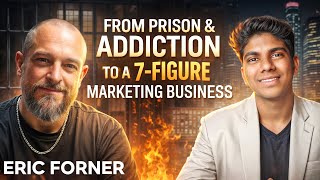
Eric Faulkner went from prison and addiction to building a 7-figure affiliate marketing business in 22 months using the GOAT method, a storytelling-driven framework. He runs challenge funnels with gamified elements like leaderboards and daily check-ins to keep churn low, and generates leads organically on TikTok before scaling with paid ads.
Chapters
How did you actually end up here? What was the journey like? What was the story overall?
I had my very first DUI at 21 years old and my second DUI one month later.
So what was the GOAT method? How did it help you? How did it transform your—
The more personable and relatable you can be as an individual, the more people you can attract, right?
How did you actually get to your first million as a journey?
A 4-week cohort. Within that 4 weeks, I've already made my first $10,000. It was actually $20,000 in 19 days.
What is actually the playbook for making a successful challenge? Most important thing, hands down, is the onboarding process. What does that, uh, you know, like gamified method look like?
If you're an action taker, you're a winner. If you're not an action taker, then you're a loser.
What's going on? What's going on, everybody who's actually listening to this podcast right now? First of all, guys, welcome back to another episode of The Nikhil Sai Show, which is hosted by me, The Nikhil Sai. And guess what's going on today? We're back with another amazing 2Kama Club interview. The guy who's jumping on has a transformational story. I mean, we're talking about going from a struggling construction worker to building a 7-figure marketing business in under 22 months. And not just that, it's not just about, you know, being in a different situation and making the life better. It's coming from a very unique background of alcohol addiction and different stuff in life. And he was able to get out of that situation and actually build a dream online business, which made him a millionaire in just 22 months. And he specializes in B2B marketing, high-ticket affiliate marketing. And we will talk about the GOAT method to propel amazing success in digital businesses. Let's not waste any time and actually let's welcome Eric Faulkner.
Hey Eric, how's it going, my brother? Nice to finally meet you. I think I met you actually at the last FHL, but it was only a picture of you. You weren't there. It was just a picture of you. And I think they were taking photographs with it. So I think I might have took a picture with it from a distance because I couldn't get up on stage with it, but somewhere in my camera roll. But either way, it's good to meet with you, man. Finally.
That was pretty fun, actually. It's a funny story that you're bringing it up. Like, I actually had my visa rejected and I was connected with Russell and all the other clients I have. And I was thinking like, okay, if I got my visa rejected, what else can I do? And Russell was kind enough, you know, and I had one of the 2 Karma Club winners help me out. Parthil was the one who helped me with the cutout and get it on the stage and whatnot. It was fun. I get a lot of criticism. People think it's Photoshop, but I'm fine. Like, go hate me. I love this, you know, like So no, it's not Photoshopped.
I was there at FHL and I seen it on the stage. So he did not Photoshop it. It's legit. I contest to it.
I was there. Yeah. But I, but you know, I mean, it's one thing. I mean, we will definitely get into your story, but coming from India and achieving early success, I kind of see a lot of people who hate me, couldn't digest the fact that, you know, I'm achieving this and they don't want to trust it. So they hate it for a reason. And I receive texts almost every day saying, That looks so fake, bro. You should get your marketing better. I'm like, yeah, it's Photoshop. I could swap your face if you want. It's $10. I play around. I play around. I used to take it personally. Now I take it as fun and it's just so fun. Very good. Appreciate you jumping on, brother. And we will definitely talk about the P2B marketing, affiliate marketing challenges, building communities, how to actually decrease the churn in communities. And a lot of other nitty-gritty stuff. But before that, walk us through your journey. How did you actually end up here? What was the journey like? What was the story overall?
Yeah, man. So take you guys kind of way back. I had my very first DUI at 21 years old and my second DUI one month later. And I basically come from a troubled background, born in Las Vegas, born and raised, you know, literally on the streets. Parents divorced when I was really young. I lived in a predominantly Hispanic neighborhood and, you know, a gang, highly gang, highly gang neighborhood, you know, high gang population. And I was like one of the, I think maybe 2 or 3 white or, you know, Caucasian families in that neighborhood. So growing up was pretty rough, right? I had to, you know, have my fair share of the fights, but at the end of the day, I became friends with a lot of people in that neighborhood, but I really didn't have the direction and the, I guess the roadmap to have a successful life. It was just more to fend for myself. So needless to say, um, I barely graduated high school and the only reason why I did is cuz I wrestled kind of like Russell's story. You know, I wasn't very good at the academics. I wasn't good at anything like that. It was basically, I was good with my hands, you know, baseball, wrestling, woodshop, you know, auto mechanics, stuff like that. I done and I loved wrestling. So that's the only thing that really got me through high school, just kind of like Russell's story, you know, with, um, going to the study classes at the end of the day just to, you know, wrestle. But either way, I ended up finding myself going down that rabbit hole of drug addiction and criminal activity at an early age. I finally got caught for the most part at 21 years old, and that was when I was in Arizona. And from then on, you know, I had my first DUI at 21 and seemed like every 3 years or so I was getting a new DUI. So I would only stay free for 3 years at a time. And my second DUI in Arizona, in the US, they'll give you prison time. For your second one. And so I ended up doing 16 months or 18 months in a DUI camp, and that was in Arizona, Phoenix, Arizona area. And from there on, it was just get out for 2 and a half, 3, maybe 3 years, and another DUI. I've always worked really hard. I was pretty much all my charges— I have a misdemeanor, uh, pipe charge, you know, for smoking weed when I was younger too. But other than that, it's just been DUIs and just in and out of the law, in and out, in and out, working construction, the mines. Finished carpentry. I built the office I'm sitting in right now. And so that's kind of like what my life was, you know, it was just work hard, even drink harder. Um, I would go to the bars every single night, do that kind of, you know, single thing. And for some reason I was always one getting caught, you know, sometimes I was driving on the wrong side of the street, but still I was always the one getting caught. Right. And, um, you know, it's just kind of like that turmoil up and down, up and down. And, and finally one day, you know, I had this epiphany moment. It was my last day on the mine site. I was like, you know what, I'm done with this stuff. I'm going to go and just kind of enjoy my life and try to figure things out, get sober. Well, it wasn't even but a week later, I picked up my, my 6th DUI. And I spent my last time in prison for 18 months this last time. I got out in 2000 and right after the COVID happened, 2020 or whatever it was, 2000, something like that. I think it was '21 or whatever it was, COVID. And I was actually released early because they couldn't transport inmates from state line to state line because they had everything shut down. So I still had charges in Idaho where I had my original kind of charge, and I still had time there to do. I was on parole at the time. And since I got caught in Montana, I had to do my time here first. But COVID happened and they said, okay, no transport in and out of state lines. But I had to be released. My time was up. So they released me to Montana and that's where I met my, my wife, uh, she's been a soldier from the beginning. She's had my back. You know, I started this adventure right out of prison. 2020, I get out and I am $3 in my bank account. I'm $40,000 in debt. My wife worked as a housekeeper here in the local town we're in. We're in a town of 2,500 people in Montana. And, uh, she's making $10 an hour. She made $10 an hour for the last, like, 4 years. They never gave her a raise, nothing, right? Anyways, I had to find a different way. So I was sitting on my couch one day, scrolling social media. And all of a sudden a post or an ad came for affiliate marketing. All right. And it's like, get this $7 course. It's going to change your life. You're one affiliate link away. I was like, yes, this is it. This is all I've ever needed. Well, guess what? It took me 7 months or 6 and a half, 7 months of going down that rabbit hole, but not with alcohol this time. This time it was with affiliate marketing, trying to learn on my own, learn for free. And I went to YouTube, Google, and all these different things. But at the end of the day, I started with Legendary Marketer. And good company. I just had some, you know, some disagreement with the way, you know, marketing was and the promises they made. But I didn't see success for about 7 months in that. I started with some MLM stuff, sold to my friends and family. And once that kind of, you know, went away, I sold all my friends and family. There's no more business. So I was like, I have to figure something out. Then I found my first mentor, Brad Shilkrout, which he had passed away 2 years ago from— almost 2 years ago from fentanyl overdose. He was actually 26 years old, but he's actually the one who taught me, you know, my GOAT method. And you talked about that one, you know, the introduction, but that's kind of how my story got started. That's an overview of, you know, who Eric Forner is. I'm 44 now. I just turned 44. I have 2 kids, a lovely wife. We have our own home in Libby, Montana, my own little studio that I built. And, uh, just, you know, pretty much all I do is work and play. That's not what I do. You know, I don't really work too much. It's 5 hours a day or so, but then I'm usually riding my side-by-side dirt bikes and stuff like that.
I love that, Eric. I mean, what a transformation, brother. I mean, I believe this story will inspire a lot more people who actually are in a situation which you are like, or anywhere close to that. I wish nobody is in that situation, but it just gives belief systems and showcase the transformation of yours. It's really transformational. I mean, I come from the neighborhood where I see a lot of people with what you're coming from, you know, like alcohol addiction and drug addiction and different things. And it's really hard, you know, to not fall into that rabbit hole, especially when you're coming from neighborhoods like that. And these are the things we didn't control. We didn't have an option. But it's great to see you coming back and flipping your life 360 degrees further. And I'm grateful that you actually did that, Eric. You know, kudos to you. So like, walk us through. So you started your affiliate marketing journey. You had your mentor Eric, you know, who's helping you out. So what was the GOAT method? How did it help you? How did it transform your business? Walk us through the journey, or what was it like to going from that, you know, like getting into the rabbit hole of affiliate marketing, MLM, to actually making this successful and building a million-dollar business? Because like I've done it in 2 years and it's no joke. It's hard actually. Like people think it's so easy, and, or maybe some people think it's impossible. No, like if you put in the work, it happens. So walk us through how did the GOAT method transform? How did you actually get to your first million as a journey?
Yeah, for sure. So as I told you guys earlier, um, I was with Legendary Marketer. I made about $40,000 in 4 months once I found my mentor. Um, and the GOAT method kind of started right there. Now, my mentor taught me a completely different strategy than what is being taught today, right? It's more like copy everybody's content and find the most viral content, copy it and copy it, make it, fake it till you make it. Well, that works for some, but it doesn't work for others. And what I've come to realize is the more personable and relatable you can be as an individual, the more people you can attract, right? You attract the right people and you repel the wrong people. That's what it's all about.
True.
Not everybody's gonna like me. Not everybody's gonna like you, uh, and your Photoshop stuff, right? But either way, um, uh, yeah, it's just like one of those things that, um, I be— I had a story to tell and I got my success and really got my traction from being authentic, transparent, You know, showed up on time and I told my story and I related with a lot of individuals. Now, the individuals that I related with, they didn't all have addictions. They didn't all have, you know, criminal backgrounds, but they knew somebody that did. They knew a brother, a sister, and they'd been through that turmoil. So they knew what I was talking about was super, like, super, like, true. But it was like super, like, I guess you could say transparent at the same time.
Like I'm being, I'm opening myself up.
And people follow me on that journey and, you know, people who started buying from me the very first day, no, but they started seeing me show up each day, be my authentic self. And that's when story selling and storytelling come into play because that's really what my GOAT method is based on. Right. So, uh, the G, the G, um, for the, for the GOAT is G is for get clients through storytelling, optimize your systems through automation, A is through attract your buyers through story selling, and then turn your cold leads into raging fans. And so that's kind of like what the GOAT method is. And so I actually had a strategy, a step-by-step process that I could teach literally anybody. And I started with the beginners and I realized really fast when I was, uh, going live on TikTok for about 30 days, 45 days straight, that I was making a lot more sales by connecting with my audience rather than putting out viral content and not getting anything. So I was, I was in between popular and making money and I was right in the center. I was, I wasn't really doing anything. Right. I was stuck in the middle. And so I was getting traction. People were liking my videos, but I wasn't making any money and it was because I wasn't being authentic and transparent. So that's when my mentor came into the picture. He had, I think I had like $4 or $5 in my bank account. My wife, like I said, when she's working at, you know, the hotel as a housekeeper, right? Well, we didn't, I didn't have any money. I didn't have any credit. She had an okay credit score. Well, we actually qualified for a loan. For a $3,500 mentor. That's what he wanted from me. He said, I'll do 4 sessions with you, 4 one-on-one sessions, 45-minute sessions. Then I'm gonna put you in a 4-week cohort. So within that 4-week cohort, within that 4 weeks, I've already made my first $10,000. It was actually $20,000 in 19 days. So I was in that cohort. I learned exactly what he was talking about, the strategies, you know, story selling, you know, building that relationship. Because the, the more relationships you build, the more revenue you'll make at the end of the day, the more you help, the more you'll make. And I didn't understand that at first, but as soon as I started going to his cohort and I, I would, I take immediate action. Like it, it was imperfect action. Like I would learn something in that mastermind and if I, if it like rang a bell or a, a light bulb went off in the mastermind on a call, I would literally turn my camera off and create a piece of content on it and send it out there because it was to my heart. It was like I felt the emotion or I felt and I seen the direction and I knew if I could, so could my avatar. So I kept doing that over and over. I'd learn it and teach it, learn it and teach it, learn it and teach it, um, by, by being authentic. And that's truly what got my start. And I see a lot of individuals in the market today, they'll go through a full course and not implement anything, then call that course or that person a scam and not do shit, right? They don't do nothing. Excuse my language, but they don't do nothing. They don't take action on nothing. So what I teach my students in each module of every one of my courses On each phase, there's a homework assignment at the end in order to get to the next phase. So I know they're actually going through and they have to submit their assets. And that's one of the things that helps with the churn rate is having an active community, but having them continuously take action. So that's kind of like, I hope I answered your question. I didn't spin off to the next side, but that's kind of like how the GOAT method came to be. Uh, met my mentor within 20 days after meeting them, I blew up and I didn't, I haven't looked back.
Love that. Love that. Like, I think this really gives the importance and shows the importance of having a mentor, you know, not just being in a course or a coaching program, but having somebody who handholds you, have that one-on-one with you or have that group coaching with you. It could be transformational. That's how I got started as well. I don't know if I would be here if I— if it wasn't for the mentors who actually did show up and helped me out when I actually needed that help. So yeah, you know, I don't think like courses and, you know, coaching programs are scam. Some people actually do have bad products, which I agree to an extent, but most of them are good. I laugh at people when they say something doesn't work. It's like you're going to the gym, you're not working out, you're blaming the machines. That doesn't make sense. You're eating shit and you're not working out and you're blaming the machines for not making you thin, not making you fit. It's on you. Yeah, that's really transformation, Eric. So walk us through. I mean, you know, so you discovered your affiliate marketing success, you know, that's when you went into high-ticket affiliate marketing, you built your communities. And you've done a lot of challenges, you know, like launching challenge funnels and stuff like that overall. So walk us through, like, give us your best learnings of what actually worked. I mean, you have done thousands and thousands, if not hundreds of challenges by this point. Walk us through what is actually the playbook for making a successful challenge. What does that, you know, like gamified method look like to keep highest engagement? Because that's what you're good at, like keeping people until the end, which is not usual in challenges. Like people do fall off in the day 2, day 3. Zone, but I'm excited to learn more on how would you do that actually.
I would say the most important part of keeping the churn rate low in a challenge and keeping, you know, the show-up rate by day number 4, because typically you have a 50% drop-off rate in challenges by day number 4. That's usually pitch day, right? I was able to get it up to keeping 70, 75% of people that initially buy into my challenge, they'll stay till day 4, all the way into day 5. Now, the way I do that And the key and the most important thing hands down is the onboarding process, right? Is having that initial touchpoint. As soon as somebody signs up for a challenge or signs up for your community, immediately have a VA, an automated system, something reach out to them. Can't be too ChatGPT-like. You want to sound very human-like, but reaching out to them, ask if they have any questions, like, what are you struck— stuck with? What are you struggling with? I'm going to help you out as much as possible. But I need to know what you need help with so I can help you. And so that is like an open door of like almost creating a friendship, right? Rather than just buy my product, I'll see you in 20 days or see you in 5 days or buy my product, I'll see you next week in my first live call. No, it doesn't have to specifically be you. If you're already making, you know, $100K or $200K, $300K a month and you have a team, you know, you don't have to be on every call. No, but have somebody make an initial touchpoint with that individual that's gonna help solidify the relationship from the beginning. Now, a person, you know, Stu, right? From ClickFunnels. He talks about this on building communities as well. And the most important portion or part is actually the onboarding. And that onboarding is the most important. So once you onboard somebody, it's the touchpoints that we have with those individuals, even through the challenge. Now I'll talk about gamified challenges and how I keep my show up rate very, very good in there. But for my my Facebook group and my communities and stuff like that to keep the churn rate very low. In that, what I do is I have a lot of engagement. So there'll be award ceremonies. I have, you know, when people hit their very first high-ticket sale or when, when somebody, you know, gets their very first ad campaign launched successfully, you know, their first $10,000, as you see it back here, there's a belt right here. Um, that's one of my, that's my 10K award. So I give that belt away for $10,000.
And another WrestleMania stuff.
Yeah. So that's the stuff right there. Right. And I have my $50,000 award. It's a ring. And then I have $100K and I give out cups. I give out mugs, bobbleheads, right. Um, all kinds of stuff just to show and appreciate, um, what they're doing, what individual doing. That's for the beginners, right? They need to, they need to build that belief in them. So if they get their very first high-ticket sale, right, let's, let's like give them a mad amount of props. Like, let's send them a cup, a t-shirt, something like that, just to let them know that, hey, people do care. And that is super important. That's a huge win, right? And so I keep, I keep congratulating them. I keep awarding my community members. And at the end of the day, this is all a write-off. Like, everything, all this is a write-off, right? So it's not really costing me anything. It will upfront initially, but when I actually purchase from this, I'm an affiliate for the company that I purchases from, so I'm making money back on it. But what it's doing, it's reinforcing that there's a community feel. There's, you know, a family kind of feel that we all want to support each other. So that's another thing. Another thing that I do is I have a naughty list, right? And so for anybody that's not taking action in my community, I'm going to put their name, blast them, tag them in my Facebook group community. This person is not taking action and now they're on the naughty list. Nobody wants to be on the naughty list, right? 'Cause everyone, everyone has to keep their, everybody wants to keep their status, right? They don't wanna lose that status of, you know, I invested, I'm a, I'm not an action taker, I'm a, I'm a, I'm a loser. 'Cause I say, if you're action taker, you're a winner. And if you're not an action taker, then you're a loser, right? And I'll say these things, it kind of hurts feelings in a sense, but that's as a mentor and a coach, I'm not here to be your best friend. I'm here to, you know, be as honest as possible, right? And if that hurts your feelings sometimes, then that's, it is what it is. But you need to hear the truth. And so if I blast you on that naughty list, I'm telling you what, I've had 20 people, 30 people on the naughty list. I blasted out there within 2 or 3 days. People are handing in homework assignments. They're showing up to calls. They're implementing, you know, boom, boom, boom. And the naughty list goes to 1 or 2 people, right? That's going to happen. So that helps with that process and giving those awards and milestones is really, really important. And also, um, uh, following up people, even if you have a lower ticket offer, $97 a month. what we do is a, a check-in call, right? So it's an automated thing, an automated message going out. Basically the check-in call would be about 5 minutes. An automated message will go out, hey, it's your monthly check-in call. Is there anything you need help with whatsoever? Respond back yes or no or whatever to this message, right? And then respond back, yeah, I've been stuck, you know, I've been in my own head. So then I'll have a team member, a virtual assistant, VA, or somebody will get on the call with them or correspond through, uh, voice typically.
Hmm.
And just find out what their problems are just to keep those touchpoints going. And there's just so many different things and then gamifying it too, you know, adding a leaderboard to your, your challenges, giving them points for the homework that they submit each and every night. So I would, every night I would have a homework assignment through each night. And then also another way to help with your churn rate keeping low and your challenge staying very active is have them commit at least 2 commitments per day inside your challenge is like, I Eric, commit to taking full responsibility of my actions, implementing everything that I learned in the course of this challenge. And then I have them sign their name and date it, right? So that's on their, that's on their pad of paper that they're, you know, taking notes with. But then I'll have my virtual assistant or somebody actually take the commitment, post it inside of the chat. They copy it, put their name in. Now they're taking action. So the quicker you get your people to start taking action and commit to themselves, cuz you gotta ask yourself, When's the last time a person's actually committed to helping themselves? Like you're talking about the gym, we'll buy gym memberships, but we'll never actually go to do self-improvement, but we're out there helping everybody out in the world but ourselves, right? And so, no, it's really hard for people to actually commit. And if you can get them to commit early on, you could see that consistency come out down the road.
Makes sense. That's a beautiful game plan. I believe this is more like an actionable playbook for anybody who is Managing a community, running a challenge, and there are so many actionable takeaways for people. And I love the fact that you're able to engage your audience because yeah, you're right. Like we could see a high-ticket business model shifting into more communities these days and everybody's talking about communities, but I see behind the scenes of big communities. I'm like, that doesn't make any sense. You know, this community will be dead in a few months because the churn is crazy. What you're giving away is very valuable. So if you like implement all of the stuff you're talking about. They could retain a lot more customers and the LTVs will, you know, shoot up like crazy. That's really helpful, Eric.
Yeah. And one more thing, I want to add one more thing too. If you have a challenge, you're running a challenge, it could be for $1,000. If you have a VIP or, you know, general mission $47, VIP $97, and then your backend offer is $1,000 as an example. If you have a backend offer of $1K, that onboarding process too is prequalification process on top of it. So if they have money to invest right then, rather than waiting the 30 days, I close about 20% of the people. So if I close, you know, 50% or 45%, 47%, whatever, at the end of that challenge, I close out of 10 people, I'll probably close 2 or 3 before the challenge even starts. Um, because I'm getting that touchpoint right then and there, I'm solving their problem with a solution right then and there. So that's super important. Don't wait for closing day on day number 4 and 5 to pitch your people. Pitch them as soon as they come into the damn door and find out where they're at, what they need help with. And you know, if you answer all questions at the end of the day, they have no choice but to invest.
Yeah, I agree. I mean, the trickiest part is getting people on the phone. If you solve for that, you know, you call it onboarding, you call it sales call, you call it triage call, qualification call, discovery call, strategy session, whatever, however you package it. But if you get people on phone, I think it's great to understand the transformation they want and, you know, obviously make an offer. So that's really, really helpful, Eric. Definitely something interesting there overall. I mean, the biggest problem most it's a B2B business, it could be, or affiliate marketing, you know, entrepreneur, it could be, is getting traffic. That's like the trickiest part. I mean, we know the ad cost is rising like insane. You know, good quality clicks can cost you $4 to $5 these days. Creative matters than ever before. And with the short-form amazing cat videos which go viral, it's really tough to compete for attention. So I'm curious, what are the best strategies or lead generation techniques you've been using for yourself and your clients which, which is working in 2024 and beyond.
Okay, for sure. So if I don't, if I don't know my avatar, the pain points, roadblocks, and desired outcomes, or, you know, even the demographics and psychographics, if I'm just kind of like, I'm jumping into this and I want to get leads, what I would do first is I would create a survey and I would ask specific questions inside of a survey to find out what their problems, pain points, and desired outcomes are. Right. And I would start making content on that. Organically at first, find out what organically attracts people, and then I would definitely turn to paid ads. But the process that we use for organic marketing is not just putting out short-form content, um, and, you know, uh, maybe calls to action every time to, uh, an offer. There's gotta be a nurture process, right? So lead content, nurture content, and then conversion content. Most people go from lead content straight to conversion content, and they don't nurture in the middle. And I see this happening a lot and they're missing a lot of, you know, low-hanging fruit. So we really focus in on like short-form platforms like TikTok. And my students, I would say probably 80% of them at least go live on TikTok because that's what I instruct them to do as soon as they get 1,000 followers. So they're creating the content, they're telling their story, being authentic and real, and now they're gonna double down on the 7-hour rule or 7-time rule, however you want to look at it, right? Some, Some people might need 7 hours of your, uh, content to take action. They might, they might need to see you 7 times to take action, however you wanna look at it. But what you're doing is you're putting the fuel on fire so you can even— Instagram is good too. Instagram, TikTok, YouTube, whatever, any kind of, any platform that has a short form, uh, uh, you know, uh, video structure to it and then also has an option to go live. So that's what I teach them. Create content, storytelling, you know, really mundane things. Like I spilled coffee on myself, dude, it was gonna be a horrible day. Then I clicked on my phone. I seen a $1,000 commission come in, come in on autopilot. Let me remind you. And I, the whole day turned around, man. If you want your day to turn around, go ahead and click on the bot, you know, whatever. I was sitting in 5 hours of traffic trying to get to my construction job. Right. And my side hustles, this, I was just having a frustrated day. I was arguing with my wife in the morning, whatever, you know, something happened. Like my client just got a new height or whatever. See what I'm saying? So, more mundane stories rather than being clickbaity. Like, it's easy to make $10,000 online by reading a book on Google. It doesn't happen, right? That's the switch and bait. We got to be more, we got to be more, not as scammy, I guess you could say, because the FTC is definitely cracking down on people on quick, fast, and easy. So the more authentic you can be, right, in your short-form content, that's perfect. Now, on TikTok, when we put out that content and we go live, we started tracking people. We don't take them right to an offer. What we do is we send them to a community, a free resource, right? So we take them off the TikTok platform and then we put them on a longer form platform, Facebook or, you know, a community to nurture that lead, right? So I look at TikTok like I'm mining gold. So I'm in a coal— I'm in a bunch of ore, you know, in a mine and I'm mining all the gold, all the people that connect with my messaging or my communication at all, they're the gold. I'm gonna take those people specifically and put 'em in a different bucket. And so I'm separating everybody. Then my nurturers over here. So that's how to really ramp up the organic marketing. You know, SEO's important too on TikTok now, being that it's a search engine platform. You could search anything on TikTok and there's ways you can categorize your videos now to where people will see them. It's pretty, pretty dialed in actually. And so if somebody's Googling how to make money online and you're categorized for how to make money online, then your videos will populate first when they search for that keyword, right? Make money online, home, something like that. Anyways, that's another topic. But either way, that's how we kind of, we create the organic rotation. Now, organic's very unpredictable, right? And it, you know, I made my first million dollars all organic, not one paid ad, all organic, million dollars. And so I realized after trying to scale past, you know, $100K per month, Now I'm jumping in. Well, it's been about 3 months, 4 months now. I'm jumping into paid ads and I'm starting to get more consistency, right? Because the algorithm works in a certain way. It's going to attract the right people, repel the wrong people, and it's more consistent, right? As long as my ROI is good, right? If I'm 2Xing at least my money or making my ad spend back by a self-liquidating offer. So basically, you know, I put in $5 and I get $10 back. Perfect. I love it. So that I would love to, you know, have that happen, but either way, Start with organic short-form content. Inspire your people by your messaging, your story, where you come from, your roadblocks, you know, your wins, your loses, all those different things. Just be authentic and be transparent.
Yeah, that was straight to the point. I mean, you've been also featured at the TikTok World Summit. So how did that happen? Walk us through the transformation. You know, it was—
I don't know. I was crushing it on TikTok. I was like maybe 5 months into my business. Maybe I got to 140,000 followers on TikTok in like 5 months or something like that. 4 and a half, 5 months. Well, Rachel Pedersen reached out to me and she's like, you have fire content. The way you storytell, the way you're authentic. I want to invite you to the TikTok World Summit. So Rachel Pedersen reached out to me, or maybe it was her, somebody else. I don't know. But it was from Rachel Pedersen, right? It could have been a VA or an automated message. I don't know. But either way, she reached out to me and she said, we have all kinds of people like, there's Rachel Pedersen. There is, who else was on there?
Me.
There is, I think there was, uh, Jonathan Montoya. There was like all these people that were doing something in the industry, right? And so my big topic was organic marketing on TikTok and how to turn a small following into a million dollars, pretty much. And so, um, you know, you can have a very small following. You don't have to have 100,000 followers on TikTok. You could have 5,000. I have students right now making more than $10K a month with only 5,000 followers on TikTok, right? So it's not how many people, it's your messaging and attracting the right people and repelling the wrong.
Yeah, I agree. I think people just get confused about the social media thing by making vanity metrics the real metrics, and it's not true. Like, real metric is, you know, like, I look at cash collected and number of quality leads in your personal network instead of just the likes and shares and comments. I mean, it's a great metric, but it's not the leading metric in my opinion. So definitely it makes a lot of sense. You know, don't let subscribers or followers make you feel good or bad. It's a business and the revenue you're generating, which should make you feel good or bad. And you know, the amount of customer success you're able to bring is, you know, what I believe is the biggest factor. And Eric, that was definitely transformational. I'm kind of curious, what kind of tools do you use on a daily basis to manage your clients, your personal productivity, and your day-to-day operations?
Absolutely. So the very first tool I use is the GOAT Systems. It's actually a white label of GHL. So I white label GHL. And I made the GOAT system, something with like, you know, Funnel Freedom, like what Jonathan Poya has, you know, same, I had the same, pretty much the same system. We started at the same time, but I used GHL for my CRM. And then to keep track of all my passcodes and all my credit card information, I use LastPass. Let me see here. I use Stripe through for all my communication for my team. Not Stripe, I mean Slack, Slack for all communication for my team. Uh, let me see here. I pretty much eliminated all my softwares. Um, you know, Zoom and Calendly, not Zoom, but Calendly, Vimeo, um, Kajabi, all these other ones. I limited all those, including ClickFunnels. And now I have everything all in one spot. And, uh, what's crazy though, let me tell you about this. You know, how much is, how much is GHL for, uh, the, the unlimited package?
$497, I guess.
Yeah. Guess how much I charge?
I don't know.
$97. Hmm. Unlimited sub-accounts, unlimited funnels, all the AI, all the, the templates, everything, 100% for $97.
Oh, so you're giving it away as sub-accounts for other people, like your students or—
No, just, yeah, letting them own their own account so they can have unlimited sub-accounts. So GoHighLevel charges $497. I'm only charging $97 because I'm white labeling it. So I'm paying $500 a month to white label it, but I could sell it for anything as long as it's not below $97. That's how I put over 200 people in my SaaS in like 2 months is because I was right. I wanted to double down. That's my beta group. And so I was like, you know what, how can we do this? I gotta like, I gotta stand out and be different from anybody else. So I'm going to give it all away for, you know, $97, right? And it's going to come with course and a community for 97 bucks. That's going to change. It's going to go to a 3-tier structure. But right now, if you guys want in, it's $97, you get unlimited access to GHL, but no. Um, so I use GHL for primarily everything. Um, all my flows, my follow-ups. Um, I use Lead Connector for my text messaging. Um, I do use the scheduling, uh, social media, you know, posts. I do use that. Um, but at the end of the day, I have everything integrated inside of there, including my affiliate software. Everything is pretty much under one roof and I don't really use anything else except for maybe Bitly and, uh, That's pretty much it.
I mean, life is easy. Like after HighLevel, I've been— the same question when I used to ask back in 2020, a lot of 2 Comma Club winners used to give me a list of double dozen softwares. Like, hey, we use Vimeo, Wistia, this tracking tool, that HighRows, like this 17 things, that split test software, this marketing automation tool, the Zapier, the workflows, the Pabbly. Now it's like, hey, we use HighLevel and that's it. So great job with Sean and all the co-founders. I've interviewed all of them on my show. So, and I'm very close. I'm actually invited to speak at their event, HighLevel Summit, this October. I hope I'll get my visa so that I could actually be there in the US. Micah can't speak, bro, so I gotta find out a way.
Yeah, for sure. Do me a favor, since you know those guys, I actually submitted to be a speaker over there at the GoHighLevel event, and I'll be getting my award, you know, because I got the more than 100. But maybe you should put a good word in for me, man. My buddy Eric has a crazy story and he's informational, whatever you want. I haven't made the $500 million for my clients yet, but I'm at $1.9 million, right? And either way, 3/4 of that was just organically.
Wow. That's pretty dope. Yeah. Let me see what I can do there for sure. So walk me through what does your typical day look like, Eric? When do you wake up? How do you structure your day? And you're more of a freedom guy. You only try to work 5 hours a day. So I'm curious. How do you structure your days typically?
Yeah, for sure. So I have a routine and I have a daily schedule, right? So I'll kind of break them down first. The routine, the routine never deviates from the plan and that's self-help, the self-care. You know, I get up around 4:30 in the morning. I have an app, it's called Sleep Cycle. I'm not sure if you can see it, but it's called Sleep Cycle and it basically monitors your sleep patterns and it tells you when you're in the REM sleep and it actually wakes you up when you're not in REM sleep, it pre-wakes you up with light sounds at first. But anyways, that helps me in the morning, but my morning routine never deviates. So that's why I wake up in the morning. As soon as I wake up, I take a cold shower out the gate. From the cold shower, I do my positive affirmations in the mirror, like just literally talk myself through kind of like what the day's going to be going on. I'm going to brush my teeth. Once I brush my teeth, I grab a banana or something light. I hit the gym. Once the gym, and the reason why I go to the gym, not necessarily train my body, I train my mind, my body will follow. I go to the gym because it's a mental thing, right? Each and every day. Of course, I like, you know, staying fit and looking good, right? But it's a mental thing and staying consistent on that. And it just adds fuel to the fire because it creates more clarity in my mind. I can focus, I have more energy and all these different things. And I'm telling you right now, take a cold shower and find out what happens. That's a bad boy there. But anyway, Um, that's how I tell my— Ooh, I could—
something is wrong with the microphone now. Yeah, it's clear now. Maybe don't, don't touch it because it was making a lot of noise.
Okay. Yeah, I probably, I probably tapped it a little bit. All right. I wanna make sure it's not too loud. Adjust it here. But anyways, my morning routine will start from me waking up around 4:00, 4:30 in the morning.
Mm-hmm.
Cold shower, um, positive affirmations. And then I typically have something by a small bite to eat, go to the gym, train my mind, my body will follow. And then I get back from the gym. I still have a few hours before everybody else wakes up. So I sit down, I have some, I take another warm shower this time. Um, I have, uh, more of a breakfast, usually my, my, uh, after workout protein shake. Then sit down, I write some emails, I'll do some market research. I'll kind of just go on and start building my Dream 100, right? I'll go do, I'll research everybody, you know, you're on my Dream 100 and I can knock you off now. And so like, I, I just kind of do my market research in the morning and then just get ideas and inspiration, but I do not check my phone. Until I come back from the gym.
Right?
Interesting. Because it's the serotonin, the oxytocin that we release, the good feelings that we release, and we only have a certain amount through the day, and there's the most chemicals released in the morning. And if we're spending that time searching and looking at our phone, getting bad info, you know, a bad text message or a bad email or whatever, that could set the tone for my whole day. So my routine is super important to me. I do that in the morning and then My daily schedule basically boils down, I write down 5 things that I need to do the next day on my whiteboard. And so I'll start and I won't do each thing until it's done. I do each thing for 45 minutes to an hour and I move to the next thing if it's done or not. And then I move all the way down the list. A lot of my tasks get done throughout the day, but then what doesn't get done today, I move to the top of the list for tomorrow. And I keep that cycle over and over. And it stems from, uh, you know, team meeting in the morning at 9 o'clock. 9 o'clock team meeting every morning at 9. Uh, that's with the 3 virtual assistants, you know, the other 6 people on my team, what are 5 people now, but either way, have my team meeting. Um, I line everybody out for the day and right now I'm in the process of building a whole new course, a whole new, uh, offer. And that's for the higher level stuff, teaching individuals how to create courses, how to create 5-day challenges, how to keep the churn rate low. Everything I've talked about is going to be in my new course. It's almost done. So that's why I've been working out in the morning. I work on that for about an hour to an hour and a half, and then I have meetings periodically through the day. My calendar doesn't go till past 4 o'clock in the afternoon, and that's like a, it's like a, it's like not an open schedule, but it's, I can take calls if I need to. So basically my work will stem from content creation, follow up a little bit on my end with, you know, higher level people. I don't really, I'm not in my DMs at all unless, unless you're somebody, I guess now, because I don't have the time. I have my VA and my other people, you know, respond back to my, my little messages. Um, I have Easy Messenger too. That's what I'm using that I'm using Easy Messenger too, to follow up with people. But anyways, course creation, content creation, a little bit of market research and a few meetings. And that's my day for pretty much, and I delegate everything else to everybody else.
I love that. That's pretty simple. Now I'm curious if you could go back and talk to 20-year-old yourself, the 20-year-old Eric, the troublemaker one, what would be the advice you would give yourself?
Pull your head out of your ass, bro. Right.
Real talk. Real talk. Yeah.
Yeah. I don't know. Like, I don't know. I don't know if I would change anything. I don't know if I would do anything because it made me who the person I am today. Right. Um, but I would tell them definitely, you know, keep, you know, keep on the right path, man. Don't struggle. You know, you're going to make your mistakes, you know, learn from your, learn from your, learn from the mistakes that you you have. But at the end of the day, you know, I don't, I don't take really too much anything back because, you know, going through the trials and tribulations that I went through and, you know, having to become a people person, going to prison so many times, you meet a lot of personalities, people that are schizophrenic, psycho, you know, crazy, crazy, you know, people that are not crazy, people that are violent, you know. So I understand I can walk into any neighborhood, probably into any country of this world, and be okay. Right. Unless they just hate white people. Right. At the end of the day, but I can still go there and be okay. Right. And I know how to communicate. So I think I've got a lot of my social skills and my personal skills and all these different things through my walk of life. But if I was 20 years old again, I would just say, pull your head outta your ass, man. There's more opportunity online. Don't do construction. Been to the, you know, as soon as the, I think online came out, I was 20 years old. When did the internet even start?
You always like, '90s is the internet boom. Like, you know, that's when it really took off. But 2000s is when like real software companies, you know, like Google started 2004 and Facebook, everything came up from that timeline. Yeah.
Right. So I always, I was, it was just now coming up. Right. So I'd be like, jump on Facebook, you know, all those different things. Um, I, I had a pager at the time, you know, we didn't have cell phones then. Um, but we had pagers, but I would say you know, just try to find something else rather than working construction because it would have saved me a lot of headache. Um, you know, find an opportunity online, find a mentor, um, find somebody that you can resonate with.
What's like the biggest mistake that you have made which you could share with us so that we could avoid the same?
Um, okay, in my business?
Yeah, business.
Okay, in my business, I would say trying to scale too fast and hire too early.
Interesting.
And the reason why I say that is because when I went from zero to a million dollars, I'd pretty much done that by myself. And then as soon as I hit that million and making over $100K a month, I started hiring everybody else to do everything for me. Now, when I started to scale, I started adding more systems. I added more tracking, more, you know, more types of funnel building that I didn't have time for. And even, I didn't even know how to do all that. Right. I was, I, I, I didn't have my SOPs created before I started bringing on sales closers on how my process works and stuff like that. So I just, I tried to scale too fast. It sounds kind of cliché, but like I was truly trying to scale too fast by hiring more, more people and hiring the wrong people. Right. I was hiring people because they said they could do it or they, you know, I liked the person. I wasn't, I wasn't really hiring them for their skill sets. Or actually trying to hire, you know, higher level people. It was just, I was trying to hire these people and my business almost went down. I'm telling you the truth right now. I've never told anybody this, but I tried, I tried bringing on like a staff of people relatively quick. Within a month or two, I had like 5 people working for me and I didn't know what was taking place in my business. I didn't know what was happening. I couldn't control anything. Like I was out of control and I was not really working on my business. I was working in my business again. And that would be to say the biggest mistake, trying to scale too fast and not hiring the right people.
Yeah, that's a big learning lesson. I believe that's like a phase for everybody to go through and grateful that you're actually being transparent and vulnerable about it. And Eric, if you could look back and be like, oh, that was a good achievement, and what would that be? And what's like your next biggest goal?
Let me see, biggest achievement, I would say would hit the million dollars for sure. I was on, I know Russell, I love you, man, you're a great guy, but I only stayed with ClickFunnels to tell you the truth for as long as I did is so I can get that to Karma Club. So I had my opt-in page in ClickFunnels, then I had the rest of my system in GoHighLevel. And so, so I was able to like, you know, kind of, you know, whatever. But, um, I don't know. I said my biggest achievement was probably, uh, hitting 7 figures, man. Um, like I was, I've never made that much money in my entire life and I was able to do it in 22 months. So I think that was my biggest achievement. I know what, from what I know now, I know I'm capable of making a million a month. Before, if you asked me that, I'd be like, you're absolutely crazy, right? But now I could see the process. I know how it unfolds and I know what I need to do. I think that's my biggest achievement and my biggest goal, I would say, no, I don't want to be materialistic or anything like that, but I would say my biggest goal right now in front of me would be creating a very transformational and profitable at the same time. For people and myself on how to, you know, my new course, my new, my new offer and all these different things and build a community that has a 99% success stay rate. Um, so 1% churn rate is my goal right now. We're, we dropped, I think I told you before we were at 3 or 4%, we dropped, we lost a few people in the last couple of weeks. So I think I'm at a 5% churn rate right now, um, out of 3 months. So 3 months past, I still have 95% of people still stick with me. And, you know, as the time goes, they'll probably decrease. But my biggest thing is try to create the best possible offer and, and have the, the most successful community I possibly can build.
That's decent, actually. You're probably one of the good communities out there with that low of a churn. I know that people are bleeding with communities who— why I see a transition from high to get— so kudos to you, great job there. And Eric, I'm curious, what inspires you? What excites you to wake up and get to work? What is like the motivation for you?
Helping others, man. Um, cause I, I took so much from my life. I was taking advantage of my family, my kids, my wife, every time I went to prison and I was always take me, me, me, me. And I think what motivates me the most and my biggest why is to help other people. Now that's people I don't know and also my family. So I just want to help people around me. I want to be that person. Not cause if, if I would've, if I would've died 5 years ago, there would've been probably one person that showed up to my funeral. Right. My goal is by the, when I die, I want a room full of people to show up when I die. Right. And not, not mourn over it, but celebrate my death because I was able to help inspire so many other individuals. If it's make money or, you know, get up off their asses and start going to the gym or motivating them or build, help building a belief, whatever. I just want to help and I want to inspire as many people as possible. Millions if I can. And that's truly what motivates me to get up each and every, every morning. Right now, if I stop today, um, I'm still making around $35,000 or $40,000, $40,000 right now. So, uh, current commissions. So I don't have to promote anything stopping today and I'll still make that much money because of my membership, because of all those different things. So it's not truly about the money. I would love to make $500 million. Trust me, I would, but well, I wouldn't be able to spend it. So I donate it and stuff like that. So help as many people possible. And I get up just to inspire. So people can say, Eric, That dude helped me out, man. He's a good dude, right?
Yeah. I love that. That's a very good intention to have. I mean, such an inspiring story, Eric. If somebody wants to work with you or get into your communities or find a little bit more about what you do, how do they find you?
Well, you guys book a call or you can go to my Facebook profile. It's Eric Forner. I'm not sure if I sent you that information or if I could post it anywhere, but I could give it to you later. Here's a chat.
I'll add that in the description.
Yeah, for sure. So I'm going to put it in the chat here. I'll send it to you. But that's my calendar. It goes, uh, oh, that's not it right there.
That's the wrong one.
Yeah. Hang on real quick. This is the right one right there. So yeah, that's the link right there. I was looking into other financial options as far as merchant accounts, because Stripe's starting to make me mad either way. They charge too much.
It's not a real, yeah, it's not a real, I mean, especially with the new updated policies, it's not really a merchant account anymore. And I have a few connections, so I could help you with, with, uh, you know, different.
I would love that. I would love that for sure.
I love that. We're here for you, brother. So any, any last one for us to conclude the whole session?
Yeah. I'll, you know, if there's anybody out there listening right now, if you're, you know, just jumping into this, the process of learning how to make money online or, you know, better your financial situation, whatever it is, or if you're, you know, wanting to scale your online business, just stay consistent, right? Go back to the basics when it becomes, when it's like you're getting that value to spare, you feel like you can't get out of it or whatever it is. Just go back to the basics, right? Find a mentor. I wouldn't say find a coach, cuz I think a coach and a mentor are different things. Find a mentor that has actually walked the walk that you would like to walk, and maybe even have a, has a past, something similar to yours, or you can resonate with that person's past, right? Because it's all about storytelling, story selling, be authentic, be upfront, and be very real and, uh, help as many people as you possibly can and watch what will happen at the end of the day.
Yeah, that was beautiful. Great message, Eric. Appreciate you showing up. And guys, hope you enjoyed the podcast so far. I mean, Eric has given us a lot of value in terms of how to do challenges, you know, what was his transformation like to going from a construction worker to building a million-dollar marketing business overall, affiliate marketing and B2B lead generation. And we talked a lot about community building, you know, value proposition, storytelling, and many more things. Here's my request. If you're watching till the end so far, like right now. You are a special dude, actually. You're committed, you're willing to learn. But don't let this story, you know, and the actionable things you're learning from this podcast be just a to-do list in random Google document. Take 5 actionable things you want to do today, learning from this podcast, and go execute. Execution is where you get the result. It's not the ideas, it's not the strategy, it's not that good aha moment. So Eric has got there because he has done the work. I am right here because I've done the work. Like that, there's no substitute for doing the work. You can only work out for yourself, you can only maintain your diet for yourself, you can only go and make money for yourself. Okay, so if you're in that phase, get to work. And we're excited, I'll be back with another amazing guest on this podcast just like Eric. I'll see you guys again. Thanks, Eric.
Thank you, brother. Have a great day.
That was
More from Nikhil










BURNED $1.5M in his 17years online #digitalmarketing #entrepreneur #onlinebusiness
